
Forgotten Weapons
Published 8 Jun 2022
(more…)
October 16, 2022
An Israeli LMG, Part II: The 8mm Dror
Comments Off on An Israeli LMG, Part II: The 8mm Dror
October 15, 2022
An Israeli LMG, Part I: The .303 Dror
Forgotten Weapons
Published 6 Jun 2022
(more…)
Comments Off on An Israeli LMG, Part I: The .303 Dror
October 5, 2022
Are the protests in Iran about to tip over into actual revolution?
In The Line, Kaveh Shahrooz reports on the still-ongoing public protests after the death of a young woman at the hands of the morality police:
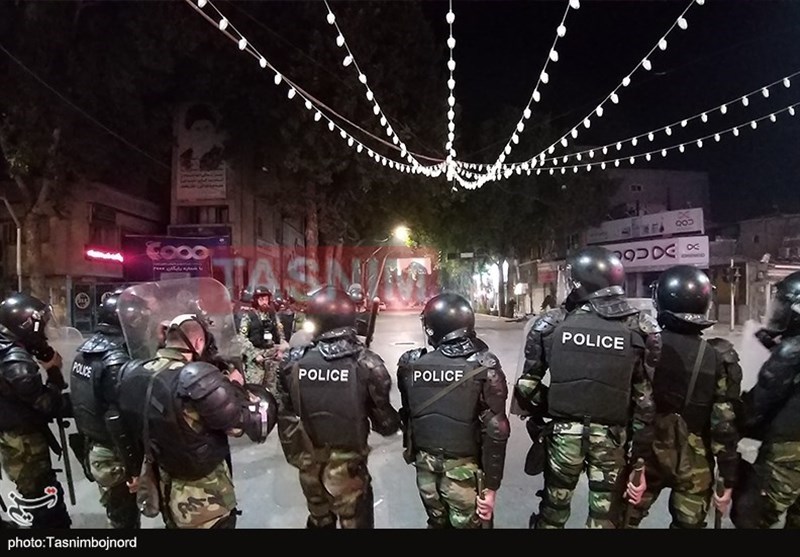
Aftermath of anti-government protests in Bojnord, North Khorasan Province, Iran, 22 September, 2022.
Photo from Tasnim News Agency Bojnord Desk via Wikimedia Commons.
Revolutions are funny things. They sometimes appear impossible until, in one single moment, they become inevitable. In Iran, that moment came on September 13th with the murder of a young woman.
Mahsa Amini, a 22-year-old who was also known by her Kurdish name “Gina”, had come from Iran’s Kurdistan region to visit her brother in Tehran. It was during that trip that she faced a particular humiliation that has become a fact of life for tens of millions of women in that country: a run-in with the country’s gasht-e ershad (“Guidance Patrol”). The role of this roving gang, seemingly imported from Atwood’s Gilead and called Iran’s “morality police”, is to monitor the streets to find and punish violations of the regime’s seventh-century moral and dress codes.
Having determined that Mahsa’s hijab exposed a little too much hair — a few strands of a woman’s hair and men will simply be incapable of controlling their sexual urges, the logic goes — they detained and beat her severely. The story for most women who deal with the morality police typically ends there, after which they are released to seethe at having endured another round of state-imposed gender apartheid. For Mahsa, the story ended differently: with a skull fracture that caused her to be brought, brain dead, to a local clinic. She died there on September 16th.
The murder of Mahsa Amini was the spark that set off a revolution. The killing reminded women of their daily misery at the hands of a regime that, both de facto and de jure, treats them as second-class citizens. And it reminded everyone of the million other senseless cruelties, large and small, that they must endure daily at the hands of a barbaric theocracy. Outraged by the death of an innocent young woman, the people took to the streets in protests that continue to this day.
There have been mass protests in Iran before. In 2009, in response to a widespread belief that Mahmoud Ahmadinejad had illegally stolen the presidential election — to the extent the word “election” means anything in a country where candidates must first be approved by a clerical body loyal to the regime — citizens protested by the millions. Their slogan, “Where’s my vote?” rested on the premise that a fair, albeit controlled, election was something that could change the system for the better. The protesters typically avoided confrontation with security forces. Even when they happened to corner a regime thug periodically, they ensured that no harm was done to him.
Comments Off on Are the protests in Iran about to tip over into actual revolution?
September 30, 2022
History Re-Summarized: The Roman Empire
Overly Sarcastic Productions
Published 16 Sept 2022
The plot twist of Rome is that it was always a mess, now sit back and enjoy the marble-covered mayhem.This video is a Remastered, Definitive Edition of three previous videos from this channel — “History Summarized: The Roman Empire”, “History Hijinks: Rome’s Crisis of the Third Century”, and “History Summarized: The Fall of Rome”. This video combines them all into one narrative, fully upgrading all of the visuals and audio, with a substantially re-written script in parts 1 and 3.
(more…)
Comments Off on History Re-Summarized: The Roman Empire
September 29, 2022
The Byzantine Empire: Part 5 – The Death of Roman Byzantium, 568-628 AD
seangabb
Published 21 Jan 2022In this, the fifth lecture in the series, Sean Gabb discusses the progressive collapse of Byzantium between the middle years of Justinian and the unexpected but sterile victory over the Persian Empire.
Between 330 AD and 1453, Constantinople (modern Istanbul) was the capital of the Roman Empire, otherwise known as the Later Roman Empire, the Eastern Roman Empire, the Mediaeval Roman Empire, or the Byzantine Empire. For most of this time, it was the largest and richest city in Christendom. The territories of which it was the central capital enjoyed better protections of life, liberty and property, and a higher standard of living, than any other Christian territory, and usually compared favourably with the neighbouring and rival Islamic empires.
The purpose of this course is to give an overview of Byzantine history, from the refoundation of the City by Constantine the Great to its final capture by the Turks.
Here is a series of lectures given by Sean Gabb in late 2021, in which he discusses and tries to explain the history of Byzantium. For reasons of politeness and data protection, all student contributions have been removed.
(more…)
Comments Off on The Byzantine Empire: Part 5 – The Death of Roman Byzantium, 568-628 AD
The History of Cyprus Explained in 10 minutes
Epimetheus
Published 24 May 2022The history of Cyprus explained from ancient times to modern.
(more…)
Comments Off on The History of Cyprus Explained in 10 minutes
September 26, 2022
Canada, a confessed “ongoing” genocidal state, has no moral grounds to criticize China, Russia, or Iran
In Quillette, Jonathan Kay expresses his frustration as Canadian Prime Minister Trudeau’s performative moral posturing and virtue signalling for his globalist comrades comes back to bite him in the ass … again:
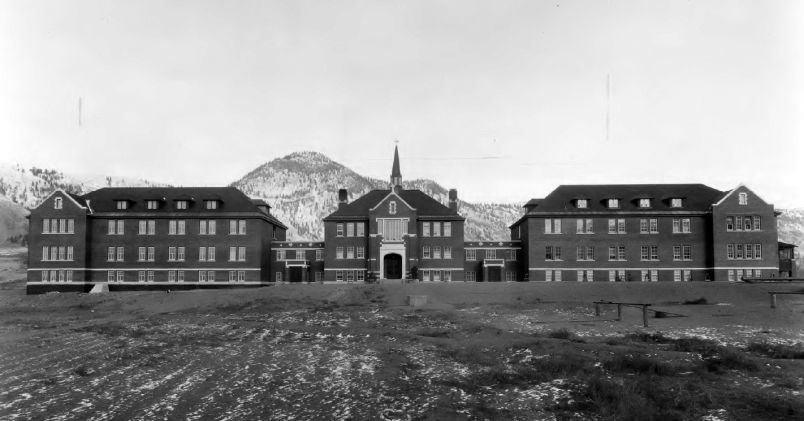
Kamloops Indian Residential School, 1930.
Photo from Archives Deschâtelets-NDC, Richelieu via Wikimedia Commons.
… [Iranian President Ebrahim Raisi] also threw in an attack on Canada’s treatment of Indigenous peoples, declaring that “bodies of hundreds of children were discovered in mass graves in a [former residential] school.”
The issue of supposed unmarked Indigenous child graves dominated the Canadian media in the latter half of 2021. But as I reported in Quillette several months ago, no “mass graves” were ever found. In fact, even the Indigenous groups that initially reported ground-penetrating radar (GPR) survey results consistent with the possible presence of unmarked burial sites weren’t talking about “mass graves”. Rather, the invented mass-graves claim was popularized by a badly botched New York Times May 28th, 2021, story written by reporter Ian Austen. (For a definitive debunking, see Terry Glavin’s account in Canada’s National Post).
In the 16 months that have passed since the unmarked-graves story broke in late May 2021, not a single body has been found, nor any human remains. And so even the less sensational allegation that 215 individual unmarked child graves lie buried under the grounds of a former Indigenous residential school in Kamloops, British Columbia, now seems doubtful. Nor have bodies or human remains been recovered at any of the other former residential-school properties where GPR surveys were conducted.
Yet that didn’t prevent Prime Minister Justin Trudeau from lowering flags on Canadian public buildings for more than five months, nor from speaking publicly as if bodies were already being dug up. And aside from the National Post, not a single major Canadian media outlet has admitted its role in feeding the unmarked-graves social panic that exploded last year, and which often included lurid speculation that the supposed grave sites not only contained the remains of Indigenous children, but that these children had been murdered through methods worthy of a horror-movie plot.
Given this, what can Canadian public figures say to Raisi now that he’s throwing spurious moral equivalences into our faces? Nothing. In making the false claim that “bodies of hundreds of children were discovered in mass graves in a [former residential] school”, the man is merely reading our own officially sourced misinformation back to us.
This isn’t the first time that Trudeau has managed to maneuver Canada into this kind of mortifying position vis-à-vis the world’s tyrants. Last year, when Canadian lawmakers voted to denounce China’s treatment of Uighurs in western Xinjiang as a form of genocide, Trudeau and his Cabinet abstained. The suspected reasons for that move were complex. But they included the fact that Canada was, by its own description, morally compromised on the genocide file: Back in 2019, Trudeau had explicitly acceded to the (absurd) claim that Canada, too, was guilty of “genocide” — this one against Indigenous women. Indeed, according to the official report that precipitated Trudeau’s mea culpa, this supposed Canadian genocide remains ongoing.
Comments Off on Canada, a confessed “ongoing” genocidal state, has no moral grounds to criticize China, Russia, or Iran
September 24, 2022
Business Intrigue Gone Wrong: High Powers for Oman
Forgotten Weapons
Published 16 May 2022The story of the Browning High Power pistols with Omani national crests is an interesting one. It begins with a man named Paul Van Hee brokering a contract for Cadillac-Gage “Commando” armored cars for the Omani government in the late 1960s. These were to be equipped with FN MAG machine guns, and it came to Van Hee’s attention that Oman might also be interested in High Power pistols. He wasn’t an FN agent, but figured he could make that deal happen (and presumably make a nice profit on it).
Van Hee imported 36 new High Powers into the US, and then had them engraved with Omani crests (although the first 9 were accidentally engraved backwards). Around the time he was showing the guns to the Omani delegation, though, the deal fell apart. FN got wind of it and arranged the sale themselves, eventually shipping 5,000 pistols to Oman (without any special markings).
The demonstration guns remained in the US, and were sold off onto the collector market having never actually seen Oman. Interestingly, they are exempted from the NFA when fitted with original Belgian shoulder stocks, like this one is.
(more…)
Comments Off on Business Intrigue Gone Wrong: High Powers for Oman
September 20, 2022
The Byzantine Empire: Part 4 – Justinian, The Hand of God
seangabb
Published 1 Jan 2022Between 330 AD and 1453, Constantinople (modern Istanbul) was the capital of the Roman Empire, otherwise known as the Later Roman Empire, the Eastern Roman Empire, the Mediaeval Roman Empire, or The Byzantine Empire. For most of this time, it was the largest and richest city in Christendom. The territories of which it was the central capital enjoyed better protections of life, liberty and property, and a higher standard of living, than any other Christian territory, and usually compared favourably with the neighbouring and rival Islamic empires.
The purpose of this course is to give an overview of Byzantine history, from the refoundation of the City by Constantine the Great to its final capture by the Turks.
Here is a series of lectures given by Sean Gabb in late 2021, in which he discusses and tries to explain the history of Byzantium. For reasons of politeness and data protection, all student contributions have been removed.
(more…)
Comments Off on The Byzantine Empire: Part 4 – Justinian, The Hand of God
September 19, 2022
City Minutes: Crusader States
Overly Sarcastic Productions
Published 13 May 2022Crusading is one thing, but holding your new kingdoms is a much trickier business. See how the many Christian states of “Outremer” rolled with the punches to evolve in form and function over multiple centuries.
(more…)
Comments Off on City Minutes: Crusader States
September 16, 2022
The Byzantine Empire: Part 3 – The Age of Justinian – Cashing in the Gains of the Fifth Century
seangabb
Published 7 Dec 2022Between 330 AD and 1453, Constantinople (modern Istanbul) was the capital of the Roman Empire, otherwise known as the Later Roman Empire, the Eastern Roman Empire, the Mediaeval Roman Empire, or the Byzantine Empire. For most of this time, it was the largest and richest city in Christendom. The territories of which it was the central capital enjoyed better protections of life, liberty and property, and a higher standard of living, than any other Christian territory, and usually compared favourably with the neighbouring and rival Islamic empires.
The purpose of this course is to give an overview of Byzantine history, from the refoundation of the City by Constantine the Great to its final capture by the Turks.
Here is a series of lectures given by Sean Gabb in late 2021, in which he discusses and tries to explain the history of Byzantium. For reasons of politeness and data protection, all student contributions have been removed.
(more…)
Comments Off on The Byzantine Empire: Part 3 – The Age of Justinian – Cashing in the Gains of the Fifth Century
September 14, 2022
“Americans, particularly the kind of Very Serious people who make up our intelligentsia, are desperate for a good war”
Freddie deBoer thinks he’s sussed out the reason so many Americans are so very, very pro-Ukraine in the ongoing fighting between the Russian invaders and the Ukrainian defenders (beyond the normal desire to “root for the underdog”):
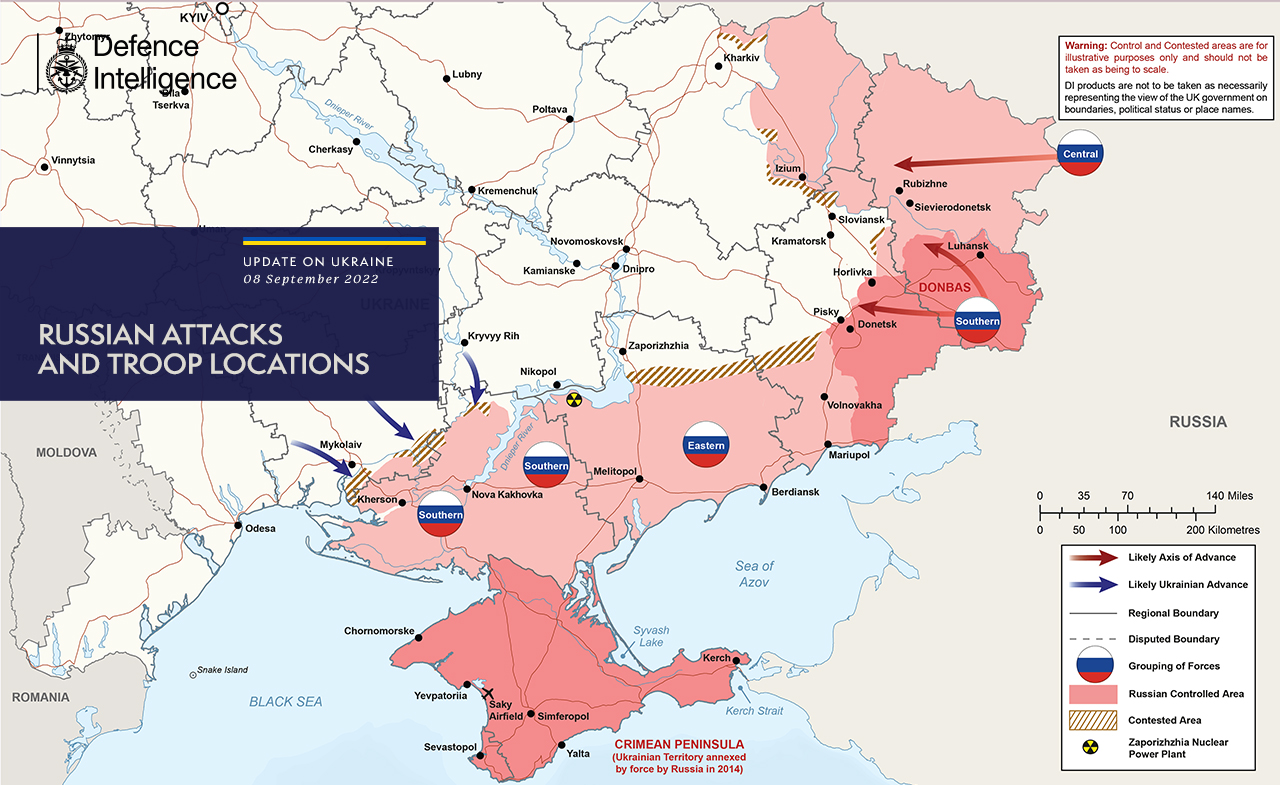
Approximate front-line positions just before the Ukrainian counter-attack east of Kharkiv in early September 2022.
It was not until I was an adult that I realized that the absurd fervor for Desert Storm was in fact about Vietnam. Fifteen years earlier, American helicopters had fled in humiliation from Saigon, and nothing had happened to take the sour taste out of the mouth of Americans since. There was plenty of power projection in that decade and a half, but no great good wars for the United States to win in grand and glorious fashion, unless you worked really hard to talk yourself into Grenada. America had been badly stung by losing a war to a vastly poorer and less technologically-advanced force. Americans had been nursing their wounds all those years. So when Saddam Hussein invaded Kuwait, and the “international community” rose to expel him, the country was ready. We were ready for another righteous combat of the Goodies vs. the Baddies. We were ready for the good guys to be the winners again.
This dynamic, I’m certain, is the source of American bloodlust over Ukraine.
We have now spent twenty years without good, noble wars against the Baddies ourselves. Afghanistan was a war effort undertaken in rage and terror, and was accordingly never intelligently conceptualized at the most basic level. The war aim of finding and capturing bin Laden and destroying Al Qaeda gave way to a war on the Taliban that ensured an endless occupation. The Potemkin government we installed was never popular with the people of the country, entailed comical levels of corruption, and showed no ability to train a loyal and effective Afghan army. After 20 years our country tired of spending hundreds of billions on that failure, we left, the government collapsed almost without resistance, and the Taliban are in power again. In Iraq, the basic arguments for the war (WMDs and a Hussein-al Qaeda connection) were swiftly revealed to be bullshit. Saddam’s army fell quickly and he was dispatched after a show trial, but a persistent insurgency inflicted thousands of American casualties. The chaos enabled the rise of ISIS and its various horrors. The new Iraqi government we’ve installed is impossibly corrupt and scores a 31/100 on Freedom House’s ratings of a country’s dedication to political rights and civil liberties. That’s what the United States has gotten for $8 trillion spent on warmaking since 9/11.
America loves a winner, and will not tolerate a loser. So I once heard. Americans, particularly the kind of Very Serious people who make up our intelligentsia, are desperate for a good war. A just war. A war where we win. They’re sick of wars that feel morally complicated, sick of wars that they have to feel queasy about, sick of wars that aren’t just Goodies and Baddies. They are very, very hungry for good war. I think Ukraine is the Desert Storm a lot of people have been waiting for: a war with (they insist) perfectly simplistic moral stakes, an impossibly noble (they assume) set of Goodies, a marauding and senseless (they demand) set of Baddies. All they’re waiting on is victory. And it’s for this reason, this view of war as one big cope, that the pro-Ukraine position is the single most rigidly enforced consensus in our country since 9/11. There is no other issue on which the majority has more vociferously demanded total consensus or more viciously attacked any who dissent or even ask questions. Because America needs a win. People need to believe in a Goodies and Baddies world again.
There are, of course, all manner of hard questions that we could ask, even if we were supportive of Ukraine in this war. That this is a conflict that has constantly inspired left-leaning people to literally say “well, yes, there’s Nazis, but …” might be seen as a matter of some concern. Perhaps, we might just say, isn’t that a little disturbing? But not in this discursive environment. Or we might consider that a total loss for Russia could be one of the most dangerous outcomes for the world even if you support Ukraine. What do you think happens, with a wounded and isolated Russia? Let’s say people get what they want and Putin is deposed. What do you think happens next? We finally get that shining city on a hill in Moscow that we were promised with the collapse of the Soviet Union? That we’ll get the world leader we expected Bagdhad to be in 2003, that a foreign country with foreign people and foreign concerns will suddenly become a docile member of the liberal-capitalist order? Maybe the best post-Putin outcome would be for a similar corrupt autocrat to take his place; at least then there might be stability. A far more likely and more frightening outcome is that leadership is splintered, you have in effect a set of rival warlords squabbling over the spoils, and the world’s largest nuclear arsenal is exposed in a terrifying way. Seems like something to worry about.
But, no. To a degree that genuinely shocks me, hard questions have been forbidden. Complications have been denied. Comparisons to previous conflicts have been forsaken. And this from Democrat and Republican, liberal and leftist, neocon and Never Trumper. It’s constant, everpresent, and relentless, the denial of any complication in the case of Ukraine and Russia. The glee and the gloating and the urge to ridicule anyone who takes even a single step outside of the consensus is remarkable, unlike anything I’ve ever really encountered before. And I find that I can’t even get people to have a conversation about that, a meta-conversation about why the debate on Ukraine is not a debate, about why there are many people who will consider any political position except one that troubles the moral question of Russia’s invasion, about why so many people who learned to speak with care and equivocation during Iraq now insist that there is no complication at hand with this issue at all. I can’t even get a conversation about the conversation going. People get too mad.
Comments Off on “Americans, particularly the kind of Very Serious people who make up our intelligentsia, are desperate for a good war”
September 12, 2022
The Lord of the Rings and Ancient Rome (with Bret Devereaux)
toldinstone
Published 10 Sep 2022In this episode, Dr. Bret Devereaux (the blogger behind “A Collection of Unmitigated Pedantry”) discusses the relationships between fantasy and ancient history – and why historical accuracy matters, even in fiction.
(more…)
September 9, 2022
The Byzantine Empire: Part 2 – Survival and Growth
seangabb
Published 15 Oct 2021Between 330 AD and 1453, Constantinople (modern Istanbul) was the capital of the Roman Empire, otherwise known as the Later Roman Empire, the Eastern Roman Empire, the Mediaeval Roman Empire, or The Byzantine Empire. For most of this time, it was the largest and richest city in Christendom. The territories of which it was the central capital enjoyed better protections of life, liberty and property, and a higher standard of living, than any other Christian territory, and usually compared favourably with the neighbouring and rival Islamic empires.
The purpose of this course is to give an overview of Byzantine history, from the refoundation of the City by Constantine the Great to its final capture by the Turks.
Here is a series of lectures given by Sean Gabb in late 2021, in which he discusses and tries to explain the history of Byzantium. For reasons of politeness and data protection, all student contributions have been removed.
(more…)
Comments Off on The Byzantine Empire: Part 2 – Survival and Growth
September 3, 2022
The Byzantine Empire: Part 1 – Beginnings
seangabb
Published 1 Oct 2021Between 330 AD and 1453, Constantinople (modern Istanbul) was the capital of the Roman Empire, otherwise known as the Later Roman Empire, the Eastern Roman Empire, the Mediaeval Roman Empire, or The Byzantine Empire. For most of this time, it was the largest and richest city in Christendom. The territories of which it was the central capital enjoyed better protections of life, liberty and property, and a higher standard of living, than any other Christian territory, and usually compared favourably with the neighbouring and rival Islamic empires.
The purpose of this course is to give an overview of Byzantine history, from the refoundation of the City by Constantine the Great to its final capture by the Turks.
Here is a series of lectures given by Sean Gabb in late 2021, in which he discusses and tries to explain the history of Byzantium. For reasons of politeness and data protection, all student contributions have been removed.
(more…)
Comments Off on The Byzantine Empire: Part 1 – Beginnings


