
CrowsEyeProductions
Published 5 Dec 2018A Victorian maidservant dresses ready for a day of work, then ventures out into a cold evening …
(more…)
December 21, 2025
Getting Dressed – Victorian Maid, Christmas 1853
Comments Off on Getting Dressed – Victorian Maid, Christmas 1853
December 20, 2025
Christmas During the Great Depression
Tasting History with Max Miller
Published 17 Dec 2024Gelatinous Christmas pudding with chocolate, nuts, dried fruit, and whipped cream
City/Region: United States of America
Time Period: 1931During the Great Depression, making Christmas festive was more important than ever. Homemade gifts, cards, and decorations defined the season when money was tight for everyone. Many people who lived through the Great Depression recalled that no matter what, Christmas dinner was special.
This recipe from 1931 comes from a radio program hosted by the fictional character Aunt Sammy, who was supposedly the wife of Uncle Sam. I’m not quite sure how this Christmas pudding was much less expensive than a traditional boiled pudding, but it’s an interesting change nonetheless. I like the flavors of the chocolate and fruit coming through, though I do wish the texture was a little smoother.
There are twelve ingredients. Quite a lot to write down but I’ll go slowly.
2 tablespoons of granulated gelatin
1 cup of cold water
1 pint of milk
1 cup of sugar
1 and 1/2 squares of chocolate
1 cup of seeded raisins
3/4 of a cup of dates
1/2 cup of nuts
1/2 cup of currants, and
3 egg whitesThat’s a long list. I’ll go over it again while you check. (Repeat)
To make this pudding, first soften the gelatin in the cold water for ten minutes. While the gelatin is soaking, melt the chocolate with part of the sugar. When it is melted, add a little of the milk, just enough to make a smooth paste. Put the rest of the milk in the upper part of the double boiler. When the milk is hot, add to it the melted chocolate. Then the sugar and salt. And, finally, the soaked gelatin. Stir the mixture. Then remove it from the fire. Set it away to grow cold. When it begins to thicken, add the vanilla, the fruit, and the chopped nut meats. Then fold in the beaten egg whites.
Now turn the mixture into a wet pudding mold decorated with whole nut meats and raisins. Set the mold in the refrigerator or other cold place, to chill. When the pudding is cold and firm, and it is time for serving at dinner, turn it out on a pudding plate or platter. Garnish it with sprigs of holly. A wreath of holly springs around the edge and one stuck in the top makes it look like a real Christmas pudding.
Serve the pudding with whipped cream, sweetened and flavored with vanilla, or with a currant jelly sauce.
— Aunt Sammy, December 1931
Comments Off on Christmas During the Great Depression
December 19, 2025
Pick One: G1 (FAL) vs G3 (H&K) w/ John Keene
Forgotten Weapons
Published 2 Aug 2025If you had to pick one, would you take a G1 (FAL) or a G3 (H&K)? Both are 7.62mm NATO rifles adopted by Germany. The G1 has more features and capabilities, like the carry handle, bipod, multiple muzzle devices, and adjustable gas system. The G3, on the other hand, is simpler, without things to change for better or worse. So which would you take?
(more…)
December 18, 2025
A 2025 Update from the Canadian Tank Museum
The Chieftain
Published 13 Dec 2025When up at the Canadian Tank Museum a whiles back, I caught up with Sam to find out what’s been going on up there and what’s coming soon.
Comments Off on A 2025 Update from the Canadian Tank Museum
December 17, 2025
The Korean War Week 78: Communists See 100% Success in the Skies! – December 16, 1951
The Korean War by Indy Neidell
Published 16 Dec 2025The Communist forces’ air power grows and grows, to the point where the UN wonders if they will lose aerial supremacy. This colors the Peace Talks, because should infrastructure be allowed to be rebuilt and rehabilitated during an eventual armistice, what airfields might the Communist side soon have in North Korea? Not just as a threat should an armistice fail, but to Japan as well.
Chapters
00:00 Intro
00:49 Recap
01:23 General Hsieh Probes
06:22 Communist Air Power
12:06 POW Issues
14:54 Summary
15:14 Conclusion
15:51 Call to Action
(more…)
Comments Off on The Korean War Week 78: Communists See 100% Success in the Skies! – December 16, 1951
History of Britain X: King Arthur, History or Myth?
Thersites the Historian
Published 7 Aug 2025In this lecture, I discuss the historicity (or lack thereof) of the Arthurian myth.
(more…)
Comments Off on History of Britain X: King Arthur, History or Myth?
QotD: The origins of Progressivism
If you want to know what’s really going on in American and world politics, it is absolutely essential to comprehend the following sequence of events. Nothing else explains the stark insanity this country has been going through for the past couple of years. Nothing else can prepare us for what’s likeliest — and ugliest — to happen next. I claim no special expertise or knowledge — especially not the telepathic abilities that the political left so often claims to possess (“No I can’t point to anything concrete he ever said or did”, they tell us, “I just know he’s a racist!”) — I only claim an above-average understanding of history and human nature.
Vladimir Lenin, I’ll remind you, once famously said “The goal of socialism is communism”. Both are political and ethical “philosophies” based on taking stuff away from those who created it or earned it, and giving it to those who didn’t — who’ll vote for you. Collectivism, which is the generic term for both of these viewpoints and every other politic-economic scam like them, is nothing more than a pathetically transparent, sleazy attempt to make theft appear respectable. It’s always easier to take away or destroy than to create or build. Stealing from others became very popular in the first half of the 19th century (“Property is theft” — Pierre-Joseph Proudhon) when it was formalized as an ideology.
From that beginning, 170 years ago, socialists began to imagine a bright, glowing, prosperous Utopian future for themselves, based entirely on theft. With every decade that passed, their physically, logically impossible fantasies became more and more real to them. It’s like the old psychiatrist joke that the difference between neurotics and psychotics is that neurotics build castles in the air, whereas psychotics move in and live in them.
The “Progressive” movement began to really blossom in the latter half of the 19th century. They were establishing socialist colonies practically everywhere. American socialist newspaper editor Horace Greeley told his readers, “Go west, young man” and to establish socialist colonies. Looking Backward, a badly-written socialist screed by Edward Bellamy and more-talented others like H. G. Wells’ When the Sleeper Wakes and The Time Machine became immensely popular. The idea of an inevitable, unstoppable socialist “wave of the future” became popular and lasted at least until I was in college in the 1960s.
L. Neil Smith, “Why They Hate Donald Trump”, Libertarian Enterprise, 2018-12-30.
Comments Off on QotD: The origins of Progressivism
December 16, 2025
The Battle of Algiers: France’s “Victory” That Lost the War – W2W 057
TimeGhost History
Published 14 Dec 2025In the mid-1950s, what Paris insists on calling a “police operation” in Algeria, steadily sparks into a full-scale war that exposes the fragility of the French Republic itself. As the FLN launches coordinated attacks, the army responds with mass arrests, torture, and collective punishment, drawing the military deeper into politics. The Battle of Algiers becomes a laboratory of counterinsurgency, even as public opinion fractures at home and successive governments collapse under the strain. By the decade’s end, the conflict has eroded faith in France’s imperial mission and helped trigger the fall of the Fourth Republic, proving that Algeria was not just a colonial war, but a crisis of the French state.
(more…)
Comments Off on The Battle of Algiers: France’s “Victory” That Lost the War – W2W 057
Swedish Paratrooper Prototype: AK Fm/57
Forgotten Weapons
Published 30 Jul 2025As Sweden was looking to adopt a new self-loading infantry rifle in the 1950s, one of the contenders was a modernized version of the Ljungman. The Fm/57 is one of the last iterations of that project. It is chambered for 6.5x55mm but uses the short-stroke gas piston conversion that we previously saw on the 7.62mm NATO conversions of the Ljungman. It also uses a more refined lower receiver than its Fm/54 predecessor, with a nose-in-rock-back 20 round magazine and a folding stock. It was entered into formal trials against the GRAM-63 (another domestic Swedish design), the M14, G3, SIG 510, FAL, and AR10 … which it lost.
(more…)
Comments Off on Swedish Paratrooper Prototype: AK Fm/57
QotD: Arms and the (pre-modern) man (at arms)
Here we do have some significant price data, but of course its tricky to be able to correlate a given value for arms and armor with something concrete like wages in every period, because of course prices are not stable. But here are some of the data points I’ve encountered:
We don’t have good Roman price data from the Republic or early/high Empire, unfortunately (and indeed, the reason I have been collecting late antique and medieval comparanda is to use it to understand the structure of earlier Roman costs). Hugh Elton1 notes that a law of Valens (r. 364-378) assessed the cost of clothing, equipment and such for a new infantry recruit to be 6 solidi and for a cavalryman, 13 solidi (the extra 7 being for the horse). The solidus was a 4.5g gold coin at the time (roughly equal to the earlier aureus) so that is a substantial expense to kit out an individual soldier. For comparison, the annual rations for soldiers in the same period seem to have been 4-5 solidi, so we might suggest a Roman soldier is wearing something like a year’s worth of living expenses.2
We don’t see a huge change in the Early Middle Ages either. The seventh century Lex Ripuaria,3 quotes the following prices for military equipment: 12 solidi for a coat of mail, 6 solidi for a metal helmet, 7 for a sword with its scabbard, 6 for mail leggings, 2 solidi for a lance and shield for a rider (wood is cheap!); a warhorse was 12 solidi, whereas a whole damn cow was just 3 solidi. On the one hand, the armor for this rider has gotten somewhat more extensive – mail leggings (chausses) were a new thing (the Romans didn’t have them) – but clearly the price of metal equipment here is higher: equipping a mailed infantryman would have some to something like 25ish solidi compared to 12 for the warhorse (so 2x the cost of the horse) compared to the near 1-to-1 armor-to-horse price from Valens. I should note, however, warhorses even compared to other goods, show high volatility in the medieval price data.
As we get further one, we get more and more price data. Verbruggen (op. cit. 170-1) also notes prices for the equipment of the heavy infantry militia of Bruges in 1304; the average price of the heavy infantry equipment was a staggering £21, with the priciest item by far being the required body armor (still a coat of mail) coming in between £10 and £15. Now you will recall the continental livre by this point is hardly the Carolingian unit (or the English one), but the £21 here would have represented something around two-thirds of a year’s wages for a skilled artisan.
Almost contemporary in English, we have some data from Yorkshire.4 Villages had to supply a certain number of infantrymen for military service and around 1300, the cost to equip them was 5 shillings per man, as unarmored light infantry. When Edward II (r. 1307-1327) demanded quite minimally armored men (a metal helmet and a textile padded jack or gambeson), the cost jumped four-fold to £1, which ended up causing the experiment in recruiting heavier infantry this way to fail. And I should note, a gambeson and a helmet is hardly very heavy infantry!
For comparison, in the same period an English longbowman out on campaign was paid just 2d per day, so that £1 of kit would have represented 120 days wages. By contrast, the average cost of a good quality longbow in the same period was just 1s, 6d, which the longbowman could earn back in just over a week.5 Once again: wood is cheap, metal is expensive.
Finally, we have the prices from our ever-handy Medieval Price List and its sources. We see quite a range in this price data, both in that we see truly elite pieces of armor (gilt armor for a prince at £340, a full set of Milanese 15th century plate at more than £8, etc) and its tricky to use these figures too without taking careful note of the year and checking the source citation to figure out which region’s currency we’re using. One other thing to note here that comes out clearly: plate cuirasses are often quite a bit cheaper than the mail armor (or mail voiders) they’re worn over, though hardly cheap. Still, full sets of armor ranging from single to low-double digit livres and pounds seem standard and we already know from last week’s exercise that a single livre or pound is likely reflecting a pretty big chunk of money, potentially close to a year’s wage for a regular worker.
So while your heavily armored knight or man-at-arms or Roman legionary was, of course, not walking around with the Great Pyramid’s worth of labor-value on his back, even the “standard” equipment for a heavy infantryman or heavy cavalryman – not counting the horse! – might represent a year or even years of a regular workers’ wages. On the flipside, for societies that could afford it, heavy infantry was worth it: putting heavy, armored infantry in contact with light infantry in pre-gunpowder warfare generally produces horrific one-sided slaughters. But relatively few societies could afford it: the Romans are very unusual for either ancient or medieval European societies in that they deploy large numbers of armored heavy infantry (predominately in mail in any period, although in the empire we also see scale and the famed lorica segmentata), a topic that forms a pretty substantial part of my upcoming book, Of Arms and Men, which I will miss no opportunity to plug over the next however long it takes to come out.6 Obviously armored heavy cavalry is even harder to get and generally restricted to simply putting a society’s aristocracy on the battlefield, since the Big Men can afford both the horses and the armor.
But the other thing I want to note here is the social gap this sort of difference in value creates. As noted above with the bowman’s wages, it would take a year or even years of wages for a regular light soldier (or civilian laborers of his class) to put together enough money to purchase the sort of equipment required to serve as a soldier of higher status (who also gets higher pay). Of course it isn’t as simple as, “work as a bowman for a year and then buy some armor”, because nearly all of that pay the longbowman is getting is being absorbed by food and living expenses. The result is that the high cost of equipment means that for many of these men, the social gap between them and either an unmounted man-at-arms or the mounted knight is economically unbridgeable.7
Bret Devereaux, “Fireside Friday, January 10, 2025”, A Collection of Unmitigated Pedantry, 2025-01-10.
- Warfare in Roman Europe AD 350-425 (1996), 122.
- If you are wondering why I’m not comparing to wages, the answer is that by this point, Roman military wages are super irregular, consisting mostly of donatives – special disbursements at the accession of a new emperor or a successful military campaign – rather than regular pay, making it really hard to do a direct comparison.
- Here my citation is not from the text directly, but Verbruggen, The Art of War in Western Europe during the Middle Ages (1997), 23.
- From Prestwich, Armies and Warfare in the Middle Ages (1996).
- These prices via Hardy, Longbow: A Social and Military History (1992).
- Expect it no earlier than late this year; as I write this, the core text is actually done (but needs revising), but that’s hardly the end of the publication process.
- Man-at-arms is one of those annoyingly plastic terms which is used to mean “a man of non-knightly status, equipped in the sort of kit a knight would have”, which sometimes implies heavy armored non-noble infantry and sometimes implies non-knightly heavy cavalry retainers of knights and other nobles.
Comments Off on QotD: Arms and the (pre-modern) man (at arms)
December 15, 2025
“America has always been a racist country”
On the social media site formerly known as Twitter, Devon Eriksen responds to an agent provocateur on the topic of racism:
Lance Cooper @lmauricecpr
A white woman called a Somali couple niggers and raised $153k in five days. America has proven again that it is a racist country. They don’t even bother to hide it anymore.America has always been a racist country in a racist world.
Indigenous Tribals were racist.
Whites were racist.
Blacks were racist.
Orientals were racist.
Arabs were racist.
Jews were racist.
Hispanics were racist.After being shocked by the excesses of the Third Reich, Whites stopped being racist for a while, and suffered for it.
Everyone else stayed racist, and prospered by it at White people’s expense.
Now White people are sick of it, and they’re becoming racist again, because the only other solution is for everybody else to stop being racist, and there’s no way to make them do that.
So the future is racist. Doesn’t particularly matter if you think that’s good or bad, or if I think that’s good or bad, or if anyone thinks it’s good or bad. It is what’s going to happen.
There was a time when it might have been possible to for everyone to simultaneously stop being racist. But it didn’t happen, because only White people were being told to stop, only White people listened, and only White people stopped.
Everyone else was told that, in the abstract, racism was bad, but they were never called out, lectured, or confronted about their own racism. In fact, that racism was tacitly encouraged, for profit and ego gratification.
Someone even invented rationalizations that only White people even could be racist, because only White people had Power™, which was different from power, because white people somehow had Power™ even if they had no power, and everyone else had no Power™ even if they were billionaires or the King of Sumatra.
So Power™ was just another word for Whiteness.
Around the time when some people started openly calling for the elimination of Whiteness from the nation, the globe, and the human race, White people’s common sense finally started winning out over our desire to be nice and and cooperative and have everyone like us.
We realized it was impossible for everyone else to like us.
Because they didn’t hate us for not being nice. Hell, the nicer we got, the more they hated us. No, they hated us for being White. They hated us for not being like them. They hated us for being successful. They hated us for thriving. They hated us for building civilization. And they wanted us to just hand it over to them, despite the clearly evident fact that a great many of them lacked the skills and temperament to even to maintain it, much less to build more.
(Hint: that desire to be nice and cooperative and have people like us is what enabled us to build all that stuff and get rich in the first place.)
So we’re just going to have to settle for liking each other, preferring each other’s company, and not particularly worrying about whether other races like us or not.
Because that’s the only remaining alternative to suicide.
And, yeah, sure, whatever, you can call me delusional or a liar. You can say White people never stopped being racist, or that we just didn’t anti-racist hard enough.
But, even if that were true, so what? The rest of y’all never stopped being racist. And you never did the anti-racist thing at all. Y’all just kept telling us to do it.
Well, no thanks. Juice isn’t worth the squeeze, because there is no juice, and we’re the ones who were getting squeezed.
And yeah, sure, that’ll keep happening for a while, because some White people haven’t figured it out yet.
And yeah, sure, you can continue to lecture me about how racism is evil, as if you weren’t super-racist yourself, every goddamn day.
But I no longer believe that moral lectures about racism from non-Whites are anything but an attempt to make Whites drop loot.
So I’m not listening.
A lot of people are about to learn the meaning of the term “preference cascade”, and it isn’t going to be pretty.
ESR responded:
I am deeply unhappy about Devon’s conclusion here. But I fear he is probably correct.
There is an alternative, which is to be explicitly high-IQist and mostly ignore skin color. But I admit that such an attempt would probably be sabotaged by the same people who insisted that anti-white racism should be government policy everywhere.
How to Eat Like an Ancient Stoic
Tasting History with Max Miller
Published 8 Jul 2025Lentil soup with leeks, coriander seeds, and herbs
City/Region: Greece | Rome
Time Period: 3rd Century B.C.E. | 1st CenturyThe ancient stoics were all about being happy with what you’ve got. If one could learn to take pleasure in eating simple foods like lentil soup and barley bread (usually eaten by the poorest members of society), then they would have more happiness than if they constantly craved luxurious food. Granted, most of these philosophers were wealthy, so they didn’t actually have to live like the very poor.
The ancient Greek stoic philosopher Zeno of Citium was known for carrying around lentil soup in a clay pot, and that was probably just lentils boiled in water. This recipe, adapted from ancient Rome’s Apicius from a few centuries later, is a little fancier, but still rather simple and uses ingredients that would have been available to Zeno. Despite its simplicity, it’s surprisingly delicious with a hint of sweetness, oniony leek, and the cooling effect of the mint.
Boil the lentils; when skimmed, put in leeks and green cilantro. Pound coriander-seed, pennyroyal, silphium, mint, and rue, moisten with vinegar, add honey, blend with garum, vinegar, and defrutum. Pour over the lentils, add oil, serve.
— Apicius, de re coquinaria, 1st Century
December 14, 2025
Andrea Dworkin – feminism’s anti-sex evangelist
On her Substack, Janice Fiamengo examines the life and work of Andrea Dworkin, whose influence on modern feminism is still quite strong, twenty years after her death:

A friend wrote a couple of days ago to say that he had seen shiny new copies of works by feminist author Andrea Dworkin (1946-2005) in Munro’s Books, one of Canada’s premier independent bookstores. One of the books was positioned on a shelf with the cover facing out to indicate that it was being showcased.
It is both shocking and unsurprising that Picador Books decided to reprint three of Dworkin’s texts in the past year, calling her a “prescient and visionary writer” who was “ahead of her time”. Anti-male paranoia is a sanctioned, cultivated taste more popular now, perhaps, than ever before, and Andrea Dworkin is its most notorious propagandist.
Known for her physical bulk, impassioned rhetoric, unkempt hair, and lesbian-identified overalls, Dworkin was a feminist icon in the 1980s and 90s, loved and hated in equal measure. No one did more to outline and consolidate the modern feminist understanding of sex than she, writing on the subject obsessively and with unparalleled fervor in books with titles such as Woman Hating (1974) and Pornography: Men Possessing Women (1981). The MeToo movement is almost unimaginable without the influence of Dworkin’s pronouncements.
Like other radical feminists, Dworkin wrote about rape, pornography, and prostitution, but her special focus was the degradation for women of sex itself: regular sex, the commonly accepted, normalized indignity that men allegedly inflict on women every day. Tempering her words in the white-heat of her revulsion, Dworkin became feminism’s anti-sex evangelist.
Sex, Dworkin believed, embodied nothing less than men’s hatred of everything female: “Intercourse is the pure, sterile, formal expression of men’s contempt for women” (p. 175). This is the thesis of her most representative book, Intercourse, which was first published in 1987 when Dworkin was 41 years old. Dworkin’s characterization of heterosexual sex as the ultimate enactment of misogyny has had an enduring impact on North American culture.
Intercourse set out to illuminate, through select readings of literary texts, what Dworkin believed to be a constant of male culture: the “hatred of women, unexplained, undiagnosed, mostly unacknowledged, that pervades sexual practice and sexual passion” (pp. 175-76). The phrase she most often used in the book to refer to intercourse was “the fuck”, which was meant to signify the raw dehumanization that supposedly characterized it.
Dworkin nominated herself the expert on male contempt for women because she had been its victim. “Specifically, am I saying that I know more than men about fucking?” she asked defiantly in the book’s preface, and answered, “Yes, I am […] the way anyone used knows the user” (p. xxxi).
While she also claimed in the preface that the book “does not say that all men are rapists or that all intercourse is rape” (p. xxxii), she does essentially say that, if not in quite those words. As she asserted only a page after the denial, “Intercourse conveys […] what it means that men — and now boys — feel entitled to come into the privacy of a woman’s body in a context of inequality” (p. xxxiv).
In another segment, she clarified that most, even the vast majority, of men were sexually abusive. She charged that men object to feminist criticism of pornography and prostitution because “So many men use these ignoble routes of access and domination to get laid,” that “without them the number of fucks would so significantly decrease that men might nearly be chaste” (p. 61). The implication was that men who objected to her arguments about the omnipresence of sexual exploitation were themselves sexual abusers who didn’t like the thought of their exploitation being curtailed.
This was the Dworkin who made feminists swoon with admiration: bombastic, hyperbolic, and incandescent with accusatory rage.
Comments Off on Andrea Dworkin – feminism’s anti-sex evangelist
Hitler becomes a German – Rise of Hitler 23, January-March 1932
World War Two
Published 13 Dec 2025The big news this winter is the German Presidential elections, held now in March for the first time since 1932, which pit current President Paul von Hindenburg against Nazi Party leader Adolf Hitler. Hitler, though, must become a German citizen before he can run; he been stateless since he gave up his Austrian citizenship seven years ago. The campaigns are quite different, but both effective, and the German people head for the polls.
(more…)
Comments Off on Hitler becomes a German – Rise of Hitler 23, January-March 1932
QotD: Why are Castles?
Castles differ from that other standby of medieval fortifications — city walls — in one crucial way, and that difference sheds a lot of light on their military application.
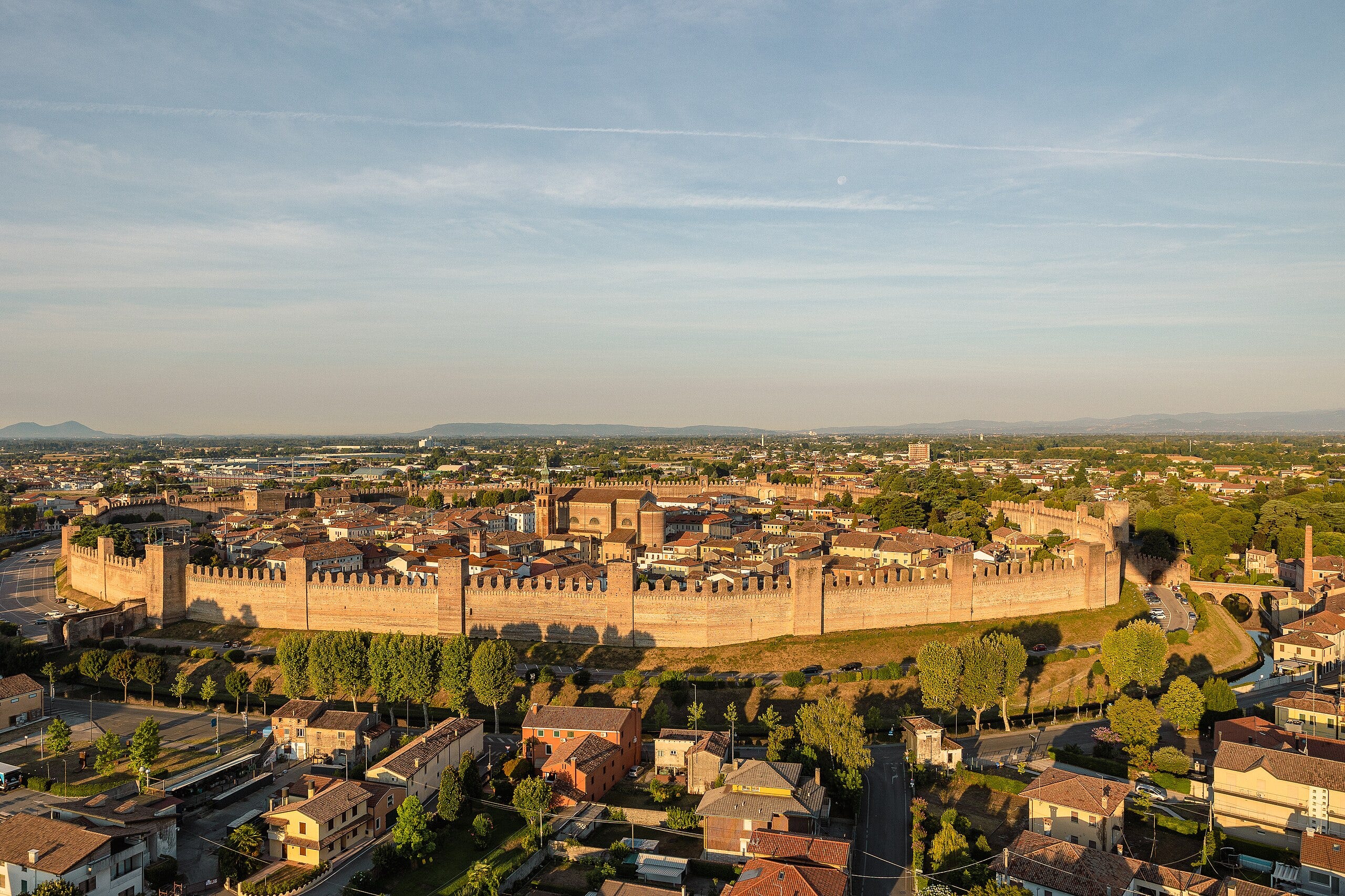
The walls of Cittadella, Italy (photo by Edoardo Bortoli, CC BY-SA 4.0).
A massive city wall, like the one shown above, has the very clear purpose of limiting access to a city or town. Close the gates, and no one can get in. Try to get in, and we’ll shoot you! The walls are meant to protect the settlement, both its inhabitants as well as its structures and physical wealth.
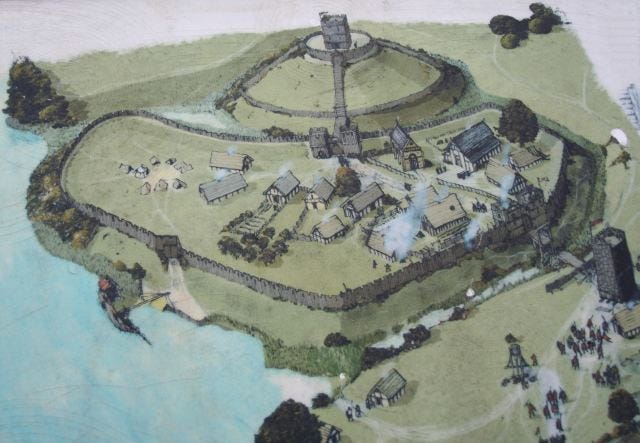
A castle, on the other hand, has a much smaller footprint than a city. It might only be a few buildings and a courtyard. Indeed, as we’ll see later in the series, the earliest castles (the classic “motte and bailey” design) were relatively small fortifications of earth and timber, capable of being built in a matter of days.
Image of a motte and bailey style castle. This particular one would take much longer than a few days to make, but it’s worth noting that even this “primitive” castle of timber and earth would have been a serious problem for any attacker. (Duncan Grey – Display Board of Huntingdon Hill Motte and Bailey Castle – CC BY-SA 2.0).
Especially if a lord was not in residence, a castle might only have a garrison of a few dozen, a far cry from the walls around urban centers that protected thousands or tens of thousands of lives!
So why bother?
Because, unlike a city wall which is meant to defend everything within it, a castle isn’t built in order to protect a tiny bit of land on top of a hill. Instead (say it with me, class): a castle is built to deny an enemy freedom of movement.
It’s not about what’s inside the walls. It’s about what’s outside the walls.
A castle allows you to control a disproportionately large area of land.
That control matters a great deal, because land was the source of wealth in pre-modern contexts. In societies where 80-95% of the populace were farmers, wealth and power came from controlling arable land. Capital did not derive principally from urban centers — wealthy and valuable as those were.1
Before we go further into how that impacts war and politics, I want to take a moment and dig deeper into why a castle allows its owner to control the land, because it’s something that’s usually glossed over, and understanding this dynamic will have a significant bearing on everything else we talk about here.
The Ugly Nature of Rule
As I’ve explained before, in order to actually rule an area, the ruler needs to have a monopoly on legitimate violence within that area. The emphasis here is on legitimate violence, which is significantly different than just “brute force”; force alone will always be a temporary and unstable method of rule. [You can read this explainer for more on that.] A ruler’s legitimacy allows that monopoly to continue unopposed.
One of the main reasons why a ruler needs that monopoly is that it allows for the collection of resources for use by the state. I’m going to lump all this together under the word “taxes”, but to be clear: in pre-modern societies, “taxes” could include manual labor commitments, payments in kind (in crops, in material, etc.), or in cash.
For all that, the ruler needs his agents to have unfettered access to the country he aims to rule; his tax collectors, law enforcers, merchants, judges, and certainly his lords and military all need to be able to move freely throughout the realm in order to do all the necessary business of maintaining law, order, and the collection of taxes.
Those are the most basic elements of statehood, the most basic mechanism of ordinary, everyday governing.
Castles fit into that system the same as any other governmental or administrative center: it’s a place to collect and store resources, a place for state agents to shelter, a locale for arbitration of justice, a residence for a lord … A castle can be a courthouse, police station, secret service listening post, governor’s mansion, and revenue service office all in one.
And a castle is fortified for much the same reasons that governmental buildings across history have always been fortified.
Even if the majority of a subject populace believes your rule is legitimate — a big if! — then there will still be people who chafe at the collection of taxes and who feel wronged by the administration of justice. Those outliers — if indeed they even are outliers — might try something stupid, like taking back their resources or stabbing your
thugspeace-loving tax collectors. Better to have everything locked up, right?And if the castle is large, and visibly imposing? Well that doesn’t hurt, does it?
That’s the every-day purpose of castles, at least in the sense that on any average Tuesday morning, that’s what the castle is for. That’s what people in the castle are doing. Ruling.
Eric Falden, “What Were Castles Actually For?”, Falden’s Forge, 2025-07-29.
1. There are exceptions, of course, such as thassalocratic polities. But sea-faring societies don’t built castles and are therefore WAY outside the bounds of this discussion.
Comments Off on QotD: Why are Castles?


