
Forgotten Weapons
Published 8 Aug 2025With the expansion of SWAT teams throughout law enforcement in the 1980s, Colt realized that it was leaving a lot of sales on the table by not having a submachine gun it could offer alongside M16/CAR-15 rifles and carbines. They addressed this in the early 1980s by adapting a CAR-15 to 9x19mm. It used an adapter in the magazine well to fit modified Uzi pattern magazines (they were given hold-open tabs on the followers), and retained the same handling and controls as the full size AR. The SMG was made as a closed bolt, hammer fired, simple blowback action. By adding weight to the bolt carrier and buffer, the rate of fire was kept down to around 800 rpm.
The Colt SMG never really captured wide appeal. It was reasonably successful for Colt in large part because of their ability to market it alongside rifles, but it was dogged by reliability problems. A bunch of different models were made with different fire control options, including a couple civilian semiautomatic models and the distinctive DoE “briefcase gun” and the integrally suppressed DEA model, although neither of those saw very substantial sales. Still, it remains available to this day.
Colt 633 DoE Reproduction: • PSA/H&R Clones the Department of Energy Co…
(more…)
December 28, 2025
Colt SMG: First of the 9mm ARs
“The Singularity is upon us”
ESR is clearly not worried about the clankers taking over, at least based on his own experience with coding assistance from AI:

Yes, I’m still 12
I was writing some code the new-school way yesterday, prompting gpt-4.1 through aider, and for whatever reason my mind flashed back 50 years and the utter freaking enormity of it all crashed in on me like a tidal wave.
And now I want to make you feel that, too.
In 1975 I ran programs by feeding punched cards into a programmable calculator. Actual computers were still giant creatures that lived in glass-walled rooms, though there were rumors from afar of a thing called an Altair.
Unix and C had not yet broken containment from Bell Lab; DOS and the first IBM PC were six years away. The aggregated digital computing capacity of the entire planet was roughly equivalent to a single modern smartphone.
We still used Teletypes as production gear because even video character terminals barely existed yet; pixel-addressable color displays on computers were a science-fiction dream.
We didn’t have version control. Public forge sites wouldn’t be a thing for 25 years yet. The number of computer games that existed in the world could probably be counted on the fingers of two hands.
Because of all this, I learned to program over the next ten years with tools so primitive that when I talk about them today it sounds like uphill-both-ways sketch comedy.
You may not even be able to imagine what a slow and laborious process programming was then, and how tiny the volume of code we could produce per month was; I have to work to remember it, myself.
Today I call spirits from the vasty deep, conversing with unhuman intelligences and belting out finished programs I would once have considered prohibitively complex to attempt within a single working day.
Fifty years, many generations of hardware technology, from punched cards to AIs that can pass the Turing test … and I’m still here, still coding, still on top of what a software engineer needs to know to get useful work done in the current day. Gotta admit I feel some pride in that!
This meditation isn’t supposed to be about me, though. It’s about the dizzying, almost unbelievable progress I’ve lived through and been a part of. If you had told me to predict when I would have a device in my pocket that would give me instant real-time access to most of the world’s knowledge, with my own pet homunculi to sift through it for me, I would have been one of the few that wouldn’t have said “never” (because I was already a science-fiction fan), but I wouldn’t have predicted a date fewer than multiple centuries in the future either.
We’ve come a hell of a long way, baby. And the fastest part of the ride is only beginning. The Singularity is upon us. Everything I’ve lived through and learned was just prologue.
QotD: The Middle Ages saw rebellions but no revolutions
At some point in this space, we discussed the difference between a rebellion and a revolution. Drawing on Michael Walzer’s key work The Revolution of the Saints, I argued that a true revolution requires ideology, as it’s an attempt to fundamentally change society’s structure.
Therefore there were no revolutions in the Middle Ages or the Ancient World, only rebellions — even a nasty series of civil wars like The Wars of the Roses were merely bloody attempts to replace one set of rulers with another, without comment on the underlying structure. A medieval usurpation couldn’t help but raise questions about “political theory” in the broadest sense — how can God’s anointed monarch be overthrown? — but medieval usurpers understood this: They always presented the new boss as the true, legitimate king by blood. I forget how e.g. Henry IV did it — Wiki’s not clear — but he did, shoehorning himself into the royal succession somehow.
Combine that with Henry’s obvious competence, Richard II’s manifest in-competence, and Henry’s brilliant manipulation of the rituals of kingship, and that was good enough; his strong pimp hand took care of the rest. Henry IV was a legitimate king because he acted like a legitimate king.
A revolution, by contrast, aims to change fundamental social relations. That’s why medieval peasant rebellions always failed. Wat Tyler had as many, and as legitimate, gripes against Richard II as Henry Bolingbroke did, but unlike Henry’s, Tyler’s gripes couldn’t really be addressed by a change of leadership — they were structural. 200 years later, and the rebels were now revolutionaries, willing to give structural change a go.
Severian, “¡Viva la Revolución!”, Founding Questions, 2025-02-27.
December 27, 2025
Campaign Furniture by Christopher Schwarz
I try not to clutter the blog with woodworking-related posts, as I know it’s a niche interest among my readership, but every now and again I find something I just have to share. Today, it’s a post from Lost Art Press on the book Campaign Furniture written by Christopher Schwarz:
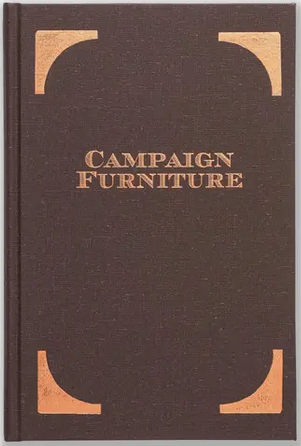
My 2014 book Campaign Furniture is now a free pdf download for everyone. You can download it via this link (a compressed version for slower connections is available here). And customers will always be able to download it from the book’s page in our store.
I’m a fan of the book … I ended up buying two copies through Lee Valley Tools (I loaned my first copy out and it got lost in the shipwreck of a friend’s messy divorce). I like Chris’s writing style and I’ve long been a fan of Campaign furniture.
Why Do I Do This?
I get asked by fellow publishers why I offer my books for free download. “Surely you use it to gather emails to market to readers.” Nope. “Are these out-of-print books that you are using to get eyeballs on your website?” Nope. “So what’s the strategy?”
I think – as much as possible – that information should be free. I think the best hope for inspiring other woodworkers is to give them whatever they need to begin in the craft.
And, I fu&%ing hate this world we’ve created where people can’t own anything. Companies come into your house and your phone and change things or take away stuff you’ve bought. Many times they take back stuff you owned then rent it back to you.
That’s why we make books. Buy a book from us, and it’s yours. Its contents can’t be changed by some ideologue a thousand miles away. All of our digital products are free of DRM (digital rights management). That means they can’t be locked or disabled. And you can copy them onto whatever device you like.
OK, the holiday rant is over.
I hope you find something of interest in Campaign Furniture. We still use three of the pieces from the book every day in our home. Other pieces are with my kids. So my family’s love of this neglected furniture style continues.
Production Hell – The Wizard Of Oz
The Critical Drinker
Published 1 Sept 2025Toxic makeup, deadly pyrotechnics, abusive directors, drugged-up child actors and horny midgets — The Wizard Of Oz had it all, and much more. Join me as I recount the insane production of the 1939 classic.
December 26, 2025
Allied Bombing 1944 – Distraction and Destruction before Dresden
HardThrasher
Published 25 Dec 2025Hello my little Christmas puddings; today’s film covers the strategic bombing forces in WW2, what they did to support Operation Overlord, the aerial war across France and into Germany during 1944, taking out enemy formations, V1 and V2 sites, and breaking up the Nazi oil fields in the process. But all did not go according to plan … this is the inbetweeny bit from June – December 1944 and the part everyone forgets before the Bulge, Dresden and all that …
00:00:00 – Introduction
00:01:12 – A Word From Our Sponsor
00:03:25 – A Few Notes For New Viewers
00:04:02 – How End A War
00:06:25 – A 90 second (well 6 minutes) Recap of the story so far
00:12:15 – On With The Show
00:18:40 – The Key Players
00:20:10 – Enter Trafford Leigh-Mallory
00:24:05 – Trafford in Charge At the AEAF
00:26:15 – The Strategic Bombers Role In D-Day
00:27:29 – The Bombers As Part Of The Deception Plans
00:28:18 – Cutting Off Normandy
00:29:41 – The V1s, Poison Gas and Biological Warfare
00:37:31 – The One True Raid To End The War
00:41:50 – Self Harm in Normandy (It’s Trafford Time Again)
00:52:04 – Focus On Oil – Why, How and What Happened in 1944
01:05:00 – And on to Dresden
01:05:25 – Survivor’s Club
(more…)
The US-Mexican border
An amusing exchange on the social media site formerly known as Twitter:
Ordnance Jay Packard Esq. @OrdnancePackard
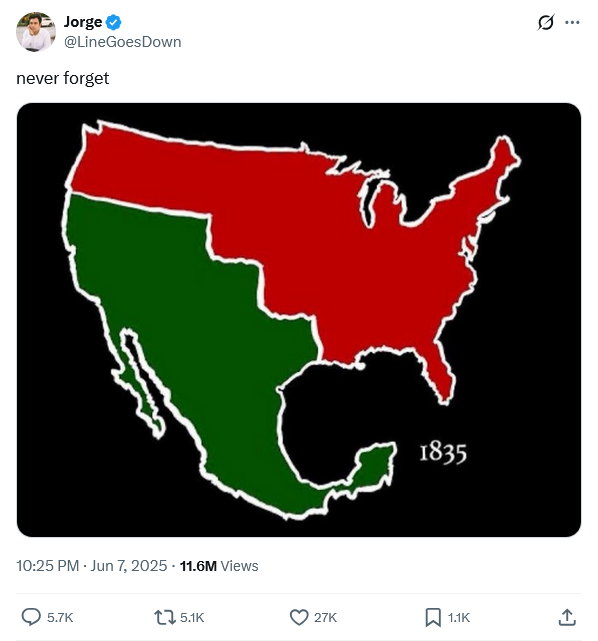
Hey @LineGoesDown, interesting your little map includes the Comancheria, a vast section of that northern green area that Mexico never set foot in because they’d get their shit pushed in by the Comanche.
It was only after the Mexican-American war that the United States put a stop to the Comanche using Mexico like an ATM.
It’s actually even funnier than that.
The reason Mexicans kept getting their shit pushed in by the Comancheria was gun control.
No, seriously. It was Spanish colonial policy to keep the population disarmed and rely entirely on deployment of the military to keep order and prevent Indian incursions. Mexico inherited this.
This was impossible. The land was vast. State capacity and the military were overstretched. The Comanches were too mobile. Result: misery and massacre.
Americans, inheriting the British colonial policy of everybody bring your own guns and form militias, didn’t suffer as badly. Raiders more often went where the soft targets were, and that meant the disarmed ones in the Mexican zone.
This is also why Alta California was so sparsely settled that Spanish and Mexican control over it was at best nominal. Anglo settlers were culturally and politically much better equipped to hold the territory, making the Mexican session eventually inevitable.
ESR, The social media site formerly known as Twitter, 2025-12-25.
Update, 28 December: Welcome, Instapundit readers! Have a look around at some of my other posts you may find of interest. I send out a daily summary of posts here through my Substack – https://substack.com/@nicholasrusson that you can subscribe to if you’d like to be informed of new posts in the future.
The Pinnacle of Movie ⚔️Swordfights⚔️
Jill Bearup
Published 8 Sept 2025Scaramouche had, until recently, the longest swordfight in cinema history. It’s still regarded as one of the best. Why? Let’s talk about it.
December 25, 2025
Bing Crosby’s “White Christmas” is still the best-selling single of all time
I knew Bing Crosby was big with my parents’ generation (including my father, unusually, who generally had little time for American singers), but I didn’t know that Bing’s recording of “White Christmas” is still, after all these years, the top single. Ted Gioia has more:
Pop culture devours its own. The destiny of all bestsellers is to fall off the charts. Even the stars in Hollywood, like those in outer space, eventually stop shining — and it happens a lot sooner.
Consider the case of Bing Crosby. Some of my readers might not even recognize the name. But a few people still alive today can recall when Crosby was both the biggest pop singer in the world and the hottest movie star in Hollywood.
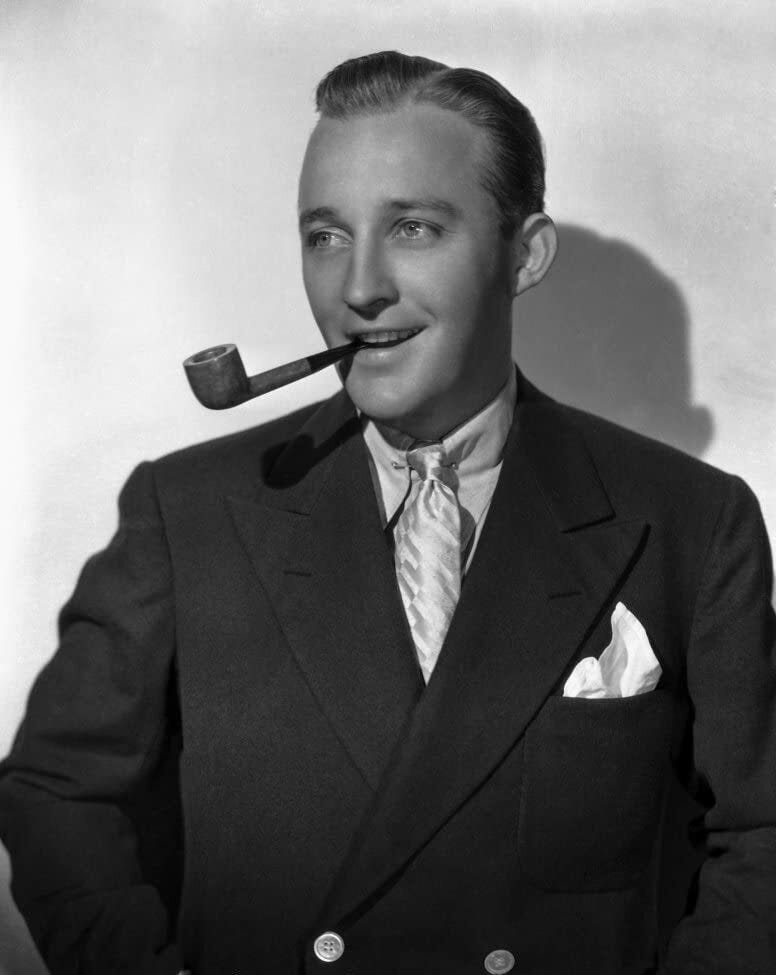
Bing Crosby publicity photo from the 1930s via The Honest Broker
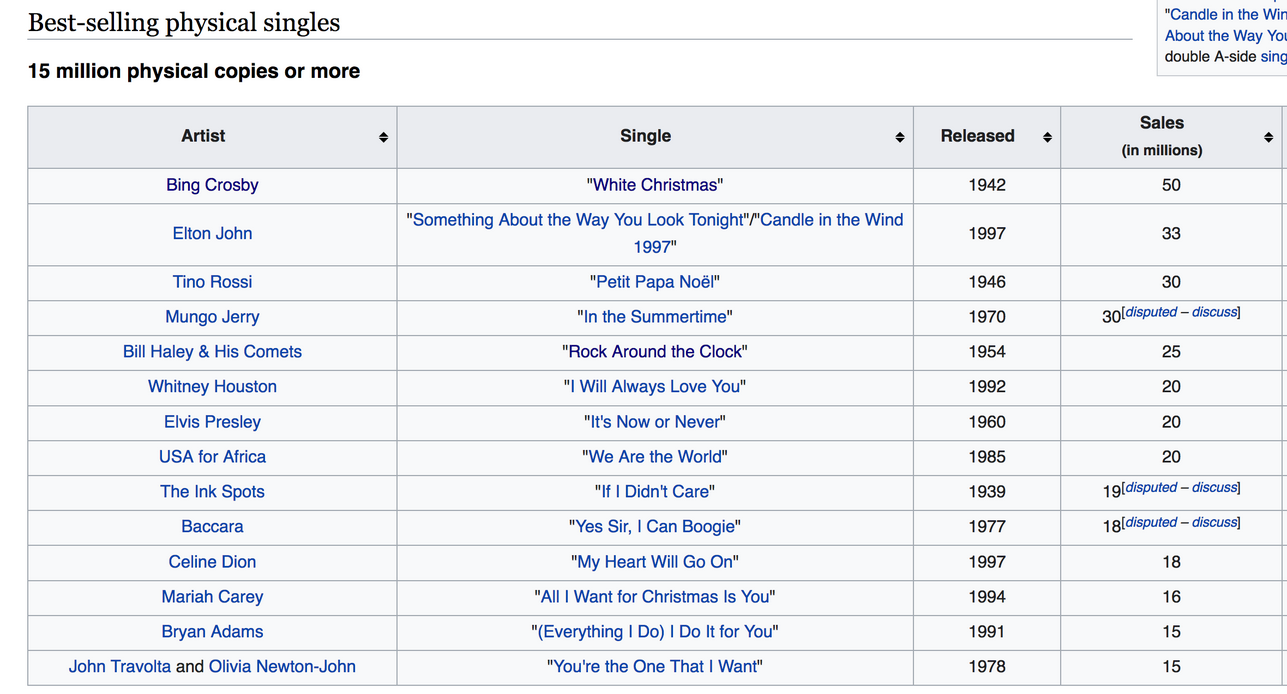
If he’s remembered nowadays, it’s only during December, when his version of “White Christmas” briefly returns to heavy rotation. Even today, it ranks as the bestselling single of all time. There aren’t many records that last eighty years, and least of all in the record business, but Crosby still sits atop this chart.
Here it is (courtesy of Wikipedia):
I’ve written about Crosby before, and will again. But today I want share four of my favorite (and very different) perspectives on Bing.
December 24, 2025
The Korean War Week 79: Soviet Technology Surpasses the USA – December 23, 1951
The Korean War by Indy Neidell
Published 23 Dec 2025Both sides finally release POW information to each other, as required by the Geneva Convention, but neither side is happy with the information, charging it either wildly incomplete or grossly mischaracterized. The Communists also refuse to allow the Red Cross in and the UN doesn’t want compulsory repatriation of POWs, but both are required under Geneva. And away from the truce tables, the Communist air power menace continues to grow, but should there be an armistice will they be allowed to rebuild air bases in North Korea?
00:00 Intro
00:38 Recap
00:58 POW Lists
05:02 Repatriation
07:52 Geoje-Do
09:01 Ambush Program
09:54 Airfields or Armistice
12:00 Communist Air Power
13:23 Summary
13:32 Conclusion
14:50 Call to Action
(more…)
The Pagan Roots of Christmas
History With Hilbert
Published 23 Dec 2017It’s Christmastime everyone, as you can tell from the name, it has a lot to do with Christ and Christianity, after all, Jesus was born on the 25th of December, right? Well, not quite. Most of what we do at Christmas time has little or nothing to do with Christianity and is rather rooted in the ancient pagan pasts of both Europe and other places. In this video I’m going to explore the aspects of Christmas that come form the traditions and beliefs of the Northern Europe Germanic or Nordic Pagans as this is what I know the most about and what interests me the most. This isn’t to say there are more explanations for where certain traditions come from or that there were other groups who contributed aspects of our modern Christmas celebrations. Things like Carol Singing, Christmas Trees, Christmas Lights, Yule Logs, Christmas Dinner, Santa Claus, the Elves, New Year’s Resolutions and Kissing under the Mistletoe can all be traced back to the pagan times of our forefathers and to various characters of Norse Myth and Legend like Odin, Freyja, Baldr and Thor.
(more…)
December 23, 2025
How Black WWII Veterans Ignited the Civil Rights Movement – W2W 058
TimeGhost History
Published 22 Dec 2025Decades before the words Black Lives Matter existed, Black American veterans were already fighting the same battle at home. After World War II, hundreds of thousands of Black soldiers returned from the frontlines of Europe and Asia believing they had earned the rights they had defended abroad. Instead, they were met with segregation, voter suppression, police violence, and terror under Jim Crow laws.
This episode explores how Black WWII veterans became a driving force behind the early Civil Rights Movement — joining the NAACP, challenging segregation in court, organizing protests, and refusing to accept second-class citizenship in the nation they had fought to protect.
From the brutal blinding of veteran Isaac Woodard Jr., to landmark legal battles led by Thurgood Marshall, from the Journey of Reconciliation to Brown v. Board of Education, this is the story of how the fight for freedom moved from foreign battlefields to American streets, courtrooms, buses, and classrooms.
We follow the rise of mass nonviolent resistance through figures like Rosa Parks and Martin Luther King Jr., the Montgomery Bus Boycott, and the creation of the SCLC — while also confronting the violent backlash, political resistance, and human cost that defined the struggle.
This is not just the history of civil rights legislation. It is the story of veterans who refused to stop fighting — and a reminder that equality in the United States has never been automatic, inevitable, or finished.
(more…)
December 22, 2025
The Great Eggnog Riot at West Point Military Academy
Tasting History with Max Miller
Published 6 Dec 2024Boozy, creamy eggnog with foam and nutmeg on top
City/Region: United States of America
Time Period: 1887At West Point in 1826, with alcohol prohibited on campus, students smuggled in large quantities of booze to make eggnog for a secret party on Christmas Eve. Drunkenness led to a riot that involved firearms, swords, broken windows, and barricades.
If you’ve never made homemade eggnog, I highly recommend it. It’s creamy, boozy, and so much more delicious than what you buy at the store. Is it good enough to start a riot over? I’ll leave that judgement up to you.
I have an allergy to raw egg whites, so in the video I used 12 egg whites worth of reconstituted dry aquafaba instead, and it worked great.
Egg Nog
Beat the yolks of twelve eggs very light, stir in as much white sugar as they will dissolve, pour in gradually one glass of brandy to cook the egg, one glass of old whiskey, one grated nutmeg, and three pints of rich milk. Beat the whites to a froth and stir in last.
— The White House Cook Book, 1887
December 21, 2025
The Fall of Chancellor Bruning – Rise of Hitler 24, April-June 1932
World War Two
Published 20 Dec 2025The runoff elections for German President give Paul von Hindenburg a strong victory over Adolf Hitler, and convince the Bruning government to try to reign in the Nazis by banning the SA and SS. However, Kurt von Schleicher has managed to convince Hindenburg that Bruning is a liability and by the end of May, Bruning is out and Schleicher has maneuvered Franz von Papen into the post of Chancellor. The Reichstag is dissolved, the ban is lifted, and who knows where Germany is headed!
(more…)
Boomers – A vampiric generation battening on the blood of the young
As a member of the recently identified “Generation Jones”, I could take part in the widespread boomer hate with a clear conscience … but as Scott Alexander points out, the hate may be more than a little over-done:
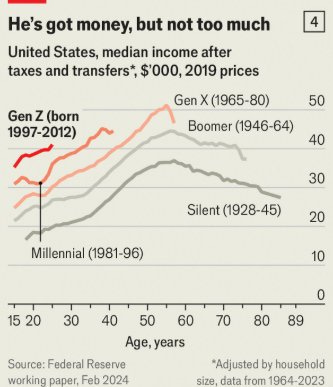
“… Millennials and Generation Z have more money (adjusted for inflation ie cost-of-living, and compared at the same age) than their Boomer parents, to about the same degree that the Boomers exceeded their own parents. This is good and how it should be. The Boomers have successfully passed on a better life to their children”
There’s a more developed theory of Boomer-hating. The more developed theory goes: Boomers are plundering the young. We know this, because their share of resources is high and keeps increasing. They use their large population share and good voter turnout to vote themselves ever-higher pensions at the expense of working taxpayers.
How might we investigate this theory? We can’t use total social security spending, because the number of elderly has gone up. Can we use social security spending per elderly person? No; the amount of social security paid out depends on the amount paid in. If each year’s retirees earned more during their career than the previous year’s did (this is true), then each year’s will get a higher SSI payment, even if the system’s “generosity” stays the same.
We might start by looking at change in social security payment divided by change in median income. Over the past fifty years, average Social Security payment in inflation-adjusted dollars increased 60%. If we expect these payments to reflect earnings twenty years before disbursement, we can look at real median personal income from 1953 to 2003; this also increased 60%. There is no increase in generosity.
Or we can just look at the history. The Social Security Administration’s own website says that its generosity peaked in 1972, when the program primarily served the Greatest Generation; since then, it’s been one contraction after another. In 1983, the government increased the full retirement age from 65 to 67; in 1993, they made Social Security more taxable. Since then, most of the changes have been cost-of-living increases, which are indexed to inflation and not the result of active lobbying on old people’s behalf.
Why do so many believe that old people have discovered a vote-themselves-infinite-benefits hack? Since old people represent an increasing fraction of the population, are living longer, and face a secular trend of rising healthcare costs, even when their benefits per capita per year are stable or declining the government will spend more money on them as a group. This spending is indeed rapidly becoming unsustainable, the elderly will need to accept big benefit cuts to make it sustainable again, and they are resisting those cuts.
So have we finally discovered the fabled Boomer selfishness? Call it what you want. But remember that the Boomers did pay money into Social Security to support their own parents, believing that they would be supported in turn. Learning that yours is the generation where the pyramid collapses is a hard pill to swallow. Maybe they should suck it up and take the sacrifice. You’d do this, right? Voluntarily give up money which is yours by right, in order to help other generations? Oh, sorry, you didn’t hear the question, you were too busy writing your 500th “You don’t hate Boomers enough, why won’t they hurry up and die, we need to declare intergenerational warfare and seize our rightful inheritance” post.
Update, 22 December: Welcome, Instapundit readers! Please do have a look around at some of my other posts you may find of interest. I send out a daily summary of posts here through my Substack – https://substack.com/@nicholasrusson that you can subscribe to if you’d like to be informed of new posts in the future.


