
World War Two
Published 31 Jan 2025This episode of the history documentary series “Death of Democracy” covers Q1 1933 with Hitler’s appointment as chancellor, the Reichstag Fire, Reichstag Fire Decree, Enabling Act, rise of Nazi terror, Gleichschaltung, and media control, explaining how Weimar Germany’s democracy collapsed in just sixty days.
(more…)
February 1, 2026
How to End Democracy in 60 Days – Death of Democracy Q1 1933
Comments Off on How to End Democracy in 60 Days – Death of Democracy Q1 1933
Don’t listen to what they say, watch what they do
On the social media site formerly known as Twitter, John Carter reacts to an Australian race-grievance grifter “Race Discrimination Commissioner” bloviating talking about Australia as “stolen land”:
The implicit meaning of this framing is that Anglos stole the land so it’s only fair for them to give hundreds of millions of Hindoids the opportunity to steal the land.
Revealed preference demonstrates this. If he believes the land is stolen, and he believes theft is morally wrong, then he would not accept a salary of hundreds of thousands of dollars from the Australian government (this is blood money), and he wouldn’t live in Australia.
Since he doesn’t do either of those things, he either doesn’t believe what he’s saying, or he does but he doesn’t think theft is bad, in which case he’s simply trying to emotionally manipulate white Australians by using their own morality against them in order to guilt them into continuing to allow him and people like him to parasitize the Australian people.

He then elaborates:
It really cannot be emphasized enough how dishonest all of this is.
America stole land from the natives, purchased some African farm equipment, and has always been a “nation of immigrants”, therefore “open the borders and give us your country”.
Canada is built on stolen land, sent some kids to boarding school, and has also always been a “nation of immigrants”, therefore “Let my people in, saar”.
Australia, same narrative as Canada.
New Zealand, same as Australia.
Britain did an imperialism, therefore “your country belongs to us now, saar”.
France, same as England.
Spain, same as France.
Ireland never had an empire and hasn’t had slaves since the Viking Age, and indeed was itself colonized by England … therefore Ireland must accept unlimited migration in solidarity with other post-colonial countries.
Germany was too mean to Jews for a few years, therefore Germans must abolish themselves and give their country to North Africans.
The only peoples the Swedes ever conquered or enslaved were neighbouring Europeans, but Sweden might have sold some iron that might have gotten used on some slave ships a few centuries ago, therefore must open its borders to Bomalians and give them all the rape toys they can penetrate.
The justification differs, but the conclusion is always the same: open borders and ethnic replacement.
The uniformity of the repugnant conclusion indicates that these narratives are formed by reasoning back from that tendentious repugnance, with the arguments tailored to national conditions using whatever specific historical circumstances are handy, with the intent of emotionally manipulating native populations into laying down their arms, foregoing resistance, and placidly accepting the loss of their countries to the hundreds of millions of third-worlders intent on flooding every developed white country on the planet.
The people making these arguments don’t believe a word that they say. Their seething resentment for Europeans is entirely real, but this is almost entirely an inferiority complex, humiliation at having been so easily conquered and then taught to eat and wipe with something other than their hands. They don’t believe that slavery or conquest are wrong: if they did, they wouldn’t still practice slavery, and they wouldn’t be trying to conquer the West in the guise of beggars, by shamelessly playing to our pity and misplaced guilt. They say these things in order to trick you by playing on a conscience they don’t have themselves. It’s a sales tactic, and they’re selling you annihilation.
Comments Off on Don’t listen to what they say, watch what they do
The Agora of Athens | A Historical Tour
Scenic Routes to the Past
Published 3 Oct 2025The Agora was the political and economic heart of ancient Athens. This tour explores its long history and evocative ruins.
Chapters
0:00 Introduction
0:47 Bouleuterion
1:44 Tholos
2:22 Monument of the Eponymous Heroes
2:56 Temple of Hephaestus
5:28 The Hellenistic Agora
6:16 Stoa of Attalos
6:57 Augustus and the Agora
8:06 Odeon of Agrippa
9:26 Herulian Wall
10:56 Overview
Comments Off on The Agora of Athens | A Historical Tour
January 31, 2026
“… nations are what Kurt Vonnegut would call a ‘granfalloon'”
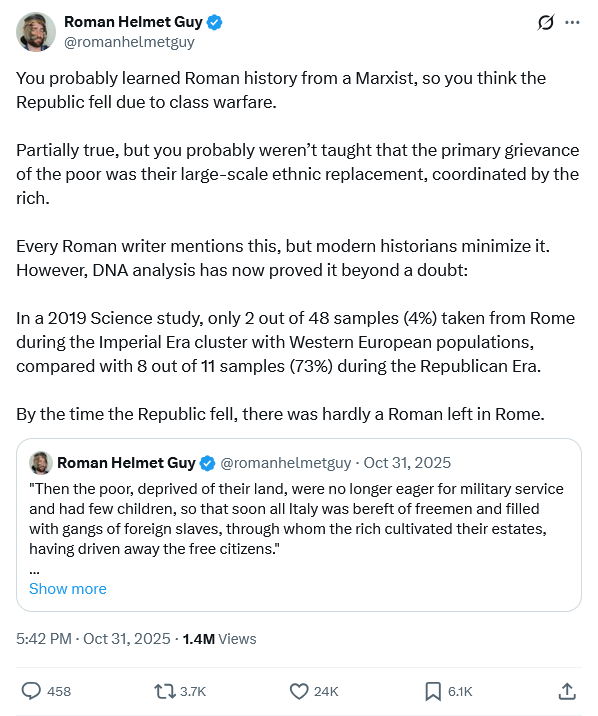
On the social media site formerly known as Twitter, Devon Eriksen responds to an older tweet about the replacement of “original” Romans during the Republic with other ethnicities over the course of the Empire:
Any time a nation allows slavery, de jure or de facto, the business owning class immediately tries to replace the working class with slaves.
If they succeed, the nation collapses and everyone dies. A nation cannot survive if it’s populated by slaves.
Why?
Because nations are what Kurt Vonnegut would call a “granfalloon” … his word for an association that only exists because people believe in it.
Now Vonnegut, who was a liberal and therefore wrong about everything important, meant to mock the concept of nations and tribes by coining this term. He believed them to be unnecessary throwbacks to humanity’s primitive past … a delusion he was able to sustain because he never had to try existing without one.
Granfalloons are indeed arbitrary — you could base them on anything — but humans cannot survive without them. Because humans are a pack animal.
If you drop your cat off somewhere in the woods at night, assuming he is a healthy and physically fit cat, he will likely survive, regardless of his unhappiness at the sudden deficiency of chin scratches and clean laundry to sleep on.
Try that experiment with your dog, and he’ll die.
Why? It’s not because cats are smarter than dogs. They’re about the same.
It’s because cats are not a pack animal. A cat doesn’t need other cats to survive. The basic unit required to execute all cat survival strategies is one cat.
Dog survival strategies work just fine, too, but they require multiple dogs. A lone dog will die because he cannot execute his survival strategies by himself.
And so it is with humans.
The great error of the classical liberal worldview is that, because history is full of tribes fighting wars over scarce resources, that it was the tribes, not the scarcity, that caused conflict.
So they decided they were going to get rids of tribes, and nations, and religions, all the granfalloons, and just glue everything together with economics. And there would somehow be world peace.
Kurt Vonnegut was a dreamer.
Unfortunately for all of us, he was not the only one.
So the experiment was carried out, and in every single place it was carried out, things got observably, obviously worse. Sometimes “gosh the boomers had it way easier than us” worse, and sometimes “what shall we do these corpses, Comrade Commissar” worse, but always worse.
Because economic incentives alone cannot hold a society together.
Economic incentives, without ethnic or cultural solidarity, get you nothing but massive robbery and fraud.
It’s why the Biden Administration let millions of third world savages into America. It’s why Proctor and Gamble sells you poison food, and why the American Heart Association takes their money to lie to you and say it’s healthy. It’s why every product you buy, from your Tesla to your laptop to your security camera system, tries to spy on you and control how you use the thing you paid for and theoretically own. It’s why you’ve never held the same job for more than three years, because they either laid you off or gave you two percent raises every year until you had to find a new company to pay you what you’re actually worth.
When there is no granfalloon, there is no incentive not to cheat. And no, fear of punishment doesn’t work. The police cannot arrest, try and convict everyone. And when there is no granfalloon, the enforcers themselves have no incentive to actually perform, instead of looking just busy enough to get paid, or taking bribes to look the other way.
An atomized group of individuals, unconnected by a granfalloon, have no morality, because morality isn’t something an individual has. It’s something a tribe has, because what the word “morality” actually means is the system of behavior that tribe members display towards each other.
A slave has no morality. He has no sense of responsibility, not only for the nation, not only for his masters, but even for his fellow slave. He is homo economicus, the man who responds purely to incentives of reward and punishment.
A slave has no granfalloon.
Kurt Vonnegut famously wrote “If you wish to examine a granfalloon, just remove the skin of a toy balloon.” By which he meant that such associations are nothing but a puff of air, and therefore unimportant.
But having been surrounded by air all his life, in abundant supply, Kurt had forgotten that air is important.
You need it for breathing.
Try removing the skin of a SCUBA tank.
WW1: Hell in the Trenches | EP 4
The Rest Is History
Published 4 Sept 2025What happened at the crucial, bloody, Battle of Ypres in October 1914? How did the battle come about? Why did the Germans and the British fight each other so brutally and for so long to take Ypres? What made the fighting so particularly violent? How were the British able to repel the relentless German onslaught time after time? What was the famous “Kindermord” — “the Massacre of the Innocents” — in the German army, and how true was it? And, what would be the outcome of this almighty clash?
Join Dominic and Tom as they discuss the terrible Battle of Ypres; its significance to the First World War overall, and its consequences for the rise of Hitler in Germany later on….
0:00 – Adobe Express AD
0:49 – Intro: To the Front
3:26 – The Kindermord Myth
5:02 – Race to Ypres
11:04 – The Ypres Salient
17:07 – Crisis at Gheluvelt
23:29 – Uber & Folio Society ADs
25:43 – November Slaughter
32:05 – The Langemark Legend
44:02 – Why the War Didn’t Stop
(more…)
Comments Off on WW1: Hell in the Trenches | EP 4
January 30, 2026
“… now that the legend is fully established, good luck trying to convince people of the facts”
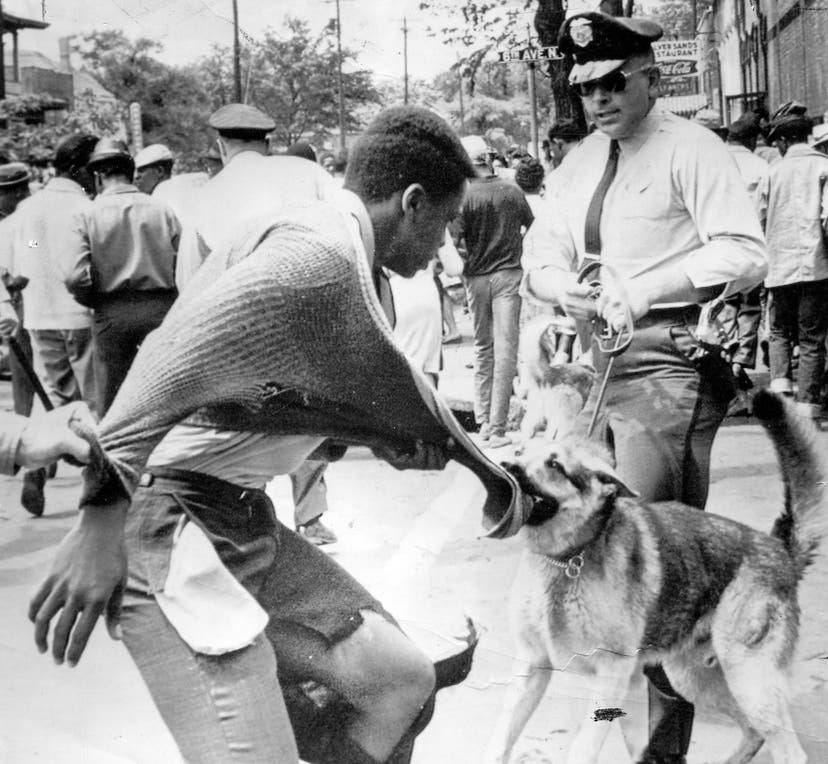
On Substack, The Scuttlebutt looks at an iconic photo, a sculpture based on the photo, and shows that the line from The Man Who Shot Liberty Valance is still quite true: “When Legend becomes Fact, print the Legend”
In an old black and white John Wayne, Jimmy Stewart movie called The Man Who Shot Liberty Valance, a newspaper man tells the hero of the piece “When Legend becomes Fact, print the Legend”. Meaning; tell the people what you want them to know, even if it’s not true. We’re going to talk about that today; but first, Get in out of the cold damn it! Seven degrees is cold even by my standards. Grab a cup of coffee, or cocoa, tea if you must, pollute it as you will, and have a seat, Dinner is Chili, please remember the tip jar where we collect for the mess. Let’s begin!
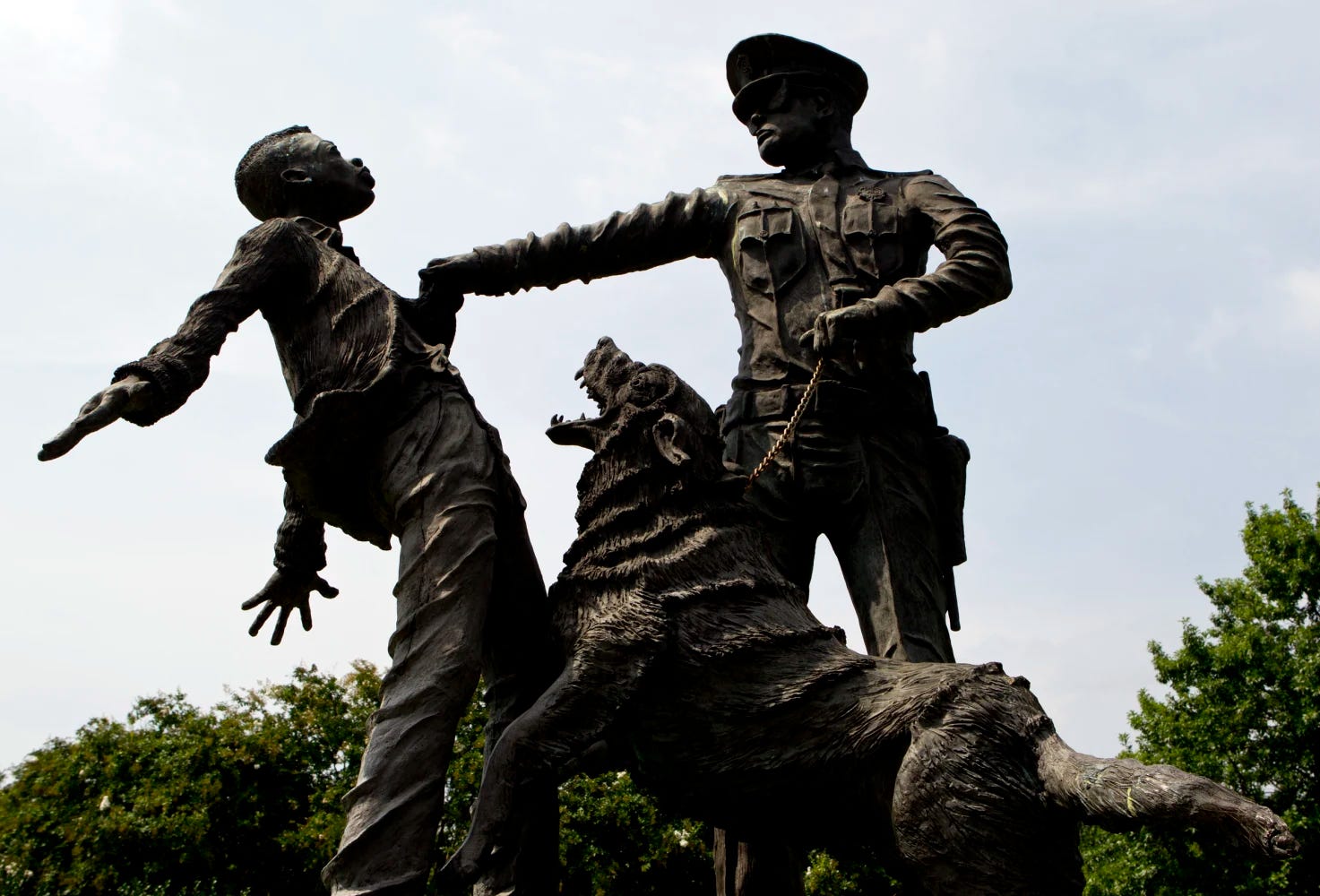
I referred to the picture above last week, though I didn’t include it. I’m going to include it now, because of something that a reader and good friend of some four decades sent me, in regard to it. See, she lives in Birmingham, where there is a statue commemorating this event, titled Foot Soldier. This is it:
Notice any differences from the photo of the event? Yeah, the cop is the one grabbing the kid, and the dog is threatening, the kid is defiant, and the cop looks like they pulled him out of a Soviet or Nazi recruiting poster. (The article I will reference also calls out the fact that the kid in the sculpture has emphasized black racial features. The kid it happened to, is so Anglo in feature he could be a white guy in “blackface”. Oh and the kid in real life is every bit as big as the cop.) Those are just the initial things, there’s more, but I’ve made my point.
Yeah, you in the back, with the purple hair and the septum ring? What’s that? “But that’s art” you say? “Putting artistic license on the sculpture is reasonable” you say?
Well, Ma’am? I think you’re a Ma’am? Yes, it is. It’s propaganda, but “Art” is allowed to be propaganda, and in fact most art is just that. From the formal paintings of Kings and Heads of State, to Andy Warhol’s stuff, images are altered to make a point. Maybe to emphasize a chin that’s pretty weak in the real guy, making him look “tougher” or putting more jewelry on the woman than the family owns to make them look richer … Most art that isn’t just “an exercise for the student” has some sort of statement. (Note, I consider “still life with fruit”, and such things to be an exercise, teaching proportion and play with light.) Political caricatures are the ultimate expression of this point, and that cop is a political caricature.
Ah, but here’s the thing. While the “art” is reasonably a political statement, the news story, and the photograph are supposed to be news, and we have been told that “News is facts, not Op-ed”.
Well, we all know that lately, that’s just not so, but here’s the thing: It never was!
It’s not that the Media is lying to you today, it’s that the media has NEVER told the truth. It’s just that by the time the truth comes out, usually, it’s decades later, and no one cares.
But you SHOULD care. Take this event enshrined in legend (Remember that quote “print the legend”?) There’s a gentleman named Malcom Gladwell. He does a podcast called Revisionist History. The transcript of the relevant show is HERE as done by Emily Maina. The whole piece is really well done, and worth your time, but it’s about twenty minutes worth of reading, so I’m pulling out a couple of points to help make my point.
Mr. Gladwell was invited by the widow of the cop, to learn, as the late Great Paul Harvey used to put it, “The Rest of the Story”. This drove him to track down the artist that did the sculpture, the actual kid that was involved, friends of the cop in question, caused him to listen to the interviews done when the statue was commemorated, and so on. It seems the legend is far different from the truth. The kid in the picture wasn’t even part of the damn protest. He was a lookie-loo who had skipped school to come see “the great man” Martin Luther King.
The protests had at this point been going on for months. Constantly getting bigger, constantly drawing more spectators. The cops, specifically “the Birmingham Chief of Police, a troglodyte named Bull Connor”, in the words of Gladwell, have been tasked with keeping the spectators separated from the protesters. There was, after all, a legitimate fear that someone in the spectators might just be a Klansman, and might be aiming to take out some of MLK’s folks.
Well, that gets harder and harder to do, and the protester numbers keep growing, the spectators keep growing, until finally, Conner decides to use the K9 units to keep the peace. This is all a part of “the plan”. The protestors are trying to get the cops to do something that can be blown up and make international headlines. Finally, they succeeded.
The third of May, 1963. A photographer, Bill Hudson, gets a picture of a kid with a cop dog on him. White officer, black victim, mean dog. That’s what the narrative is. The New York Times runs it, three columns above the fold, and makes up a story to go along with it. The trouble is, no one talked to the cop, or to the kid.
The cop was Richard Middleton, his last gig had been escorting black kids to school, to keep them from being killed by whites. He’s been assigned now, to keep the separation line between the protesters and the populace. The kid’s name is Walter Gadsden, according to the person that interviewed him at the dedication of the statue, he’s now “a grumpy old man still wedded to some of the oldest and most awkward of Black prejudices”. She sees him as Stockholmed basically.
Walter, he sees himself as a dumb kid who skipped school, went where he wasn’t supposed to, and damn near got bit by a K9 because of it. Middleton was trying to pull the dog off, you can see it in the photo, if you actually look. But that’s not the legend, and the media prints “the legend”. The artist admits:
Well, I saw that the boy was being about 6’4, the officer was maybe 5’10, 5’9. And I said, “This is a movement about power”. So I made the little boy younger and smaller, and the officer taller and stronger. The arm of the law is so strong, that’s why his arm is almost, like, straight. And the dog is more like a wolf than a real dog. Because if I’m a little boy, that’s what I would see. I would see like this superman hovering over me, putting this big old giant monster of a dog in my groin area, in my private area. And so, that’s what I envisioned when I first saw the photograph.
Of course, the artist is a black man. He continues: “So he’s almost like a blind officer. He doesn’t even see the kid, because he’s so far beyond that. ‘Killed this nigger. Attack this nigger.’ He saw past the reality of this is a hu-, innocent chi-, human child, a human being, that’s why he was wearing blind people glasses like that.”
Well, it’s art, the artist wasn’t there, never talked to anyone involved, and he told the story he wanted to tell. OK, that’s what art does. The trouble is, that’s also what the news media did.
And they got away with it, until July 6 2017, which is when the article in question came out. Actually, they are still getting away with it, because now that the legend is fully established, good luck trying to convince people of the facts.
Comments Off on “… now that the legend is fully established, good luck trying to convince people of the facts”
Japanese Last-Ditch Pole Spear Bayonet
Forgotten Weapons
Published 8 Sept 2025Japanese bayonets followed the same trend of simplification as Arisaka rifles towards the end of World War Two, culminating in what is today called the “pole bayonet”. Abandoning even the fittings to mount to a rifle, these bayonets were intended to be lashed to a pole to create a spear. The Japanese government did not have the military forces to repulse an American invasion of the home islands, and was actively planning to sacrifice millions of Japanese civilians in a hopeless defense, literally having them charge American machine guns with spears. Some of this was done on outer island battles, like Saipan and Okinawa but the scale in Japan itself would have been unimaginable. It was the nuclear bombs on Hiroshima and Nagasaki that led to a Japanese surrender and prevented this from becoming a reality.
(more…)
Comments Off on Japanese Last-Ditch Pole Spear Bayonet
QotD: Slavery in the Islamic world
As one recent study of the 19th century slave Fezzeh Khanom puts it, “The history of slavery in Iran has yet to be written”. A general history of slavery in the wider Islamic world had yet to be written, too — until Justin Marozzi took up the task.
The widespread neglect of the history of slavery in North Africa and the Middle East, which Captives and Companions seeks to redress, partly reflects a culture of American exceptionalism; slavery in other parts of the Americas (it was abolished in Brazil only in 1888) also receives little attention.
Partly, too, it reflects a tradition of denial in the Islamic world itself. Marozzi recalls a professor at Bilkent University in Turkey admonishing a younger historian not to dig too deep: “Our ancestors treated their slaves very well; don’t waste your time”.
In the West, meanwhile, Islamic slavery is an unfashionable — and often suspect — subject: one is reminded of West Germany in the 1980s, when any overemphasis on Soviet crimes against humanity could appear as an attempt to whitewash or relativise the Holocaust. Marozzi is careful not to dwell too much on comparisons between Islamic and Atlantic slavery, except as regards the scholarly attention which they have received. Still, many readers will pick up his book hungry for such comparisons. So here they are.
In both Islamic and Atlantic slavery there was a marked racial — anti-black — component. Slavery was sustained by similar religious and philosophical justifications: the biblical “curse of Ham”, for example, and the idea that geography and climate made sub-Saharan Africans naturally suited for servitude. “Chattel slavery”, Marozzi emphasises, existed in the Islamic world too. Both involved horrific violence and displacement. Both were complex and sophisticated enterprises, often with serious money at stake.
People have always been hesitant to draw any comparisons between Islamic and Atlantic slavery, albeit often for entirely opposite reasons to historians today. Whereas the Jewish-American writer Mordecai Manuel Noah was a vocal supporter of the enslavement of Africans in America, he was also bitterly opposed to the enslavement of Americans in North Africa — and therefore a strong supporter of America’s involvement in the Barbary wars.
Gladstone, meanwhile, thought that Turks killing and enslaving Europeans was far worse than “negro slavery”, which had at least involved “a race of higher capacities ruling over a race of lower capacities”. However dubious his family connections, Gladstone was born after Britain had abolished the slave trade.
The lack of attention given to Islamic slavery is all the more dismaying when one considers just how much longer it survived.
Most of slavery’s 20th century holdouts were in the Islamic world. Iran abolished slavery in 1928; Yemen and Saudi Arabia in 1962; Turkey — which we like to consider more “Western” than the others — in 1964. Mauritania half-heartedly abolished slavery in 1981. Slavery was still a feature of elite life in Zanzibar as late as 1970. When 64-year-old President Karume took an underage Asian concubine, he justified it by declaring that “in colonial times the Arabs took African concubines … now the shoe is on the other foot”.
The Royal Harem in Morocco, meanwhile, was only dissolved on the death of Hassan II in 1999. In the Islamic world, human beings were bought and sold, and forced to do demeaning and painstaking labour, within living memory; some people languish there still.
The key difference between Atlantic and Islamic slavery concerned status. Slaves in the Islamic world could rise to high places: 35 of the 37 Abbasid caliphs were born to enslaved concubine mothers; the slave eunuch Abu al Misk Kafur was regent over Egypt from 946 to 968. Slave dynasties, most notably the Mamluks, were amongst the most powerful in the Islamic world.
The polyglot governor of Hong Kong, Sir John Bowring, when he inveighed against “slavery in the Mohamedan states”, had no choice but to acknowledge that a slave in the East could attain the “highest social elevation” — a far cry from the black slaves of the West Indies. Some slaves, too, were amongst the worthies of Islam, such as the first Muslim martyr, Sumayya bint Khabat.
Slavery occupied a complex place in Islamic law. The Quran, on the one hand, permits men to have sex with female slaves. But on the other, the emancipation of slaves is smiled upon as one of the noblest things a Muslim can do. The Abyssinian slave Bilal ibn Rabah was freed by Abu Bakr and became the first caller to prayer; another freed slave, Zayd ibn Haritha, was briefly the Prophet’s adopted son.
The Quran also expressly forbids Muslims from enslaving fellow Muslims. Nonetheless, as Marozzi shows, this prohibition has not always been strictly observed. The Mahdi (of General Gordon fame) claimed to represent pure, Islamic orthodoxy, but he had no qualms about enslaving Muslim Turks.
Likewise, it mattered little that the Prophet Muhammad had explicitly forbidden castration of male slaves. For over a millennium his tomb in Medina was guarded by a corps of eunuchs. This, too, was an institution which survived into living memory: in 2022 a Saudi newspaper reported that there remained one living eunuch guardian.
Samuel Rubinstein, “The dirty secret of the Muslim world”, The Critic, 2025-10-17.
Comments Off on QotD: Slavery in the Islamic world
January 29, 2026
QotD: Nitpicking the Roman army in Gladiator (2000)
In the process of Maximus riding up, the failure of negotiations and Maximus riding to join his cavalry, we get something of an overview of the Roman army and its position and both are wrong. Let’s start with the soldiers: we see a very clear distinction between two kinds of soldiers, the mail-clad auxilia, all archers, and the legionaries wearing the lorica segmentata and there appear to be about the same number of both groups. And here is where we first see the clear influence of the Column of Trajan (and to an unfortunately lesser degree, the far more appropriate Column of Marcus Aurelius) on the depiction, because this use of armor to distinctly signal the Roman citizen legionaries and non-citizen auxilia is straight from the Column of Trajan, completed probably around 113 and commemorating Trajan’s two Dacian Wars (101-102, 105-106).
What this sequence gets correct is that the Roman army was divided into those two groups, they were roughly equal in number (by this period, the auxilia probably modestly outnumber the legions in total manpower)1 and Trajan’s Column does use that visual signifier to distinguish them. This component is the crux of the verisimilitude that leads people to trust the rest of this sequence.
The problems start almost immediately from there. Roman auxilia were far more varied than what we see here in terms of equipment and tactics and only very few of them were archers. So let’s break down Roman auxiliary contingents. With all due caveats about the limits of our evidence, infantry auxilia outnumber cavalry by about 2:1 in attested auxilia units (auxilia were grouped into cavalry alae and infantry cohortes, generally of 480 men (sometimes around 800), but unlike for legionary citizen-infantry, these cohorts were not grouped into larger legions).2 So we ought to expect about a third of our auxilia to be cavalry, which is important because the cavalry detachments of Roman legions were very small (and mostly for scouting and messenger duties). Auxilia cavalry ranged in equipment and could include horse archers and even ultra-heavy cataphract cavalry, but most were mailed shock cavalry, equipped quite a lot like how Gallic or Germanic warrior-aristocrats or Roman legionary cavalry would be.
Of the remainder, the most common kind of infantry auxilia by far seem to have been heavy infantry, fighting in fairly heavy armor. These fellows get depicted in Roman artwork generally in mail armor, with flat oval shields (as opposed to the curved, rectangular imperial-period Roman scutum), spears and swords. These fellows, totally absent in this sequence are all over the Column of Trajan, with their flat oval shields being frequently seen (although one must distinguish them from Dacians who carry the same shield; the auxilia stick out for their mail and helmets). A bit less than 10% of auxilia units are attested as cohortes sagittariorum (“cohort of archers”). We also know the Romans used slingers within the auxilia, but as far as we can tell, not in specialized units; they may have been brigaded in with other auxilia cohorts. In either case, they appear in fairly small numbers. Finally, we also see on things like the Column of Trajan Roman allied or auxiliary units that are substantially lighter infantry: on the Column of Trajan, these are local troops shown wielding large clubs and stripped to the waist, presumably representing troops local to the Danube region, fighting in local (unarmored, with heavy two-handed weapons) style.
So whereas the army we see is a nearly even split between legionary heavy infantry and auxilia archers (with a small amount of legionary cavalry waiting for Maximus to show up to lead them), in practice a typical Roman field army would have far fewer archers, indeed around ten times fewer: not almost 50% of the force, but in fact probably a bit less than 5% of the force (since they’re less than 10% of the auxilia who would make up around half of a Roman field army). Meanwhile we’re simply missing the – by far – two most common sorts of auxilia cohorts, those of heavy infantry or heavy cavalry. This mangling of the structure of a Roman army is going to have implications when we get to Maximus’ overall plan for the battle as well.
Meanwhile, the legionary infantry are also much too uniform, literally. This is easily the most pardonable error, because what has happened here is that director Ridley Scott has copied the Column of Trajan but far too uncritically. After all, the Column of Trajan is not a photograph and thus has space for the artists producing it to take liberties, particularly in the name of imperial ideology and propaganda. In this case, showing large numbers of identically equipped soldiers, often moving in unified formation, serves the same rhetorical purpose in antiquity as it does today, suggesting an impressive, inhumanly uniformed and disciplined source. Moreover, the segmented Roman body armor, which we call the lorica segmentata (we don’t know what the Romans called it), was very distinctive to the legions, as it was the one armor that it seems like the auxilia probably (the evidence here can be tricky) didn’t share. And keeping the legions distinct from the auxilia also matters, as the legionary soldiers are higher status citizens who thus get “higher billing” in the imagery, as it were, than the auxilia. So showing all of the legions equipped neatly with this armor makes them seem distinct, impressive and uniform.
In short, it served Trajan’s image (and thus the artists aim) to suggest that all of his legions wore this armor.
Archaeology tells us quite clearly it was not so. Indeed, the lorica segmentata, so iconic because of its use in this way on the Column of Trajan, was probably the least common of the three major types of Roman legionary body armor in this period. The most common armor of the Roman legions was almost certainly still – as it had been in the Late Republic – mail, exactly the same as we see the auxilia wearing. We find fragments of Roman mail in legionary sites in all corners of the Empire and it remained common everywhere. To head off a standard question: no, it does not seem that the Romans ever got the idea to layer other defenses over mail, so when it was worn, it was the “primary” armor (worn over a padded textile defense called a subarmalis, but not under any other armor).3 We also see mail represented in Roman artwork, including on very high status soldiers, like senior centurions.
The next most common armor was probably scale armor, which we find very frequently in the East (that is, on the frontier with the Parthians/Sassanids) and often enough (if less frequently) in the West (that is, the Rhine/Danube frontier). We also know that some auxilia units wore this armor too and we see quite a bit of scale armor – wholly absent in this sequence – on the Column of – wait for it – Marcus Aurelius (completed c. 193). That’s the column that commemorates this war. Contemporary with this fictional battle. But it is less famous and somewhat less well-preserved than 70-years-earlier Column of Trajan, which they pretty evidently used quite a bit more of.
The lorica segmentata shows up the least often and – to my knowledge – effectively exclusively in the west on the Rhine/Danube frontier, where it is still probably not the most common (although it may have been more common than scale on that frontier). So what we ought to see in this army are legionaries who are marked out by their large scuta (the big Roman shield, by this period distinctly rectangular and also (as in the republic) curved), but in a range of mail, scale and lorica segmentata (with mail and segmentata being the most common, because we are on the Danube frontier, but scale hardly rare), along with auxilia divided into specialist cohorts (480 man units) each with different sets of armor and weapons: a few missile cohorts (archers, slingers), a lot more heavy infantry cohorts with spears and long shields, some lighter troops, and so on. The auxilia ought to be wearing basically every armor under the sun except for the lorica segmentata (which to my knowledge we’ve only ever found in sites associated with the legions).
Finally, these units are backed up by a whole load of catapults. We see two kinds, dual-arm arrow-throwing machines (which most folks would casually call ballistae) and single-armed pot-throwing machines (which most folks would casually call catapults), all of them in stationary mounts. Now on the one hand, “the Romans use lots of torsion-based catapults as artillery” is a true statement about the Roman army of this period, but on the other hand once again beyond that basic idea, most of this is wrong. Once again there’s an issue of verisimilitude here: the appearance of strange catapults and the true fact that the Romans used a lot of unusual catapults is likely to lead the viewer to assume some research has been done here and thus that these are the right catapults. For the most part, they are not.
We can start with the easy one, the larger single-armed pot-throwers. These are onagers, a late-Roman simplified single-arm torsion catapult, named for their fearsome “kick” (like an ass, an onager). These are popular favorites for Roman artillery, for instance showing up in both Rome: Total War and Total War: Rome II (both of which have main campaigns set during the Late Republic). There’s only one problem, which is that Gladiator (much less the even earlier Total War games) is set substantially too early for an onager to appear. Our first attestation of the onager is in Ammianus Marcellinus, writing in the last two decades of the 300s AD about the events of 353-378 (his work was broader than this, but only the back end survives). Vegetius, writing roughly contemporary with Ammianus also mentions them. But before the late fourth century, we don’t have any evidence for this design and it doesn’t show up on the Columns of Trajan or Marcus. So this isn’t just a little bit too early for these catapults but, given the evidence we have, around 150 years too early, the equivalent of having a line of M1 Abrams show up in a film about the Battle of Gettysburg.
What we do have are a number of twin-armed bolt or arrow-throwing machines and the Romans certainly had those, though what we see doesn’t match up well with what the Romans used. What we see is a single size of fairly large arrow-throwing engines, aimed upward to fire in fairly high arcs and built with large metal cases containing the torsion springs (generally made of hair or sinew, tightly coiled up; it is the coiling of these springs which stores the energy of the machine).
These two-armed torsion catapults came in a wide range of sizes and could be designed to throw either arrows/bolts or stones (the latter carved into spheres of rather precise caliber for specific machines). And we ought to see a pretty wide range of sizes here, from massive one-talent engines, which threw a 1 talent (26kg) stone and stood about three times the height of a man, to much smaller anti-personnel weapons (scorpiones) that were more like a “crew served” weapon than a large artillery piece. By Trajan’s time, the Romans had even taken to mounting these smaller crew-served engines on mule-drawn carts (called carroballistae) to allow them to be rapidly repositioned, something like early modern “horse artillery” (they were not meant to fire on the move; when we see them on Trajan’s Column, at least one of the operators is usually standing on the ground outside of the cart to winch the machine). These smaller machines, which would have made up the bulk of those deployed in a field battle, seem mostly absent in the sequence.
The result of all of this is that the Roman army presented in the opening moments of Gladiator manages to strike a remarkably unhappy balance: having just enough of the appearance of accuracy to decisively influence two decades of subsequent depictions of the Roman army without actually being particularly correct about anything beyond a very surface level. But subsequent pop-culture (again, I think Rome: Total War played a significant role here) would codify this vision of the Roman army – fire-throwing onagers, lots of auxilia archers, legionary rather than auxiliary cavalry, uniform use of the lorica segmentata – as the dominant model for quite some time.
But the army isn’t the only thing that’s wrong.
Bret Devereaux, “Collections: Nitpicking Gladiator’s Iconic Opening Battle, Part I”, A Collection of Unmitigated Pedantry, 2025-06-06.
- See figures in P. Holder, Auxiliary Deployment in the Reign of Hadrian (2003).
- There’s some complexity here because some infantry auxilia cohorts had small attached cavalry contingents too.
- I suppose I should note that is an odd exception for a type of very fine armor sometimes called lorica plumata (“feathered armor”) by modern writers where metal scales were mounted on mail armor (typically with extremely fine, small rings), rather than on a textile backing. This armor type seems to have been rare and must have been very expensive.
Comments Off on QotD: Nitpicking the Roman army in Gladiator (2000)
January 28, 2026
The Korean War Week 84: Inside Truman’s Diary – January 27, 1952
The Korean War by Indy Neidell
Published 27 Jan 2026Things heat up in the Panmunjom Peace Talks, which each side arguing that the other side’s proposals violate the Geneva Convention, but by the end of the week they talks are in recess. Naval aircraft pound the North Korean infrastructure all week long, though, and US President Harry Truman has a few things to say about the Soviet Union that the world may wish to hear.
00:00 Intro
00:51 Recap
01:29 Repatriation and Parole
05:29 Airfields
07:22 Naval Aircraft Get Busy
10:36 Truman’s Diary
11:42 Summary
(more…)
Comments Off on The Korean War Week 84: Inside Truman’s Diary – January 27, 1952
The Best Operational Briefcase: American 180 & Laser Sight
Forgotten Weapons
Published 5 Sept 2025The “American 180 Security Briefcase” is the best execution of the operational briefcase concept that I have yet seen. The idea is simple; hide a submachine gun inside an ordinary looking briefcase so that it can be carried in the open by VIP security without arousing attention. Sometimes this is done strictly for stowage (see the Uzi coming out of a Secret Service briefcase during the attempted Reagan assassination) and sometimes it is designed to fire from within the case (see the H&K MP5 operational case). This one is meant for firing.
Unlike virtually all other such cases, this one includes a sight, a helium-neon laser. That allows the gun to be actually aimed — what an idea! The firing mechanism is also well thought out, with a manual safety switch that powers the laser and firing solenoid, then a constant-pressure switch for the laser and a pressure pad for the gun. I don’t know who made this, but it was a commercially available product … and a very cool one at that!
(more…)
Comments Off on The Best Operational Briefcase: American 180 & Laser Sight
January 27, 2026
Did People in the Middle Ages Drink Water?
Tasting History with Max Miller
Published 1 Aug 2025A brew of barley, licorice, figs, and sugar
City/Region: France
Time Period: 1393The myth persists that everyone was drunk in the Middle Ages because no one drank water, only alcohol. While many people preferred to drink ale, wine, or mead, people drank water all the time. Having a source of fresh, clean water was the basis of the location of many cities and towns.
Clean water isn’t just an issue of the past, either. Today, 1 in 10 people don’t have access to clean water. For the month of August, I’m joining thousands of creators across the internet to form Team Water with the goal of raising $40 million to supply 2 million people with clean water which will flow for decades. You can support Team Water by donating at teamwater.org, or by watching and sharing the episode for this recipe. I’ll be donating all of the ad revenue from this video to Team Water!
This sweet tisane is an herbal tea made with barley, licorice root, figs, and sugar. I really enjoyed it, even though the flavor of the licorice and figs didn’t come through. It kind of reminds me of the milk after you’ve eaten a bowl of Raisin Bran, which I like.
Sweet tisane.
Take some water and boil it, then for each septier of water add one generous bowl of barley — it does not matter if it is all hulled — and two parisis’ worth of licorice; item, also figs. Boil until the barley bursts, then strain through two or three pieces of linen, and put plenty of rock sugar in each goblet. The barley that remains can be fed to poultry to fatten them.
— Le Ménagier de Paris, 1393
Comments Off on Did People in the Middle Ages Drink Water?
QotD: “Two world wars and one World Cup!”
“Don’t let’s be beastly to the Germans,” Noël Coward had jeered in 1943. “It was just those nasty Nazis who persuaded them to fight.” It hadn’t been true then, of course, and the wartime generation still hadn’t quite forgiven the Germans, not only for their crimes against humanity, but for bouncing back faster than the British in the 1950s.
Erhard’s “economic miracle” had rubbed salt in the wounds of a nation that had sacrificed its status as a great power in order to save Europe. And now that same Europe had cold-shouldered the British, excluding us not once but twice from their new “economic community”. In the 1960s and 70s it was often the British, not the Germans, who felt despised and rejected. After 1966, Germanophobic football fans would chant “Two world wars and one World Cup”, but that was mere bravado. Everyone knew that the boot was now firmly on the other foot — and in many British eyes, it was a jackboot.
Daniel Johnson, “How I discovered Germany”, The Critic, 2020-08-02.
Comments Off on QotD: “Two world wars and one World Cup!”
January 26, 2026
King Donald the First
His most rabid fans liked to call him the God-Emperor, but Andrew Sullivan sees him much more as a modern King George III:
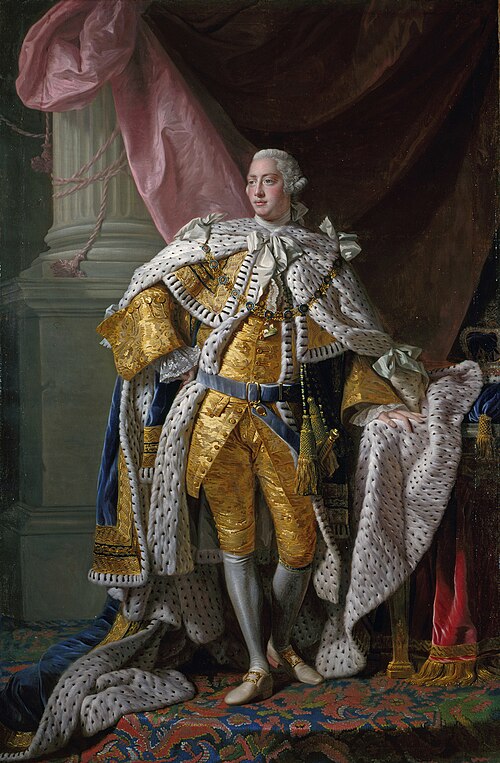
King George III in his Coronation robes.
Oil painting by Allan Ramsay (1713-1784) circa 1761-1762. From the Royal Collection (RCIN 405307) via Wikimedia Commons.
It is where lies and truth are entirely interchangeable; where the rule of law has already been replaced by the rule of one man; where the Congress has abdicated its core responsibilities and become a Greek chorus; where national policy is merely the sum of the whims and delusions of one man; and where every constitutional check on arbitrary power, especially the Supreme Court, is AWOL. In that abyss, even an attempt to explain events through the usual rubric of covering a liberal democracy is absurd. Because that rubric is irrelevant.
And so the wheels spin.
The only honest way to describe what is in front of our noses is that we now live in an elected monarchy with a manic king whose mental faculties are slipping fast. After 250 years, we appear to have elected the modern equivalent of King George III, and are busy dismantling the constitution Americans built to constrain him.
The situation is not irrecoverable — the forms of democracy remain even if they are functionally dead. We have centuries of democratic practice to fall back on. But every moment the logic of the abyss holds, the possibility of returning to democracy attenuates. Tyranny corrupts everything and everyone — fast. David Brooks returns to the ancients today to understand where we are:
As the disease of tyranny progresses, citizens may eventually lose the habits of democracy — the art of persuasion and compromise, interpersonal trust, an intolerance for corruption, the spirit of freedom, the ethic of moderation. “It is easier to crush men’s spirits and their enthusiasm than to revive them,” Tacitus wrote. “Indeed, there comes over us an attachment to the very enforced inactivity, and the idleness hated at first is finally loved.”
Forty percent of the country still backs the tyrant. Forty percent watch this and cheer.
Let us briefly review what they are cheering. For the first time since the Second World War, the president of the United States declared last week that we no longer support the notion of national sovereignty or collective security, and reserve the right to invade and occupy other sovereign countries — even close allies — to extract their resources. Quite a Rubicon. His chief adviser declared international law a dead letter:
[W]e live in a world, in the real world … that is governed by strength, that is governed by force, that is governed by power. These are the iron laws of the world since the beginning of time.
To put it bluntly, this was the argument of King George III. It was the justification for the British Empire, and, more hideously, for the Nazi and Soviet occupations of Europe. It’s a rejection of the principle that literally created the United States.
And yet this mad king threw this founding principle away because he believes a) we deserve Greenland as reparations for World War II, b) because Russia and China would invade otherwise, c) because rare earths are there — even though they are buried under a mile of ice — and d) because he didn’t win the Nobel Prize. Insane.
This staggering concession to evil — which cannot be withdrawn — robs us of any case against Russia’s invasion of Ukraine or China’s threat to Taiwan. It legitimizes war by major powers for conquest everywhere. It endangers the entire system of collective security that has kept the peace for nearly 80 years. Why? And for what? Because the king was on a high.
That’s where we are.
How Al Stewart struck gold, the folk boom and a flat-share with Paul Simon
Word In Your Ear
Published 20 Dec 2024The 17 year-old Al Stewart played electric guitar in a dance band in Bournemouth in 1963. When he borrowed an acoustic and sang “Masters Of War” in the break, he heard the sweet sound of applause. The next night he played three Dylan songs and sensed which way the wind was blowing. He talks here about moving to London, playing at Bunjies and becoming the compere at Les Cousins as his now 60-year career began to lift off. And about his Farewell Tour which kicks off in the UK in October 2025, a combination of songs and story-telling coloured by two great heroes, Peter Ustinov and Alistair Cooke.
This cracking exchange steers by way of Bert Jansch, Bob Dylan, Helen of Troy, Stalin, Hitler and the Battle of Moscow, the Weeley Festival of 1971, the three songs he always plays, the young Cat Stevens and what he told Paul Simon he should do with the just-composed “Homeward Bound”.
Comments Off on How Al Stewart struck gold, the folk boom and a flat-share with Paul Simon


