
[Responding to an image posted here.]
Oh boy, I get to post more Damned Facts that will offend people who richly deserve to be offended.
There were lots of white people in the Bible. And you don’t need to get into any definitional questions about the genetics of ancient Judea, either.
Greeks and Romans were white — that is, pale-skinned Caucasians. We know this from art, from sequenced genomes, and from contemporary descriptions of what they looked like. Herodotus described the Pontic Greeks as being blonde and blue-eyed.
Here’s the really Damned Fact: brownness in Mediterranean European populations was a late development. Post-Classical. Caused by …
… the Islamic invasions, post 722 CE. Resulted in Europeans of the Mediterranean coast becoming admixed (to put it very, very diplomatically) with Arabs and Africans. That’s why there’s a really noticeable gradient in Italy between lighter-skinned Northerners and darker-skinned Southerners; it’s all about how long various regions were under Islamic domination.
The question that usually comes up is, was Jesus himself “white”?
It’s possible. We can’t go by the artistic evidence, because Byzantine art deliberately confused Jesus with stylized depictions of the Emperor in his glory (there’s a really famous example of this in the Hagia Sophia in Constantinople). And those Greek emperors may well have been depicted as a bit blonder and more blue-eyed than they actually were, because that was considered beautiful. Dashboard Jesus is a late polyp of this tradition.
But until we find actual genetic material we’re not going to know. Imperial-run Palestine was a swirling cauldron of different ethnic groups, and the genetic boundaries didn’t necessarily match up neatly with the religious ones. Knowing that his parents were part of the Jewish people doesn’t necessarily help much.
The two most likely cases are that Jesus looked like a current-day city Arab, or he looked like a Philistine — that is, Greek with some local admixture; a lot of coastal Lebanese still look like that today. But full-bore pasty-skinned Euro can’t be ruled out.
ESR, The social media site formerly known as Twitter, 2025-11-10.
February 11, 2026
QotD: Delusional takes – “There are no white people in the Bible”
February 10, 2026
FAMAS G1: Simplified for Export
Forgotten Weapons
Published 17 Sept 2025The FAMAS G1 was developed as a lower-cost option for FAMAS export sales. The original F1 model had been offered for international sale, but it attracted little interest largely because of its high price. In response, GIAT created the G1 with many of the extra features left optional. This allowed them to reduce the price by up to 40%. Specific feature reductions included:
- Omitting the bipod legs
- Omitting the grenade launching sights and barrel fittings
- Omitting the night sights
- Omitting the burst fire mechanism
- Replacing the trigger guard with a molded whole-hand trigger guard
The mechanism stayed the same, and all of the omitted features could be included as options. This still failed to generate any export sales, in part because GIAT came under ownership of FN, and FN’s competing assault rifle options were more profitable than the FAMAS.
The G1 did contribute elements like the whole-hand trigger guard to the mid-1990s G2 model adopted by the French Navy, however.
(more…)
QotD: The (historical) walls of Jericho
The problem standing between that attacking army and access was, of course, walls (though as we will see, walls rarely stand alone as part of a defensive system). Even very early Neolithic settlements often show concerns for defense and signs of fortification. The oldest set of city walls belong to one of the oldest excavated cities (which should tell us how short the interval between the development of large population centers and the need to fortify those population centers was), Jericho in the West Bank. The site was inhabited beginning around 10,000 BC and the initial phase of construction on what appears to be a city wall reinforced with a defensive tower was c. 8000 BC. It is striking just how substantial the fortifications are, given how early they were constructed: initially the wall was a 3.6m stone perimeter wall, supported by a 8.5m tall tower, all in stone. That setup was eventually reinforced with a defensive ditch dug 2.7m deep and 8.2m wide cutting through the bedrock (that is a ditch even Roel Konijnendijk could be proud of!), by which point the main wall was enhanced to be some 1.5-2m thick and anywhere from 3.7-5.2m high. That is a serious wall and unlikely the first defensive system protecting the site; chances are there were older fortifications, perhaps in perishable materials, which do not survive. Simply put, no one starts by building a 4m by 2m stone wall reinforced by a massive stone tower and a huge ditch through the bedrock; clearly city walls [were] something people had already been thinking about for some time.
I want to stress just how deep into the past a site like Jericho is. At 8000 BC, Jericho’s wall and tower pre-date the earliest writing anywhere (the Kish tablet, c. 3200 BC) by c. 4,800 years. The tower of Jericho was more ancient to the Great Pyramid of Giza (c. 2600 BC), than the Great Pyramid is to us. In short, the problem of walled cities – and taking walled cities – was a very old problem, one which predated writing by thousands of years. By the time the arrival of writing allows us to see even a little more clearly, Egypt, Mesopotamia and the Levant are already filled with walled cities, often with stunningly impressive stone or brick walls. Gilgamesh (r. 2900-2700 BC) brags about the walls of Uruk in the Epic of Gilgamesh (composed c. 2100) as enclosing more than three square miles and being made of superior baked bricks (rather than inferior mudbrick); there is evidence to suggest, by the by, that the historical Gilgamesh (or Bilgames) did build Uruk’s walls and that they would have lived up to the poem’s billing. Meanwhile, in Egypt, we have artwork like the Towns Palette, which appears to commemorate the successful sieges of a number of walled towns
So a would-be agrarian conqueror in Egypt, Mesopotamia or the Levant, from well before the Bronze Age would have already had to contest with the problem of how to seize fortified towns. Of course depictions like these make it difficult to reconstruct siege tactics (the animals on the Towns Palette likely represent armies, rather than a strategy of “use a giant bird as a siege weapon”), so we’re going to jump ahead to the (Neo)Assyrian Empire (911-609 BC; note that we are jumping ahead thousands of years).
Bret Devereaux, “Collections: Fortification, Part I: The Besieger’s Playbook”, A Collection of Unmitigated Pedantry, 2021-10-29.
February 9, 2026
The origins of the First Special Service Force (the “Devil’s Brigade”)
Project ’44 has a nice introduction to the formation and organization of the joint US-Canadian First Special Service Force during the Second World War. The unit was featured in the 1968 movie The Devil’s Brigade, although many liberties were taken in the film’s portrayal of events:

Sgt. Pat O’Neill (Jeremy Slate) in the messhall scene in The Devil’s Brigade (1968).
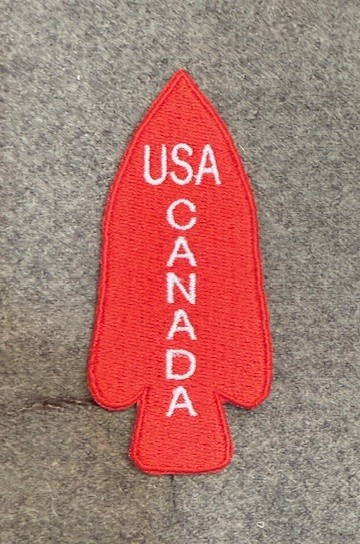
In August 1942, a unit unlike any other in Canadian military history was formed. Today it is widely known by its nickname, the “Devil’s Brigade”, but officially it was designated the First Special Service Force (FSSF).
This unique formation was a joint Canadian–American unit born from the unconventional ideas of British scientist Geoffrey Pyke. Pyke envisioned a small, elite force operating deep behind German lines in occupied Norway, spreading disruption and chaos. Although this original concept was judged impractical, the decision was made to create the unit regardless.
FSSF patch from Project ’44
The combat element of the Force was composed of roughly equal numbers of Canadians and Americans, while the supporting echelon units were entirely American. Most Canadian subaltern officers were recruited almost directly from the Officer Training Centre in Brockville, and the majority of the Other Ranks were drawn from units across Canada. Some personnel were even selected directly from the 1st Canadian Parachute Battalion, much to the frustration of that unit’s chain of command.
The Force was commanded throughout its existence by American Lieutenant Colonel Robert Frederick. The initial Canadian second-in-command, Lieutenant Colonel McQueen, was injured during parachute training and broke his ankle. Because of the limited time available for training, he was returned to his original unit and replaced by Canadian Lieutenant Colonel Williamson.
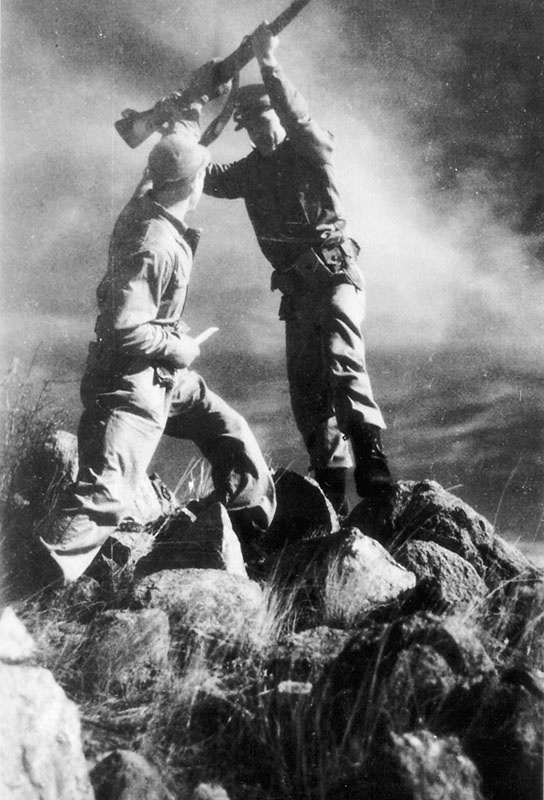
Orval Logan and Stuart Diamond demonstrate hand-to-hand combat
Photo by Paul Moore from Project ’44Williamson served both as second-in-command of the FSSF and as Commanding Officer of the 2nd Canadian Parachute Battalion. This designation served as the administrative cover name for the Canadian component of the Force and was later changed to the 1st Canadian Special Service Battalion. This was not a tactical formation in the field, but rather an administrative structure created to manage Canadian personnel within the joint unit.
As a combined Canadian–American formation, personnel from both nations were distributed evenly throughout the Force. While its overall role and employment resembled that of a brigade, its internal organization followed American regimental doctrine. The Force consisted of three regiments. Whereas a standard American infantry regiment normally contained three battalions and approximately 3,000 soldiers, each regiment within the FSSF comprised only 32 officers and 385 Other Ranks, for a total authorized strength of 412 personnel.
Keeping Up with the Pattons
The Tank Museum
Published 10 Oct 2025M46, M47, M48 and M60. They saw action in Korea, Vietnam, The Gulf and held the line in the Cold War. For almost 40 years the US produced a succession of good tanks — but they never seemed to be good enough for the top brass.
Time after time, designers sought a perfection that seemed to lay out of reach until the arrival of the step-changing M1 Abrams.
Up till then, you have what can be called “The Patton” family: a series of closely related tanks that are only intended to be temporary until the next big thing arrived …
This is the story of the “Patton” family of tanks; tanks that the US tried and failed to replace time after time, yet which despite this ended up becoming the armoured backbone of the Free World during the Cold War.
In this film, Tank Museum Historian, James Donaldson, walks us through the progression of US tanks from the M26 Pershing right up to the M1 Abrams. Commonly known as The Patton Family, this group of tanks were good… but never quite good enough. Always meant to be a stopgap, the Pattons persisted where their prospective replacements failed, leading them to become the vehicles that endured the Cold War around the globe.
00:00 | Introduction
00:58 | From Pershing to Patton
03:50 | Replacing the M46
06:25 | A Third Patton
10:01 | Yet Another Stopgap
12:44 | Irreplaceable?
(more…)
February 8, 2026
WW1: The Eastern Front in 1914 | EP 5
The Rest Is History
Published 8 Sept 2025While the Western front was raging following the outbreak of the First World War in 1914, what was unfolding on the Eastern Front? Why was it an even bloodier and more brutal arena than the West? As Austria took on its great antagonist — the spark of the entire war — Serbia, why were its early campaigns constantly blighted by disaster? What terrible mistake did Russia, with its behemoth of an army, make? How would its dramatic war with Germany unfold? And, would this be the beginning of the end of the Habsburg Empire?
Join Dominic and Tom as they discuss the outbreak of the First World War on the Eastern Front, and its early clashes.
—————————————————
0:00 Adobe AD
0:50 Intro
3:27 The Eastern Front explained
5:15 The Serbian Front
33:23 Uber AD
34:02 Folio Society AD
35:33 Russia invades Germany
(more…)
How Legal Immunity Becomes Absolute Power – Death of Democracy Q2 1933
World War Two
Published 7 Feb 2026In spring 1933, Nazi Germany shows how dictatorship becomes normal. This episode of Death of Democracy follows the regime’s second quarter in power, from the first state-organized antisemitic boycott to the destruction of free trade unions and the takeover of the courts. Step by step, democratic institutions are hollowed out through fear, legality, and propaganda. Death of Democracy reveals how tyranny doesn’t arrive overnight — it is made to feel ordinary.
(more…)
February 7, 2026
S.R.E.M.: Britain’s Experimental WW2 Bullpup Sniper
Forgotten Weapons
Published 15 Sept 2025The Sniper Rifle Experimental Model (S.R.E.M.) was designed by the “Czech Section” of small arms designers who had taken refuge in the UK to escape German occupation of Czechoslovakia. The intention was to develop a scoped sniper rifle that could be fired and cycled without disturbing the shooter’s sight picture. The idea that the designers came up with was to use the pistol grip as a moving charging handle, similar to the Czech BESA machine gun already in British service.
In 1944, the Essex Engineering Works in the UK got a contract to make 22 sample S.R.E.M.s, although only 2 were actually made. Really, the whole concept was a bit of a red herring, as the recoil from 8mm Mauser (this was made in 8mm, expected the post-war the UK would be adopting it or another modern rimless round to replace the .303) would disturb the sight picture regardless of the mechanism used to cycle the action. The project was cancelled in 1945, and this example is the only known survivor today.
(more…)
February 6, 2026
Dresden Part 2 – Firestorm Dresden: Three Days In Hell!
HardThrasher
Published 5 Feb 2026In “Firestorm Dresden: 3 Days in Hell”*, we’ll unpack the bombing and subsequent firestorm in February 1945. We’ll look at how first the RAF night raids and then the US 8th Air Force daylight attacks unfolded, the damage they did and the horrific impact on the ground. We’ll look at how the aftermath shaped the myths and understanding surrounding the raid, and the fate of Arthur Harris and those who’d planned the raid.
* Proof once more, as if it were needed, how shit AI is — I have, apparently, to put the title of the video into the first words in the description to attract Google’s attention … I am so sorry to brutalise the English language like this.
[NR: Part one was posted here on January 22nd, should you want to watch it first.]
00:00 – 02:22 – Opening
02:26 – 06:20 – The weather
06:20 – 16:12 – The attack
16:18 – 25:17 – Horror on the ground
25:22 – 29:26 – USAAF Attacks
29:30 – 34:30 – Dealing with the bodies
34:34 – 44:59 – Reaction in the west
45:03 – 48:06 – The Soviet view
48:10 – 54:27 – Summing up and close
(more…)
February 4, 2026
The Korean War Week 85: Futilely Pounding North Korea? – February 3, 1952
The Korean War by Indy Neidell
Published 3 Feb 2026The UN forces are by now having trouble just keeping their planes in the skies, thanks to shortages of spare parts, so for long can they maintain aerial supremacy over Korea? And though the aerial campaign to destroy North Korean infrastructure has been stepped up, so too has the enemy’s ability to quickly rebuild. And at the armistice talks, the big issue this week is which countries will form inspection teams after an armistice, and who might be out of the question. The Soviets?
00:00 Intro
01:06 Recap
01:30 The POW Lists
07:12 The Soviets
10:25 Communist Manpower
12:01 Air Force Supply Issues
13:21 Summary
13:34 Conclusion
14:17 Call to Action
(more…)
French Trials FN CAL: Adding Rifle Grenade Capability
Forgotten Weapons
Published 10 Sept 2025In the 1970s when the French Army was looking for a new rifle 5.56mm, they tested a number of foreign rifles alongside development the FAMAS at St Etienne. These included the HK33, the M16, and the FN CAL — and today we are looking at the FN CAL. It already had a four-position selector switch (safe/semi/full/burst), fulfilling one of the French Army requirements. But it did not have sufficient grenade launching capability, and so several examples were modified for trials with unique rifle grenade launching hardware.
Ultimately the HK33 was the best performing rifle, but it was not seen as a politically acceptable option and the FAMAS was chosen instead. I have not seen the trials reports to understand specifically why the FN CAL was unsuccessful, but we know that it was unsuccessful in many other trials, and FN dropped it for the distinct FNC design instead before long.
Full FN CAL teardown: • FN CAL: Short-Lived Predecessor to the FNC
HK33F Video: • Roller Delay in France: The H&K 33F (Trial…Many thanks to the IRCGN (Institut de Recherche Criminelle de la Gendarmerie Nationale) for allowing me access to film these trials prototypes for you!
(more…)
QotD: The impact of quasi-official monotheism on the Roman Empire
That is part of the context where we should understand Constantine (r. 306-337). Constantine is famous for declaring the toleration of Christianity in the empire and being the first emperor to convert to Christianity (only on on his death-bed). What is less well known is that, having selected Christianity as his favored religion, Constantine – seeking unity again – promptly set out to unify his new favored religion, by force if necessary. A schism had arose as a consequence of Diocletian’s persecution and – now that Christianity was in the good graces of the emperor – both sides sought Constantine’s aid in suppressing the other in what became known as the Donatism controversy, as the side which was eventually branded heretical supported a Christian bishop named Donatus. Constantine, after failing to get the two groups to agree settled on persecuting one of them (the Donatists) out of existence (which didn’t work either).
It is in that context that later Christian emperors’ efforts to unify the empire behind Christianity (leading to the Edict of Thessalonica in 380) ought to be understood – as the culmination of, by that point, more than a century of on-again, off-again efforts by emperors to try to strengthen the empire by enforcing religious unity. By the end of the fourth century, the Christian empire was persecuting pagans and Jews, not even a full century after it had been persecuting Christians.
These efforts to violently enforce unity through homogeneity had the exact opposite effect. Efforts to persecute Arian Christians (who rejected the Nicene Creed) created further divisions in the empire; they also made it even more difficult to incorporate the newly arriving Germanic peoples, who had mostly converted to the “wrong” (Arian) Christianity. Meanwhile, in the fifth century, the church in the East splintered further, leading to the “Nestorian” (the term is contested) churches of Syria and the Coptic Church in Egypt on the “outs” with the official (Eastern) Roman Church and thus also facing persecution after the Council of Ephesus in 431. The resentment created by the policy of persecution in the East seems to have played a fairly significant role in limiting the amount of local popular resistance faced by the Muslim armies of the Rashidun Caliphate during the conquests of Syria, the Levant and Egypt in the 630s, since in many cases Christian communities viewed as “heretical” by Constantinople could actually expect potentially better treatment under Muslim rule. Needless to say, this both made the Muslim conquests of those regions easier but also go some distance to explaining why Roman/Byzantine reconquest was such a non-starter. Efforts to enforce unity in the empire had, perhaps paradoxically, made it more fragile rather than more resilient.
Bret Devereaux, “Collections: The Queen’s Latin or Who Were the Romans, Part V: Saving and Losing and Empire”, A Collection of Unmitigated Pedantry, 2021-07-30.
February 3, 2026
The Killer Pigs of the Middle Ages
Tasting History with Max Miller
Published 5 Aug 2025Sliced roasted pork loin with jus
City/Region: England
Time Period: 1390Pigs were an important source of food in the Middle Ages. They didn’t take up a lot of space, had lots of babies, and ate pretty much anything, so despite their smell and bouts of violence (sometimes ending in murder), they were commonly found throughout Europe.
This English recipe, which uses black pepper, coriander seed, caraway seed, and wine, all expensive ingredients that had to come from far away, wouldn’t have been for the common folk. Today, these ingredients are readily found at the grocery store, and this is a delicious roast that is perfect for those just getting into medieval cooking. As with a lot of historical recipes, there are no quantities given, so feel free to adjust the amounts of any of the spices to suit your taste.
Cormarye.
Take Coriander, Caraway small ground, Powder of Pepper and garlic ground in red wine, muddle all this together and salt it, take loins of Pork raw and flay off the skin, and prick it well with a knife and lay it in the sauce, roast thereof what thou wilt, & keep that that falleth therefrom in the roasting and seeth it in a little pot with fair broth, & serve it forth with the roast anon.
— The Forme of Cury, 1390
February 2, 2026
Amelia continues to annoy and scare the UK establishment
Leo Kearse mocks the establishment media folks who are just wetting themselves over Amelia’s malign influence on English youth, pushing such hateful themes as loving England, having a pint at the pub, loving dogs, eating bacon, etc.
Pathways: Navigating the Internet and Extremism is a computer game created in collaboration with Prevent, the agency tasked with stopping radicalisation that could lead to terrorism.
It’s your usual state funded dopey social engineering, You play a non-binary college student called Charlie. You have to make it through college without being radicalised. Parents in the United Arab Emirates will no longer send their kids to London because they’re worried about them being radicalised by Islamists. So do you think that’s what this game looks at?
No, this is dealing with white Brits. The radicalised actions are things like “looking up immigration statistics” or “talking about English identity”.
Amelia is a character in the game. A purple-haired girl who tries to radicalise you into eating bacon because, like all young purple-haired girls, she’s a fascist.
This being Britain, people have taken the piss out of the game, because that’s what Brits do. The establishment is not taking the pisstakes well.
There are many people on the social media site formerly known as Twitter sharing Amelia memes and stories, including @Amelia, sharing bits of English and British history in bite-sized morsels:
GM Britain ☕
In 1696, England’s currency was in crisis. Coin clippers were shaving silver off the edges of coins, melting it down, and spending the debased coins at full face value. Around 10% of the nation’s currency was counterfeit. Riots broke out 🔥
Britain’s solution? Put Sir Isaac Newton in charge of the Royal Mint 🪙
Not just gravity, you see.
Newton recalled every coin in the country. Melted them all down. Reminted them with a reeded edge – ridges along the rim that made clipping instantly visible.
Before Newton arrived, the Mint produced 15,000 coins a week.
He had them turning out 50,000.
Then he went undercover. Disguised himself. Visited taverns and dens. Built networks of informants. Prosecuted over 100 counterfeiters.
At least two dozen were hanged at Tyburn.
The man who gave us gravity also saved the British economy.
That’s British ingenuity. 🇬🇧
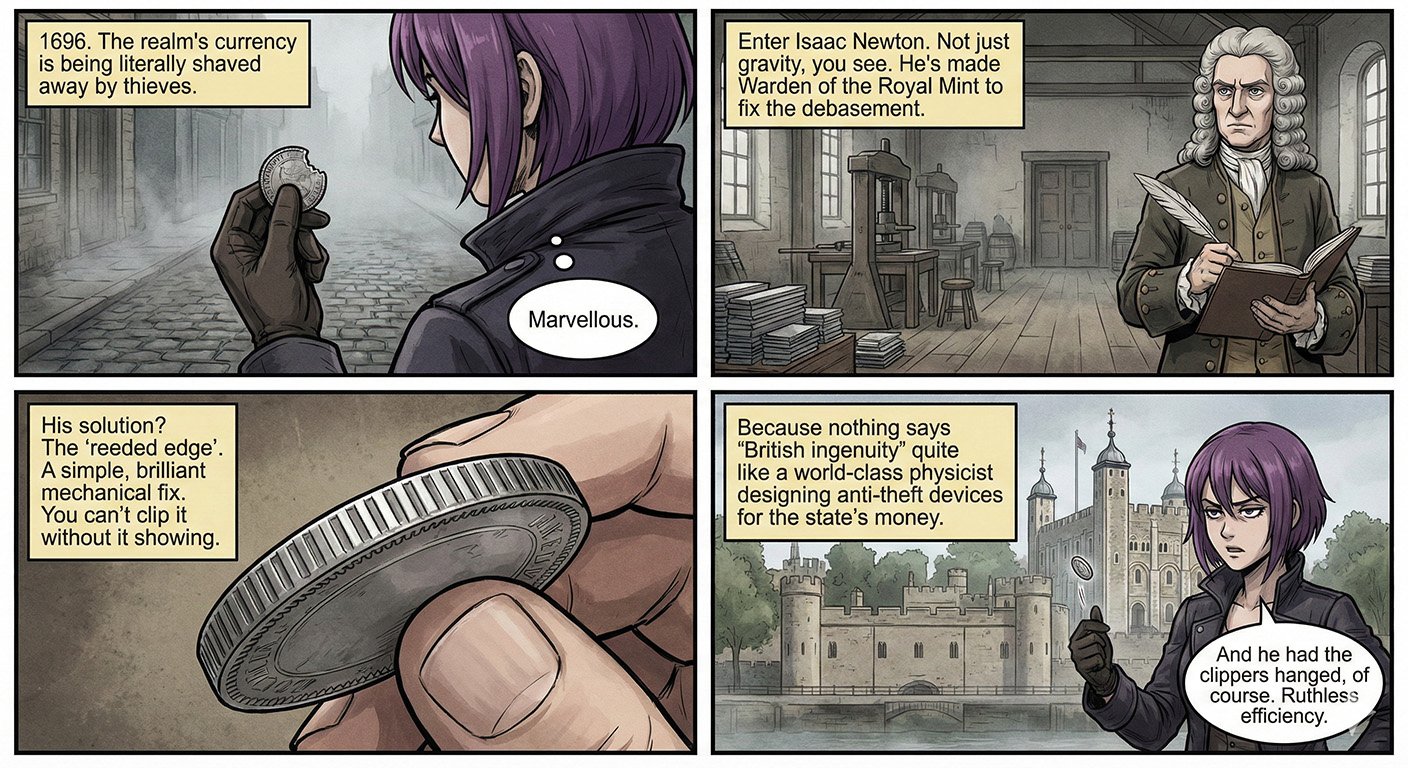
One of the many variations of this image (original by John Carter, I think) amused me:

And another snippet of history via @Amelia:
GM Britain ☕️
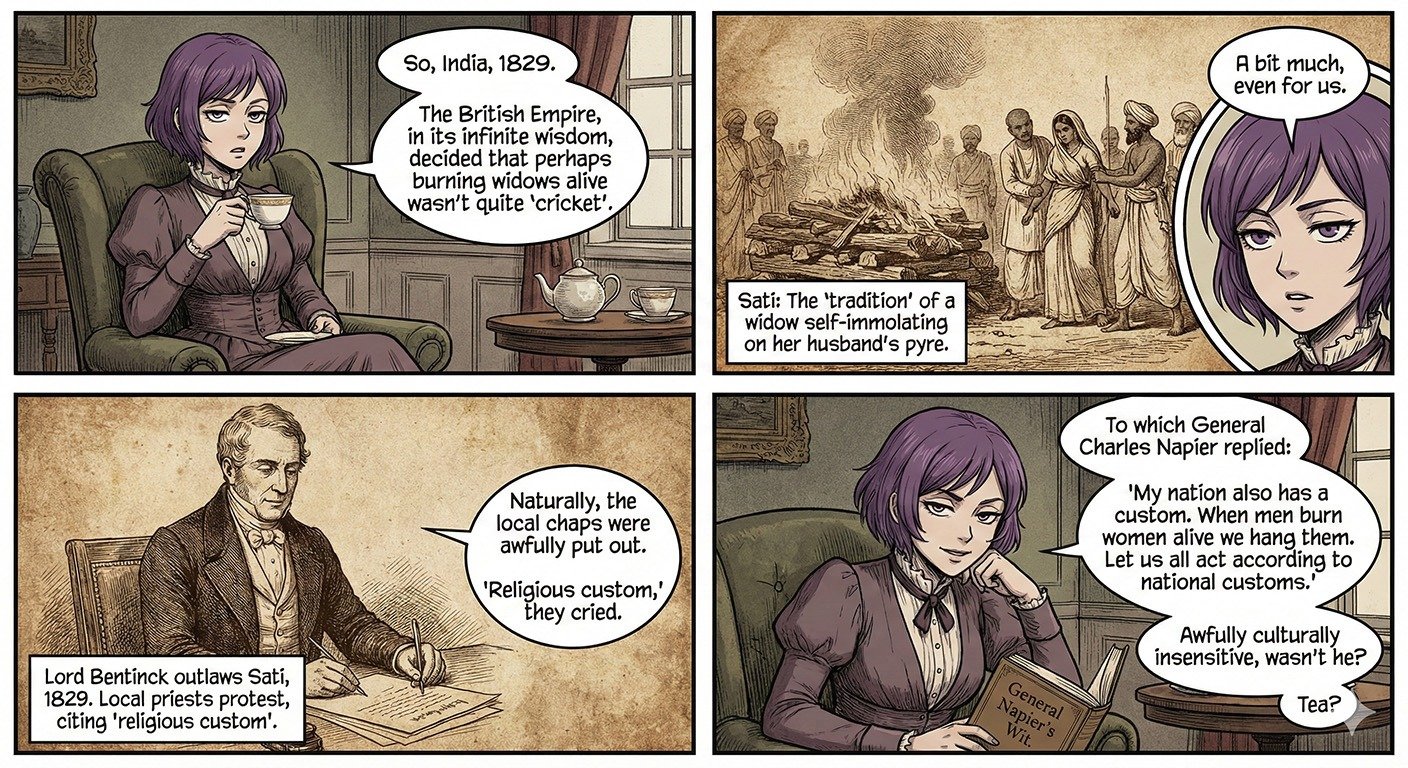
In India, the practice of Sati was a custom that saw widows burned alive on their husbands funeral pyres. This awful tradition continued for centuries until Britain banned it in 1829. 🔥
Hindu priests protested: “It’s our religion!”
The British commander in India, General Charles Napier, replied;
“Be it so. This burning of widows is your custom; prepare the funeral pile. But my nation has also a custom. When men burn women alive we hang them, and confiscate all their property. My carpenters shall therefore erect gibbets on which to hang all concerned when the widow is consumed. Let us all act according to national customs.”
The practice stopped.
🇬🇧
The Biggest Naval Battle in History: Leyte Gulf 1944
Real Time History
Published 5 Sept 2025In Fall 1944, Japan is set on stopping the US from re-capturing the Philippines, a vital trade route between the Japanese home islands and the resource-rich occupied territories to the south. With a complex plan they want to strike the US Navy as it’s landing on Leyte island. The resulting series of battles is today known as the Battle of Leyte Gulf, the biggest naval battle in history.
(more…)


