
Here I can’t resist a digression that touches on several of my favorite topics: where do you put your defensive lines? One obvious guess is what Luttwak calls “scientific frontiers”, geographic or other natural features such as rivers, mountains, the edges of deserts, places where the land is already bottlenecked. And that’s not bad as a first order approximation, but there are times that other considerations dominate. For example, placing your borders right along the banks of the Rhine and the Danube is actually quite awkward, because the headwaters of those two rivers come together in a sharp “elbow”. [Image from original post] This results in a kind of reverse-salient poking into your territory, and making it a much longer journey from one side of the intrusion to the other. Much better to conquer that wedge and push the border out a bit. Yes, the frontier is now marginally harder to defend, but it’s more than made up for by the reduced travel time for the army to get anywhere.
Here’s another one — why is Hadrian’s Wall where it is? There’s a much shorter and more defensible alternate location to the north, where the Firth of Forth and the Firth of Clyde create a natural bottleneck. In fact at one point the Romans did build a wall there and claimed all the intervening territory. On paper, the Antonine Wall looks better in every way than Hadrian’s Wall. [Image from original post] It’s shorter, so requires less military “output” to defend. And it encloses more area, so brings to the “inputs” of the machine of state both additional arable land and additional people who can be taxed and conscripted. But as it happened, the Antonine Wall was quickly abandoned, and the empire retreated to Hadrian’s Wall. Why?
It all had to do with the people living between the two walls. They were … hill people who had perfected the art of not being governed. They managed to be so thoroughly intractable, so impossible to control or corral, so very unpleasant to be around, that the Romans eventually threw up their hands in disgust and left them alone. It’s important to understand that this means they must have been true outliers, because the Roman Empire had “unit economics” like an enterprise SaaS business, where “customer acquisition costs” are financed on the assumption that they’ll be paid back in the distant future. Every Roman bureaucrat understood that newly conquered territories would be a drain on fiscal and military resources for a while, until a generations-long process of pacification and Romanization slowly made them net contributors in both departments. But in the case of the lands between the two walls, the payback timeline was so long, and the implied interest rates so high, that even a people as meticulous and relentless as the Romans decided there were better opportunities elsewhere. I count this as a serious victory for the theory of defensive barbarism.
John Psmith, “REVIEW: The Grand Strategy of the Roman Empire by Edward Luttwak”, Mr. and Mrs. Psmith’s Bookshelf, 2023-11-13.
June 29, 2026
QotD: Roman Imperial frontiers and “defensive barbarism”
June 28, 2026
How to Steal a Country Without a European War – Death of Democracy 21 – Q1 1938
World War Two and Spartacus Olsson
Published 27 Jun 2026In early 1938, Adolf Hitler turned a military scandal into personal control over the Wehrmacht — and within weeks used that power to pressure, invade, and annex Austria in the Anschluss. This episode follows the Blomberg-Fritsch crisis, Hitler’s February 4 command takeover, the Berchtesgaden ultimatum, Schuschnigg’s failed plebiscite gamble, the German invasion of March 12, and the terror that followed in Vienna.
This was not just a border crisis. It was the moment Nazi Germany moved from internal dictatorship to open territorial expansion. Britain and France did not intervene, Austria was erased as a sovereign state, and Hitler’s next target — Czechoslovakia — was already coming into view.
This historical documentary examines Nazi Germany, the Anschluss of Austria, the Wehrmacht, appeasement, antisemitic terror, propaganda, and the collapse of the post-1919 European order.
Educational documentary. Nazi symbols and imagery are shown only in a historical, critical, and anti-fascist context.
Bannerman, the Father of Gun Collecting: Tales from the Golden Age of Surplus
Forgotten Weapons
Published 11 Feb 2026Francis Bannerman is really the father of the modern military surplus industry, and in many ways a father of gun collecting as we know it today. Before Bannerman, “gun collecting” was generally something for the wealthy and revolved around fancy and bespoke guns. It was not about have representative pieces of normal arms, it was about having the fancy and exclusive things. Bannerman changed that by offering all manner of ordinary surplus at affordable prices to anyone who was interested. In addition to complete guns and other equipment, Bannerman also dealt in huge numbers of bits and pieces, and sometimes assembled them into various odd hybrid guns for sale, which we still see occasionally today …
Sample Bannerman catalog (1903):
https://archive.org/details/francis-b…
(more…)
QotD: Getting cloth to market in the ancient and medieval world
It should thus be of little surprise that regions involved in major textile production for export were often concentrated either on coasts or on rivers that were navigable to the sea (one may map the regions Pliny lists as major wool and linen exporters to find that they are all accessible by sea). While the sheep themselves may be grazed part of the year up in the uplands far from the coast, one of the great advantages of transhumance is that the sheep may transport themselves under the care of their shepherds to villages and lower pastures not too far from coastal towns which may serve as centers of textile production and major points of sale.
Now those transport costs become less and less significant the more valuable the goods being transported are. For a bulk good like grain (or common wool), transport may represent a majority of the costs. But if one is shipping something extremely valuable (particularly valuable per unit weight), the cost of acquisition at the source (and the profits of final sale) are much larger relative to the transport costs and less efficient methods of transportation become useful, thus the viability of silk and other expensive luxury goods being transported overland across Eurasia on the famous Silk Road.
Very high value fabrics didn’t need to come from so far afield though. In the Roman world, the province of Asia (corresponding roughly to western Turkey today) had several notable centers of production for particularly high valued textiles (on this, see I. Benda-Weber, “Textile Production Centers, Products and Merchants in the Roman Province of Asia” in Gleba and Pásztókai-Szeöke, op. cit.). Thyateira’s guild of purple-dyers (the πορφυροβάφοι) seem to have had trade contacts for their wares – wool dyed Tyrian purple via the murex snail – all over the province as well as in Macedonia and Italy. Weavers in the region were also known for producing fabrics with complex woven patterns and Miletus, one of the major ports in the region, had as noted the reputation for producing the best dyed wool in the Mediterranean. Such fabrics were highly valued and we find evidence that such fabrics were bought not merely by the Roman elite, but also made overland as far as Persia where such wares were valued at the Achaemenid (550-330 BC) court.
Neverthless, not all fabrics moving through trade in antiquity or the middle ages were rare or high value fabrics. As Jinyu Liu notes in a study of inscriptions relating to the textile trade, “coarse wool and wool of medium quality, and products made of these non-luxury wools dominated the market” in the Roman Empire, often being “pulled” through trade towards both large population centers in the interior of the empire and towards the Roman armies in the frontier provinces, both of which must have outstripped local production in their demand for textiles (Liu, “Trade, Traders and Guilds (?) in Textiles” in Gleba and Pásztókai-Szeöke, op. cit.). This trade included not just fabrics but also ready-made products like garments or blankets which must have been aimed at fairly modest people, neither the very poor (who couldn’t afford them) nor the wealthy (who wouldn’t have been caught dead in “ready-made” one-size-fits-no-one clothing), but rather the middling urban workers and common soldiers (and perhaps small farmers, though we might assume their households would produce most of their own textiles in the countryside where wool and flax, being agricultural and pastoral products, might be more available).
In Medieval Europe, just as in the ancient world, the centers of textile trading tended to follow the water as it made transport easier. England was a major wool-producing center in the high and later Middle Ages (and into the Early Modern period), with J.S. Lee (op. cit., 9) estimating production per capita exploding from around 1.3 pounds per person in the early 1300s to 7 pounds by the 1550s as the textile production system in England reoriented towards export. Wool products, produced in towns mostly in towns that were nearly coastal or had river-access flowed down by coastal trade and up the Thames to London to either be sold and used there or to be further exported to the dyers and fabric markets of the Low Countries (where fabrics could use the Rhine to travel further into the continent) or to be bought by the merchants of the Hanseatic League and so head into the Baltic.
Bret Devereaux, “Collections: Clothing, How Did They Make It? Part IVb: Cloth Money”, A Collection of Unmitigated Pedantry, 2021-04-09.
June 27, 2026
Destroyed In Four Minutes – The Battle of Cape Matapan
TimeGhost Cartographic
Published 26 Jun 2026March 1941. As British troops sail to reinforce Greece ahead of the expected German invasion, the Italian Navy sees a chance to strike. A powerful battlefleet puts to sea, hoping to intercept the convoys and seize back the initiative in the Mediterranean.
But the British know something is coming.
With the Mediterranean Fleet stretched to its limits, Admiral Andrew Cunningham must make a critical decision. Relying on intelligence and naval aviation in a race against time, the Royal Navy heads out to meet the tide headed their way.
What follows is one of the most dramatic naval engagements of the Second World War, culminating in a brutal conclusion that would leave a lasting mark on the Mediterranean campaign.
QotD: When Marxism went mainstream in higher education
“As Karl Marx’s ideological heirs in Communist nations struggle to transform his political legacy, his intellectual heirs on American campuses have virtually completed their own transformation from brash, beleaguered outsiders to assimilated academic insiders”, wrote Felicity Barringer.
There were notable differences, however. The stark, unmistakable contrast between the grinding poverty of the Communist nations and the prosperity of Western economies had obliterated socialism’s claim to economic superiority.
As a result, orthodox Marxism, with its emphasis on economics, was no longer in vogue. Traditional Marxism was “retreating” and had become “unfashionable”, the Times reported.
“There are a lot of people who don’t want to call themselves Marxist,” Eugene D. Genovese, an eminent Marxist academic, told the Times. (Genovese, who died in 2012, later abandoned socialism and embraced traditional conservatism after rediscovering Catholicism.)
Marxism wasn’t truly retreating, however. It was simply adapting to survive. Watching the upheaval in Poland and other Eastern bloc nations had convinced even Marxists that capitalism would not “give way to socialism” anytime soon. But this would cause an evolution of Marxist ideas, not an abandonment of them.
“Marx has become relativized”, Loren Graham, a historian at the Massachusetts Institute of Technology, told the Times.
Graham was just one of a dozen of the scholars the Times spoke to, a mix of economists, legal scholars, historians, sociologists, and literary critics. Most of them seemed to reach the same conclusion as Graham.
Marxism was not dying, it was mutating.
“Marxism and feminism, Marxism and deconstruction, Marxism and race – this is where the exciting debates are”, Jonathan M. Wiener, a professor of history at the University of California at Irvine, told the paper.
Marxism was still thriving, Barringer concluded, but not in the social sciences, “where there is a possibility of practical application”, but in abstract fields such as literary criticism.
Kristian Niemietz, “The New York Times Reported ‘the Mainstreaming of Marxism in US Colleges’ 30 Years Ago. Today, We See the Results”, Institute of Economic Affairs, 2020-09-18.
June 26, 2026
Magda Goebbels: The Nazi Mother Who Murdered Her Children
World War Two
Published 25 Jun 2026Magda Goebbels was one of the most infamous women in Hitler’s inner circle. Known as the wife of Nazi Propaganda Minister Joseph Goebbels and often treated as an unofficial “First Lady” of the Third Reich, she helped project an image of family, elegance, and loyalty while standing beside one of history’s most murderous regimes. But her story ends in one of the darkest acts of the Second World War.
As Berlin collapsed in 1945, Magda Goebbels took her six children into Hitler’s Führerbunker. Offered chances to escape, she refused. One day after Hitler’s suicide, she helped murder her own children with cyanide, claiming that a world without National Socialism was not worth living in.
In this episode of our new format, Baddies and Battleaxes, Anna Deinhard returns to tell the story of Magda Goebbels: socialite, Nazi fanatic, mother, accomplice, and child murderer. Her life reveals how women in the Third Reich were not always passive bystanders. Some, like Magda, actively embraced Nazi ideology, helped legitimize the regime, and chose loyalty to Hitler over humanity itself.
This is the story of the Nazi “First Lady” who followed fascism all the way into the bunker.
Who should Anna cover next in Baddies and Battleaxes? Tell us which heroines and villainesses of WW2 you want to see in a future episode.
Sparta vs Athens 2(c): Spartan Childhood – The Agōgē, Infant Inspection, and State Brutality
seangabb
Published 8 Feb 2026Greece: A Brief History, c.700 BC – 500 AD
This segment goes straight to the ancient evidence. Using Plutarch’s Life of Lycurgus (with the passages shown on-screen), I explain how Sparta understood itself: infant inspection and exposure, the collective upbringing of boys in the agōgē, deliberate hunger and deprivation, enforced endurance, and the suppression of private loyalties in favour of loyalty to the state.
This is not presented as scandal. Plutarch often writes admiringly, which is precisely why the text is so revealing. The system is coherent. It is also terrifying. Sparta did not merely train soldiers. It manufactured them, beginning at birth.
QotD: The submarine war against Japan
The success of the American submarine campaign was genuinely astonishing, and created a near perfect asphyxiation of the Japanese war economy, with imports of virtually every vital industrial input plummeting to near zero by 1944. Admiral Charles Lockwood, who commanded the Submarine Force Pacific Fleet, was probably only slightly boasting when he later told an instructor at the Naval Academy:
Now don’t teach those midshipmen that the submariners won the war. We know there were other forces fighting there, too. But if they kept the surface forces and the flyboys out of our patrol areas we would have won the war six months earlier.
Despite the phenomenal success of America’s submarine operations against Japan, the American war on Japanese shipping generally receives scant attention. To take just one example, Francis Pike’s magisterial and colossal tome on the Pacific War relegates American submarine operations to an appendix. In contrast, there is an astonishing volume of literature devoted to the war’s other grand submarine campaign: the so-called Battle of the Atlantic. Germany’s famous U-boats attempted a similarly strategic interdiction war against shipping to the British home isles. Unlike the American submarine force in the Pacific, however, the U-boats failed.
Big Serge, “Wolf Packs: Battle of the Atlantic”, Big Serge Thought, 2025-12-12.
June 25, 2026
Formerly Peru’s First Lady, Keiko Fujimori is now President in her own right
The new President of Peru, Keiko Fujimori, faces a big economic challenge to her nation:

With just over 99% of ballots counted, Keiko Fujimori holds a lead of roughly 40,000 votes over Roberto Sánchez — less than half a percentage point, and the third consecutive Peruvian presidential contest decided by a margin that narrow. Sánchez led through the early days of counting, carried by rural and highland turnout; but the overseas votes, which broke for Fujimori above 63%, pulled the result the other way as the tally crossed 95%.
The outcome is no longer seriously in doubt. What remains in doubt is whether a victory this narrow constitutes a mandate to govern, or merely a turn to occupy the office in impotence.
Fujimori has never held executive power. What she inherits, however, is a name: her father, Alberto Fujimori, governed Peru from 1990 to 2000, stabilizing a hyperinflationary economy and crushing the Shining Path insurgency, albeit with darkly authoritarian techniques for which he was later convicted. Long known as Peru’s answer to Venezuela’s Hugo Chávez, Fujimori has cast a long shadow over Peruvian politics ever since.
Keiko served as his First Lady through the latter half of the 1990s, then built her own career: a congresswoman from 2006 to 2011, and the leader of Fuerza Popular (“Popular Force”) since. She spent 13 months in pretrial detention on corruption charges tied to Odebrecht financing; a court voided the case in January 2025. She has run for president four times, losing the previous three runoffs by margins under a single percentage point before, now, winning her fourth.
Her governing history is, as a result, tied deeply to her father’s. She has spent two decades defending it rather than living it, which is itself a kind of qualification in a country where economic memory often prevails over institutional memory. The model her father installed — trade liberalization, fiscal orthodoxy, an open door to foreign capital — has outlasted eight changes of president in ten years. The claims of Fujimorismo — the governing-economic doctrine named for Fujimori that has dominated ever since his time — is that it alone can be trusted to keep that model standing.
Keiko Fujimori’s flagship commitments are, consequently, the two pillars of Fujimorismo itself: a hard line on crime, and an unapologetic defense of the market economy.
The security platform proposes deploying the military against organized crime and prison disorder, taking inspiration both from Peru’s own recent past, and Nayib Bukele’s divisive tactics in El Salvador. Alongside this, the platform promises expanding video surveillance, and modernizing this apparatus through the use of artificial intelligence to detect corruption in public contracting. She insists that her father’s system’s abuses will not be repeated.
The economic platform is a much-needed deregulatory shock: cutting investment-approval timelines by 40%, reducing the fiscal deficit from 2.2% to 1% of GDP, and shrinking the state. As for exactly how that shrinking will be achieved besides the aforementioned measures, Keiko is not clear.
Nevertheless, both pillars of the plan were sold on a single word, repeated at her closing rally and in her final debate: order, against the chaos she says the left represents.
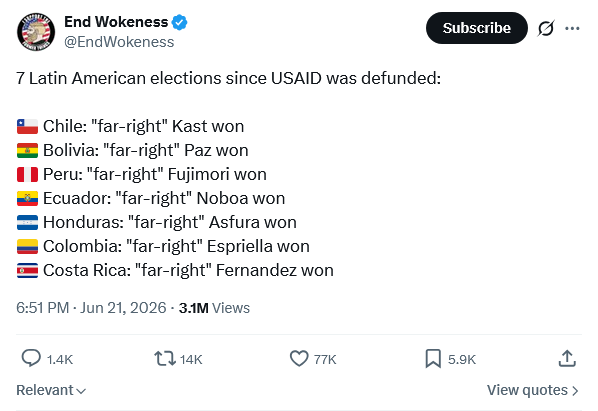
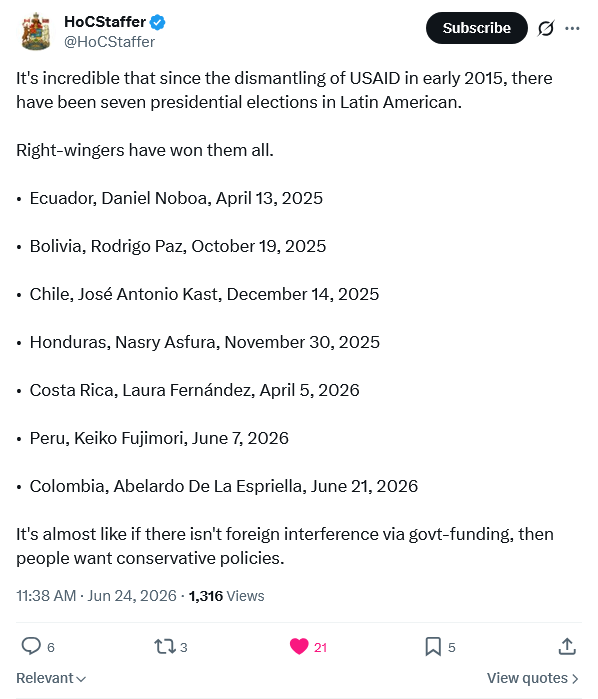
In counterpoint to recent claims that cutting USAID funding cost the lives of millions of children who depended on those funds, taking away USAID support in much of South America led to a number of electoral changes:
Coenders’ Bolt-Less Last Ditch Bolt Action Rifle
Forgotten Weapons
Published 4 Feb 2026When the German Army tested last-ditch Volkssturm rifles late in World War Two, one of the particularly obscure submissions was August Coenders’ Coenders-Rochling Volkssturmkarabiner. This was a bolt-action rifle chambered for 8mm Mauser with a 5-round magazine. However, instead of using a traditional bolt action system it had a fixed breechblock and the handle was attached to the barrel. Cycling the action meant unlocking the barrel and sliding it forward, while the breechblock held the fired case in place. When the barrel was fully forward, the next round in the magazine would kick out the empty case, and pull the barrel rearward seated the next cartridge, ready to fire. In testing, the rifle was, frankly, terrible.
Thanks to the Springfield Armory National Historic Site for giving me access to this unique specimen from their reference collection to film for you! Don’t miss the chance to visit the museum there if you have a day free in Springfield, Massachusetts: https://www.nps.gov/spar/index.htm
(more…)
June 24, 2026
The Korean War Week 105 – Destroy Suiho Dam! – June 23, 1952
The Korean War by Indy Neidell
Published 23 Jun 2026Since the beginning of the war UN air power has studiously avoided hitting North Korea’s hydro-electric complex, since the power the dams provide is mainly for civilian use, but that changes this week! Meanwhile on the ground, the focus has turned to capturing Communist POWs for information, but that task has suddenly proved impossible now that the UN POW camps are firmly back in UN control, and it seems the Communists now prefer even death to capture.
00:00 Intro
00:29 Recap
00:59 Taking Prisoners
03:18 The Shropshires
05:54 Ammunition Shortage
08:41 Targeting Power Plants
14:55 Summary
15:10 Conclusion
15:58 Call to Action
Anarchy and poverty are the “natural state” of man
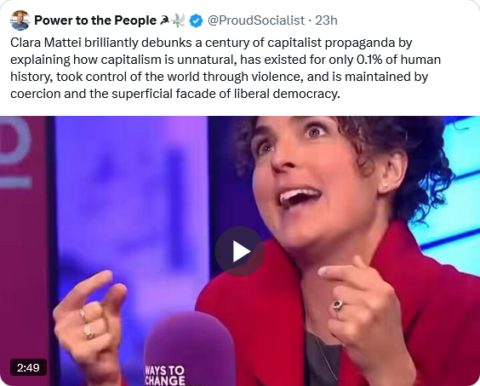
Devon Eriksen has a bit of fun refuting a silly diatribe about the evils of capitalism:
Of course capitalism isn’t natural, you incomplete set of plastic picnic utensils.
What’s natural is theft, robbery, and murder.
What’s natural is anarchy, chaos, the rape of the weak by the strong, and nature red in tooth and claw.
The free market, which you call “capitalism”, is not called “free” because everyone is free to do whatever they want. Because what a lot of people want to do is steal. You’ll know which ones by the hammer and sickle logo they draw on things.
No, the free market is called free because it is freed from coercion and violence.
And of course it was spread by violence, you factory-defective lawn flamingo. Because it was spread by hanging all the bandits and robbers, and if hangings aren’t violence I don’t know what is.
And of course it’s maintained by coercion, you British pub food connoisseur. If you don’t coerce thieves not to steal, then they will steal everything you build faster than than you can build it.
You have to use violence to stop the violent, and coerce the coercers not to coerce.
And of course it’s maintained by the superficial facade of liberal democracy, you Vogon poetry appreciator. The global average citizen is a mentally retarded third-world savage with less emotional self-control than my cat. If we let them have candidates that truly represented their agenda, then every useful thing humanity has built for the last twelve thousand years would be torn down in a week to buy them more party drugs. Followed by every woman being raped to death, and then uncomprehending starvation as they slowly and painfully learned that grocery stores don’t spontaneously spawn food pickups, like in video games.
Jesus Christ, woman, you’re talking about a species that evolved to live in hominid tribes of 100 apes, and throw rocks at zebras. In modern civilization, the so-called “average” person is so far out of his depth that the fish have lights on their noses.
And the more complex and sophisticated civilization gets, the more investments in the future that we need to protect, so that the retarded monkeys don’t steal them all to buy more vodka and cigarettes.
Yeah, sure, sometimes capitalist systems end up defending property that someone’s great-grandfather stole. But so fucking what? You think communism is gonna fix that? You think communism is gonna bring justice?
Communist nations can’t afford justice. They can’t even manage to feed themselves half the time. Get back to us when you’ve mastered the agricultural revolution, we’ve only been waiting since the beginning of recorded time.
The trick is to put the seeds in the dirt, guys.
Feeding A Roman Centurion – Pork & Puls
Tasting History with Max Miller
Published 30 Dec 2025Farro cooked in wine sauce topped with stewed pork, leeks, and dill
City/Region: Rome
Time Period: 1st CenturyWhile the common Roman foot soldier didn’t often have access to fresh meat, a Roman centurion did. A centurion was in charge of 80 fighting men and 20 servants, and holding such a rank meant that their meals were prepared for them and might include ingredients like garum, defrutum (reduced grape must), and fresh herbs and meat.
The dill and defrutum come through in the pork, and the wine isn’t overpowering. The puls, or wheat porridge, is wonderfully flavorful, and the whole dish is made up of lots of different textures (don’t skip the chopped leek garnish; it adds a wonderful crunch). If you like your puls to be thicker and more porridge-like in consistency, go ahead and crush the farro before cooking it.
… small pieces of meat and fine wheat flour or cooked groats you also season with [oenococti], and serve with small morsels of pork prepared with the same sauce.
Frontinian Piglet [oenococti sauce]:
You bone it, brown, and truss. Put into a pot garum and wine, and tie together a bundle of leek and dill. Halfway through the cooking, add defrutum. When it is cooked, wash it and dry. Sprinkle with pepper and serve.
— Apicius de re coquinaria, 1st century
June 23, 2026
They don’t do “democracy” in Europe for any important issue: the voters might get it wrong
It used to be a joke that voting never matters because the voters can’t be trusted with that kind of power. Over time, the joke stopped being at all funny, because that’s exactly what has happened in most western countries at the national level, but most blatantly in the European Union, where voters can express their will in a clear majority, yet see exactly the opposite policies implemented by Brussels:
EU delenda est
2005: the day they decided your “no” didn’t count
May 29, 2005. The French vote. Referendum on the European Constitutional Treaty.
Result: 54.68% NO.
Turnout: 69%.
Not a vote of abstainers, not a misunderstanding.
A people speaking out, massively, with full awareness.
Three years later, the same text — or nearly so — came into force. Without asking their opinion again.
Here’s how.
The context.
The Constitutional Treaty was the great federal leap: a text that gave the EU the attributes of a state. A flag, an anthem, a “constitution”, a foreign minister, supremacy written in black and white. Chirac, full of confidence, calls the French to the polls. The “yes” campaign mobilizes everything: the state, the major parties, the media, big business, the institutional unions.
And the French say no. For reasons the elite refused to hear: fear of social dumping (the infamous “Polish plumber”, the Bolkestein directive), a sense of a machine slipping out of their control, rejection of a project decided from on high and ratified by acclamation. Five days later, the Dutch say no in turn. 61%.
The treaty is dead. Officially, it’s called a “period of reflection”. In reality, it’s time to find a workaround.
The workaround has a name: Nicolas Sarkozy.
2007 campaign. Sarkozy proposes a “simplified treaty”. And above all, he lays out the adoption method: it will be the parliamentary route. No referendum. Parliament will vote in place of the people.
That’s his promise. He is elected.
And he keeps it against the people who had already decided.
The sleight of hand: the Lisbon Treaty.
Signed in December 2007.
They remove the symbols that scared people: no more “constitution”, no flag in the text, no “minister”.
They keep the essentials: permanent presidency of the Council, extension of qualified majority voting, retreat from unanimity, the Union’s legal personality, European diplomatic service. The institutional substance of the rejected text, repackaged.
The most cynical part is that they admitted it. Valéry Giscard d’Estaing, the architect of the Constitution, wrote it himself: the tools are the same, we’ve simply changed their order in the box. The stated goal: make the text unreadable so no government would be forced to submit it to a referendum. Technique replacing the popular verdict.
February 2008. Versailles.
Congress convenes to amend the French Constitution and allow ratification. Then Parliament ratifies Lisbon. The government left, which had campaigned for “no”, abstains and lets it pass. The French, they are never consulted again.
The “no” of 2005 has just been converted to “yes” by procedure.
And for those who might doubt the method: Ireland, for its part, was constitutionally required to vote. It says no in June 2008. They make it revote in 2009 until they get the right result. Vote until you get it right.
And that’s where it all connects.
This isn’t a procedural anecdote. It’s the founding act of a legitimacy problem that France has never settled.
Because the question of 2005 is exactly the one today. When Brussels signs 96 billion in development aid, when the NDICI directs billions to foreign “civil societies”, when the Global Gateway promises 300 billion the real question is never “should we do it?”.
It’s: who decided, and with what legitimacy?
The answer, we’ve known it since 2005: an administration that believes the people, when they answer wrong, must be circumvented, not heard. Hayek called it the fatal conceit.
The idea that a center knows better than the peoples what is good for them including against their explicit vote.
The French never accepted Lisbon. They were never asked.
And a structure built by going over the head of a lost referendum doesn’t carry a democratic deficit: it carries a birth defect.
The American Constitution starts with “We the People”.
Ours, the European version, started with a people who said no and an apparatus that decided it didn’t count.
Auto-translated by X from Brivael Le Pogam’s original French post.


