Quotulatiousness

January 2, 2026

Nukes Put Man in Space – W2W 060

TimeGhost History
Published 31 Dec 2025

In the 1950s, as the Cold War escalated, the same rockets designed to deliver nuclear annihilation across continents became powerful enough to break Earth’s gravity. Missiles built to destroy cities turned into launch vehicles that carried humanity into orbit.

This episode explores the dark origins of space travel — from intercontinental ballistic missiles and nuclear deterrence to Sputnik, the Space Race, and the moment the sky stopped being a safe boundary. At the center of the story stands Sergei Korolev, a Gulag survivor forced to build weapons for the Soviet regime, who nonetheless pushed humanity’s first steps into space.

Sputnik shocked the world, ignited fears of a “missile gap”, reshaped global politics, and triggered massive investments in science, education, and technology — on both sides of the Iron Curtain. The same systems built for global destruction would ultimately give us satellites, navigation, communication, and the modern world we rely on every day.

This is the paradox of the Space Age: Weapons first. Wonder second.

– Nuclear weapons and rocket technology
– The Cold War and the birth of ICBMs
– Sergei Korolev vs. Wernher von Braun
– Sputnik and the global shock of 1957
– The myth of the missile gap
– How fear reshaped science, education, and space exploration
(more…)

“You had to be unacceptably racist in 1993 to predict where South Africa would be in thirty years”

On the social media site formerly known as Twitter, Wesley Yang posted the comment in the headline. Will Tanner responded:

You did not, in fact. You just had to be paying attention

By 1993, South Africa was the only First World country left in Africa

America and the UN chased Belgium out of the Congo, and it collapsed into decades of civil war and famine

Mugabe destroyed Rhodesia after we aided the Soviets in helping him win. Angola and Mozambique became hells after Salazar died, the Carnation Revolution happened, and they were given up. Kenya and Sierre Leone all showed the hellish state of things that came with decolonization in the name of “democracy”

South Africa was the last man standing. It had a nuclear program. It had a space program. It had clean, reliable water and electricity. It had a thriving industrial sector. Crime was problematic, but not out of control

Now all of that was gone, for the same reason the Congo is a mess and Zimbabwe went from being the breadbasket of Africa to a famine-ridden mess: decolonization and equity

Anyone who paid attention could have predicted that. Maintaining First World life requires a First World mindset; that dies when handed over to race communists who are happy to backslide into the Stone Age if doing so means “equality” exists

And so South Africa went from First World to Third

And John Carter responded in turn:

When you stand back and look at this from ten thousand feet, a very dark pattern emerges.

In the aftermath of WWII, the newly established globalist institutions were used to give moral and financial support to decolonization movements, thereby chasing European countries out of what became the third world.

A governance structure that had successfully brought order, prosperity, and civilization to much of the planet was dismantled, leaving behind a chaotic mess of war and poverty.

Those same globalist organizations then embarked on a program of “foreign aid” that dramatically increased the size of that immiserated third world population (without actually improving conditions for them).

At the same time, their agents were busy at work within the governments of the former colonial powers, changing their immigration policies to allow immigration from more or less anywhere. Countries began adopting “multiculturalism” in the name of fighting “racism” … A newly developed postwar concept, which the media and education arms of the globalist project indoctrinated the youth to consider the worst of all possible sins.

Once the ideological and legal ground had been prepared in the former colonial powers, migration via legal and irregular pathways commenced, facilitated by — of course — the very same set of globalist NGOs that chased Europe out of the colonies.

Somehow, this new form of colonization is a good thing. Somehow, the European peoples enjoy none of the rights of “national self-determination” accorded to “indigenous” peoples which had been invoked to end colonialism.

As the populations of the third world were exploding thanks to the foreign aid being provided by globalist organizations, fertility in the first world fell off a cliff. The pill, abortion, feminism drawing women into universities and careers and therefore away from marriage and child-bearing, no-fault divorce destroying the family, and a gender war incited to new levels of bitter intensity every year which estranged the sexes, all served to reduce the white birth rate.

White fertility crashed just as the population bomb that had been set in the third world exploded, with the gates left open by carefully constructed legal frameworks that made immigration very easy and deportation very, very hard.

Update, 3 January: Welcome, Instapundit readers! Please do have a look around at some of my other posts you may find of interest. I send out a daily summary of posts here through my Substackhttps://substack.com/@nicholasrusson that you can subscribe to if you’d like to be informed of new posts in the future.

How did Ancient Romans build their roads?

Filed under: Europe, History, Military — Tags: , , , , — Nicholas @ 02:00

Metatron
Published 2 Sept 2025

Roman road construction was a marvel of ancient engineering that began in earnest around 312 BC with the famous Appian Way. The Romans developed a systematic approach that would serve their empire for centuries, creating over 250,000 miles of roads by 200 AD.

Their construction process started with careful surveying using tools called groma and chorobates to ensure straight lines and proper gradients. Roman engineers would then excavate a roadbed typically 14 to 16 feet wide, digging down 3 to 5 feet deep depending on local conditions and expected traffic. The foundation layer, called the statumen, consisted of large flat stones carefully fitted together. Above this came the rudus, a layer of crushed stone and mortar about 9 inches thick, followed by the nucleus, a finer mixture of gravel and mortar. The top surface, known as the summum dorsum, was made of large polygonal stone blocks called silex, fitted so precisely that no mortar was needed between them. These roads were built with a slight crown in the center to promote drainage, and ditches were dug alongside to carry away rainwater.

Roman construction crews, often composed of soldiers, would work in organized teams with specialized roles for quarrying stone, mixing mortar, laying foundations, and fitting the surface blocks. The entire process could take months or even years for major routes, but the result was a road surface so durable that many Roman roads remained in use well into the medieval period and beyond. Quality control was maintained through strict military discipline and the personal responsibility of engineers who literally put their names on milestone markers. By 117 AD, at the height of the empire, this road network connected Britain to the Middle East and North Africa to the Rhine frontier, facilitating trade, communication, and military movement across the known world.

#romanempire #ancientrome #romanroads

QotD: From Rousseau to Marx, Hegel to Gramsci

Filed under: Books, Europe, History, Politics, Quotations, USA — Tags: , , , — Nicholas @ 01:00

How did we get here? Can those of us who understand what Communism and socialism would mean for our republic win the election that will be upon us in less than 100 days? Only if we understand how on earth Karl Marx’s ideology survived the end of the Cold War to flourish and grow here in America.

The fundamentals are clear enough. The New Left in America, which is the conveyor belt for everything from Representative Alexandria Ocasio-Cortez’s (D-N.Y.) Green New Deal to Black Lives Matter, can trace its genetic roots back to Jean-Jacques Rousseau, who almost single-handedly upturned centuries of Western philosophical and theological wisdom.

Instead of believing that man is fallen, fatally flawed, and prone to selfishness and evil, Rousseau denied the reality of thousands of years of human history and posited that man is inherently good. Further, this goodness could be maximized by engineering society away from individual rights and liberties, prioritizing communal good, communal needs, and the communal will.

Thus civilization built according to how man actually behaves in real life fell out of favor; and eventually, Karl Marx’s collectivist ideology predicated on the subversion of individual human souls to the common interest (as defined by political leaders) gained steam.

Like an ideological scrapbooker, Marx picked and purloined the ideas of others to build his theory. Socialism is but a temporary stepping stone towards the eventual and inevitable end-state of all mankind, the utopian “Worker’s Paradise.” Marx stole the “inevitability” factor from Hegel and his eponymous “dialectic.”

Hegel, a profoundly religious man, unlike the rabidly and militantly atheist Marx, saw the history of man as a perpetual progression, a series of qualitative improvements in our collective lot as one new idea (antithesis) impacted upon an existing idea (thesis) and resulted in an improved conceptualization (synthesis) that has more truth value than the previous two ideas combined. This progression, so Hegel believed, would increase our enlightenment, until we perceived the ultimate synthesis, the purest version of truth’s expression, which is God himself.

Marx took Hegel’s key inevitability dynamic and removed the metaphysical elements. For Marx the intangible was irrelevant. His “dialectic materialism” posits that thesis and antithesis are instead expressions of the inherent conflict within society — the clash between the have and have nots, the oppressor and the oppressed, the capitalist and the exploited workers — which will result in a final revolution permanently removing class distinction and conflict from society.

This garbage is what Karl Marx sold the world with his books Das Kapital and the Communist Manifesto. And incredibly, some people believed this rubbish. So much so that they used it as a blueprint to sabotage and subvert multiple nations around the world, starting with czarist Russia and stretching all the way to Cuba and China. But then there was a problem. In all their attempts to effect a Communist revolution west of the Russian Empire, Marx’s followers would fail. America was an especially tough nut for Marxists to crack, because of how our nation was born.

America’s Founders, knowing full well that man is fallen and tends toward the selfish and the bad, built America with a system of separation of powers and also bequeathed us a written Constitution founded not on some absurd utopian collectivist vision of society, but built upon the recognition of the liberty of the individual and the unalienable God-given rights we each possess. Despite the advent of Progressive presidents, such as Theodore Roosevelt and Woodrow Wilson, America remained staunch in its resistance to socialism. Marx’s disciples, however, were not ready to surrender.

This is where the influence of a hunchback Italian cripple comes in.

Antonio Francesco Gramsci is the ideational grandfather to all that threatens modern America and our freedoms today, from AOC’s Green New Deal to the violence of Antifa. His writings, penned in an Italian prison cell, would be leveraged by the Hungarian Jewish writer and politician, Gyӧrgy Lukacs, each sharing the same conviction: Communism had failed in established Western democracies — as opposed to the backward and mostly peasant society of czarist Russia — because these societies are too resilient and too developed. For Marxism to flourish in the rest of Europe and America, these “bourgeois” societies must be dismantled piece by piece. From the inside.

The conceptual progeny of that realization leads straight to the panoply of Democratic Party articles of belief today — from Obamacare’s unprecedented intrusion into private healthcare choices to the anti-scientific insanity of transgenderism and beyond. This isn’t a random accusation, devoid of context. It’s not some accusation floating in space. The path from Gramsci and Lukacs to Ocasio-Cortez and Rep. Ilhan Omar (D-Minn.) is a path that may be mapped historically, geographically, and institutionally.

Sebastian Gorka, “From Alinsky to AOC: Will Communism Finally Win in America?”, American Greatness, 2020-07-29.

Update, 3 January: Welcome, Instapundit readers! Please do have a look around at some of my other posts you may find of interest. I send out a daily summary of posts here through my Substackhttps://substack.com/@nicholasrusson that you can subscribe to if you’d like to be informed of new posts in the future.

January 1, 2026

The consuls and the start of a Roman year

Adrian Goldsworthy. Historian and Novelist
Published 1 Jan 2025

For New Year’s day, we look at how the year started for the Romans, when from 153 BC onwards, the new consuls assumed office. There were rituals, sacrifices and ceremony, and then the start of the political year.

To round off, some thoughts on what is planned for the year to come on this channel.

Oh yes, and for chickens read geese!

QotD: Niccolao Manucci’s improbable early career

Filed under: Books, History, India, Quotations — Tags: , , , , , — Nicholas @ 01:00

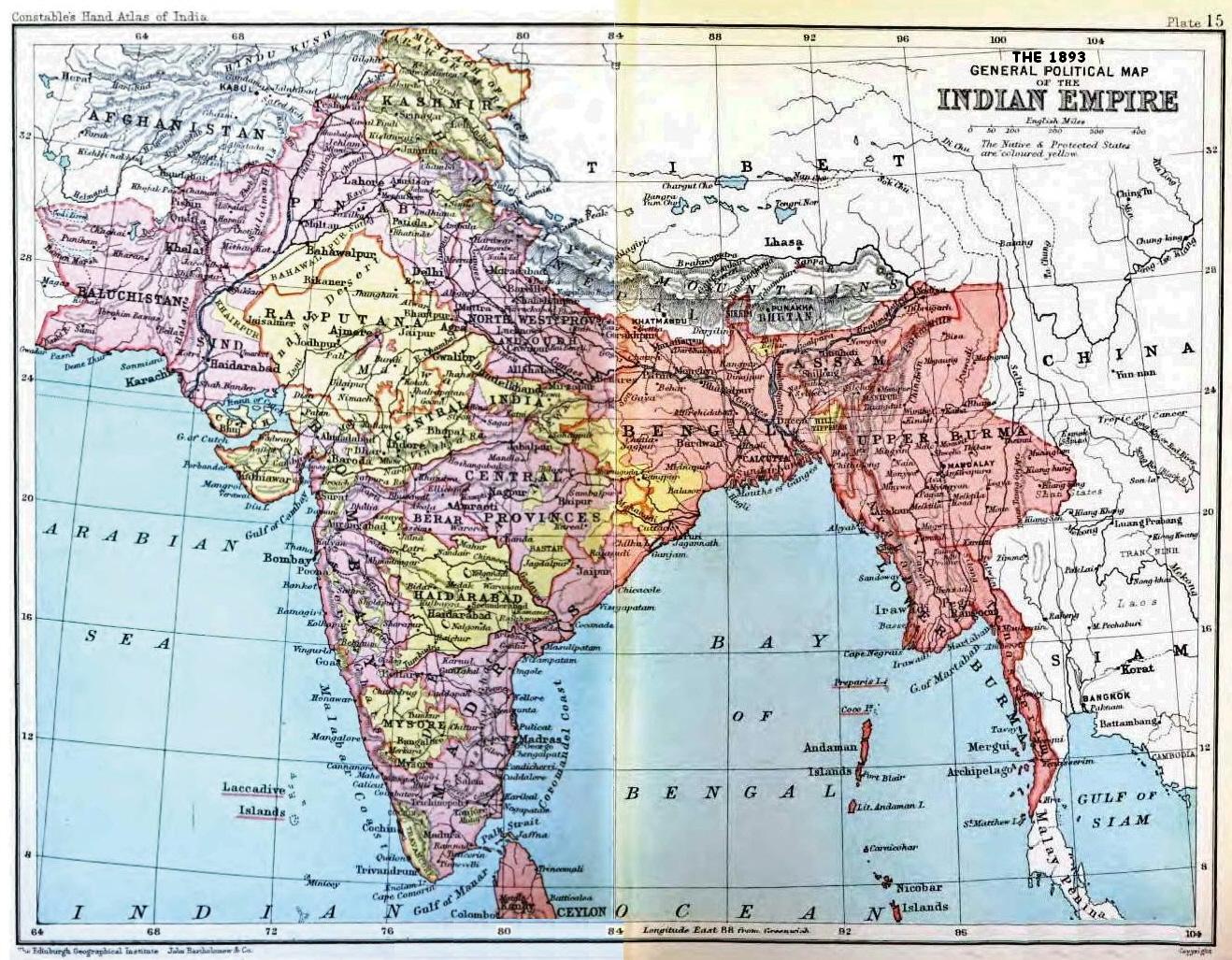
There are people who say “you can just do things”, and then there are people who at the age of fourteen stow away on an ocean-going vessel heading who-knows-where. Niccolao Manucci was the latter sort, and he held out down in that ship’s hold as long as he could, until hunger got the best of him. In fact, he lasted so long that when he finally gave in and presented himself to the captain it would have been inconvenient and uneconomical to return him to his parents in Venice. As the sailors debated whether to toss him overboard, press him into service, or maroon him on the closest bit of coastline, young Niccolao went and chatted up the other passengers. One of them, Lord Henry Bellomont, had recently escaped death at the hands of Oliver Cromwell, and invited Manucci to accompany him on an important mission to Persia.

That sounded pretty good to the teenager, so he disembarked with Bellomont at Smyrna, made the hazardous journey across Ottoman Anatolia, thence through Armenia, and finally to the Safavid Empire, where Bellomont declared himself an ambassador from the rightful king of England and sought Persian intervention in the English Civil War (!). The Shah was horrified by the regicide and amazed that the other Christian kings of Europe had not come to the aid of Charles I,1 but gently rebuffed Bellomont’s request by pointing out that it would be quite impractical to send a large army from Persia to England.

Frustrated, Bellomont set off once again with his young charge, this time to the Mughal Empire. He got as far as the port of Surat, where he suddenly died, leaving the teenage Manucci completely on his own, thousands of miles from his home, in the middle of a civil war.

I sometimes wonder how often this sort of thing happens without us ever finding out. Perhaps history is full of ridiculous people having ridiculous adventures, it’s just that most of them aren’t Zhu Yuanzhang, or they don’t write detailed memoirs, or those memoirs are lost or destroyed before they reach us. Something like this very nearly happened to Manucci. The Venetian teenager left all alone in India not only survived, but flourished socially and financially, lived to a ripe old age, and wrote thousands of pages of penetrating social observations. His account is both the most entertaining and the most reliable history of the Mughal Empire at its zenith. Manucci had the singular talent of moving through every social circle, from the royal court to the lowest of peasants. He interacted with generals and statesmen, harem attendants, Islamic jurists, Hindu sages, elephant drivers,2 Portuguese mercenaries, eunuchs, merchants, prostitutes, common soldiers, missionaries, beggars, and even the emperor himself. There are very few cases where we get to see a premodern society laid out in all its intimate detail and from every angle, and we only missed losing this one by the barest of lucky strokes.

The story of Manucci’s manuscript is a twisting one. The original copies of his tale fell into the hands of a French Jesuit who mutilated the text — excising all the fun parts, all the personal observations, the adventure stories, and of course anything remotely critical of the Catholic Church. The resulting “edition” found its way back to India and into Manucci’s hands before his death. Naturally, he freaked out and tried to reproduce his original text from memory, sending it along with a letter of protest by sealed courier directly to the Venetian Senate. But this second copy is the work of a much older man, much farther from the stories and events described, and has numerous omissions and differences from the original.3 In 1763, the Jesuit order was expelled from France and their Paris library, including Manucci’s first manuscript, was seized by the state. It was then lost during the Revolution and believed destroyed, before turning up in damaged and partial form at an auction-house in Berlin a century later.

Countless European intellectuals have tried their hand at stitching the mishmash of fragments we have back into a cohesive whole, including a “J. Bernoulli” (yes, one of those Bernoullis, but I can’t figure out which brother it was). But everybody agrees the most successful of these efforts was that by William Irvine, a British colonial administrator and fellow of both the Royal Asiatic Society and the Asiatic Society of Bengal, who also helpfully translated the whole thing into English. Irvine’s edition has been republished many times, most recently by the wonderful people at Forgotten Books, which is how it found its way into my hands.4

Irvine is not the sort of editor who confines his remarks to a preface and some footnotes. Instead, he directly injects his own commentary inline, into the body of the text. These asides range from bracketed remarks like “[here I have deleted a coarse and obscene description]” all the way up to essays dozens of pages long containing his reflections and opinions on the text. And this is layered on top of the various modifications and emendations made by French Jesuits and Venetian scribes. All of this gives the book a meta-textual, almost postmodern feeling. It’s a bit like House of Leaves. Sometimes you’re reading Manucci, and sometimes you’re reading three nested layers of people commenting on people commenting on people commenting on Manucci. And the effect is heightened when you suddenly realize that Manucci, like the protagonist of a Gene Wolfe story, is not telling you all that he knows.

John Psmith, “REVIEW: Storia do Mogor, by Niccolao Manucci”, Mr. and Mrs. Psmith’s Bookshelf, 2025-09-08.


  1. Bellomont’s only real success in his mission was to completely poison the well for all future European travelers in Persia. Manucci reports that the next Englishman to visit the court of the Shah was thrown into a dungeon for disloyalty to his liege lord (a story independently corroborated by the French adventurer Jean-Baptiste Tavernier). “[The shah’s] object was to give a lesson to his own nobles as to the manner in which they should serve their king and the fidelity they ought to display, when the occasion arose, in defence of their monarch.”
  2. The book contains extensive discussion of how all elephants and horses that the Mughal princes might want to ride are pre-ridden by an attendant, to “loosen its stomach” and eliminate any flatulence.
  3. This is actually a huge simplification — there are four distinct Venetian codices, all with major differences from each other.
  4. I started with the Forgotten Books paperback, but halfway through the first volume I was hooked, and seeing that I had a thousand pages left to go, picked up a handsome leatherbound set from a used book seller for a song. I would normally never dream of buying a second copy of a book I already own just because it feels nicer in my hands, but you, dear subscribers, have spoiled me.

December 31, 2025

The Korean War Week 80: Empty Lines and Guerrillas: X-mas ’51 in Korea! – December 30, 1951

Filed under: Britain, China, History, Military, USA — Tags: , , , , , — Nicholas @ 04:00

The Korean War by Indy Neidell
Published 30 Dec 2025

It’s Christmas, 1951, and though peace on earth and goodwill to all men might have a general appeal, peace seems as far away as ever in Korea. There are, though, no large scale offensives being planned at the moment, as the frozen winter grips Korea and the peace talks drag on and on. However, just because the war between armies is quiet, doesn’t mean Korea is; anti-guerrilla operations claim lives by the thousands, and the general drudgery of the war also takes thousands of lives on both sides each and every month. Christmas in Korea is grim.

00:00 Intro
00:27 Recap
00:49 POW Lists
02:25 New Offensive
05:29 Fighting the Guerrillas
07:20 Casualty Numbers
09:04 Boatner and the 23rd
11:54 Inspections and China
13:27 Summary
13:59 Conclusion
(more…)

Baker Pattern 1800 Rifle for Napoleonic Wars Sharpshooters

Filed under: Britain, History, Military, Weapons — Tags: , , , — Nicholas @ 02:00

Forgotten Weapons
Published 11 Aug 2025

The British military decided to organize their disparate small units of riflemen into a single standardized group in 1800. The 95th Regiment – the British Rifle Corps – was founded and it was equipped with a pattern of rifle designed by one Ezekiel Baker. This was a .625 caliber rifle with a 30” long barrel and a remarkably slow 1:120” rifling twist. That rifling was deliberately chosen to balance rifle accuracy with ease of loading and it worked quite well as a compromise solution. The Baker was considered effective on individual targets to 200 yards (300 with a particular skilled marksman) and area targets out to 500 yards.

The Baker was used throughout the Napoleonic Wars and only replaced in 1838 by the Brunswick rifle. This example is one of the original 1800 pattern, modified in 1815 to replace its distinctive bayonet bar (used to fit the large short sword bayonet made for the Baker) with a typical socket bayonet lug.

BritishMuzzleLoaders playlist on the Baker: • The 1800 Baker Rifle: Two (Very) Frequent…
(more…)

QotD: The cloth trade in the ancient and medieval world

Filed under: Economics, Europe, History, Quotations — Tags: , , , , , — Nicholas @ 01:00

Fabric as a finished product is somewhat different from the other products (grain and iron) we’ve discussed in this series so far. Bulk grain is a commodity – which means that one kilogram of grain is pretty much like the next. When grain gets traded in bulk it is because of differences in supply, not generally because grain in one region or other is particularly tasty. Consequently, you only get bulk grain trading when one area is producing a surplus and another not producing enough. The same is more loosely true of iron; Iron wasn’t a perfect commodity in the pre-modern world since some ores produced better quality metal than others and some trade in high quality ores or metal (like wootz) happened. But for every-day use, local iron was generally good enough and typically available. Iron could be – and often was – treated as a commodity too.

Fabric is not like that. While the lower classes will often have had to make do with whatever sorts of cloth is produced cheaply and locally, for people who could afford to have some choices the very nature of textile production produces lots of regional differences which incentivized trade. Almost everything about textile production is subject to regional variations:

  • What fibers are being used. Major wool and linen producing regions tended to be separate, with wool (and sheep) in colder climates and uplands while (as noted) flax tended to be grown in warmer river-valleys with rich alluvial soil. Meanwhile, the cotton-and-silk producing regions generally (with some notable exceptions, mind) did not overlap with the wool and linen producing regions.
  • The nature of the local fibers. We’ll get to some specific examples in a moment but ancient and medieval writers were well aware that different growing conditions, breeds of sheep or flax, climate and so on produced fibers of subtly different qualities. Consequently, even with the exact same processes, cloth produced in one region might be different from cloth produced in another region. But the processes were almost never the same because …
  • Local variation in production processes. Again, we’ll have some examples in a moment, but the variance here could be considerable. As we’ve seen, the various tasks in cloth production are all pretty involved and give a lot of room for skill and thus for location variations in methods and patterns. One might see different weaving patterns, different spinning techniques, different chemical treatments, different growing or shearing methods and so on producing fabrics of different qualities which might thus be ideal for different purposes.
  • Dye methods and availability. And as we discussed last time, available dyestuffs (and the craft knowledge about how to use them) was also often very local, leading to certain colors or patterns of color being associated with different regions and creating a demand for those. While it was often possible to ship dyestuffs (although not all dyestuffs responded well to long-distance shipping), it was often more economical to shift dyed fabric.

Added on top of this, fabric is a great trade-good. It is relatively low bulk when wrapped around in a roll (a bolt of fabric might hold fabric anywhere from 35-91m long and 100-150cm wide. Standard English broadcloth was 24 yards x 1.75 yards; that’s a lot of fabric in both cases!) and could be very high value, especially for high quality or foreign fabrics (or fabrics dyed in rare or difficult colors). Moreover, fabric isn’t perishable, temperature sensitive (short of an actual fire) or particularly fragile, meaning that as long as it is kept reasonably dry it will keep over long distances and adverse conditions. And everyone needs it; fabrics are almost perfect stock trade goods.

Consequently, we have ample evidence to the trade of both raw fibers (that is, wool or flax rovings) and finished fabrics from some of the earliest periods of written records (spotting textile trade earlier than that is hard, since fabric is so rarely preserved in the archaeological record). Records from Presargonic Mesopotamia (c. 2400-2300) record wool trading both between Mesopotamian cities but wool being used as a trade good for merchants heading through the Persian Gulf, to Elam and appears to have been one of, if not the primary export good for Sumerian cities (W. Sallaberger in Breniquet and Michel, op. cit.). More evidence comes later, for instance, palace letters and records from the Old Babylonian Empire (1894-1595) reporting the commercialization of wool produced under the auspices of the palace or the temple (Mesopotamian economies being centralized in this way in what is sometimes termed a “redistribution economy” though this term and the model it implies is increasingly contested as it becomes clearer from our evidence that economic activity outside of the “palace economy” also existed) and being traded with other cities like Sippar (on this, note K. De Graef and C. Michel’s chapters in Breniquet and Michel, op. cit.).

Pliny the Elder, in detailing wool and linen producing regions provides some clues for the outline of the cloth trade in the Roman world. Pliny notes that the region between the Po and Ticino river (in Northern Italy) produced linen that was never bleached while linen from Faventia (modern Faenza) was always bleached and renowned for its whiteness (Pliny, NH 19.9). Linen from Spain around Tarragona was thought by Pliny to be exceptionally fine while linens from Zeola (modern Oiartzun, Spain) was particularly durable and good for making nets (Pliny, NH 19.10). Meanwhile Egyptian flax he notes is the least strong but the most fine and thus the most expensive (Pliny NH 19.14). Meanwhile on wool, Pliny notes that natural wool color varied by region; the best white wool he thought came from the Po River valley, the best black wool from the Alps, the best red wool from Asia Minor, the best brown wool from Canusium (in Apulia) and so on (Pliny, Natural History 8.188-191). He also notes different local manufacture processes producing different results, noting Gallic embroidery and felting (NH 8.192). And of course, being Pliny, he must rank them all, with wool from Tarentum and Canusium (Taranto and Canosa di Puglia) being the best, followed more generally by Italian wools and in third place wools from Miletus in Asia Minor (Pliny NH 8.190). Agreement was not quite universal, Columella gives the best wools as those from Miletus, Calabria, and Apulia, with Tarantine wool being the best, but demoting the rest of the Italian wools out of the list entirely (Col. De Re Rust. 7.2).

In medieval Europe, wool merchants were a common feature of economic activity in towns, with the Low Countries and Northern Italy in particular being hubs of trade in wool and other fabrics (Italian ports also being one of the major routes by which cottons and silks from India and China might find their way, via the Mediterranean, to European aristocrats). Wool produced in Britain (which was a major production center) would be shipped either as rovings or as undyed “broadcloths” (called “whites”) to the Low Countries for dyeing and sale abroad (though there was also quite a lot of cloth dyeing happening in Britain as well).

Bret Devereaux, “Collections: Clothing, How Did They Make It? Part IVb: Cloth Money”, A Collection of Unmitigated Pedantry, 2021-04-09.

December 29, 2025

What Do We ACTUALLY Know About Homer? (Author of Iliad & Odyssey)

Filed under: Books, Greece, History — Tags: , , , — Nicholas @ 04:00

MoAn Inc.
Published 23 Dec 2025
(more…)

What Are Sugar Plums? How to make real Victorian sugar plums

Filed under: Britain, Food, History — Tags: , , , , , — Nicholas @ 02:00

Tasting History with Max Miller
Published 10 Dec 2024

Purple, green, yellow, red, blue, and white hard candies with cherry centers

City/Region: United States of America
Time Period: 1865

Sugar plums go hand-in-hand with Christmas, but what exactly are they? There are recipes out there for a confection made of dried fruit and nuts that’s rolled into balls, but true Victorian sugar plums were a kind of candy made up of layers of hardened sugar syrup and gum arabic surrounding a fruit or nut core. They were pretty much the same thing as Jordan almonds.

You won’t find many recipes for them in Victorian-era cookbooks because no one really made them at home. The specialized equipment and labor involved meant that most people bought them from a confectioner, and I can see why.

Making these was a three-day endeavor for me, and I had to get a panning machine attachment for my stand mixer, and gum arabic, which I surprisingly didn’t already have in my pantry. They’re a nice sweet treat, but really more trouble than they’re worth to make at home.

    Cherry Sugar-Plums. Set preserved cherries on a sieve in the stove. When they are partly dry, mix them with pounded sugar, and rub them over a sieve; dry them again, and proceed as with barberry sugar-plums.

    Barberry Sugar-Plums. Take perfectly ripe barberries, stem them, dry them in a stove, and add the gum and sugar in the swinging basin. To accomplish this, after being heated in the stove, give them a coating of one part sugar, and one part gum arabic; and, when thoroughly moistened, powder with sifted sugar. Dry the coating in a stove; add a second on the next day, so as to completely cover the fruit; then thicken, and finish like the verdun sugar-plums. The fruit must be coated away from the fire. They are colored like the rose sugar-plums, and pearled like the lemon.
    The Art of Confectionery, 1865

(more…)

December 28, 2025

Colt SMG: First of the 9mm ARs

Filed under: History, USA, Weapons — Tags: , , , , , — Nicholas @ 10:10

Forgotten Weapons
Published 8 Aug 2025

With the expansion of SWAT teams throughout law enforcement in the 1980s, Colt realized that it was leaving a lot of sales on the table by not having a submachine gun it could offer alongside M16/CAR-15 rifles and carbines. They addressed this in the early 1980s by adapting a CAR-15 to 9x19mm. It used an adapter in the magazine well to fit modified Uzi pattern magazines (they were given hold-open tabs on the followers), and retained the same handling and controls as the full size AR. The SMG was made as a closed bolt, hammer fired, simple blowback action. By adding weight to the bolt carrier and buffer, the rate of fire was kept down to around 800 rpm.

The Colt SMG never really captured wide appeal. It was reasonably successful for Colt in large part because of their ability to market it alongside rifles, but it was dogged by reliability problems. A bunch of different models were made with different fire control options, including a couple civilian semiautomatic models and the distinctive DoE “briefcase gun” and the integrally suppressed DEA model, although neither of those saw very substantial sales. Still, it remains available to this day.

Colt 633 DoE Reproduction: • PSA/H&R Clones the Department of Energy Co…
(more…)

“The Singularity is upon us”

Filed under: History, Media, Technology — Tags: , , , , — Nicholas @ 04:00

ESR is clearly not worried about the clankers taking over, at least based on his own experience with coding assistance from AI:

Yes, I’m still 12

I was writing some code the new-school way yesterday, prompting gpt-4.1 through aider, and for whatever reason my mind flashed back 50 years and the utter freaking enormity of it all crashed in on me like a tidal wave.

And now I want to make you feel that, too.

In 1975 I ran programs by feeding punched cards into a programmable calculator. Actual computers were still giant creatures that lived in glass-walled rooms, though there were rumors from afar of a thing called an Altair.

Unix and C had not yet broken containment from Bell Lab; DOS and the first IBM PC were six years away. The aggregated digital computing capacity of the entire planet was roughly equivalent to a single modern smartphone.

We still used Teletypes as production gear because even video character terminals barely existed yet; pixel-addressable color displays on computers were a science-fiction dream.

We didn’t have version control. Public forge sites wouldn’t be a thing for 25 years yet. The number of computer games that existed in the world could probably be counted on the fingers of two hands.

Because of all this, I learned to program over the next ten years with tools so primitive that when I talk about them today it sounds like uphill-both-ways sketch comedy.

You may not even be able to imagine what a slow and laborious process programming was then, and how tiny the volume of code we could produce per month was; I have to work to remember it, myself.

Today I call spirits from the vasty deep, conversing with unhuman intelligences and belting out finished programs I would once have considered prohibitively complex to attempt within a single working day.

Fifty years, many generations of hardware technology, from punched cards to AIs that can pass the Turing test … and I’m still here, still coding, still on top of what a software engineer needs to know to get useful work done in the current day. Gotta admit I feel some pride in that!

This meditation isn’t supposed to be about me, though. It’s about the dizzying, almost unbelievable progress I’ve lived through and been a part of. If you had told me to predict when I would have a device in my pocket that would give me instant real-time access to most of the world’s knowledge, with my own pet homunculi to sift through it for me, I would have been one of the few that wouldn’t have said “never” (because I was already a science-fiction fan), but I wouldn’t have predicted a date fewer than multiple centuries in the future either.

We’ve come a hell of a long way, baby. And the fastest part of the ride is only beginning. The Singularity is upon us. Everything I’ve lived through and learned was just prologue.

QotD: The Middle Ages saw rebellions but no revolutions

Filed under: Britain, Europe, Government, History, Quotations — Tags: , , , , , , — Nicholas @ 01:00

At some point in this space, we discussed the difference between a rebellion and a revolution. Drawing on Michael Walzer’s key work The Revolution of the Saints, I argued that a true revolution requires ideology, as it’s an attempt to fundamentally change society’s structure.

Therefore there were no revolutions in the Middle Ages or the Ancient World, only rebellions — even a nasty series of civil wars like The Wars of the Roses were merely bloody attempts to replace one set of rulers with another, without comment on the underlying structure. A medieval usurpation couldn’t help but raise questions about “political theory” in the broadest sense — how can God’s anointed monarch be overthrown? — but medieval usurpers understood this: They always presented the new boss as the true, legitimate king by blood. I forget how e.g. Henry IV did it — Wiki’s not clear — but he did, shoehorning himself into the royal succession somehow.

Combine that with Henry’s obvious competence, Richard II’s manifest in-competence, and Henry’s brilliant manipulation of the rituals of kingship, and that was good enough; his strong pimp hand took care of the rest. Henry IV was a legitimate king because he acted like a legitimate king.

A revolution, by contrast, aims to change fundamental social relations. That’s why medieval peasant rebellions always failed. Wat Tyler had as many, and as legitimate, gripes against Richard II as Henry Bolingbroke did, but unlike Henry’s, Tyler’s gripes couldn’t really be addressed by a change of leadership — they were structural. 200 years later, and the rebels were now revolutionaries, willing to give structural change a go.

Severian, “¡Viva la Revolución!”, Founding Questions, 2025-02-27.

December 27, 2025

Campaign Furniture by Christopher Schwarz

Filed under: Books, Britain, History, India, Woodworking — Tags: , — Nicholas @ 10:30

I try not to clutter the blog with woodworking-related posts, as I know it’s a niche interest among my readership, but every now and again I find something I just have to share. Today, it’s a post from Lost Art Press on the book Campaign Furniture written by Christopher Schwarz:

My 2014 book Campaign Furniture is now a free pdf download for everyone. You can download it via this link (a compressed version for slower connections is available here). And customers will always be able to download it from the book’s page in our store.

I’m a fan of the book … I ended up buying two copies through Lee Valley Tools (I loaned my first copy out and it got lost in the shipwreck of a friend’s messy divorce). I like Chris’s writing style and I’ve long been a fan of Campaign furniture.

Why Do I Do This?

I get asked by fellow publishers why I offer my books for free download. “Surely you use it to gather emails to market to readers.” Nope. “Are these out-of-print books that you are using to get eyeballs on your website?” Nope. “So what’s the strategy?”

I think – as much as possible – that information should be free. I think the best hope for inspiring other woodworkers is to give them whatever they need to begin in the craft.

And, I fu&%ing hate this world we’ve created where people can’t own anything. Companies come into your house and your phone and change things or take away stuff you’ve bought. Many times they take back stuff you owned then rent it back to you.

That’s why we make books. Buy a book from us, and it’s yours. Its contents can’t be changed by some ideologue a thousand miles away. All of our digital products are free of DRM (digital rights management). That means they can’t be locked or disabled. And you can copy them onto whatever device you like.

OK, the holiday rant is over.

I hope you find something of interest in Campaign Furniture. We still use three of the pieces from the book every day in our home. Other pieces are with my kids. So my family’s love of this neglected furniture style continues.

« Newer PostsOlder Posts »

Powered by WordPress