
Tasting History with Max Miller
Published 23 Dec 2025Cloudy pomegranate beer made with honey and dates
City/Region: Assyria
Time Period: 9th Century BCEAshurnasirpal II was an Assyrian king who built an empire in a rather ruthless manner. While he’s remembered for razing cities and killing and/or maiming their inhabitants, he’s also remembered for throwing one heck of a party. When he unveiled his new palace, he invited nearly 70,000 guests to a 10 day feast, and they even wrote down the menu. He provided 10,000 jars of beer for the feast, and while some were basic beer, there were also specialty brews like this much fancier version made with pomegranates, dates, and honey.
While flat, this cloudy beer is surprisingly tasty. The flavor of the honey and pomegranate come through, but with none of the sweetness, and they combine for an oddly modern taste.
Because there are no hops to preserve the beer, it’ll only keep for up to 1 week. As with any vague ancient recipe, feel free to change the amounts of the ingredients to suit your taste.
(more…)
June 17, 2026
Brewing 3,000 Year-Old Ancient Mesopotamian Beer
June 16, 2026
Why Argentina Lost the Falklands War
Real Time History
Published 6 Feb 2026On March 28, 1982 almost the entire Argentinian navy, carrying 900 troops, invaded the Falkland Islands (Islas Malvinas). The ruling junta was confident Britain wouldn’t oppose the Argentinian fait accompli. But Britain’s political will and military ability to carry out a successful campaign at the end of an 12,500 km supply line surprise many.
(more…)
QotD: Nitpicking the field fortifications in Gladiator (2000)
[…] The army is also deployed wrong.
What we are shown is pretty clearly a prepared defense on a hillside, with a series of raised terraces, with a mix of abatis (sharpened wood obstacles, often crudely cut wood stakes set in an X pattern) and mantlets, with gaps in those defenses to allow units to move and a whole bunch of catapults positioned up on the hill. The terraces make for a layered, multi-stage fighting position at each level. On the one hand, the Romans were hardly averse to field fortifications and one wonders again if this set was a product of someone with an active imagination looking at the Column of Trajan [Wiki], which features a lot of scenes of Roman soldiers cutting trees and building bridges, roads and forts.
The problem isn’t that there are field fortifications, it is everything else about them: the style of field fortification, their position, layout and use. As we’ve noted before, Roman armies on campaign built fortified marching camps nightly, so we would expect Maximus’ army to have such a camp, but as we’ve discussed even more so, one of the classic, famous features of Roman armies is that they build the same layout of camp wherever they go, the famous Roman “playing card” forts, generally built on flat, open ground (rather than hillsides). That defense would not look like this, instead consisting of a ditch (the fossa) behind which would have been a earthwork rampart (the agger) topped with a wooden palisade (the vallum); thus rather than successive layers, you’d have a single clear fighting position (the vallum) on a mount with the ditch directly in front of it. And that would be a continuous line, with just four gates (at the center of each side), rather than this kind of checkerboard pattern of fortifications, because of course the purpose of this defense was to prohibit entry. Moreover, the line of field fortifications we see are not part of, nor connected to, a marching camp: it is simply a line of fortifications on the side of the hill with nothing on the flanks, rather than the distinctive “playing card shape”. We don’t see the camp sitting behind it either.
But the really immediate problem is that Maximus’ army has formed up within his troops strung through the field fortifications, with legionary soldiers mostly in front of them (but some are behind them) and the archers in between the stakes and mantlets. This may seem like a sensible way to form up a defense, but it is not the Roman way. Maximus is very intentionally “offering battle”, – inviting his opponent into an open field engagement. The way a Roman army did this was invariably forming up on the flat, open, unfortified ground in front of the camp, toward the enemy, signalling that they would fight in the open, outside of their walls (as Maximus does indeed intend to do).
So what we ought to see is Maximus’ army formed up outside in the open field, with the camp likely visible some distance behind them. That camp would be protected by very different fortifications: you’d be able to make out its “playing-card” shape, with watch-towers on the corners and the raised vallum running the exterior and the relatively neat grid of tents in the interior.
Finally, before we get to the battle plan, I want to note one more oddity here, which is the battlefield itself. The battlefield is a muddy field, which it looks to have been recently clear-cut, otherwise surrounded by dense forest. Of course part of the reason is that this is Bourne Wood, a coniferous tree plantation (and frequent filming location) in Surrey, England (which is why the trees are all the same species, so neatly spaced out) rather than the edge of an old-growth forest somewhere in southern Germany.
But the thing is, the Marcomanni, Quadi and other Germanic-language speaking peoples were an agrarian society, same as the Romans: their villages were surrounded by farm and pastureland. Of course a lot of the forest – old-growth forest, rather than tree-farms as here – remained, but if a Roman army wanted a flat, open space to offer battle in, they needn’t have cleared it themselves (and indeed probably couldn’t, at least not in the time frame they’d have to prepare for a pitched battle), but could simply march to the nearest village with its patches of farmland. Getting a Roman army to fight in dense, old-growth forest, after all, famously required clever ambushes, as a Teutoberg Forest (modern Kalkriese) in 9 AD. And if the enemy didn’t want to fight in the open, Roman armies were perfectly happy to burn villages and pillage crops as the standard way of attempting to force an enemy to accept an offer to battle or else vacate the area.
Bret Devereaux, “Collections: Nitpicking Gladiator’s Iconic Opening Battle, Part I”, A Collection of Unmitigated Pedantry, 2025-06-06.
June 14, 2026
How to Make Dissent Disappear – Death of Democracy 19 – Q3 1937
World War Two and Spartacus Olsson
Published 13 Jun 2026In 1937, Nazi Germany moved from controlling politics to controlling thought itself. Churches, artists, workers, and dissenters all came under attack.
Berlin, September 1937. From the outside, Germany can seem strangely quiet while the rest of the world slides deeper into war, civil conflict, and authoritarianism. But inside the Reich, the Nazi state is tightening its grip on the last spaces where dissent can still exist.
This quarter, the Gestapo arrests Pastor Martin Niemöller and intensifies the attack on the Confessing Church. The regime opens the House of German Art in Munich, then stages the infamous “Degenerate Art” exhibition to mock, vilify, and destroy modernist culture. The SS establishes Buchenwald near Weimar, forcing prisoners to build their own prison. Meanwhile, Göring’s new state industrial empire and the Nuremberg “Rally of Work” reveal a society being reorganized for war.
This is Step 19 in the death of democracy: when the authoritarian state stops merely silencing opposition and begins fighting the inner freedom to believe, imagine, worship, create, and think.
Mauser M80SA: Actually a High Power and Actually Hungarian
Forgotten Weapons
Published 21 Jan 2026In the 1980s, the Mauser company was completely adrift, without any real plans or goals or good leadership. They had been trying to get by on relaunched old designs, and not been very successful. By the late 80s they move on to just buying guns from other companies (like Renato Gamba) and relabelling them as Mauser. One of these partnerships was with FEG in Hungary.
In 1990, Mauser contracted with FEG to buy Browning High Power copies. FEG had actually licensed the high Power design from FN back in the 1970s, and was already tooled up for production, so they just added a Mauser roll mark and called the gun the M80. It was a straight copy of the High Power, except for the omission of the magazine safety. Production ran from 1990 until 1995, with only 3,200 made. The gun did not sell well, which should [not] be very surprising — this was a very outdated design by the 1990s and the Mauser name just wasn’t worth much as a value-add.
(more…)
QotD: Some of H.G. Wells’ more awkward views
This was, of course, before the genocidal policies of the Nazis were implemented, and while many of these grand men and women of the left had died before the camps were liberated and the horrors known, others certainly lived on. Some were contrite, others not. Either way, it hardly forgives them their ideology and influence – naiveté and ignorance simply isn’t a viable defence in such circumstances.
Michael Coren, “Eugenics and the intellectual left”, The Critic, 2020-09-16.
Update, 15 June: Welcome, Instapundit readers! Have a look around at some of my other posts you may find of interest. I send out a daily summary of posts here through my Substack – https://substack.com/@nicholasrusson that you can subscribe to if you’d like to be informed of new posts in the future.
June 13, 2026
The intellectual dangers of “nostalgia economics”
Mani Basharzad explains that although resurgent socialist beliefs are a bad sign, there’s actually a worse danger to modern economies that isn’t a coherent ideology but all the more potent because of it:
Custom image by FEE
If someone asked me what the most dangerous economic ideology is, many would expect an Austrian to give a typical answer: Marxism, socialism, or Modern Monetary Theory. Yet I believe there is another way of thinking that is even more pervasive. It is not a coherent body of ideas like those ideologies. Rather, it is a sentiment so widespread and socially accepted that it threatens not merely economic freedom, but our very understanding of progress itself. I call it “nostalgia economics”.
Recently, the singer Sting suggested that the rise of toxic masculinity is partly the result of the “loss of manual jobs”, claiming that because many men no longer use their hands and physical strength in their daily work, unhealthy masculine traits are on the rise. Like many commentators on the political left, he also blamed Margaret Thatcher for Britain’s economic transformation. “Britain’s wealth was created in the coalfields and the steel towns and the mill towns and the shipyards”, Sting said. “All of those skill sets were thrown on the scrapheap … for Thatcher’s dream of a service economy.”
This is nostalgia economics in action. A global celebrity whose music can be streamed instantly on another continent, who earns income through digital platforms, and whose career depends on modern communications and services, criticizes the very service economy that makes his success possible.
A person in thrall to nostalgia economics will take the blessings of progress for granted while romanticizing a past that never truly existed. Imagine living in the world of Charles Dickens: you would not have had access to a typewriter for much of your life, if at all, since it was only commercialized in the late 19th century. More importantly, you would not have had access to electricity. The conveniences we now consider basic would have been unimaginable luxuries.
The economic historian Norman Stone illustrated the extraordinary pace of modern progress through the experience of the novelist Henry James:
In 1895 the novelist Henry James acquired electric lighting; in 1896 he rode a bicycle; in 1897 he wrote on a typewriter; in 1898 he saw a cinematograph. Within very few years, he could have had a Freudian analysis, travelled in an aircraft, understood the principles of the jet-engine or even of space-travel.
Had Sting been alive in 1890, a world tour would have looked very different. A journey from London to New York would have taken more than a week rather than a few hours. International audiences, instant communication, and global entertainment markets would have been beyond imagination.
The glorification of manual labor is one of the most overrated ideas in modern political discourse. This tendency is not confined to the left. Ambitions to revive manufacturing employment through government policy often draw on the same nostalgic impulse. But what exactly are we trying to return to?
Perhaps literature offers a more honest answer than politics. Oscar Wilde observed that “all unintellectual labour, all monotonous, dull labour” involved unpleasant conditions. He went even further, commenting that “there is nothing necessarily dignified about manual labour at all, and most of it is absolutely degrading”.
The reality of industrial labor was far harsher than many modern observers imagine. In Britain, workplace fatalities have fallen dramatically over the last century: fatal injuries to employees dropped from around 4,400 a year early in the 20th century to around 200 a year by the end of the century. Coal mining, one of the occupations most frequently romanticized today and the first industry Sting evoked, exposed workers to constant danger and disease. Throughout the 1950s and 1960s, coal workers’ pneumoconiosis (“black lung”) claimed well over a thousand lives annually. What would a laborer enduring dangerous conditions, long hours, and chronic health risks have given for an air-conditioned office job?
One thing Sting did identify is that men generally do need more physical activity in their lives both for general physical health but also for mental health.
The Laurentian Elite
The people who actually rule Canada — including but not limited to Liberal Party members — don’t mind “populists” who want to “spread awareness”, because it’s about as ineffective as can be and dissipates some of the energy that might otherwise be used to oppose the Laurentian Elite’s preferred outcomes:

Homesteaders, agrarians, and populists relying on “spreading awareness”, protesting, or Americanisms like “we the people” and “the silent majority” aren’t nearly as effective or influential as people think they are.
A deeply unpopular Laurentian liberal elite minority, one that increasingly LARPs as blue-state Americans and takes its cues from them, managed to transform the country against the popular will.
Over a roughly twenty-year period between the 1940s and 1960s, they spent decades scheming behind the scenes. They changed the flag, lured French Canadians into supporting them through the Royal Commission on Biculturalism and Bilingualism by promising greater national recognition of Canada’s French heritage, then dropped the whole thing almost immediately. They pulled the rug out from under them and basically said, “SYKE, you thought. Here’s infinite immigrants instead.”
In 1971 they pushed multiculturalism and the cultural mosaic, abolished assimilation while polling showed around 80% of Canadians opposed increased immigration. They later entrenched their ideology through the Charter of Rights and Freedoms, stacked and empowered a judiciary that would future-proof it, formalized the project through the 1988 Multiculturalism Act, and gradually consolidated influence over the media, education system, and cultural institutions.
The result was a decades-long effort to indoctrinate Canadians into viewing their country as a post-national economic zone built on stolen land called Turtle Island, where Canadians don’t exist, but foreigners are just as Canadian as you and me, borders are morally questionable, and none is illegal on stolen land.
This isn’t going to be reversed through awareness campaigns, symbolic protests, or endlessly posting facts online. Political systems are ultimately shaped by elites and counter-elites. The only way this order gets replaced is if a rival elite, or a political force capable of becoming one, displaces the existing ruling class and takes its place.
That process will almost certainly involve some degree of populism, but populism by itself is not enough. You need people who can actually build institutions, wield power, and replace the current establishment rather than just complain about it or bug off into the woods, or try to balkanize the country.
Sing, Muse, of A Complicated Man: Why the Narrative Structure of The Odyssey is VITAL
MoAn Inc.
Published 2 Jan 2026
(more…)
June 12, 2026
How one German soldier survived WW1
The Great War
Published 12 Dec 2025Order Alexander’s Diary in The Other Trench in English and Der andere Graben in German: https://www.theothertrench.com
More than 13 million men served in the German army during the First World War. Most wrote letters home, some kept diaries, and some wrote memoirs if they survived. But over a century later, it’s rare to have a window into the everyday thoughts and feelings of one man, a time capsule of the experience of one of those 13 million.
(more…)
QotD: George Bernard Shaw
On the other hand, he was one of the few playwrights in English whose plays can still be performed for the pleasure of an audience a century later. One or two of them might even, without absurdity, be called great. He was undoubtedly very witty, and if he was unbearably opinionated, his prose was always vigorous and quite often elegant. I learned to write from him. Many of his bons mots are still nearly as funny as those of Oscar Wilde.
It was as a playwright — one whose fame stretched around the world — not as a thinker or guide to policy that he is commemorated in the name of the theatre [at Britain’s Royal Academy of Dramatic Art]. His plays have been in print ever since they were written. His achievements in the theatre can hardly be denied. He is virtually the founder of the modern drama in English. I can extract at least 20 of his plays from the vaults of my mind.
Theodore Dalrymple, “Man and Underman at RADA”, City Journal, 2020-09-17.
June 11, 2026
“That’s the fun thing about the fall of the West; everybody gets a swing of the sledgehammer”
Devon Eriksen responds to a fairly common boomer-ish post:
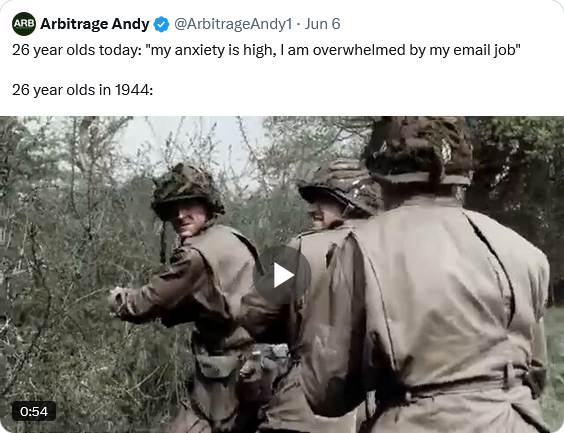
I don’t know if @ArbitrageAndy1 is a Boomer, but here he gives us a mashup of two classics from the Boomers’ greatest hits, “Younger Generations Suck”, and “The Television Never Lies to Me”.
It’s a jaunty little tune, and you can sing in it the shower, but the lyrics don’t actually make much sense.
Back in the real world, which younger generations actually have to live in, and where the television seldom tells the truth, WW2 was fought, on both sides, by guys even younger than 26.
And they were terrified.
The stress of combat against a peer adversary is overwhelming. It’s unendurable. But you endure anyway, because there you are, it’s happening to you, and you’re not getting out of it.
So you actually do have those little moments that Boomers would describe as stress meltdowns if they happened at work. You have them, and you do what you need to do anyway. Sometimes at the very same moment while you are melting down.
When you’re in this kind of war, there’s something terrible in front of you. In reality, that terrible thing is just as young and scared and overwhelmed as you are, but it sure doesn’t feel that way to you.
However, you also have something behind you, and something around you.
Behind you, you have a tribe that accepts and appreciates you. They know they sent you to hell, but they did it because hell was necessary, not because hell was fine. No one is gaslighting you pretending that everything is okay and that any problems you have are personal character flaws.
Around you, you have bros. They’re exactly where you are, doing exactly what you are doing, and they know how much it sucks. You’ve entrusted your lives to each other, and carried each other through things you don’t wanna talk about in your letters home.
Under intense stress and fear and exhaustion, your horizons shrink. You might have signed up for duty and patriotism and high ideals, but when you’re fighting, you fight to save the man next to you. And he fights to save you.
This is a very different experience than being isolated in a society that’s turned against young people, especially young men, especially young White men.
I won’t pretend it’s as difficult as fighting the Waffen SS. But young men fought the Waffen SS together.
They have to face the dissolution of the West alone.
That’s why they are anxious. Everything around them is not just going to shit.
It’s being systematically and deliberately turned into shit by powerful people who want them dead and replaced by someone else who will work cheaper and doesn’t expect to have a share of political power and a nice house and a retirement pension.
But I suppose Andy can still go ahead and dunk on them for clicks and a twenty-three dollar check from Twitter. That’s the fun thing about the fall of the West. Everybody gets a swing of the sledgehammer.
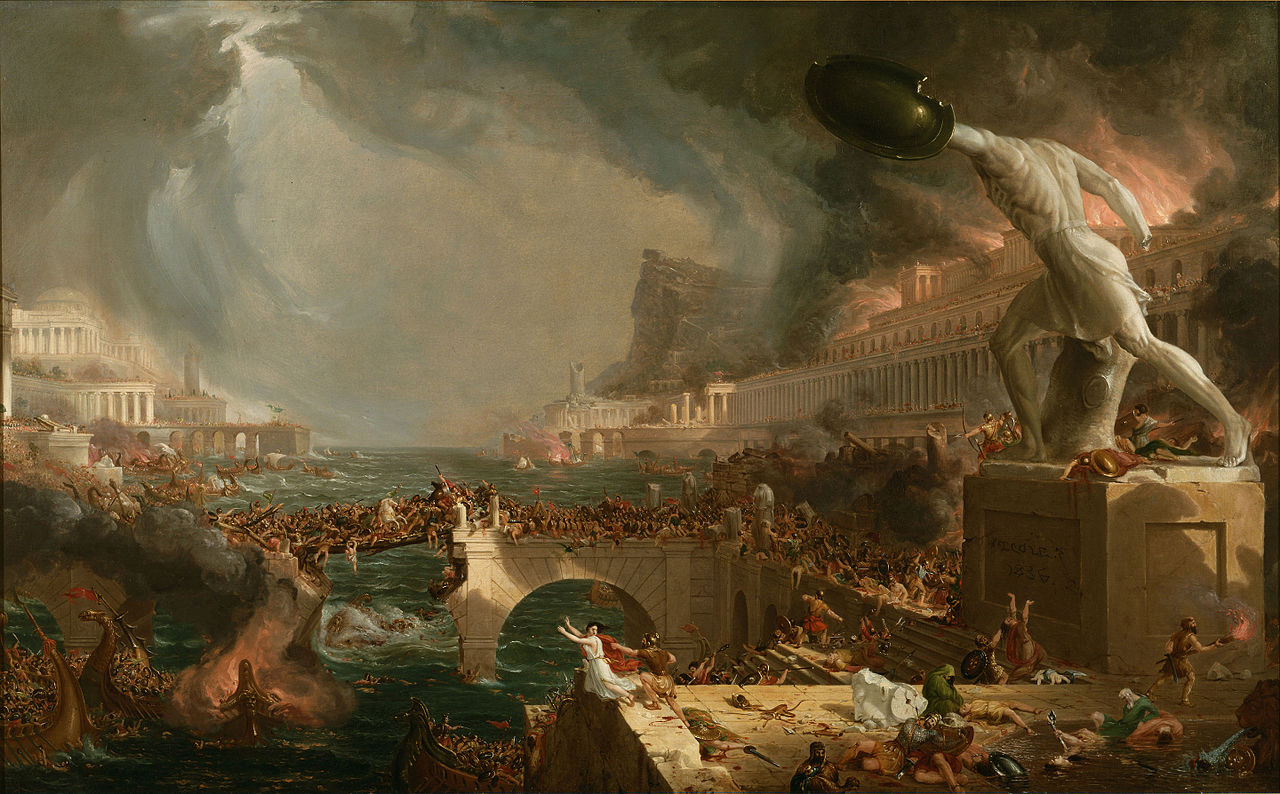
The Course of Empire – Destruction by Thomas Cole, 1836.
From the New York Historical Society collection via Wikimedia Commons.
The First Red Dot Sights: Aimpoint Electronic, MkIII, and Aimpoint 1000
Forgotten Weapons
Published 17 Jan 2026Today we are looking at the first commercial red dot optic, and its successors. In 1975, Aimpoint released the Aimpoint Electronic, a collimating optic using an LED as a light source. It was intended for the hunting market, where an unmagnified optic that could be used with both eyes open offered a significant improvement over traditional magnified optics for short-range moving targets. The sight proved popular, and led to a second generation in 1978 with an improved mount. In 1983, a third generation (the MkIII) was introduced. This model was zeroed by moving the collimating lens inside the optic, instead of moving the whole optic on its base as on the previous models.
In 1985 Aimpoint released their first optic that mounted in standard scope rings, the Aimpoint 2000. However, they continued to market and develop the initial family of optics as well, releasing the Aimpoint 1000 in 1987. This pattern was still very popular with hunters, and offered a lower mounting position than possible with scope rings. Ultimately the ring-style models became much more popular and the Aimpoint 1000 was the last of its type offered by the company.
How Red Dot Sights Work: • How Red Dot Sights Work (What is a Collima…
(more…)
QotD: Barbarism
Sometimes I worry that I’m turning into that guy but for barbarians. One of the very first reviews I wrote here was of James Scott’s The Art of Not Being Governed. That book is about the peoples who inhabit the rugged and hilly region of Southeast Asia known as Zomia, centered around the border between China and Laos. Scott is interested in the practices employed by the “barbarians” — the hill people — to resist domination by the much more numerous and organized “civilized” people living around them. He argues that many of the negative associations we have with barbarism — illiteracy, itinerancy, cousin marriage, religious messianism, and so on — are actually either deliberately adopted or emerge out of a process of cultural evolution that’s optimizing for ungovernability.
Zomia was an effective refuge from the state (in fact it still is — Dan Wang has a beautiful essay about fleeing to the exact same area to escape China’s zero-COVID policies). But what really stuck in my head from Scott’s book was the idea that barbarism is mostly a state of mind and a set of social practices and habits that could be employed anywhere. To be a barbarian is just to recognize that the world is full of forces vastly more powerful than you and coldly indifferent to your survival, be they criminal gangs, nation states, multinational corporations, fanatical social movements, artificial intelligences, or plain old egregores. When one of these entities turns its baleful gaze upon you, your options are to submit and be consumed, or go down fighting in a pointless last stand. But the barbarian chooses a different path — he hides in plain sight, adopts protective coloration, stays on the move, becomes an extremophile clinging to the marginal biomes and the “debatable lands”: a minnow living in crevices too poor and too narrow to interest the leviathans. And if worst comes to worst and he finds himself facing one of those monsters, then he makes himself as indigestible and unappealing a meal as he can manage.
That all sounds great, so why doesn’t everybody do it? The reason is that to be a barbarian carries serious costs. Some of those costs are material: the leviathans of the state, the corporation, etc., aren’t interested in your barbarian biome for a reason (probably because it kind of sucks). Other costs are intellectual and cultural: to be a barbarian is often to have no history or education (it can be used against you), and barbarian societies are often crippled and debased as a result. And some of the costs are psychological and spiritual: to live as a barbarian is to live as a hunted prey animal, always with a wariness verging on paranoia, building a protective shell around you that can make normal human relations even with close family impossible. Last year I read and reviewed the memoir of a modern American barbarian that makes all three of these forms of poverty all too apparent.
John Psmith, “REVIEW: Imperial China, by F.W. Mote”, Mr. and Mrs. Psmith’s Bookshelf, 2025-02-24.
- It isn’t actually ducks.
June 10, 2026
The Korean War Week 103 – The Outpost War – June 9, 1952
The Korean War by Indy Neidell
Published 9 Jun 2026The US 45th Division launches Operation Counter in the field this week, to take some enemy outposts, Bull Boatner finishes his plans for his operation to take total control at Koje-Do POW Camp, and in the US, the Presidential primary season finishes, though it’s still anybody’s guess who the actual Democratic and Republican candidates will be.
00:00 Intro
01:21 Recap
01:52 Primary Season
05:18 Operation Counter
09:20 Communist Artillery
12:09 Boatner
20:10 Summary
20:20 Conclusion


