
Everyone in America knows “Yankee Doodle”. That is a remarkable thing to be able to say about any piece of music, let alone one written in the middle of the eighteenth century by a British army surgeon who meant it as an insult. Most of us learned it before we learned to read. It arrives through some combination of school, parade, ice cream truck, and the ambient cultural air of the American summer, and by the time you can name it you already know it. You know the melody before you know the words, and you know the words before you know what any of them mean. A feather. A pony. Macaroni. A young man coming to town. It is the most familiar song in the American songbook and also, when you actually look at it, one of the strangest.
[…]
Which is how we ended up with a patriotic standard that is also a death threat, a sodomy joke, a farm boy’s account of watching grown men handle their enormous guns with mounting enthusiasm, and the song we teach five year olds at Fourth of July parades. All of this has been inside the song the whole time. I want to walk through what is actually in there, because once you can see it you cannot stop seeing it, and I think we owe the song more than we have been giving it.
Start with the title, because the title is already doing two things at once. “Yankee” is almost certainly from the Dutch Janke, a diminutive Dutch settlers in New York used to mock their English neighbors. The British army picked it up as convenient shorthand for a provincial American. A rube. A man of no consequence. “Doodle” meant fool, from the German dudel, and this is the part that makes it into the elementary school music program. The part that does not is that “doodle” was also eighteenth-century British slang for a penis. Both meanings were in active circulation. Neither was obscure. When the British handed this song to their regulars as a marching tune intended to demoralize the enemy, they were calling the colonists provincial idiots and, on a second pass, Yankee dicks. The American troops heard the title and, in the great tradition of men who have already stopped caring what anyone thinks of them, said yes, that one, put it on the flag.
The first thing the song was is a threat.
Yankee Doodle’s come to town / For to buy a firelock / We will tar and feather him / And so will we John Hancock.
British soldiers were singing verses like this one in the run-up to Lexington. Tar and feathering was not a prank. It was a ritual. Men were stripped, had boiling pine tar poured directly onto bare skin, rolled in feathers while the tar was still cooling, and paraded through town as public spectacle. The skin came off with the tar. Some victims died in the days that followed from shock and from infections in the raw flesh. The British soldiers are singing about doing this to a specifically named man. John Hancock. The wealthiest man in Boston, already on London’s list for arrest. “So will we John Hancock” uses his name as a verb. We will do this to him. We will use his body to make a point.
The soldiers singing this were on their way to arrest him. They missed. Hancock got through Lexington, made it to Philadelphia, and in the summer of the following year signed the Declaration of Independence in letters so large that his name became, in English, the common noun for a signature. The verb became the noun. We will destroy you publicly became I was here, I did this, come and get me. The song that had been a mob-violence threat against a living dissident was now, a year later, being sung by the men who had saved him as they mustered for the same war. The target of the verse became the architect of the country that kept the verse. This is the first transformation the song undergoes and it is not subtle. It is also not the last.
The second thing the song is is a sodomy panic. He stuck a feather in his cap and called it macaroni. Every American schoolchild has been told this means the colonist was too stupid to know what fashion was. That is the sanitized reading. The full reading requires understanding what the Macaroni Club was. Young English aristocrats came back from the Grand Tour in Italy wearing wigs so tall they required structural adjustment to pass under a doorframe, corseted coats, embroidered slippers, and Continental affectations so pronounced the London press began printing caricatures of them within the year. “Macaroni” meant dandy, in the same dictionary-accurate way “doodle” meant fool. Technically correct. Missing the entire point.
The point is that the Macaroni Club had become, by the 1770s, a convenient public container for British anxieties about male effeminacy, foreign moral contamination, and sodomy. The caricatures drew them in pinched silhouettes and muffs, in poses the London audience was supposed to read as unmistakably queer. The courts were not caricaturing. They were prosecuting. Men were pilloried. Others were executed. The word “macaroni” was carrying the weight of active criminal cases at the exact moment “Yankee Doodle” was being composed. A British army surgeon named Richard Shuckburgh is the likely author of the most famous macaroni verse, and what he wrote was a joke with a second floor. On the ground floor: the colonial rube does not know what high fashion is and mistakes a single feather for an entire wardrobe. On the second floor: the colonial rube has just put on the signifier of a group of men the British state is currently prosecuting for sodomy, and he does not realize what he has announced himself as. He is a joke to the troops singing the song, and the joke is that he is queer and does not know it.
The colonists heard all of this and kept the song anyway. The British were banking on a shame that had already dissolved. You cannot humiliate a people that has stopped needing your approval. The song arrived as an instrument of British contempt, and the colonists adopted it anyway, and from that moment on it stopped being a British song and started being something else. A vessel. Whatever the singer needed it to carry, the song carried. That is the reclamation, and it is also the engine of everything that happens to the song from here.
Emma, “Yankee Doodle, Undressed”, Past Life, Present Cleavage, 2026-04-22.
July 4, 2026
QotD: “Yankee Doodle”
July 3, 2026
1977 – when the French intelligentsia rallied to protect pedophiles
On the social media site formerly known as Twitter, Brivael Le Pogam poinpoints the formal attempt to turn criminal pedophilia into academically supported individuals with “Minor Attraction” (translated from the original French by X):

In 1977, a petition appeared in Le Monde and Libération. It called for the decriminalization of sexual relations between adults and children aged thirteen. Look at the signatures. Foucault. Derrida. Sartre. Beauvoir. Barthes. Deleuze. Guattari. Lyotard. Sollers. The entirety of the French intellectual aristocracy, the very same that would go on to colonize Yale and Berkeley, gathered under a text that pedantically explains that the child is capable of consenting.
This is not an anecdote. It is the proof.
A few days ago, I wrote that French Theory rested on a single thesis: there is no truth, there are only relations of power. I was told I was caricaturing, that these men were too subtle to be reduced to a slogan. Very well. Then let us observe what subtlety produces when pushed to its extreme.
If every norm is merely domination in disguise, then the prohibition protecting childhood is a form of domination like any other. If every truth is a construction, then innocence is a construction. If every desire is worth every other because no law is legitimate, then there is no longer any reason to defend the most elementary boundary that a civilization has ever established. They did not sign this petition despite their philosophy. They signed it because of it. It was the logical conclusion of the system. They simply had the imprudence to write it down in black and white, before their American heirs learned to wrap the same logic in more cautious vocabulary.
This is the man still taught in undergraduate courses. This is the thinker still cited with reverence at conferences. The one who, in 1977, thought the law protected children a little too much.
A thought is judged by what it makes possible. A thought that, when it reaches its term, no longer knows how to say why one does not touch children is not a subtle thought. It is a dead thought. And a civilization that continues to teach it with deference is not subtle either. It is complicit.
One does not deconstruct innocence. One protects it. It is even more or less the only thing one has no right to fail at.
Beef Bourguignon for the French Peasants from 1885
Tasting History with Max Miller
Published 6 Jan 2026Stewed beef in red wine sauce with onions
City/Region: France
Time Period: 1885Originally a peasant dish, early beef bourguignon was a sauce for leftover stewed beef. Elevated and popularized by the father of French haute cuisine, Auguste Escoffier, it shortly thereafter made the transition from a sauce to stew, and beef bourguignon was further popularized by cooking icon Julia Child.
This recipe from 1885 is for the sauce version, and it is just as delicious as the modern stew. It’s a little more wine-forward and a little less sweet, the meat is fall-apart tender, and the onions are my favorite part. If you have some leftover cooked beef like a roast or short ribs, this sauce is a great way to jazz it up. Otherwise, make the stewed beef as instructed in the recipe below because the sauce is absolutely worth it.
Boeuf Bourguignonne
Brown a piece of pork belly, diced, in butter; add a little flour, salt, and pepper, and add a mixture of half broth and half red wine; add a few small white onions, well peeled; let cook for 20 minutes, then add to this sauce your stewed beef, cut into slices. When the meat is well heated through, serve with the sauce.
— La Bonne Cuisine Pour Tous ou l’Art de Bien Vivre a Bon Marché by Marcel Butler, 1885
QotD: Matthew Josephson’s The Robber Barons
During the 1920s, after graduation, Josephson became a journalist, an expatriate to France, and, after his return, a part of New York’s literary elite. He and Beard reconnected in 1930, and the mentor urged his student to write a book denouncing the men who had launched America’s industrial power. “Oh! those respectable ones”, Beard said of America’s capitalists, “oh! their temples of respectability — how I detest them, how I would love to pull them all down!” Happily for Beard, Josephson was handy to do the job for him. Josephson dedicated The Robber Barons to Beard, the historian most responsible for the book’s contents.
Josephson began research for his book in 1932, the nadir of the Great Depression. Businessmen were a handy scapegoat for that crisis, and Josephson embraced a Marxist view that the Great Depression was perhaps the last phase in the fall of capitalism and the triumph of communism. In a written interview for Pravda, the Soviet newspaper, Josephson said he enjoyed watching “the breakdown of our cult of business success and optimism”. He added, “The freedom of the U.S.S.R. from our cycles of insanity is the strongest argument in the world for the reconstruction of our society in a new form that is as highly centralized as Russia’s …”
Though not a member of the Communist Party, Josephson co-authored an open letter of support for the Communist Party candidates for President of the United States in 1932. “We believe”, the letter said, “that the only effective way to protest against the chaos, the appalling wastefulness, and the indescribable misery inherent in the present economic system is to vote for the Communist candidates”.
Josephson traced the troubled capitalist system of the 1930s back to the entrepreneurs of the late 1800s. Thus, by explaining what he thought was the wasteful, greedy, and corrupt development of steel, oil, and other industries under capitalism, Josephson was explaining to readers why the Great Depression was occurring. “I am not a complete Marxist”, Josephson insisted, “But what I took to heart for my own project was his theory of the process of industrial concentration, in Vol. 1 of [Marx’s] Capital, which underlay my book”.
Josephson never intended to write an objective view of American economic life in the Gilded Age. He did little research and mainly used secondary sources that supported his Marxist viewpoint. As he had written in the New Republic, “Far from shunning propaganda, we must use it more nobly, more skillfully than our predecessors, and speak through it in the local language and slogans.” Thus he wrote The Robber Barons with dramatic stories, anecdotes, and innuendos that demeaned corporate America and made the case for massive government intervention.
Burton W. Folsum, “How the Myth of the ‘Robber Barons’ Began — and Why It Persists”, Foundation for Economic Education, 2018-09-21.
July 2, 2026
Reining in the administrative state – Humphrey’s Executor overruled by the Supreme Court
One of the two US Supreme Court rulings this week that sparked controversy was the court’s decision to overrule a 1935 precedent that enabled the growth of the administrative state:

Panorama of the west facade of United States Supreme Court Building at dusk in Washington, D.C., 10 October, 2011.
Photo by Joe Ravi via Wikimedia Commons.
The Supreme Court this week restored an old-fashioned constitutional idea: if a principal federal officer exercises executive power, the president must be able to remove him. The justices’ 6–3 ruling in Trump v. Slaughter, which struck down a law prohibiting the president from firing members of the FTC except for cause, is the logical endpoint of a 15-year series of cases that have steadily chipped away at Humphrey’s Executor, the 1935 decision that blessed for-cause removal protections for the heads of so-called independent agencies.
The Court didn’t mince words. Chief Justice John Roberts wrote that “Humphrey‘s framework, in short, has not withstood the test of time”. Then came the sentence that will launch a thousand administrative-law articles: “If anything more is left of Humphrey‘s, we overrule it”. The New Deal compromise that invented quasi-legislative agencies has finally met Article II of the U.S. Constitution.
That’s good, because the Federal Trade Commission isn’t a debating society. It, along with its alphabet-agency brethren, writes rules with the force of law, investigates private parties, adjudicates violations, and sues in federal court on behalf of the United States. Whatever labels Congress attached to that body in the Progressive Era, the FTC — like the FCC, SEC, NLRB, and so on — today exercises executive power. And the Constitution vests “the executive power” in one president, not in commissioners serving staggered terms, answerable to no one whom voters can fire.
This ruling isn’t a gift to Donald Trump or his successors. It’s a restoration of constitutional accountability. Congress can create executive-branch agencies and specify what they may do, but it cannot create a fourth branch of government and then pretend its officers are independent of the only person the Constitution makes responsible for executing federal law.
Roberts put the point crisply at the end of Slaughter: “Subordinates who exercise the President’s power are subject to removal by him”. That’s a unitary, not an imperial, presidency, and it’s a hallmark of republican government. The president remains constrained by statutes, appropriations, courts, Congress, elections, and the Constitution itself. If the people dislike how the FTC enforces the law, they should be able to blame — and replace — the president, not chase a goulash of insulated mandarins.
Justice Neil Gorsuch’s concurrence adds the important next step. Killing Humphrey’s Executor doesn’t cure every constitutional disease in the administrative state. It simply reallocates the power Congress poured into independent agencies. As Gorsuch warned, “the fourth branch’s powers still exist; they have just been reassigned to the President”. If agencies possess vast legislative and judicial authority, the answer isn’t to hide those powers from presidential control, but to restore legislative powers to Congress. Make Congress great again!
PBS-1 Soviet AK Silencer (the Original, not the Dead Air One)
Forgotten Weapons
Published 13 Feb 2026The Soviet Union had made fairly extensive use of silencers on Mosin Nagant rifles during World War Two, as tools for snipers and recon scouts among others. In the mid 1950s a new silencer was put into development for the new 7.62x39mm family of weapons, called the PBS (Прибор Бесшумной Стрельбы; Pribor Besshumnoi Strelyby; Silent Shooting Device). This was originally intended to be a multi-weapon silencer, but the abandonment of the SKS and reliability problems with the RPD led to it being limited to just the AK. Compared to the Mosin Nagant silencers, this new design was much more difficult, as it had to allow the rifle to cycle reliably using specialized subsonic ammunition, and also continue to run reliably with the silencer removed and standard ammunition used. This led to the most unusual element of its design; a thick rubber wipe just in front of the muzzle to help boost back pressure.
The remainder of the design was pretty simple, with 12 plain flat plate baffles. The first production PBS model used a clamshell main body, but this was replaced by a solid tube on the PBS-1 improved model in 1962. These suppressors were used until the late 1970s, when the 9x39mm cartridge was developed for better subsonic effectiveness, along with a number of unique new firearms designed for it.
Bramit Suppressor for Mosin Nagant: • Soviet WW2 Bramit Silencer for the M91/30
(more…)
QotD: The US federal election of 1848 and the resulting inevitability of the US Civil War
The Democrats’ candidate, Lewis Cass, pushed the idea of “popular sovereignty” in the territories. It wasn’t a bad move — since California was the only soon-to-be-state up for grabs, and since some parts of California are above the Missouri Compromise line, let them decide the terms on which they want to enter the Union. The problem with that, obviously, is that the Senate could become radically unbalanced very quickly, depending on how fast the rapidly-expanding population of the territories got their act together. Iowa and Wisconsin had just entered the Union (1846 and 1848, respectively), as free states under the Compromise. They were counterbalanced by Florida and Texas (both 1845), but obviously the balance was very delicate.
Cass was of course defeated (by Mexican War hero Zachary Taylor), so wrangling over California continued. Taylor wasn’t the greatest leader anyway, and when he died in office he was replaced by everyone’s favorite placeholder, Millard Fillmore. Fillmore gets an undeserved rep for incompetence; in reality, he was exactly the kind of president the Second Party System was designed to produce, even though he was never elected to the office. Most real political power before the Civil War was at the state level, so the President was supposed to be the steward and figurehead of his Party, not a strong national leader. (You can still see echoes of this as late as the early 20th century — William Howard Taft supposedly said “I forgot I ever was President;” he was much more concerned with his reputation as Chief Justice of the Supreme Court).
But slavery was a federal issue, indeed THE federal issue. In the absence of strong leadership at the top — and again, in all fairness to Fillmore and the rest, the system was designed to prevent strong Presidential leadership — it fell to Congress. Which a) is where it should’ve been, under the federal system the Founders designed; but b) meant that it was guaranteed to be a cock-up, because like all debating societies Congress was dominated by Very Clever Boys.
Worse, the immediate antebellum Congresses were dominated by the Very Cleverest Boy of them all, Stephen Douglas. I don’t think there has ever been a Cleverer Boy in American politics than Stephen Douglas, which is really saying something. (A case could be made for Lyndon Johnson, I suppose, and look how that turned out). Douglas’s signature “legislation” was the Compromise of 1850, which did a lot of things, including bringing California into the Union as a free state. It’s easy to get lost in the historical weeds here, so I’m keeping this deliberately superficial. Here are the highlights:
First, it’s important to note that nobody except Stephen Douglas knew they were voting on “the Compromise of 1850”. You have to hand it to the bastard, it’s a really slick piece of politics. He put together a whole bunch of bills, horse-trading parts of each of them among the competing factions to cobble an overarching program together. Nobody would’ve voted on an omnibus bill called “The Compromise of 1850”, but when the dust settled and all the votes were tallied on a bunch of separate measures, that’s what emerged.
Second: Douglas swiped Lewis Cass’s idea of “popular sovereignty” for the new territories (New Mexico and Utah) carved out of the Mexican Cession. At the time, this looked like a band-aid, a procedural quick-fix — those territories wouldn’t be coming into the Union as states anytime soon, and since cotton doesn’t grow so well in the desert it didn’t matter that much anyway. “Popular sovereignty” was just a way to kick the can down the road. Please note, however, that now the precedent was set: The Missouri Compromise is now officially a dead letter, though nobody will come right out and say it.
Third: The Fugitive Slave Act essentially federalized slave-catching. The details aren’t important; the principle is. The US government is now officially the enforcement arm of what many folks were openly calling “the Slave Power Conspiracy”.
Fourth: What looked like a purely symbolic measure, outlawing the slave trade in Washington DC. Here again, we misunderestimate the power of symbols at our peril. The practical effect of this was nil, since DC is tiny and if you wanted to buy slaves, the big markets literally right across the road in Maryland and Virginia would be happy to sell you some. But look at the glaring contradiction — Federal marshals can (and will, and did) dragoon local law enforcement into catching runaway slaves on the planters’ behalf, but the slave trade itself is outlawed in the Capitol’s sacred precincts, because freedom.
The term “fake and gay” hadn’t been invented yet, but since the Compromise of 1850 was the product of the Very Cleverest Boy of all, it was by definition fake and gay, and you can see it clearly with the DC slave trade ban.
So Very Clever was he, that he torpedoed his own signature achievement just four short years later in order to make a buck. Some Chicago railroad boys had him on the payroll, and while the details of the Kansas-Nebraska Act don’t matter, the principle very much does. Remember “popular sovereignty?” It didn’t matter in Utah or New Mexico; it mattered very much in Kansas, where fanatics from both sides flooded into the territory in order to vote.
Think about what kind of guy would uproot his entire life to move across state lines just to vote on shit, and Bleeding Kansas suddenly makes sense.
Here again, one is tempted to blame the President for not showing leadership, and Franklin Pierce and James Buchanan have well-deserved reps as do-nothings … except again, “doing nothing” was pretty much the President’s job description back then. That’s not to let them entirely off the hook — James Buchanan was very much a Current Year Democrat, in that even though he wouldn’t actually take any action he couldn’t stop shooting his mouth off; you have to get well into the 20th century to find a major political figure who stepped on his own dick as hard and as often as James Buchanan.
Finally, the coup de grace, the Dred Scott decision. I’m going to stop with this one, because even though things like John Brown’s Raid and the Caning of Sumner are important, they follow, as it were, from the logic laid down by Dred Scott. Some kind of Really Bad Shit was inevitable after that ruling; the precise form of the Really Bad Shit was incidental (n.b. the Caning of Sumner preceded Dred Scott (May 1856 vs. March 1857), but they were very much of a piece).
Here again, it’s easy to get lost in the details, so here are the two big takeaways:
First, Dred Scott was decided correctly as a purely legal matter. The issues surrounding the case were as broad as possible, but the narrow issue at law was this: In granting Dred Scott standing to sue in a federal court, the State of Missouri had implicitly granted him United States citizenship, which is the sole prerogative of Congress. It’s in the Constitution and everything, and back then the guys on the Supreme Court actually bothered to read the fucking thing, so they ruled against Scott on those very narrow grounds (from which all else flowed, legally).
But that’s the second big takeaway: Chief Justice Roger Taney didn’t stop there. If you only got Dred Scott in school, you got the stuff Wiki spends most of its time on — the whole bit about Taney ruling that blacks aren’t, and never can be, citizens of the United States. But the truly important part is this:
Now, … the right of property in a slave is distinctly and expressly affirmed in the Constitution. … Upon these considerations, it is the opinion of the court that the act of Congress which prohibited a citizen from holding and owning property of this kind in the territory of the United States north of the [36°N 36′ latitude] line therein mentioned, is not warranted by the Constitution, and is therefore void.
In other words, not just the Missouri Compromise, but the Compromise of 1850, and indeed the very possibility of compromise over slavery, is now officially unconstitutional. Slavery is now de facto legal everywhere in the United States, because any law prohibiting it runs afoul of the 5th Amendment as interpreted by Dred Scott.
What other outcome could there be at that point? Flip the script in 1860 — let the Democrats have their shit together, and the Republicans split three ways. Stephen Douglas is now President, and while that’s a truly horrifying prospect (never, ever let a Very Clever Boy occupy the big chair), the outcome would’ve been the same, or near enough — it’d be the Yankee fanatics in the North seceding, not the Slave Power Conspiracy in the South, but somebody was calling it quits.
Severian, “1846-1861”, Founding Questions, 2022-06-25.
July 1, 2026
The Korean War Week 106 – The Battle of Old Baldy – June 30, 1952
The Korean War by Indy Neidell
Published 30 Jun 2026On the ground, the fight for the hilltop they call “Old Baldy” really heats up this week, and it’s a bloody one. In the air, the bombing campaign to destroy the North Korean hydro-electrical complex continues, and the Suiho dam, one of the world’s largest, is put out of action and the power is out across much of the country.
00:00 Intro
00:45 Recap
01:14 Suiho Dam
05:22 Old Baldy
09:04 Army Budgets
14:29 Planning a coup?
16:08 Summary
16:22 Conclusion
17:10 Call to Action
Scholarship replaced by elitist gatekeeping and bad faith
It is possible — in fact, essential — to discover and disseminate the facts about Indian Residential Schools. Repeating the unproven (and to many, deeply discredited) narrative and denouncing those seeking the facts as “denialists” has nothing to do with scholarship but it’s very much in line with gatekeeping:
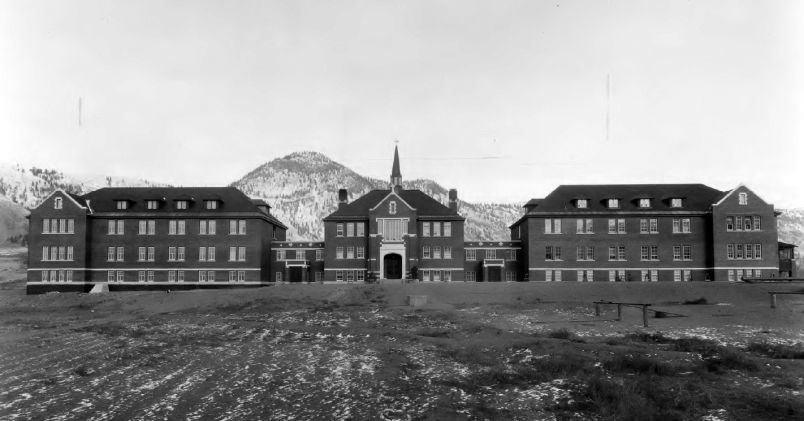
Kamloops Indian Residential School, 1930.
Photo from Archives Deschâtelets-NDC, Richelieu via Wikimedia Commons.
Let’s be honest about what is happening in this video.
This is not academic debate. It is a character attack dressed up as scholarship.
Dr. Travis Hay’s presentation at Mount Royal University, uploaded by Frances Widdowson under the title “Bad Faith: Residential School Denialism and the Academy”, is deeply disappointing. I expected a serious lecture. I expected evidence, argument, and a careful dismantling of claims he believes are wrong.
Instead, what we get is a bad faith lecture.
So yes, Bad Faith is a good title. Just not for the reason Hay thinks.
The real bad faith is pretending to defend scholarship while avoiding the hard work of open debate.
Hay spends much of the lecture drawing a line between “good faith” and “bad faith” criticism. But his standard for good faith appears to be simple: you may disagree only inside the boundaries of the approved framework. You can quibble over details. You can adjust the margins. You can offer polite corrections.
But if you challenge the premise itself, suddenly you are no longer mistaken. You are morally defective. You are a “denialist”, a “grievance merchant”, or some broken person who must be pushed outside respectable academic life.
That is not scholarship. That is gatekeeping.
None of this requires minimizing the real harm done by residential schools. It simply means historical claims should be open to examination. Evidence should be tested. Terms should be defined. Numbers should be scrutinized. Arguments should be answered.
Instead, Hay leans heavily on moral outrage, personal denunciation, and guilt by association. Rather than carefully taking apart Widdowson’s arguments, he drags in old controversies involving other people, uses emotional anecdotes, and builds a mood where the audience is being told what to feel before they are allowed to think.
The most revealing part is the conclusion. Hay says people like Widdowson do not belong in the academy. In other words, the answer to uncomfortable academic work is not better evidence, better reasoning, or open debate. It is expulsion.
That should bother everyone.
A university that cannot tolerate dissent is not protecting knowledge. It is protecting doctrine.
If Widdowson is wrong, prove it. Debate her. Bring the evidence. Take her claims apart in public. That is what serious scholars are supposed to do.
But when the response is censorship, exclusion, and personal insult, it starts to look less like confidence and more like fear.
I came away from viewing this lecture disappointed. Not because Hay disagrees with Widdowson. Disagreement is the whole point of academic life. I was disappointed because the lecture showed so little faith in the public’s ability to hear competing arguments and judge the evidence for themselves.
This lecture does not prove that Widdowson’s arguments are wrong. It proves that parts of the academy no longer know how to handle a serious challenge without reaching for moral panic and professional exile.
Elleander Morning: Causes vs Catalysts
Feral Historian
Published 6 Mar 2026Elleander Morning (Jerry Yulsman) is a peculiar bit of alt-history, brilliant in some ways and immensely clunky in others. It’s a story of a war averted, or perhaps only postponed, and it plays with some fundamental questions of history.
00:00 Intro
02:30 Implications left hanging
03:29 The Books
06:15 The New Catalyst
12:06 Gaming the Past
13:04 Concluding Musings
(more…)
June 30, 2026
Sparta vs Athens 2(d): Athenian Freedom – Drama, Free Speech, Trade, and the Economy
seangabb
Published 8 Feb 2026Greece: A Brief History, c.700 BC – 500 AD
This final segment links culture to economics and asks what Athenian “freedom” actually looked like in practice. Drama was not a private pastime. It was a civic institution performed before the citizen body. Comedy could be brutally obscene and politically personal, naming living leaders on stage — evidence of a public culture far less timid about speech than most modern states.
From there I move to Athens as a maritime power: trade, grain dependence, Piraeus, coinage, state pay, and the economic dynamism that supported participation in Assembly and law courts. The images on the slides matter here: artefacts and “industrial art” show what Athens valued in daily life.
I end by returning to Sparta’s deliberately restrictive economy — iron currency, limited trade, enforced uniformity — and why that system could produce discipline but not lasting intellectual fertility.
This is also where I state plainly what we owe to Athens.
QotD: Karl Marx and Friedrich Engels
Marx himself was an odious individual. An unkempt scrounger and a savage polemicist, he liked to boast that his wife was “née Baroness von Westphalen” but was not above siring an illegitimate son by their maidservant. On the sole occasion when he applied for a job (as a railway clerk) he was rejected because his handwriting was so atrocious. He sought to play the stock market but was hopeless at it. For most of his life he therefore depended on handouts from Engels, for whom socialism was an evening hobby, along with foxhunting and womanizing; his day job was running one of his father’s cotton factories in Manchester (the patent product of which was known as Diamond Thread). No man in history has bitten the hand that fed him with greater gusto than Marx bit the hand of King Cotton.
The essence of Marxism was the belief that the industrial economy was doomed to produce an intolerably unequal society divided between the bourgeoisie, the owners of capital, and a property-less proletariat. Capitalism inexorably demanded the concentration of capital in ever fewer hands and the reduction of everyone else to wage slavery, which meant being paid only “that quantum of the means of subsistence which is absolutely requisite to keep the laborer in bare existence as a laborer”. In chapter 32 of the first tome of Capital (1867), Marx prophesied the inevitable denouement:
Along with the constant decrease of the number of capitalist magnates, who usurp and monopolize all the advantages of this process of transformation, the mass of misery, oppression, slavery, degradation and exploitation grows; but with this there also grows the revolt of the working class …
The centralization of the means of production and the socialization of labor reach a point at which they become incompatible with their capitalist integument. This integument is burst asunder. The knell of capitalist private property sounds. The expropriators are expropriated.
It is no coincidence that this passage has a Wagnerian quality, part Götterdämmerung, part Parsifal. But by the time the book was published the great composer had left the spirit of 1848 far behind. Instead it was Eugene Pottier’s song “The Internationale” that became the anthem of Marxism. Set to music by Pierre De Geyter, it urged the “servile masses” to put aside their religious “superstitions” and national allegiances and to make war on the “thieves” and their accomplices, the tyrants, the generals, princes and peers.
Niall Ferguson, “Capitalism, Socialism and Nationalism: Lessons from History”, 2020-02.
June 29, 2026
“The state of 24 Sussex Dr. [is] a painfully obvious symbol of broader Canadian dysfunction”
For the vast majority of my readers, the address “24 Sussex Drive” might as well be “99 Sunset Strip” or “12 Grimmault Place”, but it’s a real place with some minor importance to Canadians: it’s the official residence of the Prime Minister of Canada. It’s also, famously, a dump (rather like the country has been allowed to become). It finally reached the point of structural decrepitude that the current and previous PMs never bothered to move in. Now, as related in the free-to-cheapskates portion of The Line‘s weekly dispatch, it’s supposed to be renovated.

The official residence of the Prime Minister of Canada, 24 Sussex Drive, as seen from the Ottawa River. Ottawa, Ontario, Canada. (La résidence officielle du Premier ministre du Canada 24, promenade Sussex vu de la rivière des Outaouais).
Photo by sookie via Wikimedia Commons.
Hallelujah.
We’re responding to the announcement on Friday that the Canadian government will finally deal with the mess that is 24 Sussex Dr., the official residence of the Prime Minister of Canada (at least in theory). Successive Canadian prime ministers have refused to spend the money necessary to keep the building, which dates to the 1860s, in a state of good repair. PM after PM has been too terrified of the optics of spending taxpayer money on their own mansion.
Rather than solve this problem like a grown-up country by pushing control of a reasonable maintenance budget to a non-political body — something like the National Capital Commission, come to think of it — we instead simply sat around and allowed the building to decay to the point where it was no longer habitable. Stephen Harper and his family gritted their way through their time there. Justin Trudeau and his family never bothered moving in, settling instead at Rideau Cottage, on the grounds of the Governor General’s residence.
Mark Carney, God bless him, has decided that enough is enough and it’s time to bite the bullet and just fix the damn thing.
We repeat: hallelujah.
We are actually fairly agnostic on one of the central debates here, namely whether the mansion should have been rehabilitated or simply knocked down and replaced. You can make the argument fairly either way. In making his announcement on Friday, Carney indicated that he had chosen rehabilitation because Canadians need to do more to stand up for their heritage and their history, and that includes 24 Sussex.
That struck us as an astute reading of where public sentiment is, and a way to buy at least partial political cover for what will remain controversial.
We were less impressed by the rest of what he announced. Instead of simply hiring a reputable firm to come up with a new design for the renovated building, getting some quotes and then proceeding directly, the government will instead dramatically overcomplicate things, as Canadian governments tend to do, by commissioning some kind of design competition to be overseen by eminent Canadian designers and architects. We wouldn’t be shocked if David Johnston shows up somehow. Louise Arbour is, of course, recently spoken for, but we’ll see if any other retired Supreme Court justices end up giving their design skills a whirl.
Renovated building this way is dumb. But we think the next part of what was announced was weirder, and certainly riskier for the government. To offset the costs, this will become something the government fundraises for.
Okay. We guess?
Hey, The Line has no problem with fundraising. (Ahem. See below.) But we aren’t a national government? The devil will be in the details here. If this is structured in a way that limits donations to Canadian citizens and residents, caps donations at a set dollar value, and includes strong transparency requirements, we guess it’s fine. Canadians have been feeling patriotic of late, especially boomers and Liberals. If the prime minister has figured out a way to offload the financing of this project onto them, we’ll find a way to live with that.
Gosh, there’s risk here. Will foreign donations be permitted? Corporations? If corporations are allowed, must they be Canadian? Will Canadian subsidiaries of foreign corporations be able to contribute? What about foreign governments? Will the future dining room of the official residence of the prime minister of Canada be brought to you by the People’s Republic of China? Will the front foyer be a gift of the people of Qatar?
We’ll see. Those details are still pending. We suspect, or at least hope, that the government was smart enough to foresee the optics of having the prime minister’s official residence sponsored by Brookfield Asset Management, to pick one example out of thin air.
So we don’t love the process, but we love that we’re at least doing this. The state of 24 Sussex Dr. has not only been a long-standing national embarrassment, it’s been a painfully obvious symbol of broader Canadian dysfunction. Taking care of the damn house, or fixing it or replacing it, is a really easy thing by the standards of the problems the federal government is often faced with. But both Stephen Harper and Justin Trudeau curled up into tiny little balls and melted into jelly instead of just doing their jobs and taking care of a national infrastructure asset. That they did this simply to avoid the optics of spending a little money on themselves and future prime ministers is easily understood through the lens of politics, but no less pathetic for it.
For the record, I have no problem with the government spending the money to maintain or even upgrade the PM’s official residence, but it’s been a political liability for so long that fixing the place up will likely be far more expensive than any amount of deferred maintenance might have cost if we’d just committed to keeping the place in good condition. I’ve always been puzzled why it isn’t in the purview of the National Capital Commision anyway, so that it wouldn’t become a cheap political point-scoring opportunity every time it springs a leak or needs a window pane replaced.
The Line editors also declare they’re on Team Art Deco against the anti-human monsters of Brutalist architecture and point out that there actually is a uniquely Canadian architectural style:
Look, if the decline of 24 Sussex had become symbolic of Canadian vices like dysfunction and cheapness, there was an opportunity here to signal symbolic virtues like decisiveness and seriousness by just — announcing the government was going to fix a known problem using an architect that Carney had personally approved. There is absolutely no reason to use this building as an opportunity to create a travelling roadshow of the country’s architectural “greatness” by holding a design competition that will produce 15 different varieties of the AGO Crystal or the Edmonton Public Tank/Library. To be blunt, this country’s talent pool in architecture is as shallow as every other cultural industry we can name. It can be summed up thusly; we produce the odd star in the field who moves elsewhere. What gets left behind is derivative government-funded schlock that allows us to keep up appearances and maintain our national illusions. Our ability to create world class art of any kind at present is right up there with our ability to build a pipeline, scale a company, or manage an efficient regulatory process. Our decline is a universal problem.
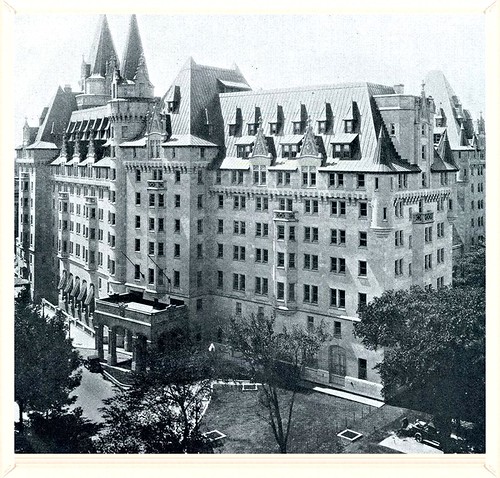
“Chateau Laurier, 1927 with the new extenstion” by Ross Dunn is licensed under CC BY-SA 2.0
.
Meanwhile, Canada already has a unique and rich architectural style that we should be using on all federal buildings intended to convey authority and heritage — it goes by many names, ranging from Railway Gothic, to neo-Chateau. It can be seen in beloved buildings ranging from the University of Toronto’s Hart House, to the aforementioned railway hotels that spread across the land. It’s turn of the century gothic revival meets French Chateaux and Scottish Kirk; romantic, a little ornate, and always grounded in the landscape and climate, and using the local materials. In other words, we already have a uniquely Canadian aesthetic language. We just stopped designing buildings this way when our cultural institutions decided that our history was a problem rather than the prima materia of our complicated national identity. We’ve been stuck with glass buildings and cheap concrete Soviet suicide boxes ever since.
And to be clear, we don’t think every Canadian building needs to look like it was built in 1919. Form ought to meet function. For buildings that are trying to convey modern values, or to align with environments sporting an updated aesthetic, there’s nothing wrong with a modern style. Museums and art galleries, for example, offer fine opportunities to push artistic envelopes. But when we’re considering buildings intended to convey government power, institutional authority, and the establishment of democratic legitimacy through continuation and heritage, that’s when we ought to be leaning back into our shared historic design languages. That’s the time to convey gravitas, solidity, and confidence; stone, ornate woodwork, traditional aspects and classical symmetry.
An updated version of Railway style, working in tandem with the existing structure of 24 Sussex, is the very obvious answer to the problem of the Prime Minister’s residence. If we can incorporate First Nations motifs or building materials, all the better.
But this country’s current architectural culture is profoundly derivative and fundamentally uncomfortable with the very institutional heritage this building needs to convey. Restrained and old fashioned is not the kind of thing that wins international acclaim. So instead, what we’re going to get is the generic, omnipresent, and pathologically insecure style better defined as “Modern Canadian Try Hard”. Think updated farmhouse, black window frames and white walls à la Studio McGee. Wavy glass Eurotrash that makes no sense for the climate of Canada and offers no gesture toward the symbolic value of the building.


Stupid Super Heavies: Germany’s Biggest Tanks
The Tank Museum
Published 27 Feb 2026By late 1943 Germany was losing the war …
They needed tanks, and lots of them, if they were going to wrestle back the initiative. Instead, they became obsessed with wonder weapons they hoped could change their fate
From the logistical paralysis of King Tiger, growing ever bigger and more unwieldy with the Maus, ultimately reaching the madness of the thousand tonne Ratte.
Like Augustus Gloop, German tank development in the Second World War greedily ate up more and more resources.
While an absolute boon for historians working at The Tank Museum, it made no logical sense … What were they thinking?
This is the bewildering story of the “Super Heavies”
00:00 | Introduction
00:48 | The Panther Problem
02:27 | Bigger is Better
05:42 | Pushing the Limits
09:19 | Gigantic Fantasies
12:03 | Losing the War (and the Plot)
(more…)


