
The Korean War by Indy Neidell
Published 7 Jul 2026The US Steelworkers Union strike enters its second month this week with no end in sight and the lack of steel production is affecting the war, worsening what is already an artillery shell crisis. President Harry Truman even considers taking over the steel industry to salvage the war effort. In South Korea, the constitution is amended to allow direct popular Presidential elections rather than the President being chosen by the National Assembly and in Chicago, at the end of the week the US Republican Party Convention begins, with Douglas MacArthur giving the keynote address.
00:00 Intro
00:39 Recap
01:09 Local SK News
03:22 Bombing the Power Plants
05:24 Artillery Crisis and Steelworkers Strike
09:53 Republican Convention Begins
13:46 Summary
13:59 Conclusion
July 8, 2026
The Korean War Week 107 – America on Strike! – July 7, 1952
Initial reactions to The Odyssey trailer
As always, I’m not closely following whatever movies Hollywood chooses to extrude, but I do see the occasional high and low lights from the reactions of others. The latest attempt to portray Homer on screen isn’t finding it easy to get potential viewers excited:
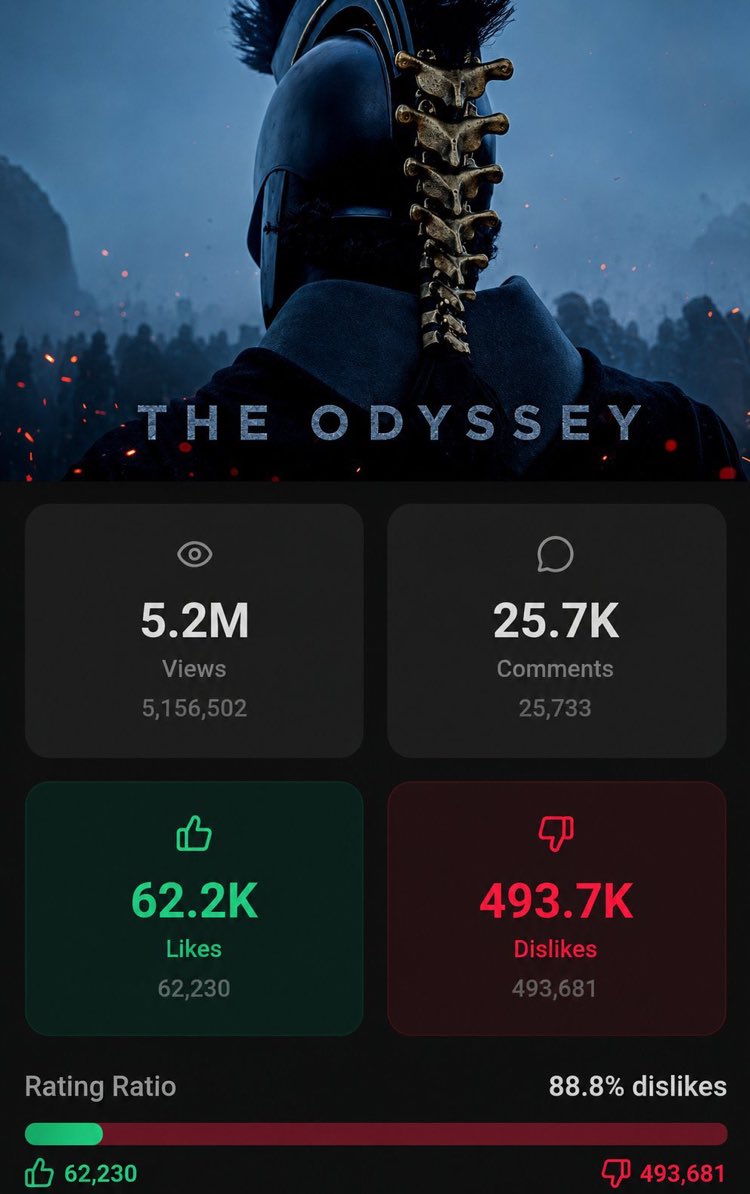
The public reaction to the Odyssey trailer is a strong indication that Nolan’s reputation won’t be enough to prevent this turd from leaving a smoking crater in the studio’s budget.
People are sick of blackwashing. They’re sick of girlboss reimagining. They’re sick of every movie turning into a sermon.
Does this mean that a Tipping Point will be reached, that Hollyweird will finally sit up and pay attention to the dashboard full of red warning lights and sirens screaming for its attention?
Lol. Lmao.
The cultural revolution means that everyone in a position to do something has been replaced with religious fanatics who don’t care about nonsense like “money”.
Just like every other institution they suborned.
They are crashing the plane with no survivors, and as it goes down in flames they will take the opportunity for a final smug lecture about how the failure of the audience to appreciate them demonstrates that the audience are nothing but white supremacists.
I’ve seen speculation that the current crop of “big” movies were all in early production just at the peak of a few trends that have since receded in popular culture — girlbosses and general wokeness — and it might just be a matter of timing … or it could be that Hollywood’s movers and shakers are still determined to press on with the undiluted progressive message even if it means losing hundreds of millions of dollars with every new release.
On the topic of The Odyssey, Ted Gioia talks about his own discovery of Homer as a youngster and says “youngsters were Homer’s target audience — you can feel that at every turn in his story”:
The first work of classical literature that thrilled me to the depths of my soul was the Odyssey. It made such a big impact that, decades later, I insisted on reading it aloud to my own children, hoping they would feel that same magic.
I was little more than a child back when I discovered Homer — 12 or 13 years old, I’d guess. Back then I knew more about comic books than serious literature. But I was outgrowing Spiderman and Superman, and decided to take a chance on Odysseus.
I approached this book with fear and trembling — worried it might be too difficult. But I soon discovered that Homer was the Stan Lee of antiquity. He told adventure stories not much different from the ones peddled by Marvel or DC.
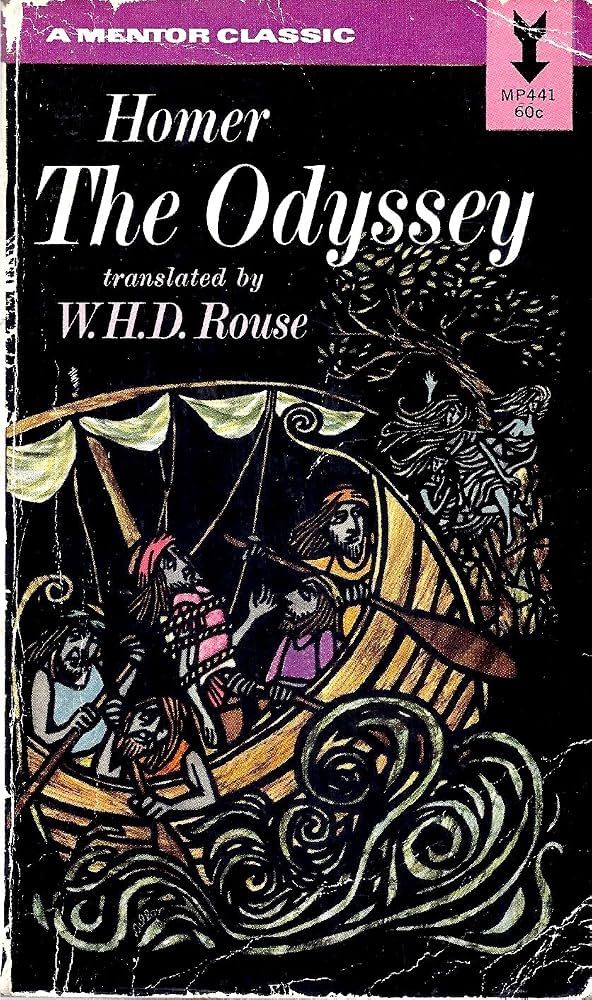
I’d somehow gotten my hands on a tattered used paperback copy of the Odyssey, in a 1937 prose translation by W.H.D. Rouse — published by Mentor Classics (cover price when new = 60 cents). This is not a respected translation — they will never assign Rouse’s version of Homer at any Ivy League college. [NR: I think this is the way I first encountered The Odyssey … possibly this version in Grade 5 as it was a prose translation.]
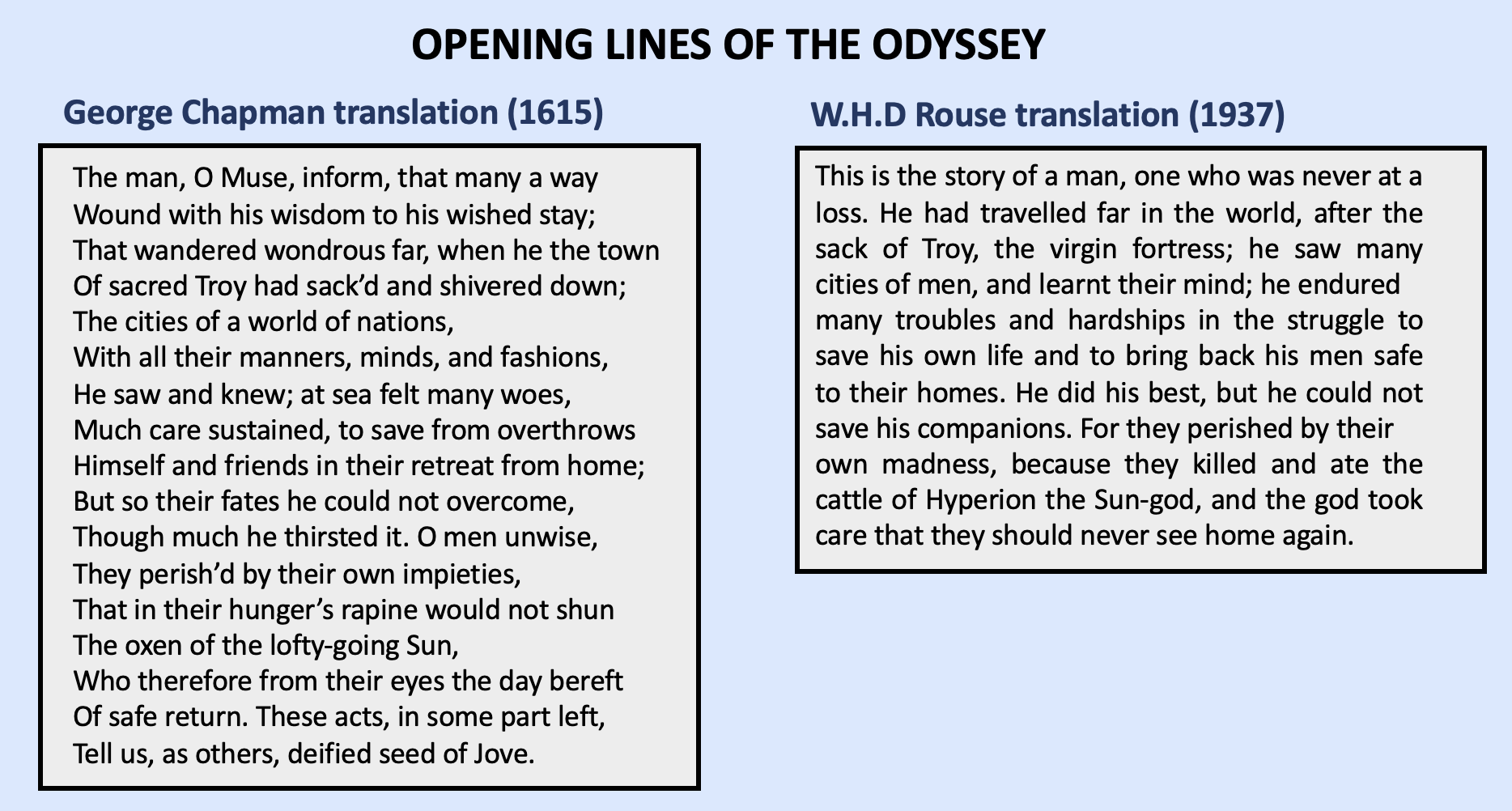
That’s because the legit translators try to convey this epic as poetry. Rouse made no attempt at that. He just turned Homer into everyday language, just like it was a pulp fiction story for the mass market.
That was the right choice, he believed, because (as he wrote in his introduction): “The Odyssey is the best story ever written … It has been a favorite for three thousand years”. Other translations of this book are, he claimed, “filled with affectations and attempts at a poetic language Homer himself is free from. Homer speaks naturally and we must do the same.”
You can see the difference by comparing Rouse’s rendering of the opening lines with the esteemed Chapman translation from Shakespeare’s era.
Is this the best version of Homer? I won’t go that far — years later I became very fond of Robert Fitzgerald’s translation. But I will insist that Rouse is the superior version for a youngster. And, in many ways, youngsters were Homer’s target audience — you can feel that at every turn in his story.
So this is the first thing about the Odyssey you won’t learn at Harvard — namely that this tale was not intended for Harvard elites. It’s a story for everybody. So it’s an obvious choice for a big-budget Hollywood movie. There was no pretension or elitism in Homer’s approach. In today’s parlance, you would say that he was appealing to a mass audience.
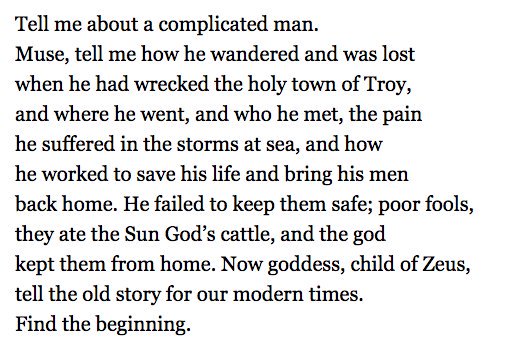
Director Christopher Nolan — whose screen version of the Odyssey makes its debut in London today — relied on the more recent Emily Wilson translation of the Odyssey into iambic pentameter. In her version, our hero is described, like Shaft, as a complicated man who won’t cop out (when there’s danger all about). Okay, she doesn’t use those exact words, but comes close …
Emily Wilson’s translation of the opening lines of the Odyssey
I like this rendering, and can almost hear that Isaac Hayes synth vamp in the background. Wilson is just as straightforward as Rouse — living up to her aspiration to “tell the old story for modern times”.
ZKP-524: A Prototype Czech 7.62x25mm 1911 Copy
Forgotten Weapons
Published 18 Feb 2026The Czechoslovak military knew when they adopted it that the vz.52 pistol was not very good, and they initiated a replacement program at the same time as its adoption. Two pistols were developed to be its replacement; the CZ 531 and the ZKP 524. The ZKP was designed by the brothers Josef and František Koucký, based heavily on the Colt 1911 and Tokarev TT33 pistols. It was chambered for the 7.62x25mm cartridge as required by the military, and held 8 rounds in a single-stack magazine. In trials against the CZ-531, it proved to be more accurate, but less reliable and more expensive. It suffered a cracked slide after 4,198 rounds fired, and an improved second example was made. However, the vz.52 proved good enough despite its shortcomings, and the program to replace it fizzled out after this testing.
Thanks to the Czech Military History Institute (VHU) for graciously giving me access to this unique prototype to film for you! If you have the opportunity, don’t miss seeing their museums in Prague:
https://www.vhu.cz/en/english-summary/CZ 531 video: • CZ-531: A Czech Browning in 7.62mm Tokarev
(more…)
QotD: The Wilmot Proviso
The details of the procedural shenanigans aren’t important. The thing to know is, the Wilmot Proviso made official and on-the-record what everybody knew, but was desperate to keep sub rosa: The Mexican War was a war for slavery. Specifically, it was a war for Texas (and California), which was a massive new slave state. And since pretty much all territory captured from Mexico after the inevitable US victory would be below the old Missouri Compromise line, slavery would be legal in all of it under the Compromise.
The Wilmot Proviso attempted to scotch that, which forced the Senate, at least, to come right out and say it. People always underestimate the power of words and symbols, and professional historians are among the worst offenders. With the newer generations of pros it’s ideological enstupidation that causes it, but the older folks were almost as bad. It’s a structural issue — we rely on documents, so even though “the temper of the times” is real obvious in the aggregate, unless you can pin it down to specific statements in archival sources it’s hard to make your case.
If it helps, think of the couple whose marriage is obviously on the rocks. They fight constantly, they all but live separately, everybody knows their relationship is doomed … but when one of them finally comes out and says “I want a divorce”, things often change radically. Temporarily, most often, but how many people have you seen suddenly make all-out efforts to patch things up only after somebody finally says the D-word?
You can hear the capital letters in their voices. Before, all that stuff — romantic weekend getaways and the like — were attempts to “get back on track” or “spice things back up” or whatever. As soon as someone says Divorce, though, all those things become capitalized — we’re Saving Our Marriage.
The Wilmot Proviso was like that. Somebody finally said the D word.
Severian, “1846-1861”, Founding Questions, 2022-06-25.
July 7, 2026
Carthage at the Gates – The Second Punic War | EP 1
The Rest Is History
Published 2 Feb 2026Our whole series on Rome vs Carthage can be found here: • Rome Vs Carthage
[NR: Last year’s animated episode on Cannae is here — The Bloody Battle of Cannae]
Did Hannibal march on Rome after his legendary victory at the Battle of Cannae in 216 BC? How could Rome fight on after losing so many men? And, where would their next cataclysmic clash take place …?
Join Tom and Dominic, as they discuss the beginning of the end for the once mighty city of Carthage, and her masterful general, Hannibal Barca.
00:00 Cold open
02:02 After Cannae
05:20 Carthage vs Rome: the long backstory
12:44 The Barcid dynasty
15:37 Hannibal’s invasion route
18:37 Why Hannibal doesn’t march on Rome
21:30 Roman morale collapse (and recovery)
25:01 Rome’s “Lord Halifax moment” that never happens
28:00 Fabius Maximus takes control
31:06 Early heroes and hard choices
33:39 The Fabian strategy returns
34:26 Italy fractures
36:10 The Capua turning point
37:07 “Hannibal at the gates”
39:40 The war becomes a stalemate
43:08 Syracuse at its peak
50:14 Archimedes’ war machines
51:15 Syracuse switches sides
52:06 Marcellus besieges Syracuse
56:20 The fall of Syracuse
57:25 Death of Archimedes
58:40 What Syracuse means for the wider war
(more…)
QotD: “I was just following orders” — the Nuremberg Defence
JerryRigEverything @ZacksJerryRig
It is illegal to obey illegal orders.
It is illegal to obey illegal orders.
It is illegal to obey illegal orders.
It is illegal to obey illegal orders.
It is illegal to obey illegal orders.
It is illegal to obey illegal orders.
Congress has not declared War.
Pass it on.Hot Take: The “Nuremberg Defense” should be completely legally valid because it was for the entirety of human history until the Nuremberg Trials.
The idea that the average GI Joe has the knowledge and capability to parse the legality of orders in life-and-death situations is one of the best examples of how Liberalism simply does not comport with reality.
Every lawyer knows this to be true, too. Ask any number of attorneys a question on a matter of law and if the question is worth a damn you’ll get as many answers as participants. All good legal questions start with the same answer: “It depends.”
If you can’t even get a team of attorneys to always agree on whether something is legal, with hours to days to weeks of research put into the question, why/how do you expect a normal joe to figure that out?
You don’t. He can’t. You know that.
You just want to inspire doubt, raise mutiny, and have a way to punish people who did things you don’t like on the orders of someone out of your reach.
J.T. Alexander, The social media site formerly known as Twitter, 2026-04-06.
July 6, 2026
“The Road to Hell is Always Paved with Good Intentions”
On the social media site formerly known as Twitter, Brivael Le Pogam expresses his frustration with young people’s recent affection for more socialism, despite all the evidence of history:
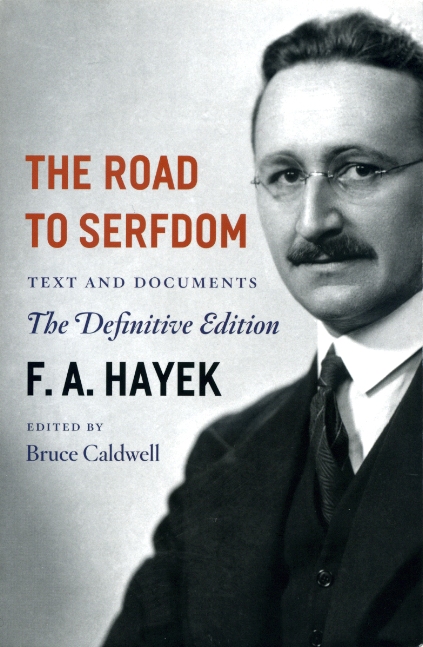
When I see the younger generation demanding more and more Marxism, more socialism, more State, more “planning” to fix a world they’ve been taught to hate — I don’t feel like snickering. I feel like screaming.
Because I recognize the opening chapter of a story whose final page I know all too well.
That story, a man wrote in 1944, under the bombs. Friedrich Hayek. The book: The Road to Serfdom. And he dedicated it — read carefully — “to the socialists of all parties”. Not out of contempt. Out of affection. Out of urgency. Because he had seen, with his own eyes, an entire Europe tip over the edge.
Remember this, it’s the heart of it all: totalitarianism never starts with monsters. It starts with good people.
It starts with idealists who want the common good. Generous young people who can’t stand injustice anymore. Soft, consensus-driven parties that promise to fix everything if you just give them a little more power. The problem isn’t their intentions. The problem is the mechanism they set in motion.
Here’s that mechanism. Follow it, it’s relentless.
To plan an economy, you need a single decision where there were once millions of free choices. So you have to concentrate power. But no society ever agrees on a single plan — everyone has their own ends, their dreams, their priorities. The planner then hits a wall: disagreement. And disagreement becomes an obstacle to eliminate. You start by persuading. Then by coercing. Then by silencing. Not out of sadism — out of logical necessity. The plan demands that you crush what resists it.
And then comes Hayek’s most chilling chapter: “Why the Worst Get on Top”. In a system that demands total power, it’s not the best who win. It’s those who are ready for anything. The scrupulous man hesitates; the man without scruples acts. The collectivist machine, whatever its colors, mechanically selects the brutes.
Look at Germany. You’ve been told Hitler fell from the sky, an anomaly, an accident of evil. That’s false, and it’s dangerous to believe it. What Hayek understood was that Germany had spent half a century abandoning classical liberalism — the individual, rights, the market — in favor of the cult of organization, the collective, the State that knows better than you. The left and the right already shared the same premise: the individual must submit to the nation’s plan. Hitler didn’t have to build that machine. He found it already assembled, warmed up, ready. He just had to grab the wheel.
That’s the warning. Totalitarianism isn’t an ideology. It’s a structure. You can fill it with red, brown, any generous color you like. Once you’ve accepted that the individual must bend to the collective, that property is just a revocable privilege, that the freedom to trade, to speak, to innovate stops where “the common good” decreed from above begins — you’ve laid the tracks. The train, it’ll come on its own.
And it always comes with the world’s best intentions. Every step toward the abyss is justified, reasonable, compassionate. One more tax for the poor. One more control against the bad guys. One less freedom, but “just that one”. No one chooses servitude. You slide into it, one good intention after another.
So I’m tossing this bottle into the sea. To you who are twenty and on fire with passion. Your revolt against injustice is beautiful — keep it. But for the love of God, learn history. Read Hayek. Read what the 20th century really was, not the caricature they’re feeding you. The tens of millions of deaths it left behind weren’t killed by sadists from another world, but by systems built, at the outset, on dreams of justice.
Freedom isn’t the problem to fix. It’s the treasure they’re convincing you to sell off cheap.
Wake up.
Auto-translated from the original French by X.
The Ancient Greeks: 03 – Enter the Persians 1 – When Empire Meets the Polis
seangabb
Published 16 Feb 2026Greece: A Brief History, c.700 BC – 500 AD
In this lecture we begin the Persian Wars not with battle, but with misunderstanding. The Greeks did not set out to fight a civilisation-defining struggle against Asia, and the Persians were not driven by irrational hatred of freedom. This episode explores the structural collision between the Persian Empire and the Greek city-state system. We examine the rise of Persian power under Cyrus and Darius, the nature of imperial governance, and the early cultural encounter between Greek and Persian military worlds. Along the way, we meet Herodotus, the first true historian, and consider how his narrative shapes our understanding of East and West.
This is the beginning of a story that ends at Marathon — but whose consequences reach much further.
July 5, 2026
How Hitler Targeted Czechoslovakia – Death of Democracy 22 – Q2 1938
World War Two
Published 4 Jul 2026Spring 1938: Hitler has taken Austria. Now he turns toward Czechoslovakia — and at home, Nazi Germany’s terror against Jews and other targeted minorities accelerates.
In this episode of Death of Democracy, Spartacus Olsson reports from Berlin at the end of Q2 1938, as the Nazi regime fuses foreign-policy intimidation with domestic repression.
After the Anschluss, Hitler pressures Czechoslovakia over the Sudetenland, but the May Crisis exposes that Germany may not yet be ready for war. Humiliated, Hitler secretly issues a revised Case Green directive: Czechoslovakia is to be smashed by military action.
At the same time, persecution inside the Reich escalates. Jews are forced to register assets. The Nuremberg Laws are extended to annexed Austria. The Great Synagogue in Munich is demolished. Berlin sees orchestrated anti-Jewish street violence. And during “Operation Work-Shy Reich“, thousands of so-called “asocials” are sent to concentration camps — including the first mass arrest of Jews since Hitler’s seizure of power.
This is the quarter when the road from Anschluss to Munich becomes clearer: diplomatic extortion abroad, racial terror at home, and a world still hoping that concessions might preserve peace.
In this episode:
– The April 1938 Anschluss plebiscite
– Jewish asset registration and Aryanization
– The extension of the Nuremberg Laws to Austria
– The Sudeten May Crisis
– Hitler’s Case Green directive against Czechoslovakia
– The demolition of Munich’s Great Synagogue
– Anti-Jewish violence in Berlin
– Operation Work-Shy Reich
– Flossenbürg and the expansion of concentration-camp labor
– The world’s hesitant response to Nazi escalation
Terni Model 1921: Italian Interwar Assault Rifle with a Cube Mag
Forgotten Weapons
Published 16 Feb 2026After World War One, the Italian military spent some time studying the effectiveness of reduced-power cartridges, including both pistol calibers semiautomatic carbines and submachine guns as well as intermediate-caliber rifles. One of the rifles developed for the subsequent testing was the Terni Arsenal model 1921, of which 200 appear to have been made in total during the 1920s. This rifle used a surprising advanced 7.35x32mm cartridge, firing a 135 grain bullet at 1970 fps. It was a short recoil design and used a Fiat-Revelli style cube magazine. Ultimately the concept was not adopted (probably for reasons of cost), and some of the surviving rifles ended up in Ethiopia — where this example was found a few years ago.
(more…)
QotD: Battlefield communication in the pre-modern world
The first option, of course, is shouting. The problem here is obvious: how is the commander’s command to be heard? Interestingly, there has been a fair bit of research by ancient historians looking at the question of how many people can possibly hear a short address unaided by modern loudspeakers and the like; figures vary but generally a few thousand if they are reasonably compact and quiet. That might work for a general’s pre-battle speech, delivered before the army advances, but it will not do for an army that is already in motion, much less once the chaos of battle has begun. Thousands of men marching (let alone fighting!) are noisy!
The modern solution to this problem is radio, but of course that’s hardly available to our pre-modern commander. Instead, to judge by films, the mind quickly jumps to signal flags. I am reminded of Braveheart (1995)’s rendition of the Battle of Falkirk, where Edward I uses signal flags to order his archers forward. HBO’s Rome also does this in its version of the Battle of Philippi, with flags being jostled and then pointed forward to signal the advance. Unfortunately, signal flags – as distinct from unit flags (which we’ll come back to in a moment) – have a few key problems, the most notable of which is that no one will be looking at them: after all the army is advancing, the soldiers are looking forward but signal flags (again, as opposed to unit flags) are going to be behind them, not placed out in the middle of No Man’s Land between the armies. As a result, signal flags are useful for sending information long distances (in a chain of stations or operators), for instance from one commander at distance to another, but not in battle; operational, rather than tactical tools. In practice, the use of signal flags like this is confined to the modern era; the first successful “optical telegraphs” (as iterations on things like smoke signals and fire relays) date to the late 18th century.
Unit flags – a banner or other big, obvious symbol (like a statue of an eagle on a stick) – are more useful. These can be positioned at the front of a unit, typically at its center. If it advances, then the soldiers in the unit also know to advance, following the standard they can see (because it is elevated, large and visible) even if they cannot hear the orders. There are two complications here though: first, the unit banner or flag is a relatively late innovation in antiquity, really only coming into its own with the Romans. The Achaemenids may have used some kinds of ensigns or standards, but the Greeks do not seem to have done. Instead our first really good documentation of something like a battle flag comes from the Romans: each legion had a signa (eventually standardized to the legionary eagle, the aquila), which was a shiny metal statue mounted on a pole so it could be easily seen. Units of the legion broken off to do other things might instead follow a less impressive cloth banner, a vexillum, by which such detachments became known as vexillationes. But the broader problem is that of course your general may not be particularly close to your flags (or other standards) which are generally at the front-center of each component unit of your army. The flags may allow a subordinate officer to “drive” the unit over the battlefield – and that’s good – but it doesn’t let the general tell that officer what to do.
A better option is music, but once again development seems to come fairly late in antiquity. Greek hoplites seem to have advanced to the music of the aulos, a double-reeded flute-like instrument; given the limitations of the instrument it is generally assumed it was used to keep time (so everyone marched in step) not transmit orders. Once again, a more complex system of musical signalling seems to come with the Romans, at least as detailed by Vegetius. Vegetius (2.22) notes three different kinds of horn instruments used by a legion: the tubicen was used to sound charge and retreat, the cornicen regulated the movement of the signa (so “advance” or “halt”), while the buccina was used mostly for camp signals: sounding watches or assemblies. It’s a system that is akin to later bugle calls, but note that the orders it can give are limited to a relative handful of prearranged signals: advance, halt, charge, retreat, assemble, change shift and so on.
The attentive reader here may have already noticed how developed Roman command and control is and may suspect that ties in with the Romans having a more “command” oriented culture of generalship; if so you are ahead of the game!
Of course if those instruments are sounding on a per-unit basis (and they are) that means you still have the problem of getting the order from the general to the instruments for the unit in question. And fundamentally here, the technology is – as I tell my students – man-on-horse. The particular fellow on the horse may be a dedicated messenger (if your military organization has those) or a subordinate officer or it may be the general himself.
But it is important to note now the limitations of this sort of system and we can use what we know of the Roman command and control system (as noted, one of the more developed of such systems prior to gunpowder) to get a sense of them. Let’s say the general realizes there is a problem on his flank and he needs a unit (probably here we’re talking a cohort or a maniple, not a legion) to change what it is doing. First off, the order needs to get within shouting range of the unit’s commander (in this case a senior centurion). The general can either go themselves or send a messenger; both options have their downsides. If the general goes himself he is essentially removing himself from observing or commanding the rest of the battle, but a common problem with sending a junior subordinate is that the unit commander may not respect or feel the need to obey that subordinate (written orders can help with this, but now we’re bringing in questions of literacy). Of course both a messenger or a general in transit may also well be killed, which will prevent the order from being received!
In either case, the message is going to move at galloping speed, which is around 40km/h, meaning that it may take several minutes for the general or messenger to navigate to the spot. That doesn’t sound so bad, but battles with contact weapons do not typically go for hours and hours; Pydna (168) was, as noted last week, decided in about an hour total! Of course a battle might be longer (or shorter!) than this, though much of that extra time is likely pre-battle skirmishing – the actual direct press of infantry formations in shock rarely lasts long because of the terror of it (and to a lesser extent its lethality; we’ll return to the balance of terror and lethality next time). Imagine if you were playing a Total War game and your input delay was, say, five minutes long in a battle that might only last an hour or two.
But of course galloping time isn’t the end of it. The message now has to be conveyed to the unit. In the Roman system, that means the messenger needs to find the appropriate centurion, explain the order to him and then ideally that fellow will then signal the instruments and signa to act accordingly – but even then, those instruments and signa only have a handful of prearranged signals available. Anything more complicated will need to be shouted down the line the old fashioned way (as we know, for instance, the Spartans did for lack of almost any of the rest of this apparatus of command, Xen. Lac. 13.9). Needless to say that means that giving any complex order to a unit already engaged or about to be engaged is going to mean starting by signalling retreat and then attempting to regroup the unit; regrouping an already retreating unit is one of the most difficult tasks on a battlefield and is rarely performed successfully in an unplanned fashion (even in a planned fashion it goes wrong as often as it goes right).
(This is, by the by, why reserves are so important. An unengaged unit hanging behind the lines can be given new orders far, far easier than a unit that is already engaged or about to be. And indeed, those familiar with the Roman system of fighting with its three lines of heavy infantry will note that it is a system heavy on reserves. Indeed, the manipular legion essentially assumes it will be necessary to retreat and regroup the first line of heavy infantry (the hastati) behind the second (the principes) and plans and drills for that. Note how the Roman command culture, the Roman fighting method and the actual apparatus of messengers, signa, instruments and junior officers all align here – that’s common because these sort of institutions tend to co-evolve.
By contrast we may compare a Greek hoplite army in the Classical Period. It has no battle flags or ensigns and the general is expected to fight on foot. In the past I’ve described the resulting phalanx as an “unguided missile” and this is a big reason why. That’s not to say hoplite generals never exerted command on the battlefield – better generals might keep a reserve to be rushed to important points (as Pagondas does at the Battle of Delium in 424 BC). But for the most part, once a hoplite general formed up the army and hit “go”, they had very little control over the army.
Bret Devereaux, “Collections: Total Generalship: Commanding Pre-Modern Armies, Part II: Commands”, A Collection of Unmitigated Pedantry, 2022-06-03.
July 4, 2026
In the “early Victorian period … drinking whisky was the modern-day equivalent of licking hallucinogenic toads”
Scotland was terra incognita to the English for far longer than one might think, even though the two kingdoms shared a monarch as early as 1603. On his Substack, Ed West shows how modern day Scotland has long since emerged from the mysterious shadows of the past:

“Scotch whiskies” by Chris huh is licensed under CC BY-SA 4.0 

 .
.
In his highly entertaining history of alcohol and the British, Empire of Booze, Henry Jeffreys observed how one effect of the Napoleonic Wars was to make Scotland a popular destination for English holiday makers. What with the continent being isolated and everything, there weren’t many more exotic places for the richer, more adventurous traveller to visit.
The country was until then largely unknown to many people south of the border, something also true of its trademark drink. “Highland and lowland whisky in the early 19th century would have been a mystery to the majority of Englishmen”, Jeffreys writes: “In the literature of the Georgian and early Victorian period it’s apparent that drinking whisky while in Scotland was the modern-day equivalent of licking hallucinogenic toads while in the Amazon or eating rancid whale in Iceland”.
The conflict with revolutionary France proved to be a great boost to Brand Scotland, and not just because of the limits it placed on rival destinations, but also for the dash that the Scots cut on the field. This culminated with a momentous scene in which “the Highland regiments dazzled the French when the Allied armies marched into Paris”.
Here they wowed both friends and enemies alike, and Sergeant Thomas Campbell of the Grenadier Company recalled how the Tsar even personally “examined my hose, gaiters, legs, and pinched my skin, thinking I wore something under my kilt, and had the curiosity to lift my kilt up to my navel, so that he might not be deceived”. Thanks to the likes of the Black Watch and Gordon Highlanders, the Scots had arrived on the global stage, and no one would ever forget Die Damen aus der Hölle (Ladies from Hell) as German troops would later call Highlanders.
This period of upheaval and war – the birth pangs of true modernity — was marked by a growing craze for Highlandism, “a peculiar phenomenon where lowland Scotland, a predominantly settled mercantile society, took on the trappings of the Highlander as a way of differentiating themselves from Englishmen who they were now yoked to in the Union”.
Previously viewed as menacing, the Highlanders had been tamed by the defeat of the Jacobites and the Clearances that followed, making this once-feared Gaelic culture now safe for English speakers to adopt as their own. Much of this was driven by the romantic imagination of Edinburgh’s Walter Scott, who helped shape both Scottish national identity and the 19th century resurgence of medievalism. Perhaps more than literature, however, Highlandism was boosted by the region’s most famous export — whisky. As Jeffreys writes: “The growth of Scotch coincided with the birth of Highlandism”.
The development of Brand Scotland was also helped by a man widely regarded as Britain’s greatest buffoon and waste of space, the former Prince Regent. Historian John Plumb described a hugely influential visit by the now George IV in 1822, where: “He paraded Edinburgh in the kilt, resplendent in the Royal Stuart tartan and flesh-coloured tights, and yet managed to keep his dignity. The Scots loved it! Quaintly enough, George IV had struck the future note of the monarchy … Be kilted! Be sporans! Be tartans! Riding up Princess Street … To the roaring cheers of loyal Scots, he was showing the way that the monarchy would have to go if it were to survive an industrial and democratic society.”
It was the start of a beautifully symbiotic relationship, with the Royal Family immersing themselves in Highlandism ever since, spending much of their summer holidays there and helping to project an ideal of a region famed for its dramatic countryside, castles, distilleries and golf courses. They’re not alone: Donald Trump, whose mother hailed from the Isle of Lewis, has a noted fondness for the old country, even if this is not always reciprocated, and no doubt many more of his compatriots will be making the pilgrimage in the coming year thanks to the country’s newest brand ambassadors. These are, of course, another occupying force of Scots, the fans of the national football team who followed their country’s brief recent appearance at World Cup.
The Scots in Boston marched as proudly as their ancestors. Their bagpipers serenaded the opposition. Some even turned up at a wedding. They came to watch the Boston Red Sox, which one local described as “the best thing that’s happened in years”. They attracted many neutrals, including a duck. Folk songs were written about them. Everyone loved them, even if some struggled to understand them.
The Boston Globe published a full-page letter thanking them. One local reported how Scotland fans leaving Boston was “almost like a day of mourning for the Americans“. After they left, Massachusetts State Senator Paul Feeney made an emotional farewell, thanking them for visiting children’s hospitals and donating money to local charities: “You’ve been great, courteous guests, you’ve been polite and you’ve been fun and I don’t want that to end”. He invited them to return next year, by which time Glasgow will be twinned with Boston. Indeed, Scottish fans so impressed the Bostonians that the city changed its zoning laws, not an easy task in America. They may even have solved the fertility crisis. Indeed, the Tartan Army charm offensive in Boston has been so overwhelming that I half suspect it’s some sort of devious RICU operation.

The Dark Truth Behind America’s National Anthem
The Rest Is History
Published 8 Jun 2026How did the War of 1812 result in America’s national anthem, The Star Spangled Banner? Who came up with it? And, why does this origin story make the anthem so controversial?
Join Dominic and Tom as they launch into the first episode of their Football World Cup special, with the story behind America’s national anthem, and its secret story.
0:00 – Lloyd’s
01:21 – The Star-Spangled Banner
02:43 – A World Cup Series on National Anthems
04:08 – America’s Most Controversial Anthem
05:00 – The Forgotten War of 1812
09:10 – Britain Strikes Back
11:39 – Francis Scott Key Boards the British Fleet
15:27 – The Bombardment of Fort McHenry
18:14 – The Giant Flag That Inspired the Anthem
20:41 – Francis Scott Key Writes the Poem
23:28 – Why the Anthem Used an Old English Tune
26:13 – The Anacreontic Song
29:07 – How the Song Became a Hit
30:37 – The Times
31:48 – Is The Star-Spangled Banner About Slavery?
36:08 – Escaped Slaves and the British Army
40:55 – The People Who Found Freedom Under the Union Jack
42:29 – Francis Scott Key’s Complicated Legacy
47:06 – The Song Spreads Across America
51:39 – Why America Took So Long to Get a National Anthem
56:42 – How It Finally Became the Anthem
57:06 – Controversial Performances
1:00:17 – Colin Kaepernick and Taking the Knee
1:02:39 – Can You Separate the Anthem from the Author?
1:03:03 – The Abolitionist Version of the Anthem
1:04:13 – Coming Next: God Save the King
1:06:33 – The Rest Is History ClubVideo Editors: Jack Meek, Harry Swan + Adam Thornton
Social Producer: Harry Balden
Producers: Tabby Syrett & Aaliyah Akude
Senior Producer: Callum Hill
Executive Producer: Dom Johnson
Chief Digital Officer: Sam Oakley
“The fact that [Canadians] cannot define our values should concern every one of us”
While our American neighbours are busy celebrating their 250th anniversary, Canadians are still left wondering why we can’t seem to define what our own values are except in opposition to those of the United States. Eva Chipiuk discusses this briefly here:
In writing my book, Reconnect to Canada, the most difficult part was not recounting our history or explaining our political and legal systems. It was answering a simple question:
What does it mean to be Canadian?
Over the last few years, I have asked that question repeatedly.
It was clear that something fundamental had shifted, but I could never quite articulate what it was.
The responses to that question were revealing, and most telling was that there was no common answer at all.
Some said hockey. Some said healthcare. Others said diversity or simply that Canadians are “nice”.
The fact that we cannot define our values should concern every one of us.
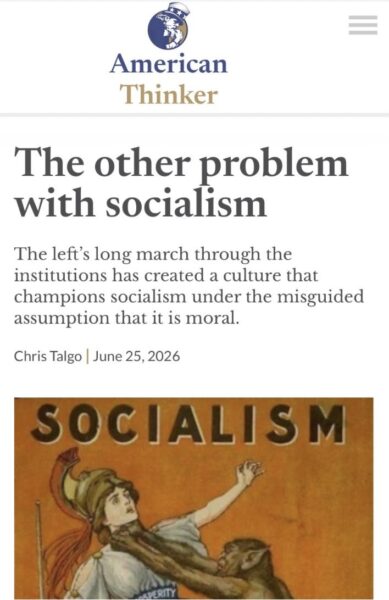
Then I came across this article, and it put things into perspective:
Socialism, in its depraved but effective way, appeals to people’s worst instincts and impulses. It presents the world as a zero-sum game in which there are winners and losers. It pits groups of people against each other based on arbitrary measures. For the narrow-minded, it makes sense.
It embodies most of the seven deadly sins.
Pride: Socialists have zero humility because they reject the fallibility of humanity. They can micromanage an entire society. They can create a centralized, one-size-fits-all, command-and-control utopia. They know all and know best.
Envy: Taking one’s property because they have too much to give to others who have less is not noble; it is theft. Stealing with state-sanctioned approval is unjust. The sheer resentment that some have more, better, or bigger material possessions is the driving force of socialist ideology.
Wrath: Socialist doctrine fuels anger, rage, violence, and a desire for vengeance against the so-called oppressors. Instead of mimicking the successful, the people turn their ire toward them.
Sloth: Because socialism is about passing the buck and the blame, it excuses idleness and promotes laziness. It allows one to shirk personal duties and retards personal growth.
The uncomfortable truth is that Canada increasingly reflects these traits, yet we refuse to acknowledge it.
We insist we are compassionate while shaming and disparaging those who hold different opinions.
We claim to value equality while encouraging envy.
We preach inclusion while dividing Canadians into competing groups.
We speak of unity while constantly finding new reasons to divide ourselves.
We demand accountability from everyone except the government.
We expect government to solve problems that citizens, families, communities, and free people once solved themselves.
Worst of all, we have become experts at pretending none of this is happening.
We congratulate ourselves on being tolerant, generous, and virtuous while our institutions fail, productivity declines, public debt explodes, trust evaporates, and Canadians become more divided than they have been in decades.
That is not something to celebrate.
It is something to confront.
If Canadians can no longer articulate what it means to be Canadian, perhaps it is because we have abandoned the principles that once defined us: freedom, personal responsibility, hard work, accountability, respect for the rule of law, and service to one another rather than dependence on the state.
You do not need to take my word for it.
Just open your eyes. Look around!
A country does not lose its identity overnight. It loses it one abandoned principle at a time.
A nation without shared values eventually becomes little more than a collection of people living within arbitrary borders.
So if we are going to celebrate Canada today, let us celebrate the principles that made this country worth celebrating in the first place and commit ourselves to restoring them where they have been lost.
Flag image candy for the 4th of July
Lofty Pursuits
Published 13 Jun 2018At Lofty Pursuits we make hard candy using techniques and equipment from the 1800’s. Here we are making Blue Berry and Strawberry shortcake candy in a pattern inspired by the American flag for flag day and the 4th of July. This is one of our most complex designs as it does not have an outer wrap. The video covers some fun bits about the history of the American Flag.
Get our candy here: http://www.pd.net


