
Forgotten Weapons
Published 2 Apr 2012The “Bigot” was a modification of an M1911 .45 caliber pistol developed by the Office of Strategic Services during WW2. The OSS was a clandestine operations service, the predecessor of the CIA. The Bigot was intended as a way for commandos to quietly eliminate sentries — although we are not sure what advantage it might have had over a silenced pistol. Questionable utility doesn’t prevent it from being a pretty interesting piece of equipment, though, and we had the opportunity to take a look at one up close recently.
August 26, 2023
OSS “Bigot” 1911 dart-firing pistol
Comments Off on OSS “Bigot” 1911 dart-firing pistol
August 25, 2023
The German Democratic Republic, aka East Germany
Ed West visited East Berlin as a child and came away unimpressed with the grey, impoverished half of Berlin compared to “the gigantic toy shop that was West Berlin”. The East German state was controlled by the few survivors of the pre-WW2 Communist leaders who fled to the Soviet Union:
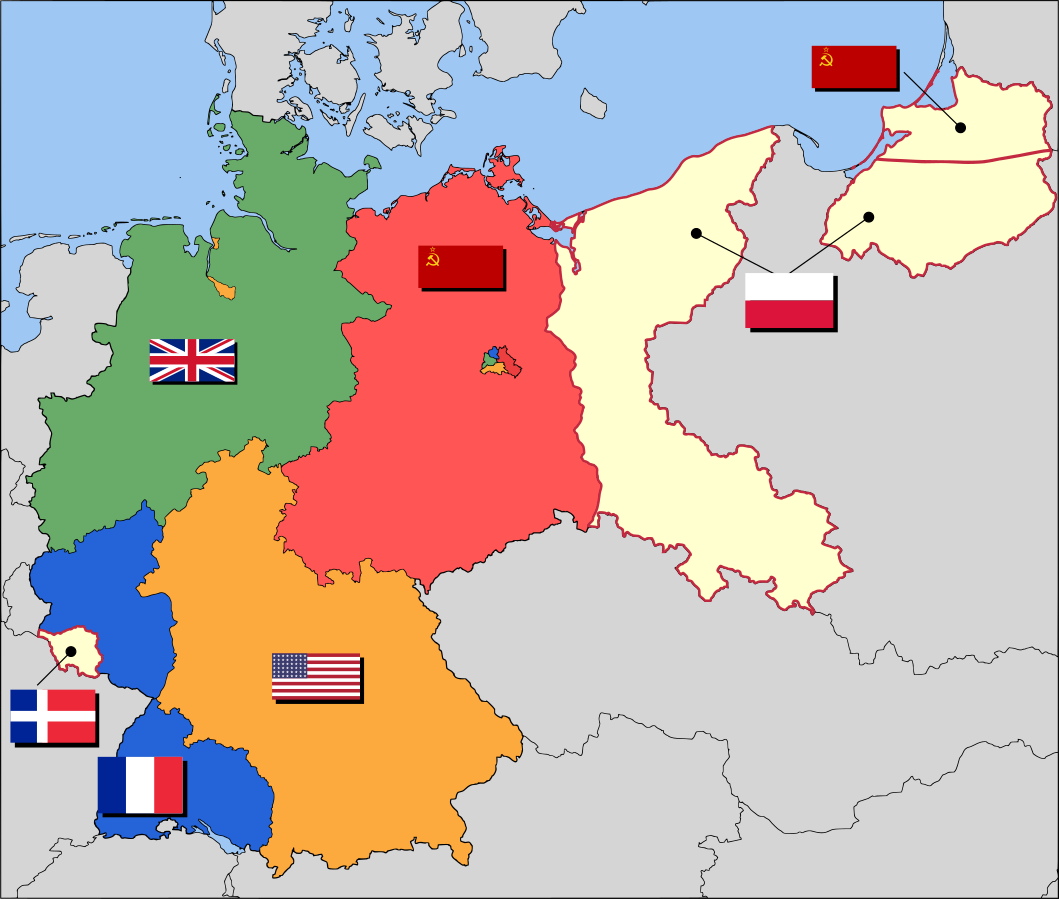
Occupation zone borders in Germany, 1947. The territories east of the Oder-Neisse line, under Polish and Soviet administration/annexation, are shown in cream as is the likewise detached Saar protectorate. Berlin is the multinational area within the Soviet zone.
Image based on map data of the IEG-Maps project (Andreas Kunz, B. Johnen and Joachim Robert Moeschl: University of Mainz) – www.ieg-maps.uni-mainz.de, via Wikimedia Commons.
In my childish mind there was perhaps a sense that East Germany, the evil side, was in some way the spiritual successor both to Prussia and the Third Reich – authoritarian, militaristic and hostile. Even the film Top Secret, one of the many Zucker, Abrahams and Zucker comedies we used to enjoy as children, deliberately confused the two, the American rock star stuck in communist East Germany then getting caught up with the French resistance. The film showed a land of Olympic female shot put winners with six o’clock shadows, crappy little cars you had to wait a decade for, and a terrifying wall to keep the prisoners in – and compared to the gigantic toy shop that was West Berlin, I was not sold.
I suppose that’s how the country is largely remembered in the British imagination, a land of border fences and spying, The Lives of Others and Goodbye Lenin. When the British aren’t comparing everything to Nazi Germany, they occasionally stray out into other historic analogies by comparing things to East Germany, not surprising in a surveillance state such as ours (these rather dubious comparisons obviously intensified under lockdown).
This is no doubt grating to East Germans themselves, but perhaps more grating is the sense of disdain often felt in the western half of Germany; for East Germans, their country simply ceased to exist in 1990 as it was gobbled up by its larger, richer, more glamorous neighbour, and has been regarded as a failure ever since. For that reason, [Katja] Hoyer’s book [Beyond the Wall] is both enjoyable holiday reading and an important historical record for an ageing cohort of people who lived under the old system. To have one’s story told, in a sense, is to avoid annihilation.
Despite the similarities between the two totalitarian systems, East Germany almost defined itself as the anti-fascist state, and its origins lie in a group of communist exiles who fled from Hitler to seek safety in the Soviet Union. Inevitably, their story was almost comically bleak; 17 senior German Marxists in Russia ended up being executed by Stalin, suspected by the paranoid dictator of secretly working for Germany. Even some Jewish communists were accused of spying for the Nazis — which seems to a rational observer unlikely. As Hoyer writes, “More members of the KPD’s executive committee died at Stalin’s hands than at Hitler’s”.
Only two of the nine-strong German politburo survived life in Russia, one of these being Walter Ulbricht, the goatee-bearded veteran of the failed 1919 German revolution and communist party chairman in Berlin in the years before the Nazis came to power.
The war had brutalised the eastern part of Germany far more than the West. It suffered the revenge of the Red Army, including the then largest mass rape in history, and the forced expulsion of millions of Germans from further east (including Hoyer’s grandfather, who had walked from East Prussia). The country was utterly shattered.
From the start the Soviet section had huge disadvantages, not just in terms of raw materials or industry – western Germany has historically always been richer — but in having a patron in Russia. While the Americans boosted their allies through the Marshall Plan, the Soviets continued to plunder Germany; when they learned of uranium in Thuringia they simply turned up and took it, using locals as forced labour.
“In total, 60 per cent of ongoing East German production was taken out of the young state’s efforts to get on its feet between 1945 and 1953,” Hoyer writes: “Yet its people battled on. As early as 1950, the production levels of 1938 had been reached again despite the fact that the GDR had paid three times as much in reparations as its Western counterpart.”
After the war, so-called “Antifa Committees” formed across the Soviet zone, “made up of a wild mix of individuals, among them socialists, communists, liberals, Christians and other opponents of Nazism”. Inevitably, a broad and eclectic left front was taken over by communists who soon crushed all opposition.
And as with many regimes, state oppression grew worse over time. “By May 1953, 66,000 people languished in East German prisons, twice as many as the year before, and a huge figure compared to West Germany’s 40,000. The General Secretary’s revival of the ‘class struggle’, officially announced in the summer of 1952 as part of the state’s ‘building socialism’ programme, had escalated into a struggle against the population, including the working classes.” The party was also becoming dominated by an educated elite, as happened in pretty much all revolutionary regimes.
Protests began at the Stalinallee in Berlin on 16 June 1953, where builders marched towards the House of Ministries and “stood there in their work boots, the dirt and sweat of their labour still on their faces; many held their tools in their hands or slung over their shoulders. There could not have been a more fitting snapshot of what had become of Ulbricht’s dictatorship of the proletariat. The angry crowd chanted, ‘Das hat alles keinen Zweck, der Spitzbart muss weg!’ – ‘No point in reform until Goatee is gone!'”
The 1953 protests were crushed, the workers smeared as fascists, but three years later came Khrushchev’s famous denunciation of Stalin, which caused huge trauma to communists everywhere. “The shaken German delegation went back to their rooms to ponder the implications of what they had just learned.” By breakfast time, “Ulbricht had pulled himself together”, and decreed the new party line. Stalin, it was announced “cannot be counted as a classic of Marxism”.
Comments Off on The German Democratic Republic, aka East Germany
Fortress Britain with Alice Roberts S01E03
Fortress Britain with Alice Roberts
Published 16 Apr 2023
Comments Off on Fortress Britain with Alice Roberts S01E03
August 24, 2023
Life and Death at the heart of Nazism – On the Homefront 018
World War Two
Published 22 Aug 2023The Nazis love to spread the myth that they have transformed the German capital from a city of sin, unemployment, and Marxist street violence to the centre of a glorious new Reich. But the reality is that right now, Berliners are trapped between the Allied bombing and the Nazi regime’s tightening grip. And yet, the men and women of Berlin continue to support this war. For them, it’s a war of survival.
(more…)
Comments Off on Life and Death at the heart of Nazism – On the Homefront 018
QotD: Apparatchiks of the perma-bureaucracy
… in Tocqueville’s day the American government was almost inconceivably weak by our standards. For “magistrate”, then, read “bureaucrat”. Though of course American congress-critters do have “a vast deal of arbitrary power”, most of the real damage is done by unelected, unaccountable, indeed unknown bureaucrats. It’s the perma-bureaucracy, the Apparat, as the Soviets called it, who really run things. If you need examples, just google “Hawaiian judge meme”. That’s the Apparat, in all its glory, and exactly the kind of thing Tocqueville was discussing as the precursor of tyranny.
Being unelected, and therefore unaccountable, the Apparat works solely for the benefit of apparatchiks – and, obviously, vice versa. This is the mechanism by which Conquest’s famous “second law” operates: “Any organization not explicitly right-wing sooner or later becomes left-wing”. This has nothing to do with “philosophical” orientation, since as we’ve discussed, the terms “left” and “right” are essentially meaningless when it comes to modern politics. Rather, Conquest’s law works because bureaucrats always prioritize the bureaucracy’s continued existence over its ostensible mission, whatever that happens to be. Pick any do-gooder organization: The “end hunger” bureaucrats of the Feed-the-World NGO would be out of a job if the world actually got fed; ergo, you’ll soon enough find the world-feeders disinterested in, and eventually openly sabotaging, the organization’s efforts to feed anyone.
Severian, “Anticipations and Objections (I)”, Founding Questions, 2020-12-16.
Comments Off on QotD: Apparatchiks of the perma-bureaucracy
August 23, 2023
From “hunter-gatherer” to “settled farmer” as a Just-so story
The latest book review at Mr. and Mrs. Psmith’s Bookshelf is James C. Scott’s Against the Grain: A Deep History of the Earliest States by Jane Psmith:
Okay, stop me if you’ve heard this one already. So, there are these hunter-gatherers, right, and one of the things they like to gather, while they’re roaming around the hilly flanks of Anatolia following herds of gazelles, is the large, carbohydrate-rich seeds of local grasses. Then one day some bright soul gets the idea of planting the seeds on purpose, people selectively replant the ones that have exciting mutations like “have really big seeds” and “don’t shatter your stalk and scatter your really big seeds everywhere when they’re ripe, just hang out and wait to be reaped,” and they all start staying in one place to tend their fields. They quickly discover that agriculture can create a lot more calories than foraging, so all of a sudden they have a nice surplus that can go towards supporting non-food-producing specialists like dedicated craftsmen, priests, bureaucrats (but I repeat myself) and kings to expedite and organize all that agricultural labor, and, hey presto! you have civilization.
Oh, cool, you read Guns, Germs, and Steel in high school too?
Only James C. Scott is here to tell you that’s not how it happened. And while you might be excused for thinking (especially if you’ve read our review of The Art of Not Being Governed) that this is Scott doing his contrarian “ooh, look, I’m turning the accepted narrative on its head” thing, you would be wrong. (Don’t worry, though, we definitely will get to the point where he does that.) He’s just offering a summary of the new scholarly consensus: the transition from mobile bands of hunter-gatherers to sedentary agriculturalists didn’t follow that neat logical progression, and it was far patchier, more tenuous, and more bidirectional than generally assumed. In fact, practically since the moment in the late 1920s that V. Gordon Childe coined the term “Neolithic revolution“, archaeological evidence has been accumulating that complicates every aspect of the story I just told you, from agriculture to sedentism to state formation.
To begin with, what constitutes agriculture? Back in the 1960s, paleobotanist Jack Harlan used a flint sickle to harvest enough wild Anatolian wheat in just three weeks to feed a family for an entire year. Now, we can probably agree that just harvesting a stand of wild wheat and storing the grain doesn’t really count as agriculture, but what about pulling up the non-wheat interlopers from a half-ripe stand you hope to harvest later in the year? What about saving some seeds and tossing them on a welcoming plot of soil next spring? What about digging up or burning other plants to make that welcoming plot? And then it turns out that all the harvesting and processing tools — those sickles, winnowing baskets, grindstones, and even purpose-built granaries — seem to have existed before there was any intentional cultivation, suggesting wandering tribes who came together only at harvest time but spent most of the year apart. Also, it seems all like those exciting morphological changes that make grain agriculture so efficient (big seeds and non-brittle rachis) come hundreds and hundreds of years after agriculture was established.1 Our simple story is already getting complicated! But it gets worse.
Archaeologists used to assume that sedentism — that is, people staying in one place year-round — and agriculture necessarily went together. In one direction this is obvious, because once you’re feeding your family from a particular plot of ground you probably want to stick around to weed and water it and keep away any animals (or other people) who might swoop in at the last minute and take your harvest. But it goes the other way, too: we generally assume that pickings as a hunter-gatherer are slim enough that your group needs to keep moving around to find more food. (Or, in the immortal words of the Minnesota Educational Computing Consortium: “if you continue to hunt in this area, game will become scarce.”) This is actually true at higher trophic levels: large animals tend to migrate throughout the year, so people whose subsistence strategies depend heavily on hunting them will follow the herds. But hunter-gatherer mobility is a tendency, not an iron law, and the archaeological (and even historical) record is full of non-agricultural peoples who lived in one place year-round because their environment was rich enough to support it. This was common among the tribes of the Pacific Northwest, who created quite socially and materially complex cultures without agriculture, but it also shows up plenty of other places. The earliest sedentary culture we know about, the Natufians, flourished along the coast of what is now Israel more than thirteen thousand years ago, largely by gathering wild grains and hunting gazelles.
Do note, though, that it would be a mistake to call these non-agricultural environments “natural”, because humans have been actively managing our landscapes for at least a million years. The main tool before the widespread adoption of agriculture was fire, which can be used to stampede prey animals into a trap or to remove unwanted vegetation and make way for the grasses and shrubs that we, or our preferred prey, like to eat. “The game they subsequently bagged,” Scott writes, “represented a kind of harvesting of prey animals they had deliberately assembled by carefully creating a habitat they would find enticing”. It’s even been suggested that the Little Ice Age of the early modern period was due to the sudden cessation of burning activity (and its CO2 emissions) in the Americas when newly-introduced Old World pathogens killed off most of the people who did the burning.
Against the Grain focuses on the region archaeologists call Southwest Asia, people who like reading books about archaeology call the Fertile Crescent, and everyone else calls the Near and Middle East, but it zeroes in specifically on southern Mesopotamia. This wasn’t the first place to host year-round settlements, nor was it the site of the original crop domestications, but it is the home of the third element of the traditional story of the birth of civilization: the state. Scott is unwilling to define the state precisely, describing it instead as an “institutional continuum” where something can be more or less state-like, but he writes that “a polity with a king, specialized administrative staff, social hierarchy, a monumental center, city walls, and tax collections and distribution is certainly a ‘state’ in the strong sense of the term”. It was here, near the mouth of the Euphrates on the Persian Gulf, that the earliest “statelets” arose, and it’s here, once again, that Scott brings up recent archaeological evidence that undermines the usual narrative. This time, the abandoned theory is that the region was as arid at the dawn of agriculture as it is today; an agricultural population might have succeeded in the oases and river valleys, but as numbers swelled they would need to undertake massive irrigation projects, which would in turn require “the mobilization of labor to dig and maintain the canals, which implied the existence of a public authority capable of assembling and disciplining that labor force”. In short, agriculture was assumed to have required a state. But it didn’t.
Scott’s argument draws heavily on the work of Jennifer Pournelle, who reconstructed the landscape of the southern Mesopotamian alluvium in the seventh and sixth centuries BC using a combination of remote sensing, ancient sediments, and climatological history, and concluded that, far from the arid landscape of today, the land between the rivers was in fact an “intricate deltaic wetland.”
The inhabitants of these marshes lived on what are called “turtlebacks,” small patches of slightly higher ground, comparable to cheniers in the Mississippi delta, often no more than a meter or so above the high-water mark. From these turtlebacks, inhabitants exploited virtually all the wetland resources within reach: reeds and sedges for building and food, a great variety of edible plants (club rush, cattails, water lily, bulrush), tortoises, fish, mollusks, crustaceans, birds, waterfowl, small mammals, and migrating gazelles that provided a major source of protein. The combination of rich alluvial soils with an estuary of two great rivers teeming with nutrients, dead and alive, made for an exceptionally rich riparian life that in turn attracted huge number of fish, turtles, birds, and mammals — not to mention humans! — preying on creatures lower on the food chain.
Moreover, the first settlements in the area were right on the border between the brackish water of the coastal estuary and the freshwater ecology upstream, and on the incredibly flat floodplain of the lower Euphrates (the gradient is less than two inches per mile) that seam moved great distances with the tides. “Thus,” Scott writes, “for a large number of communities, the two ecological zones moved across the landscape while they remained stationary, taking sustenance from both”. They didn’t need to roam in search of new food sources; the food came to them. Agriculture — of the flood-retreat form, where seeds are sown in nutrient-rich new soils deposited by the retreating river, and which is the least labor-intensive type possible — was just another of their many diverse and overlapping subsistence strategies. The shift between wet and dry season, with its pulse of migrating animals and harvest of whatever seeds they had sown, can be considered moving zones on a longer timescale: a new habitat arriving on their doorstep to be added to the mosaic of available options. By 6000 BC, Scott says, they were “already agriculturalists and pastoralists as well as hunter-gatherers. It’s just that so long as there were abundant stands of wild foods they could gather and annual migrations of waterfowl and gazelles they could hunt, there was no earthly reason they would risk relying mainly, let along exclusively, on labor-intensive farming and livestock rearing.”
Thus do we, with James C. Scott, reject the old model in which agriculture leads almost at once to both sedentism and the state. Instead, we see sedentism arise in particularly favorable ecological niches as early as 12,000 BC, with most of the main founder crops and animals domesticated between 8000 and 6000 BC, and then a gap of almost four thousand years before the appearance of the state. A naively Whiggish view of history might ask, “What took so long?” But James C. Scott, being James C. Scott (yes, here we’re coming to the “turn it on its head” bit), thinks the more accurate question might be, “What went wrong?”
1. For more on this, Scott suggests this 2013 paper.
Comments Off on From “hunter-gatherer” to “settled farmer” as a Just-so story
Frustration as a key driver in motivating mass unrest
Rob Henderson reviews the old classic The True Believer by Eric Hoffer:
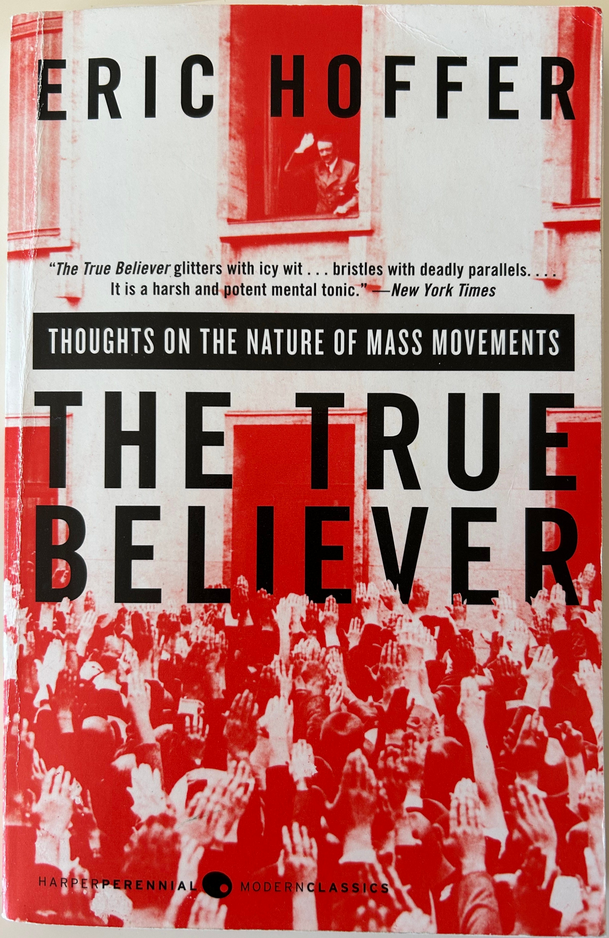
Eric Hoffer made the case that if you peel back the layers of any mass movement, you will find that frustration is their driving force.
Frustration, though, doesn’t arise solely from bleak material conditions. The dockyard philosopher argued that “Our frustration is greater when we have much and want more than when we have nothing and want some. We are less dissatisfied when we lack many things than when we seem to lack but one thing.”
He points out in the years leading up to both the French and Russian Revolutions, life had in fact been gradually improving for the masses. He concludes, “It is not actual suffering but the taste of better things which excites people to revolt” and that “The intensity of discontent seems to be in inverse proportion to the distance from the object fervently desired.”
Personally, I saw this when I first arrived at Yale. I recall being stunned at how status anxiety pervaded elite college campuses. Internally, I thought, “You’ve already made it, what are you so stressed out about?” Hoffer, though, would say these students believed they had almost made it. That is why they were so aggravated. The closer they got to realizing their ambitions, the more frustrated they became about not already achieving them.
Hoffer’s conceptions of frustration highlight how if your conditions improve, but not as much or as quickly as you’d like, you will be vulnerable to recruitment by mass movements that promise to make your dreams come true.
In Democracy in America, Alexis de Tocqueville wrote, “When inequality is the general law of society, the most blatant inequalities escape notice. When everything is virtually on a level, the slightest variations cause distress. That is why the desire for equality becomes more insatiable as equality extends to all.” For Hoffer, this insatiability cultivates frustration — a nebulous, simmering emotional state that can be harnessed by any ideology.
He describes what has now become known as the “Tocqueville effect”: A revolution is most likely to occur after an improvement in social conditions. As circumstances improve, people raise their expectations. Societal reforms raise reference points to a level that is usually not matched, eliciting rage and frustration.
Comments Off on Frustration as a key driver in motivating mass unrest
Slovenian SAR80: Sterling Out-Simplifies the AR-180
Forgotten Weapons
Published 15 May 2023The British Sterling firm designed the SAR-80 (specifically, their engineer Frank Waters) as a very simple rifle to sell to countries outside the main NATO/Warsaw Pact spheres of influence. Sterling ended up getting a license to produce the AR-18 though, and didn’t put Waters’ design into production.
When the newly formed Chartered Industries of Singapore came looking for a rifle to produce, the SAR-80 design was a chance for Sterling to sell a production license. CIS needed something to produce domestically to equip the Singaporean Army, and the SAR-80 met their needs. After selling the rifles to their own Army, the company went looking for export clients. They found a few, including Croatia, the Central African Republic, and Slovenia. A total of about 80,000 SAR-80 rifles were made, and this is one of the Slovenian-contract examples.
(more…)
Comments Off on Slovenian SAR80: Sterling Out-Simplifies the AR-180
QotD: “Megacorporations” of the Roman era
Which is to say that what really defines a megacorporation is that it trespasses into domains usually occupied by the state: military, police and judicial functions – the use of force. A megacorporation is, simply put, a corporation so large and powerful that it begins to act as a state, be that in the form of the private armies of Cyberpunk 2077, the privatized police force of the Robocop franchise, or the straight-up corporate governments of Stellaris (which in turn channel things like the Spacer’s Guild or the Ferengi Alliance) And that is core to the generally dystopian leaning of megacorporations – they are meant to reflect capitalism and corporate empire building taken to an extreme, to the point where it has swallowed the entire rest of the society.
Taking that definition to history, we can actually see a fair number of megacorporations; they are by no means common, but they do exist. Going very far back, the Roman societates (lit: “fellowships”, but “business association” or “company” is an accurate enough rendering) of the publicani (businessmen who filled public contracts) exercised close to this sort of power in some of Rome’s early provinces. During the Middle and Late Roman Republic, the job of extracting tax revenue from the provinces was too administratively complex for the limited machinery of the Republic, so instead the senate directed the censors to auction the right to collect taxes. Groups of Roman businessmen (and often silent patrician partners) would group resources together to bid for the right to collect taxes from a province – any taxes they took in excess of that figure would be their profit.
These companies could be very large indeed. For instance, parts of the lex portorii Asiae (the customs laws for the Roman province of Asia) survive and include regulations for the relevant company including a slew of customs houses and guard posts (the law is incomplete, but mentions more than 30 collection points – all major ports – to which would also need to be added posts along the land routes into the province). From other evidence we know that the staff at customs posts included armed guards along with the expected tax collectors and bookkeepers. And we know that publicani were sometimes delegated local or Roman forces to do their work (e.g. Cic. Ad Att. 114, using Shackleton Bailey’s numbering). They also maintained the closest thing the Roman Republic had to a postal service (Cic. Ad Att. 108). It’s not clear exactly how many employees one of the larger tax collection companies might have had (and those for the province of Asia – equivalent to the west coast of Anatolia – would have been some of the largest), but it was clearly considerable, as were the sums of money involved.
To the cities and towns of a province, such Roman companies must have seemed like megacorporations, especially if they were in with the governor (which they generally were) and thus could call down the forces of Rome on recalcitrant taxpayers. And we certainly know that these publicani often collected substantially far more than was due to them under the law (the reason why “tax collector” and “sinner” seem to be nearly synonymous in the New Testament, a fact that gave Ernst Badian’s study of them, Publicans and Sinners, its title). At the same time, we see the clear limitations too: such companies were clearly subservient to the governor and to the Roman state. Administrative changes beginning under Julius Caesar and brought to completion under Augustus did away with some of the largest tax contracts and the influence of the societates publicanorum with them.
Bret Devereaux, “Fireside Friday: January 1, 2021”, A Collection of Unmitigated Pedantry, 2021-01-01.
Comments Off on QotD: “Megacorporations” of the Roman era
August 22, 2023
“… the theatrics employed by Hitler and Mussolini just seemed too weird and downright ridiculous to the British”
In Spiked, Ralph Schoellhammer discusses some of the difficulties the Green Gestapo, er, I mean the likes of Extinction Rebellion and their mini-mes like Just Stop Oil have been encountering with the British public:

Roderick Spode, 7th Earl of Sidcup, leader of the “Saviours of Britain”, also known as the Black Shorts.
Still from Jeeves and Wooster (1990).
I have long been convinced that one of the reasons why fascism never had a chance in Britain was due to the predispositions of her people. If nothing else, the theatrics employed by Hitler and Mussolini just seemed too weird and downright ridiculous to the British.
PG Wodehouse captured this perfectly in an exchange between a British wannabe fascist, Roderick Spode, and Bertie Wooster: “The trouble with you, Spode, is that just because you have succeeded in inducing a handful of half-wits to disfigure the London scene by going about in black shorts, you think you’re someone.”
I don’t intend to liken fascists to environmentalists, but Brits have at least expressed a similar, visceral distaste for the theatrics of eco-activist groups in recent years. Marching in black “footer bags”, pretending to be the voice of the people, is just as ridiculous as holding up traffic in an orange “Just Stop Oil” t-shirt.
The environmental movement becomes more absurd by the day. The Guardian‘s George Monbiot, for instance, has just called for the reintroduction of deadly wolves and lynxes to Great Britain, in order to manage a surging deer population. One can only hope that this call to action will have about as much success as his campaign against meat, milk and eggs, which Monbiot is convinced are an “indulgence” humanity can no longer afford.
Sadly, the same is not true in Germany, where the elites are all too keen to humour even the most extreme climate fanatics. German discount supermarket Penny recently decided to increase the prices of its meat and dairy products, to include the environmental costs incurred in their production, as part of a week-long experiment. The price of frankfurter sausages rose from €3.19 to €6.01. The price of mozzarella rose by 74 per cent, to €1.55. And the price of fruit yoghurt rose by 31 per cent, from €1.19 to €1.56.
While the usual suspects in the establishment are clearly excited by this idea that in the future even shopping at a discount shop might become the preserve of the rich, average Germans are less pleased. Germany’s public broadcaster, WDR, asked Penny customers what they thought about the price-hike experiment. Due to a lack of enthusiasm from shoppers, WDR decided to have one of its employees cosplay as a happy shopper. That taxpayer-funded broadcasters now have to resort to outright fraud in order to drum up support for idiotic climate action tells you everything you need to know.
Comments Off on “… the theatrics employed by Hitler and Mussolini just seemed too weird and downright ridiculous to the British”
History Summarized: Sparta’s Finest Hour
Overly Sarcastic Productions
Published 12 May 2023It’s not Thermopylai.
SOURCES & Further Reading:
Constantine Cavafy, The Collected Poems. Translated by Evangelos Sachperoglou, Oxford University Press, 2008. – George Economou, On Translating C.P. Cavafy’s “Come, O King of the Lacedaimonians”. https://newohioreview.org/2013/09/02/… – Plutarch, Lives of Agis and Cleomenes. Translated by Bernadotte Perrin, W. Heinemann, 1968. – Polybius, Histories. Edited by F. W. Walbank and Christian Habicht. Translated by W. R. Paton, VI, Harvard University Press, 2012.
– For way the heck more about Kleomenes and Kratisikleia, you can also read my undergraduate Honors Thesis, Greekness in Peril: Cavafy and the Essence of Hellenism. 2018. https://www.academia.edu/44709355/Gre…
(more…)
Comments Off on History Summarized: Sparta’s Finest Hour
QotD: Megafauna extinction
There is, sadly enough, a common misconception about our ancestors. Nature loving, that Rousseauesque fantasy of just drinking the clear water, munching on the acorns that fall unbidden. That humans don’t thrive on acorns matters not a whit to those who share this fantasy of an Elysian past. The truth being that humans – and proto- – were the most vicious beasts out there. That’s why we survived to thrive. It’s not just modern day humans who would scale down a cliff to throttle babbie seabirds for the pot after all.
So too with the bargain bucket meal on legs just found:
Half-tonne birds may have roamed Europe at same time as humans
They roamed, we eated, they roamed no more. As with the arrival of the Maori in New Zealand and the exit of moas. The American horse disappearing about the same time Amerinds made it past the ice barriers into British Columbia and points south. Dodos and sailing ships and on and on around the globe. The major factor in megafauna going extinct being humans turning up to eat them.
Tim Worstall, “Crimea Fried Ostrich – And Then We Eated It”, Continental Telegraph, 2019-06-27.
Comments Off on QotD: Megafauna extinction
August 21, 2023
What the parades are for | Dorktown
Secret Base
Published 8 Aug 2023This is the second episode of our seven-part docuseries, The History Of The Minnesota Vikings.
For the Vikings, the 1970s were so full of comedy, drama, and doomed snowmobiling expeditions that we had to split this decade into two episodes. And we STILL had to leave stuff out! What a team.
(more…)
Comments Off on What the parades are for | Dorktown
Baby Boomers – “a marketing category is not an age group”
Sarah Hoyt (who’s a few years younger than me) tackles the generational conflict that always seems to flare up on social media, if not so much in real life:
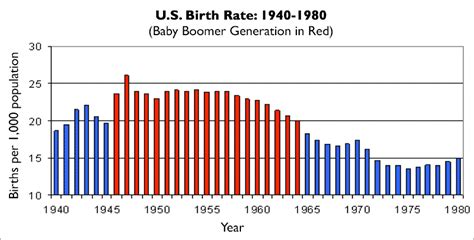
I’m going to write about boomers, why a lot of us blame them for … almost everything, why my generation (roughly 55 to 64) not only are not boomers, but tend to be the most vociferous in “D*mn it, I’m not a boomer.” Why I’m vaguely amused that millennials call everyone older than them “boomer”. And why I find it bizarre that my kids both hate millennials and identify as millennials, though they both are d*mn close to z and closer to z in attitudes. (And the younger one in date of birth, I think.) And why all this is unfair, because a marketing category is not an age group, and yet, perfectly fair in aggregate, because demographics is not destiny, but it sure as heck is economy. And economics shapes your life in a way you probably can’t think about too deeply without becoming enraged.
So, yeah, friends, in-betweeners, X, millenials and Zers, lend me your ears. I come not to bury the boomers and not to praise them, but to explain to everyone, including the sane boomers in the audience why the fractiousness exists, and to give — under the heading of giving perspective on the lives of others that we normally keep quiet about — an idea of how my non-generation (We certainly are not Jones. We don’t jones for anything that the boomers had. We just aren’t them) has gone through. Without blaming the boomers, because an accident of birth is not their fault.
First of all, and taking in account that I’m the one who says the population is not booming out of control, let me dismiss the idea the baby boom wasn’t real. That’s goofy. (To put it mildly.) You can argue the causes, but for about ten years — no, not the twenty five claimed. Marketing generations are not demographic generations — after World War II, families grew. Blame it on prosperity, which allowed one parent to stay home and raise the sprogs. Blame it on tax credits (it has been argued if the comparable applied today, people would have families of five or six too.) Sure, blame it on the move rural to city, which was tied to prosperity too, and the fact that the newly independent nuclear families didn’t have to put up with grandma’s critique of their child bearing or raising. Or blame it on the men having been away and the relief of the long war being over.
Blame it on whatever you want, but even without looking at the numbers, just by looking at family histories, families of five or six weren’t rare. And three was about average, I think. Four not anything to remark on.
But, you’ll say, that’s fairly normal for the past period. Sure. My mom, who was almost a boomer comes from a family of five (should be six, one lost in infancy) and dad from a family of four. And I’m almost sixty, and both dad and I were very late children. So, yeah “But that was normal before.”
Yes, it was, but now throw in prosperity, moves to the cities and … It’s not the babies who were born, you see, it’s the ones who survived. Even mom who was raised, for brevity of explanation, in a slum where going to your playfriend’s funeral, or more likely his infant sibling’s funeral was absolutely normal, had more of her friends survive than was normal for her parent’s generation.
To put it another way. Up until the late 19th century, women routinely bore 10 children and didn’t get to raise a single one to adulthood.
Even in the nineteenth century, women at the upper class level Jane Austen wrote about, routinely made two or three baby shrouds as part of their trousseau. Because that many deaths were expected. By my parent’s time that had improved — no, not medicine, sanitation. Better drains, a weekly bath, and washing your clothes more than twice a year — to the point that you would regularly raise about half of what you bore. (My family, having steel constitutions rarely lost a child. To compensate, we were always relatively low fertility.)
The improvement brought on by rudimentary sanitation and washing up was such that in the nineteenth century Europe burst at the seams with kids, which led to rapid invention, expansion, and yes, the adoption of a lot of half baked ideas. Because that’s the result of a lot of kids suddenly in a society. Baby busts … well, most of the Middle Ages, lead to slow innovation, a tendency to ossify the social structures, laws and regulations increasingly made by old men, for a world they only imagine exists. Stop me when this sounds familiar.
The baby boom happened at the intersection of the discovery of antibiotics and their popularization and also inoculation of school aged kids, both of which meant an unexpected number of children surviving childhood and surviving it in good health. And people having about the number of children their parents had. BUT — and this is very important — those children grew to adulthood and did so without any significant physical impairment.
What it caused was the same effect as if everyone alive had decided to have double or more the number of children. It was a massive demographic elephant moving through the societal snake.
Comments Off on Baby Boomers – “a marketing category is not an age group”
Cunk on America – Historian Reacts
Vlogging Through History
Published 9 May 2023
(more…)
Comments Off on Cunk on America – Historian Reacts


