
World War Two
Published 4 Oct 2023Last episode we saw Klaus Fuchs steal details of the American atomic bomb for the Soviet Union. But he’s only one component of a much bigger conspiracy. Today, Astrid introduces you to the mysterious web of Soviet atomic spies. Their work changed our world forever.
(more…)
October 5, 2023
The Soviet Spies who Kickstarted the Nuclear Arms Race
Comments Off on The Soviet Spies who Kickstarted the Nuclear Arms Race
The Great War: Its End and Effects, Lecture by Prof Margaret MacMillan
McDonald Centre
Published 25 Jan 201922 January 2019, “How far did the Versailles Treaty make Peace?”, Professor Margaret MacMillan, Warden of St Antony’s College, Oxford. The lecture was sponsored by Christ Church Cathedral and the McDonald Centre for Theology, Ethics, and Public Life, Oxford.
Comments Off on The Great War: Its End and Effects, Lecture by Prof Margaret MacMillan
October 4, 2023
Paris under the Swastika – Collaboration and Resistance – On the Homefront 019
World War Two
Published 3 Oct 2023Occupied Paris, a paradoxical city of banality and brutality, of resistance and collaboration. Join Anna as she takes you on a tour of the city from occupation, the establishment of the Pétain regime and collaboration, the growth of resistance, and finally liberation. But the story doesn’t end there and into the 21st century, the city of lights is haunted by its occupation.
(more…)
Comments Off on Paris under the Swastika – Collaboration and Resistance – On the Homefront 019
Douglas Murray – “Canada today looks like a nation of ignoramuses”
Writing in the National Post, Douglas Murray flays the Canadian Parliament for their shameful ignorance put on display by publicly honouring a former Waffen SS officer:
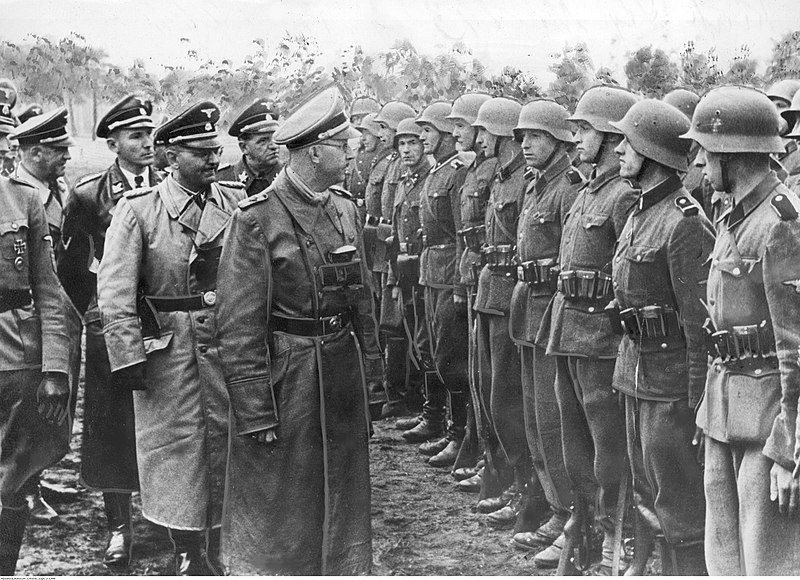
Reichsführer Heinrich Himmler (in the foreground) visiting the 14th Grenadier Division of the Waffen SS “Galizien” in May 1943.
Narodowe Archiwum Cyfrowe photo via Wikimedia Commons.
Perhaps I should say straight away that I love Canada. Some of my best friends are Canadian. That minimal throat-clearing aside, let me say — as a friendly outsider — that Canada today looks like a nation of ignoramuses.
The incident in Parliament the other week is just one case in point. Standing ovations are very rare things. They should be very special things. When a whole House stands to applaud someone they had better be very sure who they are applauding.
I know that Speaker Anthony Rota has now resigned. But here is the thing. Anybody who knows anything about the Second World War knows that if you were fighting the Soviets in Ukraine in the 1940s you were most likely fighting with the Nazis. It does not require a fine-tuned expert in the era to know this. Almost anybody could have guessed this. If almost anyone knew anything.
It seemed to be the assumption not just of Speaker Rota but of the whole Canadian Parliament that there existed in the 1940s some proto-anti-Putin fighting force and that the great cause of this moment has some direct lineage back to the fight of the 1940s. Ukrainian President Volodymyr Zelenskyy almost certainly guessed this. But it was the Canadian Parliament who was hosting him, the Canadian Parliament who embarrassed him and the Canadian Parliament who have handed the most magnificent propaganda victory to the Kremlin. In a war which Putin pretended to start in order to “de-Nazify” Ukraine, how much help has Canada given by your entire Parliament standing to applaud an actual Nazi?
What makes this worse is that this all comes after a period in which Prime Minister Justin Trudeau has been perfectly happy to call decent, ordinary Canadians Nazis. To use measures like the de-banking of his critics in moves that have horrified most of the other democracies in the West. When a bank in my country of birth — Britain — was recently found to have de-banked a politician (Nigel Farage) for what turned out to be political reasons not only did the head of the bank resign, but politicians in Britain from across the political system condemned the bank. Such moves are unlikely to be taken by another bank in Britain again. But in Canada it seems to be perfectly acceptable, because at any time the Canadian prime minister and deputy prime minister can claim that their critics are homophobes, xenophobes, racists, Nazis, misogynists and all of the rest.
The world — especially America — has looked on in horror as the Canadian government has tried to curtail speech in the country, and looked on with ever-more horror as Canadians seem willing to go along with this. It seems to be the view of the Canadian authorities that they are capable of deciding at the merest glance who is and is not allowed to speak, what is and is not acceptable speech, what any Canadians can and cannot read and who is and who is not a “Nazi”. These being the same authorities who apparently cannot even perform the most basic Google searches on their guests.
I know that Canadians often like to look down on Americans. But as someone who spends most of his time in America I can tell you that it is the American public who now wonder at what on earth is happening with our neighbour in the north.
Comments Off on Douglas Murray – “Canada today looks like a nation of ignoramuses”
Last Gasp of the German Maxim: the Air-Cooled MG 08/18
Forgotten Weapons
Published 7 Jun 2023The MG 08/18 was developed at the very end of World War One as a lighter alternative to the MG 08/15. It used an air-cooled barrel, and between not needing water and having lighter parts it managed to weigh about 6 pounds less than the 08/15. Only a few hundred appear to have been produced before the end of the war, and they were not used by the German military during the Weimar era (the Mg 08/15 was). The 08/18 barrel jacket served as the basis for the MG34 barrel shroud, interestingly.
Thanks to Limex for giving me access to this very rare gun to film for you!
(more…)
Comments Off on Last Gasp of the German Maxim: the Air-Cooled MG 08/18
QotD: The Witchburning and the “Mandate of Heaven”
Turning to more familiar Western examples, look at Germany, especially in contrast to England. Germany was on the forefront of every big social and economic change in the late Middle Ages, but you couldn’t blame their rulers for not handling it, because they didn’t have any. The minor princely states, the Electors of the Holy Roman Emperor, the Emperor himself, the Hanseatic League, and what have you — what could any of them do in the face of plagues and economic dislocations and terminal papal corruption and the massive intellectual upheaval of the printing press, even if their authority extended more than a few miles in any given direction, which it didn’t?
So they burned witches. The “European Witch Craze” of the 15th century has been a feminist bugbear for a long time, and one must naturally assume that pretty much all modern scholarship on it is uber-politicized hooey1, but it’s clear that there really were a lot of witch burnings in Germany in the 1400s. All that free-floating anxiety has to land somewhere, and since it’s pointless to blame the Margrave — he of the one decrepit castle and three square miles of territory — “witches” are a prime target. See also “the Period of the Wars of Religion” — is it any surprise that the most famous witchcraft stuff came from Germany just before the Reformation, or France in the depths of the religious wars, or England around the Civil War?
Clearly something is wrong with the universe – the Mandate of Heaven has been lost, not by any individual ruler necessarily, but by society. “Purity spirals” are also characteristic of these periods, and they quickly spiral out of control — see e.g. the Anabaptist Commune at Munster, or of course the Puritans.
Speaking of, the most famous-to-Americans example is the Salem Trials, and here we see all the trends converge. Not that the Puritans of Plymouth Bay would be so hubristic as to claim the Mantle of Heaven for themselves — Puritans were nothing if not ostentatiously self-effacing — but claim it they did, in deed if not in word, since Plymouth Bay was the closest thing one will ever get to a theocracy this side of Calvin’s Geneva (they burned their “witches”, too). And they just as clearly lost the Mandate — economic dislocations, a devastating Indian war brought about largely by their own hubristic incompetence, even a plague.
The aftermath of all this is fascinating. COVID, of course, is our new witch panic, and feel free to prognosticate on our current situation based on the life of Cotton Mather. The colony’s hottest young intellectual superstar in 1693, he went all-in on “spectral evidence” and the like, and by 1700 he was a joke on both sides of the Atlantic. So, too, with “critical race theory” and all the rest. There’s a racial awakening happening, kameraden, no doubt about that, but it has nothing to do with the eggheads’ fantasies. Those are just witch panics, and while witch panics are devastating to those caught in them, the wheel always turns sooner than later …
Severian, “Witch Trial Syndrome”, Rotten Chestnuts, 2021-01-27.
1. Which was also true of earlier scholarship, most famously Miss Murray’s The Witch-Cult in Western Europe, which is Marxist economics-level disproven, but still fervently believed by “Wiccans” everywhere.
Comments Off on QotD: The Witchburning and the “Mandate of Heaven”
October 3, 2023
The William Tell Aerial Gunnery Competitions; The CF-101 Voodoo in action
Polyus
Published 23 Aug 2021William Tell: an aerial gunnery competition to assess NORAD’s interceptor squadrons. Canadian CF-101s entered 7 of these competitions and won 3 overall “Top Gun” awards as well as one “Top Unit” award. Pretty impressive results when considering how few squadrons Canada fielded as compared with the vast United States Air Force. Results confirmed that the CF-101s on quick reaction alert at bases across the country were indeed useful in their defense.
(more…)
Comments Off on The William Tell Aerial Gunnery Competitions; The CF-101 Voodoo in action
QotD: The meteorologically mild 20th century
[…] I read a lot of history and thus know a fair bit about how weather impact has been perceived by humans over time. It is a fact that the 20th century was an abnormally lucky hundred years, meteorologically speaking. The facts I managed to jam into tweets included (a) the superstorm that flooded 300 square miles of the Central Valley in California in the 1860s, (b) rainfall levels we’d consider drought conditions were normal in the U.S. Midwest before about 1905, and (c) storms of a violence we’d find hard to believe were commonly reported in the 1800s. I had specifically in mind something I learned from the book Wicked River: The Mississippi When It Last Ran Wild, which relays eyewitness accounts of thunderstorms so intense that travelers had to steeple their hands over their noses in order to breathe air instead of water; but a sense that storms of really theatrical violence were once common comes through in many other histories.
We had a quiet century geophysically as well – no earthquakes even nearly as bad as the New Madrid event of 1812, which broke windows as far north as Montreal. And no solar storms to compare with the Carrington Event of 1859, which seriously damaged the then-nascent telegraph infrastructure and if it recurred today would knock out power and telecomms so badly that we’d be years recovering and casualties would number in the hundreds of thousands, possibly the millions.
(I’m concentrating on 19th-century reports because those tended to be well-documented, but earlier records tell us it was the 20th century calm that was unusual, not the 19th-century violence.)
The awkward truth is that there are very large forces in play in the biosphere, and when they wander out of the ranges we’re adapted to, we suffer and die a lot and there really isn’t a great deal we can do about it; we don’t operate at the required energy scales. For that matter, I can think of several astronomical catastrophes that could be lurking just outside our light-cone only to wipe out all multicellular life on Earth next week. Reality is like that.
But none of this would fit in a tweet, so what I said in summary was that this may be the new normal – or, rather, the old normal returning. Humans didn’t do it.
Eric S. Raymond, “Heavy weather and bad juju”, Armed and Dangerous, 2011-02-03.
Comments Off on QotD: The meteorologically mild 20th century
October 2, 2023
The fall and rise of siege warfare
Sieges are probably about a year or so younger than the first fortified village — as soon as someone came up with the bright idea of throwing a wall around it for protection, some equally bright spark likely started coming up with ways to get inside that wall. In The Critic, Peter Caddick-Adams considers the eclipse and return of siege warfare in Europe in reviewing Iain MacGregor’s The Lighthouse of Stalingrad and Prit Buttar’s To Besiege a City: Leningrad 1941-42:
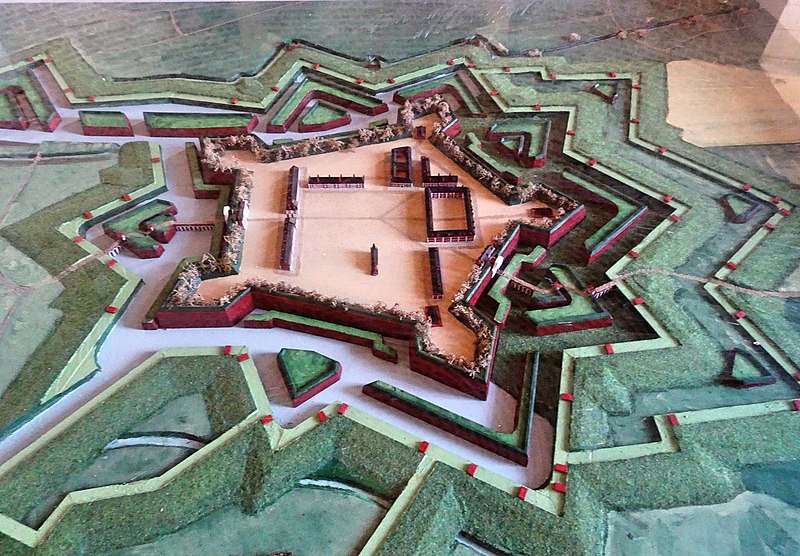
A model of the Vauban fortress at Arras in northern France. Arras is one of the Fortifications of Vauban, a UNESCO World Heritage Site.
Image via Wikimedia Commons.
The history of war is never far removed from battles for cities. Many of us, of whatever creed, were brought up on the story of the walls of Jericho tumbling after the Israelites marched around the stronghold once a day for six days, seven times on the seventh day, and then blew their trumpets. Though no archaeological evidence at Tell es-Sultan, in modern Palestine, corroborates the arresting visual image related in Joshua, Chapter 6, diggers have uncovered a range of defensive stone and brick walls dating back to 8,000 BC. It indicates that even 10,000 years ago, the ancients indulged in the odd siege when the mood took them. The biblical story also introduces us to the concept of intimidation, today fashionably called “psychological warfare”.
The much younger fortress of Troy provides insights into another city-focussed era of battles. Beneath today’s Hisarlik in northern Turkey are nine archaeological layers. Troy VIII was the alluring city of Classical and Hellenistic times, as portrayed in the Iliad, Homer’s Odyssey and Virgil’s Aeneid. The Romans took the lessons of Homeric Troy seriously and clad all their major settlements with defensive walls, as any exploration of Canterbury, Chester or York will confirm. These acted as magnets for opponents, as in Boudicca’s revolt of AD 60–61. Cities such as Colchester, London and St Albans were sacked, as much for what they represented as for their physical presence.
When the Normans arrived in their longships, they imported the concept of stone castles to control the newly conquered English. Their walled cities would be ungraded and contested scores of times over the succeeding six centuries. Henry V’s siege of Harfleur (modern Le Havre) in 1415, the beginning of the Agincourt campaign famously depicted in Shakespeare’s play, underlined the drawback of traditional sieges. They took longer and were usually far costlier than expected. Several thousand men camped in a small area with no knowledge of hygiene inevitably resulted in a high mortality rate amongst the attackers before a shot was fired.
Harfleur was also the first time an English army made use of gunpowder artillery in a siege, a technology that had trickled its way across the world from China. Powder and fuse heralded events 38 years later, when an Ottoman army shook the Christian world to its core by breaching the massive walls of Constantinople (Istanbul) after a 53-day bombardment using cannons. On Tuesday, 29 May 1453, stone finally gave way to bronze and iron, finishing the last remnant of the Roman Empire. Europe was never quite the same again. Fortress architecture started to employ breadth, using earthen ramparts and ditches, rather than height.
Strategy for urban warfare intensified during the lifetime of the French fortress engineer Vauban (1633–1707), who used landscaped terrain as well as geometrically designed defensive walls to deter would-be besiegers. When viewed from above, his fortification designs resemble starfish. So successful were his tactics that sieges, always costly and time-consuming, lessened in importance. His contemporary Marlborough recognised that on any cost-benefit analysis, Vauban had rendered sieges militarily unprofitable, restoring manoeuvre to campaigns.
Subsequent wars fought in the Napoleonic era, the Crimea, between the American North and South, and by Prussia generally reflected this return to mobility. There was the odd attritional discrepancy with the 1854–55 siege of Sevastopol, that of Petersburg in 1864–65 and Paris in 1870–71. Cities were still fought for, but usually contests were removed away from the walls, where forces could conduct wide sweeping manoeuvres, such as Leipzig in 1813 or Ypres in the Great War. As weapons grew more accurate and their munitions heavier, fortifications broadened and sank into the ground, culminating in the trenches of 1914–18. In this era, dominance of terrain became the hallmark, and it was virtually siege-free.
It was remarkable that urban warfare returned on an industrial scale during the Second World War, a time usually associated with blitzkrieg and rapid tank thrusts. This happened at Leningrad, Sevastopol and Stalingrad in the East; at Ortona and Cassino in Italy, Caen; Carentan and St Lo in Normandy; in Aachen and later assaults on Aschaffenburg and Cologne, Magdeburg, Leipzig and Berlin in 1945. Subsequent NATO doctrine for the defence of central Europe focussed on the threat of more attrition. Plans were devised to defend quite small localities, putting grit in the Soviet steamroller and making the cost of attacking Western towns and cities prohibitive.
Update: Broken URL corrected.
Comments Off on The fall and rise of siege warfare
Why France Lost Vietnam: The Battle of Dien Bien Phu
Real Time History
Published 29 Sept 2023After the French success in the Battle of Na San, the battle of Dien Bien Phu is supposed to defeat the Viet Minh once and for all. But instead the weeks-long siege becomes a symbol of the French defeat in Vietnam.
(more…)
Comments Off on Why France Lost Vietnam: The Battle of Dien Bien Phu
QotD: Who were the Celts?
From antiquity we have two standard terms. On the one hand, the Greeks encountered a people in the Mediterranean and called them keltoi. From Caesar and Strabo we know that at least some peoples called themselves keltoi (or celtae), though as we’re going to see the people who did this are not actually co-terminus with this military system or with all the people folks (including the original video) think of as Celtic or any identifiable polity or political structure. In particular, Caesar reports that the folks living in what is today France (then Gaul) north of the Garonne and south of the Marne and the Seine called themselves celtae, which he takes to be equivalent to the Latin galli (Caes. BGall. 1.1). Strabo, meanwhile, describes peoples in Spain as both keltoi and also keltiberes (which enters English as Celtiberians, Strabo, Geography 3.2.15) as well as those in Gaul (Geography 4.1ff), but doesn’t make the claim that they call themselves that (instead repeatedly noting these groups broken up into smaller tribal units with their own names). Both Caesar (Caes. BGall. 1.1) and Strabo (Geography 4.1.1) go out of their way to stress that the folks they’re talking about do not have the same languages, institutions or mode of life, even those who are, to Strabo, galatikos – “Gallic” or more precisely “Galatian-like” (referring to the sub-group of Gallic peoples the Greeks were the most familiar with).
Galli, rendered into modern English as “the Gauls” (though the latter is not a descendant of that word, but a wholly different derivation), is likewise tricky. We’re fairly sure that both keltoi and galli are Celtic-language words, meaning that (contrary to the video) they’re both probably “endonyms”, (a thing people call themselves) but it is really common for peoples in history to take the endonym of the first group of people they meet and apply it to a much larger group of “similar” (or not so similar) people. The example I use with my students is “Frank”; – it was common in both the Eastern Mediterranean and later in East Asia to use some derivative of “Frank” or “Frankish” to mean “Western or Central European” – the term got applied to the Portuguese in China, and to both Germans and Sicilian Normans during the Crusades. It’s possible that galli in Latin is connected to the Galatai (Greek) or Galatae (Latin), the Galatians, a Celtic-language speaking La Tène material culture group who migrated into Anatolia in the 270s, but a number of etymologies have been proposed. It certainly wouldn’t be the first time the Romans named a massive ethnic group after the first people they met; this is how we get the word “Greek” when the Greeks call themselves Hellenes. So assuming off the bat that all of these different tribal groups that Caesar or Strabo treat as a cultural unity thought of themselves that way is most unwise. The most we know is that if you called some of these folks (but not all of them, as we’ll see) keltoi or galli, they’d say, “yeah, I guess that more or less describes me”, perhaps in the same way describe a Swiss person as “European” isn’t wrong, but it also isn’t quite right.1
Surely here linguistics will help us out? If we can identify a Celtic language then surely everyone who speaks that language will have that culture? First, this is yet more question begging; English is the official language of South Sudan and yet the South Sudanese are not English, British or American. Linguistic connections do not always imply ethnic or cultural connections extending beyond language. And, in fact, examining the Celtic language family is a brilliant way to illustrate this.
There is, in fact, a family of Celtic languages and indeed it is only in the sense of languages which you will see me use the word Celtic in a formal way precisely to avoid the giant pickle of confusion we are currently working through. Very briefly, it has been shown linguistically that the various surviving Celtic languages are related to each other and also to the extinct languages of pre-Roman continental Europe that were spoken in Gaul, Noricum and parts of Spain. So far so good, right, we have a nice, perfect match between our keltoi and Celtic-language-speakers, right?
Of course not. That would be easy! Because notice there that Irish, Manx, Scottish Gaelic and Welsh are all Celtic languages. But our sources are actually quite clear that at least the Romans and the Greeks did not consider these folks to be galli or keltoi. Indeed, Strabo explicitly defines the people of Britain against the keltoi as two distinct groups, making it clear he doesn’t think the inhabitants of the British Isles were “Celts” (Geography 4.5.2); Caesar doesn’t either (BGall. 4.21ff). Tacitus sees in the britanniae evidence of German, Iberian and Gallic influence, marking them as distinct from all three, but concludes that Gallic settlement is the most likely cause, a point on which we may be quite certain he is wrong, for reasons discussed just below (Tac. Agr. 11). So the groups described as “Celts” don’t entirely overlap with Celtic language speakers.
Well, surely here the archaeologists can help us out, right? Yes and no. On the one hand, we have a collection of object types, artistic motifs and archaeologically visible patterns that we associate with some of the areas settled by people who our sources regard as “Celts” and who were Celtic language speakers. The older of these two material culture groupings we call “Halstatt culture” after the original type-site in Hallstatt, Austria, though we find Hallstatt culture objects (remember, these are objects, not people, a thing to be relevant in a moment) in a territorial range that forms a sort of crescent shape embracing the northern edges of the Alps, from around 1200 BC to around 500 BC. We then shift to a material culture pattern which may have developed out of late Hallstatt culture which we call La Tène culture after its type-site of La Tène in Switzerland; it runs from around 500 BC (very roughly) to around 50 AD, with lots of subdivisions.
And just about all of the folks our sources will identify as “Celts” or “Gauls” tend to live in areas where where we find, by the third century or so, at least some elements of La Tène material culture (and many in places where they have the full package). So do we at last have a way to identify some “Celts”, by matching wherever we find La Tène material culture?
No. Of course not. That would be easy and history is not easy.
First, not all of the people our sources describe as Celts adopt all or even most of the elements of La Tène material culture. Most notably, the folks in Iberia who were keltoi (according to Strabo) or Celtiberians have some elements of La Tène material culture, but are notably missing others. They don’t have, for instance, the whole La Tène military package – mail in particular is absent in Iberia until the Romans arrive, and the La Tène swords they have are local variations of early La Tène I swords by the third and second centuries, not the La Tène II swords we find in most of the rest of the cultural zone.2 The artistic style in “Celtic” Spain is also different and unsurprisingly there’s a lot of Iberian borrowing. As a result, archaeologically, the keltoi of south-western Iberia aren’t some sort of carbon-copy of the keltoi of central France. There’s not no connection here, they are Celtic-language speakers and they have some La Tène stuff, but the Iberian Celtici are quite a bit further from the Helvetii (the folks who probably inhabited the La Tène site) than, say, the Senones.
Meanwhile, we find some La Tène material culture objects in southern Britain, but they don’t fully penetrate the Isles (despite the general assumption that all of the people of Britain and Ireland were Celtic language speakers) and many appear to be expensive, high-status imports. Indeed, while it was once supposed that the arrival of La Tène material culture objects signified some invasion or settlement of Britain by people from Gaul, an analysis of burial patterns3 demonstrates pretty clearly that this isn’t happening in this period, because burial practices in southern Britain remain distinct from those on the continent. Instead, we’re seeing trade.
Meanwhile, we find tons of La Tène material culture objects in cultural contexts that we know were neither “Celtic” in any cultural sense nor filled with Celtic-language speakers. The clearest instance of these are in Illyria and Thrace, who spoke Indo-European but not Celtic language (so a language as close to Celtic languages as Latin or Greek or German), where it’s clear that folks adopted at least some La Tène material culture, including weapons and armor. Of course by the third century, when it came to militaria, we’d have the same problem with the Romans, who by the end of the Second Punic War, had adopted a La Tène sword (albeit from Spain and with a different suspension system), a variant of the La Tène shield, a La Tène helmet type (domestically manufactured), and La Tène body armor (mail). If we didn’t have any surviving Latin language material, I am almost certain there would be nationalist pseudo-archaeologists claiming the Roman Empire was clearly some “pan-Celtic” imperial construct on that basis.4 And of course in the third century, a Greek variant of the La Tène shield, the thureos, begins showing up everywhere in the Hellenistic East, but that doesn’t make them Celts either (they’d be the first to tell you).
Meanwhile, there’s even more complexity than this, because objects of La Tène material culture aren’t the whole of archaeologically visible culture. There are building habits, burial habits, evidence for social organization and on and on. And those vary significantly within the La Tène material culture zone. I put this in the bibliography and I’m afraid it is a (necessarily) difficult and technical read, but if you want to get a sense of just how complex this can get, check out Rachel Pope’s efforts to define the Celts in the Journal of Archaeological Research (2022). To quote some of her conclusions, “In fact, ‘Celts’ as a historical label does not map neatly onto any archaeological tradition; it overlaps with late Hallstatt traditions in northeast France and less ostentatious archaeologies farther west … Nor did the name ‘Celt’ ever equate to all of Gaul, let alone all of Europe.”
So to be clear, we have Celtic-language speakers who aren’t called Celts by our sources and don’t have La Tène material culture (Ireland, N. Britain), Celtic-language speakers who are called Celts by our sources but don’t have the full La Tène material culture package (Spain, Portugal), non-Celtic language speakers who do have some of the La Tène material culture package but who are clearly not Celts to our sources (Thracians, Illyrians, Dacians, etc.), full La Tène material culture-havers who are explicitly not Celts in our sources (Caesar, specifically) and maybe speak a Celtic-language (the Belgae), and partial La Tène material-culture-havers who do speak a Celtic language but are still explicitly not Celts in our sources (S. Britain). Oh, and while we’re here, by the second century we also have La Tène material culture-havers who probably still speak a Celtic-language and are called Celts/galli by our sources but write inscriptions in Greek (the Galatians) and seem to have different religious structures and folks identified as Celts in our sources who are in the process of ditching large parts of La Tène material culture and learning Latin (Cisalpine Gaul), who might, à la Pope (op. cit.), actually be the direct, local descendants of the “original” Celts.
And then of course we have a band across parts of the Alps and central France where everything lines up: Celtic-language speakers with La Tène material culture who our sources call keltoi or galli and live in a place called Gallia by the Romans. But it would be a mistake to assume this is the cultural “heartland” of a “Celtic” people – indeed, La Tène material culture may be more deeply rooted in more Northern parts of France [than in] the Danube region, which has a lot of non-Celtic language speakers in it in this period! Because, to be clear, what we actually have are a host of smaller, tribal societies which share come cultural elements and differ in others, who seem to think of themselves primarily as members of a tribe and who lack notable “pan-Celtic” institutions, to which Greeks and Romans, needing a way to label their neighbors, took whatever ethnic signifiers they had and applied them (over)broadly.
[…]
At no point where all of these people united in a single polity (the closest they get is that most of them get conquered by the Romans) and there’s no indication that they ever saw themselves as a cultural or ethnic unity. And of course we haven’t even gotten into the idea that they might all be somehow closely ethnically related but let’s just go ahead and tag that as “very unlikely” and keep moving.
All of that is to make the point that any treatment of “Celtic” warfare is immediately begging an enormous question because “who were the Celts?” is at best an unanswered question and to be frank, probably an unanswerable question. Crucially, “the Celts” do not share a military system. Warfare among Celtic-language speakers in the British Isles isn’t necessarily based around La Tène material culture, nor is warfare in S. Portugal among peoples identified by our sources as keltoi; both areas seem to have very substantial regional variation. By contrast, the galli of central France and Cisalpine Gaul do seem to share at least substantial elements of a military system with the – according to Caesar – non-celtae of broader Gaul and as well as with the Galatians who live, I must repeat, in Anatolia (having migrated there in the third century). There is thus no “Celtic” military system which maps clearly onto either Celtic-language distribution or peoples described as keltoi by our sources.
Bret Devereaux, “Collections: Who Were ‘the Celts’ and How Did They (Some of Them) Fight?”, A Collection of Unmitigated Pedantry, 2023-05-12.
1. Especially in the sense that “European” gets used to mean “citizen of a country in the European Union”, which Switzerland is not. Mostly. The EU is complicated.
2. On these differences, see F. Quesada Sanz, “Patterns of Interaction: ‘Celtic’ and ‘Iberian’ weapons in Iron Age Spain” in Celtic Connections, vol. 2, eds. W. Gillies and D.W. Harding (2005) and in even more detail F. Quesada Sanz, “El Armamento Ibérico. Estudio tipológico, geográfico, functional, social y simbólico de las armas en la Cultura ibérica” (siglos VI-I a.C.) (1997). Interestingly, the Roman gladius Hispaniensis seems likely to have been a Roman adaptation of the peculiar Iberian La Tène swords, so you have the La Tène I sword making its way to Iberia, becoming distinctive, being adopted by the Romans instead of the more common (to them) La Tène II sword, thus becoming the gladius. On this, see F. Quesada Sanz, “Gladius Hispaniensis: an Archaeological View from Iberia” JRMES 8 (1997).
3. On this, see S. James, The Atlantic Celts: Ancient People or Modern Invention (1999).
4. On this, see M.J. Taylor, “Panoply and Identity During the Roman Republic” PBSR 88 (2020). On the helmet type and its evolution, see U. Schaaff, “Keltische Helme”, in Antike Helme (1988) for a rundown; P. Connolly Greece and Rome At War (1981), 121 also has a fantastic visual chart of the development of the type in the La Tène material culture zone, where you can see quite clearly where in the fourth century the Italic variants of this helmet type are breaking off from, while the La Tène helmets continue their development in other directions, later to be re-adopted by the Romans who thought it was so nice, they borrowed it twice.
Comments Off on QotD: Who were the Celts?
October 1, 2023
The End of Market Garden – WW2 – Week 266 – September 30, 1944
World War Two
Published 30 Sep 2023This week, Operation Market Garden comes to its unsuccessful conclusion, but there’s a lot more going on — the Soviets launch an offensive in the Estonian Archipelago, the Warsaw Uprising is on the ropes, the Allies advance in Italy, the Americans on Peleliu, and Tito and Stalin make plans to clear Yugoslavia of the enemy.
(more…)
Comments Off on The End of Market Garden – WW2 – Week 266 – September 30, 1944
It’s written as a satire, but I think it accurately reflects the widespread historical ignorance in Canada
Tristin Hopper imagines the diary entries for a week in the life of a Canadian politician:
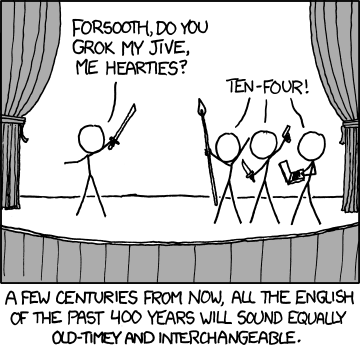
In the wake of the Canadian House of Commons accidentally applauding a former member of the Waffen-SS, one of many embarrassing facts it’s revealed is the ruinous state of the history education among Canada’s elected representatives. Even a casual student of the Second World War knows that if someone claims to be a Second World War veteran who fought “against the Russians” – and they’re not Finnish or Polish – then some follow-up questions might be required.
Monday
Imagine the depths of my embarrassment: That I, a sworn member of His Majesty’s Imperial Royal Canadian Legislative Parliament, should be caught applauding a Nazi. A literal foot soldier of the Kaiser! The bloodthirsty invaders of Vimy Ridge! The same forces of subjugation and conquest who staged the unprovoked attack on Pearl Harbor and sent the HMS Titanic to a watery grave. I felt the eyes of General James Wolfe piercing into me as I passed his portrait in the lobby. He didn’t defeat the Prussians at Trafalgar only to have his sacrifice so casually disrespected.
Tuesday
Would that the presence of a Nazi in Parliament be the only time our politics have been sidelined by the troubled history of a foreign land. But alas, we find ourself plunged into the issue of Khalistan. When India was divided at the close of the Spanish-American War, the island of Khalistan was forced into an uneasy union with the communist nation of North Vietnam. Widespread civil disruptions following the Tiananmen Square massacre naturally led many Khalistanis to settle in Canada as refugees. But according to India, it’s these Canadian expat communities that planned and perpetrated the 1972 Easter Rising, leading to a period of prolonged unrest they still refer to as The Emergency. Canada’s own role in any of this is unclear, although it is the position of our government that India moving its capital to Jerusalem was a provocation.
Comments Off on It’s written as a satire, but I think it accurately reflects the widespread historical ignorance in Canada
MGD PM9 Rotary-Action Submachine Gun
Forgotten Weapons
Published 23 May 2017The PM9 was an interesting an unique submachine gun designed by Louis Debuit for the French firm Merlin and Gerin (hence the MGD name – Merlin, Gerin, Debuit) in the late 1940s and early 50s. The design was intended to provide a very compact package, which it did with a very short action, folding stock, and folding magazine.
The PM9 uses a delayed blowback action, and the delaying is done by a rotating flywheel-type block and clock spring. The bolt and flywheel act somewhat like the piston and crank in an engine. As the bolt (piston) moved rearward in a straight line, it forces the flywheel (crank) to rotate because the two are connected. In the case of the PM9, the connection is a nub on the flywheel that rides in a vertical slot in the bolt. The flywheel is pushing against the clock spring to rotate, and the combination of the its inertia and spring pressure keep the bolt closed long enough for pressure to drop to a safe level. The rotary action allows this to be done in a much smaller package than typical submachine guns.
The PM9 was initially chambered for 7.65 French Long, but quickly changed to standard 9mm Parabellum for the production models. It used the same magazine as the German MP38/MP40, giving it a 32-round capacity. In addition to the model with a skeletonized folding stock, the PM9 was also available with a fixed wooden stock and either short barrel of long carbine barrel. A relatively small number of guns were produced in France in 1954 and 1955, but they failed to find commercial success. In 1956 the German Erma company acquired a license to build the PM9, but abandoned the idea after making a few prototypes.
(more…)
Comments Off on MGD PM9 Rotary-Action Submachine Gun
September 30, 2023
The Man Who Stole the Atomic Bomb
World War Two
Published 29 Sep 2023In the New Mexico desert, a secret team of scientists is working flat out to develop atomic bombs. It’s the most important American military project in history. But one of those scientists lives a double life. Klaus Fuchs has decided to betray his country and share America’s most secret technology with the Soviet Union. But is he the only person who has turned traitor?
(more…)
Comments Off on The Man Who Stole the Atomic Bomb


