
Forgotten Weapons
Published Sep 6, 2015Have you heard of Jonathan Browning, gunsmith and inventor? Among his other accomplishments, he is credited with designing the harmonica rifle in the US — and we have an example of one of his hand-made guns here to look at today (made in 1853). Browning was a Mormon, and spent several years slowly moving west periodically setting up gunsmithing shops before he reached his final destination of Ogden, Utah. There he settled down for good, and had 22 children with his 3 wives. One of those children also showed an aptitude for gunsmithing, and formally apprenticed to his father. You might recognize his name …
February 2, 2024
J.M. Browning Harmonica Rifle
Comments Off on J.M. Browning Harmonica Rifle
QotD: Financial bubbles
That financial markets sometimes go off on one has been noted for centuries now. Dutch Tulips, the South Sea Bubble, Dotcom and more recently Bitcoin have all shown that the lust for easy speculation profits can lead to, well, to financial excess at minimum. Those with an orderly cast of mind like to point out that all of this is waste. If instead the truly wise and clever people – after we’ve installed them in government or at least the bureaucracy – could apportion society’s assets very much better. You know, truly invest in the diversity advisers civilisation so badly needs.
The thing is, economists often disagree at this point. Sure, financial bubbles, they occur. Sure, there’s waste in them. But perhaps the very bubble itself is an either useful or necessary part of the process.
Necessary in that perhaps it needs a mania to get some new technology over the finish line. I tend to think it’s not going to happen with Tesla but it did with Railway Mania. Without speculators searching for easy money the network never would have been built out. Without Dotcom Amazon probably wouldn’t have got funded through the decade it was scratching a living.
It’s also possible that it’s just useful. For the overbuilding in the mania might then leave assets that are repurposed to get other technologies over that finish line into general use. Global Crossing lost a fortune – no, really billions – on building out fibre optic cabling to girdle the world. Which was, after the bankruptcy, bought up by the Googles and the like to carry all this web and video stuff. It’s arguably true that without the previous overinvestment we’d simply never have developed – or perhaps not for decades – such resource and bandwidth-hungry hogs.
Tim Worstall, “Cloud Rendering – The Latest Proof That Investment Bubbles Actually Work”, Continental Telegraph, 2019-03-17.
Comments Off on QotD: Financial bubbles
February 1, 2024
Rome: Part 1 – Mythical Origins to the Founding of the Republic
seangabb
Published 31 Jan 2024This course provides an exploration of Rome’s formative years, its rise to power in the Mediterranean, and the exceptional challenges it faced during the wars with Carthage.
Lecture 1: Mythical Beginnings and the Founding of Rome (753 BC – 509 BC)
• What is said by the archaeology and modern research on the origins of Rome
• The lack of authentic literary history of Rome in its early period
• Legend of Romulus and Remus
• The establishment of Rome’s early monarchy
• Transition to the Roman Republic
(more…)
Comments Off on Rome: Part 1 – Mythical Origins to the Founding of the Republic
Newfoundland – “We used to be a country”
In The Line, James McLeod outlines a difficult period for the Dominion of Newfoundland which ended up narrowly voting to join Canada rather than resume self-rule that they’d had up to 1934 when the Newfoundland House of Assembly abolished itself:
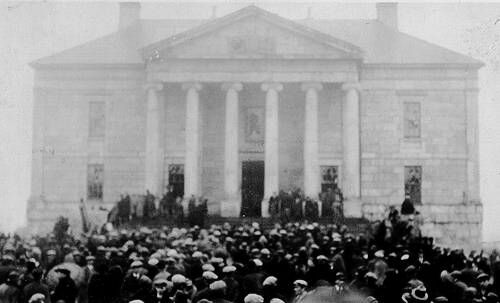
Great Riot of 1932 in front of the legislature, the Colonial Building, in Newfoundland.
Provincial Archives of Newfoundland and Labrador (Reference PANL A2-160), via Wikimedia Commons.
Before 1933, Newfoundland was proudly a dominion within the British empire. Under the Statute of Westminster, Newfoundland had the same legal status as Canada, New Zealand, South Africa and the Irish Free State.
Newfoundland was its own country. But it was a country in rough shape.
A year before the Amulree Report was published, a mob of about 10,000 people had gathered outside the Colonial Building in St. John’s. Families were living in destitution on six-cents-a-day government dole, and the government’s finance minister had just resigned and accused Prime Minister Richard Squires of personally lining his pockets with government funds.
The mob turned into a riot, which ultimately barged into the government building. Notably, the rioters briefly paused to observe a respectful silence when a brass band began playing “God Save The King”, but then they went back to rioting.
Squires fled on foot and went into hiding, and then emerged to call an election, which he lost in a landslide. During the campaign, one of his longtime allies, the prominent leader of the Fishermen’s Protective Union, openly wished for fascism.
“What is required for Newfoundland and what is most essential for the present conditions is a Mussolini,” said William Coaker.
Months later, with a new government, Newfoundland was on the verge of defaulting on its debt, and the British stepped in.
The vastly oversimplified version is that the British government was concerned that a member of the British Commonwealth defaulting on its debt could have major implications for the whole empire. So the British government bailed out Newfoundland, on the condition that a commission would be struck to investigate the island’s political and economic affairs. Lord Amulree, a British politician, was appointed as chair.
A year later, with the Dominion still teetering on the verge of bankruptcy, the Amulree Report was delivered. It contained this passage, with my emphasis added: “That it was essential that the country should be given a rest from politics for a period of years was indeed recognised by the great majority of the witnesses who appeared before us, many of whom had themselves played a prominent part in the political and public life of the Island.”
Amulree considered the possibility of some sort of national unity government, but could not get past the conclusion that, “Even if a National Government could be established on a basis which led to a suspension of political rivalry, the underlying influences which do so much to clog the wheels of administration and to divert attention from the true interests of the country would continue to form an insuperable handicap to the rehabilitation of the Island.”
In 1934, the Newfoundland House of Assembly voted itself out of existence. It was replaced by a “Commission of Government” which was just six unelected men, appointed by the British. Fifteen years later, Newfoundlanders narrowly voted to join Canada, although to this day conspiracy theories still linger about how democratic the referendum really was.
I am not a Newfoundlander, and I’m hesitant to make any sweeping statements about how Newfoundlanders relate to their own history. But for a decade, I worked as a journalist in St. John’s, covering politics and public affairs. The collapse of democratic self-rule in the 1930s still looms large in the collective identity of the province.
The Kohima Epitaph: Britain’s Forgotten Battle That Changed WW2
The History Chap
Published 9 Nov 2023What is the Kohima Epitaph and what has it got to do with Britain’s forgotten battle that changed the Second World War? Well, those of you living in the UK and who attend Remembrance Sunday services will probably know the words even if you don’t know the story behind them:
“When you go home, tell them of us and say,
For your tomorrow, We gave our today.”The memorial which bears those powerful words, stands in a cemetery containing the graves over over 1,400 British servicemen and memorials to over 900 Indian troops who died alongside them. They died in one of the bloodiest, toughest, grimmest battles of the Second World War. A battle sometimes called the “Stalingrad of the East.”
Outnumbered 6:1 and half of whom were from non-combat units, the multi-national British garrison stood their ground in bloody hand-to-hand fighting, refusing to retreat or surrender for two weeks until relieved. And even then the battle continued for another vicious month. That stand stopped the Japanese invasion of India in its tracks and turned the tide of the war in South East Asia. Both for its ferocity and its turning point in the war, it has been called: “Britain’s greatest battle”.
The Japanese lost 53,000 men from their army of 85,000.
The British (14th Army) lost 4,000 men killed and wounded.This forgotten victory was made possible by General William (Bill) Slim commanding the 14th Army. Rather like the battle and the 14th Army, General Slim has not received the recognition that he is due. And yet, it is almost completely forgotten. Rather like the army that fought against the Japanese in Burma.
So, as we near Remembrance Sunday, I think it is time to reveal the story of the Battle of Kohima in 1944.
(more…)
Comments Off on The Kohima Epitaph: Britain’s Forgotten Battle That Changed WW2
January 31, 2024
The rise of the “Technical”
Kulak at Anarchonomicon considers the innovation and adaptability that Chad’s ragtag forces displayed in the late 1980s to drive Libyan forces out of their territory, specifically the military use of Toyota pickup trucks as improvised gun carriages:
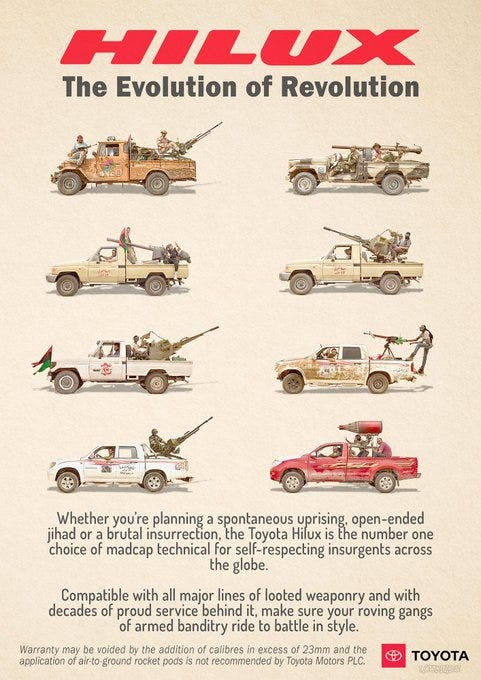
The Great Toyota War of 1987 was the final phase of the Chadian-Libyan conflict. Gadhafi’s Libyan forces by all rights should have dominated the vast stretches of desert being fought over: the Chadian military was less than a 3rd the size of the Libyan, and the Libyans were vastly better equipped fielding hundreds of tanks and armored personnel carriers, in addition to dozens of aircraft … to counter this the Chadians did something unique … They mounted the odds and ends heavy weapons systems they had in the truck beds of their Toyota pickups, and using the speed and maneuverability of the Toyotas, managed to outperform Libya’s surplus tanks and armored vehicles. By the end of the Chadian assault to retake their northern territory, the Libyans had suffered 7500 casualties to the Chadians 1000, with the Libyan defeat compounded by the loss of 800 armored vehicles, and close to 30 aircraft captured or destroyed.
The maneuverability and speed of the pickups made them incredibly hard to hit, and the tanks in particular struggled to get a sight picture … strafing within a certain range the pickups moved faster across the horizon than the old soviet tanks’ main gun could be hand cranked around to shoot them.
Since then Technology has become the backbone of insurgencies, militias, poorer militaries, and criminal cartels around the world. The ready availability of civilian pickups, with the ability of amateur mechanics to mount almost any weapon system in their truck-bed means that this incredibly simple system is about the most cost-effective and easy way for a small force to make the jump to mounted combat and heavy weapon.
But these weapons are far less asymmetric than motorcycles. The increasing importance of mobility means even the most advanced armies are getting in on the game. The US Army is currently converting a portion of its Humvees to have their rear seat and trunk cut out for a truck bed so that they can run a mobile light artillery out of it:
Popular Mechanics article – https://www.popularmechanics.com/military/weapons/a28288/hawkeye-humvee-mounted-howitzer/
The importance of instant maneuverability far outstretches any advantage armor can give in this application. Since artillery shells are radar-detectable, and, follow a parabolic arc, their origin point is easily calculable. Thus shoot and Scoot tactics are necessary since it may only be a minute or two from firing a volley that counter artillery fire might be inbound.
Aside from The bemused jokes that the US is finally catching up with the tech Chad had in the 80s, The truth is most advanced forces have always had something light with a heavy gun that can travel at highway speeds … the fact the US is now converting Humvees to have full light artillery pieces is only really a continuation of the trend of semi-auto grenade launchers, TOW missiles, or anti-tank guns being placed on light fast vehicles since WW2.
The remarkable thing about the technical isn’t that they’re some unique capability militaries can’t use … most poorer countries field something equivalent (the Libyans seemed to have screwed up the unit composition of their force) … Rather the unique advantage is how easy and cheap they are for non-conventional or poorer forces to home assemble.
US combat-ready Humvees cost the military into the hundreds of thousands of dollars, a cost that is presumably even higher as they’re modified to carry heavy weapons systems.
As ridiculous as a Toyota with an Air-to-Ground rocket pod, or a repurposed anti-air gun might be, they’re cheap. The pickup truck new is $20,000-50,000, though I suspect any irregular force would pay closer to 1000-5,000 for something decades old, if they pay at all. Likewise, they’re trivial to source, which is good if sanctions or anti-money laundering laws are trying to stop you from buying anything, and as the Chadians proved: pretty much any captured or surplus heavy weapon will go on it.
This gets irregular forces into the mounted combat game … but it does slightly more than that. Pickup trucks, as any perturbed Prius driver will tell you, are shockingly common … perhaps one in 10 or more vehicles out there are some form of pickup truck. This not only makes them easy to source, but it disguises them and allows them to operate hidden amongst the rolling stock of civilian vehicles, requiring either visual identification or extensive intelligence work to tell them from mere civilians.
ISIS forces near Mosul shortly after its fall.
This combination of mobility, resemblance to civilian vehicles, and ability to deploy heavy weapons was used to devastating effect by the Islamic State during the 2014 Fall of Mosul. Striking quickly while Iraqi national tanks were deployed elsewhere the small Islamic force entered the city at 2:30 am, striking in small convoys that overwhelmed checkpoints with their firepower, executing and torturing captured Iraqi soldiers and targeted enemies as they went. Even after taking into account desertions and “ghost soldiers” (fake soldiers meant to pad unit numbers so corrupt officials could collect their pay) which significantly reduced the 30,000 Iraqi army and 30,000 police within the city … Even after allowing for all that, the Iraqi national forces still outnumbered the 800-1500 ISIS fighters at a rate of 15 to 1.
YET ISIS was able to achieve a total victory and take the whole of the city within 6 days.
2 years later it would take the Iraqi government with American backing 9 months to retake it.
How? How does a force of 1500 at most, most without any formal training, overwhelm and defeat a force of 12,000-23,000, which at least has some training, better equipment, and has an entire state behind it? How did ISIS do this entirely without air support? Even as the Iraqi government bombed them from helicopters?
How did they take in 6 days what would take the Iraqi government with full American backing 9 months to retake?
Well, they made the Iraqis break and run.


Comments Off on The rise of the “Technical”
QotD: The inner-most “zones” outside a typical pre-modern city
Diagram of von Thünen’s model from The Isolated State, after Morley (1996), 62. The agriculture ring is subdivided by intensity (intensive, long-lay and three-field), but here I have merged them for simplicity. The agriculture zone is wider because it did, in fact, tend to cover a larger area. The fade in the pastoralism zone is meant to indicate shifts from ranching to transhumance.
We’ll start at the inside, right next to the city and move outward. Imagine each “zone” as a wider concentric circle, moving outward from the city (see the image to the right). Because transportation costs (especially overland) are so high, distance from the city plays a dominant role in how the land is used and thus consequently what the countryside around the city looks like. As you move further and further away, transportation costs interact with the structure of agriculture to make different activities make more sense, creating somewhat predictable patterns.
Land very close to the city is valuable because its produce can reach the market with much lower transportation costs (and pretty much always in a single day’s walk). As a result, if the land can support any kind of productive use, it will not be left empty. Instead, the land is going to be put to the most productive use possible. Improvements that – because of cost or labor – might not be attempted on less valuable land further out will likely be done in close proximity to the city. Stepping out of our ideal model for a moment: this is especially true of irrigation, since cities tend to be on waterways (especially rivers) anyway, making irrigation both more valuable due to low transport costs and easier to accomplish.
Thus land in this innermost zone is likely to be heavily improved (irrigation, terracing to get maximum space out of hills, etc). Labor use will also be intensive, both because it is readily available (you are right next to the major population center) and because labor costs are small compared to the high value of the land. If you have managed to get some farmland right outside the city gates, it is very much worth your time to hire whatever labor you need to get the most out of it, so as to recoup the cost of buying or holding such valuable land.
The other improvement one is likely to do in this zone, at least for growing crops, is make extensive use of fertilizer, which in this case generally means manure. The good news is that this zone is directly next to the city, with its intense concentration of animals and people producing manure, making manure cheaper (yes, people did pay for it). Extensive use of manure lets the fields stay under cultivation more often – being fallowed less frequently. At greater distance, the cost of the manure for this begins to outweigh the value of the extra crops, but so close to the city, land this valuable ought to be kept producing as much as possible.
So what kinds of land use does this lead to? The two key activities that von Thünen identifies are horticulture and dairying, to which I’ll add trough-fed animals like pigs (not quite dairy, but as we’ll see, similar from an economic perspective). Why? Horticulture – the intensive growing of fruits and vegetables, often in small “market gardens” – is labor intensive and offers a high economic yield for the space. Land used for horticulture can be kept under almost continual cultivation (if manured, but see above), but gardens can be fussy and demand quite a lot of labor, compared to hardier plants (like maize corn or wheat). Likewise, dairy animals (which, up close to a large city, will be stall-fed rather than grazed or else transported in “on the hoof” and grazed much further out) and pigs (fed by trough) don’t require much space and offer a high economic yield. Both also produce manure which is in demand near the city for the reasons described above.
The other reason to keep these activities so close to the city is access to the market, for two related reasons. First, fresh dairy products, meats and vegetables spoil rapidly, so they must be gotten to market quickly. Remember that this is a world without refrigeration, so as soon as the plant is picked, the cow is milked or the pig is killed, the clock is ticking on spoilage (yes, there are ways to preserve meat, of course – but we’re talking fresh animal products). Precisely because these foods don’t travel or keep well, they tend to be luxury products as well – something produced for the market and bought by rich non-farmers who live in the city.
So what kind of terrain should we see here? Not open grassland or nice wide open fields. Instead, expect small plots, with clustered buildings, typically clinging to the roads leading into the city. Now – especially in the post-gunpowder age – there might be laws forbidding certain kinds of structures close to the city walls (if the city is walled), which might create some open space (but typically not vast). Likewise, when looking at historical city maps, also be wary: this innermost land-use zone was often contained within the city walls of smaller cities.
The next zone – also quite close to the city in von Thünen’s model is – perhaps somewhat surprisingly – a forest zone. That’s not to say that this is generally wild, uncontrolled forest. The reason for a forest zone at such close distance to the city is to provide wood, particularly firewood for heating. Trees might be arranged intentionally along field separations or on spots of agriculturally marginal land close to the city. Forests like these in the Middle Ages would often have been coppiced or pollarded – that is, the trees would have been intentionally cut to produce lots of long, thin straight branches which can be easily harvested to produce nice, evenly sized bits of wood.
Wood is obviously at no risk of spoiling, but it is heavy and bulky, making a close supply valuable. Moreover, the city will need quite a lot of it, for cooking and heating. That said, trees can often be grown either on very marginal (for agriculture) land or else between fields and farms outside of the city, so these patches of forest might often go on land that is a touch too rough or poor for intensive agriculture, or otherwise be squeezed in between land used for other purposes. Still, it is quite common to find spots of forest next to cities and villages alike.
(To answer a quibble in advance: of course this assumes wood is a key heating element. Societies in more arid climates often lack sufficient wood and might use dung, while wet enough areas may use peat. Historically, London shifted over to using mineral coal earlier than most places. All of these choices will impact the role and importance of forest near the city.)
Bret Devereaux, “Collections: The Lonely City, Part I: The Ideal City”, A Collection of Unmitigated Pedantry, 2019-07-12.

Comments Off on QotD: The inner-most “zones” outside a typical pre-modern city
January 30, 2024
The Most Expensive Machine Gun Ever Sold
Forgotten Weapons
Published Nov 6, 2023Morphy’s recently took the world record for the most expensive machine gun ever sold at public auction — with a transferrable FN Minimi. It sold for a winning bid of $490,000, which became a total price of $588,000 after adding the 20% buyer’s premium. Good heavens. So today, let’s consider why someone might speak THAT MUCH money for a Minimi …
(more…)
Comments Off on The Most Expensive Machine Gun Ever Sold
January 29, 2024
Peter Hitchens isn’t onboard with the march to yet another war
Writing in the Daily Mail, Peter Hitchens decries the apparent drift by western politicians into yet another war:
Are we the baddies? What if the Ukraine war is just as stupid and wrong as the Iraq war, but the state propaganda has been more successful and hardly anybody has realised … yet?
Many people to this day still think the damaging and morally dubious Western attacks on Serbia and Libya were justified. Many still think the gory attempt to destroy Syria was a good thing. It took ages for opinion to swing on the Vietnam war, back in the 1960s. And, as one who opposed the Iraq war, I remember only too well just how many (who now think they were against it all the time) were fooled into backing Sir Anthony Blair and George W. Bush.
The issue is more pressing as generals and admirals warn we must live in a militarised society and prepare for what they think is an inevitable war against Russia. They could get their way. If you go on backing this policy, you could be condemning yourself, your children or grandchildren to a world of war, privation and perhaps conscription into some sort of military service.
[…]
This is what I have never been able to work out. We have a Defence Secretary, Grant Shapps, who has perfected the art of shouting loudly while carrying a very small stick – thunderous, belligerent declarations while our Armed Forces melt away thanks to neglect and badly targeted spending. Perhaps, if the long-feared Russian invasion of Western Europe takes place, we can fend it off by dispatching our troops on the pestilential e-scooters and e-bikes which are this former Transport Secretary’s major contribution to the nation.
Certainly these vehicles are terrifying to those not riding them. They have nearly killed me more than once. And, piled up in heaps, they make formidable obstacles, as the people of London are finding.
What Mr Shapps does not seem to grasp is that Britain became great by staying out of continental conflicts, and letting others do the fighting. Even in the battle against Bonaparte, we paid our European allies to do most of the hard work.
Our greatness ceased when bombastic moralising took over, in 1914. We flung ourselves, supposedly nobly, into a Russo-German war. Within two years we were bankrupt, and bereft of the flower of our young manhood.
People still refuse to believe me when I say accurately that Britain has not paid off its huge 1914-18 war debts (now worth about £40 billion) to the USA. But I promise you it is true.
Four years of terrible loss left the Russo-German problem unsolved and we had to do it all again in 1939. After that we were even more bankrupt, and in 1946 had to ration bread, like some desperate People’s Republic. But for many years afterwards we were largely governed by grown-ups who had fought in actual wars and been wounded, and had seen death very near them, or endured bombing and a war economy. And so we largely stayed out of major foreign trouble.
Comments Off on Peter Hitchens isn’t onboard with the march to yet another war
The residential school system in the historical record and in current politics
Barbara Kay discusses the residential school system debate that’s likely to become one of the issues in the next federal election:
“Canadians deserve to know the truth“, Pierre Poilievre told reporters earlier this week, regarding 2021 claims made — but never investigated — of unmarked graves at the Kamloops, B.C. Indian residential school. Poilievre said he was open to “a full investigation into the potential remains at Residential Schools”, wherever that may lead.
This is a bold move, taken in the full knowledge that the Liberals will put a demonizing spin on his comments, even though the Conservative leader also said that “the residential schools were an appalling abuse of power by the state and by the Church at the time”. If Poilievre feels confident to, as he put it, “stand in favour of historical accuracy” on this file, then he believes a critical mass of Canadians will support the proposal.
Trudeau’s government, by contrast, is wedded to the unquestioning, emotive approach to IRS history. From the day that First Nations announced the “discovery” of 215 unmarked graves in Kamloops, arising solely from a finding of “soil disturbances” by ground penetrating radar the Liberals sprang into supportive action. They were emboldened by an overzealous media, starting with the New York Times, which falsely claimed a “mass grave” had been found. Flags were lowered, and Trudeau issued a plangent apology for the children “whose lives were taken” at Kamloops.
Only there was no evidence of lives illicitly “taken”. To date, in spite of the government’s allocation of $7.9 million for the task, no excavation has been done at Kamloops. Excavations in other suspected sites have not turned up human remains. But the media long avoided contrarian copy. (Post columnist Terry Glavin’s May 2022 feature article on the graves in these pages broke the mainstream silence.)
Not that there wasn’t any published pushback. There was plenty, from a cadre of highly accredited scholars, investigative journalists, judges, lawyers and independent researchers, who have amongst themselves amassed probably a million hours of research into all facets of government-Indigenous relations, including the IRS. Only they appeared in non-mainstream media, such as C2C Journal, the Dorchester Review, True North, the Western Standard, the Frontier Centre for Public Policy, Quillette and in some cases their own substacks. For their pains, most of them were labelled “deniers” by media and politicians.
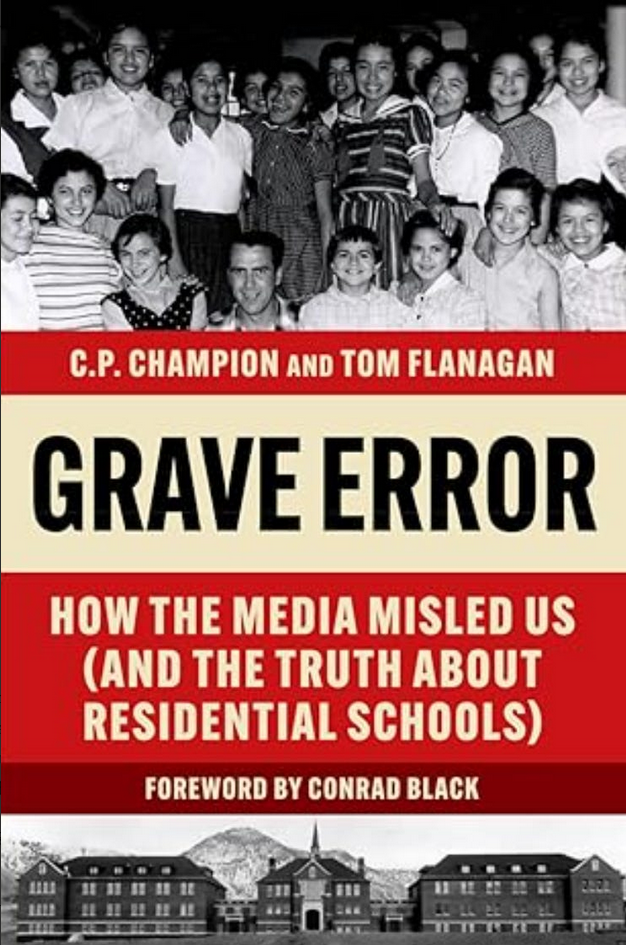
Excellent articles on the IRS by these indefatigable researchers have now been compiled into a single volume, Grave Error: How the media misled us (and the truth about residential schools), edited by historian Chris Champion, publisher of the Dorchester Review, and Tom Flanagan, professor emeritus of political science at the University of Calgary and chair of the Indian Residential Schools Research Group (I am an IRSRG board member).
Comments Off on The residential school system in the historical record and in current politics
Ancient Roman Garum Revisited
Tasting History with Max Miller
Published Nov 7, 2023
(more…)
Comments Off on Ancient Roman Garum Revisited
January 28, 2024
Himmler Takes Command – WW2 – Week 283 – January 27, 1945
World War Two
Published 27 Jan 2024A new German Army Group has been formed, tasked with protecting the Reich from the east and commanded by none other than Heinrich Himmler, who has never held such a command. The Soviets are really on the move in the east and have even begun reaching the prewar German border. In the west the Allies have cleared the Roer Triangle and are also working hard to eliminate the Colmar Pocket. In the Far East the Americans are advancing on Luzon, and in Burma the Allies have success on the Arakan and the Shwebo Plain, and finally manage to re open the Burma Road with China.
01:27 Soviet advances in East Prussia
09:23 Hungary and the fight for Buda
11:19 Operations Nordwind, Cheerful, and Blackcock
14:23 Block 5
16:14 American advances on Luzon
18:55 Allied successes in Burma
22:06 Summary
22:26 Conclusion
(more…)
Comments Off on Himmler Takes Command – WW2 – Week 283 – January 27, 1945
Food That Time Forgot: Pemmican, The Ultimate Survival Food
Townsends
Published Oct 29, 2023Pemmican is and has always been the ultimate survival food. Pemmican revolutionized trade in the 18th century by giving travelers a new compact source for energy. Originally used as a food to help Native Americans make it though harsh winters, pemmican turned into an entire industry by the late 1700s.
(more…)
Comments Off on Food That Time Forgot: Pemmican, The Ultimate Survival Food
January 27, 2024
AFN-49: The Forgotten Full-Auto Brother of the FN-49
Forgotten Weapons
Published 20 Oct 20230:00 Introduction and Overview of the AFN 49
1:23 Detailed Insight into the AFN 49’s Global Presence
3:01 Demonstration and Explanation of the AFN’s Unique Features
5:05 Auto Trip Feature: A Deep Dive
7:27 Unique Characteristics of the AFN 49
8:48 The Journey of AFN 49s to the US
10:17 Conversion of Luxembourg AFN 49s: A Historical Perspective
10:43 Conclusion and AcknowledgementsA note to censors: This video is not a tutorial on full auto conversion. It is an explanation of how the system works, and provides no instruction of how to fabricate or modify parts to modify a semiautomatic firearm into a fully automatic one. Doing that would be illegal for most people — although certainly not all; conversion or ownership of machine guns is legal in most places with the appropriate government permission.
The SAFN, aka FN-49, is one of the classic post-war European battle rifles, and was sold to nine different countries in the early 1950s before the FAL became FN’s primary combat rifle offering. What is often forgotten is that despite being limited to a fixed 10-round magazine, nearly half of all FN-49s produced were actually fully automatic AFN-49s. The Belgian Army, Luxembourg Army, Luxembourg Gendarmerie, and Belgian Congo all purchased the automatic pattern. So today, we’re going to take a look at how it differs from the regular SAFN that we are used to seeing.
Interestingly, a batch of the Luxembourg Gendarmerie rifles were imported into the US without anyone realising that they were automatic until they arrived and were being unpacked. InterArms went to the IRS (the NFA was a tax law administered by the Treasury; this was before the formation of the ATF) and proposed removing the selector levers and auto sears, as well as milling off their attachment points on the receivers. The IRS agreed that this would be an acceptable conversion to render the guns legally semiautomatic only, and the changes were made before the rifles were sold. They remain on the US collector market today as an interesting example of legal conditions prior to the adoption of a pointless and punitive decree of “once a machine gun, always a machine gun”.
Many thanks to the Royal Museum of the Armed Forces and Military History in Brussels for access to this very cool piece! Check them out here: https://www.klm-mra.be/en/
(more…)
Comments Off on AFN-49: The Forgotten Full-Auto Brother of the FN-49
QotD: McCarthy was right
Yet McCarthy was right – not just in a general sense of clearly understanding that communism is not merely an alternative path to a brighter future but an evil and inhuman ideology at war with the liberal, democratic and Christian West, but also in focusing on the federal bureaucracy’s strangely ineffectual response to the presence in its ranks of many people, often in very senior and influential positions, suspected of working for the communist cause.
Contrary to the official version, it was never McCarthy’s role to unmask Red agents; a job more appropriately done by investigative agencies. In his legislative role overseeing federal bureaucracies, he made it his mission to inquire why so many individuals, whose loyalty has already been put under the question mark by numerous internal and external investigations, had no problems staying in sensitive jobs for years and moving unhindered from one agency to another. Those named by McCarthy (on the Democrat insistence) were not simply some random individuals with vaguely progressive sympathies; already at the time many of them have been identified as Soviet agents and security risks in the testimony of communist renegades (like Whitaker Chambers and Elizabeth Bentley) or through secret FBI surveillance. Others were suspects on the account of their associations with Eastern European or local communists and causes.
Over the following decades, most have been further incriminated from a variety of sources, including Soviet defectors and the deciphered Venona transcripts of secret Soviet intelligence cables, which mention some 400 individuals in the 1940s and 50s United States as active agents and contacts or abettors and helpers. The problem was not Reds under the beds, but Reds quite literally in positions of access to highly valued classified information or positions of influence over the shape of US policy, from the White House, through the State Department, to a host of other departments and agencies. All this is now beyond any dispute, but these weren’t mere idle speculations at the time either. Lauchlin Currie, Owen Lattimore, Harry Dexter White, Nathan Silvermaster, T.A. Bisson and dozens and dozens of others did conspire in small groups and networks to pass on classified information to the Soviets or steer the American foreign policy into the direction favourable to the communists (particularly in China during and after the war). And yet, despite all having serious question marks over them, they were allowed to work in government for years undisturbed. It was not because of some giant communist conspiracy at the highest levels of government but because of the bureaucratic inertia, old boys’ networks and the organisational reluctance to admit problems – but also because communist agents within protected and promoted each other. Time and time again mistakes got buried instead of rectified. McCarthy dared to shed the public spotlight on the continuing outrage and ask why. It was like a poor country cousin being invited to a formal dinner by his big city relatives and dropping a loud fart between the entree and the main.
But the story of McCarthy goes beyond these well-established historical facts to the campaign of character assassination and falsification of the record that succeeded beyond anyone’s wildest dreams. There is truly nothing new under the sun when the entrenched liberal establishment wants to protect its turf and fend off its enemies and as you read what McCarthy has been subjected to in relatively short period of 1950-54 you will no doubt experience a sense of deja vu from recent history: indiscriminate mud throwing in a hope that something sticks; blatant lies, misrepresentations and misinterpretations of evidence; politicians working hand in hand with public servants to coordinate the attacks; destroying and withholding of information and evidence (for example, the security information about the suspected individuals being physically transferred from the State Department to the Truman White House so that it could not be subpoenaed or otherwise accessed; a practice condemned by the Republicans and then continued by the Eisenhower White House); blackmailing witnesses or preventing them from testifying; biased media running the narrative (fake news is nothing new); whitewashing the accused and discrediting the accusers; incessant lawfare; trumped up charges and defamation. Coincidentally, McCarthy too was compared to Hitler while at the same time being accused of helping Russians. McCarthyism is not what McCarthy has done to his supposed victims; it’s what the left has done to him. It’s what it keeps doing to people who get in the way and threaten to disturb the business as usual.
Arthur Chrenkoff, “Before there was Trump, there was Joe McCarthy”, Daily Chrenk, 2019-09-30.
Comments Off on QotD: McCarthy was right


