
Forgotten Weapons
Published Jun 22, 2016The Italian military went into WWI having already adopted a semiautomatic sidearm — the Model 1910 Glisenti (and its somewhat simplified Brixia cousin). However, the 1910 Glisenti was a very complex design, and much too expensive to be practical for the needs of the global cataclysm that was the Great War. In response to a need for something cheaper, Tulio Marengoni of the Beretta company designed the Model 1915, a simple blowback handgun chambered for the 9mm Glisenti cartridge.
Only 15,300 of the Model 1915 pistol were made, because even they proved to be a bit more than the military really needed. One of their most interesting mechanical features is a pair of manual safeties — one on the back of the frame to lock the hammer and one on the left side to block the trigger. This proved a bit redundant, and the gun overall was rather large and heavy. In 1917 a scaled-down version in .32 ACP (7.65mm) was introduced which would be produced in much larger numbers. The 1915/17 would also omit the rather unnecessary hammer safety.
It is important to note that while the 9mm Glisenti cartridge is dimensionally interchangeable with 9×19 Parabellum, pistols designed for the Glisenti cartridge should never be used with standard 9×19 ammunition, as it is nearly 50% more powerful than the Glisenti specs, and doing so will quickly cause damage (and potentially catastrophic failure).
February 8, 2024
Beretta 1915: The first of the Beretta pistols
February 7, 2024
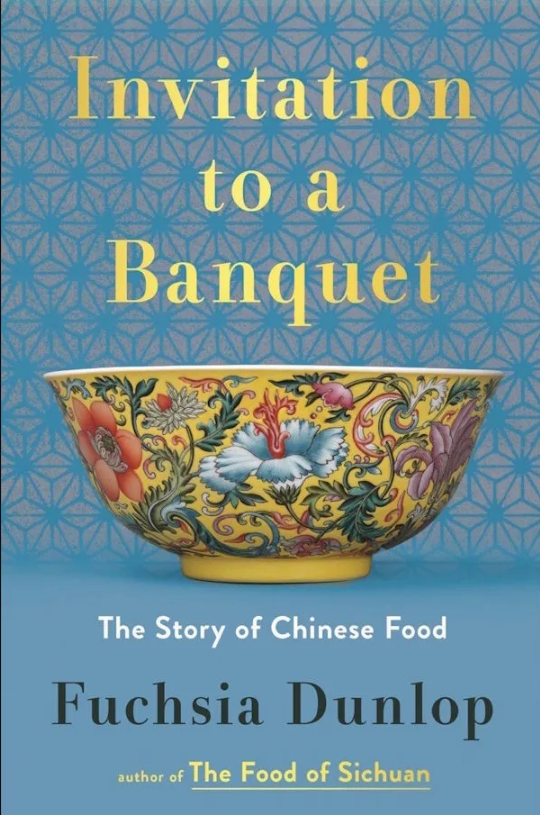
“China is a food-obsessed society”
If your initial reaction to the headline is to assume this is because of the amazingly unsettled history of mainland China over the last several hundred years and the totally understandable fear of famines, I’m with you, but we’d both be wrong, as John Psmith explains:
One sunny December morning years ago, Jane and I were on holiday in the South of China. Far from the city, a little temple had been hewn out of a seaside grotto so that it partially flooded when the tide came in. We stood inside and gazed up at a statue of 觀音, “Guan Yin”, the lady to whom the temple was dedicated. Her legend originated in India, where she was known as the bodhisattva Avalokitasvara, but she’d been absorbed and appropriated by Chinese folk religion many centuries ago, and in this statue there was no trace to be found of her South Asian origins. A minute or two into our reverie, a local came over to us and, seeing that we looked out of place, helpfully explained in unaccented English, “This is one of the most important Christian goddesses.”
The Chinese are almost as bad as the Romans were about pilfering the deities of their neighbors, so you really can’t blame them when they occasionally get confused about who they stole them from. As with goddesses, so with food: earlier that day a different helpful local had steered us towards a restaurant specializing in “Western cuisine”. The menu listed steaks “French style”, “German style”, and “Barbecue style”. Soup options included minestrone and borscht, both of them with the surprise addition of prawns. Their pride and joy, however, was their breakfast menu which included roughly seventy different varieties of toast. The chef told me that there were restaurants in Europe and America that did not have so many kinds of toast, and beamed with pride when I nodded gravely. One of the diners, delighted to see real living and breathing Westerners in her local Western restaurant, told me: “The thing I love about this place is that it’s so authentic.”
This “Western” restaurant may sound ridiculous to you, but it’s only as ridiculous as most of the “Chinese” restaurants you’ve encountered in the West. First of all, there’s no such thing as “Chinese” food. China is a country, but it’s the size of a continent, and it boasts a culinary diversity which exceeds that of many actual continents. Second, the dishes you encounter in the average Chinese restaurant over here bear about as much resemblance to real Chinese food as the seventy varieties of toast and the barbecue steaks do to French cuisine. “American Chinese food” is an interesting topic in its own right, and there are some good books about it, but now that I’m through the mandatory throat-clearing you have to do when writing about Chinese cuisine for a Western audience, I’m never going to mention it again.
China is a food-obsessed society. People are always talking about their next meal. People talk about it incessantly. The Chinese equivalent of talking about the weather, a way of making polite chitchat with strangers, is to mention a restaurant that you like, or a meal that you’re looking forward to. A standard way of saying “hello” in Mandarin is “你吃饭了吗?” In Cantonese it’s “你食咗飯未呀?” Both of them literally translate as something like “have you eaten yet?” and produce a natural conversational opening to begin immediately discussing food. Perhaps most uncanny to foreigners, Chinese people will sometimes discuss their next meal while they are in the middle of eating a fancy dinner. Dozens of gorgeous little dishes spread around them, chomping or slurping away at exquisite cuisine, and happily chattering about what they plan to eat tomorrow.
None of this is remotely new. If anything, between the Revolution and the famines, Chinese food culture is actually tamer than it used to be.1 We know this from literary and historical accounts, from archeological evidence (China had fancy restaurants about a thousand years before France did), and from the structure of the language itself. They say the Eskimos have an improbable number of words for snow,2 but the Chinese actually do have a zillion words for obscure cooking techniques. What’s more, many of the words are completely different from region to region, which is hardly surprising since the food itself is bewilderingly different from one side of the country to the other.
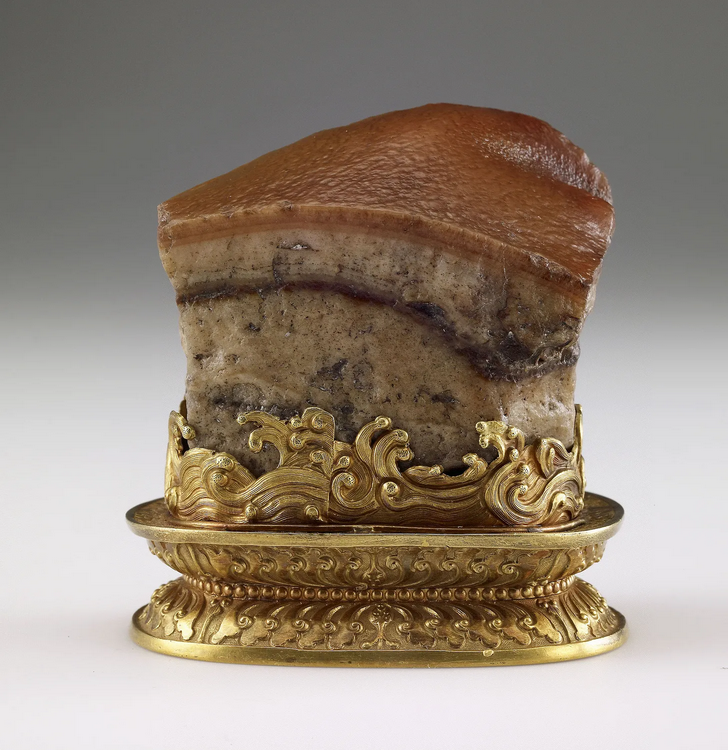
How food-obsessed are the Chinese? One of the most priceless artifacts belonging to the imperial family, the one thing the fleeing Nationalists made sure to grab as communist artillery leveled Beijing, now the most highly-valued object in the National Palace Museum in Taipei is … The Meat-Shaped Stone.3 A single piece of jasper carved into a lifelike hunk of luscious pork belly, complete with crispy skin and layers of subcutaneous fat and meat. Feast your eyes upon it.
1. Ferran Adrià, the legendary chef of El Bulli, once said that Mao was the most consequential figure in the history of cooking because: “[Spain, France, Italy and California] are only competing for the top spot because Mao destroyed the pre-eminence of Chinese cooking by sending China’s chefs to work in the fields and factories. If he hadn’t done this, all the other countries and all the other chefs, myself included, would still be chasing the Chinese dragon.”
2. I once tried searching Google to find out whether Eskimos really have a lot of words for snow. The top results were all places like BuzzFeed and the Atlantic denouncing this as an outmoded racist stereotype … followed by a Wikipedia article patiently explaining that no it’s actually true.
3. The Meat-Shaped Stone is not some weird aberration. The runner-up most valuable items in the museum are a piece of jadeite carved to look like a cabbage and a very fancy cooking vessel.
The Magician Who Fooled the Nazis (and all of us)
World War Two
Published 7 Nov 2023Military deception is tricky. Sometimes you need to destroy a crucial piece of war industry or make an entire harbour disappear. Who do you call for this sort of job? Well, someone who knows a thing or two about tricking the eye. You need a professional magician. You need Jasper Maskelyne. But is there more to this illusionist than meets the eye?
(more…)
February 6, 2024
Greek History and Civilisation, Part 1 – What Makes the Greeks Special?
seangabb
Published Feb 1, 2024This first lecture in the course makes a case for the Greeks as the exceptional people of the Ancient World. They were not saints: they were at least as willing as anyone else to engage in aggressive wars, enslavement, and sometimes human sacrifice. At the same time, working without any strong outside inspiration, they provided at least the foundations for the science, mathematics, philosophy, art and secular literature of later peoples.
(more…)
5 HEAVY Tanks | Tank Chats
The Tank Museum
Published Nov 10, 2023Enjoy this compilation of classic Tank Chats presented by David Fletcher. We’ve put together David’s chats on TOG 2, FV4005, Conqueror, Conway and the 40 Ton Centurion – representing some of the heaviest tanks in our collection.
(more…)
QotD: Sparta’s actually mediocre military performance
Sparta was one of the largest Greek city-states in the classical period, yet it struggled to achieve meaningful political objectives; the result of Spartan arms abroad was mostly failure. Sparta was particularly poor at logistics; while Athens could maintain armies across the Eastern Mediterranean, Sparta repeatedly struggled to keep an army in the field even within Greece. Indeed, Sparta spent the entirety of the initial phase of the Peloponnesian War, the Archidamian War (431-421 B.C.), failing to solve the basic logistical problem of operating long term in Attica, less than 150 miles overland from Sparta and just a few days on foot from the nearest friendly major port and market, Corinth.
The Spartans were at best tactically and strategically uncreative. Tactically, Sparta employed the phalanx, a close-order shield and spear formation. But while elements of the hoplite phalanx are often presented in popular culture as uniquely Spartan, the formation and its equipment were common among the Greeks from at least the early fifth century, if not earlier. And beyond the phalanx, the Spartans were not innovators, slow to experiment with new tactics, combined arms, and naval operations. Instead, Spartan leaders consistently tried to solve their military problems with pitched hoplite battles. Spartan efforts to compel friendship by hoplite battle were particularly unsuccessful, as with the failed Spartan efforts to compel Corinth to rejoin the Spartan-led Peloponnesian League by force during the Corinthian War.
Sparta’s military mediocrity seems inexplicable given the city-state’s popular reputation as a highly militarized society, but modern scholarship has shown that this, too, is mostly a mirage. The agoge, Sparta’s rearing system for citizen boys, frequently represented in popular culture as akin to an intense military bootcamp, in fact included no arms training or military drills and was primarily designed to instill obedience and conformity rather than skill at arms or tactics. In order to instill that obedience, the older boys were encouraged to police the younger boys with violence, with the result that even in adulthood Spartan citizens were liable to settle disputes with their fists, a tendency that predictably made them poor diplomats.
Bret Devereaux, “Spartans Were Losers”, Foreign Policy, 2023-07/22.
February 5, 2024
The Vesuvius Challenge prize has been awarded!
Scrolling through Twit-, er, I mean “X” this morning brought me this amazing piece of news for classical scholars:
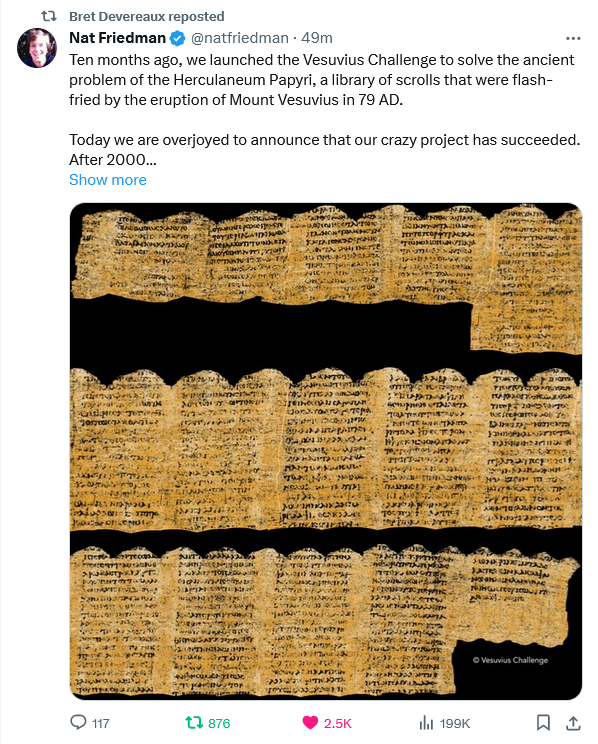
We received many excellent submissions for the Vesuvius Challenge Grand Prize, several in the final minutes before the midnight deadline on January 1st.
We presented these submissions to the review team, and they were met with widespread amazement. We spent the month of January carefully reviewing all submissions. Our team of eminent papyrologists worked day and night to review 15 columns of text in anonymized submissions, while the technical team audited and reproduced the submitted code and methods.
There was one submission that stood out clearly from the rest. Working independently, each member of our team of papyrologists recovered more text from this submission than any other. Remarkably, the entry achieved the criteria we set when announcing the Vesuvius Challenge in March: 4 passages of 140 characters each, with at least 85% of characters recoverable. This was not a given: most of us on the organizing team assigned a less than 30% probability of success when we announced these criteria! And in addition, the submission includes another 11 (!) columns of text — more than 2000 characters total.
The results of this review were clear and unanimous: the Vesuvius Challenge Grand Prize of $700,000 is awarded to a team of three for their excellent submission. Congratulations to Youssef Nader, Luke Farritor, and Julian Schilliger!

Much more information at the Vesuvius Challenge site.
Western Front Tank Warfare 1944
World War Two
Published Nov 8, 2023Indy takes a look at the armoured beasts battling it out on the Western Front. On the German side we have vehicles like the long-serving Panzer IV, the sleek and modern Panther, and the obnoxiously heavy King Tiger. These are arrayed against the American stalwart, the M4 Sherman, and British tanks like the up-gunned Firefly, Cromwell, and Churchill.
(more…)
QotD: The history of slavery in America
But the NYT chose a neo-Marxist rather than liberal path to make a very specific claim: that slavery is not one of many things that describe America’s founding and culture, it is the definitive one. Arguing that the “true founding” was the arrival of African slaves on the continent, period, is a bitter rebuke to the actual founders and Lincoln. America is not a messy, evolving, multicultural, religiously infused, Enlightenment-based, racist, liberating, wealth-generating kaleidoscope of a society. It’s white supremacy, which started in 1619, and that’s the key to understand all of it. America’s only virtue, in this telling, belongs to those who have attempted and still attempt to end this malign manifestation of white supremacy.
I don’t believe most African-Americans believe this, outside the elites. They’re much less doctrinaire than elite white leftists on a whole range of subjects. I don’t buy it either — alongside, I suspect, most immigrants, including most immigrants of color. Who would ever want to immigrate to such a vile and oppressive place? But it is extremely telling that this is not merely aired in the paper of record (as it should be), but that it is aggressively presented as objective reality. That’s propaganda, directed, as we now know, from the very top — and now being marched through the entire educational system to achieve a specific end. To present a truth as the truth is, in fact, a deception. And it is hard to trust a paper engaged in trying to deceive its readers in order for its radical reporters and weak editors to transform the world.
Andrew Sullivan, “The New York Times Has Abandoned Liberalism for Activism”, New York, 2019-09-13.
February 4, 2024
Is the Red Army too fast for its own good? – WW2 – Week 284 – February 3, 1945
World War Two
Published 3 Feb 2024Soviet forces have reached the old German border in force, however, logistical issues and a strong enemy presence possibly threatening their flanks means that a drive on Berlin may not be doable just now. Heinrich Himmler is in charge of the new Army Group to defend the Reich, and he has a host of problems. On the Western Front, the Allies finally eliminated the Colmar Pocket, and in the Philippines, the American advance reaches Manila, and the battle for the city is about to begin.
(more…)
Civil strife in Spain before the full civil war broke out
Niccolo Soldo continues his in-depth look at the situation in Spain leading up to the outbreak of the civil war in 1936. It’s clear that bloodshed was in the immediate future — so much so that it’s almost surprising that it took as long as it did for the war to start in earnest:

Flag of Spain during the Second Spanish Republic (1931-1939).
Image by SanchoPanzaXXI via Wikimedia Commons.
In 1930, almost half of all Spaniards over the age of 10 were illiterate. The country was still overwhelmingly agrarian, with a small number of very wealthy landowners owning about 2/3rds of all the arable land in Andalusia alone, employing almost a million landless campesinos at barely subsistence-level wages. Industry was almost entirely found only in the north and northeast. Industrialization was beginning to pick up pace by the turn of the century, but was still very far behind the rest of Western Europe by the time the Second Spanish Republic came into being in 1931.
Despite Spain having one foot in the past, its other foot was in the present, a present that was rapidly changing and very unstable politically. The loss of confidence in King Alfonso XIII on the part of the middle and upper classes led to his abdication which opened the door to the establishment of the Second Republic, a democracy in a time when democracy itself was under attack throughout Europe, having already lost in Russia and Italy, and on its way to disappearing in other countries, most notably Germany.
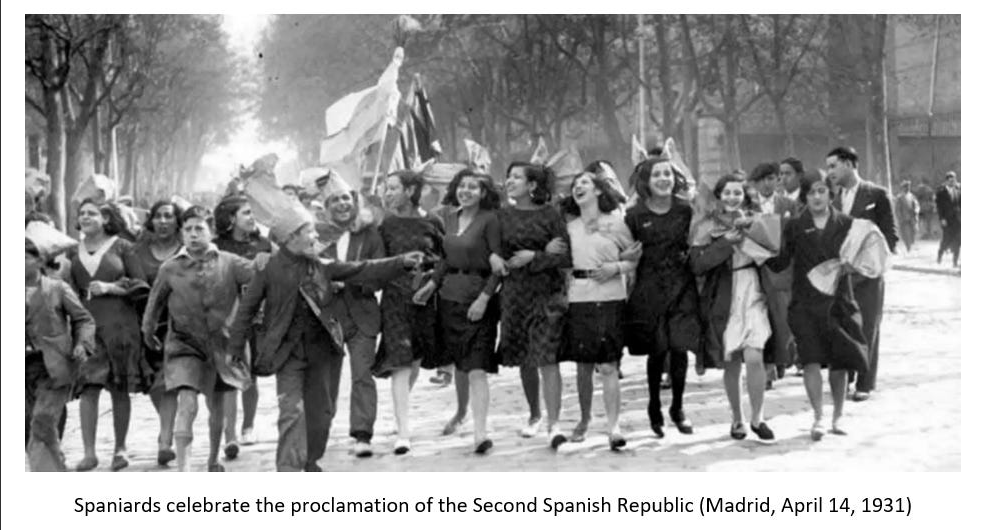
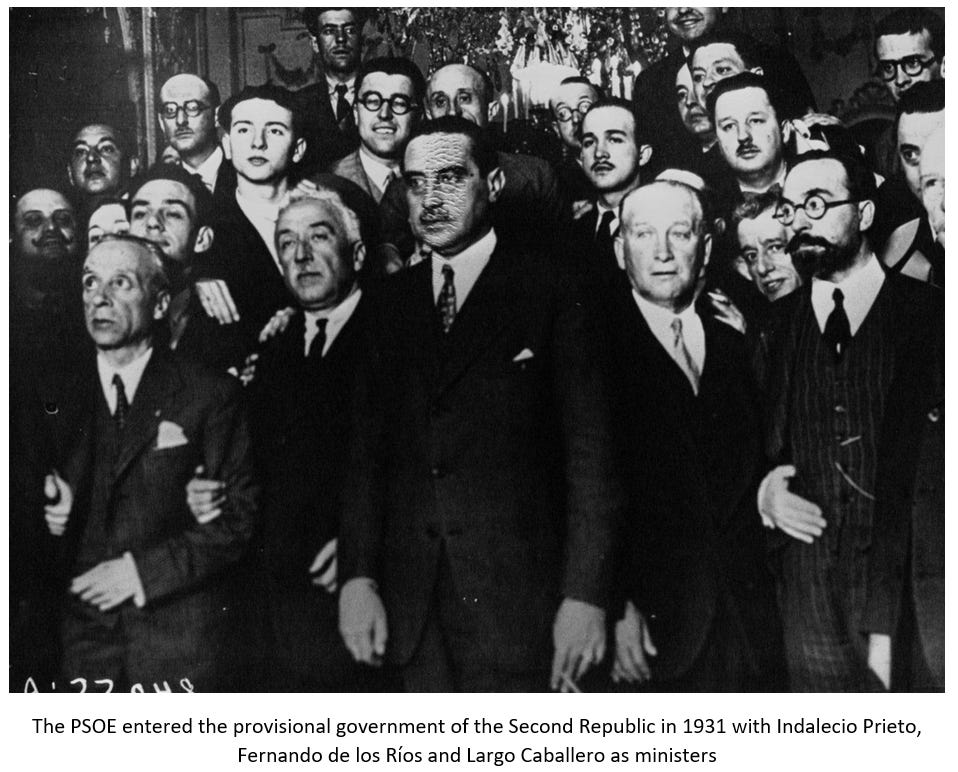
The end of the monarchy was celebrated throughout the country (with some exceptions), but not always for the same reason. Yes, anti-monarchist forces viewed the monarchy as retrograde and out of step with the modern era, but only the liberals and various republican parties were committed to democracy and parliamentary politics. The Socialists (PSOE) for example, were riven by factionalism and a generational divide whereby there were those who sought to use power in office to both settle scores with their old enemies in the military, the landowning class, and especially the Catholic Church, and to actually launch a revolution along Marxist lines. For them, the Second Republic was a vehicle for a larger goal, and not an end goal in and of itself. Anarchists celebrated the end of the monarchy, but they were opposed to any and all government on principle. For Anarchists, the Second Republic was also a path towards revolution as well. For Catalan separatists, the Spanish Second Republic was a stepping-stone towards independence, or at least towards as much political and economic autonomy as possible.
Conservatives were in a state of disarray upon the establishment of the Second Republic. Despite this condition, all the factions that could be grouped as “conservatives” largely supported the new regime … at least at the outset. Once the agenda of the first government of the Second Republic was made public, opposition began to harden.
Rather than trying to generate a grand consensus among the various factions that dominated Spanish politics, economics, and society in 1931, the liberals, republicans, and socialists who led the country from 1931-33 instead chose to attack the core interests of their political rivals to the right. The military was to be slashed via the retirement of a large number of its officer class, land was to be seized from wealthy landowners in order to redistribute it to the poor and landless, and the Catholic Church was to be stripped of its role in educating young Spaniards, with the Jesuits expelled from the country altogether, and many churches, convents, monasteries, episcopal residences, parish houses, seminaries, etc. expropriated by the Spanish state. Private Catholic schools were also expropriated and turned into government-run ones instead. The Church was also forced to pay taxes and was banned from all industry and trade, “… enforced with strict police severity and widespread mob violence”.
These attacks on the Catholic Church (which also saw the torching of churches, monasteries, and convents in 1931 as we saw in the previous entry in this series) resulted in the release of a Papal Encyclical by Pope Pius XI on June 5, 1933 entitled “Dilectissima Nobis“. In this encyclical, Pius XI decries the persecution of the Church in Spain, and asks Spanish Catholics to defend themselves and the Church from attacks by the government. He describes the attacks as “… [an] offense not only to Religion and the Church, but also to those declared principles of civil liberty on which the new Spanish regime declares it bases itself”. As we already saw previously, then-Minister of War in the Spanish cabinet, Manuel Azaña, famously declared that “All the convents in Spain are not worth a single Republican life“.
There was no attempt to build a solid democratic foundation for the Second Republic whatsoever. Instead, a cultural revolution was quickly ushered in, and an agrarian revolution was threatened, but only implemented half-heartedly. The first government of the Second Spanish Republic managed to alienate the military, the landowning class, conservatives, and the Catholic Church overnight.
On the other side of the political divide, the centrists were attacked from the left for not going far enough, fast enough. Campesinos and small landowners demanded immediate expropriation of latifundia estates to be redistributed to them. The youth wing of the PSOE urged the nationalization of all industry, which led to factionalism within the socialist groupings. Less radical socialists pointed to the extension of voting rights to women, to the enshrining of the eight hour workday in law, and to the increase in wages for industry workers as the biggest successes of the first two years of the Second Republic. These radical factions were not content with these incremental gains, and demanded “more, now!”
This radicalism culminated in the “Casas Viejas Incident”, which I described in the previous entry:
Staying true to form, the anarchists were restless and, as is their nature, opposed the present government in Spain as they opposed all governments, viewing them as inherently oppressive. Their massive labour union, CNT, led by the vanguard of FAI, began demonstrations in various locations across the country, with the greatest actions taking place in Andalusia. Political violence ensued, with two Civil Guards wounded. The Assault Guards, set up by the new Constitutional authorities in the Republic to provide a new force to purportedly protect those who lacked protection under the Monarchy, raided the village of Casas Viejas near Cadiz. They encountered a group of anarchists locked in a house and set fire to it (while disarming others in the village who were armed), and then executed them.
This act of state violence was committed not by fascists, nationalists, royalists, or even conservatives. It was committed by a liberal-socialist regime and its purposely-created security force, against anarchists. All the parties involved in this incident would find themselves on the same side in the not-too-distant Spanish Civil War.
Johnson LMG: History & Disassembly
Forgotten Weapons
Published Feb 29, 2016The Johnson light machine gun is one of the lesser-known US military machine guns of WWII, although it seems to have been very popular with all those who used it in combat. Melvin Johnson made a commendable attempt to get his rifles adopted by the US military, but was unable to unseat the M1 Garand as American service rifle. However, he did make a significant sale of both rifles and light machine guns to the Dutch colonial army.
By the time those Dutch guns were ready to ship, however, the Japanese had overrun most of the Dutch islands. The guns were thus basically sitting on the docks with nowhere to go, and at that point the US Marine Corps took possession of them. Because of their short recoil action and quickly removable barrels, the Johnson guns were ideal for airborne Paramarines, and saw use in the Pacific with these forces. They were also used by the joint US/Canadian First Special Service Force in Italy.
In many ways, the Johnson LMG is similar to the German FG-42, although with more emphasis on full-auto use instead of shoulder rifle use. It fired from a closed bolt in semiauto and from an open bolt in full auto, and had a bipod both effective, light, and easily detachable. Overall the Johnson is a light, handy, and very easily dismantled weapon, and its popularity with combat troops seems well deserved.
QotD: American railroads and the Interstate Commerce Commission
Randy Holcombe, Liberty in Peril: Democracy and Power in American History, (2019).
February 3, 2024
A Day in Ancient Rome
toldinstone
Published Nov 10, 2023Following Marcus Aurelius on the day of his final triumph.
Chapters:
0:00 Another day
1:05 Petitions
3:12 Breakfast
3:51 The Triumph
4:44 Romanis Magicae
5:37 Artifacts of the wars
7:09 Caesar, you are mortal
(more…)
February 2, 2024
The Sad Story of Churchill’s Iceman, Geoffrey Pyke
World War Two
Published Jan 31, 2024Geoffrey Pyke is remembered as an eccentric scientist who spewed out ideas like giant aircraft carriers made of icy Pykerete. But there was much more to him than that. He was a spy, a special operations mastermind, and his novel ideas contributed to the success of D-Day.
(more…)


