
Barbara Tuchman […] said something about medieval nobles once, to the effect of “the reason some of their decisions seems so childish to us is that a lot of them were children”. I don’t think she’s right about that — kids grew up pretty damn fast in the Middle Ages — but if you expand it a bit to “rookies make rookie mistakes”, she’s got a big, important point. No account of the reign of Henry VIII, for instance, can really be complete without considering that when he took the throne he was only 17, and had only been heir apparent for a few years before that. He was most definitely the “spare” in the old “heir and a spare” formula for medieval dynastic success; it’s likely that his father was preparing him for a Church career when his elder brother Arthur died suddenly in 1502, when Henry was 11. What Arthur had been in training his whole life to do, Henry got at most six frantic years of, under an increasingly feeble father.
Leaving all of Henry’s personal quirks aside — and his was a very strong, distinctive personality — that’s got to affect you.
So many of the changes in Henry’s reign, then, must have been driven in part by the fact that it was the same man, reflecting on a lifetime’s experience in a job he was never expected to have, wasn’t really prepared for, and didn’t seem to want (aside from the lifestyle). There’s been lots of pop-historical theorizing about what was “wrong” with the later Henry — senility, syphilis, the madness of power — but more naturalistic explanations of his later actions must take into account simple age. A man nearing the end of his life, knowing that his succession was very much in doubt and fearing for the state of his soul, will do things differently than a young man in the prime of life.
[…]
Life was hard back then, and cheap. When every other child dies before the age of five and the average life expectancy is 35, I imagine, you live your life cranked to 11 every waking moment. Accounts of grown men weeping like little girls at the theater aren’t an exaggeration; the whole age was given to extreme outbursts. And that’s just the baseline! Now consider that a guy like Henry never had a moment to himself, and I do mean never — not once, in his entire life. He even had a guy with him on the crapper, who would wipe his ass for him. The relationship between Henry and a guy like Wolsey, then — to say nothing of his relationship with the Groom of the Stool — must’ve been intimate in a way we can’t possibly grasp. Compared to that, you and your wife are barely on speaking terms. If Henry seemed sometimes to set policy just because he was pissed at Wolsey, we must consider the possibility that that’s exactly what happened.
The best you can do, then, is imagine yourself back there as best you can, and make your interpretations in that light, acknowledging your biases as best you can (I’m not a medievalist, obviously, but I’m a much better read amateur than most, and though Henry VIII is a very hard guy to like, he’s equally hard not to admire). Most of all — and this, I think, is the hardest thing for academic historians, more even than recognizing their presentist biases — you have to keep your humility. Perhaps Henry’s decision about ___ was part of a gay little frenemies spat with Wolsey. That’s sure what it seems like, knowing the man, and having no contrary evidence …
… but contrary evidence might always emerge. It might not have been the optimal decision, but it might’ve been a much better one than you thought, because Henry had information you didn’t, but now do. It makes for some restless nights, knowing that your life’s work could be overturned by some grad student finding some old paper at a yard sale somewhere, but … there it is.
Severian, “Writing Real History”, Rotten Chestnuts, 2021-08-18.
October 26, 2024
QotD: Henry VIII
October 25, 2024
How a Soviet Clerk Took Down a Spy Network
World War Two
Published 24 Oct 2024Igor Gouzenko, a Soviet cipher clerk in Canada, defected in 1945, bringing with him documents that revealed a massive Soviet espionage network in the West. His actions forced the world to confront Soviet infiltration, shifting global politics and igniting early Cold War tensions. This episode uncovers how one man’s bravery exposed a hidden war.
(more…)
October 24, 2024
The colonization of academia
Lorenzo Warby decries what he calls “the systematic attack on sense-making”, especially the galloping credentialization of everything in sight partly through the long-running takeover of the universities:

University College, University of Toronto, 31 July, 2008.
Photo by “SurlyDuff” via Wikimedia Commons.
The disastrous dysfunction of our universities is nowhere more obvious than in the Education Faculties and Departments, which have been invaded by systems of toxic nonsense that not only have no pedagogical value, they are actively pedagogically destructive. Ideas that manifest in pedagogical “theories” and “techniques” that not only lack evidence, but actively go against the evidence, yet allow adherents to flatter themselves as noble Social Justice activists.
In 2004, psychologist Richard E. Mayer published in American Psychologist the paper “Should There Be a Three-Strikes Rule Against Pure Discovery Learning?: The Case for Guided Methods of Instruction”. In it, he decried the way Education academics kept re-packaging ideas that have been shown, again and again, not to work.
Fast forward to 2023 and the National Assessment Program – Literacy and Numeracy (NAPLAN) results show that about a third of Australian school children have inadequate literacy. The Australian Education Minister announces a A$12bn package to, among other things, essentially bribe the public school systems to bring in explicit instruction — an effective approach to pedagogy in line with what psychologists have shown across decades to work. This would replace the — yet again repackaged — notions pushed by Education academics that do not work and which appear to be on their fourth or fifth iteration. So, no, three strikes were not enough.1
Sympathetic reviews of Isaac Gottesman’s The Critical Turn in Education applaud the sets of ideas he discusses as flowing through Education academe. Yet they are all sets of ideas not only without pedagogical value, but that are actively pedagogically toxic.
All of this colonising of Education Faculties — and then of school systems — of pedagogically disastrous ideas has been done on the basis of massive bad faith. This process of colonisation pushed ideas that did not remotely reflect the view of the citizens that were paying for all this and who entrusted their children to ideologically-colonised school systems.
Ideas that have no evidentiary basis worth mentioning to support them: indeed, went systematically against the available evidence. Ideas, moreover, that actively seek to increase social dysfunction so that the oppressive “dross” of contemporary societies can be burnt away and the transformational future can emerge like gold from the ashes: i.e., social alchemy theory.
Hence the systematic attack on the mechanisms for adjudicating facts, and on mechanisms of accountability.
Much of the anti “disinformation” push — also coming out of the universities — is about protecting preferred ways of looking at the world from inconvenient criticism and inconvenient concerns. Fake news, even on a broad definition, is a tiny proportion (0.15 per cent) of US daily media consumption, and is dwarfed by consumption of mainstream news. It is a prop of convenience.
The convenient-moral-panic campaigns to block “disinformation” also go against both historical and scholarly evidence that censorship tends to promote conspiracism and entrench views among the censored. The hate speech laws of Weimar Germany enabled prosecuted Nazis to play the martyr game.
Cargo cult grant structures
There is a lot one could say about the institutional problems that gave rise to all this academic dysfunction. For instance, the innovation cargo cult that has led to spurious academic “innovation” funded by grants. Grant structures that have had many invidious effects — including, via daft citation metrics2 and straightforward financial interest, the replication crisis — and massive waste of public funds on toxic nonsense.
Universities and mainstream media want to maintain their authority, while evading responsibility for what they have done to destroy that authority.
1. Australia has had public schools since the 1850s. Apparently, they still have not yet learnt to reliably teach students adequate literacy. Let that sink in. (In reality, it is worse than that, their performance has regressed.)
2. Citation metrics that replace what is useful — good teaching — with what is public while also enabling idea laundering.
Did the Media Lose the Vietnam War?
Real Time History
Published Jun 21, 2024In late April 1975, dramatic images from Saigon are beamed across the world. North Vietnamese troops proclaimed final victory. Just how did the US lose the Vietnam War?
(more…)
QotD: From the OG Pontifex Maximus to the Pope
The Protestants might be happy to hear Misanthrope claim this would make you sick, because they’d correctly state that absolutely none of this is in the Bible. The entire liturgical structure of the Catholic Church is pagan, an inherited but corrupted structure from classical antiquity. Thus, a great majority of historic Christianity is syncretic. You might even say haphazardly pagan. The very idea of a high priest who would oversee the spiritual and religious duties is copped by the Pope’s role in Catholicism. The vestments worn by Catholic clergy, the use of incense (especially frankincense, the main herb used by invocations in Hellenism), chants, the sanctification of holy spaces, and the very architecture of Catholic cathedrals are derived from religious practices of pagan Rome. Let’s not get into art. The processions, the veneration of saints (akin to the Roman household gods or Lares), ancestor worship (which Catholics pretend they don’t do), and the hierarchical structure all reflect a continuity from Rome’s Hellenic pagan past. The Catholic Church’s liturgy, with its detailed rituals and sacraments is a direct continuation of the Greco-Roman pagan way of embedding religious practice into every aspect of public and private life. The transformation of its pantheon of gods into a multitude of saints, each with specific roles and domains is indistinguishable from how they interacted with their deities.
Fortissax, “Spiteful Mutant Christians”, Fortissax is Typing, 2024-07-19.
[NR: Glossary links added.]
October 23, 2024
The Korea War 018 – The Fall of Pyongyang – October 22, 1950
The Korean War by Indy Neidell
Published 22 Oct 2024The North Korean capital falls to the UN forces, which isn’t really surprising since the North Korean armies have been completely routed. However, the Chinese are entering the country in droves to back up the Northern forces, which UN Commander Douglas MacArthur is unaware of despite endless recon sorties every day. In other aerial news, an unlikely apology from MacArthur manages to soothe the Soviets after UN planes hit targets in the USSR, but what’s really the story there?
(more…)
Canadian history through the propagandist lens
Fortissax casually tosses a few bricks into the glass house of Canadian history as it has been taught to schoolchildren over the last 30-40 years:

During our annual Not One Body Found season, I thought I’d discuss the truth about the brutal violence and savagery of North America’s most early, prominent and influential indigenous tribes, and popular narratives surrounding them.
If you’re an ethnic Canadian, born in the 1990s, you’re no doubt familiar with the education system’s attempts to subject you to a program of Maoist-style struggle sessions over the alleged genocide of the indigenous peoples in Canada. These struggle sessions in classrooms and collective humiliation rituals serve multiple purposes. One is to de-legitimize the history of, and perpetuate the ongoing deconstruction of Canada. The other is to de-legitimize the existence of the Canadian people as a nation (defined as a group sharing ethnic, cultural, and historical ties), in preparation for demographic replacement via mass migration.
The average Canadian’s school experience is filled with a turbo-charged version of liberal Noble Savage mythology, which is still propagated by leftists and indigenous activists. This has given the impression to many of the indigenous tribes as a singular race, continent-wide, uniformly peace-loving, non-binary, nature-appreciating matriarchal egalitarians until the evil, white, patriarchal Christian man arrived.
This resembles equally revisionist history about the Indo-European invasions into Europe around 4000 B.C. against the Pre-Indo-Europeans. You know that story: patriarchal brutes from the Eurasian steppes, with their advanced bronze weaponry and horse-powered chariots, wiped out the longhouse-dwelling, peace-loving, egalitarian agricultural Early European Farmers, who were feminist. This theory, conceived by Maria Gimbutas, a feminist intellectual, was debunked and discarded years ago. In reality, the Early-European-Farmers were extraordinarily warlike, violent, engaged in child murder or sacrifice and were apparently innovative as they built monuments like Stonehenge. This is much the same for indigenous in North America. All of this is framed in a Marxist oppressor-oppressed paradigm.
Tales of cruel treatment, deliberate biological warfare via smallpox blankets (of which there is only one known reference, with attempts to implement unknown), or extermination by colonial death squads haunts the minds of Canadians, planting the seeds of self-doubt and masochism. If you listen carefully to the rhetoric of leftists and indigenous activists, you’d be led to believe there was an industrial mass-slaughter of tribes, with conveyor belts funneling indigenous people into machines that spit out moccasins and dream catchers. The depopulation of indigenous tribes was not the result of deliberate action but rather Europeans being far more numerous and carrying diseases to which they had no immunity. The second cause was perpetual, brutal warfare by the survivors against each other. The mass depopulation from epidemic disease in North America occurred in the mid-1600s, after epidemic breakouts in the filthy, cramped conditions of Europe. Not almost a hundred years later in 1763, where smallpox blankets are merely discussed by General Jeffrey Amherst and Colonel Henry Bouquet.
Indigenous activists believe they were subject to a holocaust-style genocide. It is not a coincidence that the amplifying of the National Day for Truth and Reconciliation occurs at the same time as the Managerial Regime in Canada has declared itself a “post-national state” (which the indigenous also live in and suffer consequences from). They believe Canada is a country without a people. Ironically this lines up with activists’ own definition of “cultural genocide”, because in 1867 during Confederation Year, according to census data, Canada was 92% Anglo-French, 7% miscellaneous Europeans, and the remaining 1% indigenous. Canada is unquestionably, unmistakably, a European construct of Anglo-French extraction.
In 2021, seemingly out of nowhere, the public was subjected to the establishment of this astroturfed federal holiday, which was made statutory—still only for employees of the federal government (what a coincidence!)—as of March 2023. Participation in this public humiliation ritual involves the coerced wearing of orange, and sometimes red, shirts. Canadians across the political spectrum knowingly or unknowingly participate in this ritual, with many rough, cowboy-hat-wearing, lifted-big-black-truck-driving conservatives, as well as tattooed, soy-eating, vegan ketamine enthusiast quartz-worshiping leftists also enthusiastically partaking.
It’s called being a decent human being, Chud! Schools, the monopolized legacy media, corporations, and brands all recognize and partake in the humiliation ritual, directed exclusively at ethnic Canadians. Football games have their players sing the national anthem, and every clinically obese, corn-syrup-slurping sportsball fan claps as the announcer humiliates and shames him or her with a land acknowledgement to prove to the crowd and community that they “don’t see race”. Medical professionals and university faculty across the country also include land acknowledgements in professional email signatures. Even law enforcement gleefully participate in the the ritual, dancing like circus monkeys to the tune of people who despise them.
The Last Surviving Giant Passenger Hovercraft
The Tim Traveller
Published Jul 2, 2024In early 1968, Britain launched a revolutionary new form of sea transport: the giant SRN4-class hovercraft. They are the largest passenger hovercraft ever built, and they could fly between England and France in just 30 minutes — three times faster than anything else on the water. So why don’t we have anything like them any more?
MORE INFO
The Hovercraft Museum: https://www.hovercraft-museum.org/
The museum’s “Support Us” page, if you’d like to help them out: https://www.hovercraft-museum.org/sup…
QotD: Sheep shearing in the ancient and medieval world
The availability of iron for tools represented a fairly major change. Iron, unlike bronze or copper, is springy which makes the standard design of sheep shears (two blades, connected by a u-shaped or w-shaped metal span called a “bow”) and the spring action (the bending and springing back into place of the metal span) possible. The basic design of these blade shears has remained almost entirely unchanged since at least the 8th century BC, with the only major difference I’ve seen being that modern blade shears tend to favor a “w-shape” to the hinge, while ancient shears are made with a simpler u-shape. Ancient iron shears generally varied between 10 to 15cm in length (generally closer to 15 than to 10) and modern shears … generally vary between 10cm and 18.5cm in length; roughly the same size. Sometimes – more often than you might think – the ideal form of an unpowered tool was developed fairly early and then subsequently changed very little.
Modern shearing, either bladed or mechanical, is likely to be done by a specialized sheep shearer, but the overall impression from my reading is that pre-modern sheep shearing was generally done by the shepherds themselves and so was often less of a specialized task with a pastoral community. There are interesting variations in what the evidence implies for the gender of those shearing sheep; shears for sheep are common burial goods in Iron Age Italy, but their gender associations vary by place. In the culturally Gallic regions of North Italy, it seems that shears were assumed to belong to men (based on associated grave goods; that’s a method with some pitfalls, but the consistency of the correlation is still striking), while in Sicily, shears were found in both male and female burials and more often in the latter (but again, based on associated grave goods). Shears also show up in the excavation of settlements in wool-producing regions in Italy.
That said, the process of shearing sheep in the ancient world wasn’t much different from blade shearing still occasionally performed today on modern sheep. Typically before shearing, the sheep are washed to try to get the wool as clean as possible (though further post-shearing cleaning is almost always done); typically this was done using natural bodies of moving water (like a stream or shallow river). The sheep’s legs are then restrained either by hand or being tied and the fleece is cut off; I can find, in looking at depictions of blade shearing in various periods, no consistency in terms of what is sheared first or in what order (save that – as well known to anyone familiar with sheep – that a sheep’s face and rear end are often sheared more often; this is because modern breeds of sheep have been selectively bred to produce so much wool that these areas must be cleared regularly to keep the fleece clean and to keep the sheep from being “wigged” – that is, having its wool block its eyes). Nevertheless, a skilled shearer can shear sheep extremely fast; individuals shearing 100-200 sheep a day is not an uncommon report for modern commercial shearers working with tools that, as noted, are not much different from ancient tools. That speed was important; sheep were generally sheared just once a year and usually in a fairly narrow time window (spring or very early summer; in medieval England this was generally in June and was often accompanied by a rural festival) so getting them all sheared and ready to go before they went up the mountain towards the summer pasture probably did need to be done in fairly short order.
Bret Devereaux, “Collections: Clothing, How Did They Make It? Part I: High Fiber”, A Collection of Unmitigated Pedantry, 2021-03-05.
October 22, 2024
A Conquering Hat: a History of the Bicorn
HatHistorian
Published Jul 1, 2022Emblematic of Napoleon Bonaparte and his age of conquest, the bicorn is a distinctive military hat that became part of the most formal of dress uniforms and remains to this day in certain ceremonial outfits
The bicorn I wear in this video comes from Theatr’Hall in Paris https://www.theatrhall.com. The uniform comes from thejacketshop.co.uk
Title sequence designed by Alexandre Mahler
am.design@live.comThis video was done for entertainment and educational purposes. No copyright infringement of any sort was intended.
QotD: Antisemitism
Doesn’t matter that one side is a liberal democracy that grants rights to women and non-Jews, and the other side has thugs and assassins for rulers and sends its kids to summer camps where they learn the joys of good ol’ fashioned Jew-killin’; doesn’t matter at all. According to the script of the hard left, Israel was created when some Europeans (hisssss) invaded the sovereign nation of Palestine, even though we all know the Jewish homeland is somewhere outside of Passaic. Then for no reason Israel invaded the West Bank and Gaza — which for some reason had not been set up as New Palestine by the Egyptians and the Jordanians, but never mind — and made everyone stand in line and get frisked. Those who joined the line in ’67 are just getting through now. Evil Zionists.
James Lileks, “The most important story in the world last Sunday”, Screedblog, 2005-08-11.
October 21, 2024
Romanian Model 1879 Martini-Henry Rifles & Carbines
Forgotten Weapons
Published Jul 5, 2024Following its experience in the Russo-Turkish War, the Romanian Army was quite impressed by the Martini-Henry rifle in Turkish service. Unlike so many Western observers who were taken by the Winchester repeating rifles that actually didn’t make much battlefield impact, the Romanians recognized the all-around quality of the Martini. So after the war when looking to equip their own newly independent army, they went to Britain for Martinis. They were not able to get rifles made in Britain, but did purchase a license to make the rifle in .45 Gatling, which they took to a factory in Witten, in the German state of Wurtemburg. This factory was newly opened, run in part by Friedrich von Martini himself — so what better place to get Martini rifles?
An initial contract for 60,000 rifles and 8,000 carbines was accepted by the factory and delivered fairly quickly. When the Romanians came back for more guns the factory had gone bankrupt, however. Subsequent orders were instead made from OEWG Steyr in Austria. In total, Romania acquired about 145,000 Martini long rifles and between 12,000 and 18,000 carbines. They were replaced by the Model 1893 Mannlicher in the 1890s, and thus were never used as a front-line rifle in any major combat. They served in World War One in a secondary role only.
Thanks to the King Ferdinand I Military Museum for giving me access to these examples and to A.N.C.A. for coordinating the visit! If you are in Bucharest, make sure to stop in and visit the museum:
https://www.muzeulmilitar.ro/en/
(more…)
October 20, 2024
Nazi Conspiracies Everywhere – Rise of Hitler, April 1930
World War Two
Published 19 Oct 2024Join us for the May 1930 edition of the Weimar Wire, where we cover violent communist Youth Day demonstrations, a tough first month for new German chancellor Bruning, crazy Nazi conspiracy theories, and a whole lot more.
(more…)
Debunking the “Muslims saved the Graeco-Roman legacy” intellectual urban legend
In my weekly set of recommendations from Substack there was a link to A History of Mankind‘s debunking of what is described as an “intellectual urban legend”:
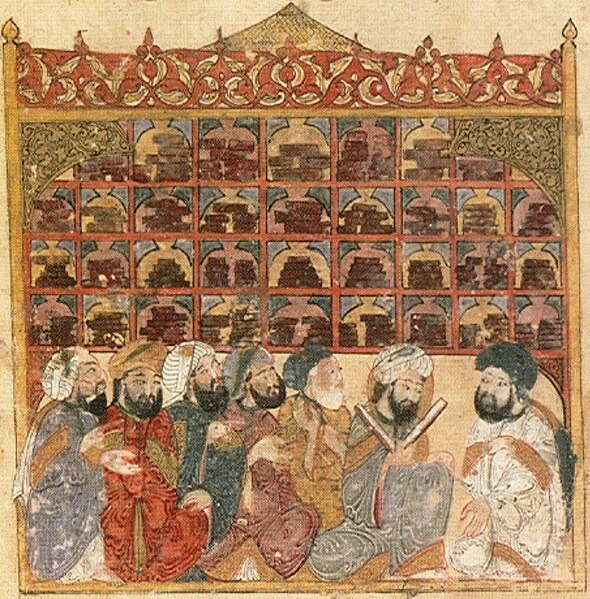
Islamic scholars at an Abbasid library in Baghdad.
Illustration by Yahyá al-Wasiti from 1237 via Wikimedia Commons.
Among the most popular of those legends, there’s one that can be summarized as “Arab scholars and translators saved the books of Graeco-Roman antiquity from being destroyed by the Christians and/or forgotten”. This a surprisingly widespread view. I’ve lived in several countries, and heard versions of this legend, often told in very simple terms over somewhat complicated drinks, from well-educated people often working in academia or the financial sector (which makes more sense than it appears — I’ve worked in the financial sector myself, and people there are highly educated as a rule).
I’ve even heard scholars (normally not Medievalists) express this view, and I’ve read views to this effect in multiple occasions. Just Google “did the arabs save graeco-roman books” and look at the top results, if you don’t believe me. Lots of well-educated people believe this, not to speak of history enthusiasts all over the Internet.
However, the truth is that Arab translators had only a modest impact on the transmission of Graeco-Roman texts to modern times. There are various reasons that explain this, but first let me provide some clarity on why Baghdad’s Medieval “House of Wisdom” — oft-cited, correctly, as the center of the Abbasid-era translation movement inasmuch as there was one — is one of history’s most misunderstood institutions.
The House of Wisdom functioned as a state library with a focus on the transcription and storage of manuscripts, and their translation to the court’s main language, Arabic. Based on a similar library patronized by the Sasanian emperors and staffed with some of its personnel from about the 8th century, the House of Wisdom employed Christian Greek speakers – very few Muslims spoke or read Greek fluently in this era and others, particularly Arabs – as well as Muslim and Zoroastrian Arabic or Syriac speakers who worked to translate and disseminate work.
[…]
Just to give a final touch of class to these absurd claims, Abu Sahl added the detail that the Greeks, dunces as they all are, forgot to actually steal many Iranian books, and simply memorized the contents before they torched them, so the actual Greek copies of Iranian greats are, by necessity, inferior versions diluted by the Greeks’ faulty memory.
Some Muslim scholars later came up with a new wrinkle that Byzantines were poor keepers of their own treasures, and their books were eaten by insects, as the bibliographer Al-Nadim (932-995) wrote in a second- or third-hand anecdote about some guy who visited Constantinople and was sad to see some ancient temple filled with neglected books, later widely quoted, and included in his Index of 987. The same Al-Nadim transmits from someone “trustworthy” that the Byzantines burned fifteen loads of books by Archimedes, which never happened.
Abdullah Ibn-abi-Zayd (922–998), a prolific North African writer on Islamic law, came up with a wrinkle for this wrinkle: that the Byzantine emperor gathered books and hid them in a secret building to prevent heresy among potential readers; and when Yahya, a prominent Bamarkid Persian in the Abbasid court, heard of the repository he asked if he could borrow the texts. The emperor agreed on the condition that they were never returned, so that they would never hurt the delicate Christian feelings of his subjects.
Others with less experience of the Christian West, like the Egyptian Arab Ibn Ridwan (988-1061), claimed that ancient sciences were forgotten there, and only survived in the Ummah because of the supreme wisdom and care displayed by Al-Mamun and their successors. Ridwan’s fable showing just how obscurantist and dumb Christians are proved particularly successful, being often retold with the kind of reverence typically reserved for hadiths:
The history of medicine begins with a brief account of the development in antiquity from Asclepius to Galen. After Galen, the community of the Christians emerged from and prevailed over the Greeks. The Christians considered it a fault to study intellectual matters and their kings cast away the care for medicine and failed to take care of its students. So its students ceased to commit themselves to the toilsome study of medicine and found reading Hippocrates’ and Galen’s works too tedious; thus, it fell into disorder and its condition worsened. Then came Oribasius, after the Christian kings’ lack of interest in the instruction [of medicine] was firmly rooted … When none of the kings any longer felt the desire to promote the teaching [of medicine] and the people found Hippocrates’ and Galen’s works on it too tedious and tended to compendia and abridgments, the most prominent Alexandrian physicians, afraid that the art would vanish altogether, asked those kings to retain the teaching [of medicine] in Alexandria and [to allow] only twenty books on medicine to be read, sixteen from Galen’s and four from Hippocrates’ works … The teaching stood on shaky ground until al-Ma’mun ‘Abd-Allah ibn-Harun al-Rashid became caliph, who revived and spread it and favored excellent physicians. But for him, medicine and other disciplines of the ancients would have been effaced and obliterated just as medicine is obliterated now from the lands of the Greeks, which had been most distinguished in this field.
I should also mention that it wasn’t just the Graeco-Romans who the Abbasid-era Muslims ripped off in bulk. The fact that Indian numerals came to be known in Europe as “Arabic” numerals, and chess was widely, and wrongly, believed to be an Arabic invention, gives an idea about the impact that Caliphate scholars had as synthesizers and popularizers of scientific knowledge.
Indeed, when the Iranian Al-Khwarizmi (780-850), head of the House of Wisdom from around 820, published the earliest Arabic text on Indian numerals, he chose a title of disarming honesty: “Addition and subtraction according to the Indian calculation”. Such honesty was rarely imitated by Al-Khwarizmi’s successors.
I think you are probably getting the gist of how the story about the Muslim salvage of Graeco-Roman antiquity came about, and was later embraced by every Atheist writer in the West, so that he or she could have nice laughs at the expense of those barbarian fools who never washed themselves, the Christians.
The True History of Deep Dish Pizza
Tasting History with Max Miller
Published Jul 2, 2024Deep dish cheese pizza with a bready crust
City/Region: Chicago
Time Period: 1945 | 1947The unsung hero of deep dish pizza is a woman named Alice Mae Redmond, who was the head chef at famous pizzerias like Pizzeria Uno and Gino’s. It seems like wherever she went, that was the best pizza place in town. She’s also the one who changed deep dish pizza crust from the bready version in this recipe to a butterier, more biscuit-like version that is found in modern deep dish.
This crust is still delicious, and the sauce is super flavorful. Be sure to cook the sauce down enough so that it’s nice and thick (mine was a bit too watery for my taste). In the 1940s, you could get cheese OR anchovies OR sausage, but not any of them together. I made a cheese pizza with my preferred ratio of about 50/50 cheese to sauce, but feel free to change things up however you like. You could even add more than one topping, though it won’t be quite as historically accurate.
(more…)


