
We’ve gone over this before, but we should also cover the objectives the attacker generally has in a siege. In practice, we want to think about assaults fitting into two categories: the raid and the siege, with these as distinct kinds of attack with different objectives. The earliest fortifications were likely to have been primarily meant to defend against raids rather than sieges as very early (Mesolithic or Neolithic) warfare seems, in as best we can tell with the very limited evidence, to have been primarily focused on using raids to force enemies to vacate territory (by making it too dangerous for them to inhabit by inflicting losses). Raids are typically all about surprise (in part because the aim of the raid, either to steal goods or inflict casualties, can be done without any intention to stick around), so fortifications designed to resist them do not need to stop the enemy, merely slow them down long enough so that they can be detected and a response made ready. […]
In contrast, the emergence of states focused on territorial control create a different set of strategic objectives which lead towards the siege as the offensive method of choice over the raid. States, with their need to control and administer territory (and the desire to get control of that territory with its farming population intact so that they can be forced to farm that land and then have their agricultural surplus extracted as taxes), aim to gain control of areas of agricultural production, in order to extract resources from them (both to enrich the elite and core of the state, but also to fund further military activity).
Thus, the goal in besieging a fortified settlement (be that, as would be likely in this early period, a fortified town or as later a castle) is generally to get control of the administrative center. Most of the economic activity prior to the industrial revolution is not in the city; rather the city’s value is that it is an economic and administrative hub. Controlling the city allows a state to control and extract from the countryside around the city, which is the real prize. Control here thus means setting up a stable civilian administration within the city which can in turn extract resources from the countryside; this may or may not require a permanent garrison of some sort, but it almost always requires the complete collapse of organized resistance in the city. Needless to say, setting up a stable civilian administration is not something one generally does by surprise, and so the siege has to aim for more durable control over the settlement. It also requires fairly complete control; if you control most of the town but, say, a group of defenders are still holding out in a citadel somewhere, that is going to make it very difficult to set up a stable administration which can extract resources.
Fortunately for potential defenders, a fortification system which can withstand a siege is almost always going to be sufficient to prevent a raid as well (because if you can’t beat it with months of preparatory work, you are certainly unlikely to be able to quickly and silently overcome it in just a few night hours except under extremely favorable conditions), though detection and observation are also very important in sieges. Nevertheless, we will actually see at various points fortification systems emerge from systems designed more to prevent the raid (or similar “surprise” assaults) rather than the siege (which is almost never delivered by surprise), so keeping both potential attacking methods in mind – the pounce-and-flee raid and the assault-and-stay siege – is going to be important.
As we are going to see, even fairly basic fortifications are going to mean that a siege attacker must either bring a large army to the target, or plan to stay at the target for a long time, or both. In a real sense, until very recently, this is what “conventional” agrarian armies were: siege delivery mechanisms. Operations in this context were mostly about resolving the difficult questions of how to get the siege (by which I mean the army that can execute the siege) to the fortified settlement (and administrative center) being targeted. Because siege-capable armies are either big or intend to stick around (or both), surprise is out of the window for these kinds of assaults, which in turn raises the possibility of being forced into a battle, either on the approach to the target or once you have laid siege to it.
It is that fact which then leads to all of the many considerations for how to win a battle, some of which we have discussed elsewhere. I do not want to get drawn off into the question of winning battles, but I do want to note here that the battle is, in this equation, a “second order” concern: merely an event which enables (or prohibits) a siege. As we’ll see, sieges are quite unpleasant things, so if a defender can not have a siege by virtue of a battle, it almost always makes sense to try that (there are some exceptions, but as a rule one does not submit to a siege if there are other choices), but the key thing here is that battles are fundamentally secondary in importance to the siege: the goal of the battle is merely to enable or prevent the siege. The siege, and the capture or non-capture of the town (with its role as an administrative center for the agricultural hinterland around it) is what matters.
Bret Devereaux, “Collections: Fortification, Part I: The Besieger’s Playbook”, A Collection of Unmitigated Pedantry, 2021-10-29.
November 4, 2024
QotD: Early raids on, and sieges of, fortified cities
November 3, 2024
Unholy Alliance topples Saxony – Rise of Hitler 05, May 1930
World War Two
Published 2 Nov 2024May 1930 brings political upheaval to the Weimar Republic, with the French deciding to leave the Rhineland, violent clashes between Communists and Nazis, and a surprising alliance that dissolves Saxony’s government. See how these events unfold and shape Germany’s current political landscape.
(more…)
Ancient Sparta Historian Breaks Down 300 Movie | Deep Dives
History Hit
Published Jul 8, 2024Ancient Greek historian Roel Konijnendijk takes a deep dive into the historical accuracy of one of the most iconic and ridiculous depictions of the Spartans – 300 (2006).
00:00 Introduction
00:33 Spartan Society and Customs
02:34 Xerxes’ Messenger
06:56 The Ephors, the Oracle and the Carneia
10:30 The 300
15:39 The Persian Fleet
16:14 Thermopylae, the “Hot Gates”
17:17 Spartan Battle Technique
19:12 The Persian Army
24:42 Xerxes
28:28 Ephialtes
32:01 Dilios – Why Did the Spartans Stay?
34:18 The Final Stand
38:44 Aftermath of Thermopylae and Delios
40:53 Movie Quotes: Fact or Fiction?
(more…)
November 2, 2024
The Short SA.4 Sperrin; Britain’s Back-Up, Back-up Nuclear Bomber
Ed Nash’s Military Matters
Published Jul 9, 2024No, I have no idea how you pronounce “Gyron”.
November 1, 2024
FN M249S semiauto for military collectors
Forgotten Weapons
Published Jul 10, 2024In 2015, FN USA introduced a Military Collector product line — semiautomatic versions of their military contract small arms. These were the M4, M16, and — most interestingly — the M249 SAW. The SAW is a version of FN’s Minimi light machine gun, developed in 1974 and adopted by the US in 1982. The semiauto version, designated M249S, is exactly the same as the military M249 but adapted to fire from a closed bolt in semiautomatic only, making it a non-NFA item like any other semiautomatic rifle. The semiauto conversion as done by essentially chopping off the back of the bolt carrier to act as a linear hammer, thus allowing the use of the original style of trigger mechanism. Since its introduction in 2016, FN USA has made more than 10,000 of these rifles, truly proving the depth of American collector interest in this sort of thing (much to the surprise of the Belgian FN administration …).
(more…)
October 30, 2024
The Korean War 019 – The Chinese Threat Revealed! – October 29, 1950
The Korean War by Indy Neidell
Published 29 Oct 2024Communist Chinese forces make themselves known on the battlefield in a big way, and openly engage UN troops for the first time. What was supposed to be a stroll to the Chinese border turns into a week-long nightmare. How do the South Koreans of ROK II Corps perform in battle against this new threat? And how will Douglas MacArthur and his staff respond?
Chapters
01:07 Reaching the Yalu
02:29 The Chinese Strike
06:16 The West
07:43 Eighth Army Response
14:26 Summary
(more…)
Halloween Special: Frankenstein
Overly Sarcastic Productions
Published Oct 31, 2017It is a tale. A tale of a man … and a MONSTER!
It’s finally time to talk Frankenstein! Part sci fi, part horror, part opinion piece on the dangers of hubris, this classic story reminds us all to appreciate what’s really important to us: friends, family, loved ones, and most importantly, NOT creating twisted mockeries of God’s creations in an attempt to reach beyond the veil of life itself.
Nnnnnnnow here is a riddle to guess if you can,
sings the tale of Frankenstein!
Who is the monster and who is the man?~
QotD: The right to bear arms
Whether one agrees or disagrees with it, the Second Amendment is usually interpreted in these latter days as an axiom of and about political character — an expression of republican political thought, a prescription for a equilibrium of power in which the armed people are at least equal in might to the organized forces of government.
It is all these things. But it is something more, because the Founders regarded political character and individual ethical character as inseparable. They had a clear notion of the individual virtues necessary collectively to a free people. They did not merely regard the habit of bearing arms as a political virtue, but as a direct promoter of personal virtue.
The Founders had been successful armed revolutionaries. Every one of them had had repeated confrontation with life-or-death choices, in grave knowledge of the consequences of failure. They desired that the people of their infant nation should always cultivate that kind of ethical maturity, the keen sense of individual moral responsibility that they had personally learned from using lethal force in defense of their liberty.
Accordingly, firearms were prohibited only to those intended to be kept powerless and infantilized. American gun prohibitions have their origins in racist legislation designed to disarm slaves and black freedmen. The wording of that legislation repays study; it was designed not merely to deny blacks the political power of arms but to prevent them from aspiring to the dignity of free men.
The dignity of free men (and, as we would properly add today, free women). That is a phrase that bears thinking on. As the twentieth century draws to a close, it sounds archaic. Our discourse has nearly lost the concept that the health of the res publica is founded on private virtue. Too many of us contemplate a president who preaches family values and responsibility to the nation while committing adultery and perjury, and don’t see a contradiction.
But Thomas Jefferson’s question, posed in his inaugural address of 1801, still stings. If a man cannot be trusted with the government of himself, how can he be trusted with the government of others? And this is where history and politics circle back to ethics and psychology: because “the dignity of a free (wo)man” consists in being competent to govern one’s self, and in knowing, down to the core of one’s self, that one is so competent
Eric S. Raymond, “Ethics from the Barrel of a Gun”.
October 29, 2024
The slavery reparations grift – “it’s not possible for us to compensate a man for having made him better off”
The demands for reparations from Britain over the slave trade are not based on the actual history as much as emotion and selective blindness to the facts:
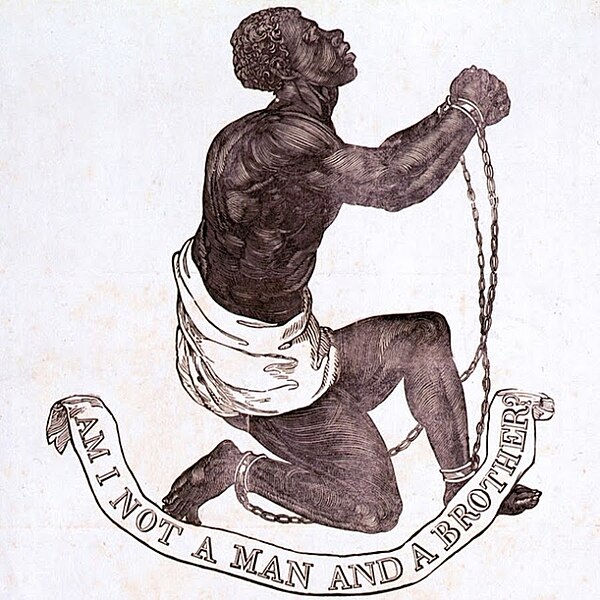
The Official Medallion of the British Anti-Slavery Society, by Josiah Wedgwood 1795.
British Abolition Movement via Wikimedia Commons.
No, no, stop squealing. Yes, slavery was appalling, vile, we’re all damn glad we don’t do it any more. But slave labour was not free.
We could — possibly should — look at the difference between that subsistence level that the slaves got and what free labour — not free as in at no cost, free as in free to choose — got at the same time. The answer being not much difference in fact. If we’re to believe Jason Hickel (which, of course, we shouldn’t) free labour in England got below subsistence incomes. To be Marxist, what was the expropriation from those slaves, from the value of their labour? And, well, not a hugely different amount from that of free labour at the time.
While imperial Britain soared to sustainable economic development and global military superpower status, the enslaved and their descendants were left to this day with enduring pain, persistent poverty and systemic suffering.
This is, as the cool kids say, problematic. Beckles is from Barbados. So, let us use Barbados numbers. And compare them to Sierra Leone and Liberia. The places that slaves not transported across to their servitude were freed into.
So, Hils, Matey, what is this poverty and pain you’re condemned to?
An obvious point — it’s not possible for us to compensate a man for having made him better off.
But we need to go further too. Britain did not benefit from this labour anyway. We did not then have a state controlled economy, we do not now have a state controlled economy. Britain didn’t own the slaves so it’s not Britain that — even if you can prove that there should be reparations — which should pay for owning the slaves it didn’t.
This does then rather leave the reparations argument being that Barbados — or whoever — needs to go around suing, individually, the estates of those who owned slaves. Good luck with that one.
The so-called Slavery Abolition Act, the most racist legislation ever passed in the British parliament,
Aha, have you ever in your puff seen such a perfect perisher of an argument? That abolition of slavery itself was the most racist legislation ever?
Aha, aha, aha. Becks must have practised that one in the mirror a lot for no audience would be able to hear that without screaming in laughter.
compensation of £20m in cash paid as reparations to the enslavers. The enslaved were valued at £47m, and the remaining amount was paid off with labour in kind for four extra years of enslavement after they were freed. They received no compensation for the theft of their labour or the denial of their human identity.
A £20 million bribe and cheap at twice the price. For that’s what it was. A bribe. One we’re still paying off today — no, Osborne did not pay it off, he issued more gilts to pay off the old ones — and I’m wholly happy to be paying my mite of that amount. Absolute damn bargain, freeing 700k people from slavery for such a trivial sum. As to the slaves, well, they gained their freedom. Which is of value. Actually, that’s rather the point, freedom has value, no?

QotD: The Roman Republic after the Social War
Mithridates’ effort against the Romans, begun in 89 relied on the assumption that the chaos of the Social War would make it possible for Mithridates to absorb Roman territory (in particular the province of Asia, which corresponds to modern western Turkey) and eventually rival Rome itself (or whatever post-Social War Italic power replaced it). That plan collapsed precisely because Rome moved so quickly to offer citizenship to their disgruntled socii; it is not hard to imagine a more stubborn Rome perhaps still winning the Social War, but at such cost that it would have had few soldiers left to send East. As it was, by 87, Mithridates was effectively doomed, poised to be assailed by one Roman army after another until his kingdom was chipped away and exhausted by Rome’s far greater resources. It was only because of Rome’s continuing domestic political dysfunction (which to be clear had been going on since at least 133 and was not a product of the expansion of citizenship) that Mithridates lasted as long as he did.
More than that, Rome’s success in this period is clearly and directly attributable to the Roman willingness to bring a wildly diverse range of Italic peoples, covering at least three religious systems, five languages and around two dozen different ethnic or tribal identities and forge that into a single cohesive military force and eventually into a single identity and citizen body. Rome’s ability to effectively manage and lead an extremely diverse coalition provided it with the resources that made the Roman Empire possible. And we should be clear here: Rome granted citizenship to the allies first; cultural assimilation only came afterwards.
Rome’s achievement in this regard stands in stark contrast to the failure of Rome’s rivals to effectively do the same. Carthage was quite good at employing large numbers of battle-hardened Iberian and Gallic mercenaries, but the speed with which Carthage’s subject states in North Africa (most notably its client kingdom, Numidia) jumped ship and joined the Romans at the first real opportunity speaks to a failure to achieve the same level of buy-in. Hannibal spent a decade and a half trying to incite a widespread revolt among Rome’s Italian allies and largely failed; the Romans managed a far more consequential revolt in Carthage’s North African territory in a single year.
And yet Carthage did still far better than Rome’s Hellenistic rivals in the East. As Taylor (op. cit.) documents, despite the vast wealth and population of the Ptolemaic and Seleucid states, they were never able to mobilize men on the scale that Rome did and whereas Rome’s allies stuck by them when the going got tough, the non-Macedonian subjects of the Ptolemies and Seleucids always had at least one eye on the door. Still worse were the Antigonids, whose core territory was larger and probably somewhat more populous than the ager Romanus (that is, the territory directly controlled by Rome), but who, despite decades of acting as the hegemon of Greece, were singularly incapable of directing the Greeks or drawing any sort of military resources or investment from them. Lest we attribute this to fractious Greeks, it seems worth noting that the Latin speaking Romans were far better at getting their Greeks (in Southern Italy and Campania) to furnish troops, ships and supplies than the Greek speaking (though ethnically Macedonian) Antigonids ever were.
In short, the Roman Republic, with its integrated communities of socii and relatively welcoming and expansionist citizenship regime (and yes, the word “relatively” there carries a lot of weight) had faced down a collection of imperial powers bent on maintaining the culture and ethnic homogeneity of their ruling class. Far from being a weakness, Rome’s opportunistic embrace of diversity had given it a decisive edge; diversity turned out to be the Romans’ “killer app”. And I should note it was not merely the Roman use of the allies as “warm bodies” or “cannon fodder” – the Romans relied on those allied communities to provide leadership (both junior officers of their own units, but also after citizenship was granted, leadership at Rome too; Gaius Marius, Cicero and Gnaeus Pompey were all from communities of former socii) and technical expertise (the Roman navy, for instance, seems to have relied quite heavily on the experienced mariners of the Greek communities in Southern Italy).
Like the famous Appian Way, Rome’s road to empire had run through not merely Romans, but Latins, Oscan-speaking Campanians, upland Samnites, Messapic-speaking Apulians and coastal Greeks. The Romans had not intended to forge a pan-Italic super-identity or to spread the Latin language or Roman culture to anyone; they had intended to set up systems to get the resources and manpower to win wars. And win wars they did. Diversity had won Rome an empire. And as we’ll see, diversity was how they would keep it.
Bret Devereaux, “Collections: The Queen’s Latin or Who Were the Romans, Part II: Citizens and Allies”, A Collection of Unmitigated Pedantry, 2021-06-25.
October 28, 2024
History of the Krummlauf Device: Hitler’s Folly (One of Many)
Forgotten Weapons
Published Jul 7, 2024Today we are taking a look at the backstory of the famously recognizable Krummlauf device, the curved barrel attachment for the StG-44. It is really a perfect example of how German late-war desperation weapons took shape. It went from an idea nobody actually wanted to an impossible development program in the chaos of the German defeat.
You can see my previous video on an example of the Krummlauf (from 2014) here:
https://youtu.be/HSsFiS2VoxgAnd definitely check out Garand Thumb‘s video shooting an original one here:
https://www.youtube.com/watch?v=cO2Gu…
(more…)
October 27, 2024
The Great Demobilization: How the Allied Armies Were Sent Home
World War Two
Published 26 Oct 2024After the war, the Allies face the new challenge how to bring home the tens of millions of troops they have deployed across the globe. Today Indy examines this massive logistical effort, looking at the American Operation Magic Carpet, the British government’s slow but steady approach, and the devastation that Soviet troops returned home to.
(more…)
Reading the Herculaneum Papyri
Toldinstone Footnotes
Published Jul 5, 2024On this episode of the Toldinstone Podcast, Dr. Federica Nicolardi and I discuss the challenges of reading scrolls charred and buried by the eruption of Vesuvius in 79 AD.
Chapters:
00:00 Discovery of the scrolls
03:23 Opened and unopened
05:17 How to handle charred papyrus
09:11 New texts
13:17 Philodemus of Gadara
16:04 Epicurean philosophy
20:20 The library in the Villa of the Papyri
24:05 The Vesuvius Challenge
25:56 Progress so far …
28:44 The newest text
30:06 What comes next
34:20 What’s still buried?
QotD: Puritans, predestination, and the Ranters
The outpourings of radical thought in the English Civil Wars included sects who came to exactly this conclusion. The Ranters, at least by reputation, advocated a lifestyle of Dionysiac excess. If orgies and boozing, gluttony and blasphemy did not have any material impact on whether you were going to heaven or hell, then why not shag, indulge and curse the Lord as much as you want?
The extent of their membership is disputed and the fear of the Ranters was strong among the Puritans, partly, I suspect, because the logical fallacy of the original tenet is so glaringly obvious. Many of the theological arguments espoused by the men who were labelled Ranters were more textured and complicated than a license to loucheness. But the essential point remains: if you are already damned, your actions and intent are irrelevant.
The Puritan response was a horrified recoil. If God has made you one of the elect, you have a responsibility to Him to behave as if you are elect. A rare few came to believe they were not elect, and tortured themselves with it. If this sounds familiar, you have probably met an apologetic white male ally of the woke.
Antonia Senior, “Identity politics is Christianity without the redemption”, UnHerd, 2020-01-20.
October 26, 2024
Secrets of the Herculaneum Papyri
toldinstone
Published Jul 5, 2024The Herculaneum papyri, scrolls buried and charred by Vesuvius, are the most tantalizing puzzle in Roman archaeology. I recently visited the Biblioteca Nazionale in Naples, where most of the papyri are kept, and discussed the latest efforts to decipher the scrolls with Dr. Federica Nicolardi.
My interview with Dr. Nicolardi: https://youtu.be/gs1Z-YN1aQMChapters:
0:00 Introduction
0:40 Opening the scrolls
1:47 A visit to the library
2:38 A papyrologist at work
4:00 The Vesuvius Challenge
4:46 What the scrolls say
5:40 Contents of the unopened scrolls
6:28 The other library
7:12 An interview with Dr. Nicolardi
(more…)


