
Tasting History with Max Miller
Published 3 Sept 2024Fudgy brownies with walnuts
City/Region: Chicago, Illinois
Time Period: 1904I love a gooey, chocolatey brownie, so I opted not to make the first recipe for something called brownies from 1896, because it had no chocolate and instead used molasses. Certainly not the brownies of my heart.
There are a couple of origin stories about brownies, but the one for Bangor brownies goes that a housewife forgot to put baking powder into her chocolate cake. While I question the validity of this story, we do see a lot of recipes for Bangor brownies during the early 20th century that closely resemble brownies today.
While these may not rival my favorite modern ones, they’re very good. They come out fudgy and dense without being heavy and have a surprising amount of chocolate flavor for the amount of chocolate in the recipe. No matter their origin, brownies haven’t changed all that much in the last 120 years.
Bangor Brownies
Cream one-half cup of butter, one cup sugar. Add two squares (one-quarter cake) Baker’s chocolate, melted, two eggs. One half-cup pastry flour and one-half cup chopped walnuts. Spread on baking tins and bake fifteen minutes in a moderate oven.— Service Club Cook Book, 1904
January 14, 2025
Baking the Original Brownie – The History of Brownies
QotD: Ritual in medieval daily life
I am not in fact claiming that medieval Catholicism was mere ritual, but let’s stipulate for the sake of argument that it was — that so long as you bought your indulgences and gave your mite to the Sacred Confraternity of the Holy Whatever and showed up and stayed awake every Sunday as the priest blathered incomprehensible Latin at you, your salvation was assured, no matter how big a reprobate you might be in your “private” life. Despite it all, there are two enormous advantages to this system:
First, n.b. that “private” is in quotation marks up there. Medieval men didn’t have private lives as we’d understand them. Indeed, I’ve heard it argued by cultural anthropology types that medieval men didn’t think of themselves as individuals at all, and while I’m in no position to judge all the evidence, it seems to accord with some of the most baffling-to-us aspects of medieval behavior. Consider a world in which a tag like “red-haired John” was sufficient to name a man for all practical purposes, and in which even literate men didn’t spell their own names the same way twice in the same letter. Perhaps this indicates a rock-solid sense of individuality, but I’d argue the opposite — it doesn’t matter what the marks on the paper are, or that there’s another guy named John in the same village with red hair. That person is so enmeshed in the life of his community — family, clan, parish, the Sacred Confraternity of the Holy Whatever — that “he” doesn’t really exist without them.
Should he find himself away from his village — maybe he’s the lone survivor of the Black Death — then he’d happily become someone completely different. The new community in which he found himself might start out as “a valley full of solitary cowboys”, as the old Stephen Leacock joke went — they were all lone survivors of the Plague — but pretty soon they’d enmesh themselves into a real community, and red-haired John would cease to be red-haired John. He’d probably literally forget it, because it doesn’t matter — now he’s “John the Blacksmith” or whatever. Since so many of our problems stem from aggressive, indeed overweening, assertions of individuality, a return to public ritual life would go a long way to fixing them.
The second huge advantage, tied to the first, is that community ritual life is objective. Maybe there was such a thing as “private life” in a medieval village, and maybe “red-haired John” really was a reprobate in his, but nonetheless, red-haired John performed all his communal functions — the ones that kept the community vital, and often quite literally alive — perfectly. You know exactly who is failing to hold up his end in a medieval village, and can censure him for it, objectively — either you’re at mass or you’re not; either you paid your tithe or you didn’t; and since the sacrament of “confession” took place in the open air — Cardinal Borromeo’s confessional box being an integral part of the Counter-Reformation — everyone knew how well you performed, or didn’t, in whatever “private” life you had.
Take all that away, and you’ve got process guys who feel it’s their sacred duty — as in, necessary for their own souls’ sake — to infer what’s going on in yours. Strip away the public ritual, and now you have to find some other way to make everyone’s private business public … I don’t think it’s unfair to say that Calvinism is really Karen-ism, and if it IS unfair, I don’t care, because fuck Calvin, the world would’ve been a much better place had he been strangled in his crib.
A man is only as good as the public performance of his public duties. And, crucially, he’s no worse than that, either. Since process guys will always pervert the process in the name of more efficiently reaching the outcome, process guys must always be kept on the shortest leash. Send them down to the countryside periodically to reconnect with the laboring masses …
Severian, “Faith vs. Works”, Rotten Chestnuts, 2021-09-07.
January 13, 2025
Forgotten War – Ep 7 – Imphal ’44 Pt1 – Planning Prevents
HardThrasher
Published 12 Jan 2025DO NOT PANIC IF YOU HAVEN’T WATCHED THE OTHER VIDEOS IN THIS SERIES YOU CAN START HERE
A video discussing the planning phase of the Battles of Imphal and Kohima at the start of 1944
Please consider donations of any size to the Burma Star Memorial Fund who aim to ensure remembrance of those who fought with, in and against 14th Army 1941–1945 — https://burmastarmemorial.org/
(more…)
The “Thucydides Trap”
At History Does You, Secretary of Defense Rock provides a handy explanation of the term “the Thucydides Trap”:

In the world of international relations, few concepts have captured as much attention — and sparked as much debate — as the “Thucydides Trap”. Brought to prominence by Harvard political scientist Graham Allison, the term suggests that conflict is almost inevitable when a rising power threatens to displace an established one, a dynamic often invoked to frame the strategic rivalry between the United States and China. Lauded as a National Bestseller and praised by figures like Henry Kissinger and Joe Biden, Allison’s Destined for War: Can America and China Escape Thucydides’s Trap? has become a staple of policy discussions and academic syllabi. Yet beneath the widespread acclaim lies a deeply flawed analysis, one that risks oversimplifying history and perpetuating a fatalistic narrative that could shape policy in dangerous ways. Far from an inescapable destiny, the lessons of history and the nuances of modern geopolitics suggest that the so-called “trap” may be more myth than inevitability.
The term “Thucydides Trap” is derived from a passage in the ancient Greek historian Thucydides’ work History of the Peloponnesian War, where he explained the causes of the conflict between Athens (the rising power) and Sparta (the ruling power) in the 4th century BC. Thucydides famously wrote
It was the rise of Athens and the fear that this instilled in Sparta that made war inevitable.
Allison defines the “Thucydides Trap” as “the severe structural stress caused when a rising power threatens to upend a ruling one”.1 More articles by Allison using this term previously appeared in Foreign Policy and The Atlantic. The book, published in 2017, was a huge hit, being named a notable book of the year by the New York Times and Financial Times while also receiving widespread bipartisan acclaim from current and past policymakers. Historian Niall Ferguson described it as a “must-read in Washington and Beijing”.2 Senator Sam Nunn wrote, “If any book can stop a World War, it is this one”.3 A brief search on Google Scholar reveals the term “Thucydides Trap” has been cited or used nearly 19,000 times. In 2015, Australian Prime Minister Malcolm Turnbull even publicly urged President Xi and Chinese Premier Li Keqiang to avoid “falling into the Thucydides Trap”.4 One analyst observed that the term had become the “new cachet as a sage of U.S.-China relations”.5 The term has become so prominent that it is almost guaranteed to appear in any introductory international politics course when discussing U.S.-China relations.
Allison wrote in his essay “The Thucydides Trap: Are the U.S. and China Headed for War?” in The Atlantic published in 2015, “On the current trajectory, war between the United States and China in the decades ahead is not just possible, but much more likely than recognized at the moment” forewarning, “judging by the historical record, war is more likely than not”.6 A straightforward analysis of the 16 cases in the book and previous essays might indicate that, based on historical precedent, there is approximately a 75 percent likelihood of the United States and China engaging in war within the next several decades. Adding the additional cases from the Thucydides Trap Website would still leave a 66 percent chance, more likely than not, that two nuclear-armed superpowers will go to war with one another, a horrifying and unprecedented proposition.7
With such alarm, it’s no surprise that the concept gained such widespread attention. The term is simple to understand and in under 300 pages, Allison delivers a sweeping historical narrative, drawing striking parallels between events from ancient Greece to the present day.8 International Relations as a field often struggles to break through in the public discourse, but Destined for War broke through, making a broad impact on academic and popular discourse.
1. Graham Allison, Destined For War: Can America and China Escape Thucydides’s Trap? (Boston: Houghton Mifflin Harcourt, 2017), 29.
2. Ibid., iii.
3. Ibid., vi.
4. Quoted by Alan Greeley Misenheimer, Thucydides’ Other “Traps”: The United States, China, and the Prospect of “Inevitable” War (Washington: National Defense University, 2019), 8.
5. Misenheiemer, 1.
6. “Thucydides’s Trap Case File” Belfer Center for Science and International Affairs, Harvard Kennedy School, accessed December 31, 2024
7. Graham Allison, “The Thucydides Trap: Are the U.S. and China Headed for War?” The Atlantic, September 24, 2015.
8. Misenheimer details what Thucydides actually said about the origins of the Peloponnesian War, 10-17.
The Writings of Cicero – Cicero and the Power of the Spoken Word
seangabb
Published 25 Aug 2024This lecture is taken from a course I delivered in July 2024 on the Life and Writings of Cicero. It covers these topics:
• Introduction – 00:00:00
• The Deficiencies of Modern Oratory – 00:01:20
• The Greeks and Oratory – 00:06:38
• Athens: Government by Lottery and Referendum – 00:08:10
• The Power of the Greek Language – 00:17:41
• The General Illiteracy of the Ancients – 00:21:06
• Greek Oratory: Lysias, Gorgias, Demosthenes – 00:28:38
• Macaulay as Speaker – 00:34:44
• Attic and Asianic Oratory – 00:36:56
• The Greek Conquest of Rome – 00:39:26
• Roman Oratory – 00:43:23
• Cicero: Early Life – 00:43:23
• Cicero in Greece – 00:46:03
• Cicero: Early Legal Career – 00:46:03
• Cicero: Defence of Roscius – 00:47:49
• Cicero as Orator (Sean Reads Latin) – 00:54:45
• Government of the Roman Empire – 01:01:16
• The Government of Sicily – 01:03:58
• Verres in Sicily – 01:06:54
• The Prosecution of Verres – 01:11:20
• Reading List – 01:24:28
(more…)
QotD: The rise of coal in England
And not far along the coast from the city were also the huge woodlands of the Weald, which stretched across the southeastern counties of Sussex, Surrey and Kent, and which did not even send much of their wood to London at all. Firewood from the Weald was not only exported to the Low Countries and the northern coast of France, but those exports more than tripled between 1490 and the early 1530s, from some 1.5 million billets per year to over 4.7 million. That level was still being reached in 1550, when not interrupted by on-and-off war with France, but by then the Weald was also meeting yet another new demand, for making iron.3
Ironmaking was extremely wood-hungry. In the 1550s Weald, making just a single ton of “pig” or cast iron, fit only for cannon or cooking pots, required almost 4 tons of charcoal, which in turn required roughly another 28 tons or so of seasoned wood. England in the early sixteenth century had imported the vast majority of its iron from Spain, but between 1530 and 1550 Wealden pig iron production increased eightfold. The expansion would have demanded, on a very conservative estimate, the sustained annual output of at least 50,000 acres of woodland — an area over sixty times the size of New York’s Central Park. Yet even this hugely understates the true scale of the expansion, as pig iron needed to be refined into bar or wrought iron in order to be fit for most uses, which required twice as much charcoal again — or in other words, a total of 86 tons of seasoned wood had to be first baked and then burned, just to make one ton of bar iron from the ore. And all this was just the beginning. By the 1590s the output of the Wealden ironworks had more than tripled again, for pig iron alone (though the efficiency of charcoal usage had also halved — a story for another time, perhaps).4
Given the rapidity of these changes, it will come as no surprise that there were complaints from the locals about how much the ironworks had increased the price of fuel for their homes. No doubt the wood being exported was having a similar effect as well. But the 1540s and 50s were also time of rapid general inflation, because of a dramatic debasement of the currency initiated by Henry VIII to pay for his wars. This not only made imports significantly more expensive, and so likely spurred much of the activity in the Weald to replace increasingly unaffordable iron from Spain, but they also made exports significantly cheaper for buyers abroad — and thus unaffordable for the English themselves.
In 1548-9, in a desperate bid to keep prices down, royal proclamations repeatedly and futilely banned the export of English wheat, malt, oats, barley, butter, cheese, bacon, beef, tallow, hides, and leather, to which the following year were added — like a game of inflation whack-a-mole — rye, peas, beans, bread, biscuits, mutton, veal, lamb, pork, ale, beer, wool, and candles. And of course charcoal and wood.5 For us to have records of the Weald exporting large quantities of wood in 1550 then, they must either have been sold through special royal licence, or have all been shipped out before the ban came in force just halfway through the year in May. Presumably a great deal more than recorded was also smuggled out. In 1555, parliament saw the need to put the ban on exporting victuals and wood into law, adding severe penalties. Transgressing merchants would lose their ship and have to pay a fine worth double the value of the contraband goods, while the ship’s mariners would see all their worldly possessions seized, and be imprisoned for at least a year without bail.6
It’s perhaps no wonder that the Weald’s ironworks continued to expand at such a rapid pace: the export ban would have freed up a great deal of woodland for their use. And ironmaking soon spread to other parts of England too, to where it did not have to compete for fuel with people’s homes. Given iron was significantly more valuable by both weight and volume than wood, it could easily bear the cost of transporting it from further away, and so could be made much further inland, away from the coasts and rivers whose woodlands served cities. In the early seventeenth century, iron ore and pig iron from the southwest of England was sometimes shipped all the way to well-wooded Ireland for smelting or refining into bar.7 In the early eighteenth century scrap iron from as far away as even the Netherlands was being recycled in the forested valleys of southwestern Scotland.8
Whenever ironmaking hit the limits of what could be sustainably grown in an area, it simply expanded into the next place where wood was cheap. And there was almost always another place. England, having had to import some three quarters of its iron from Spain in the 1530s, by the 1580s was almost entirely self-sufficient, after which the total amount of iron it produced using charcoal continued to grow, reaching its peak another two hundred years later in the 1750s.9 Had iron-making not been able to find sustainable supplies of fuel within England, it would have disappeared within just a few years rather than experiencing almost two centuries of expansion.10
And that’s just iron. The late sixteenth century also saw the rapid rise in England of a charcoal-hungry glass-making industry too. Green glass for small bottles had long been made in some of England’s forests in small quantities, but large quantities of glass for windows had had to be imported from the Low Countries and France. Just as with iron, however, the effect of debasement was to make the imports unaffordable for the English, and so French workers were enticed over in the 1550s and 60s to make window glass in the Weald. Soon afterwards, Venetian-style crystal-clear drinking glasses were being made there too.
What makes glass even more interesting than iron, however, is that its breakability meant it could not be made too far away from the cities in which it would be sold, and so had to compete directly with people’s homes for its fuel. Yet by the 1570s crystal glass was even being made even within London itself. Despite charcoal supplies being by far the largest cost of production, over the course of the late sixteenth century the price of glass in England remained stable, making it increasingly common and affordable while the price of pretty much everything else rose.11
What we have then is not evidence of a mid-sixteenth-century shortage of wood for fuel, and certainly not of those demands causing deforestation. It is instead evidence of truly unprecedented demands being generally and sustainably met.
And despite these unprecedented demands, the intensity with which under-woods were exploited for fuel seems to have actually decreased. During the medieval population peaks, the woods and hedges that supplied London had been squeezed for more fuel by simply cropping the trunks and branches more often, cutting them away every six or seven years rather than waiting for them to grow into larger poles or logs. After the Black Death killed off half the population, the cropping cycle could again lengthen to about eleven. But under-woods in the mid-sixteenth century were being cropped on average only twelve or so years — about twice as long a cycle as before the Black Death — which by the nineteenth century had lengthened still further to fourteen or fifteen.12
The lengthening of the cropping cycle can imply a number of things, and we’ll get to them all. But one possibility is that in order to meet unprecedented demands, more firewood was being collected at the expense of the other major use of trees: for timber.
Anton Howes, “The Coal Conquest”, Age of Invention, 2024-10-04.
1. Estienne Perlin, “A description of England and Scotland” [1558], in The Antiquarian Repertory, vol.1 (1775), p.231. Perlin must have visited Britain in early 1553, as he mentions the arrival of a new French ambassador, which occurred in April 1553, as well as the wedding of Lady Jane Grey, which occurred in May of that year. Also Danielo Barbaro, “Report (May 1551)” in Calendar of State Papers Relating to English Affairs in the Archives of Venice, Vol 5: 1534-1554 (Her Majesty’s Stationery Office, 1873). And: Paul Warde and Tom Williamson, “Fuel Supply and Agriculture in Post-Medieval England”, The Agricultural History Review 62, no. 1 (2014), p.71
2. Galloway et al., p.457 for the estimate of 17.4 miles overland as the outer limit of London’s firewood supply; Proceedings in the Parliaments of Elizabeth I, Vol I: 1558-1581, ed. T.E. Hartley (Leicester University Press, 1981), p.370: specifically, the London MP Rowland Hayward complained of the cost of firewood billets and charcoal having increased in price over the previous 30 years (which would encompass the period of debasement-induced inflation), before noting that “Sometimes the want of wood has driven the City to make provision in such places as they have been driven to carry it 12 miles by land”.
3. Mavis E. Mate, Trade and Economic Developments, 1450-1550: The Experience of Kent, Surrey and Sussex (Boydell Press, 2006), pp.83, 92, 101.
4. These statistics are derived from a combination of Peter King, “The Production and Consumption of Bar Iron in Early Modern England and Wales”, The Economic History Review 58, no. 1 (1 February 2005), pp.1–33 for the iron production estimates, and G. Hammersley, “The Charcoal Iron Industry and Its Fuel, 1540-1750”, The Economic History Review 26, no. 4 (1973), pp.593–613 for the estimates of how much charcoal, wood, and land was required at a given date to produce a given quantity of pig or bar iron.
5. Paul L. Hughes and James F. Larkin, eds., Tudor Royal Proclamations., Vol. I: The Early Tudors (1485-1553) (Yale University Press, 1964), proclamations nos. 304, 310, 318, 319, 345, 357, 361, 365, 366.
6. 1 & 2 Philip & Mary, c.5 (1555)
7. William Brereton, Travels in Holland, the United Provinces, England, Scotland and Ireland 1634-1635, ed. Edward Hawkins (The Chetham Society, 1844), p.147
8. T. C. Smout, ed., “Journal of Henry Kalmeter’s Travels in Scotland, 1719-20”, in Scottish Industrial History: A Miscellany, vol. 14, 4 (Scottish History Society, 1978), p.19
9. See King. Note that there was an interruption to this growth in the mid-seventeenth century, for reasons I mention later on.
10. There was a period in the early-to-mid seventeenth century when English ironmaking stagnated, but this was due to the growth of a competitive ironmaking industry in Sweden.
11. D. W. Crossley, “The Performance of the Glass Industry in Sixteenth-Century England”, The Economic History Review 25, no. 3 (1972), pp.421–33
12. Galloway et al. On cropping cycles in particular, see pp.454-5: they note how the average cropping of wood in their sample c.1300 was about every seven years, but by 1375-1400 — once population pressures had receded due to the Black Death — the average had increased to every eleven. See also Rackham, pp.140-1. John Worlidge, Systema agriculturæ (1675), p.96 mentions that coppice “of twelve or fifteen years are esteemed fit for the axe. But those of twenty years’ standing are better, and far advance the price. Seventeen years’ growth affords a tolerable fell”.
January 12, 2025
Waffen SS T-34s Go into Battle! – Prokhorovka Part 5
World War Two
Published 11 Jan 2025A shocking twist at Prokhorovka as the Germans unleash a new weapon — captured T-34s! As Das Reich tries to hold the line, these iconic Soviet tanks turn their guns on former comrades. On the other side of the Psel, Totenkopf‘s Tiger tanks lead the drive forward.
(more…)
Quebec within the British Empire after 1760
Fortissax, in response to a question about the historical situation of Quebec within Canada, outlines the history from before the Seven Years’ War (aka the “French and Indian War” to Americans) through the American Revolution, the 1837-38 rebellions, the Durham Report, and Confederation:
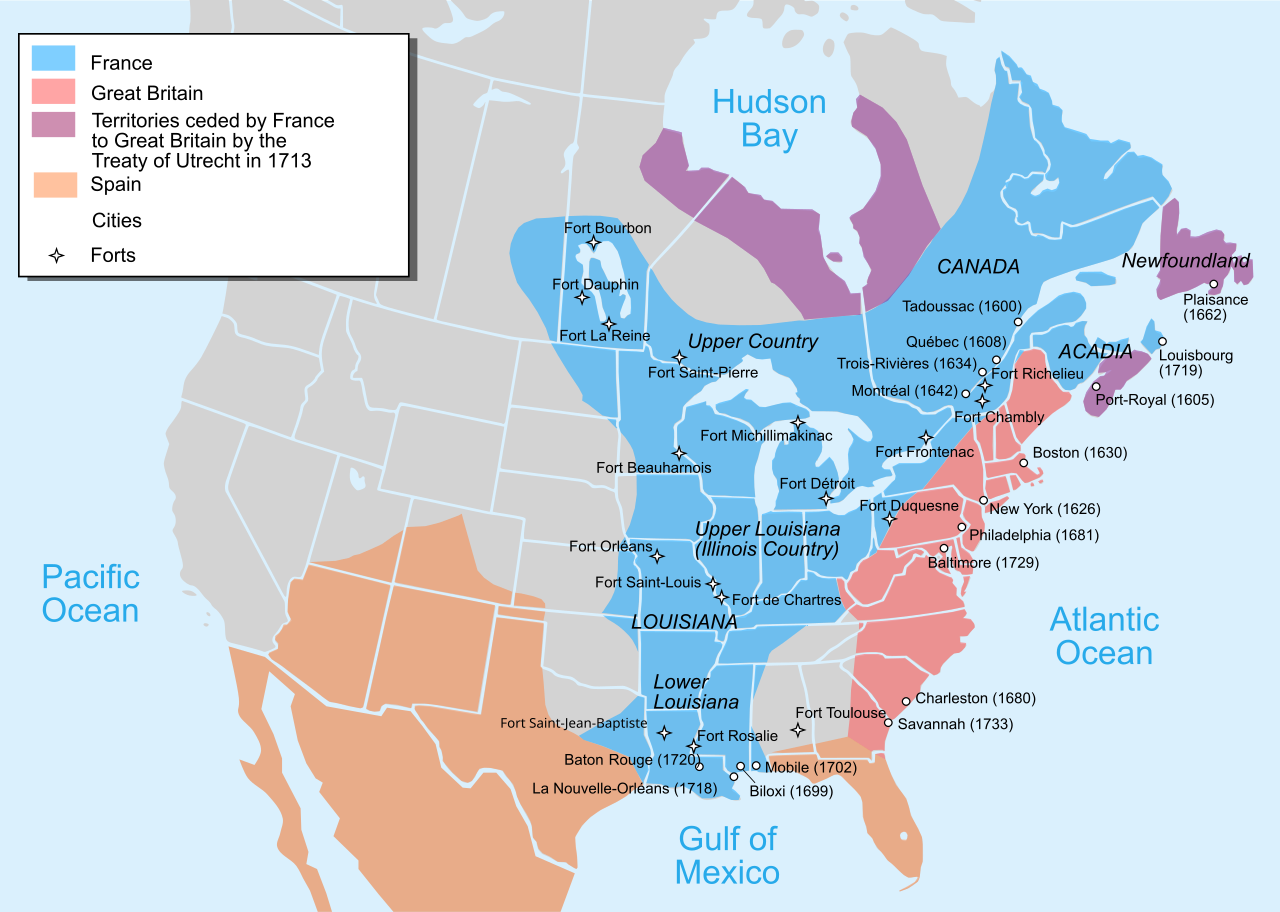
First and foremost, Canada itself, as a state — an administrative body, if you will — was originally founded by France. Jacques Cartier named the region in 1535, and Samuel de Champlain established the first permanent French settlement in North America in Quebec City in 1608. This settlement would become the largest and most populous administrative hub for the entire territory. Canada was a colony within the broader territory of New France, which stretched from as far north as Tadoussac all the way down to Louisiana. It included multiple hereditary land-owning noblemen of Norman extraction.
Much of the original territory of New France
During the Seven Years’ War, on 8 September 1760, General Lévis and Pierre de Vaudreuil surrendered the colony of Canada to the British after the capitulation of Montreal. Though the British had effectively won the war, the Conquest’s details still had to be negotiated between Great Britain and France. In the interim, the region was placed under a military regime. As per the Old World’s “rules of war”, Britain assured the 60,000 to 70,000 French inhabitants freedom from deportation and confiscation of property, freedom of religion, the right to migrate to France, and equal treatment in the fur trade. These assurances were formalized in the 55 Articles of the Capitulation of Montreal, which granted most of the French demands, including the rights to practice Roman Catholicism, protections for Seigneurs and clergymen, and amnesty for soldiers. Indigenous allies of the French were also assured that their rights and privileges would be respected.
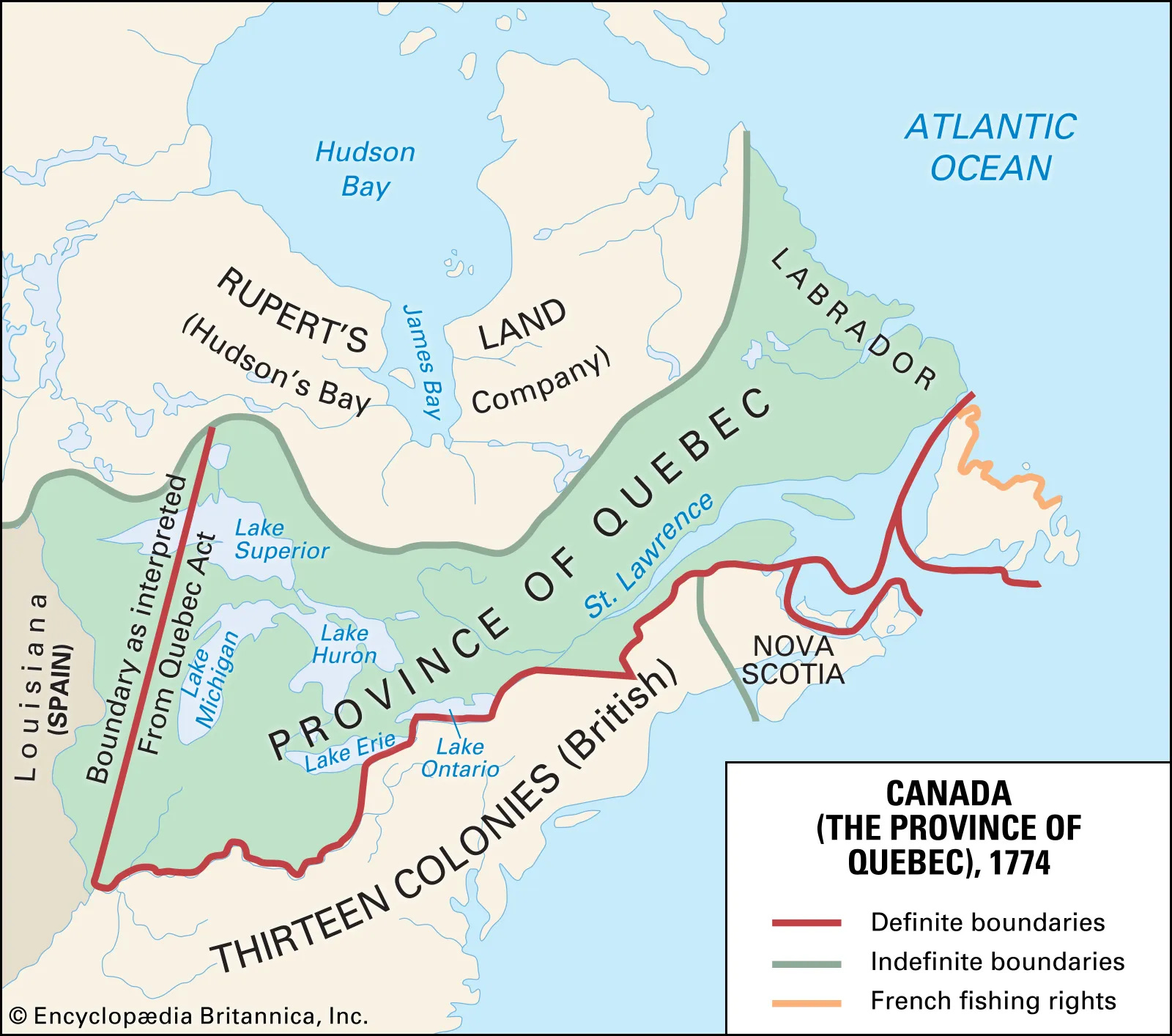
The Treaty of Paris in 1763 officially ended the war and renamed the French colony of “Canada” as “the Province of Quebec”. Initially, its borders included parts of present-day Ontario and Michigan. To address growing tensions between Britain and the Thirteen Colonies and to maintain peace in Quebec, the British Parliament passed the Quebec Act in 1774. This act solidified the French-speaking Catholic population’s rights, such as the free practice of Catholicism, restoration of French civil law, and exemption from oaths referencing Protestant Christianity. These provisions satisfied the Québécois Seigneurs (land-owning nobleman), and clergy by preserving their traditional rights and influence. However, some Anglo settlers in America resented the Act, viewing it as favoring the French Catholic majority. Despite this, the Act helped maintain stability in Quebec, ensuring it remained loyal to Britain during the American Revolutionary War and Quebec was fiercely opposed to liberal French revolutionaries.
British concessions, from the terms of the 1763 Treaty of Paris to the Quebec Act of 1774, safeguarded the cultural and religious identity of Quebec’s French-speaking Catholic population, fostering their loyalty during a period of significant upheaval in North America. Following this period, merchant families such as the Molsons began establishing themselves in Montreal, alongside early Loyalist settlers who trickled into areas now known as the Eastern Townships. These merchant families quickly ingratiated themselves with the local Norman lords and seigneurs.
The Lower Canada Rebellion arose in 1837-1838 due to the Château Clique oligarchy (an alliance of Anglo-Scottish industrialists and French noble landowners), in Quebec refusing to grant legislative power to the French Canadian majority. The rebellion was not solely a French Canadian effort; to the chagrin of both chauvinistic Anglo-Canadians and French Canadians, who in recent years believed it was either a brutal crackdown on French degeneracy, or a heroic class struggle of French peasants against an oppressive Anglo elite. It included figures like Wolfred Nelson, an Anglo-Quebecer who personally led troops into battle.
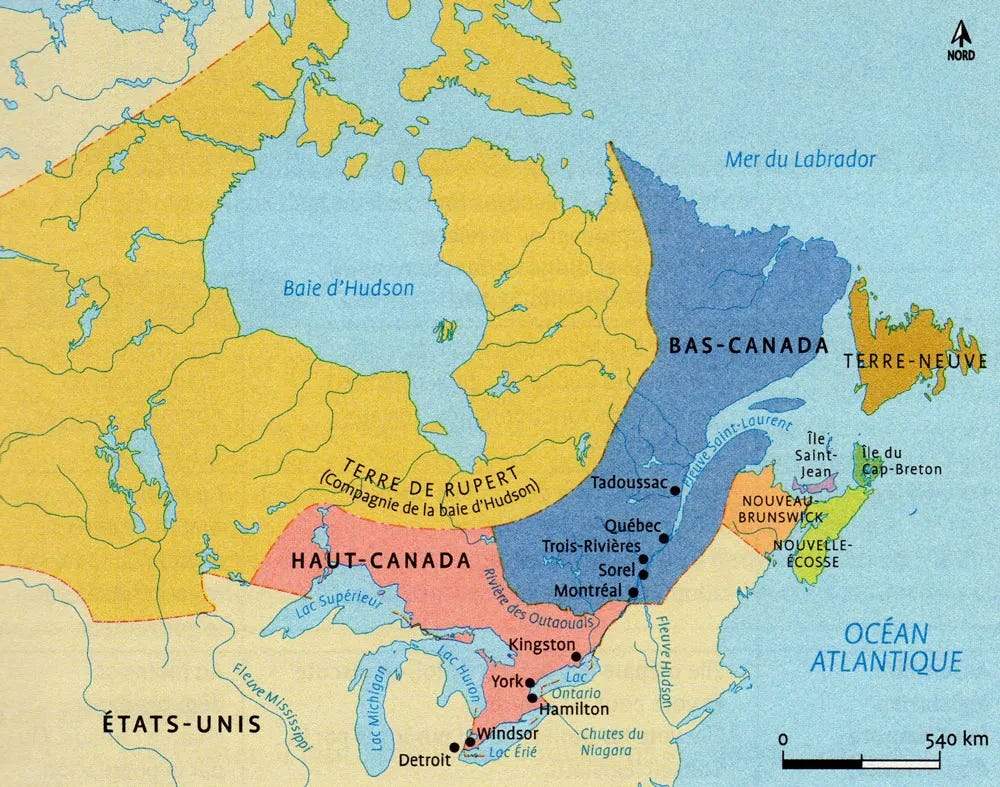
In response to the unrest following the rebellions of 1837-1838, Lord Durham, a British noble, was sent to Canada to investigate and propose solutions. His controversial recommendation, outlined in the Durham Report of 1839, was to abolish the separate legislatures of Upper Canada (Ontario) and Lower Canada (Quebec) and merge them into a single entity: the Province of Canada. This unification aimed to demographically and culturally assimilate the French Canadian population by creating an English-speaking majority.
However, the strategy failed for multiple reasons, and was given up shortly after. Lord Durham, having neither been born nor raised in the New World, underestimated the complexities of Canadian society, which was a unique fusion of Old World ideas in a New World setting. His assumption that French Canadians could be assimilated ignored their strong cultural identity, rooted in large families, which encouraged high birth rates as a means of survival. While Durham hoped unification would erode divisions, the old grievances between the British and French began to dissipate naturally.
The Province of Canada, whose unofficial capital was Montreal, where the two groups mixed
Despite Lord Durham’s intentions, French Canadians maintained their dominance in Quebec. Families averaged five children per household for over 230 years, a trend actively encouraged by the Catholic Church’s policy of La Revanche des Berceaux (the Revenge of the Cradles). This strategy aimed to preserve French Canadian culture and identity amidst the British short-lived attempts at assimilation. In Montreal, British industrialists expanded their influence by forging alliances with French landowning nobles through business partnerships and intermarriage. This blending of elites produced a bilingual Anglo-French upper class that became historically influential.
Such alliances drew on long-standing connections established as early as 1763 and later exemplified by the North West Company (NWC). The NWC in particular is interesting as a prominent fur trading enterprise of the late 18th and early 19th centuries, in that it embodied this fusion of cultures. Led primarily by Anglo-Scots, the company’s leaders frequently formed unions or marriages with French Canadian women, fostering vital ties with the French Canadian communities crucial to their trade. Simon McTavish, known as the “father” of the NWC, maintained alliances with French Canadian families, while his nephew, William McGillivray, and other leaders like Duncan McGillivray followed similar paths. Explorers such as Alexander MacKenzie and David Thompson married French women. These unions strengthened familial and cultural bonds, shaping the broader Anglo-French collaboration that defined this period.
This relative harmony between Anglo and French Canadians continued with the formation of the modern Canadian state in 1867 during Confederation. Sir John A. Macdonald deliberately chose George-Étienne Cartier as his second-in-command. This collaboration contributed to the emergence of Canada’s ethnically Anglo-French elite, who have historically been bilingual. This legacy is evident in the backgrounds of many Canadian politicians, such as the Trudeaus, Mulroneys, Martins, Cartiers, and countless others who have both Anglo-Canadian and French-Canadian roots.
In more recent history, this dynamic has been further solidified by the federal government, where higher-paid positions often require bilingual proficiency. Interestingly, about 20% of Canada’s population is bilingual, reflecting the ongoing influence of this historical coexistence.
The last cannon which is shot on this continent in defence of Great Britain will be fired by the hand of a French Canadian.
~ George Etienne Cartier
QotD: Kaiser Wilhelm II
This was completely incompatible with Bismarck’s system, which had centralized power upon his own person. With uncharacteristic focus and subtlety, Wilhelm sought to reclaim the power that his grandfather had ceded to the chancellor. This was not to prove especially difficult; Bismarck’s position had always relied upon his indispensability to the emperor. Thus, when Bismarck offered his resignation (as he often did during disputes) Wilhelm merely accepted it. The last great man of the wars of unification had now disappeared from the balance.
While the German Empire never became a true autocracy, Wilhelm succeeded in creating what historian, and biographer of the Kaiser, John C. Röhl called a “personalist” system.1 The Kaiser had significant power over personnel. Promotions in the officer corps required his assent. Advancement within civil service (from which civilian ministers were appointed) was also dependent on his favor. By exercising this power, Wilhelm was able to ensure the highest levels of the German government were men agreeable to his point of view. Though they were not mere “yes men”, Wilhelm ensured that they were knowingly dependent on his favor for their position. The Kaiser — even to the end of the monarchy — exercised considerable “negative power” (as Röhl termed it.)2 While Wilhelm’s ability to actively make policy was limited, anything he disapproved of was simply not proposed.
Wilhelm II’s reign marked a departure from the more restrained leadership of his predecessors, as he sought to assert direct influence over the German Empire’s governance and military affairs. This shift toward a more “personalist” system, where loyalty to the Kaiser outweighed true statesmanship, weakened the effectiveness of German leadership and contributed to its eventual strategic missteps. The rigid adherence to the Schlieffen Plan and the technocratic focus on material advantages, such as firepower and mobility, overshadowed the need for adaptable strategic thinking. These failures in both leadership and military planning set the stage for Germany’s disastrous involvement in World War I, where an empire led by personalities rather than policies was ill-prepared for the complexities of modern warfare. Ultimately, Wilhelm’s influence and the culture of sycophancy he fostered played a pivotal role in leading Germany down the path of ruin.
Kiran Pfitzner and Secretary of Defense Rock, “The Kaiser and His Men: Civil-Military Relations in Wilhelmine Germany”, Dead Carl and You, 2024-10-02.
1. John C. G. Röhl, Kaiser Wilhelm II: A Concise Life (Cambridge: Cambridge University Press. 2014).
2. Negative power refers to the ability of an actor or group to block, veto, or prevent actions, decisions, or policies from being implemented, rather than directly initiating or shaping outcomes.
January 11, 2025
We Produced a Video with 22 Students from the University of Zürich (Hoplite Revolution Debate)
SandRhoman History
Published 22 Sept 2024In this video, we will look at the core arguments in the hoplite revolution debate to provide you with 1) an overview of the debate itself, 2) a glimpse into warfare in ancient Greece, and 3) evidence of why historical revisionism is necessary. To achieve this, we will follow a similar overview used in a seminar we taught at the University of Zürich in the spring of 2024. Throughout the video, the participants of this seminar will contribute the expertise they have acquired by providing critical information about the ancient primary sources they analysed during the seminar.
Chapters:
00:00 Revisionism, really?!
04:21 19th Century Germany and Ancient Greece
05:39 A Hoplite Revolution?
11:53 Political Implications
16:19 Agonal Warfare (Fair War?)
22:49 Training and Discipline
25:53 Phalanx Formation
30:13 Exclusivity of Hoplites
33:04 Revisionist Battle
36:46 History is not the past.
(more…)
QotD: “Composite” pre-gunpowder infantry units
This is actually a very old concept. The Neo-Assyrian Empire (911-609 BC) is one of the earliest states where we have pretty good evidence for how their infantry functioned – there was of course infantry earlier than this, but Bronze Age royal records from Egypt, Mesopotamia or Anatolia tend to focus on the role of elites who, by the late Bronze Age, are increasingly on chariots. But for the early Iron Age Neo-Assyrian empire, the fearsome effectiveness of its regular (probably professional) infantry, especially in sieges, was a key component of its foreign-policy-by-intimidation strategy, so we see a lot more of them.
That infantry was split between archers and spear-and-shield troops, called alternately spearmen (nas asmare) or shield-bearers (sab ariti). In Assyrian artwork, they are almost always shown in matched pairs, each spearman paired off with a single archer, physically shielding the archer from attack while the archer shoots. The spearmen are shown with one-handed thrusting spears (of a fairly typical design: iron blade, around 7 feet long) and a shield, either a smaller round shield or a larger “tower” shield. Assyrian records, meanwhile, reinforce the sense that these troops were paired off, since the number of archers and spearmen typically match perfectly (although the spearmen might have subtypes, particularly the “Qurreans” who may have been a specialist type of spearman recruited from a particular ethnic group; where the Qurreans show up, if you add Qurrean spearmen to Assyrian spearmen, you get the number of archers). From the artwork, these troops seem to have generally worked together, probably lined up in lines (in some cases perhaps several pairs deep).
The tactical value of this kind of composite formation is obvious: the archers can develop fire, while the spearmen provide moving cover (in the form of their shields) and protection against sudden enemy attack by chariot or cavalry with their spears. The formation could also engage in shock combat when necessary; the archers were at least sometimes armored and carried swords for use in close combat and of course could benefit (at least initially) from the shields of the front rank of spearmen.
The result was self-shielding shock-capable foot archer formations. Total War: Warhammer also flirts with this idea with foot archers who have their own shields, but often simply adopts the nonsense solution of having those archers carry their shields on their backs and still gain the benefit of their protection when firing, which is not how shields work (somewhat better are the handful of units that use their shields as a firing rest for crossbows, akin to a medieval pavisse).
We see a more complex version of this kind of composite infantry organization in the armies of the Warring States (476-221 BC) and Han Dynasty (202 BC – 220 AD) periods in China. Chinese infantry in this period used a mix of weapons, chiefly swords (used with shields), crossbows and a polearm, the ji which had both a long spearpoint but also a hook and a striking blade. In Total War: Three Kingdoms, which represents the late Han military, these troop-types are represented in distinct units: you have a regiment of ji-polearm armed troops, or a regiment of sword-and-shield troops, or a regiment of crossbowmen, which maneuver separately. So you can have a block of polearms or a block of crossbowmen, but you cannot have a mixed formation of both.
Except that there is a significant amount of evidence suggesting that this is exactly how the armies of the Han Dynasty used these troops! What seems to have been common is that infantry were organized into five-man squads with different weapon-types, which would shift their position based on the enemy’s proximity. So against a cavalry or chariot charge, the ji might take the front rank with heavier crossbows in support, while the sword-armed infantry moved to the back (getting them out of the way of the crossbows while still providing mass to the formation). Of course against infantry or arrow attack, the swordsmen might be moved forward, or the crossbowmen or so on (sometimes there were also spearmen or archers in these squads as well). These squads could then be lined up next to each other to make a larger infantry formation, presenting a solid line to the enemy.
(For more on both of these military systems – as well as more specialist bibliography on them – see Lee, Waging War (2016), 89-99, 137-141.)
Bret Devereaux, “Collection: Total War‘s Missing Infantry-Type”, A Collection of Unmitigated Pedantry, 2022-04-01.
January 10, 2025
Germany Votes – Rise of Hitler 09, September 1930
World War Two
Published 9 Jan 2025The September 1930 elections reshape Germany’s political landscape. With surging support for extremists like the Nazis and Communists, and declining votes for democratic parties, Weimar faces a deeply polarized future. This episode breaks down the results, voter shifts, and what this means for the Republic.
(more…)
Rome – Part 6, The Second Punic War, 218-201 BC
seangabb
Published 22 Aug 2024This course provides an exploration of Rome’s formative years, its rise to power in the Mediterranean, and the exceptional challenges it faced during the wars with Carthage.
Lecture 6: The Second Punic War (218-201 BC)
• Carthaginian Expansion into Spain
• Hannibal Takes Over in Spain – War Declared
• Hannibal and the Invasion of Italy
• The Three Shattering Defeats
• Roman Strategy for Victory
• Compete and Overwhelming Roman Victory
• Rome Emerges as the Mediterranean Superpower
(more…)
January 9, 2025
Hollywood’s favourite creation … the “hero forgives” scene
I’ve never been much of a moviegoer or TV-watcher, so I hadn’t consciously noticed what kulak is discussing here:
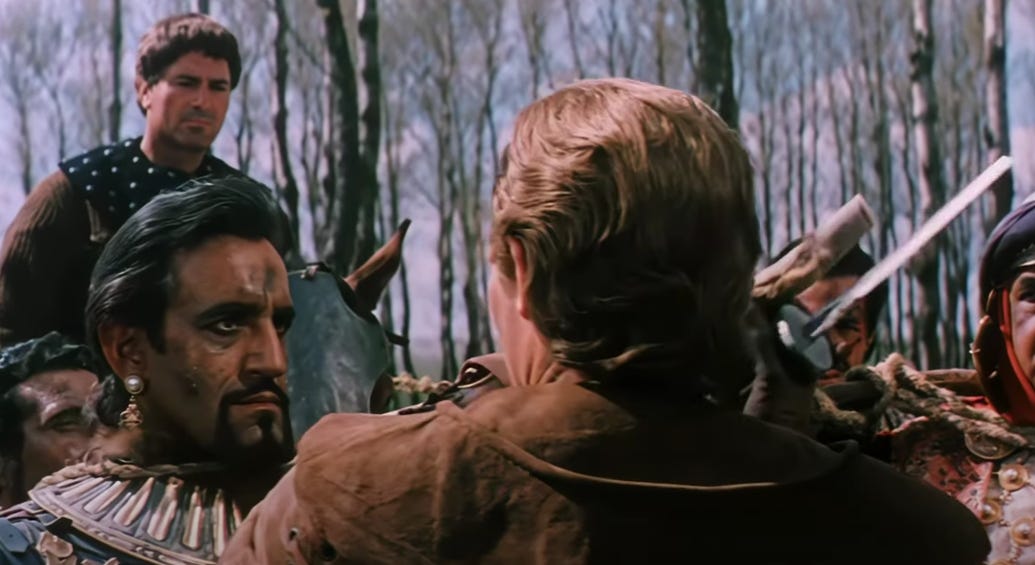
“El Cid” (Charlton Heston) releases enemy raiders who’ve just burnt down a village … for no reason.
“All that it takes for evil to triumph is for good men to do nothing.”
-Edmund BurkeThe reason the boomers are the way they are, and the reason no one in the west fights back against their dispossession and replacement is an 80 year long program to indoctrinate an Ideology I call “Hollywood Anti-justice”.
In almost every piece of media to do with violence, crime, justice, and individual heroism of the past 80 years there is a scene: The “Hero Forgives” scene.
Upon violently defeating, disarming, and capturing the villain, the hero, in spite of his every instinct, in spite of friends screaming at him and reasoning with him with arguments he can’t counter, in spite of the villains mocking unrepentance, dead to rights evidence, gleeful confessions, and even vows to reoffend.
Even if the villain is guilty of hundreds of murders, rapes, and treason, even if the hero himself has killed hundreds of henchmen to capture the villain …
The hero will refuse to kill or punish him.
Sometimes the hero will insist that he must go through the courts … Sometimes the villain will openly mock him that the courts are corrupt and will never convict him, and the hero still will refuse to take matters into his own hands …
Sometimes the hero himself IS the lawful authority. Sometimes the hero is a Military officer, post apocalyptic militia captain, Medieval Knight, Greek Hero, Roman Centurion … etc. And in fact his private judgement IS the official lawful means of passing judgement and executing obviously guilty villains … And he STILL refuses to punish or kill them.
I recently saw El Cid, where the hero, a Knight, refused to hang brigands who had pillaged, raped, burnt a town, confessed and were themselves quite resigned to dying, and even as his fellow knights berated him that the law itself demands he hang them, that it is his sacred duty to hang them, and that it would be treason for him not to…
And the Hero simply cuts their bindings and lets them go … Choosing to be forsworn as a traitor rather than hang the confessed and red-handed guilty. Now this may be a historical, but as far as I’ve been able to find such an event never occurred, it’s been made up for the film, doubly egregious because the historical El Cid almost certainly executed many criminals and brigands, committing and ordering justice … Which is NOT depicted in the film.
Even if the hero has been in this exact position before and spared the villain only for more to die, sometimes even his own family and friends, demonstrating the failure of this unspoken philosophy, the hero will STILL let them go … AGAIN.
Ussually there is some Deus Ex Machina that makes this all workout some ironic or divine punishment will find the Villain through their own folly … but not always. Indeed entire franchises have been perpetuated on THE SAME serial killer villain being forgiven, released, allowed to escape, etc. over and over again.
And audiences consistently hate this, this is always the most cliched, poorly written, out of character, film breaking scene in the entire work … Supposedly great kings, ruthless bounty-hunters, outlaws, veteran knights, military officers, grey and black market criminal anti-heroes, smugglers … All of them transformed into the most inconsistent pacifists for exactly this scene. I’ve seen audiences groan and scream at the TV “Just kill him” and yet the hero, often entirely contrary to their character, will not.
This is not an old literary trope, this is a Hollywood trope.
You can read the original Greek legends, the tales of King Arthur and his Knights, early modern nationalist heroes’ stories, the adventure stories of the Napoleonic officer, the Boys’ Own adventures of empire, and well into contemporary fiction westerns, crime stories, military science fiction, historical fiction, etc.
And in all of them you will see heroes kill their enemies in cold blood, order executions of the guilty, demand deserters, spies, and traitors be shot, seek revenge, order mass hangings … Etc.
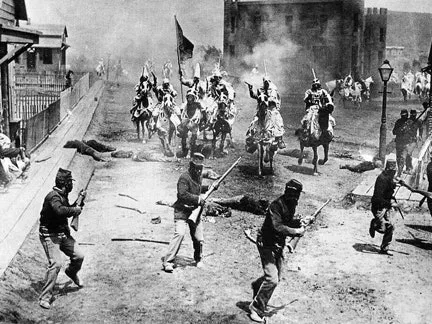
Nor is this some uniquely American madness … As late as the 1950s the vigilantes/terrorists of the original reconstruction era (1864-1877) Ku Klux Klan were treated as folk heroes… Birth of a Nation was played at the White House when it was released. The idea of vengeance, wild justice, and vigilante killings being some unconscionable moral horror was simply not the case in the first half of the 20th century … It was celebrated, much as it had been for the previous 3000 years of the west.
In 1915 the legitimacy of Vigilantism, Vengeance, and Private Justice was so accepted that even arch-progressive, Princeton University Professor, and US President Woodrow Wilson screened Birth of a Nation, a celebration of the Ku Klux Klan’s vigilante-terror campaign, at the White House.
Why did Hollywood invent this trope?
Where Hollywood producers just so attached to an idea of Christian forgiveness and pacifism that they just HAD to include it over the groans and often shouting of their audiences?
Were any of these writers, directors and producers even Christian to begin with!?
Why would the communists, atheists, Jews, and pedophiles that comprise the core of Hollywood writing include such an unusual Christian theme so insistently and often story breakingly?
Well. why do they insist on bullshit girl-bossery, race mixing, and woke theming today over the protests and disinterest of their audience?
Because it benefits them to brainwash the masses that way.
The Hollywood writers never identified with the hero refusing to kill an enemy … they identified with the villain and quite liked for him to get away (indeed many Hollywood writers will openly say as much, that they identify with the villains and much prefer writing them).
Forgotten Armies of the Vietnam War: Australia, Korea, China, USSR
NR: Sorry about this … RTH must have taken this video down at some point between me scheduling it to appear and today.
Real Time History
Published 16 Aug 2024The Vietnam War is mainly remembered as a conflict between the Vietnamese and the United States. But both sides received direct and indirect support from other countries.
(more…)


