
The Korean War by Indy Neidell
Published 7 Jan 2025The Chinese People’s Volunteer Army crosses the Imjin River in force and attacks the South Korean capital. The best units available to Eighth Army commander Matt Ridgway defend it, but with more Chinese armies and reformed North Korean units pushing in the east, is there any hope of holding onto it?
Chapters
00:00 Intro
00:50 Recap
01:09 Seoul Good
03:13 Seoul Gone
07:39 To Line D
10:20 The Ceasefire Committee
14:02 Summary
14:20 Conclusion
(more…)
January 8, 2025
The Korean War 029 – The Third Battle of Seoul – January 7, 1951
Comments Off on The Korean War 029 – The Third Battle of Seoul – January 7, 1951
How To Make 17th Century Clotted Cream – A History
Tasting History with Max Miller
Published 27 Aug 2024Clotted cream served with scones and jam
City/Region: England | Scotland
Time Period: 1670 | 1755Clotted cream is one of the most delicious and simple foods I’ve ever had. It’s made with only one ingredient, but has a richness and nuttiness that is divine. It’s one of those foods that is difficult to track down the origins of, but one story includes the ancient Phoenicians, and another a fairy princess and prince. Both are equally likely to be true.
For best results, look for cream that isn’t ultra-pasteurized. Labels will say “pasteurized” or “low temp pasteurized”. This recipe doesn’t have a lot of active time, but the cream does need to cook for 12 hours, so I recommend starting first thing in the morning. It’s worth it.
To make clouted Cream
Take Milk that was milked in the morning, and scald it at noon; it must have a reasonable fire under it, but not too rash, and when it is scalding hot, that you see little Pimples begin to rise, take away the greatest part of the Fire, then let it stand and harden a little while, then take it off, and let it stand until the next day, covered, then take it off with a Skimmer.
— The Queen-Like Closet, or Rich Cabinet by Hannah Wolley, 1670Clouted Cream
… If you please beat Part of it with a little Rose-water, and a Lair of unbeaten Clouts, with Sugar between …
— A New and Easy Method of Cookery by Elizabeth Cleland, 1755
Comments Off on How To Make 17th Century Clotted Cream – A History
January 7, 2025
Caesar’s dictatorship and the Ides of March – The Conquered And The Proud 11
Adrian Goldsworthy. Historian and Novelist
Published 31 Jul 2024Continuing “The conquered and the proud”, this time we look at Julius Caesar as dictator in Rome, about his activities and reforms and his murder on the 15th March — The Ides of March — in 44 BC. We talk about Brutus, Cassius and the other conspirators and what motivated them.
Comments Off on Caesar’s dictatorship and the Ides of March – The Conquered And The Proud 11
January 6, 2025
See Inside the Last British Heavy Tank | Conqueror | Tank Chats Reloaded
The Tank Museum
Published 6 Sept 2024After the shock appearance of the Soviet IS-3 Heavy Tank, NATO armies set about designing their own heavies to deal with the threat. For the US Army, this was the M103, for the British, this tank – FV 214 Conqueror.
In this film, we explore Conqueror inside and out and talk to ex-Sgt. John Chappell, a former tank commander about his experiences as a Conqueror crewman as part of the British Army of the Rhine in the 1960s.
00:00 | Introduction
02:58 | The FV 200 Series
04:51 | Conqueror
11:35 | See Inside
20:48 | Success? Or Waste of ResourcesThis video features archive footage courtesy of British Pathé.
#tankmuseum
Comments Off on See Inside the Last British Heavy Tank | Conqueror | Tank Chats Reloaded
January 5, 2025
“Everything humans build starts with human and social capital. This includes everything economic.”
Lorenzo Warby explains why he has always disagreed with the “standard model” of economic growth, as it fails to include the biggest cultural variables that matter enormously for economic development:
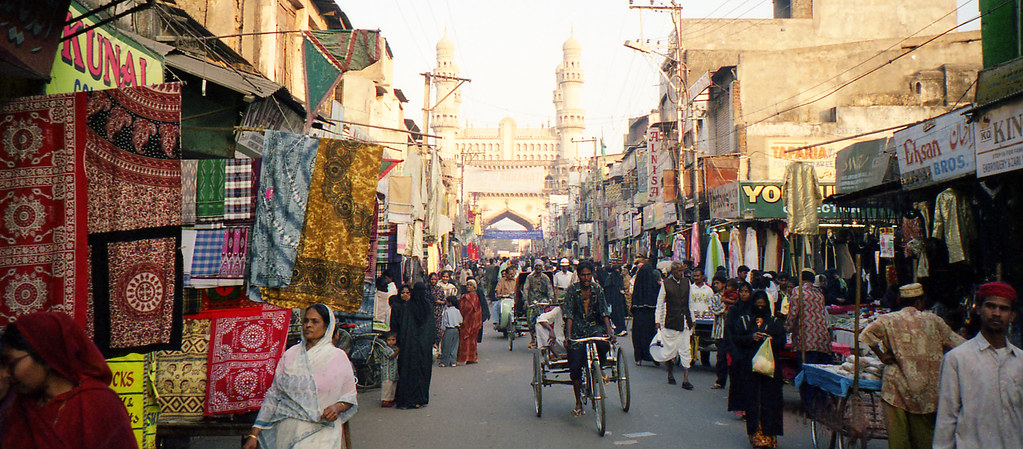
“Hyderabad bazaar” by ruffin_ready is licensed under CC BY 2.0 
 .
.
The seminal theory of economic growth is the Solow Growth Model (technically, the Solow-Swan model). The model can be easily expressed mathematically.
I have never liked the model, nor its later variations.1 The intuition behind my dislike was that societies — and indeed different ethnic groups within societies — obviously varied enormously in their capacity to use, to “put together”, the factors of production. They also vary enormously in their capacity to generate factors of production: specifically capital, the produced means of production. The model implies that there will be a general convergence between economies that has not happened.
Updating the model by including human capital was a gesture in that direction but did not fix the problem with the model, which is much more basic. The update attempted to grapple with the failure of investment to flow to poorer countries and, by implication, the long-term, systematic failures of foreign aid. The failures of foreign [aid] also supported my intuition.
The most recent (2024) Nobel memorial was for work that also directly supports my intuition — how much institutions matter for economic growth. The long-term economic growth literature — identifying culture as very much mattering for economic growth — also supports my intuition.
Skills and knowledge (human capital) are basic
To explain why the entire approach — basically, fiddling with some version of the Cobb-Douglas production function — is fundamentally mistaken, we need to go back to the origins of human economic growth. I mean, right back — all the way to foragers.
What are the original forms of capital? Well, there are tools, which are the original form of physical capital. But without the skills to make and use the tools, they either do not exist, or they are useless.
So, we start with skills and knowledge, with human capital. It takes almost 20 years to train a young human forager to be a subsistence adult — that is, to forage as much nutrition as they consume. The need to stuff the human brain with skills and knowledge — and the need to grow a brain that can be so stuffed — is why we have the most biologically expensive children in the biosphere. The need to impart skills to biologically expensive children is fundamental to the dynamics of all human societies.
Human capital — skills and knowledge — is not an “add on”. It is basic.
So are social connections (social capital)
Foragers do not live as atomistic individuals. They live in families and (fluid) foraging bands. Families and foraging bands are vehicles for our highly cooperative subsistence and reproduction strategies.
That we are the tool-making and tool-using species lacking tearing teeth and claws with the most biologically expensive offspring is why we have highly cooperative subsistence and reproduction strategies. It is also why we are so much the normative species — enabling robust cooperation based on convergent expectations — and why we have prestige and propriety as forms of status.
Both these forms of status represent currencies of cooperation. Prestige grants people status for doing things which are risky, clever, hard, entertaining. It is status by conspicuous competence. It provides a way to reward people for engaging in activities which generate wider social benefits — what economists call positive externalities. It also encourages people to want to associate with you.2
The other form of status — propriety — grants status to those who uphold the norms of the group. In particular, it wields stigma against those deemed to have violated those norms. It provides a way to punish people for engaging in activities which generate wider social costs — what economists call negative externalities. It helps solve the free-rider problem regarding the effort to enforce norms.
Reversing (i.e. perverting) status patterns so that people get prestige from victimhood — extending to various forms of failures of competence or even wildly anti-social behaviour — while stigmatising people who conspicuously successful (as oppressors or exploiters) is deeply destructive of human flourishing.3 We can see this pattern currently operating in “progressive” US states, and especially cities, but murderous versions of it operated in various Communist states. These things affect economic activity, but cannot be discerned by a Cobb-Douglas production function.
It is not true that scientists have never discovered Homo economicus. Unfortunately, Homo economicus is not a member of genus Homo. It is Pan troglodytes (chimpanzees) playing strategy games in a lab. It is precisely because we Homo sapiens are more normative, allowing us to encapsulate the social conquest of the Earth, that there are billions of us and only a few thousand of them.
We — as a highly social, indeed ultra-social, species — engage in both individual and social calculations. Different cultures notoriously generate different patterns for, and balances between, such calculations.
1. The model has some utility for short-term calculations of growth.
2. As with any social benefit, the knock-on dynamics of prestige can be complex, but status from conspicuous competence is at the heart of it.
3. The November 2014 Shirtgate controversy — where a rocket scientist who had led the technically incredibly difficult task of landing a probe on a comet was publicly humiliated over the shirt he wore (a gift from a female friend it turned out) — represented conspicuous achievement (prestige) being trumped by feminist stigmatisation (propriety).
Comments Off on “Everything humans build starts with human and social capital. This includes everything economic.”
Four Waffen SS Tigers vs 50 T-34s – Prokhorovka Part 4
World War Two
Published 4 Jan 2025A mass of Soviet armour charges at the Leibstandarte Division, it looks like they might smash through the German lines. Then, Michael Wittmann’s Tiger tanks go into action. Will the Waffen SS be able to turn the tide at Prokhorovka? Indy reveals all.
(more…)
Comments Off on Four Waffen SS Tigers vs 50 T-34s – Prokhorovka Part 4
QotD: The customary Dictatorship in the Roman Republic before 82BC
It’s important to note at the outset that the Romans had no written constitution and indeed most of the rules for how the Roman Republic functioned were, well, customary. The Roman term for this was the mos maiorum, the “custom of the ancestors”, but Roman practice here isn’t that different from how common law and precedent guide the functioning of something like the British government (which also lacks a written constitution). Later Roman writers, particularly Cicero, occasionally offer theoretical commentary on the “rules” of the Republic (as a retrojected, ideal version), but just as often their observations do not actually conform to the practice we can observe from earlier periods. In practice, the idea here was that the “constitution” of the Republic consisting in doing things as they had always been done, or at least as they were understood to have always been done.
Consequently, as historians, we adopt the formulation that the Republic is what the Republic does – that is that one determines the rules of offices and laws based on how they are implemented, not through a hard-and-fast firm legal framework. Thus “how does the dictatorship work?” is less a question of formal rules and more a question of, “how did the eighty-odd Roman dictatorships work?”
The basic idea behind the office was that the dictator was a special official, appointed only in times of crisis (typically a military crisis), who could direct the immediate solution to that crisis. Rome’s government was in many ways unlike a modern government; in most modern governments the activities of the government are carried out by a large professional bureaucracy which typically reports to a single executive, be that a Prime Minister or a President or what have you. By contrast, the Roman Republic divided the various major tasks between a bunch of different magistrates, each of whom was directly elected and notionally had full authority to carry out their duties within that sphere, independent of any of the other magistrates. In crude analogy, it would be as if every member of the United States cabinet was directly elected and none of them reported to any of the rest of them but instead all of them were advised by Congress (but in a non-binding manner). Notionally, the more senior magistrates (particularly the consuls) could command more junior magistrates, but this wasn’t a “direct-report” sort of relationship, but rather an unusual imposition of a more senior magistrate on a less senior one, governed as much by the informal auctoritas of the consul as by law.
In that context, you can see the value, when rapid action was required, of consolidating the direction of a given crisis into a single individual. This is, after all, why we have single executive magistrates or officials in most countries. So, assuming you have a crisis, how does this process work?
The typical first step is that the Senate would issue its non-binding advice, a senatus consultum, suggesting that one or both of the consuls appoint a dictator. The consuls could ignore this direct, but almost never did (save once in 431, Liv. 4.26.5-7). The consuls would then have to nominate someone; they might agree on the choice (which would make things simple) or one of them might be indisposed (out of the city, etc.), which would leave the choice to the one that remained. If both consuls were present and did not agree, they’d draw lots to determine who got to pick (which happens in the aforementioned instance in 431 after the tribunes got the consuls of that year to relent and pick someone, Liv. 4.26.11).
The nominating consul could pick anyone except himself; if you, as consul, wanted to be dictator, you would need your co-consul to so nominate you. There were no formal requirements; of course nominations tended to go to experienced commanders, which tended to mean former consuls, but this was not a requirement. Publius Claudius Pulcher (cos. 249), enraged when the Senate directed him to appoint a dictator (because of his own bungled military command) infamously nominated his own freedman, Claudius Glicia, as dictator (Liv. Per. 19.2; Seut. Tib. 2.2), which was apparently a bridge too far; Glicia was forced to abdicate but his name was duly entered onto the Fasti because the appointment was valid, if ill-advised (despite the fact that, as a freedman, Glicia would have been ineligible to run for any [office]). Nevertheless, dictators were usually former consuls.
Once the name was picked, in at some cases the appointment may have been confirmed by a vote of the Comitia Curiata, Rome’s oldest voting assembly, which was responsible for conferring imperium (the power to command armies and organize law courts; essentially “the power of the kings”) on magistrates; not all magistrates had imperium (consuls, praetors, proconsuls, propraetors, dictators and their magistri equitum did; quaestors, aediles, tribunes, both plebeian and military, and censors did not). We do not know of any instance where the Comitia Curiata put the kibosh on the appointment of a dictator, so this step was little more than a rubber-stamp, and may have been entirely optional (Lintott, op. cit., 110, n. 75), but it may have also reflected the notion that all imperium had to be conferred by the people through a voting assembly. It is often hard to know with clarity about pro forma elements of Roman politics because the sources rarely report such things.
The dictator was appointed to respond to a specific issue or causa, the formula for which are occasionally recorded in our sources. The most common was rei gerundae causa, “for the business to be done” which in practice meant a military campaign or crisis. In cases where the consuls were absent (out on campaign), a dictator might also be nominated comitiorum habendorum causa, “for having an assembly”, that is, to preside over elections for the next year’s consuls, so that neither of the current consuls had to rush back to the city to do it. Dictators might also be appointed to do a few religious tasks which required someone with imperium. Less commonly but still significantly, a dictator might be appointed seditionis sedenae causa, “to quell sedition”; only one instance clearly under this causa is known, P. Manlius Capitolinus in 368, but several other instances, e.g. L. Quinctius Cincinnatus in 439, also dealt with internal matters. Finally, once in 216, Marcus Fabius Buteo held the office of dictator senatus legendi causa, “to enroll the Senate”, as the Battle of Cannae, earlier that year, had killed so many Senators that new inductions were needed (Liv. 23.23).
The dictator then named a subordinate, the magister equitum (“master of the horse”). The magister equitum was a lieutenant, not a colleague, but interestingly once selected by a dictator could not be unselected or removed, though his office ended when the dictator laid down his powers. We should note Marcus Minucius, magister equitum for Q. Fabius Maximus in 217 as an exception; his selection was forced by the people via a law and his powers were later made equal to Fabius’ powers. This turned out to be a substantial mistake, with Fabius having to bail the less prudent Minucius out at Geronium – the undermining of Fabius generally during 217 was, in retrospect viewed as a disaster, since the abandonment of his strategy led directly to the crushing defeat at Cannae in 216.
One of the ways that legal power was visually communicated in Rome was through lictors, attendants to the magistrates who carried the fasces, a bundle of rods (with an axe inserted when outside the sacred bounds of the city, called the pomerium). More lictors generally indicated a greater power of imperium (consuls, for instance, could in theory give orders to the praetors). Praetors were accompanied by six lictors; consuls by 12. The dictator had 24 lictors when outside of the pomerium to indicate his absolute power in that sphere (that is, in war), but only 12 inside the city. The magister equitum, as the dictator’s subordinate, got only six, like the praetors.
It also seems fairly clear that while dictators had almost complete power within their causa, those powers didn’t necessarily extend beyond it (e.g. Liv. 2.31.9-11, the dictator Manius Valerius, having been made dictator to resolve a military problem, insists to the Senate that he cannot resolve internal strife through his dictatorial powers and instead lays down his office early). The appointment of a dictator did not abolish the other offices (Cicero thinks they do, but he is clearly mistaken on the matter, Cic. De Leg. 3.9, see Lintott, 111). In essence then, the dictator was both a supreme military commander and also expected to coordinate the other magistrates with his greater degree of imperium, though of course in practice the ability to do that is going to substantially depend on the individual dictator’s ability to get cooperation from the other magistrates (but then, on the flip side, the dictator has just been designated as the leader in the crisis, so the social pressure to conform to his vision must have been intense). Notably, dictators could not make a law (a lex) on their own power or legislate by fiat outside of their causa; they could and did call assemblies which could by vote approve laws proposed by a dictator, however.
The dictator served for six months or until the task for which he was appointed was resolved, whichever came first. There is a tendency in teaching Roman history to represent a figure like Cincinnatus, who laid down his dictatorship after just fifteen days in 458, as exceptional but while the extreme shortness of term was exceptional, laying down power was not. Indeed, Cincinnatus (or perhaps a relative) served as dictator again in 439 and again laid down his power, this time in merely 21 days. In practice, the time-limited nature of the dictatorship meant there were few incentives to “run out the clock” on the office since it was so short anyway – better, politically, to solve the crisis quickly and lay down power ostentatiously early and “bank” the political capital than try to run out the period of power, accomplish relatively little and squander a reputation for being public-spirited.
Bret Devereaux, “Collections: The Roman Dictatorship: How Did It Work? Did It Work?”, A Collection of Unmitigated Pedantry, 2022-03-18.
Comments Off on QotD: The customary Dictatorship in the Roman Republic before 82BC
January 4, 2025
Winning WW2’s Most Important Battle – Battle of the Atlantic
Historigraph
Published 15 Aug 2024The Second World War featured many important land battles on a colossal scale. They involved hundreds of thousands of participants, ranged across hundreds of miles and inflicted the most terrible destruction. But none of them were as long-running, as vast or as crucial to allied victory as that fought at sea in the Atlantic, where for four years Allied navies and civilian sailors fought a life or death struggle against Germany’s U-boats. This is the story of how it was fought, and how it was won.
00:00 – WW2’s most important battle
00:45 – The U-boat menace in the early years
08:53 – The massacre off the eastern seaboard
13:12 – American ship printer go brrrrrrrrr
19:31 – The Allies gain the upper hand
21:49 – Black May: the convoy battles of 1943
24:41 – The most important victory of WW2
(more…)
Comments Off on Winning WW2’s Most Important Battle – Battle of the Atlantic
January 3, 2025
The Boomers and “reset to Year Zero”
On Twit-, er, I mean “X”, ESR responds to a post from Devon Eriksen decrying the Baby Boomers for effectively destroying the culture of the postwar “American Dream”:

… I’m a late Boomer, born in ’57. I can dimly remember the day JFK was shot. I watched the moon landing. My teens and early twenties coincided with the 1970s. I was there for it all.
And even then, even in the 1970s, feeling a sense of subtle disintegration all around me, I already dimly grasped that we weren’t just falling. We were being pushed.
But I was very young then; I wouldn’t come to fully understand why, and by whom, for almost another 30 years
We Boomers didn’t burn down our heritage in a fit of thoughtless hedonism. I mean, we did some thoughtless hedonism, yeah, but that’s not where the real damage came from.
If you want to know where the damage came from, look up Yuri Bezmenov. Listen to him explain “demoralization” and the long game of Soviet culture-jamming against the West in general and the U.S. in particular.
Reset to year zero was a Marxist idea. It was part of a suite of memetic weapons, infectious propaganda bombs deployed against the social and cultural cohesion of the “main enemy”.
Often, they were successful in damaging us by leveraging not our vices but our virtues. Valorizing tolerance and liberality until they became helplessness in the face of more and more extreme forms of deviance was one of their attacks.
We didn’t fall on our own. We were pushed. The Boomer fault wasn’t that we were hedonists or nihilists, it’s that we didn’t have sufficient cultural immune defenses against what was being done to us.
Why that is exactly is a long sad story that I’m still not sure I completely understand. But I can hit some highlights.
One is that religion failed us. This is nobody’s fault and I don’t think it could have gone differently; it’s a failure that had been on the cards ever since the mechanistic worldview reached effective completion by Darwin. One of the things the Marxists did was work to accelerate the inevitable decay of religious authority.
Secular conservatives failed us, too. They had one job — just one job — which was to explain why all those Chesterton’s fences shouldn’t be torn down. They utterly flubbed that on all three levels of awareness, analysis, and persuasion. That could have gone differently.
It didn’t help that after the Army-McCarthy hearings in 1954 conservatives developed a severe case of cowardice about calling out Communist subversion.
That may have been their single greatest dereliction of duty. The result was that over the next 50 years Communist institutional capture of academia and other institutions went almost unopposed. Which is why today we struggle with “woke”.
Most of us Boomers weren’t wreckers, even by accident. Most of us were duped. It’s easy to say in hindsight we should have done better, but the enemy was very clever and determined.
Try not to judge us too harshly, kids. It’s nice to think that a later generation might have done better, but … I haven’t seen it happen yet.
Comments Off on The Boomers and “reset to Year Zero”
January 2, 2025
Forgotten War – Ep 6 – The Battle of the Admin Box – Feb. 1944
HardThrasher
Published 1 Jan 2025A short video on the highlights of the Battle of the Admin Box, and its build up DO NOT PANIC IF YOU HAVEN’T WATCHED THE OTHER VIDEOS IN THIS SERIES
Please consider donations of any size to the Burma Star Memorial Fund who aim to ensure remembrance of those who fought with, in and against 14th Army 1941–1945 — https://burmastarmemorial.org/
(more…)
Comments Off on Forgotten War – Ep 6 – The Battle of the Admin Box – Feb. 1944
Why Germany Lost the Battle of Britain
Real Time History
Published 2 Aug 2024Summer 1940. The United Kingdom is gripped by the fear of a German invasion. Even if the Luftwaffe secures the sky over Britain, could Germany’s Operation Sea Lion ever really work?
(more…)
Comments Off on Why Germany Lost the Battle of Britain
QotD: Sincerity
This is what the French call le horse pucky. If we may be so bold as to speak of “the human spirit” — which is pretty heavy for a column starting with a professional wrestler — the 90s killed it stone cold dead. The human spirit can flourish in the most awful situations, but one indispensable requirement is: Sincerity. You just can’t be snarky about the “Ode to Joy” or ironic about the Sistine Chapel. If you do, then there really is no difference between Beethoven and MC Funetik Spelyn, nothing to choose between Michelangelo and a dog turd on the sidewalk — someone placed them there intentionally, which is the only distinguishing characteristic of “art” possible in a world overrun by Postmodernists and Deconstructionists.
Severian, “Why the 90s Was the Worst Decade Ever”, Rotten Chestnuts, 2021-07-04.
Comments Off on QotD: Sincerity
January 1, 2025
3,500 Years of Hangover Cures – Kishkiyya from Baghdad
Tasting History with Max Miller
Published 31 Dec 2024A slightly sour lamb stew with herbs, chickpeas, and fat, eaten as a hangover cure in 10th century Baghdad
City/Region: Baghdad
Time Period: 10th CenturyWhere there are hangovers, there are hangover cures. Throughout history they’ve varied from having a good wash, drinking lemonade while drinking alcohol, and the dubious prairie oyster. This stew is kind of like 10th century Baghdad’s version of my favorite hangover food: a greasy burger and fries.
Fatty lamb is stewed with kishka (a dried yogurt-like dairy product), verjuice, chickpeas, herbs, and greens, along with some olive oil just to make sure there’s enough grease involved. It doesn’t look all that pretty, but it tastes good. It’s complex and layered, with each flavor following the last, and the variety of textures is wonderful.
Wash 3 ratls meat and put it in a pot. Add ½ ratl chopped onion, ¼ ratl fresh herbs, a handful of chickpeas, 1 piece galangal, and ¼ ratl olive oil. Pour water to submerge the ingredients in the pot. Let the pot cook until meat is almost done. Add any of the seasonal green vegetables and a little chard. When everything in the pot is cooked, add 3 pieces of sour kishk, and ½ ratl kishk of Albu-Sahar, Mawsili, or Bahaki. Pound them into fine powder and dissolve them in 1 ratl (2 cups) ma’hisrim (juice of unripe sour grapes).
When kishk is done, add 2 dirhams (6 grams) cumin and an equal amount of cassia. Add a handful of finely chopped onion. Do not stir the pot. When the onion cooks and falls apart, add to the pot 2 danaqs (1 gram) cloves and a similar amount of spikenard.
Stop fueling the fire, let the pot simmer and rest on the remaining heat then take it down, God willing.
— Kitāb al-Tabīkh by ibn Sayyār al-Warrāq, 10th Century, translation from Annals of the Caliph’s Kitchen by Nawal Nasrallah
Comments Off on 3,500 Years of Hangover Cures – Kishkiyya from Baghdad
The Korean War 028 – Happy Nuke Year! – December 31, 1950
The Korean War by Indy Neidell
Published 31 Dec 2024Matt Ridgway arrives in Korea to find his Eighth Army broken and dysfunctional from top to bottom. He has a mere few days to rectify these issues and get them combat-ready before the Communist Chinese forces approach once more. But the stakes are high; UN forces commander Douglas MacArthur continues to pressure Washington to expand the war, through either conventional or atomic means. As 1950 expires, the doomsday clock is ticking.
(more…)
Comments Off on The Korean War 028 – Happy Nuke Year! – December 31, 1950


