
Mr. McDonnell, deputy leader of the British Labour Party, which for the time being is in opposition, recently objected to the presence of hereditary peers in the “upper” house of Britain’s Parliament, using the crude and vulgar language typical of populist politicians anxious to demonstrate their identity with the people or the masses. (It is strange, by the way, how rarely leftists who are in favor of confiscatory economic policies are condemned as populist, when they appeal mainly to envy, spite, and resentment, those most delightful of all human emotions.)
Speaking for myself — the only person for whom I am fully entitled to speak — I would rather be ruled (at least in the modern world) by the Duke of Northumberland than by Mr. McDonnell; and this is for perfectly rational reasons and not, as might be supposed, from any feeling of nostalgia for a world we have lost.
Unlike Mr. McDonnell, the Duke of Northumberland does not feel that he has to make the world anew, all within his lifetime — or rather within his political lifetime, a period that is even shorter. He knows that the world did not begin with him and will not end with him. As the latest scion of an ancient dynasty going back centuries, he is but the temporary guardian of what he has inherited, which he has a duty to pass on. Moreover, as someone whose privileges are inherited, he knows that his power (such as it is) is fragile in the modern world. He must exercise it with care, discretion, and consideration.
Theodore Dalrymple, “The Appeal of Inherited Power”, Taki’s Magazine, 2017-07-29.
March 28, 2023
QotD: In praise of aristocracy and monarchy
March 27, 2023
The vicious – not virtuous – circle of green
Elizabeth Nickson thinks that our societal pursuit of green technology will be the undoing of everything we have built:
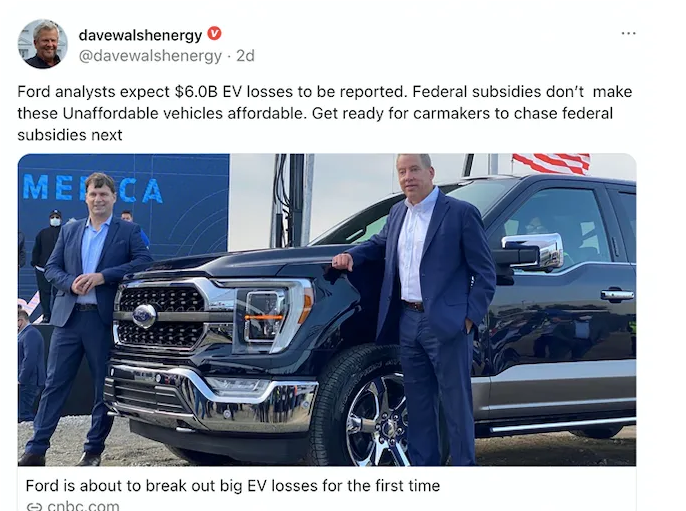
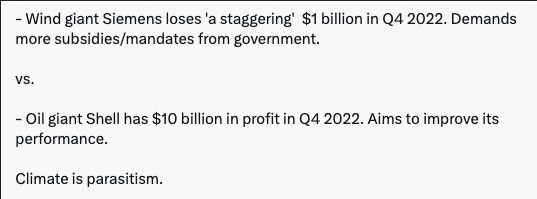
Some of us have been saying this for a very long time: green will bring down the world. Green creates a vicious circle, a term you may remember from Economics 101. It is when the serpent eats itself, no wealth is created and collapse results. That is what we are doing with ESG, with carbon taxes, with the forced adoption of unreliable vertiginously expensive green energy. It has skewed every single market. No one is investing in sound enterprise, and anything once sound is a Jenga tower, unstable, rotting from within. This. This is what threatens to bring down the world.
Green is built on subsidies. And not just government subsidy. Every mutual fund, every hedge fund, every multinational and every local or national corporation has a green monster within preventing innovative investments, sucking profits and growth. Every local, regional and state government leaks millions to green morons promising to “bring sustainable prosperity”. The only prosperity is theirs. They fiddle around in lakes and watercourses, producing “studies”, all of which are hysterical and exaggerated. They muck around in forests, buying as much as possible, shut them down, never visit again, leaving them to desertify. They buy farms and ranches, leaving them to rot. They are termites, eating us alive.
These outfits have burrowed into every level of government and every ministry. They are purely extractive. They do not produce anything of value. They leech. They move in and out of government. When in government, they identify sources of funds to plunder once out of government. In 2015, I did a cross-ministry analysis of just how much money these folks take from the government annually. It is in the hundreds of billions in the US alone. From private foundations they take more billions. All this money is used to shut down economic activity.
[…]
Here is the nasty little secret that lies at the heart of environmentalism. It has been long captured by plutocrats and WEFers, who use it to take resources once thought to belong to the people, to everyone, to use in order to innovate and develop. This freedom and access, and only this was the source of prosperity in the United States. It powered the entire world. It made America the beacon, the lighthouse of the world. It produced strong healthy brilliant young people who performed one feat of innovation, athleticism, and creation after another. All those kids today are working on ever more vicious ways to surveil, control and supress via AI.
And the interior is being cleared of people, businesses, farms, ranches, working forests, mines, and oil and gas installations.
In pursuit of 2030 goals, Biden’s agents are busily acquiring hundreds of millions of acres from private owners, from state and regional land banks, which they will then lock down. Many ranchers, including the heroic Wayne Hage, believe that government is taking that land to use as collateral for its massive debt to the Bank for International Settlements. The only people who will be able to use those resources are multinationals who pay a fee to government and to the BIS to pay down the loans. No citizens will be able to access those resources to make money for themselves, to build families and businesses and towns and cities. The environmental movement has, within 40 years, returned us to serfdom, where we eat what we are told to eat, go where we are told to go, take whatever medicine they want to give us, and eventually, fight when we are told to fight.
The environmental movement is so evil, it has twisted ethical standards to the point where we are able to kill each other with impunity. Their PR is so strong, so invasive, that every school child now believes there are too many people (this is nonsense), and population must be drastically drawn down (a genocide unrivalled in history). Every adult secretly fears this is true. This appalling lie has created a culture of death. What are the effects of this thinking, that life is no longer sacred, but a threat?
March 26, 2023
Plandemic? Manufactured crisis? Mass formation psychosis?
In The Conservative Woman, James Delingpole lets his skeptic flag fly:

“Covid 19 Masks” by baldeaglebluff is licensed under CC BY-SA 2.0


Tell me about your personal experiences of Covid 19. Actually, wait, don’t. I think I may have heard it already, about a million times. You lost all sense of smell or taste – and just how weird was that? It floored you for days. It gave you a funny dry cough, the dryness and ticklishness of which was unprecedented in your entire coughing career. You’ve had flu a couple of times and, boy, when you’ve got real flu do you know it. But this definitely wasn’t flu. It was so completely different from anything you’ve ever known, why you wouldn’t be surprised to learn that it had been bioengineered in a lab with all manner of spike proteins and gain-of-function additives, perhaps even up to and including fragments of the Aids virus …
Yeah, right. Forgive me for treading on the sacred, personal domain of your lived experience. But might I cautiously suggest that none of what you went through necessarily validates lab-leak theory. Rather what it may demonstrate is the power of susceptibility, brainwashing and an overactive imagination. You lived – we all did – through a two-year period in which health-suffering anecdotes became valuable currency. Whereas in the years before the “pandemic”, no one had been much interested in the gory details of your nasty cold, suddenly everyone wanted to compare notes to see whether they’d had it as bad as you – or, preferably, for the sake of oneupmanship, even worse. This in turn created a self-reinforcing mechanism of Covid panic escalation: the more everyone talked about it, the more inconvertible the “pandemic” became.
Meanwhile, in the real world, hard evidence – as opposed to anecdotal evidence – for this “pandemic” remained stubbornly non-existent. The clincher for me was a landmark article published in January 2021 by Simon Elmer at his website Architects For Social Housing. It was titled “Lies, Damned Lies and Statistics: Manufacturing the Crisis”.
In it Elmer asked the question every journalist should have asked but which almost none did: is this “pandemic” really as serious as all the experts, and government ministers and media outlets and medics are telling us it is? The answer was a very obvious No. As the Office for National Statistics data cited by Elmer clearly showed, 2020 – Year Zero for supposedly the biggest public health threat since “Spanish Flu” a century earlier – was one of the milder years for death in the lives of most people.
Let’s be clear about this point, because something you often hear people on the sceptical side of the argument say is, “Of course, no one is suggesting that Covid didn’t cause a horrific number of deaths.” But that’s exactly what they should be suggesting: because it’s true. Elmer was quoting the Age Standardised Mortality statistics for England and Wales dating back to 1941. What these show is that in every year up to and including 2008, more people died per head of population than in the deadly Covid outbreak year of 2020. Of the previous 79 years, 2020 had the 12th lowest mortality rate.
Covid, in other words, was a pandemic of the imagination, of anecdote, of emotion rather than of measured ill-health and death. Yet even now, when I draw someone’s attention to that ONS data, I find that the most common response I get is one of denial. That is, when presented with the clearest, most untainted (this was before ONS got politicised and began cooking the books), impossible-to-refute evidence that there was NO Covid pandemic in 2020, most people, even intelligent ones, still choose to go with their feelings rather with the hard data.
This natural tendency many of us have to choose emotive narratives over cool evidence makes us ripe for exploitation by the cynical and unscrupulous. We saw this during the pandemic when the majority fell for the exciting but mendacious story that they were living through a new Great Plague, and that only by observing bizarre rituals – putting strips of cloth over one’s face, dancing round one another in supermarkets, injecting unknown substances into one’s body – could one hope to save oneself and granny. And we’re seeing it now, in a slightly different variant, in which lots of people – even many who ought to know better – are falling for some similarly thrilling but erroneous nonsense about lab-leaked viruses.
It’s such a sexy story that I fell for it myself. In those early days when all the papers were still dutifully trotting out World Health Organisation-approved propaganda about pangolins and bats and the apparently notorious wet market (whatever the hell that is) in Wuhan, I was already well ahead of the game. I knew, I just knew, as all the edgy, fearless seekers of truth did that it was a lab leak wot done it. If you knew where to dig, there was a clear evidence trail to support it.
We edgy, fearless truth seekers knew all the names and facts. Dodgy Peter Daszak of the EcoHealth Alliance was in it up to the neck; so too, obviously, was the loathsomely chipper and smugly deceitful Anthony Fauci. We knew that all this crazy, Frankenvirus research had initially been conducted in Chapel Hill, North Carolina, but had been outsourced to China after President Obama changed the regulations and it became too much of a hot potato for US-based labs. And let’s not forget Ukraine – all those secret bio-research labs run on behalf of the US Deep State, but then exposed as the Russians unhelpfully overran territory such as Mariupol.
March 25, 2023
Canada’s ChiCom influence scandal – “All of the damage has been self-inflicted”
The Trudeau government has been expending a lot of time, effort, and political capital trying to avoid an open scandal. So much, so typical. What isn’t typical for the federal Liberals is just how badly they’re going about doing everything all of a sudden:
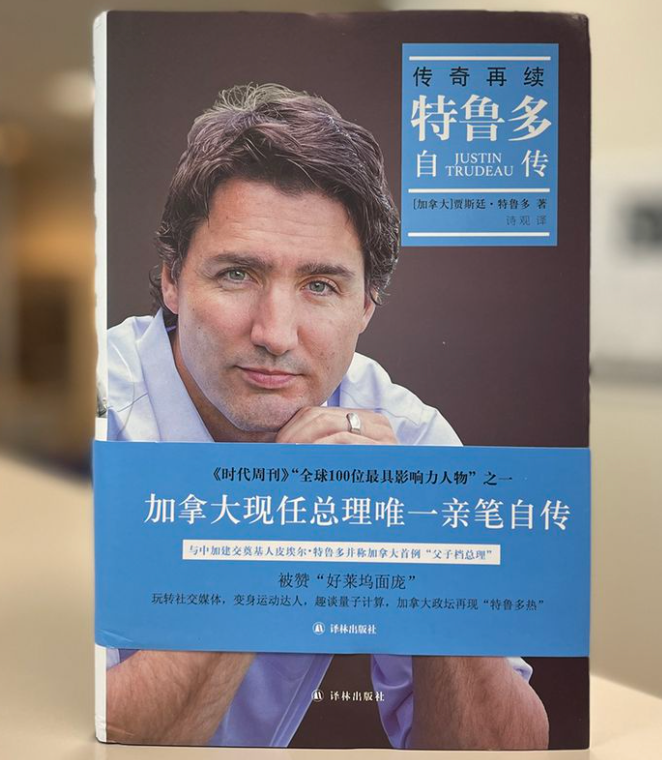
None of this ought to have been a shock, and none of it needed to put the Prime Minister’s Office in its current state of calcified pickle. After all, rumours and off-the-record chats about this stuff have been going around for literally years.
No, how this crew has chosen to handle these stories at every single step has made the scandal worse for themselves. Every. Single. Step. All of the damage has been self-inflicted.
This government is the epitome of an organization that is tactically smart and strategically dumb. Not only has their damage control mirrored the response of the SNC scandal (that ended so well for them), but every misstep has had the result of slowly backing the prime minister into rhetorical traps he has set for himself. This is a government that knows how to win the daily news cycle by losing the game. One that can’t distinguish between legitimate criticism and bad-faith partisan attack — probably because it is so insular and bunker-bound that it sees the world before it divided between loyalists and blood enemies. It’s symptomatic of leadership that is in its final stages of terminal fatigue, and doesn’t yet realize it. These guys cannot help but win themselves to death.
[…]
Imagine, as more stories hit the wire, the government had skipped all of those unnecessary weeks of obfuscation and deflection and simply appointed a special rapporteur to examine the need for a public inquiry. In this counterfactual, let’s also assume that the person he picked isn’t a long-time personal friend. What if Trudeau took allegations of interference seriously at the outset, and his party avoided stunts like skipping committee meetings and filibustering to prevent the testimony of his chief of staff, Katie Telford?
Where would they be today if they hadn’t squandered every iota of credibility and goodwill with the press, the NDP, and his own intelligence services? To put it more directly, what if they hadn’t spent the past few weeks acting as if they had something to hide?
Would they be better off? Maybe?
As an aside, I notice that many of the Liberal proxies are out in force on social media attacking the media and CSIS in an effort to defend the sitting government. I have to ask: how’s that working for y’all? Are you getting the sense that Global News and Sam Cooper and the Globe and Mail have been successfully cowed? Have their CSIS sources stopped leaking? Has Jagmeet Singh been brought to heel?
I’m going to put something out for consideration: Perhaps the denials, obfuscations and attacks are only making the scandal worse. They’re convincing journalists that there’s a real story here while prompting an already pissy collection of national security sources to leak harder.
South Africa – from bad to indescribably worse
John Psmith reviews South Africa’s Brave New World: The Beloved Country Since The End Of Apartheid by R.W. Johnson. It isn’t a pretty picture at all:

The whole world had come to Pretoria to see the inauguration of Nelson Mandela as the first democratically elected South African President. It was the greatest assemblage of heads of state since John F. Kennedy’s funeral … But it was the flight of nine SAAF [South African Air Force] Mirages overhead, dipping their wings in salute, which brought tears to many eyes. It said so many things: the acceptance of, indeed, the deference to, Mandela by the white establishment, the acknowledgement that he was fully President, able to command all the levers of power — and, for many black people in the crowd, it meant that for the first time the Mirages’ awesome power and white pilots were on their side, part of the same nation … All the products of that white power, including South Africa’s sophisticated economy and infrastructure, were being handed over intact.
A little over a decade later and that same South African Air Force was no longer able to fly. It wasn’t for lack of planes: new ones were procured from European arms manufacturers in an astonishingly expensive and legendarily corrupt deal. But once purchased the planes rotted from lack of maintenance and languished in hangers for lack of anybody able to fly them. Most of the qualified pilots and technicians had been purged, and most of the remainder had resigned. The air force did technically still have pilots, after all it would be a bit embarrassing not to, but those pilots were chosen for patronage reasons and didn’t technically have any idea how to fly a fighter jet.
It isn’t just the air force. That whole “sophisticated economy and infrastructure” that got “handed over intact” now by and large no longer exists. Consider something as basic as running water: in 1994, South Africa had some of the most sophisticated water infrastructure on earth, with a whole system of dams, reservoirs, and long-distance inter-basin conduits working together to conquer the geographical challenges of having several major cities and mining centers located on an arid plateau. All of this water was safe, drinkable, and actually came out of the tap when you turned the handle. This picture was marred of course by poor delivery to black rural communities and squatter camps, but in the early 90s the government was making rapid progress towards serving more of those people too.
Like the air force, that water system is now basically non-functional. It’s estimated that something like 10 million people no longer have reliable access to running water. When the water does run, it’s frequently filthy and contaminated with human sewage. South Africa had its first urban cholera outbreak in the year 2000, and they are now a regular occurrence. Again, like the air force, this isn’t for lack of money or effort. The state has spent billions on trying to fix the water problems, and the government’s water bureaucracy has tripled in size since 1994. Something else has gone wrong.
Neither of these examples is cherry-picked. Ask about literally any of the necessities for human life, and the picture is the same: basically first-world quality under the apartheid Nationalist government, and basically post-apocalyptic today. The electric grid is failing, with rolling blackouts consuming the country on a daily basis. The rail network, once one of the finest on earth, is now so degraded that mines in the North of the country prefer to truck their products overland to ports in Mozambique rather than risk the rail journey to Durban. The medical system was once the jewel of Africa and now teeters on the brink of collapse, with qualified doctors and nurses fleeing the country in droves. As for education, one South African author notes: “When Anthony Sampson’s authorized biography of Mandela appeared one of its more embarrassing asides was that all the educational institutions which had nourished Mandela had since collapsed. A Mandela could be produced in colonial times, but no longer.”
Had enough yet? At last count between a third and a half of the population is unemployed. Public order is non-existent outside gated communities and tourist areas patrolled by private security. The murder rate in South Africa exceeds that of many active war zones. Every major city in South Africa is among the most dangerous cities on earth, and the countryside is much worse than the cities. The reported cases of rape alone establish South Africa as the worst country on earth for rape, and the vast majority of cases are likely unreported, since the police have essentially stopped prosecuting this crime.
Something has gone very wrong. What happened? That’s the subject of this book by R.W. Johnson, an ultra-detailed examination of the 10 or so years following the end of apartheid in 1994. Johnson is the right guy to write this book — he’s lived in South Africa since the 1960s, and was active in the movement against apartheid from its earliest days, so he personally knows most of the players who’ve been running the country. And now he has the bittersweet task of writing a book documenting how what happened is “just what white racists predicted and what white radicals like myself scorned”.
March 24, 2023
Only a paper dragon?
In UnHerd, Edward Luttwak suggests that China’s military may be much more apparent than real:

The day after Li Keqiang, China’s departing Prime Minister and the last of Beijing’s moderates, called for more market liberalisation to reach this year’s 5% growth target, Xi Jinping responded by announcing a muscle-flexing 7.2% increase in China’s defence spending. That is certainly consistent with Xi’s truculent stance (he replied to Nancy Pelosi’s recent Taiwan visit with a series of ballistic missile launches), and with his official promise to the Communist Party that China will become the world’s dominant power by 2049. But what do those percentages actually mean?
The declared total of China’s newly increased defence budget at 1.56 trillion yuan amounts to $230 billion, according to the current exchange rate. If that were the case, it would mean that China is falling further behind the United States, whose own fiscal 2023 defence spending is increasing to $797 billion (and actually more, since that figure does not include its funding for military construction or the added help to Ukraine).
China’s own figure is also generally assumed by experts to be greatly understated — not by fiddling the numbers one by one, but rather by wholesale exclusions, such as the attribution of research-and-development spending to civilian budgets. Even if a commando team of elite forensic accountants were sent into action to uncover China’s actual defence spending, with another team dispatched to determine what’s missing from the US budget, we would still only have a very loose indication of how much actual military strength China and the United States hope to add.
But one thing can be said with absolute certainty: each side is adding less than the rising numbers imply.
In China’s case, a manpower shortage undercuts military spending in the PLA’s ground forces and naval forces, and soon it will affect manned air units as well. The PLA ground forces now stand at some 975,000, a very small number for a country that has 13,743 miles of borders with 14 countries — including extreme high-mountain borders where internal combustion engines lose power, jungle-covered borders where remote observation is spoiled by foliage, Russian-river borders with endemic smuggling, and the border with India’s Ladakh where an accumulation of unresolved Chinese intrusions have forced each side to deploy substantial ground forces, with at least 80,000 on the Chinese side.Except for Ladakh, which now resembles a war-front, borders are not supposed to be guarded by army troops but by border police. And China did in fact have a substantial dedicated border force, but it was abolished for the same reason that the PLA ground army is so small: a crippling shortage of physically fit Chinese men willing to serve in these regions. Cities and towns, by contrast, do not seem afflicted by such severe manpower shortages, leading to the weird phenomenon on Nepal’s main border crossing to Tibet where, according to an acquaintance, a group of freezing Cantonese city policemen were checking travellers and “guarding the border”. (They said they had been “volunteered” for two months.)
A very different take on the Wuhan Coronavirus pandemic
At The Conservative Woman, Dr. Mike Yeadon lays out his case for doubting that there ever actually was a novel coronavirus in the first place:

Wuhan Institute of Virology.
Wikimedia Commons.
I’ve grown increasingly frustrated about the way debate is controlled around the topic of origins of the alleged novel virus, SARS-CoV-2, and I have come to disbelieve it’s ever been in circulation, causing massive scale illness and death. Concerningly, almost no one will entertain this possibility, despite the fact that molecular biology is the easiest discipline in which to cheat. That’s because you really cannot do it without computers, and sequencing requires complex algorithms and, importantly, assumptions. Tweaking algorithms and assumptions, you can hugely alter the conclusions.
This raises the question of why there is such an emphasis on the media storm around Fauci, Wuhan and a possible lab escape. After all, the “perpetrators” have significant control over the media. There’s no independent journalism at present. It is not as though they need to embarrass the establishment. I put it to readers that they’ve chosen to do so.
So who do I mean by “they” and “the perpetrators”? There are a number of candidates competing for this position, with their drug company accomplices, several of whom are named in Paula Jardine’s excellent five-part series for TCW, Anatomy of the sinister Covid project. High on the list is the “enabling” World Economic Forum and their many political acolytes including Justin Trudeau and Jacinda Ardern.
But that doesn’t answer the question why are they focusing on the genesis of the virus. In my view, they are doing their darnedest to make sure you regard this event exactly as they want you to. Specifically, that there was a novel virus.
I’m not alone in believing that myself at the beginning of the “pandemic”, but over time I’ve seen sufficient evidence to cast strong doubt on that idea. Additionally, when considered as part of a global coup d’état, I have put myself in the position of the most senior, hidden perpetrators. In a Q&A, they would learn that the effect of a released novel pathogen couldn’t be predicted accurately. It might burn out rapidly. Or it might turn out to be quite a lot more lethal than they’d expected, demolishing advanced civilisations. Those top decision-makers would, I submit, conclude that this natural risk is intolerable to them. They crave total control, and the wide range of possible outcomes from a deliberate release militates against this plan of action: “No, we’re not going to do this. Come back with a plan with very much reduced uncertainty on outcomes.”
The alternative I think they’ve used is to add one more lie to the tall stack of lies which has surrounded this entire affair. This lie is that there has ever been in circulation a novel respiratory virus which, crucially, caused massive-scale illness and deaths. In fact, there hasn’t.
Instead, we have been told there was this frightening, novel pathogen and ramped up the stress-inducing fear porn to 11, and held it there. This fits with cheating about genetic sequences, PCR test protocols (probes, primers, amplification and annealing conditions, cycles), ignoring contaminating genetic materials from not only human and claimed viral sources, but also bacterial and fungal sources. Why for example did they need to insert the sampling sticks right into our sinuses? Was it to maximise non-human genetic sequences?
Notice the soft evidence that our political and cultural leaders, including the late Queen, were happy to meet and greet one another without testing, masking or social distancing. They had no fear. In the scenario above, a few people would have known there was no new hazard in their environment. If there really was a lethal pathogen stalking the land, I don’t believe they’d have had the courage or the need to act nonchalantly and risk exposure to the virus.
Most convincingly for me is the US all-cause mortality (ACM) data by state, sex, age and date of occurrence, as analysed by Denis Rancourt and colleagues. The pattern of increased ACM is inconsistent with the presence of a novel respiratory virus as the main cause.
If I’m correct that there was no novel virus, what a genius move it was to pretend there was! Now they want you only to consider how this “killer virus” got into the human population. Was it a natural emergence (you know, a wild bat bit a pangolin and this ended up being sold at a wet market in Wuhan) or was it hubristically created by a Chinese researcher, enabled along the way by a researcher at the University of North Carolina funded by Fauci, together making an end run around a presidential pause on such work? Then there’s the question as to whether the arrival of the virus in the general public was down to carelessness and a lab leak, or did someone deliberately spread it?
March 22, 2023
California – Embrace the Unicorn! No, the other Unicorn!
Chris Bray on California’s hoped-for path to transition away from fossil fuels:
California has the progressive vision to go all-electric, with laws and regulations that phase out gas water heaters, furnaces, and cars in the near future — while transitioning away from the production of electricity through the use of nuclear and natural gas technologies. Putting the teensy-weensy engineering questions aside and embracing the unicorn, this deep blue vision of the future means the state needs to build wind and solar power facilities in massive quantities, and now. California currently has about half the power it needs to do what it says it plans to do in just ten years.
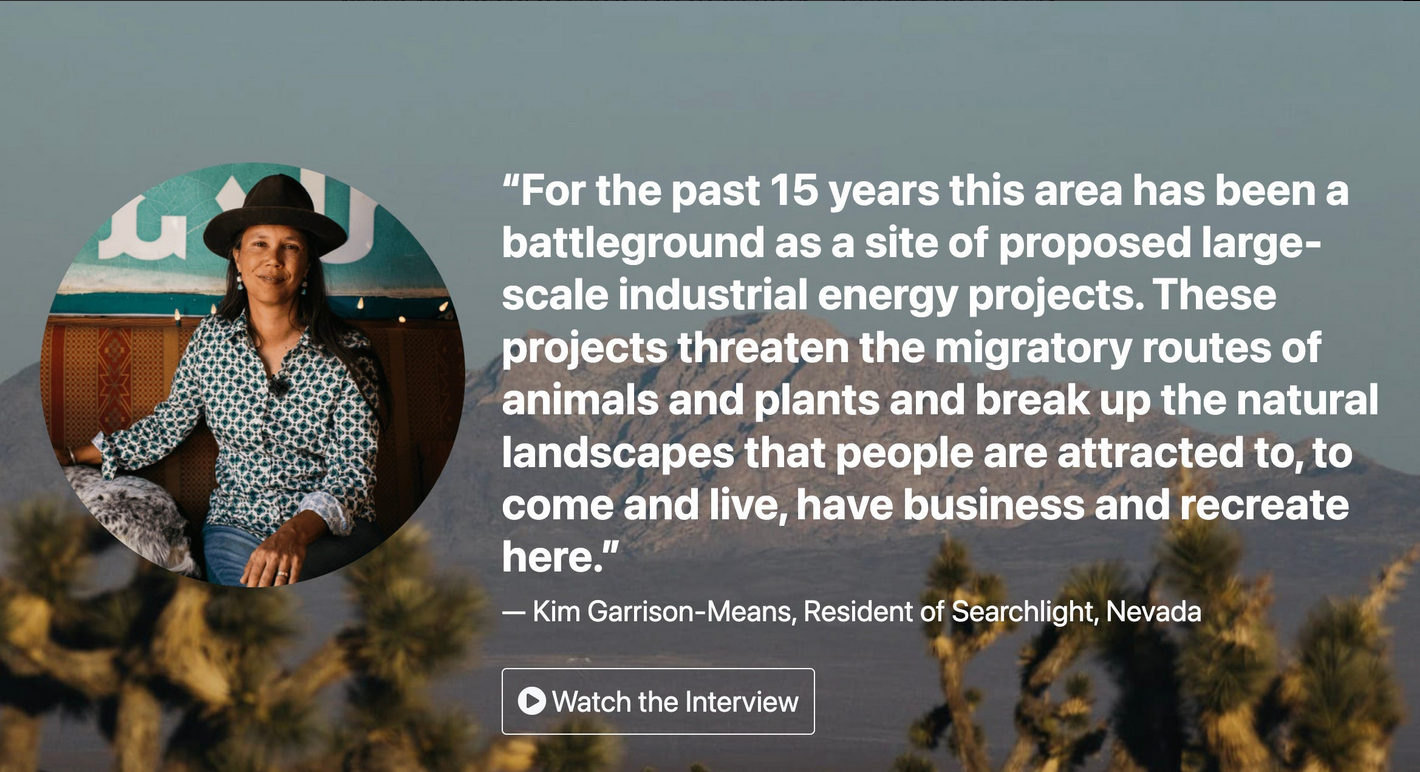
But President Joe Biden just announced a move that aggressively advances the progressive vision of preserving wilderness and preventing development, naming the Avi Kwa Ame National Monument in the Mojave Desert — preventing solar and wind development on 506,814 acres of lightly populated and federally owned desert land. The coalition of tribal and community groups that has worked to get the national monument designated make the anti-solar point explicit on their website:
Where progressive coastal urbanites see the progressive project of decarbonization, people in wilderness-adjacent areas see industrial blight, and express that view in the language of progressive conservationism. To a degree not explored by the false binary of media-defined American politics, in which good people on the left face bad people on the right, California’s future is an increasingly sharp conflict between left and left — and note what kind of permits energy companies have to get to build big wind and solar plants in the desert:
When progressive California builds its progressive energy infrastructure, it’s going to incidentally take a shit-ton of bighorns and tortoises and birds. I assume I don’t have to explain the euphemism.

March 21, 2023
The reason there are no EV charging facilities along the Interstate Highway System
Jon Miltimore explains why a 1956 law prohibits the installation of EV charging bays anywhere on the Interstate:

Nissan Leaf electric vehicle charging.
Photo by Nissan UK
In 1956, Ike signed into law a bill — the Federal-Aid Highway Act — that paved the way (pun intended) for the interstate highway system, which included rest areas at convenient locations.
While there were numerous problems with the legislation, a relatively minor one was that it created strict limits on what could be sold at these rest stops. Today, federal law limits commercial sales to only a few items (including lottery tickets), the Verify team found. When President Joe Biden rolled out a $5 billion funding plan for states to create EV charging stations, he neglected to carve out a commercial exemption for EVs.
“You would be paying for that energy”, Natalie Dale of the Georgia Department of Transportation told WXIA-TV Atlanta. “That would count as commercialized use of the right-of-way and therefore not allowed under current federal regulations.”
If you think this sounds like an inauspicious roll out to the massive federal EV program, you’re not wrong.
Allowing drivers to charge their EVs at convenient, familiar locations that already exist along interstate highways is a no-brainer — yet this simple idea eluded lawmakers in Washington, DC.
Unfortunately, it illustrates a much larger problem with the top-down blueprint central planners are using to create their EV charging station network.
“We have approved plans for all 50 States, Puerto Rico and the District of Columbia to help ensure that Americans in every part of the country … can be positioned to unlock the savings and benefits of electric vehicles”, Transportation Secretary Pete Buttigieg said in a 2022 statement.
While it’s good the DOT isn’t trying to single-handedly map out the locations of thousands of EV charging stations across the country, there’s little reason to believe that state bureaucrats will be much more efficient. A review of state plans reveals a labyrinth of rules, regulations, and stakeholders dictating everything from the maximum distance of EV stations from highways and interstates to the types of charging equipment stations can use to the types of power capabilities charging stations must have.
The primary reason drivers enjoy the great convenience of gasoline stations across the country — there are some 145,000 of them today — is that they rely on market forces, not central planning. Each year hundreds of new filling stations are created, not because a bureaucrat identified the right location but because an entrepreneur saw an opportunity for profit.
March 20, 2023
“It amounts to nothing less than a declaration of all-out war between the government and the Big Tech companies”
The editors of The Line have strong opinions on the federal government’s decision to batter Google, Facebook, and other online “giants” over their opposition to the proposed internet legislation in bills C-11 and C-18:
As a result of C-18, both Google and Meta have considered dropping news distribution from their platforms, or have outright promised to do so. To which we have responded: “Well, no shit, Sherlocks.” We have, in fact, warned all of the parties involved with this misguided bill that that’s exactly what was going to happen.
Nonetheless, the dim-witted government officials and corporate media barons who have pinned their hopes of survival to the apparent money spigot of Big Tech didn’t believe us. So when Meta came right out and said it would drop news last week, the ashen-faced Minister of Heritage accused them of using “intimidation and subversion” tactics. And, thus, these demands for private correspondence appear to have been drafted.
It amounts to nothing less than a declaration of all-out war between the government and the Big Tech companies — and, by extension, the many independent media creators like ourselves.
Well. Okey Dokey then.
*cracks knuckles*
Let’s start with two very obvious points: firstly, we at The Line don’t object to forcing these tech companies to disclose funding to third parties for the purpose of opposing C-18 et al. That is perfectly reasonable, in our minds. Further, if these companies are being accused of anything illegal, by all means, investigate away — after you get a warrant.
The rest of these demands are nothing short of banana crackers; it’s an extraordinary interpretation of the committee’s mandate. It’s the kind of overbroad dragnet that will necessarily create privacy breaches for the unknown numbers of ordinary citizens, dissidents and journalists who have corresponded with these companies about these bills.
We will remind the government that private citizens and private companies do not owe the government a full accounting of their private business or communications. The government is subject to this kind of transparency and disclosure because the government works for us. Not the other way around.
We will also point out the irony. The government is demanding years worth of correspondence from private entities within a very short time frame: this is a level of transparency that no government department would subject itself to. Don’t believe us? Just try to draft a similar ATIP request to any ministry; it would take years to get such a request fulfilled, and half if it would come back redacted.
McKinsey, in the backrooms, with a masterplan
Elizabeth Nickson suggests that the vast disruption of life in western societies, the transformation of governments from barely competent to actively tyrannical, and the economic undermining of middle class prosperity may all be linked to one management consulting firm:

The brutalism of government during the last three years was anomalous in western democracies. First of all, it was irrational, it contravened common sense, which almost everyone possesses, and it destroyed millions of household economies and small businesses. It impoverished and starved a billion people in the developing world. It killed the old, brutally, refusing them affection in their last days. It divided us and is still dividing us. The virus was engineered by the government and paid for by the people it was unleashed upon. And then the fiends forced injections upon anyone with a job and a family to feed, via relentless propaganda, where it too contravened basic reason (acquired immunity, tiny effect on people under 70), and then the shot started to kill. And the deaths were ignored, records hidden, and the press was quiescent.
Who did this? This wasn’t normal government behavior. Government is usually just incompetent. At the very least it pretends compassion, is generally well-meaning, its check the voting booth. But now, it’s full-on Satanic. And the voting booth is essentially gone, corrupted by cartels, the CCP, the international left, the profiting UniParty.
But this niggled at me. Who drew up the plan, instituted it in every country, bullied every citizenry, devised the advertising, instituted the protocols? What operation has that level of power, of discipline?
Only one answer: McKinsey. McKinsey innovated and executed the whole damned thing. Mr Google is quite clear. In France, in Canada, in the U.S., in Australia and New Zealand. The cruelty, the ruthless crushing of millions, it was all them. In Canada alone they made $100 million “transitioning” government’s duty of care into a brutal suppression of anyone without elite status.
McKinsey is the international consultancy that lands everywhere that owners want to maximize their income. It is profoundly efficient. It privileges the predator class and institutes a brutal Darwinian system for everyone else.
“We don’t do policy,” said Richard Elder, DC Mckinsey chief. “We do execution.” Sure, buddy, you aren’t at the meeting where they tabletop ICE budgets, game the Chicago Health bureaucracy by Kaiser or how to sell more opioids to teens?
Trudeau had to have taken McKinsey advice when he set planeloads of anonymous black Kevlar-clad mercenaries on Canadian truckers and their supporters. He simply doesn’t have the nerve to do it alone. That action was unprecedented in Canadian history. Even the poodle press thinks McKinsey runs Canada. It has contracts across ministries, its former CEO, Dominic Barton, is Trudeau’s ambassador to China, and he is likely guiding some of the election theft that has been taking place under Trudeau. Whether McKinsey games immigrant ballot harvesting remains to be seen, but it bears its fingerprint.
March 19, 2023
Disagree with the Canadian government’s attempt to take over significant parts of the internet? Get ready for administrative punishment, citizens!
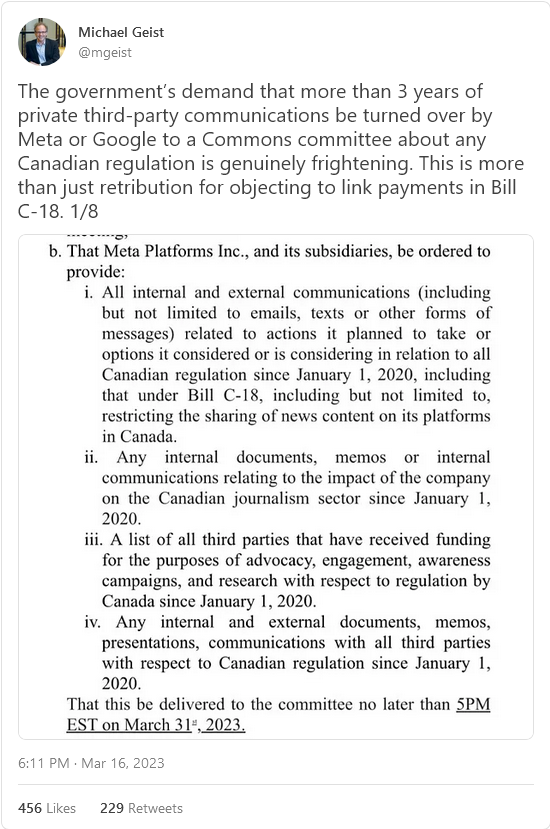
Michael Geist, who often seems like the only person paying close attention to the Canadian government’s growing authoritarian attitudes to Canadians’ internet usage, shows the utter hypocrisy of the feds demanding access to a vast array of private and corporate information on a two-week deadline, when it can take literally years for them to respond to a request for access to government information:

Senator Joe McCarthy would be in awe of the Canadian government’s audacious power grab.
Library of Congress photo via Wikimedia Commons.
The government plans to introduce a motion next week requiring Google and Facebook to turn over years of private third-party communication involving any Canadian regulation. The move represents more than just a remarkable escalation of its battle against the two tech companies for opposing Bill C-18 and considering blocking news sharing or linking in light of demands for hundreds of millions in payments. The motion – to be introduced by the Parliamentary Secretary to the Minister of Canadian Heritage (yes, that guy) – calls for a series of hearings on what it describes as “current and ongoing use of intimidation and subversion tactics to avoid regulation in Canada”. In the context of Bill C-18, those tactics amount to little more than making the business choice that Heritage Minister Pablo Rodriguez made clear was a function of his bill: if you link to content, you fall within the scope of the law and must pay. If you don’t link, you are out of scope.
While the same committee initially blocked Facebook from even appearing on Bill C-18 (Liberal MP Anthony Housefather said he was ready for clause-by-clause review after just four hearings and no Facebook invitation), bringing the companies to committee to investigate the implications of their plans is a reasonable approach. But the motion isn’t just about calling executives before committee to answer questions from what will no doubt be a hostile group of MPs. The same motion sweeps in the private communications of thousands of Canadians, which is a stunning disregard for privacy and which could have a dangerous chilling effect on public participation. Indeed, the intent seems fairly clear: guilt by association for anyone who dares to communicate with these companies with an attempt to undermine critics by casting doubt on their motivations. Note that this approach is only aimed at those that criticize government legislation. There has been a painfully obvious lobbying campaign in support of the bill within some Canadian media outlets, but there are no efforts to uncover potential bias or funding for those that speak out in favour of Bill C-18, Bill C-11, or other digital policy initiatives.
It is hard to overstate the broad scope of the disclosure demands. Canadian digital creators concerned with Bill C-11 who wrote to Youtube would find their correspondence disclosed to the committee. So would researchers who sought access to data from Google or Facebook on issues such as police access to social media records or anti-hate groups who contacted Facebook regarding the government’s online harms proposal for automated reports to law enforcement. Privacy advocates focused on how Google administers the right to be forgotten in Canada would ironically find their correspondence disclosed as would independent media sites that wrote to Facebook about the implications of Bill C-18.
March 13, 2023
When did the “elites” of the West become so bumbling and incompetent?
Chris Bray on the blatant decay of western political leadership on display at the #Twitterfiles hearing in Washington D.C.:
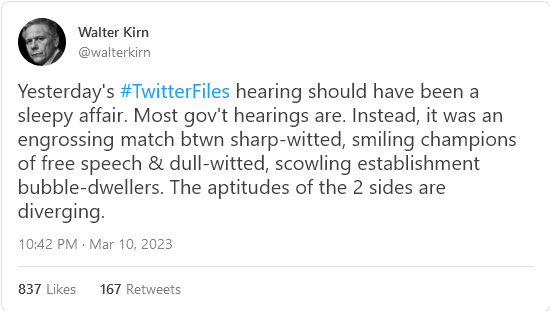
I should probably just go back to sleep for a decade, because Walter Kirn always has it covered:
I was trying to be clever about this yesterday, but it should be said plainly for the space aliens who eventually find the ruins of our former civilization and have to use the surviving digital evidence to report to their superiors on the collapse of the earth losers.
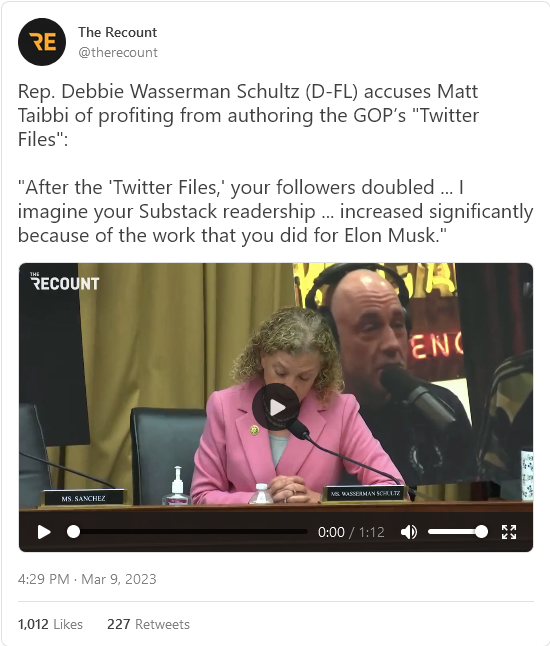
The most striking thing about the average member of the contemporary political class — the “elite”, and yes, I know — isn’t that they’re almost invariably wrong, or that they’re never interesting, or that they have no wisdom of any kind that ever shines through anything they do, ever. Instead, the most striking thing about the contemporary political class is that most of them can’t actually speak, in the sense that you ask them something and then they think and then words come out. Here, watch:
Even in the screenshot, her face is pointed downward at a piece of paper. She’s only ever reading. She’s looking at prepared questions and giving voice to a script, like a much dumber Anne Hathaway. And, yes, what the script says is idiotic — Matt Taibbi gets paid for his journalismz!!!!! (unlike members of Congress, who take a vow of poverty and work for free) — but the more interesting thing to me is that this person, in her fifty-trillionth term in Congress, can’t say what she thinks without reading it. Mr. Taibbi, it says on this piece of paper that you are a very bad person.
They don’t know anything. They don’t think anything. They have no ability, no insight, no value to offer. So they make our laws.
March 11, 2023
British attitudes to crime differ substantially between average Britons and the ruling elite
Scott Alexander does a monthly roundup of interesting links and this one popped up for his March collection:
Looks like the British population is tough on crime (h/t James Johnson):
… including about 15% who want prison time for not wearing a seatbelt, 47% who want prison time for sexist abuse on social media, and 80% who want prison time for possession of a knife (and 18% think it should be over five years)! Meanwhile, in actual Britain, a guy with multiple previous violence convictions who brutally assaulted a cyclist and then stomped on her head while she lay unconscious was let off with community service. This is an interesting contrast to see in a democracy!
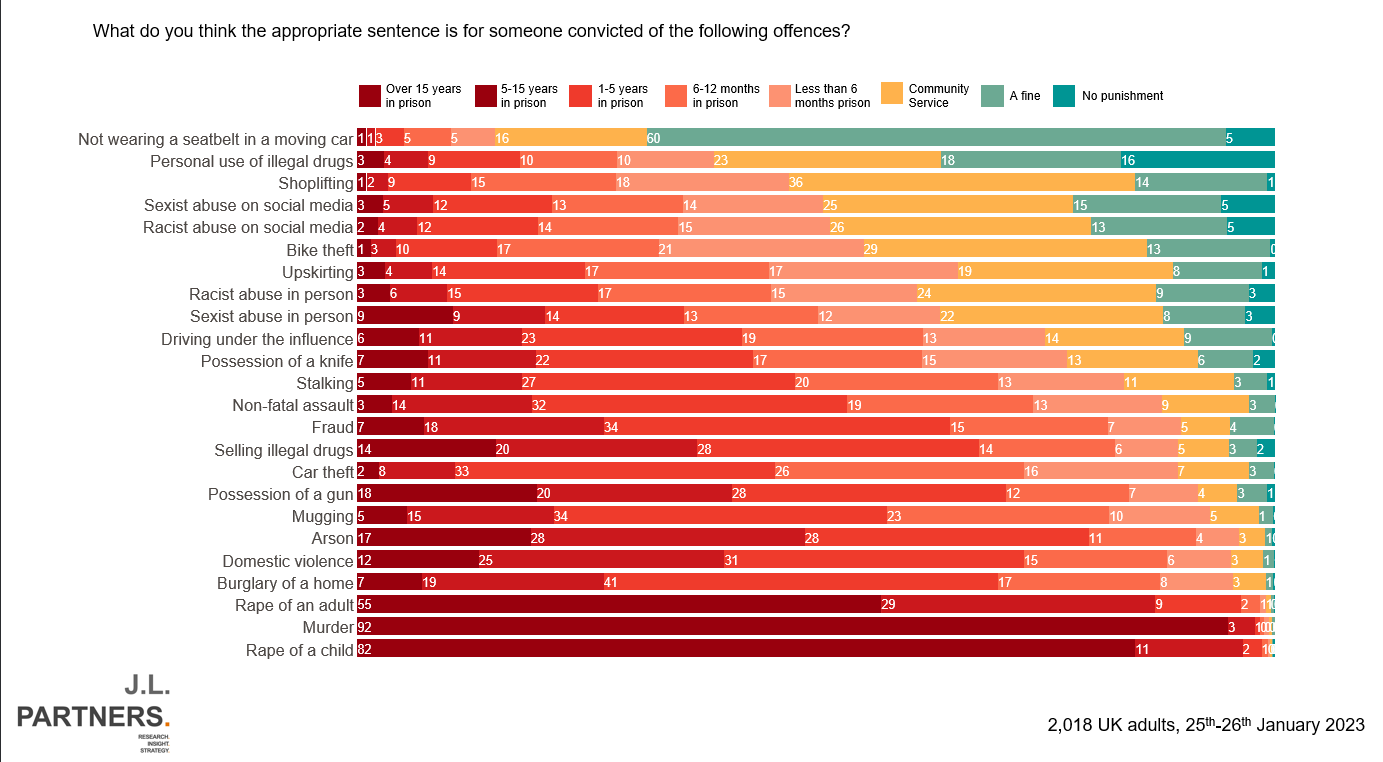
As an illustration of the rift between the people who suffer from the criminal and sub-criminal activities of the “non-law-abiding community” and those who are fully insulated from that same community, this is pretty typical. Very similar rifts would almost certainly be found in Canada, the United States, Australia, and New Zealand. When you have no skin in the game, you can let your virtue signalling freak flag fly, and our elites have no skin in the game.
March 10, 2023
Having solved all other problems, Congress now investigates … (checks notes) … the Protestant Reformation
Chris Bray respectfully outlines some of the questions the honourable Congressmen Congresspersons Congressentities Representatives would be likely to pose to the witnesses:

Martin Luther nails his 95 theses to the door of All Saints Church in Wittenberg, 1517.
Painting by Ferdinand Pauwels (1830-1904) via Wikimedia Commons.
1.) Mr. Luther, you — sorry, having trouble with my reading glasses. It says here you … mailed 95 feces to a door? Do you feel that it was appropriate to put something like that in the mail?
2.) Mr. Calvin, sir, you have raised numerous objections to the elevation of the host. Shouldn’t you be equally concerned about the elevation of the hostess? Don’t you feel that gendered terms are problematic?
3.) For all the witnesses, I’m told you wish to choose your own pastures. Isn’t that a question best left to the farmers?
4.) Gentlemen, you apparently propose to dissolve the monasteries. But most of them are, in my understanding, made out of big rocks, with very solid walls. Wouldn’t that take a prohibitive amount of acid to dissolve those? Have you done an EIR?
5.) I must very candidly inform the witnesses that I cannot agree to your premise, and I frankly find it absurd to say that faith alone is the cause of salivation. Do you have credentials in the science of digestion?


