
The current standards for dishwashers took effect in 2013. The standards, which were based on a consensus agreement between manufacturers and efficiency advocates, specify minimum energy and water efficiency levels. The standards require that standard-size dishwashers use no more than 307 kWh per year and 5.0 gallons of water per cycle.
In 2024, DOE finalized amended standards for dishwashers based on a joint recommendation from manufacturers and efficiency advocates. The new standards for dishwashers will cost-effectively reduce energy consumption by 15% relative to the current standards while also cutting water waste. Dishwashers
It is a general problem, but what started me thinking about it was being told by my dishwasher that it would take three and a half hours to wash the dishes. That seems, judging by a quick search online, to be longer than average but still within the normal range. I have not been able to find figures online for how long dishwashers took twenty or thirty years ago but, by what I remember, it was substantially less — and the dishes ended up dry, which ours don’t.
The explanation is in the final word of the quote above, “waste”. The owners of dishwashers pay for water and power, so if making them more efficient in those dimensions was costless, did not require giving up something else, there would be no need for the Department of Energy to make the manufacturers do it. I conclude that it was not costless, that it either made dishwashers cost more or do their job less well — take longer, not dry the dishes as well, not clean them as well. Using more power or water to do a better job is not waste.
David Friedman, “Optimizing On A Single Variable”, David Friedman’s Substack, 2025-06-02.
September 20, 2025
QotD: Why modern dishwashers suck
September 19, 2025
What’s the next thing to be devoured on Trump’s menu? Ah, Antifa it is …
Again leaning heavily on the social media site formerly known as Twitter, ESR has several posts on Donald Trump’s announcement that Antifa is in his crosshairs:
Next comes the part where every NGO/nonprofit implicated in funding a major terrorist organization gets a proctological exam by people with no sense of humor at all.
As I have emphasized several times in the last week: the long game in taking down a terrorist network is to smash its funding chain.
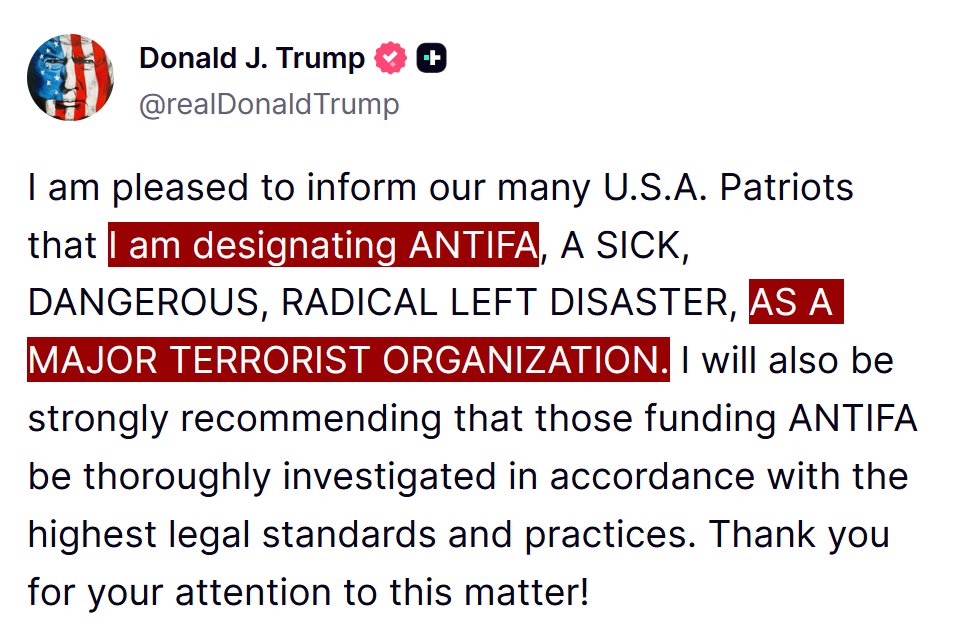
ESR’s analysis begins thusly:
Antifa has just been declared a “major terrorist organization”. Putting on my intelligence-analyst hat again, I’m going to examine its strategic options in the new political and legal conditions following the assassination of Charlie Kirk.
I’m going to start with a briefing on what Antifa is and what it does.
A reminder: Antifa is not a unitary conspiracy. It’s a cluster of horizontally-networked cells, some visible aboveground, some semi-covert, possibly some that are fully underground. By design it doesn’t have a central command.
So we’re really asking what range of behaviors Antifa cells normally choose, or can choose.
Before we can explore that we have to identify what Antifa is for and how it fits into the political ecology of the U.S.
None of what I’m about to tell you is speculation. It can be verified by reading Antifa’s propaganda and watching its behavior.
Antifa is an organization of Communists and Left-Anarchists; thus the red and black flags in the main Antifa logo. Its ultimate goal is a violent anti-capitalist revolution that will destroy American constitutional government. The Communists and Left Anarchists have agreed to argue about the shape of what comes afterwards after the revolution.
In practice, Antifa acts as willing street muscle for a range of associated Communist and Socialist organizations, most notably the DSA (Democratic Socialists of America), CPUSA (Communist Party of the USA), the SWP (Socialist Workers Party), and various SWP splinter groups.
Antifa also takes strategic direction from the left wing of the Democratic Party. My readers can make their own judgments about whether there is anything remaining in the Democratic Party other than a left wing; the answer to that question is not relevant to the rest of this analysis.
An important point is that the links between the Democratic party and Antifa are personal and deniable. They probably do not run through the Democratic National Committee. A good place for counter-terror analysts to look (and I’m sure Palantir already has this mapped) would be the politicians known as “the Squad” and their close associates.
The strategic sub-goal that was being executed when Charlie Kirk was shot was the creation of a climate of fear that would inhibit public speech by conservatives. This is an explicit goal of Antifa direct action.
Antifa’s funding is deliberately obscure. Before USAID was dismantled, a significant percentage of it was probably coming from the American taxpayer through several layers of shadowy NGOs.
It is very likely that one way or another most of its money comes from low-profile liberal dark money groups such as Arabella, the Tides Foundation, and the Open Societies Foundations.
The effectiveness of Antifa as a political actor has always depended on its ability to act as a terror instrument for left-wing American politicians while maintaining deniability that the politicians’ rhetorical hate-targeting of opponents ever cashes out as violent action.
The first major constraint on Antifa’s future behavior is that this deniability is going to be much more difficult to maintain from now on. Because while the deliberate diffusion of its structure makes legal proof that something called “Antifa” shot Charlie Kirk difficult, it also made Antifa affiliation of any left-wing assassin impossible to effectively deny.
In my next post, I will examine the consequences of this shift.

Mafia families don’t have membership cards.
Why am I bringing this up now? Because one attempt to head off the hammer coming down on Antifa that we’re hearing from its aboveground allies is that Antifa doesn’t exist.
It’s just an idea. There’s no central command. No common funding. No membership cards. No way to tell who’s a member and who isn’t.
The reductio ad absurdum of this bullshit is to point out that, following the argument, the Mafia cannot possibly exist. Which would be interesting news to all the people it murdered.
Historical note: there was a period when the Mafia was structurally different from Antifa in that it had a Boss of All Bosses, but the position was abolished by assassination in 1931.
In reality, when you’re dealing with a criminal or terrorist conspiracy that doesn’t have membership cards, you identify members of it the same way that other members do: by their willingness to cooperate with each other on shared projects.
And sometimes, by their participation in shared bonding rituals like a Cosa Nostra initiation ceremony or a “bash the fash” demonstration.
None of this is difficult, and it’s exactly the kind of situation that the RICO (Racketeering and Corrupt Influence) laws were written to address.
From Trump’s public statements, I’m guessing that they’re going to go right past RICO to a Foreign Terrorist Organization designation.
This won’t be difficult either. If you have any doubt that at least some Antifa chapters are funded by Chinese Communist money, you really need to get out more.
The announcement clearly didn’t come out of the blue:
Still wearing my intel-analyst hat, and have realized something.
Trump’s announcement that Antifa is being designated a “major terrorist organization” doesn’t make any sense unless law enforcement is already holding evidence that the assassination of Charlie Kirk was an Antifa op.
Otherwise, the risk of political blowback from that announcement would be way too high. Trump can be erratic, but he’s cunning about stuff like this and obviously has a shrewd sense of what he can get away with.
So, yep. The most likely scenario was the correct one. The hoofbeats really were horses, not zebras. Everybody still in denial about this is destined for more pain.
And back to the analysis:
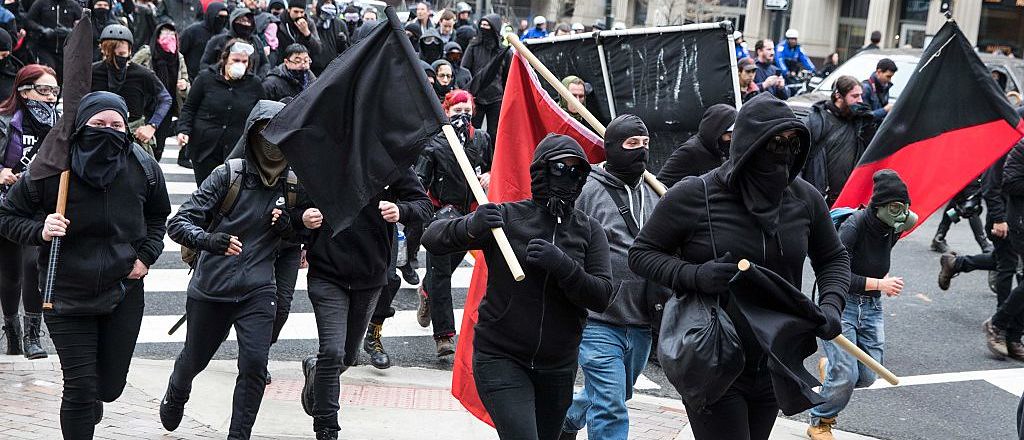
“antifa 8973ag” by cantfightthetendies is licensed under CC BY 2.0

Continuing my analysis of Antifa’s strategic options following the Charlie Kirk assassination. These have changed yet again — narrowed considerably — following President Trump’s declaration yesterday.
The Federal Government has legal instruments that it can employ. The RICO (Racketeering and Corrupt Influence) laws were specifically designed to attack a different headless network of horizontally connected nodes — organized crime. The fact that Antifa doesn’t have membership cards or a unitary command structure isn’t even going to slow the Feds down.
I think that it’s likely the Feds will designate Antifa a foreign terrorist organization, zeroing in on Chinese Communist funding of some Antifa chapters. This will allow the direct use of the CIA, which is normally heavily restricted from operations on American soil.
Nothing Antifa itself can do as an organization will be able to prevent or deflect a massive multi-agency investigation. It is very likely that Palantir already has their core membership identified and their communications channels mapped. Fusion centers will be capturing an unknown but probably large percentage of Antifa message traffic.
(They’ll be helped by the fact that Antifa’s communications security is terrible — it uses Discord for most comms, which is strictly amateur-hour. To be fair, the inner membership is likely to be savvy enough to be using Signal.)
Antifa’s only hope is pressure by its aboveground allies in politics and media. The cells with intelligent leaders will understand that they must cease all direct actions in order to avoid putting those allies in any position of appearing to support assassinations.
Unfortunately for Antifa, in order for hunkering down to work, every single cell has to have leadership that is both strategically patient and capable of restraining its more mentally unstable footsoldiers.
A related problem is that subversive and terrorist organizations that don’t act tend to develop morale problems. A certain minimum level of satisfying violence is required to keep their troops engaged.
Antifa probably has a worse issue here than the average terrorist organization because they recruit so heavily from sexual deviants and borderline mental cases who are likely to have other MBD-related issues including impulsivity and high time preference.
Over time, external pressure for Antifa to look easy for its aboveground allies to defend will remain steady or increase. This is especially so if the Democratic Party line remains Joe Biden’s “Antifa is just an idea”.
At the same time, internal pressure for direct action will increase. Antifa’s survival may depend on how long it is able to manage that pressure.
Antifa needs the investigation to be stalled out and paralyzed by Democratic lawfare before its stupidest cells do something too public and violent for its allied mainstream media to willfully ignore or suppress.
Longer-term, if Antifa survives, it faces a different problem. It dreams of revolution, but is only capable of operating on the sufferance of a general public that largely dismisses it as a LARP for nose-ringed freakazoids. Having committed a gaudy murder of an Everyman figure, it is not likely to get that sufferance back.
Edmund Burke, lawfare, and the East India Company
In The Coolidge Review, Amity Shlaes discusses “the most outrageous campaign of lawfare in the history of the Anglosphere”, as Edmund Burke assailed Warren Hastings, the first governor general of India:
Why do even principled statesmen — and there are some in this administration, too — not dig in their heels and try to arrest the chain of revenge? Why do even cautious, logical men and women succumb to the passion of lawfare?
The most outrageous campaign of lawfare in the history of the Anglosphere, the impeachment and trial of the first governor general of India, Warren Hastings, was mounted by Mr. Incrementalism himself, Edmund Burke. The father of modern conservatism spent nearly a decade of his time in Parliament—from 1787 to 1795—crusading against Hastings, antagonizing allies all around.
Impeaching the “Wicked Wretch”
There were reasons to investigate what was going on in India: Hastings exploited the fact that the East India Company was, at that time, an adjunct of the Crown. That connection between a powerful company and a government — a far more powerful company than, say, Intel — was the trouble, for as Burke would put it, it created “a state in disguise of a merchant“.
Burke chose to prosecute Hastings — and failed. The “wicked wretch”, one of Burke’s slime phrases for Hastings, emerged from the ordeal with a pension, not a conviction. Burke biographer Russell Kirk has argued that the public flaying of Hastings served posterity — in England at least. After Burke’s death, at “every grammar and public school”, the story of Burke and Hastings “impressed upon the boys who would become colonial officers or members of Parliament some part of Burke’s sense of duty and consecration in the civil social order”. That slowed another chain, the chain of abuse by Britons of Indians. After Burke, England recognized that, as Kirk puts it, she had a “duty to her subject peoples in the East”.
Still, even Kirk’s excellent biography leaves readers wondering: Was Hastings truly the archest of the arch villains, as Burke maintained? And is this the right way to go about it all? A book that Burke penned in the same years that he waged his Hastings war, Reflections on the Revolution in France, influenced a far greater number, and in a greater number of lands, than the Hastings story. Burke might have had the same reach with a Reflections on the Abuses of the East India Company.
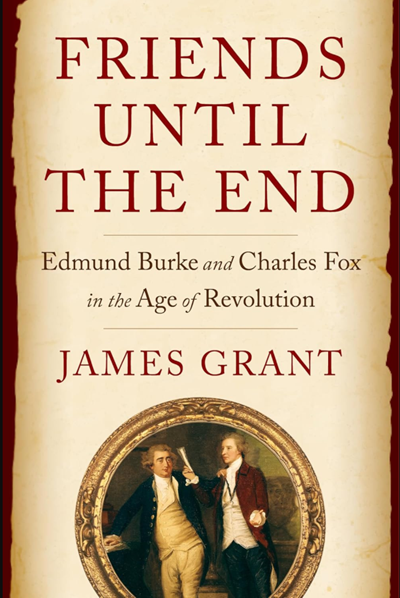
All the more welcome then is James Grant’s Friends Until the End, which gives the best-yet account of the chain reaction in Burke’s soul that drove him to weaponize government, what his crusade cost him, and what such crusades may cost all of us.
[…]
Next, however, came a challenge that deeply frustrated Burke. Scanning the empire’s horizon for a place to commence a model reform, Fox and Burke settled on the East India Company, which abused the some thirty million Indians it oversaw with the same admixture of plunder, condescension, and cruelty familiar to Catholics of Ireland. The pair put their hearts into the Indian reform: Fox promised a “great and glorious” reform to save “many, many millions of souls”. They also put their minds into the project. To track the East India Company, Burke personally purchased sufficient shares to win him rights to attend and vote at quarterly meetings. He steeped himself in knowledge of a land he’d never seen, learning names of “numerous Indian nawabs, rajas, nizams, subahs, sultans, viziers, and begums“.
Such prep work, as Grant points out, enabled the Whigs to identify the correct solution: de-mercantilization. “Separate the company’s two incompatible missions: sovereign rule and moneymaking”, Grant writes. The compromised statute that emerged from the House of Commons was not as neat: A seven-man commission would rule India, while a board would govern East India’s commercial operations. But the commercial board would be a subsidiary to the commission. And in marshaling their votes for the measure, the pair still confronted the formidable obstacle of East India shareholders in Britain, furious at the threat to their fortunes that such reform represented. Fox might emancipate Hindus, their opponent William Pitt warned, but he must also “take care that he did not destroy the liberties of Englishmen”.
The king and his allies in any case defeated Fox’s India Bill, as it was known, in the House of Lords. The king, who had that prerogative, booted Fox and Burke from paid posts. In the 1784 general election, Burke held on to his seat in Parliament, as did Fox (by a hair), but so many Whigs, now labeled “Fox’s martyrs”, were ousted by voters from Parliament that the Whigs’ opponent, Pitt, became prime minister. Burke’s disillusionment ran deep: “I consider the House of Commons as something worse than extinguishd”, he wrote.
It was thus, at the age of fifty-nine and merely an opposition parliamentarian, that Burke risked his high-stakes lawfare. He commenced impeachment proceedings with a four-day anti-Hastings polemic. Of course, Burke universalized his point: The Hastings trial was “not solely whether the prisoner at the bar be found innocent or guilty, but whether millions of mankind shall be made miserable or happy”. And of course he raised the stakes for fellow lawmakers by appealing to their honor: “Faults this nation may have; but God forbid we should pass judgment upon people who framed their laws and institutions prior to our insect origin of yesterday!” The House must join him in impeachment, the Lords convict Hastings.
The House did join him, handing to the Lords charges that Hastings had “desolated the most flourishing provinces”, “pressed, ruined, and destroyed the natives of those provinces”, and violated “the most solemn treaties”. In thousands of hours of speeches before a jury from the House of Lords, the eager prosecutor, Burke, dwelt on Hastings’s cruelty to the Rohillas, an Afghan tribe from land bordering Nepal. He also charged that Hastings had taken revenge on a crooked tax collector, Nandakumar, for alleging that he — Hastings — had taken a bribe, seeing to it that Nandakumar was convicted and hanged for forgery. Not all of this was proven. And, as the jury of Lords slowly considered the charges, as the months and years passed, Burke found himself more and more isolated. Fox, Burke’s initial ally in the undertaking, faded. By the time the Lords’ jury voted not to convict, eight years on, a full third of their original number had already passed away.
After the Charlie Kirk assassination, here are three possible futures
On the social media site formerly known as Twitter, ESR lays out what he sees are the three most likely short-term futures for the United States after the assassination of Charlie Kirk:

I’m a student of history. Here are three possible futures following the assassination of Charlie Kirk. They’re based on historical examples of what happens when a Communist subversion campaign or insurgency overplays its hand and triggers broad popular resistance.
1. Popular revulsion against aboveground leftists celebrating the murder gives the Trump administration political cover to go after Antifa and its shadow funding network hard. Both are smashed.
Communist agents of influence in the mainstream media and academia continue to self-discredit.
Relatively few Communists are arrested, but their millions of aboveground tools become isolated and demoralized.
Propelled by a huge swing in voter registrations that we are already seeing happen, the Democrats get crushed in the 2026 midterms.
The long period of fever, madness, and Left ascendancy that began with the assassination of JFK by a Soviet agent in 1963 ends not with a bang but with a whimper.
This is the best case scenario for everybody, including the Communists who don’t get thrown out of helicopters or shot down in the streets.
If things don’t go this way it will likely be because Democratic lawfare prevents the counter-subversion push from being fully effective. An obvious index of this failure would be another high-profile political assassination or attempt against a conservative target after about 4 months out.
What happens in the event of that failure, especially if the third public attempt to kill Trump succeeds:
2. A period of Caudillismo. A charismatic strongman rides popular anger into power. If this happens, the Left better pray that the strongman is an infuriated JD Vance, because any alternative to him is likely to be worse for them.
The crackdown against the Communist network becomes brutal and routinely uses extra-Constitutional means, possibly thinly covered by a declared state of emergency.
At the harder end of this range of possibilities, right-wing death squads not exactly formed by government but winked at by it go after Communist public figures that are out of reach of the law because they’ve carefully preserved deniability. Many journalists are at the top of this target list.
It is not likely that the Communist network can survive this future. The only way it happens is if they have enough popular support to develop a semi-militarized resistance — in effect making certain parts of the country no go regions for Federal agents.
Going by historical precedents, the index of this failure would be a resurgence of banditry by armed groups, initially with overtly political goals but decaying into general predation.
This would land us at:
3. Low-grade civil war, a la Bosnia or the Irish troubles. Anybody wishing for this has no idea how bloody, ugly, and brutal it would probably be. Especially if the Left succeeds at what it will with absolute certainty try to do, which is racialize the conflict.
I don’t think there is any realistic scenario in which the Communists win any of these confrontations. Not in the U.S., not in the 21st century. The question is how much blood and agony the rest of us will go through before they are finally defeated.
Update, 20 September: Welcome, Instapundit readers! Please do have a look around at some of my other posts you may find of interest. I send out a daily summary of posts here through my Substack – https://substack.com/@nicholasrusson that you can subscribe to if you’d like to be informed of new posts in the future.
September 18, 2025
Broken feedback paths lead to broken organizations … like government
Lorenzo Warby on the ever-increasing dysfunction of most western governments due to the deliberate sabotage of what used to be functional feedback paths:
That institutions within Western democracies have deteriorated in recent decades is clear. That the march of progressivism through the institutions is at the heart of this deterioration is also clear.1
This has been progressives acting like progressives, with all the perverse relationship with information that is at the heart of progressivism. A perverse relationship that leads directly to their degradation of institutions.
Progressives use the imagined future as their benchmark of judgement, but there is no information from the future, so there is no reality-test in their benchmark of judgement. The imagined future can, however, be as glorious as one likes.
Conversely, anything actually created by humans will have downsides and even sins attached. This gives progressives a great rhetorical advantage over anyone who attempts to defend anything humans have actually built. All of the painful history of human achievement is rendered as naught, as mute, in the face of the splendours in their head.
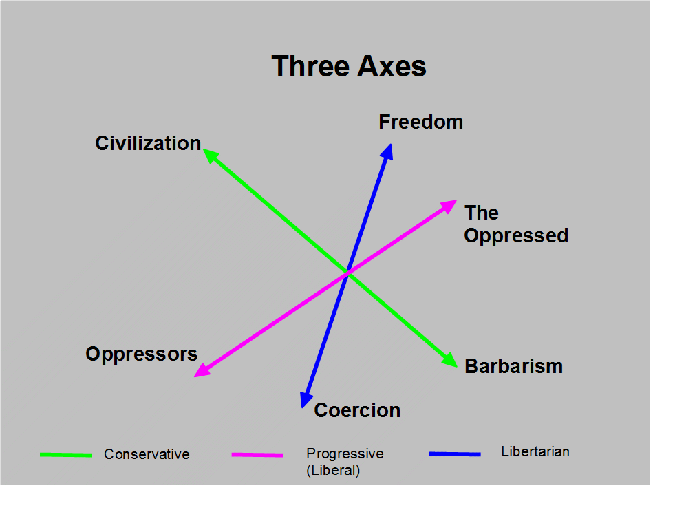
Arnold Kling’s Three Languages of Politics model.
If a group is disproportionately successful, that is not an example to emulate but a sign of their oppressor status. If they are comparatively unsuccessful, that is not a warning about what to avoid, but a sign of their oppressed status. This is an outlook deeply hostile to learning from what does, and does not, work.
For using the glorious imagined future as the benchmark of judgement creates the basis for denigrating anything that comes from the past: which is all the information we have about what works and does not. This includes denigrating the embedded learning in institutions. Even fundamental questions about what is required to sustain a social order get written out of acceptable discourse as not fitting with their imagined-future benchmark of judgement, with the splendours in their heads.
Using the imagined future as one’s benchmark of judgement also naturally leads to concluding that one owns morality, as any opposition to the glorious imagined future is clearly immoral. This leads to, at best, comprehensive disengagement with, and at worse, systematic denigration and delegitimisation of, those who disagree. A systematic denigration and delegitimisation that often involves systematic misrepresentation of those who disagree. The consequence of all this is to block feedback about one’s political projects.
The most extreme instance of this has been the UK, where the Blair–Brown Governments of 1997-2010 took power away from elected officials (apart from the PM) and handed it to “experts” in quangoes, to judges via human rights legislation and to the EU. Those with the “correct” understandings could do their thing, insulated from voters. This made the UK a state, a polity, with broken feedbacks.
Modern Western civilisation is a civilisation with broken feedbacks — as I discuss here, here, here, here and here — but the Blair-Brown constitutional vandalism extended that pattern of broken feedbacks systematically to the British state. The consequences have become grimly obvious. Massive waves of unwanted migrants as part of a massively dysfunctional British state.
If you systematically kill feedbacks from voters, you systematically kill accountability. Of course dysfunction will spread across the organs of the state, as it has. (See here for a discussion of aspects of that horrifying dysfunction.)
- Feminisation of institutions has also been a corrosive factor, but that is deeply intertwined with the march of progressivism through the institutions.
Update, 19 September: Welcome, Instapundit readers! Please do have a look around at some of my other posts you may find of interest. I send out a daily summary of posts here through my Substack – https://substack.com/@nicholasrusson that you can subscribe to if you’d like to be informed of new posts in the future.
NYC smokers get most of their cigarettes from the black market
Smokers in New York City pay very high taxes for their nicotine delivery systems, so it shouldn’t have surprised public health officials that many would turn to the black market … but the state and local taxes add so much to the price of a pack of cigarettes that most of the supply now comes from the black market:
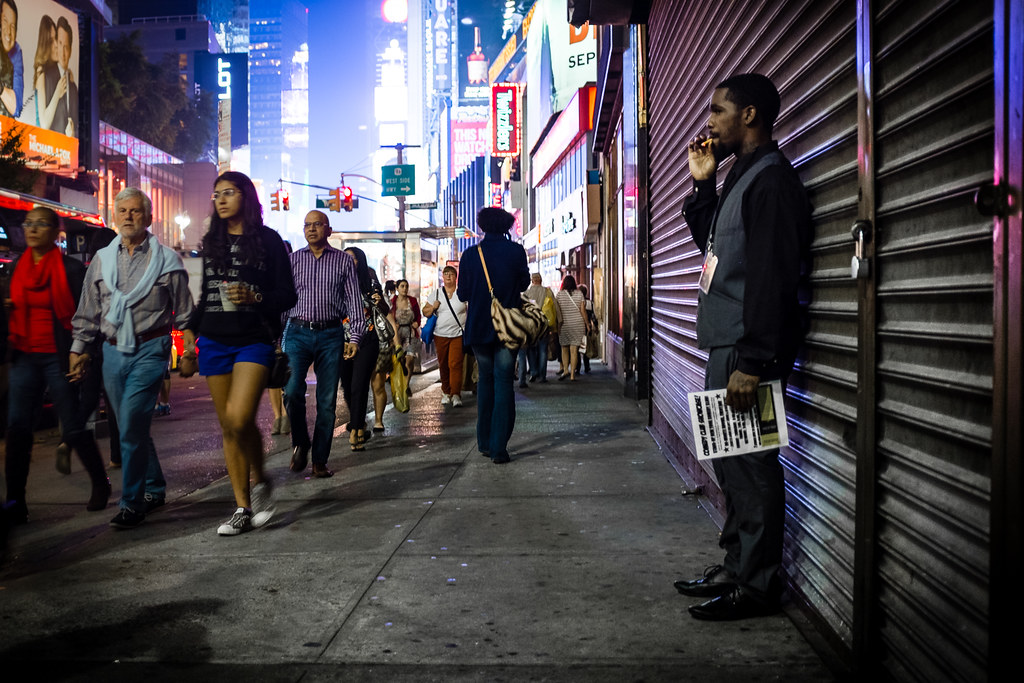
“Enjoyin’ a cigarette at busy Time Square, NYC” by Mel Schmidt is licensed under CC BY 2.0 
 .
.
In 2023, New York raised its cigarette excise tax by $1.00 to $5.35 per pack. New York City imposes its own tax of $1.50 per pack, and that’s before you include federal and sales taxes, making for the most expensive smokes in the country. That is, cigarettes are expensive in New York for those who pay those taxes. But state officials were warned that such a high rate would drive consumers to the black market, and that’s exactly what happened. According to recent research, more New Yorkers than ever are turning to tax-evading illicit sources for their nicotine needs.
Taxes Into Good Health — or Not
When the New York excise tax was hiked, the Albany Times-Union noted, “it’s the nation’s highest and brings a pack of cigarettes at many retailers to about $12 … Health advocates hailed the increase, saying it will lead to fewer smokers and cancer deaths. Anti-tax groups, though, predicted it will increase trafficking in illicit untaxed cigarettes in the state.”
Health advocates like taxing vices on the theory that raising taxes simultaneously generates government revenue while escalating prices for allegedly bad things — like cigarettes — out of reach of many consumers. What they rarely consider is that there are other options, such as buying cigarettes smuggled from jurisdictions with lower levies.
“New York has created a cigarette-smuggling empire, and the worst is yet to come,” Todd Nesbit, an economics professor at Ball State University, and Michael LaFaive, of the Mackinac Center for Public Policy, warned even before the 2023 tax increase. “It’s the unavoidable consequence of the state’s decades long history of raising the cigarette tax.”
“If enacted, consumers will go across borders to do their shopping or rely on black-market suppliers,” agreed the Tax Foundation’s Adam Hoffer. “Tax revenues will fall, illicit activities will thrive, and law enforcement spending will need to increase.”
In fact, as Nesbit, LaFaive, and Hoffer emphasized, even before the dollar-per-pack tax hike, more than half of cigarettes sold in the state of New York lacked local tax stamps and were smuggled from elsewhere. Since 2023, illicit dealers appear to have claimed even more market share.
QotD: Americans, poker, and chess
The game of chess has never been held in great esteem by the North Americans. Their culture is steeped in deeply anti-intellectual tendencies. They pride themselves in having created the game of poker. It is their national game, springing from a tradition of westward expansion, of gun-slinging skirt chasers who slept with cows and horses. They distrust chess as a game of Central European immigrants with a homesick longing for clandestine conspiracies in quiet coffee houses. Their deepest conviction is that bluff and escalation will achieve more than scheming and patience (witness their foreign policy).
J.H. Donner, “The King: Chess Pieces”, New In Chess, 2008.
September 17, 2025
QotD: Indecision
“It’s not that he makes bad decisions; it’s that he doesn’t make any decisions at all.”
Any time you see that situation in a manager, any manager, it is a flashing neon sign of incompetence.
One of the reasons why Marxists make such poor managers is that if they are presented with a situation which cannot be addressed by Party doctrine, they are largely indecisive. Even worse, if that doctrine runs counter to good management, they will use that as the underpinning for their indecisiveness. We saw this a lot under Obama, who was pathetically underqualified as a manager, having had no executive experience in his entire life before becoming POTUS. More often than not, when faced with a decision, he simply froze and allowed events to dictate the outcome, even if that outcome was inimical to the interests of the country he was supposed to be governing. (And to prove my point above, his Marxist doctrine held that the United States was a malignant force in world affairs, so allowing harm to befall the country was — to his mind — actually the proper thing to do as it “corrected” or atoned for America’s past sins.)
Kim du Toit, “Failure”, Splendid Isolation, 2020-06-04.
September 16, 2025
QotD: The Dictatorship in the late Roman Republic
For Sulla, the purpose of using the dictatorship was to offer his reforms to the Republic some degree of legitimacy (otherwise why not just force them through purely by violence without even the fig leaf of law). Sulla was a reactionary who quite clearly believed in the Republic and seems to have been honestly and sincerely attempting to fix it; he was also a brutal, cruel and inhuman man who solved all of his problems with a mix of violence and treachery. While we can’t read Sulla’s mind on why he chose this particular form, it seems likely the aim here was to wash his reforms in the patina of something traditional-sounding in order to give them legitimacy so that they’d be longer lasting, so that Sulla’s own memory might be a bit less tarnished and to make it harder for a crisis like this to occur again.
And it failed at all three potential goals.
When it comes to the legitimacy of Sulla’s reforms and the memory that congealed around Sulla himself, it is clear that he was politically toxic even among many more conservative Romans. A younger Cicero was already using Sulla’s memory to tarnish anyone associated with him in 80, casting Chrysogonus, Sulla’s freedman, as the villain of the Pro Roscio Amerino, delivered in that year. In the sources written in the following decades at best Sulla is a touchy subject best avoided; when he is discussed, it is as a villain. Our later sources on Sulla are uniform in seeing his dictatorship as lawless. Moreover, his own reforms were picked apart by his former lieutenants, with key provisions being repealed before he was even dead (in 78 BC so that’s not a long time).
Finally, of course, far from securing the Republic, Sulla’s dictatorship provided the example and opened the door for more mayhem. Crucially, Sulla had not fixed the army problem and in fact had made it worse. You may recall one benefit of the short dictatorship is that no dictator – indeed, no consul or praetor either – would be in office long enough to secure the loyalty of his army against the state. But in the second and early first century that system had broken down. Gaius Marius had been in continuous military command from 107 to 100. Moreover, the expansion of Rome’s territory demanded more military commands than there were offices and so the Romans had begun selecting proconsuls and propraetors (along with the consuls and praetors) to fill those posts. Thus Sulla was (as a result of the Social War in Italy) a legate in 90, a propraetor in 89, and consul in 88 and so had been in command for three consecutive years (albeit the first as a legate) when he decided to turn his army – which had just, under his command, besieged the rebel stronghold of Nola – against Rome in 88, precisely because his political enemies in Rome had revoked his proconsular command for 87 (by roughing up the voters, to be clear). And then Sulla has that same army under his command as a proconsul from 87 to 83, so by the time he marches on Rome the second time with the intent to mass slaughter his enemies, his soldiers have had more than half a decade under his command to develop that ironclad loyalty (and of course a confidence that if Sulla didn’t win, their service to him might suddenly look like a crime against the Republic).
Sulla actually made this problem worse, because one of the things he legislated by fiat as dictator was that the consuls were now to always stay in Italy (in theory to guard Rome, but guard it with what, Sulla never seems to have considered). That, along with Sulla having butchered quite a lot of the actual experienced and talented military men in the Senate, left a Senate increasingly reliant on special commands doled out to a handful of commanders for long periods, leading (through Pompey‘s unusual career, holding commands in more years than not between 76 and 62) to Julius Caesar being in unbroken command of a large army in Gaul from 58 to 50, by which point that army was sufficiently loyal that it could be turned against the Republic, which of course Caesar does in 49.
For Caesar, the dictatorship seems to have been purely a tool to try to legitimate his own permanent control over the Roman state. Caesar is, from 49 to 44, only in Rome for a few months at a time and so it isn’t surprising that at first he goes to the expedient of just having his appointment renewed. But it is remarkable that his move to dictator perpetuo comes immediately after the “trial balloon” of making Caesar a Hellenistic-style king (complete with a diadem, the clear visual marker of Hellenistic-style kingship) had failed badly and publicly (Plut. Caes. 61). Perhaps recognizing that so clearly foreign an institution would be a non-starter in Rome – unpopular even among the general populace who normally loved Caesar – he instead went for a more Roman-sounding institution, something with at least a pretense of tradition to it.
And if the goal was to provide himself with some legitimacy, the effort clearly catastrophically backfired. The optics of the dictatorship were, at this point, awful; as noted, the only real example anyone had to work with was Sulla, and everyone hated Sulla. Many of Caesar’s own senatorial supporters had probably been hoping, given Caesar’s repeatedly renewed dictatorship, that he would eventually at least resign out of the office (as Sulla had done), allowing the machinery of the Republic – the elections, office holding and the direction of the Senate – to return. Declaring that he was dictator forever, rather than cementing his legitimacy clearly galvanized the conspiracy to have him assassinated, which they did in just two months.
It is striking that no one after Caesar, even in the chaotic power-struggle that ensued, no one attempted to revive the dictatorship, or use it as a model to institutionalize their power, or employ its iconography or symbolism in any way. Instead, Antony, who had himself been Caesar’s magister equitum, proposed and passed a law in 44 – right after Caesar’s death – to abolish the dictatorship, make it illegal to nominate a dictator, or for any Roman to accept the office, on pain of death (App. BCiv, 3.25, Dio 44.51.2). By all accounts, the law was broadly popular. As a legitimacy-building tool, the dictatorship had been worse than useless.
So what might we offer as a final verdict on the dictatorship? As a short-term crisis office used during the early and middle republic, a tool appropriate to a small state that had highly fragmented power in its institutions to maintain internal stability, the dictatorship was very successful, though that very success made it increasingly less necessary and important as Rome’s power grew. The customary dictatorship withered away in part because of that success: a Mediterranean-spanning empire had no need of emergency officials, when its military crises occurred at great distance and could generally be resolved by just sending a new regular commander with a larger army. By contrast, the irregular dictatorship was a complete failure, both for the men that held it and for the republic it destroyed.
The real problem wasn’t the office of dictator, but the apparatus that surrounded it: the short duration of military commands, the effectiveness and depth of the Roman aristocracy (crucially undermined by Sulla and Marius) and – less discussed here but still crucial in understanding the collapse of the Republic – the willingness of the Roman elite to compromise in order to maintain social cohesion. Without those guardrails, the dictatorship became dangerous, but without them any office becomes dangerous. Sulla and Caesar, after all, both marched on Rome not as dictators, but as consuls and proconsuls. It is the guardrails, not the office, that matter.
Bret Devereaux, “Collections: The Roman Dictatorship: How Did It Work? Did It Work?”, A Collection of Unmitigated Pedantry, 2022-03-18.
September 15, 2025
QotD: Federal equalization payments
There is no official answer to this question, and all the possible answers lead to moral and mathematical absurdities. It’s not just that we don’t know whether equalization works, as Terence Corcoran observed in the Financial Post yesterday. We literally don’t even know what it’s meant to accomplish
Colby Cosh, “Economist plays ethicist”, National Post, 2005-09-01.
September 13, 2025
“It was about control before green policy became popular, and it is about control now”
In the National Post, Carson Jerema identifies the common thread among all of Prime Minister Mark Carney’s efforts since becoming Liberal party leader:

Then-Governor of the Bank of Canada Mark Carney at the 2012 Annual Meeting of the World Economic Forum in Davos, Switzerland.
WEF photo via Wikimedia Commons.
Prime Minister Mark Carney may not be as obnoxiously progressive as Justin Trudeau, but that doesn’t mean he isn’t stubbornly left wing in his own right, though he has managed to convince many critics otherwise.
Over the past decade, the Liberals were particularly self-righteous over climate policy, so much so that the deviations made by Carney since assuming office have been met with praise — or, on the left, with scorn — that he is somehow pro-business and represents the return of the centre-right Liberals. Some even think he’s a conservative. Others have suggested that Conservative Leader Pierre Poilievre is now entirely redundant.
This narrative is just more proof of how utterly captured the media is in this country by the Liberal party. It is true that Carney gives the appearance that he is abandoning many of the government’s environmental policies. He set the carbon tax rate to zero, paused the EV mandate and, on Thursday, he refused to endorse his government’s own carbon-emissions targets.
None of this, however, should be taken as evidence that Carney represents some sort of rightward or pro-business shift in the Liberal party. He is not proposing to let markets determine what infrastructure projects get built. Nor is he proposing to minimize regulations to attract investment.
Instead, Carney wants to command the economy by himself, laying bare the reality that what attracts left-wing politicians to climate policy is not saving the planet from carbon, but using environmental objectives to manage the economy. It was about control before green policy became popular, and it is about control now. For Carney specifically, before he entered politics, “decarbonizing” markets was quite remunerative in his various banking roles.
Noticeably absent from the five infrastructure projects that the prime minister said on Thursday would be fast-tracked under the Major Projects Office was an oil and gas pipeline. Also noticeable was the fact that all five of the projects had already been approved, but the government tried to pass them off as something new anyway.
Even if the projects had been all brand new, the lack of a pipeline would still be of no surprise, as what private investor would be willing to back a pipeline when the Liberals’ Impact Assessment Act, tanker ban and emissions cap all exist to conspire against energy projects of any kind?
One thing that became incredibly obvious early in Justin Trudeau’s premiership was that the prime minister — and his ministers in general — really did seem to believe that talking about doing something was as effective in solving problems as actually doing the thing. Many had hoped that Mark Carney would be different … but as Dan Knight points out, he may actually be worse:
From there, [Poilievre] broadened the attack. He spoke of an entire generation priced out of homeownership, of immigration growing “three times faster than housing and jobs”, of crime rising, and of what he called “the worst economy in the G7”. And then he turned squarely on Carney: “Mr. Carney is actually more irresponsible than even Justin Trudeau was“, citing an 8% increase in government spending, 37% more for consultants, and 62 billion dollars in lost investment — the largest outflow in Canadian history, according to the National Bank.
The message was simple: Liberals talk, Conservatives build. Poilievre painted Carney as a man of speeches and promises, not results. “The mistake the media is making is they’re judging him by his words rather than his deeds“, he said.
It was an opening statement designed less to introduce policy — those details came later — and more to frame the battle. For Poilievre, Carney isn’t just Trudeau’s replacement. He’s Trudeau’s sequel, and in some ways worse.
[…]
Pierre Poilievre didn’t hold back when asked about Mark Carney’s record. His words: “Mr. Carney is actually more irresponsible than even Justin Trudeau was“. That’s not a throwaway line, he backed it with numbers.
According to Poilievre, Carney inherited what he called a “morbidly obese government” from Trudeau and made it worse: 8% bigger overall, 37% more for consultants, and 6% more bureaucracy. He says Carney’s deficit is set to be even larger than Trudeau’s.
Then the jobs number: 86,000 more unemployed people under Carney than under Trudeau. That, Poilievre argued, is the real measure, not the polished speeches Carney gives. His line: “The mistake the media is making is they’re judging him by his words rather than his deeds“.
Lorenzo Warby on the “conspiracy error”
Note that this piece was published before the assassination of Charlie Kirk the next day, and it does not directly address issues stemming from that crime.
On Substack, Lorenzo Warby explains why conspiracy theories spring up so readily:
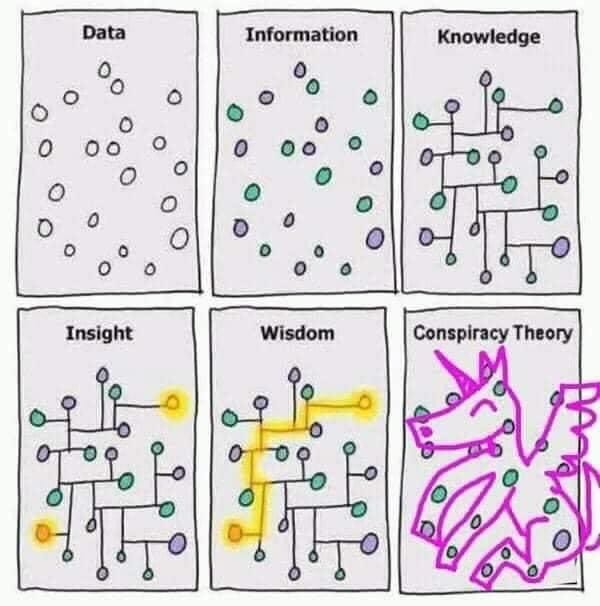
Analysis of events abhors an analytical vacuum. That is, if your mental architecture lacks certain key analytical tools or framing, then you will be driven to mischaracterise — potentially seriously mischaracterise — events.
Given the human propensity for identifying patterns, and awareness of human intentionality, what can very easily fill in an analytical gap is some form of conspiracy theory. A conspiracy theory alleges that there are centrally organised people operating in secrecy — usually in a malign way — controlling events.
A conspiracy theorist is someone who advances such an idea. The term can also be used as a term of abuse for anyone who inconveniently notices patterns — such as folk advancing claims and beliefs that suit people like themselves — or simply advances claims that people find inconvenient or awkward.
There are actual conspiracies. We know there are actual conspiracies, because they have been exposed.
The question is whether the claimed level of coordination and control over events, and the required level of continuing secrecy, is what is happening. The more restricted one’s analytical tools, the more conspiracy is likely to seem the default explanation for any coordinated pattern of behaviour.
Something that people do openly is not a conspiracy. Nor is conspiracy the only way for people to coordinate. It is perfectly possible to coordinate via mutual signalling, for instance. This is particularly true if people are engaged in shared status games. It is even more true if networks share common interests, common information sources and are playing shared status games.
Among us Homo sapiens, much of the point of status is to generate currencies of cooperation. We are a very status-driven species because we are very social beings, so prestige (conspicuous competence) and propriety (conspicuous conformity to norms) have been currencies of cooperation for our highly cooperative subsistence and reproduction strategies that developed across hundreds of thousands of years.
In thinking about the dramatic changes brought about by the Sexual Revolution of the 1960s, it became clear to me that there were always sexual outliers, there are always folk trying different life strategies. Due to the Pill and legally available abortion, which life strategies worked suddenly changed, so folk shifted to them and the norms that enabled them.
Thinking seriously about the mechanisms by which sexual mores changed leads to considering networks, signalling, life strategies. Once you grasp the power of these social mechanisms, you are in a much better situation to see how much conspiracy theories are a product of a lack of analytical breadth and depth. Conspiracy theories are a mechanism to “explain” events, one that occurs naturally to our pattern-seeking minds aware of human intentionality. They do so, however, in the absence of analytical alternatives, if we do not have better operational mechanisms to explain events — and especially observed social coordination — by.

September 12, 2025
Canada’s temporary foreign worker programs
At Acceptable Views, Alexander Brown calls for the end to the Canadian federal temporary immigration scam programs:
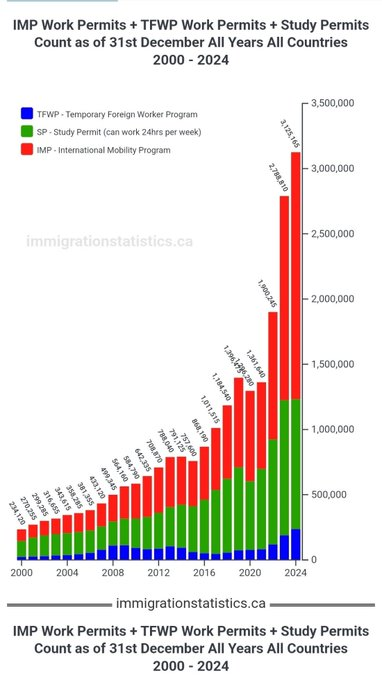
It’s not hyperbole to say that Canada has built an entire economy on exploiting cheap, foreign labour through TWFP, as well as the International Mobility Program (IMP). These are two slightly different programs that allow foreign nationals to work in Canada, with most going to Ontario. But contrary to its name, there is nothing “temporary” about the TFWP. Its original purpose was to remedy proven labour shortages while Canadians were hired and trained to eventually do the jobs in question. Meanwhile, the IMP allows international students to work—with or without a proven labour shortage—while they’re studying in Canada.
Between 2019 and 2023, the TFWP increased by 88 percent and the IMP increased 126 percent. They account for close to 1.58 million work permit holders, equal to roughly 7 percent of Canada’s labour force.
Taken together, the results of the TFWP and IMP are deplorable. The TFWP allows foreign nationals to be recruited abroad in vast numbers, brought to Canada, housed in degrading conditions, paid the minimum wage, forced to work long hours, pressured into not joining a union, and required to work for only one employer. Yes, the IMP is more flexible, but it’s more pernicious because it does not even pretend to address labour shortages.
Both schemes are also of course bad for Canadians themselves. The problem is especially grievous for young Canadians trying to get started in the labour market. Canada lost 40,800 jobs this past July, the unemployment rate is now 6.9 percent, and youth unemployment (those between 15 and 24 years old) is now 14.6 percent.
Both the TFWP and IMP are used as business models. Hiring foreign nationals at minimum wage keeps prices low and profits high—most notoriously in the hospitality and trucking sectors, but no industry seems untouched now.
Addicted to cheap foreign labour
The use of the TFWP in the healthcare sector, for example, has grown by an appalling 1,700 percent since 2000. That dramatic rise has no doubt been abetted by the absence of uniform standards and credential recognition among Canadian provinces. If medical personnel could move easily from one province to another, shortages could be filled by Canadians. But historically this has not been possible, and so medical institutions have had to turn to the TFWP. Ontario’s recent determination to solve this problem by speeding up recognition of 50 “in-demand” professions from other provinces is a step in the right direction, and hopefully not too little too late.
Meanwhile, the IMP is a vehicle for outright fraud, ranging from fake acceptance letters from bogus “colleges” to elaborate human-trafficking schemes. Not long ago, nearly 50,000 holders of foreign student visas were working and attempting to settle here, rather than studying at any Canadian university or college. Most were migrants from India, and some were trying to cross the border illegally into the United States. The RCMP is now working with Indian law-enforcement to investigate alleged links between dozens of “colleges” in Canada and two “entities” in India allegedly facilitating passage into the U.S. When we reflect that an astounding 4.9 million temporary visas are set to expire this year, we have reason to believe that this abuse, exploitation, and fraud are on a much larger scale that we understand.
The consequences for young Canadians
Both the TFWP and the IMP serve to keep wages artificially low and profits high, and to price Canadians out of the job market. It wouldn’t be wrong to view these programs as distortionary government subsidies or welfare for unproductive businesses. The effects disproportionately harm younger Canadians who are priced out of the labour market, given that temporary workers overwhelmingly earn less than the median wage. And yet, we’re constantly hectored about labour shortages, Canadians’ “unwillingness” to do certain jobs, and the need for foreign workers.
It shouldn’t take much intellectual effort to see that the use of foreign labour and the difficulties of employing younger Canadians are two sides of the same ugly coin. Foreign workers are more cooperative because they are bound to their employers like serfs. They face normally insurmountable barriers to joining unions and have no attachment to the community in which they’re expected to work. In comparison, the domestic population is generally better educated and rooted in the local community.
Young Canadians can afford to be discriminating and should rightly expect higher wages than foreign nationals. Employers should instead work harder to invest in and reward their domestic workforce. In any other era, this would have been obvious. But now there is little incentive for businesses to look beyond cheap, foreign labour.
To get an idea of the magnitude of our collective failure here, consider the following fact. A 2024 study by RBC Economics revealed that Canadian businesses are sitting on a stockpile of cash worth almost a third of our country’s GDP. In other words, Canadian companies have the means to invest in hiring and training Canadians, but simply refuse to do so. The results of this refusal are stagnant wages, structural unemployment, and a de-skilling of the domestic population.
Britain’s network of weather stations is becoming less and less reliable
Well-sited weather stations can provide useful raw data on temperature ranges, wind speed, precipitation, and other measurables, but that “well-sited” makes a huge difference. Older weather stations situated in areas of rapid urban expansion will often be less reliable as they become part of the urban heat island and report higher temperatures due to locally generated heat sources rather than the ambient temperature they were able to record before. This is what has apparently happened to far too many of the UK’s temperature measuring sites, according to Chris Morrison in The Daily Sceptic:
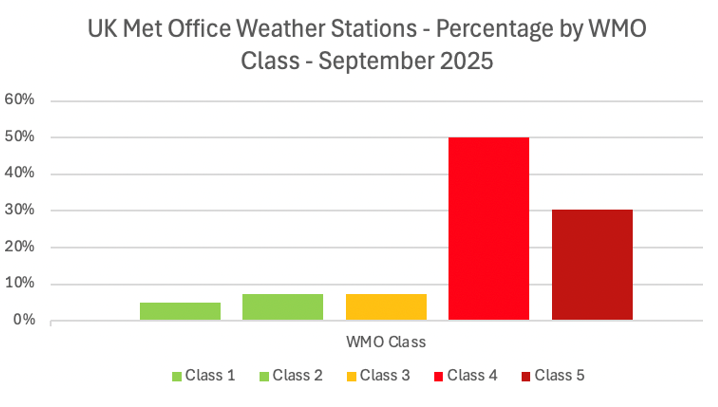
The latest WMO Class figures at the Met Office shown in block graph form. The higher the class number, the less reliable the station reports become.
Image from The Daily Sceptic
In March 2024 the Daily Sceptic shocked the science and political world by disclosing that nearly 80% of the UK Met Office’s temperature measuring sites were so poorly located that potential “uncertainties” could corrupt the readings by a numbers of degrees of centigrade. World Meteorological Organisation (WMO) Classes 4 and 5 in its CIMO scale come with “uncertainties” up to 2°C and 5°C respectively, and a Freedom of Information (FOI) request found that 77.9% of its sites were in these two “junk” categories. It should have been a wake-up call demanding immediate improvement of the nationwide network, not least because the Met Office frequently catastrophises its temperature figures in the interest of promoting the Net Zero fantasy. Alas, no. A new FOI has found that the Classes 4 and 5 junk sites have increased significantly over the last 18 months and now total an appalling 80.6% of the entire network. Pristine Class 1 sites – which measure a credible ambient air temperature with little chance of unnatural heat corruption – are just 4.9% of the total, having fallen in number in this short period from 24 to 19.
Hundreds of millions of pounds have flowed through this Government department over the last 18 months but little effort seems to have been made to improve its basic and important meteorological measuring function. What is worse is that the Met Office doesn’t seem to understand the scale of the problem. Over the 18 months, it appears that 20 new sites have been opened in its now 387-strong network. Seventeen of these have been given WMO classifications, of which a frankly ludicrous 64.7% are starting life in the Class 4/5 junk lane.
The WMO rates weather stations by the degree of possible temperature corruption caused by nearby unnatural or natural influences. Classes 1 and 2 are considered what we might call pristine, with no significant errors arising from artificial influences. The latest figures show that the Met Office has just 12.1% of its sites in these two unadulterated categories. Class 3 comes with an uncertainty of up to 1°C and accounts for 7.23% of the total. The real shocker is Class 4 where the percentage of the total has risen from 48.7% to over half at 50.1%. Class 5 has no defining conditions and could be located next to a blast furnace door. It has risen over the last 18 months from 29.2% to 30.5%. The WMO states that a Class 1 location can be considered a “reference site”. A Class 5 site is said to be a location “where nearby obstacles create an inappropriate environment for a meteorological measurement that is intended to be representative of a wide area”.
Despite this, Class 5 “extremes”, often caused by temporary but obvious heat spikes, litter the Met Office databases and record books. Of course such Class 5 data, unsuitable for providing an accurate temperature for a “wide area”, are loaded into databases producing “hottest evah” days, months, seasons and years. Their final destinations are the global datasets that exaggerate recent warming, again to promote Net Zero. Sprinkling the Class 4 and 5 fairy dust over the figures adds a bit more of the urgency required for elite political purposes.
September 9, 2025
Employers insist that there are lots of high-paying “entry level” jobs that Canadians won’t do
Canada’s insanely out-of-control temporary foreign worker program hinges on employers being honest about the jobs on offer being impossible to fill with Canadian citizens or legal immigrants. The huge numbers of these jobs — often listed at much higher than minimum wage in areas with very high unemployment — strongly implies that employers are systematically gaming the system:

A selection of jobs subject to active Labour Market Impact Assessments (LMIA), meaning that an employer has applied for a temporary foreign worker on the grounds that no Canadian is available to fill the position.
Photo by Government of Canada Job Bank.
If public sentiment is turning against the TFW system, it’s partially because of a greater awareness of the conditions under which employers are claiming they cannot find Canadians for their jobs.
Any hiring of a temporary foreign worker has to first be preceded by a “Labour Market Impact Assessment”. It’s effectively a job posting laying out the basic details of the position, and carrying the disclaimer “the employer could not find a Canadian worker for this job and applied for a Labour Market Impact Assessment (LMIA) to hire a temporary foreign worker”.
What’s made many of these LMIAs so controversial is that they often describe quite desirable jobs with minimal qualifications. There are also noticeably high numbers of them being submitted in cities with high unemployment.
Last year, a viral Reddit post featured a heat map of all the Toronto-area employers who had been approved for temporary foreign workers after claiming to find no Canadian applicants. More recently, the website JobWatchCanada has launched a searchable database of active LMIAs, complete with interactive maps and guides to which employers are the heaviest users.
What really bothers a lot of Canadians about the program is the high number of jobs posted with few or no qualifications at well-above market rates at the same time that young Canadians are finding it impossible to get hired no matter how many positions they apply for:
In June, a Calgary auto shop submitted an LMIA for a “motor vehicle mechanic helper”. The job is to essentially act as a “gofer”. The starting wage for the helper job is $36.50 per hour, the employer promises to cover relocation costs, and the “experience” category contains only the words “will train”.
A Langley, B.C., drywall contractor said it can’t find any Canadian drywall installers at $36.75 per hour. A vape shop in Lloydminster, Sask., has filed an LMIA to fill a $36.05 per hour shift supervisor job in which the educational requirement is a high school diploma.
In Woodbridge, Ont., a homeowner filed an LMIA for a $38 per hour housekeeper in which the only qualification is that the applicant has to speak English. “No degree, certificate or diploma”, is listed in the space for educational requirements, and the requirement for work experience is just “will train”.
The useful site fakejobs.ca currently shows three LMIA positions in my small town each paying at least $35 per hour that supposedly can’t be filled by local applicants. The jobs — two food service supervisors and a marketing co-ordinator — can’t possibly have such exotic required qualifications that nobody in the area can match, which is why I strongly suspect they’re fakes.


