Quotulatiousness

April 20, 2025

The essence of (most) modern western governments

Chris Bray on the paradox of how many western governments manage the alchemy of being both omnipresent and yet absent simultaneously:

Adding to my last post about covering language that masks the massive expansion of government behind performative language about limiting government: The most Los Angeles thing I have ever seen happened behind the Yoshinoya Beef Bowl.

See the alley between the Yoshinoya and the pharmacy? As I drove by on Wilshire, two extremely alert LAPD officers on motorcycles were sitting at the edge of that parking lot, postures tight and poised for action, urgently scanning the street. It was like watching a gunfighter movie, in the scene when the camera closes in on the gunfighter’s eyes, watching his opponent for the draw. These dudes were ready. If you did 38 in the 30 MPH zone, then brother, you were dead-ass done, nailed up in the trophy case.

Also, no more than thirty feet away from them, a little gaggle of filthy human zombies was passing a glass pipe around the circle, throwing up clouds of smoke, at the top end of an alley wall-to-wall full of open drug use and not terribly subtle drug dealing (and probably the prostitution that pays for the drugs, but I didn’t wander into the alley to look). But California made the possession and use of heroin, meth, and cocaine a misdemeanor, and the DA at the time was very proud that he wouldn’t allow his office to file most misdemeanor cases, because misdemeanors are lifestyle crimes that punish people for being poor, or for being “individuals experiencing homelessness”. So that alley full of people Hunter Bidening all day out in the open weren’t doing anything that could lead to prosecution, but your expired registration tags would bring down an immediate police response in you happened to roll by them.

Grand Guignol human depravity and ruin: no big deal. Minor traffic offenses: front and center.

This is Blue Zone governance, full stop, the thing people describe as anarcho-tyranny. Common San Francisco business owner experience: Police don’t intervene in the constant vandalism and tagging that degrades business property, but the highly alert army of code enforcement officers fine business owners for failing to clean up the damage that the city hasn’t prevented.

I forget who recently suggested this on I-still-call-it-Twitter, but go to Yelp and read some reviews for gas stations in Oakland:

April 17, 2025

Canadian labelling regulations save us from “too many vitamins”

Filed under: Australia, Britain, Bureaucracy, Cancon, Food, Government, Health — Tags: , , , , — Nicholas @ 03:00

In the National Post, Jesse Kline points out that Canadian food label regulations have become so nit-picky that they prevent safe and accurately labelled foods from Australia, Britain, and other countries from being sold here:

Marmite from the UK and Vegemite from Australia, two of the products at risk of Canadian over-regulatory twitches.

Shortly after winning the Liberal leadership, Mark Carney travelled to Paris and London to shore up our trading relationship with our European allies.

Yet it is noteworthy that Canada is one of only two countries that has not yet ratified the United Kingdom’s accession into the CPTPP, meaning that we don’t enjoy the benefits of free trade with the country with whom we share a system of government and a King. Meanwhile, France is one of a handful of countries that has yet to ratify the free-trade agreement between Canada and the EU.

If we can’t even agree to implement trade deals that have already been negotiated and agreed upon with countries that have such deep historical ties to Canada, what hope do we have of improving trade with our other partners around the world?

Part of the problem is that Canada refuses to follow the example of countries like Australia and New Zealand, which successfully phased out their own systems of supply management years ago with great success.

As a result, supply management has proven to be a sticking point in virtually every trade negotiation we’ve entered into, and is a constant source of tension even among countries we have free-trade deals with.

But we have also fallen into the trap, along with our European friends, of over-regulation. Modern bureaucratic states impose so many restrictions on commercial enterprises, it often becomes uneconomic to market their products in other countries.

Canada, for example, imposes stringent labelling requirements to ensure product information is available in both English and French, and that nutritional information conforms to our very specific requirements.

None of this is necessary, especially in an age in which we can hold a phone up to a box of French crackers to see what it says. But the problem extends far beyond language or disagreements over the recommended daily intake of fibre.

As the CBC reported on Monday, Leighton Walters, an expat from Down Under who owns several Australian-themed coffee shops in the Greater Toronto Area, was told earlier this year by the Canadian Food Inspection Agency (CFIA) that he was no longer allowed to sell the roughly $8,000 worth of Vegemite he had imported because it contains … too many vitamins.

Under current regulations, only a select list of products are allowed to contain added vitamins. Vitamin B-rich spreads like Vegemite and its British equivalent Marmite are not among them because … well, just because.

A similar situation arose a decade ago when reports that the government had ordered Marmite and the Scottish drink Irn-Bru to be taken off the shelves of a British supermarket in Saskatoon caused outrage on both sides of the pond.

The CFIA later clarified that only versions of those products formulated specifically to meet Canadian requirements — i.e., those that don’t contain added vitamins or a specific type of food colouring — are allowed to be sold in this country. Because heaven forbid we trust that other advanced Commonwealth nations would have reasonable enough food safety standards.

We have quite literally regulated ourselves into a corner. We can’t even import spreads like Marmite and Vegemite — which have been staples of British and Australian diets for decades — not because they’re unhealthy or unsafe, but because they don’t conform to our nit-picky regulations.

April 16, 2025

Government freezes the bank account of a PPC candidate, gives no reasons

Filed under: Cancon, Government, Media, Politics — Tags: , , , , — Nicholas @ 03:00

The federal government had the banks freeze the accounts of a large number of Freedom Convoy supporters back in 2022 … without any legal justification. The courts failed to act in protection of ordinary Canadians so the feds are at it again, in this case freezing the bank account of a PPC candidate in the current election:

I still hadn’t completely given up on the country, and with an election pending, I saw one last opportunity to fight for change, and to force some conversations that had been suppressed in my progressive Vancouver East riding. Last month, I decided to run as a Canadian Member of Parliament, and began to publicize my decision to run for the People’s Party of Canada (PPC) — the only party truly committed to fighting for freedom and women’s sex-based rights.

My candidacy was confirmed officially on Tuesday. That same day, I tried to access my bank account and could not. I contacted my bank, Vancity, and was informed the account had been frozen as per direction from the government. I had accessed my account just two days prior, so the timing was clear. I had not been informed of this freezing by anyone — not the bank, not the government. No one attempted to contact me. I was completely blindsided.

When I contacted my bank they refused to give me any information beyond the fact they were following government orders, and they gave me a number and name to contact. I called the number, and got a voicemail saying the employee was on vacation all week. So basically this guy froze my bank account and immediately went on vacation.

His voicemail offered another extension to call, which I did. No one answered, so I left a message. I called again later that day and left another message. No one returned my call, so I called back the next day and left another message. Still no one returned my call. The following day I called again and received a message saying I could not get through on account of “technical difficulties”. I tried calling a general number, and asked the woman on the other end of the phone if she could please refer me to someone who could provide me with information about why my bank account was frozen. She told me, “I can’t give you any information unless you give me more information about what’s going on,” to which I responded, “I have no information, that’s why I’m calling you: to get information”. We went back and forth like this for a while until I asked her if she was retarded and then said, “What exactly is your job — what is it you are being paid to do with the tax dollars of Canadians”. She explained her job was to refer people who called to the appropriate departments, numbers, and individuals. “Ok,” I said. “Then can you please refer me to someone who can explain to me what is going on with my bank account.” She said “No,” and I hung up.

It has now been a week since my bank account was frozen and I have received zero communication or information from the government.

I had a flight booked back to Canada today, which I cancelled, because if my bank account is frozen I can’t operate in the country and because I am very concerned about what awaits me upon arrival. I decided it wasn’t worth the risk of persecution or attempted prosecution so will not be returning to Canada, despite my original intention to come back to campaign.

I am completely appalled that this is how the Canadian government treats its citizens, accountability-free. It is unacceptable and reprehensible to freeze the bank accounts of Canadians, leaving them potentially starving, homeless, and unable to survive — EVER, never mind without contacting them, communicating with them, or providing them with any information.

I cannot help but note that the timing of all this is incredibly sketchy, and so my suspicion is that I am being targeted for political reasons, and that the government is attempting to find an excuse to criminalize me, as well as to punish me generally on account of my continued criticisms of the ruling Liberal party.

It also worth noting that the freezing of my bank account at this precise moment constitutes election interference, as I am now prevented from returning to Canada to campaign in my riding.

I knew things were bad in Canada — they have been moving in a terrifying direction for years, and yet far too many Canadians refuse to take their heads out of the sand and see that they are living under an increasingly authoritarian, punitive, evil government, never mind push back against this tyranny.

Canadians are mere weeks away from having their rights and freedoms completely disappeared, yet many remain in hysterics about Donald Trump and an electric vehicle company owned by an American man who has zero impact on the lives of regular Canadians.

I am lucky to have a platform where I can speak up about these things — many Canadians don’t, and the government will therefore easily get away with doing whatever they like to their citizens, accountability-free, knowing most regular Canadians are left without recourse.

This government is sick. Things are not fine. Things are very bad. And if Canadians don’t wake up now, en masse, things will undoubtedly get worse.

April 15, 2025

Learning from history can be helpful … if you learn the correct lessons

Filed under: Economics, Government, History, Technology, USA — Tags: , — Nicholas @ 03:00

Tim Worstall explains why Donald Trump and his advisors pointing to the historical experience of high tariffs after the US civil war fails to take into account all the technological changes that happened during that time:

Trump and his economics team clearly believe that tariffs work (at least for certain values of “work”)

Post US Civil War tariffs rose strongly. Doubled and in some cases more than that. It’s also true that the US economy expanded remarkably in that period. Went from the exploitative frontier (and slave) economy to the world’s richest manufacturing one in fact. So, yay for tariffs, obviously.

Except US trade kept increasing over this period. So, tariffs were not reducing imports. Or rather, the total level of imports did not fall because tariffs even as tariffs obviously had an effect upon limiting imports — without tariffs there would have been more.

So, what happened here? The answer is the ocean going steamship.

Tariffs are only one barrier to trade, one cost of trade. Paperwork is another, local standards a third, the theft by rapacious dockside unions a fourth and, obviously enough, the cost of transport a fifth. And we can go on — the cost of information flow a sixth and soon enough we’ll be Richard Murphy shouting eleventhly.

The ocean going steamship reduced the total costs of trade by more than the tariffs raised it. Therefore trade carried on increasing.

Now forward a century, the 1970s and following. We’re told that there’s been some grand policy turn to free trade. That everyone decided to gut the rich world of real manly jobs and ship them off to sweating coolies who could be paid peanuts. The GATT, WTO, just proof of the contention and look, look, they lowered tariffs!

But the container ship (which did for those rapacious dockside unions in most places other than the US), the jet liner, the telephone and now the internet have lowered all those other costs of trade massively. The total costs of trade have dropped massively whatever we could have, should have, done about tariffs. Global trade was going to expand by multiples whatever GATT or WTO did that is.

Which is why these tariffs now have to be so large and bigly. Because to get back to that 1970s – let alone 1870s — it’s necessary to raise total costs of trade to where they were, not just tariffs.

April 13, 2025

They really are trying to shut down “wrong” speech on the internet

I’ve always been a huge fan of free speech, which has been under continuous and escalating threat by many governments both in person and online. A side-note in the ongoing Canadian federal election has been Liberal leader Mark Carney’s commitment to addressing “online harm” as he defines it:

At a campaign rally in Hamilton, Ontario, Liberal leader Mark Carney unveiled what can only be described as a coordinated assault on digital freedom in Canada. Behind the slogans, applause lines, and empty rhetoric about unity, one portion of Carney’s remarks stood out for its implications: a bold, unapologetic commitment to controlling online speech under the guise of “safety” and “misinformation”.

    We announced a series of measures with respect to online harm … a sea of misogyny, anti-Semitism, hatred, conspiracy theories — the sort of pollution that’s online that washes over our virtual borders from the United States.

He then made clear his intention to act:

    My government, if we are elected, will be taking action on those American giants who come across [our] border.

The former central banker, who now postures as a man of the people, made it clear that if the Liberals are re-elected, the federal government will intensify efforts to regulate what Canadians are allowed to see, say, and share online. His language was deliberate. Carney condemned what he called a “sea of misogyny, anti-Semitism, hatred, conspiracy theories” polluting Canada’s internet space — language borrowed directly from the Trudeau-era playbook. But this wasn’t just a moral denunciation. It was a legislative preview.

Carney spoke of a future Liberal government taking “action on those American giants who come across our borders”. Translation: he wants to bring Big Tech platforms under federal control, or at least force them to play the role of speech enforcers for the Canadian state. He blamed the United States for exporting “hate” into Canada, reinforcing the bizarre Liberal narrative that the greatest threat to national unity isn’t foreign actors like the CCP or radical Islamists — it’s Facebook memes and American podcasts.

But the most revealing moment came when Carney linked online speech directly to violence. He asserted that digital “pollution” affects how Canadians behave in real life, specifically pointing to conjugal violence, antisemitism, and drug abuse. This is how the ground is prepared for censorship: first by tying speech to harm, then by criminalizing what the state deems harmful.

What Carney didn’t say is just as important. He made no distinction between actual criminal incitement and political dissent. He offered no assurance that free expression — a right enshrined in Canada’s Charter of Rights and Freedoms — would be respected. He provided no definition of what constitutes a “conspiracy theory” or who gets to make that determination. Under this framework, any criticism of government policy, of global institutions, or of the new technocratic order could be flagged, throttled, and punished.

And that’s the point.

Mark Carney isn’t interested in dialogue. He wants obedience. He doesn’t trust Canadians to discern truth from fiction. He believes it’s the job of government — his government — to curate the national conversation, to protect citizens from wrongthink, to act as referee over what is and isn’t acceptable discourse. In short, he wants Ottawa to become the Ministry of Truth.

In Britain, their equivalent to Canada’s “online harms” legislation has induced Bitchute to discontinue service to users in the UK:

A READER alerted us to this statement posted on the Bitchute homepage, visible to geolocated UK users:

    After careful review and ongoing evaluation of the regulatory landscape in the United Kingdom, we regret to inform you that BitChute will be discontinuing its video sharing service for UK residents.

    The introduction of the UK Online Safety Act of 2023 has brought about significant changes in the regulatory framework governing online content and community interactions. Notably, the Act contains sweeping provisions and onerous corrective measures with respect to content moderation and enforcement. In particular, the broad enforcement powers granted to the regulator of communication services, Ofcom, have raised concerns regarding the open-ended and unpredictable nature of regulatory compliance for our platform.

    The BitChute platform has always operated on principles of freedom of speech, expression and association, and strived to foster an open and inclusive environment for content creators and audiences alike. However, the evolving regulatory pressures — including strict enforcement mechanisms and potential liabilities — have created an operational landscape in which continuing to serve the UK market exposes our company to unacceptable legal and compliance risks. Despite our best efforts to navigate these challenges, the uncertainty surrounding the OSA’s enforcement by Ofcom and its far-reaching implications leaves us no viable alternative but to cease normal operations in the UK.

    Therefore, effective immediately, BitChute platform users in the UK will no longer be available to view content produced by any other BitChute user. Because the OSA’s primary concern is that members of the public will view content deemed unsafe, however, we will permit UK BitChute users to continue to post content. The significant change will be that this UK user-posted content will not be viewable by any other UK user, but will be visible to other users outside of the UK. Users outside the UK may comment on that content, which the creator will continue to be able to read, delete, block, reply and flag. Users outside the UK may share UK-user produced content to other users outside of the UK as normal. In other words, for users in the UK, including content creators, the BitChute platform is no longer a user-to-UK user video sharing service.

This is the exactly the kind of consequence we at TCW feared a result of the overly restrictive and poorly written Online Safety Act 2023, which has now come into force.

The way the technology works is that websites can use a geolocation service to analyse the IP address your internet service provider has given your service, and use this to determine where you are. Google does this to tailor ads to you, Amazon does this to get you the most convenient version of their website.

Now Bitchute are using this service to protect themselves from the UK Government’s overreach.

The good news: there is a way round this.

QotD: The 15-minute city

Take, for example, the 15-minute city, which is a radical proposal that people should be able to get pretty much anywhere they need to go within fifteen minutes and ideally without needing a car. It’s a lovely idea, and the parts of residential America that are like that — most of them former suburbs — are insanely desirable and therefore insanely expensive. If it were easy to make more of them, you’d think the market would have figured out how! And if I had any confidence whatsoever that anyone involved in municipal planning could produce more neighborhoods like that — leafy green places full of parks, libraries, schools, and shops — or even that they wanted to have safe, clean, and reliable transit options, I’d be all for it. But these are the same people who are gutting public safety in the cities while failing to maintain or enforce order on existing transit. These are the same people who imposed draconian Covid mitigation policies like Zoom kindergarten, padlocked churches, and old people dying alone with nothing but a glove full of warm water to mimic human touch, all of which were meant to buy time for … something (human challenge trials? nationalized N95 production?) that never happened. It’s easy to ban things; it’s hard to do things. So you’ll excuse my doubts about their ability to build a 15-minute city that looks like Jane Jacobs’s ideal mixed-use development, with safe, orderly streets and a neighborhood feel. One rather suspects they would find it far more within their wheelhouse to simply abolish single-family zoning or imposing restrictions on who can go where, when.

Jane Psmith, “REVIEW: The Wizard and the Prophet, by Charles C. Mann”, Mr. and Mrs. Psmith’s Bookshelf, 2024-01-22.

April 12, 2025

Carney’s Liberals promise to do something that’s been part of the legal code for decades

Filed under: Cancon, Government, Law, Media, Politics, Weapons — Tags: , , — Nicholas @ 04:00

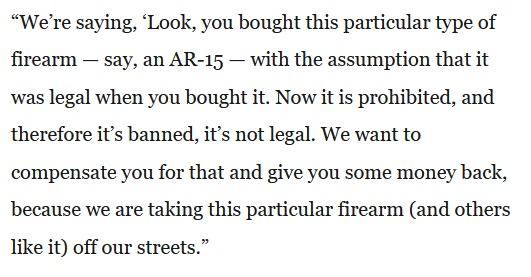
Among the Conservative and Liberal mis-steps of the election campaign this week, the promise by Liberal leader Mark Carney to pass legislation to boldly and courageously do something that has been part of the firearms laws for over 40 years deserves calling out:

Your Line editors knew that guns were going to come into the campaign eventually. It’s one of the eternal issues for the Red Team, and while they seemed to have shied away from it a bit after some pretty brutal fumbling in Justin Trudeau’s later years, we figured it would be back eventually. And so it was on Thursday, when Liberal leader Mark Carney announced, as part of a package of crime policy proposals, that a re-elected Liberal government would make sure that guns were automatically taken from anyone convicted of a violent crime, including intimate partner violence.

*pulls hard on chain, activating bullshit klaxon*

See, here’s the thing, friends. First of all, to take Carney at his word here would require us accepting, even just for a moment, that this didn’t already happen. That up until Thursday of this week, the Liberals were hunky dory with people convicted of violent crimes, including intimate partner violence, keeping whatever guns they may own or wish to acquire.

That is, we suspect readers know, utter bullshit. Removing guns is already required in those circumstances, and it doesn’t even require a conviction. Police officers can seize any weapon of any type if it isn’t in the safety interest of any person, even without a warrant, and revoke any license they hold immediately.

Nobody is eligible to hold a license if it isn’t in the safety interest of a person — that’s literally the first eligibility criterion in the Firearms Act. Issuing a license requires the issuer to consider all past convictions, mental illnesses, history of violent behaviour, previous prohibitions, any potential intimate partner violence, and any potential harm to any person before they issue it. That is checked through a process called Continuous Eligibility Screening, where license holders are checked for “hits” against police systems every single day to determine whether they are still able to hold a license.

This is something almost no one outside Canada’s firearms-owning community understands, and The Line wants to underline this point — anyone with a firearms licence is automatically checked for any new legal issues that might render them unable to own firearms every single day. If you happen to find yourself hanging out with someone with a firearms licence, they were checked out by law enforcement within the last 24 hours. This includes your friends at The Line. The day you’re reading this is a day they passed another screening.

A conviction for a violent crime, it hardly need be said — well, actually, check that, apparently it does need saying — would render one rather ineligible! Not only is this already the law, but there are so many overlapping laws to deal with that exact scenario that it takes real effort to be ignorant of them. Weapon prohibition orders on conviction for violent offences? Already a thing at the federal and provincial levels. Prohibitions while on bail? Already a thing. Firearm seizures during divorces? Not automatic, but common, sometimes even where there is no history of violence or reasonable belief that violence is likely.

The Liberals know all this, especially since it was the Liberals who last changed these laws — though not to add the removal provisions, which largely already existed, but to remove any discretion or ability for rehabilitation.

Every party is fine with keeping guns away from domestic violence perpetrators. Carney making this an issue is bullshit. He’s counting on the public to not know enough to call him out on it.

It’ll probably work.

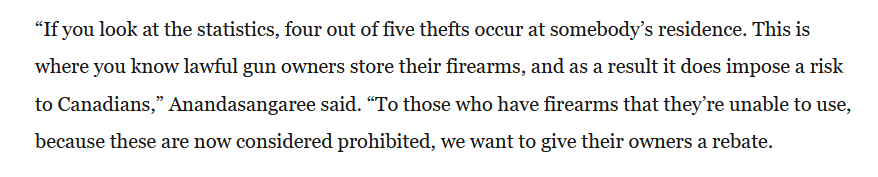
Oh, and by the way. If you don’t want to take our word for any of the above, you can just read the Firearms Act yourself. Relevant section, below.

President Trump … or any president … shouldn’t have the unilateral power to levy tariffs

Filed under: Economics, Government, Politics, USA — Tags: , , , , — Nicholas @ 03:00

Love him or hate him — and there are lots of people in both camps — President Donald Trump has the power to randomly throw spanners into the international trade arena … because Congress ceded that power to the presidency long before Trump began his political career:

In response to Donald Trump’s tariff maneuvers, Senator Rand Paul has been arguing that presidents shouldn’t have the power to raise tariffs themselves. Taxing power belongs to Congress, and that’s where tariffs should be born. Trump’s tariffs result from the use of emergency power that Congress gave to the POTUS, and we shouldn’t normalize emergency rule. You can watch him say all of that here.

Every word of that is completely right. I don’t disagree with a single breath of it. I respect Rand Paul, and I’m inordinately fond of his dad. But it misses the point about how we got here, and why, starting with the fact that Congress gave away its taxing authority.

  1. Congress delegated its authority;
  2. Donald Trump used the authority that Congress gave him;
  3. Therefore, Donald Trump is very bad, and what he’s doing is wrong.

The core sickness at the heart of the American republic is Congress, and we keep discussing that sickness by saying that Trump sucks. He’s doing what you gave him the power to do, and he’s not the first.

See also my recent post in which I described a time when Congress made something illegal, than asked the administrative agencies to explain to them what they had just banned. Congress has delegated its authority, over and over again, and the resulting political vacuum is a serious problem. But anyway, TRUMP TRUMP TRUMP.

American political discourse keeps taking a wide range of political pathologies and assigning them to the same account. Orange Man Bad, Orange Man Bad, Orange Man Bad, they explained, with drool running down their chins. Donald Trump is our deflector object, our national excuse. [Problem name here]; OH NO WHY IS TRUMP DOING THIS TO US.

The commandant of the United States Coast Guard spoke at a maritime conference, a few days ago, and he said that the organization he runs wakes up every day and tries to keep the doors from falling off: “The US Coast Guard is less ready today than any other time since World War II. We are on a readiness spiral. Today our fleet of cutters are in significant decline. We are in repair failure mode … No ship today gets underway without cannibalizing others for parts.”

See also, from one of his subordinates:

Serious question: Did all of those problems begin at noon on January 20, 2025?

A Basic Introduction To The Ancient Roman Political System

Filed under: Europe, Government, History — Tags: , , , — Nicholas @ 02:00

MoAn Inc.
Published 12 Dec 2024
(more…)

QotD: The changed role of the Dictatorship in the late Roman Republic

And then the dictatorship sleeps, for 119 years. The Romans don’t appoint any dictators at all during the second century, despite appointing, on average, one roughly every four years for the first three centuries of the republic. And then in 82, L. Cornelius Sulla Felix “revives” the dictatorship.

Now, precisely because we are now talking about the irregular dictatorship, there really is no way to lay out its features except to go through its uses. Fortunately, there aren’t that many.

In the spring of 83 BC, Sulla, who had been notionally serving in a proconsular command in the East to fight Mithridates, landed in Italy with his army; Rome had effectively come under the control of a military junta initially led by Gaius Marius (cos.107, 104-100, 86) and after his death by L. Cornelius Cinna, Gn. Papirius Carbo and Gaius Marius the younger (son of the former). Sulla openly fought the consuls of 83 (Gaius Norbanus and L. Cornelius Scipio), pushing towards Rome. As the year shifted over into 82, Carbo and Marius the Younger had themselves elected consuls. Marius was killed in 82 during the siege of Praeneste; Carbo fled to Sicily after Sulla took Rome (where he’d eventually be captured and killed by Pompey in 81).

Now this posed a problem, constitutionally: there were always to be two consuls and consular elections had to be presided over by a consul … but one consul was dead and the other fled. The customary solution to this problem was the appointment of an interrex, a five-day-long office which essentially only had the authority to hold elections for new consuls in the absence of consuls or an already appointed dictator. Prior to 82, the last confirmed interrex we know of was in 216, but there may have been another in 208, in either case this also a long-unused office. All the interrex is supposed to do is hold an assembly of the comitia centuriata which can elect new consuls; they did not have any further authority.

Sulla, sweeping into Rome, convened the Senate and directed them to select an interrex; one wonders if this was the same meeting of the Senate Sulla convened within hearing distance of his soldiers in the process of butchering six thousand captured Romans who had sided against him, in case the Senate imagined they were being given a choice (Plut. Sulla 30.1-3). In any event, the Senate selected Lucius Valerius Flaccus (its oldest member, App. BCiv 1.98) on the assumption he would hold elections; instead, Sulla directed him (with the obvious threat of violence) to instead convene the comitia centuriata and instead of holding elections, propose a law (the lex Valeria) to make Sulla dictator with the remit of rei publicae constituendae causa, “for reforming the constitution of the Republic” – an entirely new causa never used before. Of course with Sulla’s army butchering literally thousands of his political opponents, the assembly knew how they were to vote.

This is, to be clear, a thing that customarily the interrex cannot do. This is also not, customarily, how dictators are selected. The appointment of a dictator had not been recommended by the Senate and in any case has also chosen the wrong voting assembly (the comitia centuriata instead of the comitia curiata) and also the interrex doesn’t have the authority to nominate a dictator or propose a law that nominates a dictator. You may begin to see why I see this as a new political innovation and not a clear extrapolation from previous practice. None of this is how the customary dictatorship had ever worked.

The law also gave Sulla a lot of powers, which was important because most of these powers were not things that customarily a dictator could do. He could legislate by fiat without an assembly, something dictators could not do before. He was given the ability to alter the number of senators as well as choose new senators and expel current senators; a dictator had once been named, Fabius Buteo in 216, to enroll new senators, but had (according to Livy) openly noted he did not consider himself to have the authority to remove senators enrolled by the previous Censors (Liv. 23.23). Sulla rendered his authority immune to the acts of the tribunes, whereas that office had previously been the only office to exist outside of the dictator’s authority. Finally, his appointment had no time limit set to it, whereas previously all dictators had six months and no more.

What Sulla has done here is used new legislation (remember, Rome has no written constitution which could invalidate any new law) to create what was is effectively an entirely new office, which shared neither an appointment procedure, term limit, or set of authorities and powers with the previous version.

Sulla then made a lot of very reactionary changes to the Roman Republic we need not get into here, got himself elected consul in 80, and then resigned his dictatorship (after rather a lot longer than six months, making Sulla, by the traditional criteria, the worst dictator Rome had up until that point, though I doubt he saw it that way), and after that retired from public life. Sulla seems to have imagined the office he created out of thin air in 82 would be a thing sui generis, a unique office to him only, to that moment only. Which was incredibly foolish because of course once you’ve created the precedent for that kind of office, you can’t then legislate away your own example.

And so Caesar utilized the same procedure. M. Aemilius Lepidus (later to be triumvir with Octavian and Antony), the praetor in 49, put forward the legislative measure – once again, proposed as a law rather than through the normal process – to make Caesar dictator for that year (Dio 41.36.1-3), with the same sweeping powers to legislate by fiat that Sulla had. One of the first things Caesar did was openly threaten the tribunes with violence if they interfered with him; as noted the tribune’s powers were not at the discretion of the dictator in the customary system and tribunes were held to be sacrosanct and thus legally immune to any kind of coercion by other magistrates, so this too represented a continuation of Sulla’s massive increase in the dictator’s absolute authority (App. BCiv 2.41, Plut. Caes. 35.6-11).

Caesar’s dictatorship, rather than initially being without time limit, was renewed, presumably every six months, from 49 through February 44, when Caesar had himself instead appointed dictator perpetuo rei publicae constieundae causa, “Dictator forever for the reformation of the Republic”, at this point (if not earlier) reusing Sulla’s made-up causa and now making explicit his intention to hold the office for life. He was assassinated a month later, on March 15, 44 BC, so perpetuo turned out to not be so perpetual.

As an aside, Julius Caesar is sometimes given a rosy glow in modern teaching materials, in part because he got such a glow from the ancient sources (one could hardly do otherwise writing under the reign of his grand-nephew, Augustus, who had him deified). That glow was often reinforced by (early) modern writers writing with one eye towards their monarch – Shakespeare, for instance. This may be a topic for another time, but I think a fair assessment of Caesar strips away most of this glow (especially his “man of the people” reputation), except for his reputation as a gifted general, which is beyond dispute. Julius Caesar’s career was a net negative for nearly everyone he encountered, with the lone exception of Augustus.

Bret Devereaux, “Collections: The Roman Dictatorship: How Did It Work? Did It Work?”, A Collection of Unmitigated Pedantry, 2022-03-18.

April 11, 2025

Critical Trade Theory

A discussion at the amusingly named Handwaving Freakoutery on the ongoing wave of tariff activity under the Trump II administration, characterizing them as “woke” tariffs:

The great argument playing out in the media right now about the relative value and ethical implications of reciprocal tariffs is not relevant. It is not relevant because these tariffs are not reciprocal tariffs in any measurable way. They aren’t reciprocal, they aren’t sensible, and the justification for them is Woke in every sense of the word. Let’s take a close look at what we might call Critical Trade Theory, back our way into an understanding of what a woke tariff is and how this is definitely that, and close with a quick word about how political realignments portend doom for the left even though the right is really screwing this up. Then we’ll all buy mop handle futures.

Awokening

The Great Awokening of the prior decade was founded in part on the False Cause Fallacy. Our major institutions for the better part of the last ten years were operated by wokerists, who used an Intersectional Matrix of Culturally Encouraged Race and Gender Prejudice to counteract what they viewed as hidden unmeasurable forces such as “systemic racism”. They couldn’t point to the systemic racism, but they knew it must be there because of the imbalance in socioeconomic metrics, and they denied any other possible explanation for the imbalance. Once the False Cause was in place, the devout wokerist was forced to fight the hidden prejudice with overt reverse prejudice, because they couldn’t conceive any other cause.

For example, if black folks have a hard time getting into Harvard or UNC, it must be because society is systemically racist against black people, and no other reason, therefore we should redirect admission slots from Asians who earned them to blacks who didn’t, for race balancing.

Harvard did exactly that, for exactly that reason, and admitted it, and it was sent to the Supreme Court, and the Supreme Court banned it, and then Harvard kept doing it and is still doing it using different words.

Some of our other institutions are still running this wokery program, although the Trump Administration purged much of it from the halls of federal power this year under their DEI ban, and many other institutions used Trump as cover to independently purge it from theirs. But this same smooth-brained thinking wiggled its way right into Trump’s tariff plan last week, through an equation that looks fancy but is something my middle school son could figure out.

[…]

The media thinks these woke tariffs are going to bomb the economy back to the stone age, but when I make the abhorrent choice to read the graphs myself it looks more like January 2024. A 20% tariff on Chinese goods is rough. Adding 34% more to it is rougher. But a 54% tariff on Chinese goods is nothing compared to Shenzhen closing its entire manufacturing sector down because they found a germ, and probably not significantly worse than the Fed turning off the free money spigot in 2022.

These tariffs are going to do goofy shit to the economy. I don’t like the goofy shit they’re likely to do. I think that trade balancing through tariffs is an idea so stupid that only Rust Belt union workers could come up with it, which is why they probably did come up with it, and also probably why Trump won the election by flipping the Rust Belt.

April 10, 2025

Too much free speech is bad for German democracy

Filed under: Germany, Government, Liberty, Media, Politics — Tags: , , , , , — Nicholas @ 04:00

eugyppius notes that criticizing German politicians for their lack of commitment to the principles of free speech can land you in prison if you’re not careful:

David Bendels, the chief editor of the AfD-adjacent Deutschland Kurier, has been threatened with prison time and sentenced to seven months of probation for a Twitter meme. It is the harshest sentence ever handed down to a journalist for a speech crime in the Federal Republic of Germany.

This is the illegal tweet, which Bendels posted via the official Deutschland Kurier X account on 28 February 2024:

It shows German Interior Minister Nancy Faeser holding a sign that has been manipulated to read “I hate freedom of speech!” Bendels posted the image to satirise Faeser’s disturbing plans to restrict the speech, travel and economic activity of political dissidents in Germany, which she had announced at a press conference a few weeks earlier.

Faeser personally filed criminal charges against Bendels for defamation after Bamberg police brought the meme to her attention. Last November, the Bamberg District Court summarily ordered Bendels to pay an enormous fine for this speech crime “against a person in political life”. This is yet another prosecution that proceeds from our lèse-majesté statute, or section 188 of the German Criminal Code, which provides stiffened penalties for those who slander or insult politicians, because politicians are special people and more important than the rest of us.

The same Bamberg prosecutor’s office and the same Bamberg District Court had previously pursued the German pensioner Stefan Neihoff for the crime of posting another meme implying that German Economics Minister Robert Habeck might be a moron. That case, too, seems to have been brought to Habeck’s attention by Bamberg police, who requested that Habeck file charges. The Bamberg police apparently have very little to do beyond trawling the internet for political memes and protecting democracy by suppressing democratic freedoms.

Bendels appealed his summary penalty, and so the Bamberg District Court put him on trial. Yesterday the judges found him guilty and sentenced him to seven months in prison, which they suspended in favour of probation. The judges claimed that Bendels was guilty because he had distributed a “factual claim about the Minister of the Interior, Ms Faeser … that was not recognisably … inauthentic”, and judged that his meme was “likely to significantly impair [Faeser’s] public image”. The presiding judge demanded that Bendels submit a written apology to the Interior Minister for having so egregiously slandered her.

Canadian political aspirations to being “very mid” on the world stage

In The Line, Matt Gurney reflects on a recent statement by caretaker prime minister Mark Carney about Canada taking a “leadership role” on the international stage and supplanting the United States under President Trump:

Oh, we will, eh?

Don’t get me wrong, I like the sound of it. He’s certainly manifesting that elbows-up spirit that seems to be so impressing Canadians.

But, like — Carney knows which country he’s in, right? Canada? The one full of Canadians? Because as I heard him say what Canada would do in response to the accelerating American withdrawal from global affairs, I couldn’t help but note that there is a problem here.

Canada isn’t a leader. Canada doesn’t lead.

Even as I write this, I know it’s going to be a fraught statement. Canadian patriotism is a bit supercharged right now. It’s nice to see. But a lot of stupidity gets overlooked — or even caused — by patriotic outbursts. Internal dissent becomes a lot less popular when everybody is sewing the Maple Leaf onto their backpack. So I want to make my point respectfully and politely, largely to spare myself the agony of wading through idiotic replies for a few days. So here goes: many Canadians do indeed lead in their fields, and there is nothing inherent about Canada that makes us incapable of exercising leadership. If Mark Carney remains prime minister — or if someone with similar ambitions should replace him and make a point of pursuing a policy of broad-based Canadian global leadership — I don’t write that off as a doomed proposition.

There is more that we could choose to do. There are practical constraints that would bind us, and we’ll talk about those in a minute, but just to get into the spirit of the moment: sure. We could choose to exercise global leadership.

But we would first have to start with the recognition that it has been generations since we have actually tried to do that. This is not a moral judgment on Canada or Canadians. It is simply a recognition of the historical record. This country has not pursued a national policy — or even a series of smaller policies that take on a greater form in the aggregate — that sought to establish this country as a leader in the world.

If we’re being honest, we’ve typically pursued almost the opposite policy, and deliberately. I’m not saying we’re slavish followers. But this is a country that for generations has been quite comfortable thinking of itself as an overachieving middle power, nestled comfortably in a supporting role for allied countries that do seek to lead. Usually the Americans. Maybe sometimes the British or French. Or something like the UN or NATO. We’ve never claimed to land the hardest punches, or tried to. We’d settle for punching above our weight. We haven’t tried to conquer or command or even compel. In the words of a member of the incumbent government, our aspiration largely maxed out at wishing to convene.

But, of course, as we’re learning these days, Canadian politicians of almost all parties (Maxime Bernier is the only exception I’m aware of) consider the beneficiaries of our trade-distorting supply management system to be the only ones whose interests they always champion:

The most interesting field of international relations, though, and the most germane to what Carney said on Liberation Day, is in the field of trade. Canada definitely likes trade. I’ll even give some credit here to both Liberals and Conservatives. It has been broadly understood that Canada thrives when we have access to markets all over the world. The pursuit of expanded trading relationships has been a bipartisan priority for Liberals and Conservatives alike … so long as it doesn’t cost us anything on the domestic political front.


And yes, I’m talking about dairy. Some other things, too. But mostly the milk and eggs.

Seriously. Scroll up a bit. Look at that big quote I dropped in at the top from Carney. Watch the CTV feed again. Canada is going to pursue a role of leadership in defending liberalized free trade?

Really? Forgive me for squinting. I’m struggling with my middle-aged eyes to find the tiny text appended to Carney’s pledge that notes that “conditions apply”. Because that very same Mark Carney has already gone out of his way to say that protecting Canada’s supply-managed dairy and egg producers is an absolute, unbendable priority for him and his party.

So yes. Let’s all pledge ourselves to a new era of Canadian leadership in defence of free trade and unfettered market access, right up until the moment some weirdo foreigner gets it into their pathetic little brain that they should be allowed to sell me a stick of butter. Because that ain’t on, friends. Let’s get our elbows up, and bury them deep into this wheel of filthy xenocheddar.

April 9, 2025

“South Africa is what happens when a country becomes ungovernable”

Niccolo Soldo’s weekend roundup includes some quotes from Lawrence Thomas on what he terms a “racketeer party state“, what the “Rainbow Nation” of South Africa has degenerated into since the end of Apartheid:

South Africa is what happens when a country becomes ungovernable. From endemic sexual crime to farm murders, rolling blackouts, and expropriation, the rest is just the details. What has come to be termed “South Africanization” is not the failed development of a Third-World nation such as Afghanistan or Somalia, but the structural de-development of a once fully modern state that had its own nuclear weapons program. President Trump’s support of Afrikaner farmers has brought global attention to the decaying state of the country and is perhaps the most high-level recognition yet that the 1990s “Rainbow Nation” dream is dead. What’s strange about it all is how much of it happened on purpose.

What may be worse is that the very system of law and government itself has become an instrument to be captured and used to further the mass looting of the country. South Africans of all races inherit a Western political culture and economy. The average South African experiences a strong civic identity, highly active political parties, popular national media networks, a market economy, and a parliamentary constitutional order. The last thirty years saw a coalition of political actors, patronage networks, and organized criminal gangs seize control of and use all the infrastructure of modern government for their own ends.

[…]

While songs like “Kill the Boer” at rallies tend to grab headlines, the most consequential development of late is the passing of expropriation without compensation into law by the supposedly moderate President Cyril Ramaphosa. In addition to further eroding property rights, it emboldens a widespread movement that sees land redistribution as the sole resolution to the country’s racial conflict and views the presence of any white population as fundamentally illegitimate. The radicalization of race politics is the means through which political fights are won, since it plays on the country’s major divides and wins over those who feel left out of the spoils.

On the ground, reports tell of ANC officials tacitly allowing invasions of private and public land by squatters. Occupations of this sort have sometimes preceded the farm murders which have gained media attention internationally, and squatters have now begun to invoke the Expropriation Act. Such groups become the shock troops of political pressure: they can harass and pressure the occupants of the lands they occupy, or worse, while becoming a media story about the “landless oppressed” used to justify broader government action. The broad facilitation of ground-level conflict and crime by those with political power is the defining feature of South Africanization.

[…]

In other words, decay is a burden without benefit. There is no “rock bottom”. Business, political organization, social fabric, and all other forms of Western cultural life just face increasing costs. Some are direct, while others are opportunity costs: how much doesn’t happen because almost no one can guarantee electricity? In a relatively developed country, there’s still much more to break down and expropriate.

The combination of social progressivism with an economic model of managed decline has become orthodoxy in many establishment parties across the developed world. South Africa is a study of the political phenomenon in its advanced stage and a demonstration of what is at stake in defeating it in the rest of the Western world. Flip Buys, leader of the Afrikaner trade union Solidariteit, was likely prophetic when he foresaw that South Africa would become home to the “first large grouping of Westerners living in a post-Western country”.

Emphasis from Niccolo’s excerpts.

QotD: Legitimacy and revolution

Any revolutionary regime is faced with what you might call a crisis of foundations. Not necessarily a crisis of legitimacy, it’s important to note. “The power of the mighty hath no foundation, but in the opinion and belief of the people,” as Hobbes said, and he put his money where his mouth was — despite writing the firmest possible defense of royal absolutism, he took the Engagement and came home in 1651. Whatever the theoretical rights and wrongs of it, Parliament actually exercised power.

But though the English Civil War produced the first truly revolutionary regime, they were able to effectively co-opt most of the old regime’s symbols …

Let’s back up for a sec: As you recall, a revolution seeks to replace a people’s entire mode of living, whereas rebellions are just attempted changes of government. England had faced many rebellions before 1642, some of them successful, by which I mean they replaced one ruling faction with another. The usurpation of Richard II’s throne by Henry IV was extremely problematic, political theory-wise, but nobody was openly challenging the institution of monarchy as such. So too with the Wars of the Roses, the Peasants’ Revolt, the Pilgrimage of Grace, and so on: Those were all about the person of the king and his methods of rule, not about the legitimacy of his government.

The English Civil War was different. Charles I wasn’t the first English king executed by rebels (the aforementioned Richard II was starved to death; Henry VI died under extremely suspicious circumstances in the Wars of the Roses), but he was the first one found guilty of treason. To the kingdom he was king of. That’s a far different thing than “oopsie, I guess we forgot His Majesty’s lunch for two months running” or “we sent a whole bunch of goons with knives to the Tower, only to find His Majesty dead of melancholy”. A king who is guilty of treason is necessarily somehow inferior to his own kingdom, which forces us to confront the questions of 1) what, exactly, IS the kingdom? and 2) where does its legitimacy come from?

That’s why the rule of first the Council of State, then Lord Protector Cromwell, was a true revolution. In both cases, it was all too obvious where their legitimacy came from: out of the barrel of a gun, as Mao would so pithily put it 300 years later. And thanks to that power, they were free to remake the “lifeways” (as anthropologists say) of the people how they saw fit. Puritan England was as close to a totalitarianism as 17th century technology and information velocity would allow …

… but that wasn’t very close at all, as it turns out, and so most people in most places could get on with their lives pretty much as before. And even for those people directly under the State’s gaze, the Protectorate looked enough like the old monarchy that if you squinted and tilted your head sideways, you couldn’t really see the difference.

Severian, “Repost: National Symbols”, Founding Questions, 2021-10-27.

« Newer PostsOlder Posts »

Powered by WordPress