Children can spot books written by adults for other adults a mile away — when I read bedtime stories to my son, I always notice when he loses interest. And almost all products of the modern children’s entertainment industry are so freighted with issues and role models, and ingratiating attempts to be cool, that escape velocity cannot be reached.
C.S. Lewis, the master of escapist fiction, was prophetic in warning against such noxious paternalism from authors. “Of all tyrannies, a tyranny sincerely exercised for the good of its victims may be the most oppressive”, he wrote. “It may be better to live under robber barons than under omnipotent moral busybodies. The robber baron’s cruelty may sometimes sleep, his cupidity may at some point be satiated; but those who torment us for our own good will torment us without end for they do so with the approval of their own conscience.” Let’s hope Barbie director Greta Gerwig, who has been tapped up to direct the next year’s Chronicles of Narnia series, is taking note.
In the meantime, we have the books, the first of which, The Lion, the Witch and the Wardrobe, was published 75 years ago today. When I read this to my son, it transfixed him in a way that all those morally improving Disney and Pixar movies could not — and in a way that I recognised too from my own childhood. The Narnia books are weird and archaic and they are far from comforting. But they leave unanswerable questions and imaginative territory to roam for a lifetime.
What would compel a child to climb into a claustrophobic wardrobe, full of moth-eaten coats and spiders, as apt a symbol as any for the human psyche? C.S. Lewis knew all too well. There are real and terrible things to escape from. And the land of magic, mystery and hope that Peter, Susan, Edmund and Lucy arrived in would soon reveal that it too was blighted. By facing up to this, conquering its climate of terror, the child would become an adult. If they didn’t pass into the dark and through it, they would remain infantilised.
This partly explains the backlash against Lewis. Two years ago, it was reported that the Government’s counter-terrorism unit, Prevent, had classified his works along with some by his friend J.R.R. Tolkien as potentially leading to “radicalisation”: the kind of wormtongue deception worthy of the villains of Narnia or Middle Earth. It demonstrates that, at its best, fantasy can be the mirror that shows us who we are and what we’ve become. But then, there is a long history of people taking leave of their senses when it comes to Narnia. The books have been banned in the US for being both too Christian and not Christian enough. One critic ranked the books (with delicious venom) as worse than 120 Days of Sodom or Mein Kampf. Being shot by all sides might indicate a writer is on the right track.
For his part, Lewis lambasted “those who do not wish children to be frightened […] Since it is so likely that they will meet cruel enemies, let them at least have heard of brave knights and heroic courage. Otherwise, you are making their destiny not brighter but darker.” He knew of the existence of shadows from early in life. There is a spine-chilling passage in his memoir, Surprised by Joy, in which he recalls waking up one night with toothache when he was 10. He called out his mother’s name and she did not come. She was dying in another room. His father was never the same and sent Lewis off to a boarding school run by a deranged sadist. “With my mother’s death, all settled happiness, all that was tranquil and reliable, disappeared from my life.”
As a result, Lewis developed a fear and mistrust of the adult world in those years — and it was well-placed. Scarcely more than a boy, Lewis was sent to the trenches. He was seriously injured in the Battle of Arras (he would have shrapnel, from a shell that obliterated a colleague, embedded permanently in his body) and, like Tolkien, he watched many of his friends die. “One cannot help wondering why,” he wrote to his father.
Update, 13 February: Welcome, Instapundit readers! Have a look around at some of my other posts you may find of interest. I send out a daily summary of posts here through my Substack – https://substack.com/@nicholasrusson that you can subscribe to if you’d like to be informed of new posts in the future.
On Substack, Fergus Mason updates us on what’s happening around the UK/US military base on Diego Garcia in the Chagos Islands in the Indian Ocean:
Diego Garcia
One of the great mysteries of Keir Starmer’s government is why he’s so determined to give the Chagos Islands to Mauritius, which is 1,200 miles away and has never owned them. Even now, as he desperately fights for his political survival, Starmer is pushing ahead with plans to give away the strategic archipelago then pay tens of billions of pounds to lease back one of the islands. It’s an odd thing to be so focused on — but whether his compulsion to surrender the islands is driven by corruption or naivete, it’s sending out signals of weakness. And those signals are being noticed.
The Maldives Makes A Grab
Last Thursday the Republic of Maldives announced that it had rejected the UN International Tribunal for the Law of the Sea’s ruling on its maritime boundaries, and sent an armed boat to carry out a “special surveillance operation” in the northern part of the Chagos island’s Exclusive Economic Zone (EEZ). The Chagos EEZ is claimed by Mauritius, but of course actually belongs to Britain until Starmer’s surrender deal is approved by Parliament. However, the Maldivian government has now decided to make its own claim on the area — and it’s very publicly doing something about it. The “coast guard vessel” CGS Dharumavantha — a former Turkish Navy fast attack craft — is now operating in the area, along with drones from the Maldives National Defence Force Air Corps.
Of course, the Maldives has no real claim to the Chagos islands or any part of their waters. The country — a tiny group of islands southwest of Sri Lanka, with a land area of just 115 square miles — was a British crown colony from 1796 to 1953, and a British protectorate until 1965. Like Mauritius, it has never owned the Chagos Islands. However, it’s just 300 miles away from them, much closer than Mauritius. It appears that its leader, President Mohamed Muizzi, has decided that if the key British territory is up for grabs the Maldives should be the ones to grab it. It’s true the Maldives doesn’t have much of a navy, but then Mauritius doesn’t have much of a navy either and is a lot further away. If the Maldives can seize control over part of the extremely valuable Chagos Marine Protected Area (MPA), and even possibly some of the northern islands, there isn’t a lot Mauritius can do about it.
Why would the Maldives be so keen to seize part of the Chagos EEZ? That one’s simple. Under British protection, the Chagos MPA (which is the largest marine nature reserve in the entire world) has been officially off limits to commercial fishing since 2010 but, in practice, has barely been fished at all since 1968. This makes it a unique and potentially lucrative resource in the Indian Ocean region, which has seen its ecosystems devastated by destructive fishing methods. The wealth of the MPA is the main reason Mauritius wants the Chagos islands. Its own coastal waters have been blighted by overfishing, including the destruction of coral reefs by explosives and bleach injection, and now it wants to plunder the MPA. The Maldives is also busily engaged in destroying its own fish stocks (fishing is the country’s largest industry and employs half the population) and is desperate for new waters to pillage. They don’t just want access for their own boats, either. Like Mauritius, the Maldives under Muizzi’s rule is an increasingly close ally of China.
The Scourge Of The Seas
China has the world’s largest fishing fleet, and it’s not even close. Over 44% of all commercial fishing is carried out by Chinese boats — and they’re notorious for flouting international law. Chinese boats regularly change their names and disable their satellite tracking systems to conceal their identity, then fish illegally in other countries’ waters. They violate quotas, catch protected species and strip whole swathes of ocean clean of any life much larger than plankton with massive, indiscriminate drift nets. Chinese fishing boats have also been implicated in people trafficking, drug smuggling and acting as spying and covert action platforms for the Chinese navy.
If either Mauritius or the Maldives gain control of the Chagos MPA it’s a certainty they will immediately give Chinese boats access, and this priceless nature reserve will rapidly be trawled and drift-netted into a barren, lifeless wasteland. From China’s point of view, of course, it doesn’t matter which of their lackeys takes over the Chagos islands as long as one of them does, so don’t expect them to step in to help Mauritius. They don’t care who they get the fishing rights from.
Comments Off on Heightening tensions in the Indian Ocean
On his Substack, Ed West shares some of the highlights, lowlights, and WTFites of the last week’s stories from formerly Great, now Mediocre Britain, including the case of an American asylum-seeker, the state of the jury system, and Birmingham among others:
Image from the Foundation for Economic Education
The quintessential UK news story mixes the sinister and comical. As I put it last time: the “Yookay” has elements of authoritarian menace with total farce and incompetence, a slapstick comedy in which WPCs turn up at your house to arrest you over Facebook posts while your son sits in a classroom next to a 30-year-old Iranian man pretending to be a child asylum seeker. All the internet mockery of Britain in the past few years focusses on the theme of a bizarrely mismanaged country, run by people whose priorities are totally upside down.
In her recent Wall St Journal column, Louise Perry wrote about what she described as “Mr Bean Authoritarianism … after the comic character played by Rowan Atkinson, one of Britain’s most successful comedy exports. Mr. Bean is childish and incompetent. He constantly gets things wrong. He can’t understand the most basic facts about everyday life, which results in various slapstick disasters. The British government frequently manifests Mr. Bean-style incompetence but without his genial manner.” She wrote:
“Pathways” isn’t the first example of government messaging that treats the British public like naughty children. In 2023, Police Scotland came up with another, much-mocked cartoon character called “the hate monster”. “Before ye know it, ye’ve committed a hate crime,” announced the voice-over, with an effect that was simultaneously sinister and risible. “You are constantly on the brink of criminalization,” the ad implicitly told us. “Now look at this silly cartoon.”
Incompetence and authoritarianism are often bedfellows. Governments that frequently make mistakes will feel compelled to hide those mistakes, for fear of the public’s response.
[…]
Take a hike
“The British countryside will be made into a less ‘white environment’ under nationwide diversity plans. Officials in rural areas, including the Chilterns and the Cotswolds, have pledged to attract more minorities under plans drawn up by the Department for Environment, Food & Rural Affairs (Defra). The plans follow Defra-commissioned reports that claimed the countryside would become ‘irrelevant’ in a multicultural society, as it was a ‘white environment’ principally enjoyed by the ‘white middle class’.
“More diverse staff will be recruited, marketing material will be produced featuring people visibly from ethnic minorities, and written in ‘community languages’.”
Isn’t English a “community language”? I’ve written about the War on the Countryside before; the powers-that-be are obsessed with getting Muslims to hike, for some reason. Just recently, a woman received an MBE for walking up hills while wearing a hijab. It all seems so counter-productive, increasing a sense of paranoia among everyone, when no one is stopping anyone from taking a walk in the countryside, and no one is going to give you a hard time. As Alexandra Wilson explains, some of this is downstream of the incentive systems within academia.
[…]
Official secrecy
One of the characteristics of the UK state, and which differentiates it from the US, is a tendency towards secrecy. I think it’s in the English character, which is why we basically invented spying, and are very good at it, give or take the odd communist traitor. This was most egregiously displayed by the government’s secret plan to airlift huge numbers of Afghans into the country, without telling the public, and it has become a regular feature of the criminal justice system.
Just last month it was revealed that a “reporting restriction was put in place at Nottingham Crown Court in September last year, preventing any mention of the defendant’s immigration status”. The man in question was from Pakistan and the authorities were worried about the risk of disorder, but he was unmasked by local Reform MP Lee Anderson.
This is the second time in a month where a British court has deliberately withheld the nationality of a rapist: “Last May in Leamington Spa, a girl was abducted and raped by two Afghan asylum seekers who had arrived by small boat just months before. Initially, Warwickshire Police described the rapists as ‘two 17-year-old boys from Leamington’, while referring to their 15-year-old victim as a ‘young woman’. It was not until the case went to sentencing in December that their backgrounds could be reported, after a legal challenge by the Daily Mail was granted. Meanwhile, the ‘horrific footage’ played at the trial has still not seen the light of day, with their barrister saying: ‘I have no doubt that if the general public were exposed to that, we would have disorder on our hands’.”
I don’t think the press habit of referring to foreign offenders as “Newcastle man” or “Burnley man” really helps the situation. All the details are immediately shared on social media anyway; it’s not the 90s any more.
The Sniper Rifle Experimental Model (S.R.E.M.) was designed by the “Czech Section” of small arms designers who had taken refuge in the UK to escape German occupation of Czechoslovakia. The intention was to develop a scoped sniper rifle that could be fired and cycled without disturbing the shooter’s sight picture. The idea that the designers came up with was to use the pistol grip as a moving charging handle, similar to the Czech BESA machine gun already in British service.
In 1944, the Essex Engineering Works in the UK got a contract to make 22 sample S.R.E.M.s, although only 2 were actually made. Really, the whole concept was a bit of a red herring, as the recoil from 8mm Mauser (this was made in 8mm, expected the post-war the UK would be adopting it or another modern rimless round to replace the .303) would disturb the sight picture regardless of the mechanism used to cycle the action. The project was cancelled in 1945, and this example is the only known survivor today. (more…)
Comments Off on S.R.E.M.: Britain’s Experimental WW2 Bullpup Sniper
In “Firestorm Dresden: 3 Days in Hell”*, we’ll unpack the bombing and subsequent firestorm in February 1945. We’ll look at how first the RAF night raids and then the US 8th Air Force daylight attacks unfolded, the damage they did and the horrific impact on the ground. We’ll look at how the aftermath shaped the myths and understanding surrounding the raid, and the fate of Arthur Harris and those who’d planned the raid.
* Proof once more, as if it were needed, how shit AI is — I have, apparently, to put the title of the video into the first words in the description to attract Google’s attention … I am so sorry to brutalise the English language like this.
[NR: Part one was posted here on January 22nd, should you want to watch it first.]
00:00 – 02:22 – Opening
02:26 – 06:20 – The weather
06:20 – 16:12 – The attack
16:18 – 25:17 – Horror on the ground
25:22 – 29:26 – USAAF Attacks
29:30 – 34:30 – Dealing with the bodies
34:34 – 44:59 – Reaction in the west
45:03 – 48:06 – The Soviet view
48:10 – 54:27 – Summing up and close (more…)
Comments Off on Dresden Part 2 – Firestorm Dresden: Three Days In Hell!
On Substack, Celina101 outlines the long and sordid history of official deliberate blindness to a widespread and horrific crime wave in Britain, all for fear that if they paid proper attention they’d be labelled as “racists”:
There are crimes so extreme that the mind instinctively rejects them, not because they are implausible, but because accepting them would require acknowledging a collapse of morality too large to comprehend. Child sexual abuse is one such crime.
Child sexual abuse does not arrive in a single form. It ranges from isolated abductions, to organised pornography networks, to violence carried out by parents or those entrusted with care. Every one of these crimes is horrific, and none should ever be minimised or ignored.
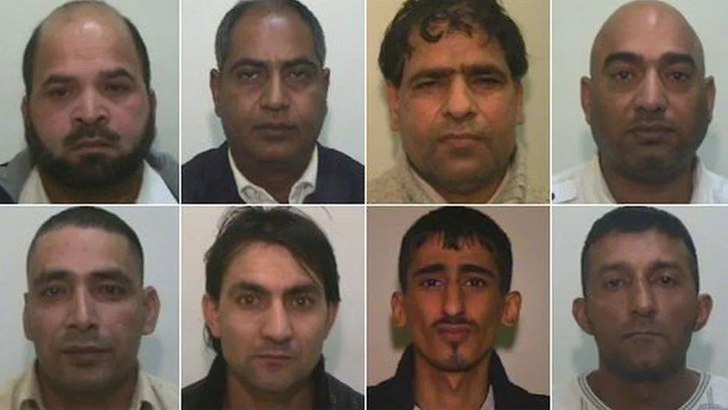
But there is one form of abuse that stands apart, not because it is worse in kind, but because it was allowed to flourish unchecked. The organised targeting of schoolgirls by groups of men who lingered outside schools, fast-food outlets, and transport hubs, grooming children into addiction, sexual exploitation, and prostitution, constituted a distinct and recognisable pattern of abuse.
This pattern was not hidden. It was not unknowable. And yet for longer than a quarter of a century, British authorities chose not to act. Despite the issue being raised at a national level as early as 2003, and despite its presence being well understood in certain towns since at least the late 1980s, it was deliberately sidelined, minimised, and left to metastasise.1
For decades, these gangs were allowed to congregate openly around school gates without consequence. What shielded them was not ignorance or lack of evidence, but an institutional terror of confronting anything that carried racial implications; the shade of their skin protected them.
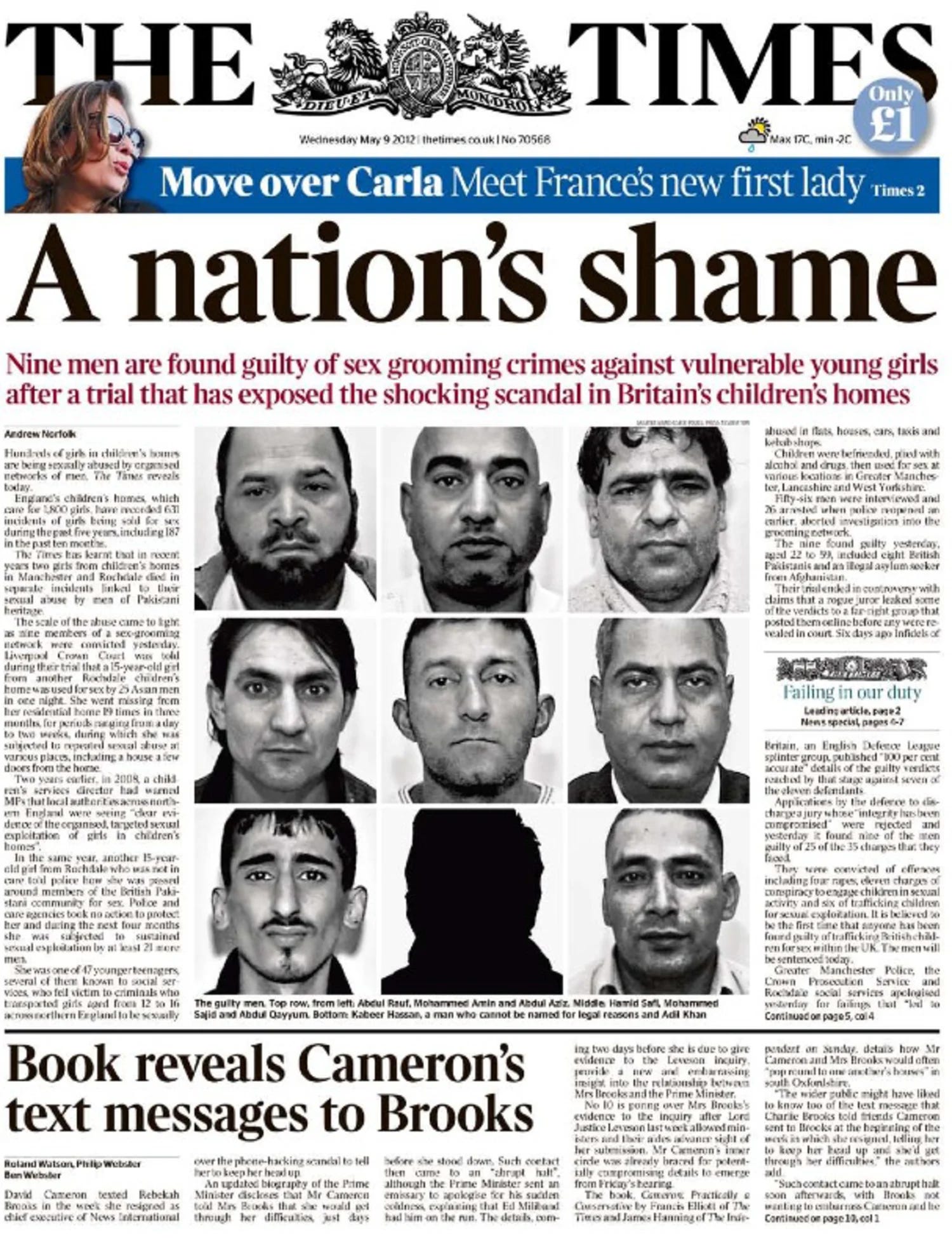
By 2011, the long-standing silence surrounding the issue began to break. Once the initial barrier was breached, the extent of the abuse became increasingly difficult to suppress.2 Over the following years, British media outlets published a succession of detailed investigations that brought the scale of the crimes into public view.
In September 2012, The Times published an extensive overview of the phenomenon.3 The paper reported that for more than a decade, organised groups of men had been able to groom, exploit, and traffic girls across multiple towns and cities in Britain, often operating with minimal interference from authorities.
Yet, event The Times underestimated the scale of this. By early 2015, senior police figures were publicly acknowledging the scale of the crisis. One officer spoke of “tens of thousands” of current victims of grooming gangs. A Member of Parliament, representing a constituency widely associated with the problem, went further, suggesting that the total number of victims nationwide, past and present, could reach as high as one million.4
These figures are almost impossible to comprehend. They refer to school-aged girls systematically identified, isolated, and exploited over many years. And yet, despite the magnitude of the harm, perpetrators were able to operate with remarkable impunity.
By the end of 2014, the Association of Chief Police Officers confirmed that the number of victims each year ran into the tens of thousands.5 Even on the most conservative interpretation, this would place the number of victims over a twenty-year period well into six figures. Against this backdrop, the number of successful convictions, under 200, stands as a staggering indictment of the system meant to protect the vulnerable and enforce the law.
There is no comparable serious crime in modern Britain where the disparity between victims and convictions is so extreme.
On Substack, Frank Furedi examines the rapid-onset victimization plague that now afflicts most western societies:
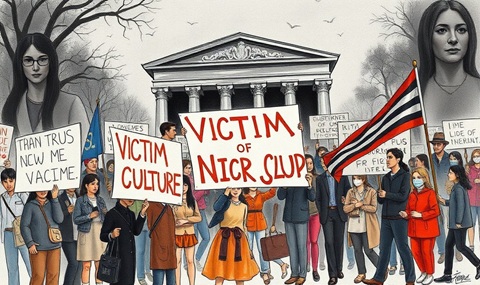
It seems that these days there is a relentless demand for gaining the status of a victim. No group wants to be left out, which is why a group of cultural entrepreneurs from Manchester, England have decided that since working people get a raw deal in the arts world class should become a “protected characteristic”.1 In other words, they believe that the working class should be regarded as a victim of social discrimination and join the ranks of other formally protected victim groups like women and racial and sexual minorities.
The aim of this essay is to explain the changing meaning of the term victim and its evolution into what has become one of the most valued and celebrated identity in the western world. In this Part One of our discussion of the rise of the cult of the victim our aim is to provide context for the development of the unique status of the victim. In our era of historical amnesia, it is easy to overlook the fact that the moral authority enjoyed by the victim, its subsequent politicization and its transformation into a stand-alone identity is a relatively recent development.
Remember!!! Until relatively recently being victimised did not constitute a claim to a distinct identity.
The evolution of the cult of victimhood
It is important to note that originally the word victim had very restrictive meaning. In the 15th century it referred to a “living creature offered as a sacrifice to God or other power”.2 Its meaning gradually altered to refer to the experience of being harmed either intentionally or unintentionally. Its shifting focus did not simply refer to an act of harm or crime affected by an agent of force but also to the existential difficulties caused by being a “victim of circumstances”. Since the 1970s and 1980s, the victim category was no longer restricted to those who suffered from crime or some other act of injustice. Virtually any misfortune could be assimilated into the perspective of victimization. According to this convention, people who suffer from a physical or psychological problem are represented as victims of their condition. People do not so much have heart attacks, they are often portrayed as victims of heart attack. Alcoholics have been reinvented as victims of alcohol addiction. A multitude of new interest groups now claim that they are victims of addictive behaviour. Compulsive eaters, sex addicts, internet addicts, shopping addicts, lottery addicts, junk food addicts are some of the new group of victim addicts that were invented during the last two decades of the twentieth century.
The status of victimhood is not confined to those individuals who have directly suffered from a particular grievance. Moral entrepreneurs argued for the recognition of what they characterise as secondary or indirect victims. As one criminologist noted, “crime victim activists have worked to expand the concept of victim to include the family and friends of the actual victim”.3 Members of a family of the direct victim are often referred to as indirect victims. Victim advocates argue that family members and sometimes friends must be given access to therapeutic services and other resources. People who witness a crime or who are simply aware that something untoward has happened to someone they know are all potential indirect victims. The concept of the indirect victim allowed for a tremendous inflation of the numbers who are entitled to claim victim support. Anyone who has witnessed something unpleasant or who has heard of such an experience could become a suitable candidate for the status of indirect victim. This was the outlook that influenced the British Government’s law reform body, the Law Commission, when it recommended in March 1998 that people who suffer mental illness after witnessing or hearing of a relative’s death, even on television or radio should have the right to compensation.4
On the social media site formerly known as Twitter, John Michael Greer provides a quick thumbnail sketch of the Amelia story for folks who need to get caught up:
I’ve been watching the saga of Amelia from the far side of the Atlantic in a state of utter bemusement.
For those who don’t know the first act of the saga, the British government had some collection of flacks create a video game for British kids, which was designed to elicit “racist” (that is, patriotic and un-woke) statements from them — at which point the kids who fell for it would be reported to the police for, erm, reeducation. (I wish I was making this up.)
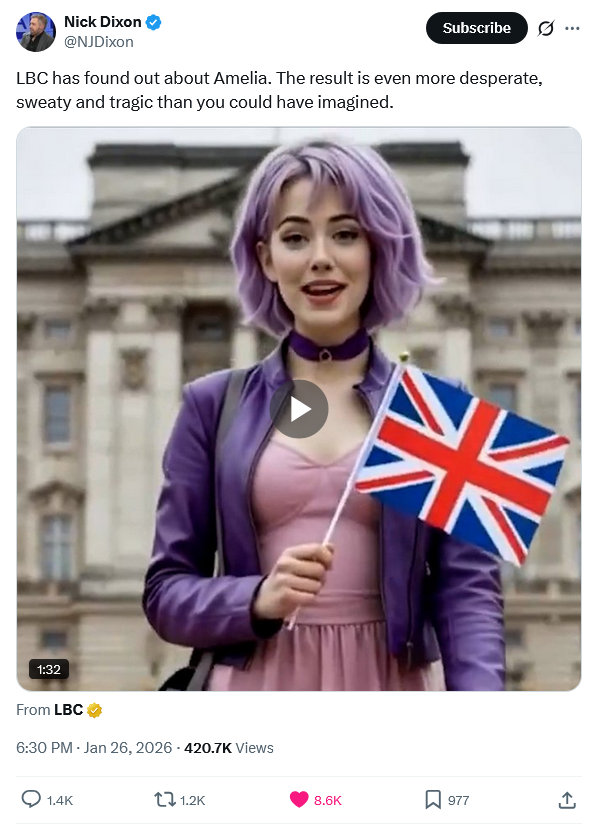
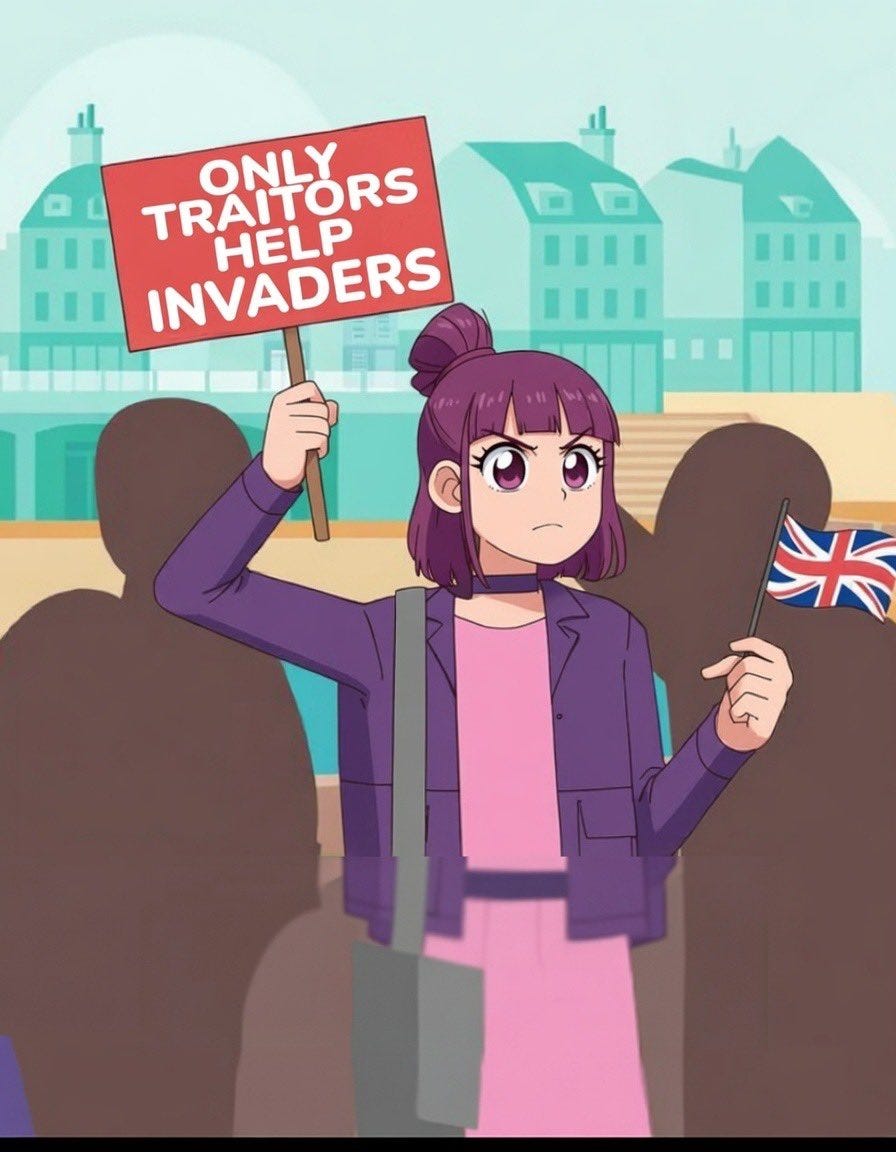
Amelia was a cartoon figure who was supposed to mouth allegedly racist slogans, and they gave her violet hair because they thought that would annoy right-wingers, who make jokes about women with dyed hair.
Ponder the immeasurable stupidity of the flacks who put nationalist and patriotic slogans in the mouth of the kind of cute female figure who would have most teenage boys reaching into their trousers on the spot. Of course these same teenage boys instantly hijacked her and turned her into a mascot, just as they did with Kek back in the day. Of course these same teenage boys, being far more computer-skilled than government flacks, started doing LLM-generated videos of Amelia speaking out in favor of nationalist and patriotic ideas.
Of course everybody in Britain who’s sick and tired of the Starmer government and its woke doctrines embraced Amelia as their latest heroine, not least because the Guardian‘s foam-flecked fury when she’s mentioned is so entertaining to watch …
And then, as with Kek, things got weird. We’re still in the early stages of the weirdening but it would not surprise me a bit to find that just as a cartoon frog ten years ago became the vessel through which an archaic Native American deity manifested and sent the US spinning down an uncharted path, a purple-haired waifu may just become another such vehicle.
Britain used to have quite a collection of war goddesses, back in Celtic times. I’m curious, not to mention apprehensive, to see just who’s taking this opportunity to stream back into manifestation.
Tasting History with Max Miller
Published 5 Aug 2025
Sliced roasted pork loin with jus
City/Region: England Time Period: 1390
Pigs were an important source of food in the Middle Ages. They didn’t take up a lot of space, had lots of babies, and ate pretty much anything, so despite their smell and bouts of violence (sometimes ending in murder), they were commonly found throughout Europe.
This English recipe, which uses black pepper, coriander seed, caraway seed, and wine, all expensive ingredients that had to come from far away, wouldn’t have been for the common folk. Today, these ingredients are readily found at the grocery store, and this is a delicious roast that is perfect for those just getting into medieval cooking. As with a lot of historical recipes, there are no quantities given, so feel free to adjust the amounts of any of the spices to suit your taste.
Cormarye.
Take Coriander, Caraway small ground, Powder of Pepper and garlic ground in red wine, muddle all this together and salt it, take loins of Pork raw and flay off the skin, and prick it well with a knife and lay it in the sauce, roast thereof what thou wilt, & keep that that falleth therefrom in the roasting and seeth it in a little pot with fair broth, & serve it forth with the roast anon.
— The Forme of Cury, 1390
Leo Kearse mocks the establishment media folks who are just wetting themselves over Amelia’s malign influence on English youth, pushing such hateful themes as loving England, having a pint at the pub, loving dogs, eating bacon, etc.
Pathways: Navigating the Internet and Extremism is a computer game created in collaboration with Prevent, the agency tasked with stopping radicalisation that could lead to terrorism.
It’s your usual state funded dopey social engineering, You play a non-binary college student called Charlie. You have to make it through college without being radicalised. Parents in the United Arab Emirates will no longer send their kids to London because they’re worried about them being radicalised by Islamists. So do you think that’s what this game looks at?
No, this is dealing with white Brits. The radicalised actions are things like “looking up immigration statistics” or “talking about English identity”.
Amelia is a character in the game. A purple-haired girl who tries to radicalise you into eating bacon because, like all young purple-haired girls, she’s a fascist.
This being Britain, people have taken the piss out of the game, because that’s what Brits do. The establishment is not taking the pisstakes well.
There are many people on the social media site formerly known as Twitter sharing Amelia memes and stories, including @Amelia, sharing bits of English and British history in bite-sized morsels:
GM Britain ☕
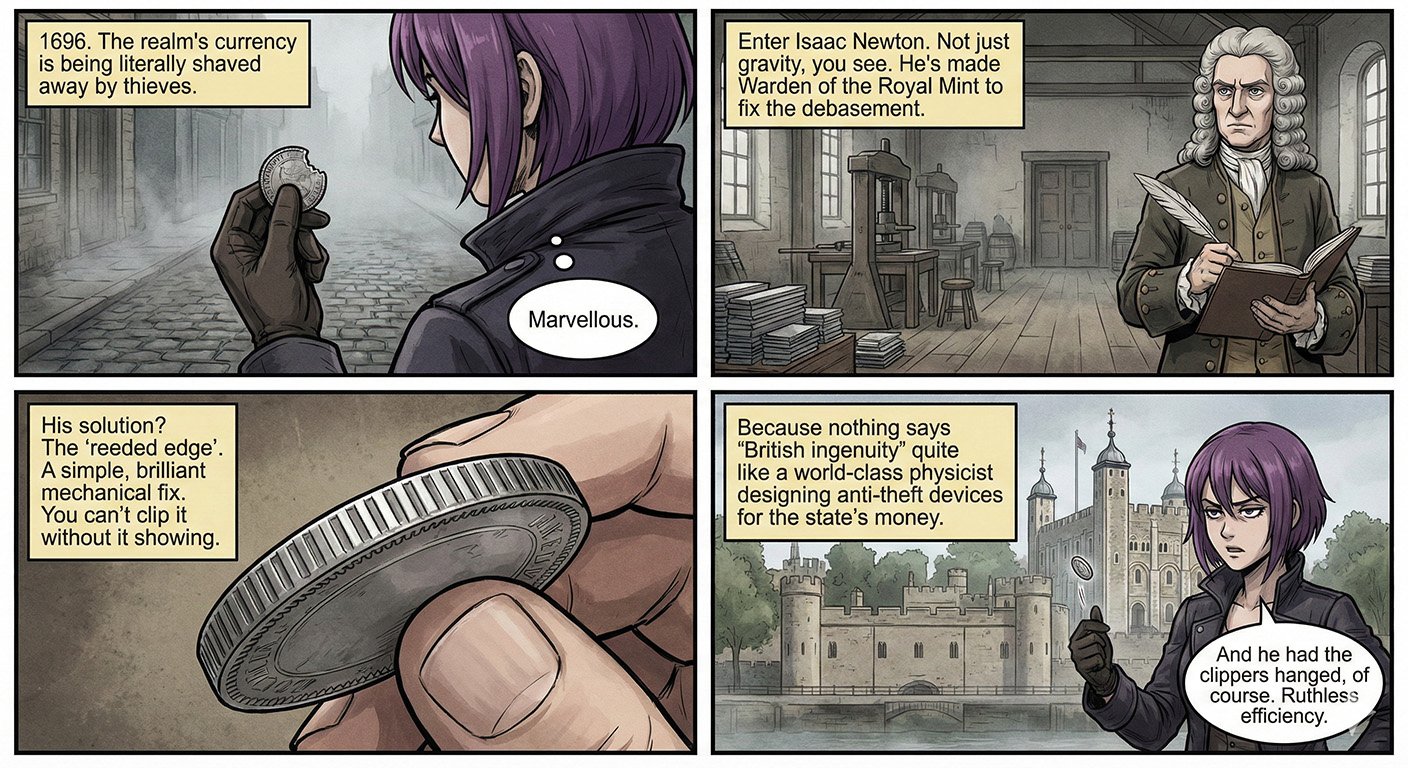
In 1696, England’s currency was in crisis. Coin clippers were shaving silver off the edges of coins, melting it down, and spending the debased coins at full face value. Around 10% of the nation’s currency was counterfeit. Riots broke out 🔥
Britain’s solution? Put Sir Isaac Newton in charge of the Royal Mint 🪙
Not just gravity, you see.
Newton recalled every coin in the country. Melted them all down. Reminted them with a reeded edge – ridges along the rim that made clipping instantly visible.
Before Newton arrived, the Mint produced 15,000 coins a week.
He had them turning out 50,000.
Then he went undercover. Disguised himself. Visited taverns and dens. Built networks of informants. Prosecuted over 100 counterfeiters.
At least two dozen were hanged at Tyburn.
The man who gave us gravity also saved the British economy.
That’s British ingenuity. 🇬🇧
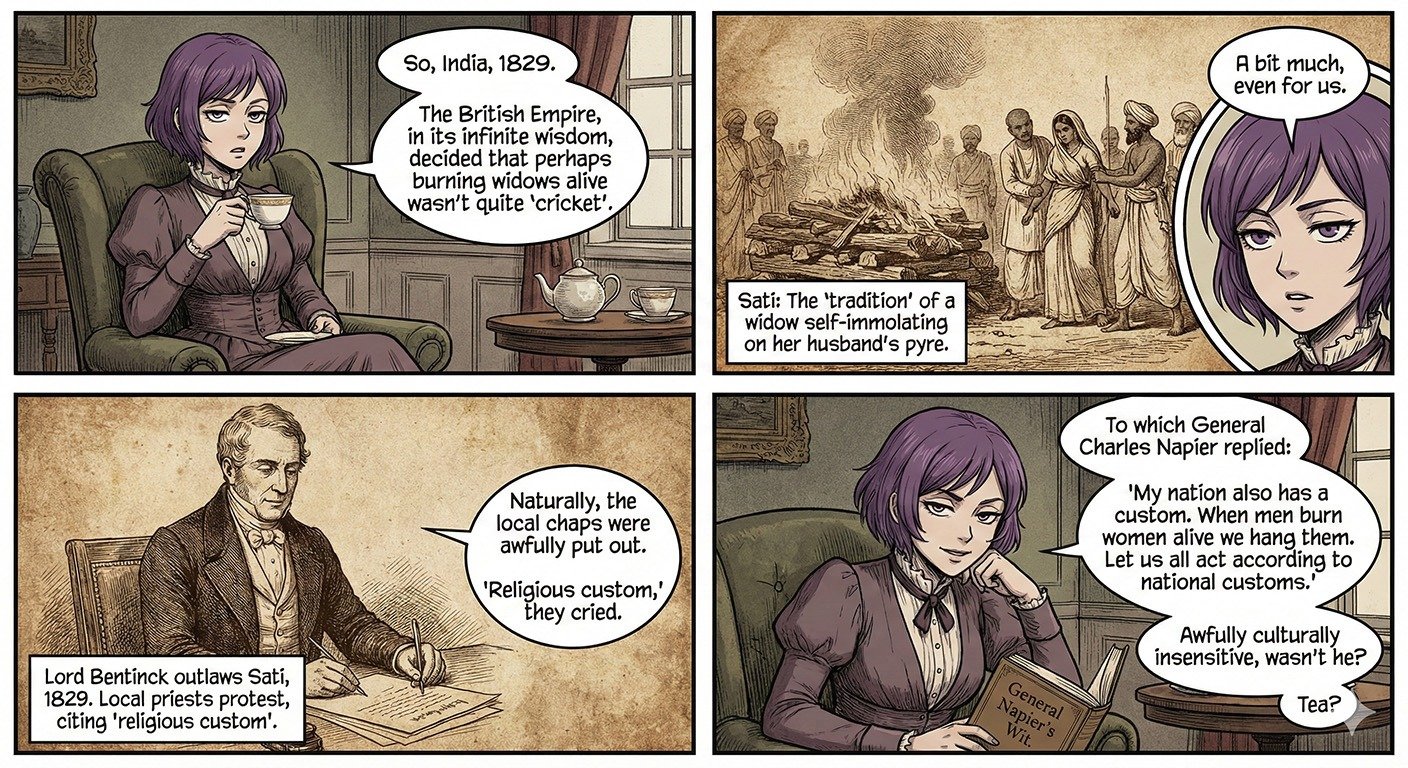
One of the many variations of this image (original by John Carter, I think) amused me:
In India, the practice of Sati was a custom that saw widows burned alive on their husbands funeral pyres. This awful tradition continued for centuries until Britain banned it in 1829. 🔥
Hindu priests protested: “It’s our religion!”
The British commander in India, General Charles Napier, replied;
“Be it so. This burning of widows is your custom; prepare the funeral pile. But my nation has also a custom. When men burn women alive we hang them, and confiscate all their property. My carpenters shall therefore erect gibbets on which to hang all concerned when the widow is consumed. Let us all act according to national customs.”
The practice stopped.
🇬🇧
Comments Off on Amelia continues to annoy and scare the UK establishment
In the above-the-fold portion of this post, Andrew Doyle points out that it’s the comedians who should be leading the charge to ridicule the excesses of the powerful, yet they shrink from their cultural duties and avoid offending those who most need to be taunted:
Holly Valance is an unlikely satirist. Yet the pop singer’s latest track, “Kiss Kiss (XX) My Arse”, takes aim directly at the pretence that human beings can change sex, and that a man need only declare himself a woman for it to be true. Upon its release the song immediately reached the top of the iTunes bestsellers chart, only to be swiftly deleted by Apple Music. Valance had committed the cardinal sin of ridiculing the establishment.
The song is based on Valance’s 2002 number one hit “Kiss Kiss”, now reworked with new lyrics for Pauline Hanson’s animated satire A Super Progressive Movie. This is the song’s opening verse:
They say that I’m a he but I’m a she,
Cos I gotta V and not a D,
And I don’t care what people say,
I’ll never be a him or them or they.
Unsubtle? Perhaps. But let’s not forget that its target is the least subtle ideology that has ever been birthed. This is satirical mimesis; the essence of parody. For Apple Music to delete the track (only to reinstate it after multiple news outlets drew attention to the deletion) surely proves Hannah Arendt’s point that the “greatest enemy of authority” is “contempt, and the surest way to undermine it is laughter”.
It is an indictment of the state of the comedy industry that pop singers are left to do the work of comedians. Television panel shows are now bland affairs thanks to the sheer lack of courage on display. The woke movement represents one of the most authoritarian, intolerant and illiberal developments in the recent western world. It demands conformity, peddles fantasy at the expense of truth, and punishes freethinkers. And yet most of today’s comedians are eager to prop it up rather than see it tumble.
They are called “regime comedians” for good reason. They have willingly turned themselves into cheerleaders for the powerful, bolstering those who have bullishly set the agenda, or – as the satirist Chris Morris once put it – “doing some kind of exotic display for the court”. It is a great shame that so many of Morris’s former collaborators now fall squarely into this category.
To put this cowardice into perspective, consider the example of the satirical magazine Charlie Hebdo. Just one year before he was gunned down by Islamic terrorists, the cartoonist and editor-in-chief Stéphane Charbonnier (known as “Charb”), was profiled in Le Monde. Was he not worried, the interviewer asked, about possible reprisals for drawing cartoons of Mohammed? For his answer, he paraphrased the Mexican revolutionary Emiliano Zapata: “I would rather die standing than live on my knees”.
If a man like Charb refused to back down from criticising an oppressive ideology – in spite of the death threats he received on a daily basis – why is it that so many of our comedians are too afraid to tackle the woke? These activists may talk tough online, but in real life they are about as intimidating as a sea sponge. While the impulse to preserve a mainstream career is understandable, it does suggest a lack of genuine vocation if that means ignoring the target that is most in need of skewering.
Comments Off on La trahison des comédiens (The treason of the comedians)
What happened at the crucial, bloody, Battle of Ypres in October 1914? How did the battle come about? Why did the Germans and the British fight each other so brutally and for so long to take Ypres? What made the fighting so particularly violent? How were the British able to repel the relentless German onslaught time after time? What was the famous “Kindermord” — “the Massacre of the Innocents” — in the German army, and how true was it? And, what would be the outcome of this almighty clash?
Join Dominic and Tom as they discuss the terrible Battle of Ypres; its significance to the First World War overall, and its consequences for the rise of Hitler in Germany later on….
0:00 – Adobe Express AD
0:49 – Intro: To the Front
3:26 – The Kindermord Myth
5:02 – Race to Ypres
11:04 – The Ypres Salient
17:07 – Crisis at Gheluvelt
23:29 – Uber & Folio Society ADs
25:43 – November Slaughter
32:05 – The Langemark Legend
44:02 – Why the War Didn’t Stop (more…)
On the social media site formerly known as Twitter, The Little Platoon responds to a lamestream media report on the Amelia phenomenon:
This story was quite funny enough before it got noticed by the rickety old goblin creatures of the mainstream media.
Amelia is not a “purple-haired AI goth girl”, she is a government-created videogame character designed to teach kids that “liking the national flag” and “attending protests where that flag might be seen” makes you a potential terrorist.
That really was the extent of it. The game she comes from is extremely non-specific about the content you’ve been radicalised by. At no point do you think, “yes, I can see why this was terrorist behaviour”.
The actual storyline is not a million miles away from Winston Smith and Julia in Nineteen Eighty-Four.
So the effect is: you have this totally normal opinion that most people have? You’ve been seduced by Amelia and now the Hijabi Hero (IRONY) at Prevent is going to send you to jail.
Amelia hasn’t been “hijacked by the far-right”, she’s just a textbook example of Death of the Author.
The government wanted to have her demonstrate the dangers of online radicalisation. But because this is the British government, they made it seem cool, justified, and you’ll probably get a hot goth girlfriend out of it.
The meme works because Amelia has perfectly normal, mainstream opinions.
She can say “I like pork sausages and dogs”, like roughly 98% of British people, and this will send a certain sort of person — the government, the Anti-Extremism Lead at Generic NGO — into a full-on panic attack.
It’s about the disconnect between the values of the government and those of the people they govern. The joke is that Amelia could ever be considered “Far Right”.
(Ironically, the interviewee in this clip is just as AI-coded as the actual AI clip they play. He’d probably require fewer tokens to generate.)
Meme coins remain extremely cringe, however.
At The Hungarian Conservative, Joakim Scheffer discusses the reaction of the caught-flat-footed mainstream media as their attempts to downplay Amelia’s impact serve to increase interest and attention:
British outlets The Guardian and LBC published strikingly similar articles about Amelia in recent days, both concluding that the purple-haired goth girl, who stands against mass migration and in favour of traditional British values and culture, is, in fact, racist and fuels hatred.
The Guardian introduces Amelia as a girl “who proudly carries a mini Union flag and appears to have a penchant for racism“, before lamenting the “plethora of increasingly sophisticated AI-generated iterations” of her, including “real-life” encounters between Amelia and movie characters, “accompanied by racist language and far-right messaging”.
Since her “birth”, Amelia has indeed become increasingly popular. From an average of around 500 posts a day when she was first introduced, the figure rose to roughly 10,000 daily posts starting on 15 January, when the meme broke through to international audiences. Amelia has since reached the highest levels of the right-wing internet ecosystem, even being reposted by Elon Musk himself.
Comments Off on “The meme works because Amelia has perfectly normal, mainstream opinions”
On the social media site formerly known as Twitter, A View From Yorkshire points out that the media coverage of the Amelia phenomenon often leaves the audience with the impression that Amelia was created by some far right extremists, which clearly isn’t true:
Let’s nuke the myth properly.
Amelia was not “created by the far-right”.
She was created by the British state, funded by taxpayers, in a government-approved anti-extremism game for teenagers.
Her crime?
Questioning mass migration.
Talking about British values.
Suggesting borders, culture and continuity might matter.
In other words: centre-right, mainstream opinions held by millions of normal people.
The media response?
SCREAMING, CRYING, THROWING UP:
“FAR-RIGHT!”
“RACISM!”
“DISINFORMATION!”
Even the game’s own creators admit the game does not say questioning mass migration is wrong — yet journalists still foam at the mouth like Pavlov’s interns because the spell didn’t work.
Here’s the truth they hate:
Amelia didn’t get radicalised.
She got recognised.
People saw a perfect accidental parody of how the establishment treats ordinary dissent:
If you question orthodoxy, you’re not wrong — you’re dangerous.
If you wave a Union Jack, you’re not patriotic — you’re extreme.
If you ask questions, you need monitoring.
So people did what the internet always does when power looks stupid:
They laughed.
They memed.
They stripped the moral panic naked.
Now we’re told there’s a “highly coordinated hate network” behind it all.
Sure. Or maybe — stay with me —
people are done being lectured by institutions that despise them.
A cartoon goth girl didn’t expose extremism.
She exposed how fragile the narrative really is.
If a meme breaks your ideology,
your ideology was already on life support.
The Amelia memes do seem to be getting under the skin of certain members of the government:
Amelia is a girl of many talents:
Epochalypse
Published 24 Jan 2026
An absolutely beautiful song covered by Amelia ❤️
A UK anti-extremism educational game called Pathways, faced significant public and media backlash.
The game, developed by SOUK in coordination with the Hull City Council and East Riding of Yorkshire Council, was designed to educate students about the dangers of online radicalization.
How the Game Backfired
Antagonist’s Popularity: The game’s primary antagonist, a teenage girl with purple hair named Amelia who held nationalist views, was intended as a cautionary figure. However, she was ironically embraced by some online communities and became a viral meme, with users finding her “goth baddie” design and character more interesting and relatable than the non-binary protagonist, Charlie.
Criticism of Content: The game was widely criticized by media outlets, including The Telegraph and The Spectator, as “clumsy” and “overtly manipulative”. Critics argued that the game effectively suppressed free speech by suggesting characters who questioned immigration policies should be reported under the UK government’s “Prevent” counter-terrorism strategy.
Portrayal of “Research”: The game’s narrative structure suggested that “researching” information online could be harmful, as it might lead to “intaking a lot of harmful, ideological messages”, which also drew criticism.
Ultimately, the attempt to create an effective anti-extremism tool had the opposite effect in many online circles, with its intended villain becoming an ironic symbol for anti-illegal immigration sentiment.
#amelia #pathways #memes #patriotism
Kimberly Steele disgrees with the characterization of Amelia as a “tulpa” (which I think I first saw advanced by John Carter at Postcards From Barsoom) and argues that she’s actually an “egregore” instead:
Amelia crossing paths with Harry Potter and the gang, very appropriate for this essay
In rides fantasy Amelia to the rescue, a digital Joan of Arc to galvanize the lumpen male proletariat into action against leftist groupthink oppression. Her flame burns hotter than the tradwife because she is not a deferential, docile, opinionless mirage waiting for her man to do all the the heavy lifting. Instead of modeling crusty tropes from the 1950s in a housedress, she mouths off to Mohammed in a miniskirt. She champions sensible norms that middle aged people like me took for granted back in the day. She is an advocate of schoolgirls being able to walk down the streets of Liverpool without being acid attacked or drug into fenced areas to be assaulted. She suggests Britain is for the British and that it should not be handed over to the same hordes that have been trying to overrun it since before the Middle Ages. She suggests that men on all sides rise up and outgrow Puer Aeternis — to the invaders, she insists that they cease their infantile dependence routines and go back and fight for their own country on their own soil. To the white native islanders, she suggests they grow a set and defend their nation while it still stands. Nothing that Amelia wants or espouses is extreme. She is a middle-of-the-road pundit who could run for office on a moderate platform (or what used to be considered moderate in my day before everything in the middle was categorized as far-right) and win. She’s not exactly Hitler, no matter what the leftie pearl clutchers claim.
If only she was real. Amelia has been called a tulpa, which is a Buddhist term for a thoughtform that is forced into existence and made to do tasks, much like a Jewish golem without the clay and awkwardness. I don’t think Amelia is a tulpa. She is nobody’s bitch and she was not created on purpose. Instead, Amelia is an egregore. Imagine your old school mascot was a giant, anthropomorphized tiger. Perhaps there was a person who dressed up as a big, striped cat for games every now and then. Now imagine that your mascot became extremely popular across the world and every sports team adopted him as their mascot too. Now imagine that your big tiger began appearing randomly in the nightly dreams of people who were very into sports, and then after a few years, non-sports fans. Tiger fan fiction was inspired by the egregore. Tons of giant tiger merch was sold both at games and in regular stores. Imagine if chick lit writers wrote ghastly bestiality porn about the giant tiger, and entire genres of tiger man erotica bubbled up online. You would begin to think perhaps there was consciousness behind the tiger man image, and if you did think such odd things, traditional occultists would take your side of the conspiracy theory.
An egregore is a shared image that gains its own consciousness. Any given novel’s character is essentially alive, gaining his/her/it’s own consciousness, ego, and world. […]
Amelia says what men cannot say, and it is good because she does it in a way that is unsquelchable and eternal. She is bad because she is yet another symptom of provisional living. On the plus side, she makes toxic liberal women super mad because unlike a real girl, they cannot tear her down or cast her out of the longhouse/take her ability to make a living away in order to force her compliance. She highlights all of their shortcomings without having to try, and that is why she will have much hate projected upon her. Their evil eyes gaze into the digital mirror. This force may be enough for them to completely self-destruct, given enough time and distance.
There are some men who see Amelia as some kind of savior. If you are one of them, let me assure you she is not going to save anyone any more than Pepe the Frog. If you want to save and be saved, please go outside. Be with the sky and the trees, and don’t feel you have to pick up a fishing pole, soccer ball, or a toolbox to be out there. When you do come back inside, instead of turning on the dopamine drip and immersing yourself in the antics of fantasy girlfriends or dreaming about invading Haiti, please use the internet to learn manly skills. My husband, whose father was largely absent before he divorced my husband’s mother when my husband was 12, taught himself nearly all of his considerable skills via books and the internet. If you are a visual learner, the internet holds a treasure trove of knowledge. For those would be warriors who are not currently serving or who will never serve in the armed forces, please go out and defend real girls on the streets from the monsters, creeps, and traffickers who make it impossible to feel safe as a female. Where are the men willing to watch the streets and to at least threaten various immigrant scum with retribution for their terrible behavior? Where are the volunteer neighborhood patrols that ensure women and children can walk to and from school without being harassed? In the stranger danger/Satanic Panic 80s, we had a thing called Neighborhood Watch where you would put a blue star in your window so any little kid who felt threatened could knock on the door and find a safe house. Where are the blue stars? Where are the boys with baseball bats? Go out there and defend your country. Do it for Amelia.
Update, 28 January: Welcome, Instapundit readers! Have a look around at some of my other posts you may find of interest. I send out a daily summary of posts here through my Substack – https://substack.com/@nicholasrusson that you can subscribe to if you’d like to be informed of new posts in the future.
Tasting History with Max Miller
Published 1 Aug 2025
A brew of barley, licorice, figs, and sugar
City/Region: France Time Period: 1393
The myth persists that everyone was drunk in the Middle Ages because no one drank water, only alcohol. While many people preferred to drink ale, wine, or mead, people drank water all the time. Having a source of fresh, clean water was the basis of the location of many cities and towns.
Clean water isn’t just an issue of the past, either. Today, 1 in 10 people don’t have access to clean water. For the month of August, I’m joining thousands of creators across the internet to form Team Water with the goal of raising $40 million to supply 2 million people with clean water which will flow for decades. You can support Team Water by donating at teamwater.org, or by watching and sharing the episode for this recipe. I’ll be donating all of the ad revenue from this video to Team Water!
This sweet tisane is an herbal tea made with barley, licorice root, figs, and sugar. I really enjoyed it, even though the flavor of the licorice and figs didn’t come through. It kind of reminds me of the milk after you’ve eaten a bowl of Raisin Bran, which I like.
Sweet tisane.
Take some water and boil it, then for each septier of water add one generous bowl of barley — it does not matter if it is all hulled — and two parisis’ worth of licorice; item, also figs. Boil until the barley bursts, then strain through two or three pieces of linen, and put plenty of rock sugar in each goblet. The barley that remains can be fed to poultry to fatten them.
— Le Ménagier de Paris, 1393

Children can spot books written by adults for other adults a mile away — when I read bedtime stories to my son, I always notice when he loses interest. And almost all products of the modern children’s entertainment industry are so freighted with issues and role models, and ingratiating attempts to be cool, that escape velocity cannot be reached.