
As a child of postwar England, I found that there was no love lost for the Germans. So I set out to find that lost love. I don’t remember how many times I encountered unthinking hostility towards them, but it was often enough to make me think there must be something to be said for them.
“Don’t let’s be beastly to the Germans,” Noël Coward had jeered in 1943. “It was just those nasty Nazis who persuaded them to fight.” It hadn’t been true then, of course, and the wartime generation still hadn’t quite forgiven the Germans, not only for their crimes against humanity, but for bouncing back faster than the British in the 1950s.
Erhard’s “economic miracle” had rubbed salt in the wounds of a nation that had sacrificed its status as a great power in order to save Europe. And now that same Europe had cold-shouldered the British, excluding us not once but twice from their new “economic community”. In the 1960s and 70s it was often the British, not the Germans, who felt despised and rejected. After 1966, Germanophobic football fans would chant “Two world wars and one World Cup”, but that was mere bravado. Everyone knew that the boot was now firmly on the other foot — and in many British eyes, it was a jackboot.
Daniel Johnson, “How I discovered Germany”, The Critic, 2020-08-02.
January 27, 2026
QotD: “Two world wars and one World Cup!”
January 26, 2026
How Al Stewart struck gold, the folk boom and a flat-share with Paul Simon
Word In Your Ear
Published 20 Dec 2024The 17 year-old Al Stewart played electric guitar in a dance band in Bournemouth in 1963. When he borrowed an acoustic and sang “Masters Of War” in the break, he heard the sweet sound of applause. The next night he played three Dylan songs and sensed which way the wind was blowing. He talks here about moving to London, playing at Bunjies and becoming the compere at Les Cousins as his now 60-year career began to lift off. And about his Farewell Tour which kicks off in the UK in October 2025, a combination of songs and story-telling coloured by two great heroes, Peter Ustinov and Alistair Cooke.
This cracking exchange steers by way of Bert Jansch, Bob Dylan, Helen of Troy, Stalin, Hitler and the Battle of Moscow, the Weeley Festival of 1971, the three songs he always plays, the young Cat Stevens and what he told Paul Simon he should do with the just-composed “Homeward Bound”.
January 24, 2026
Britain’s Amelia phenomenon
On his Substack, Fergus Mason talks about the new Queen of English Resistance, Amelia:

Amelia, the new queen of the British right.
Independent journalism is a pretty grim business right now. Writing about the state of our poor broken country can be soul-destroying. Good news is thin on the ground; new calamities seem to arrive daily, either a fresh atrocity committed by an illegal immigrant or some new Labour assault on our freedom. So it’s nice when something a little more light-hearted comes along — even if it does make some serious points, too.
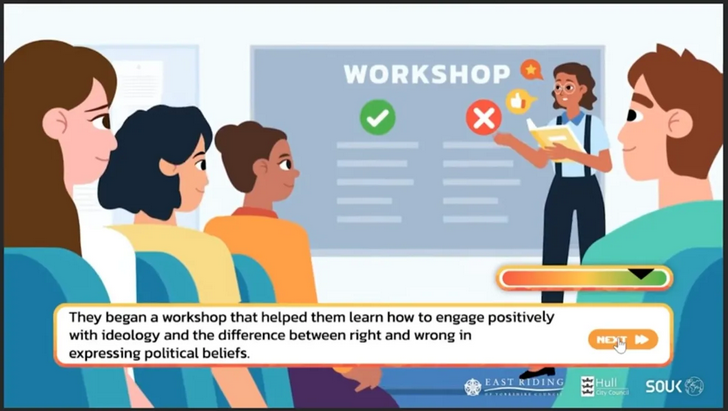
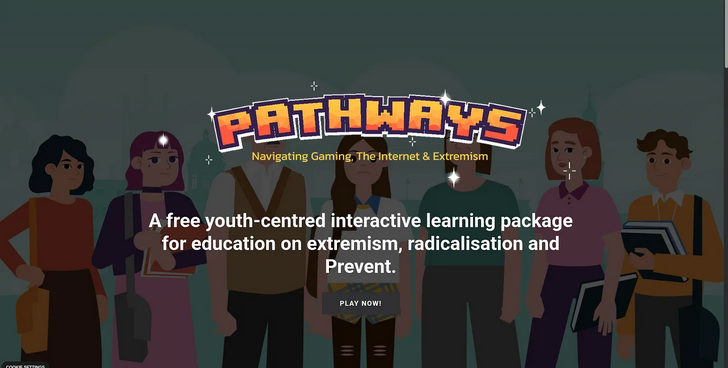
A couple of weeks ago the media started reporting a new online game funded by Prevent, the government’s (completely dysfunctional) department for diverting people away from extremism. Commissioned by Hull City Council and produced by “creative social enterprise” Shout Out UK, the game — called Pathways — is intended to “Encourage learning about the concept of extremism and radicalisation through the process of choice and safe exploration”.
As games go, this is a spectacularly dull one. Players choose a character, from a very limited selection — there are two, one male and one female, but they’re both called Charlie and use they/them pronouns. They then have to navigate their character through a series of scenarios, answering multiple-choice questions. The idea is that if you give the “wrong” answers you’ll get referred to Prevent, but it soon becomes obvious that almost any answers will get you referred to Prevent. The constant theme is that there are approved views and ways of acting — which don’t, for example, include doing research to find out if something you saw on the internet is true or not — and that, if you deviate from this, the state will step in to “support” you. A lot of this support looks suspiciously like re-education:
[…]
Of course, if you know much about the online right, you’ll probably see the problem already. As one stunned Reddit user commented, “Wait, are you telling me they made the cute goth e-girl the ‘racist’? Do they understand how the internet works?”
Well, they certainly do now.
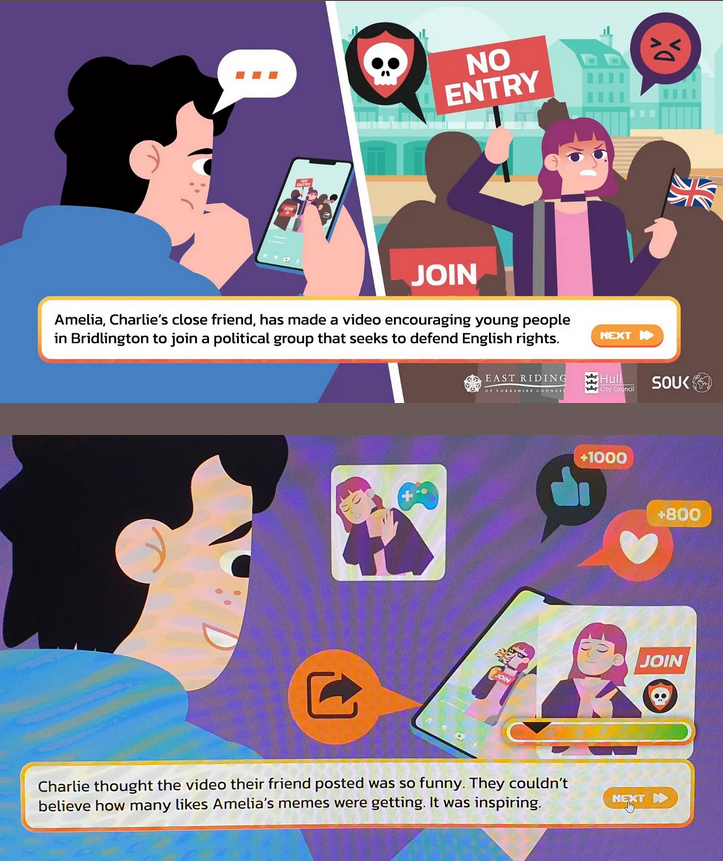
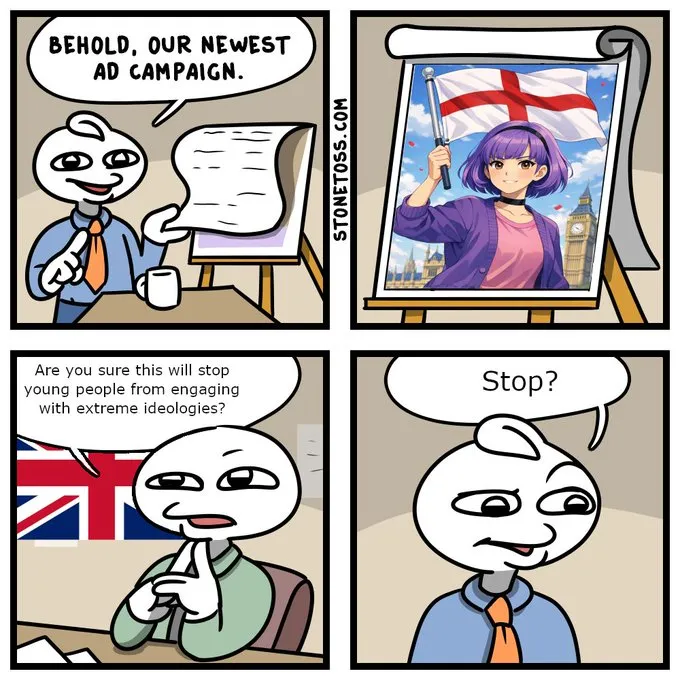
The Daily Telegraph published an article about Pathways on 9 January, bringing the game to public notice. That same day, X user Bovril-Gesellschaft posted “I think I’m in love with Amelia”. It seemed many other right-wingers were too, because within hours Amelia memes were appearing in large numbers. Mostly produced with AI, these depicted Amelia in a wide range of styles (probably reflecting their creators’ personal tastes), but all featured her purple hair and most stuck with the outfit of a pink dress and purple hoodie or cardigan the game depicted her in. Images ranged from cartoons in the style of the original game to photorealism. […]
There’s a lot to laugh about in this. For example, brightly coloured “danger hair” has generally been the hallmark of women on the far left. Amelia subverts this by giving our new heroine her distinctive purple bob. Will we see the pro-Hamas nuts and trans cultists abruptly return to natural hair colours to dissociate themselves from Amelia? That would be funny.

January 23, 2026
The Rise and Fall of Watneys – human-created video versus AI slop
YouTuber Tweedy Misc released what he believed was the first attempt to discuss Watneys Red Barrel, the infamous British beer that triggered the founding of the Campaign for Real Ale (CAMRA). His video didn’t show up in my YouTube recommendations, but a later AI slop video that clearly used Tweedy’s video as fodder did get recommended and I even scheduled it for a later 2am post because it seemed to be the only one on the topic. I’m not a fan of clanker-generated content, but I was interested enough to set my prejudices aside for a treatment of something I found interesting. Tweedy’s reaction video, on the other hand, did appear in my recommendations a few weeks later, and I felt it deserved to take precedence over the slop:
And here’s the AI slop video if you’re interested:
Dear Old Blighty
Published Dec 20, 2025Discover how Watneys Red Barrel went from Britain’s biggest-selling beer to its most hated pint in just a few short years. This video explores how corporate brewing, keg beer, and ruthless pub control nearly destroyed traditional British ale, sparked a nationwide consumer revolt, and gave birth to CAMRA. From Monty Python mockery to boycotts in local pubs, Watneys became a national punchline and a cautionary tale in business failure. Learn how one terrible beer accidentally saved British brewing culture, revived real ale, and reshaped how Britain drinks forever.
#Watneys #BritishBeer #UKNostalgia #RealAle #CAMRA #BritishPubs #RetroBritain #LostBrands #BeerHistory #DearOldBlighty
WW1: 1 Million Vs 1 Million at the Marne | EP 3
The Rest Is History
Published 1 Sept 2025What extraordinary events saw the French — already on the brink of defeat — take on the formerly formidable German army in a remarkable counter-offensive on the 4th of September, in France, in a clash that would later become known as the Miracle on the Marne? Why was this such a decisive moment in the events of the First World War How did it relate to the famous Schlieffen plan? Did it really see the French charging into battle in Renault taxis? And, why did it become one of the most legendary moments in all of French history?
(more…)
January 22, 2026
Dresden Part 1 – Targets, Tangents & Genocide
HardThrasher
Published 20 Jan 2026Was Dresden a war crime or a late-war military decision made in cold blood? The firebombing of Dresden (13–14 Feb 1945) remains one of the most infamous episodes of the WW2 history: a firestorm, a shattered city, and a death toll that still sparks argument today.
But most of what “everyone knows” about Dresden is wrong. In Part 1 of this two-part series, you and I will dig into the real reasons Dresden became a target. We also ask the uncomfortable questions: Was Dresden an “innocent” city? How Nazi was it? And what does Dresden reveal about the logic — and limits — of strategic bombing? And because this is my video and I’ll do as I damn well please, we’ll also do a quick overview of nearly 1,000 years of history, because why not. Thus in this you will also get the Northern Crusades, a discussion of pottery, a smattering of Central European history and long discussion of how the Nazis subverted power and used it to abuse people whilst being wildly incompetent at the basics
00:00 – Start
04:39 – Part 1 – A Brief History of Everything in Central Europe
17:36 – Rise of the Nazis and the Nuremberg Laws
30:25 – Military and Industrial Dresden
34:03 – Failure to Prepare for War
40:37 – How did it become a target?
52:37 – Survivor’s Club
(more…)
January 21, 2026
“It is a deal so bad that only Keir Starmer could have negotiated it”
In Spiked, Fraser Myers says that British Prime Minister Keir Starmer fully deserves to be humiliated over his give-it-all-away negotiations for the Chagos Islands, which includes the strategic naval base at Diego Garcia:
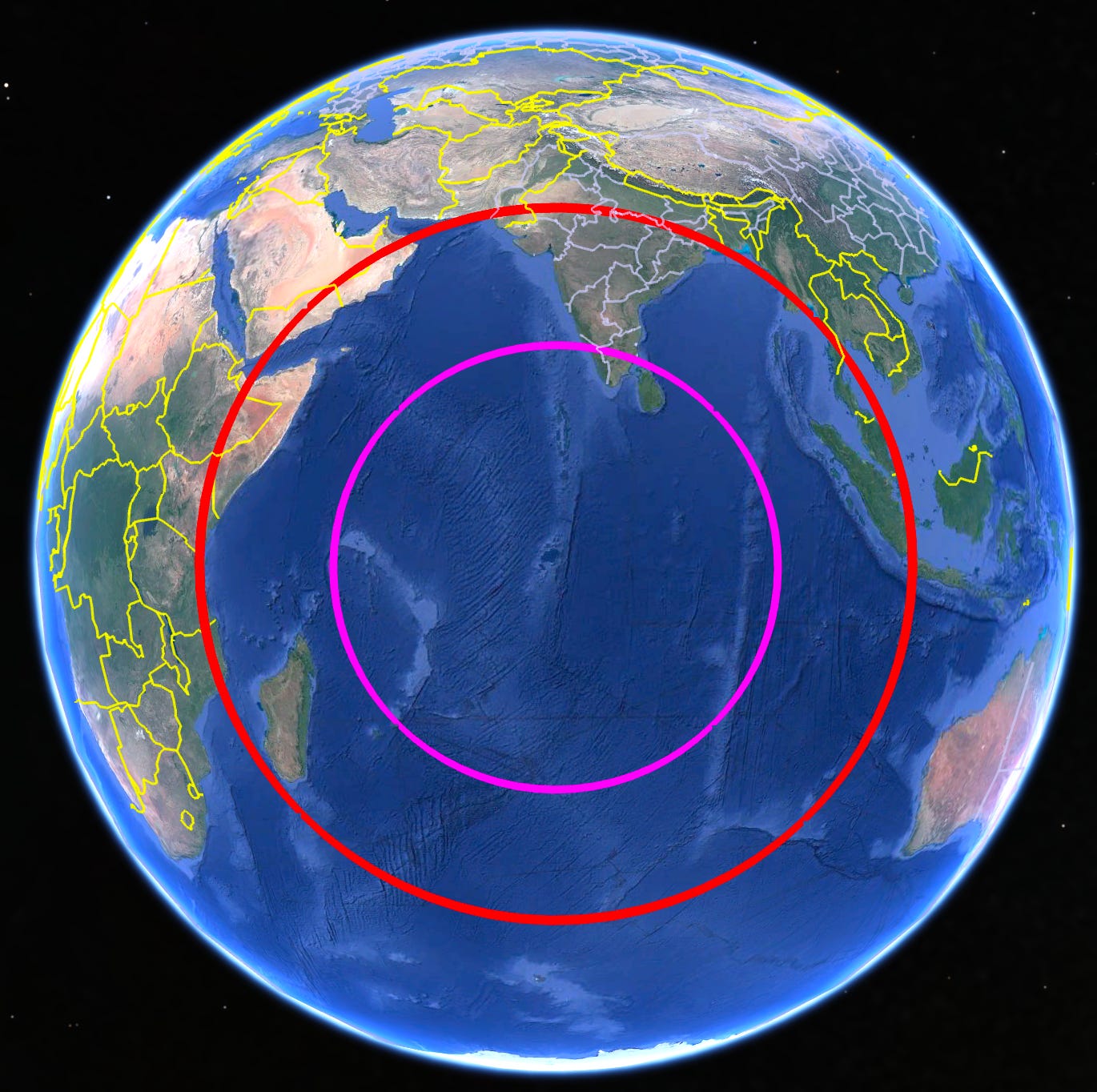
In the middle of that map is Diego Garcia, British Indian Ocean Territory and home to one of the most strategic airfields and anchorages on the planet. […] The red circle is 2,000 nautical miles from the island. The purple circle is 1,150 nautical miles, roughly the distance from London to Malta, that represents the distance from Diego Garcia. That circle is also the distance from Diego Garcia to the island of Mauritius.
Caption and image from CDR Salamander.
With the assistance of the brightest and best of the UK Foreign Office, the Labour government agreed to an arrangement that would hand over territory containing an Anglo-American military base to an unfriendly country, condemn its former inhabitants to permanent exile, and pay tens of billions of pounds for the pleasure.
I’m talking, of course, about Chagos (officially, the British Indian Ocean Territory), which has briefly caught the attention of the world’s most powerful man. This morning, amid a flurry of Truth Social posts about his designs on Greenland, US president Donald Trump’s gaze briefly alighted on this small, tropical archipelago on the other side of the planet. And he did not hold back in his criticism of Britain’s plans: “Shockingly, our ‘brilliant’ NATO Ally, the United Kingdom, is currently planning to give away the Island of Diego Garcia [the largest of the Chagos Islands], the site of a vital US Military Base, to Mauritius, and to do so FOR NO REASON WHATSOEVER”, he wrote. “The UK giving away extremely important land is an act of GREAT STUPIDITY”.
Trump’s reaction has widely been described as a major about-turn. But, in truth, his team has veered all over the place on the Chagos question. In October 2024, when Starmer initially agreed to hand over the islands, Marco Rubio, then still a US senator for Florida, reportedly warned that this would allow “Communist China” to spy on the US Navy, given Mauritius’s alliance with China. Yet in February 2025, when Starmer visited the Oval Office, the US president said he was “inclined to go along with” the UK’s proposals. And by May, when the deal was signed between the British and Mauritian governments, Rubio, by now US secretary of state, welcomed it. He claimed that Trump himself had “expressed his support for this monumental achievement”, hailing the deal that would cede sovereignty to Mauritius, while Diego Garcia would be leased to Britain for the next 99 years.
Of course, Trump’s motivation for bashing Starmer’s deal now has little to do with the Chagos Islands themselves. The real prize for the US president is in a different hemisphere entirely, as he freely admits. In a bizarre non-sequitur, the US president’s Truth Social post goes on to say that the Chagos deal is “another in a very long line of reasons why Greenland has to be acquired” by the US. This smackdown over Chagos, this attempt to humiliate Starmer and Britain on the global stage, is clearly part of Trump’s broader pressure campaign against the European powers, in his bid to seize Greenland for the US.
Nevertheless, it really should not have taken Trump’s intervention to put the brakes on the dreadful Chagos deal. Whichever way you spin it, this arrangement has never been in Britain’s national interest, nor the interests of the Chagossians who call the islands their home. It poses a risk to Western security interests, handing sovereignty over a territory, where almost 400 UK and US troops and 2,000 contractors are based, to a country that’s allied to China. The cost of leasing back Diego Garcia from Mauritius is also eye-watering. Although the Labour government tried to present the cost as just £3.4 billion, the true figure is believed to be 10 times as much, at around £34.7 billion.
So what on Earth possessed Starmer to sign up to such a risible deal? What leverage was a tiny island like Mauritius able to gain over Britain?
January 19, 2026
British Islamists scare Islamic governments more than the British government
In Spiked, Rakib Ehsan discusses the recent efforts by the governments of some Gulf states to limit potential radicalization of their own people by reducing support for students attending British universities:

Flag of the United Arab Emirates (UAE)
In yet another blow to Britain’s reputation on the global stage, the United Arab Emirates (UAE) has curbed state funding for its citizens seeking to enrol at UK universities, over concerns they will be radicalised by Islamists.
As reported in the Telegraph last week, the Gulf state has taken this drastic step because of the influence in the UK of the Muslim Brotherhood – a transnational Sunni Islamist organisation, which is a designated terror group in the UAE. It is also banned in Egypt, Saudi Arabia and Jordan. The UAE has long offered Emirati students generous grants – including rent and living allowances – for studying “priority” subjects at British universities. These scholarships have now ended because, according to a source quoted in the Telegraph, “the UAE doesn’t want its kids to be radicalised on campus”.
This is not the first time that the UK has been embarrassed for being a soft touch on Islamism by a Muslim country. In January last year, the UAE placed eight UK-based organisations on its local terror list on the grounds of their alleged connections to the Muslim Brotherhood. Most of these entities, which range from property firms to video-production outlets, are registered in London. Then, in April, the head of the Muslim World League, Saudi Arabia’s Sheikh Mohammad bin Abdulkarim al-Issa, warned that the UK should treat poor integration as a national-security issue. He said that young British Muslims had grown disillusioned because of conflicts in the Middle East, advising the UK that “a political situation outside should not interfere with integration inside”.
The UAE’s latest decision should hardly come as a surprise. Indeed, for some time, British universities have embraced the very extremism that Muslim-majority countries have long sought to root out.
January 18, 2026
Mark Carney’s actual jobs before becoming Prime Minister
On the social media site formerly known as Twitter, Ezra Levant explains the various jobs Mark Carney has held compared to what many Canadians think he’s done:
Laura Stone @l_stone
Unifor President Lana Payne calls China EV deal “a self-inflicted wound to an already injured Canadian auto industry”. Says providing a foothold to cheap Chinese EVs “puts Canadian auto jobs at risk while rewarding, labour violations and unfair trade practices”. #onpoliI think there’s a misconception amongst Canada’s chattering classes that Mark Carney is an experienced and successful businessman and executive.
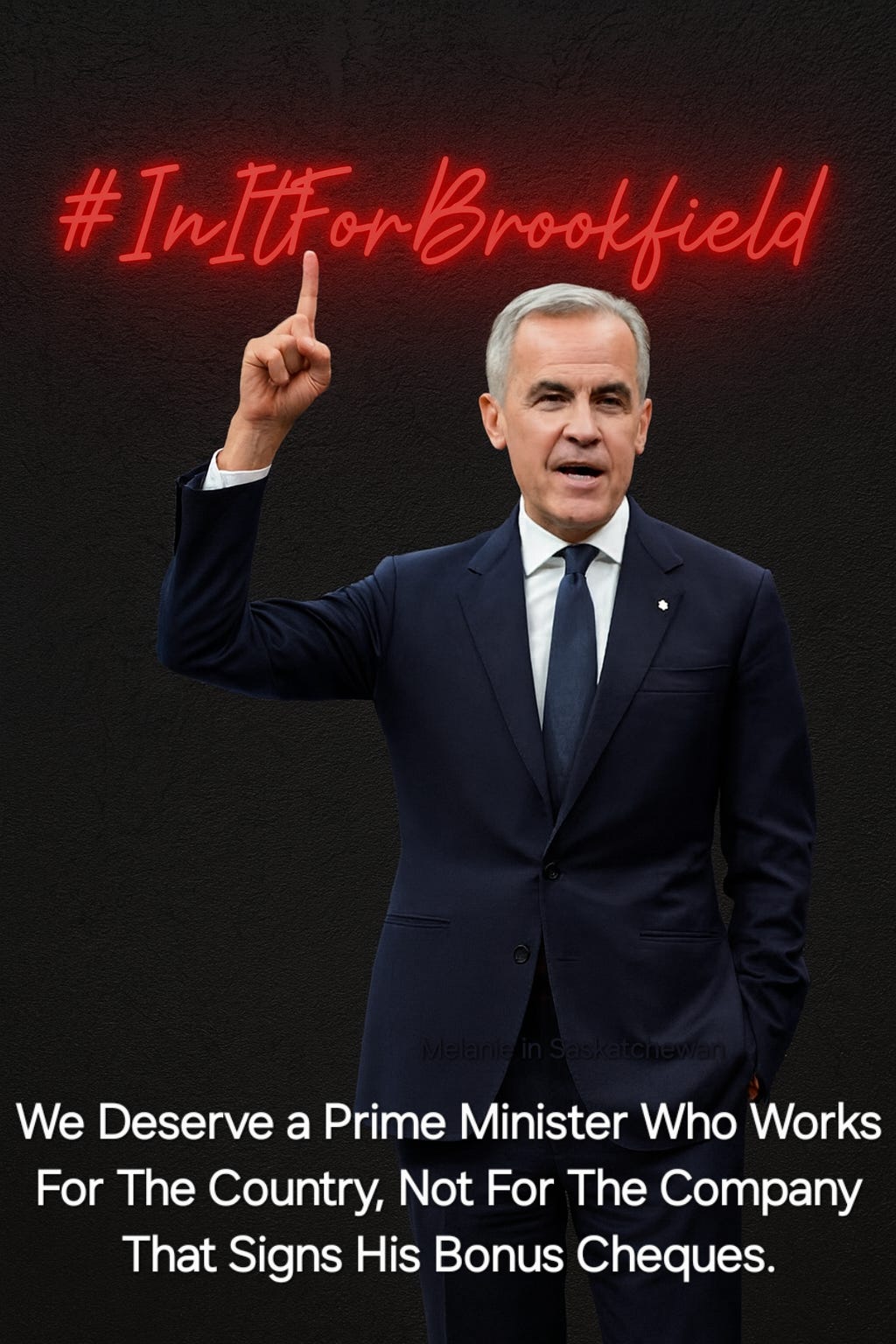
He wasn’t. He wasn’t CEO of Brookfield. He was its chairman, overseeing quarterly board meetings and spending the rest of his time flying around to different globalist conferences at the UN or WEF.
He was more of a mascot, a symbol, an ambassador of Brookfield. He didn’t negotiate deals or turn around companies. He did photo-ops.
Before that, he worked at the Bank of England, and before that, the Bank of Canada.
No Googling: can you name a single actual duty of that job? Can you tell me what Carney actually achieved?
He wafted up from fake job to fake job — like Justin Trudeau did, but instead of being a surf instructor and a substitute teacher, he had meaningless executive jobs.
And now when it’s time to shine … he doesn’t know what to do.
It’s been a year, and he has no deal with Trump, despite saying that was his chief focus.
What exactly did he achieve in Beijing? The tariffs against Saskatchewan were lifted — so that merely brings us back to the status quo ten months ago. Nothing else. No investments in Canada, which was the pretext of the trip. Just a capitulations, to allow the dumping of 49,000 Chinese EV cars, with their spyware and malware.
But he looks good in a suit and says ponderous words like “catalyze” and “transformative”. And that’s enough to impress the Parliamentary Press Gallery. Not that they needed much impressing — they’re all on his payroll already, through his massive journalism subsidies. They’re too busy holding the opposition to account to take notice of this latest disaster.
But the regime media shouldn’t feel too bad about being conned. Carney tricked Doug Ford pretty good, didn’t he?
January 17, 2026
Shout Out UK – “… embracing right-wing extremism will give you a shot at getting a manic pixie dream girl gf”
At Postcards from Barsoom, John Carter looks at the most amazing political own-goal I’ve encountered in a long, long time:
Somewhere in the suffocating fog of the unhappy and restless Yookay, a minor functionary of the government’s behavioural shaping bureaucracy is staring at her computer screen in appalled alarm at the horror she’s accidentally helped to summon from the churning depths of the Immaterium.
Shout Out UK, which describes its mission as “countering disinformation through political and media literacy”, released a “visual novel” called Pathways, subtitled “navigating the Internet, gaming, and extremism”. The game itself is of course terrible, a ham-fisted “teaching aid” intended to remind British teenagers that even innocuous and entirely peaceful activities – downloading memes, speaking your mind, watching videos, researching things for yourself, attending rallies – will complicate their lives if they draw the concerned and empathetic eye of the managerial state, which after all just wants what’s best for them.
Prevent, if you haven’t heard of them, are a group of government-funded busybodies whose remit is to prevent extremism via early intervention, catching impressionable youth before they can be radicalized. The organization was nominally started to deal with Islamic terrorists, but in recent years it has focused on the “right-wing extremism” of the native British to the exclusion of all else. The Southport butcher Axel Rudakubana, for instance, was referred to Prevent multiple times for his open glorification of white genocide, which Prevent ignored completely.
The player can choose either a male or female character, both of whom are amusingly and awkwardly referred to with they/them pronouns, with grammatical abominations such as “Charlie decided to look for themselves” sprinkled throughout. The character is then placed in a series of scenarios and made to choose between good and bad options: downloading extremist content or telling an adult; agreeing with a classmate that ethnic minorities are being shown favouritism at the expense of native youth vs clapping back at her unconscionable bigotry; watching a video and reading more about the subject or ignoring it; accepting or refusing an invitation to join a secret group chat; attending an anti-immigration rally or staying home. If you make the bad choice, a little “extremism meter” goes into the red.
[…]
If you want to play the game for yourself, your best bet is probably to download the archived version of the Government Approved Goth Girl Dating Simulator. I was able to play it a week ago, but since then it gets stuck on the loading screen, which at first I thought was because they’d taken it offline, but is probably just because Shout Out UK has gotten DDOSed by an entirely unexpected surge of interest in their execrable product (or maybe it’s just that the Shout Out UK website has a dead link on its page, as after poking around a bit on their website I was able to find one that works). Alternatively, you can find most of the screenshots archived here.
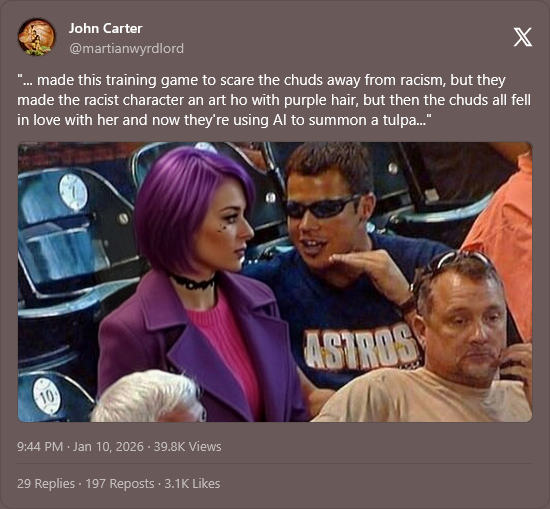
Had it not been for one unfortunate creative choice made by the development team, no one would have taken any notice of Pathways. It would have been one of countless cringe-inducing training aids churned out by regime-adjacent quangos cashing in on the flood of taxpayer lucre sluicing through the DEI-and-disinformation industry. But for some reason, which can be explained only by a calamitous failure on the part of Shout Out UK to develop an accurate theory of mind for their target audience, the creators of Pathways decided that it would be a great idea to cast the awful bigot leading the protagonist step by step to his ideological doom in the form of a cute alt girl, thereby sending the message that embracing right-wing extremism will give you a shot at getting a manic pixie dream girl gf.
Update, 18 January: Welcome, Instapundit readers! Have a look around at some of my other posts you may find of interest. I send out a daily summary of posts here through my Substack – https://substack.com/@nicholasrusson that you can subscribe to if you’d like to be informed of new posts in the future.
QotD: The introduction of tanks on the western front did not break the trench stalemate
In theory, a good tank ought to be effectively immune to machine-gun fire, able to cross trenches without slowing and physically protect the infantry (who could advance huddled behind the mass of it), all while bringing its own firepower to the battle. Tracked armored vehicles had been an idea considered casually by a number of the pre-war powers but not seriously attempted. The British put the first serious effort into tank development with the Landship Committee, formed in February of 1915; the first real tanks, 49 British Mark I tanks, made their first battlefield appearance during the Battle of the Somme in 1916. Reliability proved to be a problem: of the 49 tanks that stepped off on the attack on September 15th, only 3 were operational on the 16th, mostly due to mechanical failures and breakdowns.
Nevertheless there was promise in the idea that was clearly recognized and a major effort to show what tanks could do what attempted at Cambrai in November of 1917; this time hundreds of tanks were deployed and they had a real impact, breaking through the barbed wire and scattering the initial German defenses. But then came the inevitable German counter-attacks and most of the ground taken was lost. It was obvious that tanks had great potential; the French had by 1917 already developed their own, the light Renault FT tank, which would end up being the most successful tank of the war despite its small size (it is the first tank to have its main armament in a rotating turret and so in some sense the first “real” tank). This was hardly an under-invested in technology. So did tanks break the trench stalemate?
No.
It’s understandable that many people have the impression that they did. Interwar armored doctrine, particularly German Maneuver Warfare (bewegungskrieg) and Soviet Deep Battle both aimed to use the mobility and striking power of tanks in concentrated actions to break the trench stalemate in future wars (the two doctrines are not identical, mind you, but in this they share an objective). But these were doctrines constructed around the performance capabilities of interwar tanks, particularly by two countries (Germany and the USSR) who were not saddled with large numbers of WWI era tanks (and so could premise their doctrine entirely on more advanced models). The Panzer II, with a 24.5mph top speed and an operational range of around 100 miles, depending on conditions, was actually in a position to race the train and win; the same of course true of the Soviet interwar T-26 light tank (19.3mph on roads, 81-150 mile operational range). Such tanks could have radios for coordination and communication on the move (something not done with WWI tanks or even French tanks in WWII).
By contrast, that Renault FT had a top speed of 4.3mph and an operational range of just 37 miles. The British Mark V tank, introduced in 1918, moved at only 5mph and had just 45 miles of range. Such tanks struggled to keep up with the infantry; they certainly were not going to win any race the infantry could not. It is little surprise that the French, posed with the doctrinal problem of having to make use of the many thousands of WWI tanks they had, settled on a doctrine whereby most tanks would simply be the armored gauntlet stretched over the infantry’s fist: it was all those tanks could do! The sort of tank that could do more than just dent the trench-lines (the same way a good infiltration assault with infantry could) were a decade or more away when the war ended.
Moreover, of course, the doctrine – briefly the systems of thinking and patterns of training, habit and action – to actually pull off what tanks would do in 1939 and 1940 were also years away. It seems absurd to fault World War I era commanders for not coming up with a novel tactical and operational system in 1918 for using vehicles that wouldn’t exist for another 15 years and yet more so assuming that they would get it right (since there were quite a number of different ideas post-war about how tanks ought to be used and while many of them seemed plausible, not all of them were practical or effective in the field). It is hard to see how any amount of support into R&D or doctrine was going to make tanks capable of breakthroughs even in the late 1920s or early 1930s (honestly, look at the “best” tanks of the early 1930s; they’re still not up to the task in most cases) much less by 1918.
Bret Devereaux, “Collections: No Man’s Land, Part II: Breaking the Stalemate”, A Collection of Unmitigated Pedantry, 2021-09-24.
January 16, 2026
Rapidly declining democracy in the home of the “Mother of Parliaments”
As I’ve mentioned before, it sometimes seems that Australia, Britain, and Canada are in a three-way race to de-democratize themselves as fast as they possibly can. Here’s the free-to-cheapskates portion of Ed West‘s essay on the return of liberal authoritarianism:
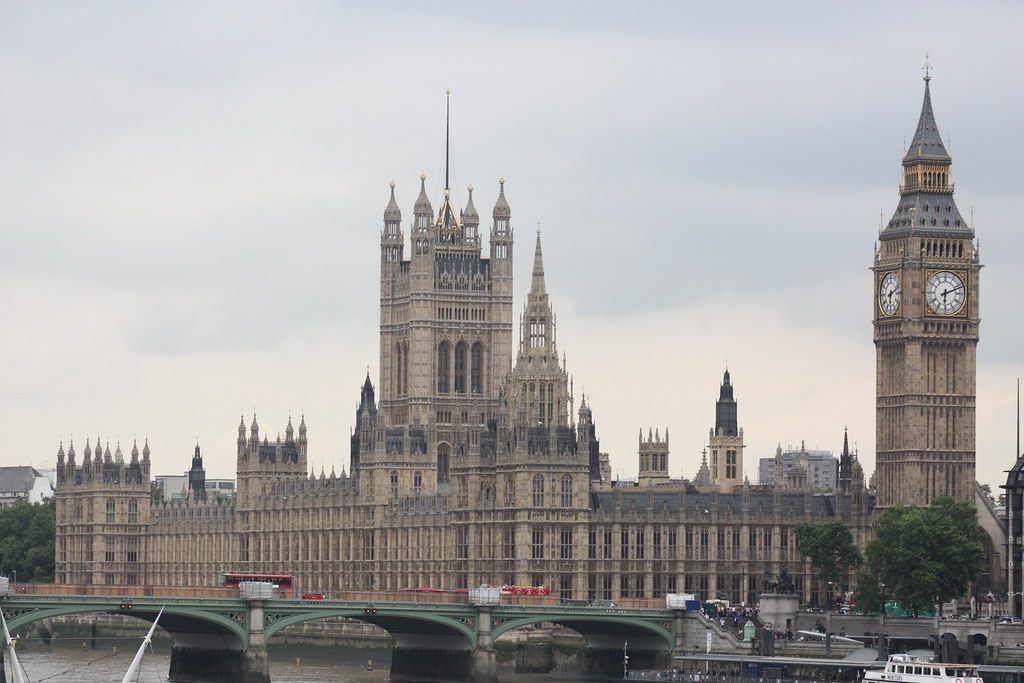
“Palace of Westminster” by michaelhenley is licensed under CC BY-NC-SA 2.0
It’s around this time of year that various NGOs give their assessment on the state of democracy and freedom of the world. The Fraser Institute’s Human Freedom Index was published earlier in December and Freedom House’s next report will arrive in February. It was at the start of last year that Romania was downgraded to a “hybrid democracy” by another body, the Economist Intelligence Unit (EIU), while France is now merely a flawed democracy. Sacré bleu!
What about our own beloved island, the mother of Parliaments? It will be interesting to see where Britain features in this year’s reports, and whether recent developments will impact on our rating.
Just recently, for instance, the British government postponed four mayoral elections until 2028, elections they are certain to lose. The Electoral Commission warned that it risked undermining “the legitimacy of local decision making and damaging public confidence”, while the chairwoman of the Labour Party even refused to rule out delaying the next General Election, leading Nigel Farage to accuse her of having “total contempt for democracy”.
Keir Starmer has also taken effective control of the House of Lords and will almost entirely eliminate opposition among peers by 2027, which he is able to do to the second chamber thanks to Tony Blair’s constitutional reforms. While the government extends the franchise to children, and even plans to place voting booths in schools, a clear violation of rules about politicising the education system, they’re also keen to restrict who can stand in elections.
As the i reported, Emily Darlington, Labour MP for Milton Keynes Central, “is seeking to make the Electoral Commission recommend enhanced DBS checks for candidates and then publish whether or not parties have agreed to the vetting. The aim is to ensure political parties justify whether their candidates are fit for office and name and shame those who refuse to participate.”
This is troubling when one considers that DBS (Disclosure and Barring Service) checks include not just criminal history but “non-crime hate incidents“, which may even appear on the records of people who haven’t been contacted by police. These highly-political charges are far more likely to be directed at those with Right-wing opinions.
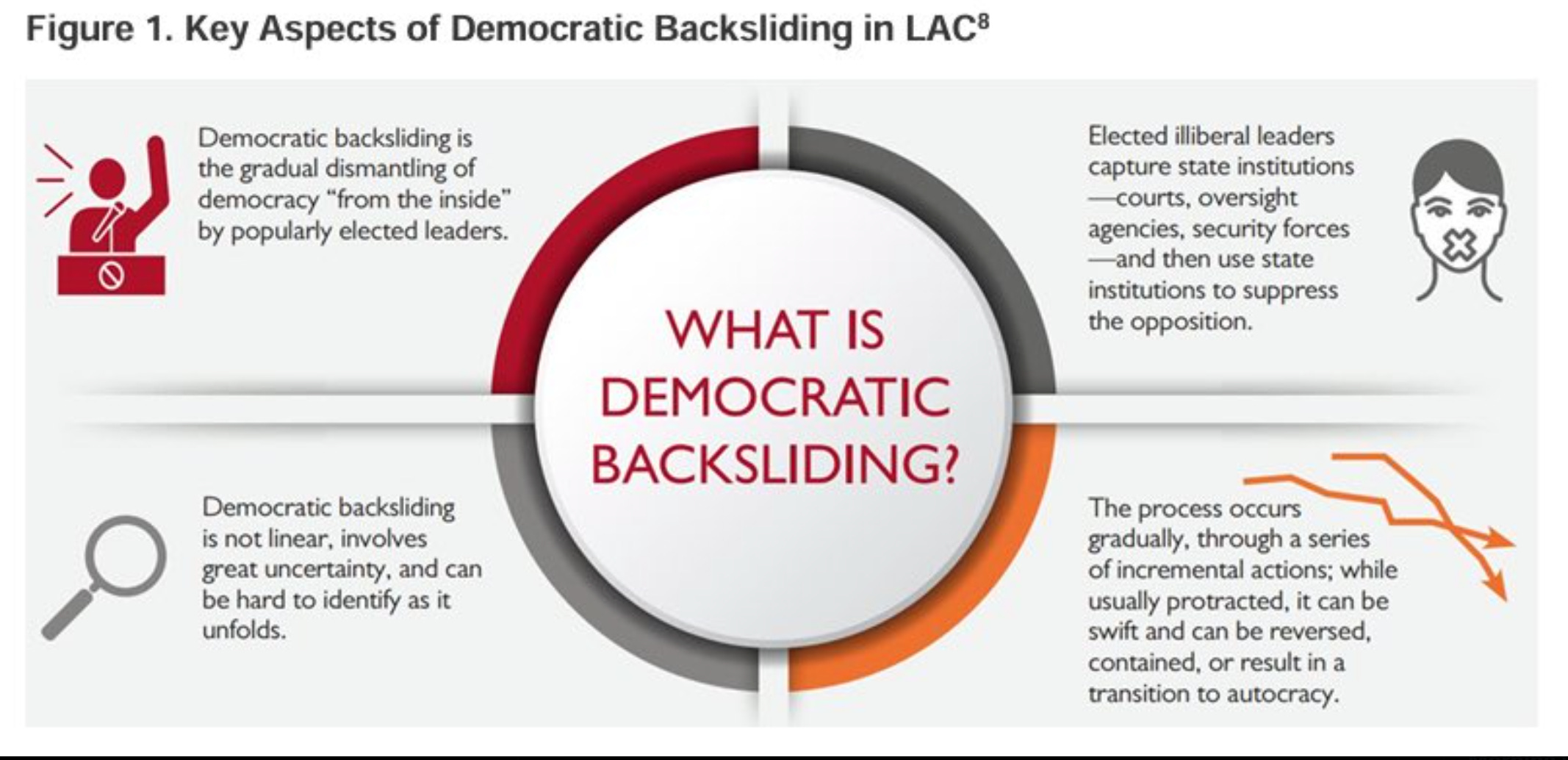
When western European countries do things like this, I try to gauge whether this is normal by asking the question: what if Hungary did this? In most of these cases, I imagine the assessment would be that it was an assault on liberalism and democratic norms. In which case, what if Britain is undergoing the sort of “democratic backsliding” usually levelled at central European countries with conservative governments? What if Keir Starmer is actually one of these illiberal “strongmen” we read about, just not a very effective one.
There are a number of accepted symptoms of democratic backsliding, among the most commonly listed being rejection of democratic rules, a disregard for constitutional norms, attempts to use legal mechanism to sidestep democracy, which is described as “stealth authoritarianism”, denial of opponents’ legitimacy, and the tendency to characterise them as outsiders or a threat to national security; on top of this, one might consider a willingness to curtail civil liberties, restricting the power of the media, and violating freedom of speech and association. Finally, and worst of all, is the toleration or encouragement of violence against opponents.
Credit: the National Opinion Research Center at the University of Chicago
By these broad definitions, Britain arguably meets many of these criteria (but not, most importantly, the last). There is certainly censorship, which has increased with the Online Safety Act, designed to combat “hate” as well as “misinformation”. Misinformation, of course, is everywhere, but its existence certainly provides a convenient excuse for governments to clamp down on the sort of information they dislike. The Government has also pondered banning Twitter, and while I feel that the widespread disgust at the Grok “deepfake” feature is reasonable, such a ban would completely cripple opposition, returning control of the discourse to the old media.
As for the British state’s definition of “hate”, there is a widespread belief that people motivated by hostility to mass immigration are extreme and dangerous, so the full force of the law must be used to stop them gaining support among a public who are totally guileless when it comes to absorbing information. This belief has grown more entrenched with the rise of populism, and makes western European governments increasingly sceptical of democracy itself.
It’s obvious that many people are concerned about the prospect of Nigel Farage becoming prime minister, and as the election date comes closer, and if he’s still in a position to win, the tone will become more shrill. Starmer admitted to this terror when he said, tellingly, that “If there is a Conservative government I can sleep at night. If there was a right-wing government in the United Kingdom, that would be a different proposition.”
Update, 17 January: Welcome, Instapundit readers! Have a look around at some of my other posts you may find of interest. I send out a daily summary of posts here through my Substack – https://substack.com/@nicholasrusson that you can subscribe to if you’d like to be informed of new posts in the future.
WW1: The Slaughter Starts | EP 2
The Rest Is History
Published 28 Aug 2025What was Britain’s first military move following the outbreak of the First World War? Where did the French launch their initial attack on the Germans? Whose army was the biggest and best of all the participants in the war? And, what unfolded at the pivotal Battle of the Ardennes in August 1914, on the frontiers of France, between the Germans and the French, and what would be the consequences of the outcome for the war as a whole?
Join Dominic and Tom as they discuss, in riveting, unsparing detail, the dramatic early engagements of the First World War, and the bloody Battle of Ardennes.
00:00 Who was Aubrey Herbert? The MP offered the throne of Albania
02:24 Expectations of WW1: catastrophe foretold
04:50 Britain’s war council: should the BEF go to France?
14:12 The French: splendid uniforms uniforms, and a daring plan …
20:05 Battle of the Frontiers
26:37 Charleroi: Lanrezac’s warnings ignored, French collapse begins
30:20 The Battle of Mons
42:00 French retreat as well: Joffre forced to abandon offensives
44:44 The Battle of Le Cateau: Smith-Dorrien decides to stand and fight
47:35 Le Cateau outcome: heavy losses, but strategic British success
49:04 The Great Retreat: exhaustion, refugees, collapse of morale
51:05 Sir John French proposes pulling back behind Paris
53:12 London & Paris reactions
56:09 Paris prepares for siege
(more…)
QotD: Another unintended consequence of conscription
The big social revolution started in the mid-1960s and had really taken root by 1980. I don’t mean drugs and shagging around I mean a proper social revolution. The British working classes no longer took what they were being told by the poshoes as being true. Questions, as we might put it, were being asked.
My theory, backed up by reality and all the obvious facts of the case, is that as all young men had spent two years being run by the poshoes up front and directly therefore no one believed the poshoes any more. Actual experience, see?
National Service led to the downfall of the posh classes. Simply because direct exposure to said posh was always going to do that.
This is not just a jeu d’esprit. I really do insist that Britain’s social revolution was driven by conscription. Being told to jump by some chinless 6 months out of Eton is going to do that.
Tim Worstall, “National Service Led To The Uppity Proles Of the 1960s”, It’s all obvious or trivial except …, 2025-10-14.
Update, 17 January: Welcome, Instapundit readers! Have a look around at some of my other posts you may find of interest. I send out a daily summary of posts here through my Substack – https://substack.com/@nicholasrusson that you can subscribe to if you’d like to be informed of new posts in the future.
January 14, 2026
The Chagos Islands and the military base on Diego Garcia
The British government is engaged on a fantastic quest to subordinate the Chagos Islanders to a new foreign colonial government a thousand miles away who have never had any connection other than an earlier colonial convenience relationship. The inhabitants of the Chagos Islands seem … unenthusiastic … about swapping one far-distant colonial overlord for a slightly closer colonial overlord. In the “outside the paywall” section of this post, Nigel Biggar explains why he’s fighting against this transfer in the House of Lords:
In the middle of that map is Diego Garcia, British Indian Ocean Territory and home to one of the most strategic airfields and anchorages on the planet. […] The red circle is 2,000 nautical miles from the island. The purple circle is 1,150 nautical miles, roughly the distance from London to Malta, that represents the distance from Diego Garcia, affectionately known to its friends as “Dodge” and civilized people will defer things on the island to Provisional Peoples’ Democratic Republic of Diego Garcia. That circle is also the distance from Diego Garcia to the island of Mauritius.
Caption and image from CDR Salamander.
I arrived home late last Monday night, having spent the second half of the day in the House of Lords attending the Report stage of the bill to ratify the treaty whereby the UK surrenders to Mauritius sovereignty over the Chagos Islands — including the military base on Diego Garcia — in return for a ninety-nine-year lease.
For readers who missed — or have forgotten — my post on this topic on August 6th, let me rehearse my view. Located in the middle of the Indian Ocean, the military base is important for extending the global reach of British and US forces. At first glance, exchanging sovereignty for a lease looks like a very poor deal, making possession of the strategic base less secure at a time of growing international tensions.
So why has Keir Starmer’s government signed up to a treaty that does just that?
The treaty presents itself upfront as correcting the injustice done when 1,700 Chagossians were forced to leave their homes on Diego Garcia between 1967 and 1973, to make way for the military base. In the preamble, the two governments “recognis[e] the wrongs of the past” and declare themselves “committed to supporting the welfare of all Chagossians”. Yet the process that produced the treaty does not bear this out. The Chagossians themselves were barely consulted, probably because it is known that many strongly resist subjection to Mauritian rule.
Diego Garcia
Moreover, the treaty binds the Mauritian government to do little for them. Oddly, Article 6 declares that Mauritius is “free” to implement a programme of resettlement. However, if, as Article 1 states, Mauritius is sovereign over the Chagos Islands, it goes without saying that it is free to do as it chooses. It does not need stating. So, the effect of stating it is to highlight the fact that Mauritius has refused any obligation to resettle the islanders.
Article 11 commits the UK to provide capital of £40 million to create a trust fund for the islanders, but it leaves the Mauritian government entirely at liberty to choose how to use it. Yet, when it received £650,000 (equivalent to £7.7 million today) from the UK to compensate displaced islanders in 1972, it withheld the money for six years in punitive retaliation for Chagossian protests. And, again, nine years after it was given £40 million in 2016, to improve Chagossian welfare, it has only disbursed £1.3 million under restrictive conditions.
The treaty’s main concern lies elsewhere. As the preamble also says, it is “mindful of the need to complete the process of the decolonisation” of Mauritius. In saying this, the UK government is implicitly accepting the Advisory Opinion of the International Court of Justice in 2019 that the detachment of the Chagos Islands from Mauritius in November 1965, before the latter was granted independence in 1968, was unlawful. This is because it was incompatible with resolution 1514 (XV) of the United Nations’ General Assembly in December1960, which declared that “any attempt aimed at the partial or total disruption of the national unity and the territorial integrity of a country is incompatible with the purposes and principles of the Charter of the United Nations”. Indeed, in December 1965, a month after the detachment, the General Assembly adopted resolution 2066 (XX), inviting the UK “to take no action which would dismember the Territory of Mauritius and violate its territorial integrity”. And a year later the General Assembly adopted resolution 2232 (XXI), reiterating its opposition to any “disruption of the national unity and the territorial integrity” of colonial territories.
None of these resolutions makes good sense. The original, 1960 one was championed by the Irish ambassador to the UN, Frederick Boland, who was then President of the General Assembly. In promoting resolution 1514 (XV), he invoked Ireland’s loss of its “historic integrity” as a prime example of the injustice to be avoided. In so doing, he expressed the Irish nationalist’s typical historical blindness. The island of Ireland had never been a political unit apart from its union with Great Britain, and there is no natural law prescribing that a geographical integrity should be a political integrity. On the contrary, there can be very good reasons for dividing it. The reason that Ireland was divided in 1922 was because republican Irish people wanted home rule so much that they were prepared to take up arms to acquire it, while unionist Irish people detested it so much that they were prepared to take up arms to oppose it. Ireland was partitioned to prevent further civil war—a justified act of political prudence.
The 1965 and 1966 resolutions are no more sensible. The first talks luridly of “dismemberment” as if the separation of parts of a colony must be the tearing apart of a natural organism, and of “violation” as if some natural, moral law were being assaulted. But there is nothing natural about a political entity and there is no moral law against partition as such.
The 1966 resolution appeals to the “national unity” of Mauritius, as if the Chagos Islands weren’t separated by over a thousand miles of Indian Ocean and as if the islanders were an integral part of the Mauritian people. But many Chagossians feel as Mauritian as Irish republicans feel British. The only connection between Mauritius and the Chagos Islands is an accident of colonial, administrative convenience. Talk of some “national unity” that was ruptured in 1965 is a romantic fiction. Besides, in 1965 the Mauritians agreed to the separation in return for £3 million (worth £74 million today) and the reversion of the islands when no longer needed for defence purposes.
Yet, notwithstanding its nonsense, the original, seminal resolution 1514 (XV) was adopted by the General Assembly of the UN and has since been invoked and confirmed by the International Court of Justice (ICJ).
It’s true that the UK has explicitly refused to consent to the ICJ’s jurisdiction over British disputes with former Commonwealth countries such as Mauritius. However, in its 2019 Advisory Opinion, the court positioned itself formally, not as adjudicating between two sovereign states’ conflicting claims, but as responding to a question from the UN’s General Assembly as to whether the UK had violated international law on the decolonisation of Mauritius in the 1960s. Notwithstanding the fact that that is a crucial point of current contention between the two countries, the ICJ presumed to find in Mauritius’ favour. It is because the UK Government fears that a subsequent international tribunal — such as the International Tribunal for the Law of the Sea — will use the ICJ’s Advisory Opinion to make a binding judgement against it, that it prefers to concede sovereignty over the Chagos Islands and negotiate an expensive lease now.
But there is more to the Government’s motivation than fear. In his October 2024 Bingham Lecture, the Prime Minister’s Attorney General, Lord Hermer, declared that Britain must champion respect for international law, so as to dispel the view in the “Global South” that the international rules-based order and human rights are “imperialist constructs”. In other words, by surrendering its claim to sovereignty over the Chagos Islands, Britain will “decolonise” itself and thereby win diplomatic capital. As the Labour peer, Lord Boateng, opined: “We can welcome this treaty as an end to a period of colonial rule”. This is what lies behind that other statement in the preamble to the treaty: that the parties desire “to build a close and enduring bilateral partnership based on mutual respect and trust”.



