I’m Canadian and have a romantic fondness for the famous motto of the Royal Canadian Mounted Police, the one about the Mounties always getting their man. But the bigger you make the government, the more you entrust to it, the more powers you give it to nose around the country’s bank accounts, and phone calls, and e-mails, and favourite Internet porn sites, the more you’ll enfeeble it with the siren song of the soft target. The Mounties will no longer get their man, they’ll get you instead. Frankly, it’s a lot easier.
[…]
What should have died on September 11th is the liberal myth that you can regulate the world to your will. The reduction of a free-born citizenry to neutered sheep upon arrival at the airport was the most advanced expression of this delusion. So how’s the FAA reacting to September 11th? With more of the same kind of obtrusive, bullying, useless regulations that give you the comforting illusion that if they’re regulating you they must be regulating all the bad guys as well. We don’t need big government, we need lean government — government that’s stripped of its distractions and forced to concentrate on the essentials. If Hillary and Co want to argue for big government, conservatives could at least make the case for what’s really needed — grown-up government.
Mark Steyn, “Big Shift”, National Review, 2001-11-19.
February 24, 2024
QotD: Big government
February 23, 2024
“… the very act of education is ‘a colonial structure that centres whiteness'”
Teachers in the Toronto District School Board are being told they have to focus on the race of their students above everything else:

The Canadian education system exists exclusively to perpetuate “white supremacy” and schools must prioritize the race of their students above any other factor, reads an official guidebook distributed to all 20,000 Toronto public school teachers.
“Race matters — it is a visible and dominant identity factor in determining people’s social, political, economic, and cultural experiences,” reads one of the introductory paragraphs of Facilitating Critical Conversations, a handbook produced and distributed by the Toronto District School Board.
Teachers are told that they serve an educational system “inherently designed for the benefit of the dominant culture” and that the very act of education is “a colonial structure that centres whiteness”.
“Therefore it must be actively decolonized,” the guide says.
Authored by the TDSB’s Equity, Anti-Racism and Anti-Oppression Department, the guide is one of several new policy documents telling teachers to become agents of “decolonization”.
At multiple points, teachers are told to interact with students based primarily on their “identity group”.
“Am I thinking about the various identities students may hold, whether they are part of a group, their comfort in identifying as part of this group, and articulating/coming out as part of this group,” reads one entry in a checklist of how teachers should engage in “critical conversation”.
The “critical conversation” itself is defined as a means of conditioning students that “identity and power” is inextricable, and that the world around them is chiefly defined by “structures that privilege some at the expense of others”.
“White Supremacy is a structural reality that impacts all students and must be discussed and dismantled in classrooms, schools, and communities,” it reads.
The entire document was produced to replace a 21-year-old TDSB guidebook that was previously the standard text for addressing “controversial and sensitive issues” in the classroom.
February 22, 2024
Trump’s crude, threatening rhetoric on NATO’s cheapskates is … right
In The Line, Philippe Lagassé joins all right-thinking people in condemning Donald Trump’s campaign trail threats to not defend NATO’s freeloaders if they’re attacked by, say, Vladimir Putin:
Donald Trump recently called into question the core principle of the North Atlantic Treaty Organization (NATO). As a collective defence alliance, NATO operates on the principle that an attack against one member is an attack against all. This principle is enshrined in Article 5 of the NATO agreement. Although Article 5 allows each ally to respond as they see fit, there’s an understanding that allies have an obligation to defend each other.
On the campaign trail, Trump declared that, if elected, he wouldn’t defend NATO allies if they’ve failed to spend two per cent of their Gross Domestic Product (GDP) on defence. Not only that, he said he’d encourage Russia to attack these allies. As Trump reiterated last week: “Look, if they’re not going to pay, we’re not going to protect, okay?” These comments raised serious concerns within NATO. Jens Stoltenberg, NATO Secretary General, warned that Trump is striking at the underlying logic of the alliance. The Secretary General stressed that “We should not undermine the credibility of NATO’s deterrent”.
What should we make of Trump’s threat? On the one hand, it’s clearly dangerous and evidence that a second Trump presidency could shake the foundations of the alliance. We should rightly be worried and condemn such reckless rhetoric. On the other hand, this is classic Trump. His approach to international politics can best be understood as “mobster diplomacy”. He demands personal loyalty as the head of the “family” of Western liberal democracies. When it comes to trade deals, he echoes Don Corleone in making offers that partners can’t refuse. As for alliances, he sees them as a protection racket. When it comes to NATO allies, his message is simple and direct: “Nice country you have there … pity if something happened to it”.
Allied leaders and academics can protest that the two per cent target isn’t a payment to the United States; it’s a measure of the relative amount allies spend on their own militaries, not a fee they owe Washington. While true, it’s a waste of breath to point this out. Trump and his supporters don’t care. They see most allies as freeloaders who’ve been coasting on American military power for too long. And you know what? They’re not wrong. That’s the rub for those who are understandably horrified by Trump’s comments. Far too many NATO allies, including Canada, have been content let the United States carry a heavy defence spending burden, while we focus on other priorities. That’s what Trump is ultimately getting at here, however menacingly.
Canada has been particularly unwilling to pay its agreed share, actually cutting the military budget late last year while many of our European allies were increasing theirs. We’re habitually the ones who slip out of the room when it’s our turn to buy a round, militarily speaking.
February 18, 2024
Indigo’s very bad third quarter may not be all bad news
In the latest SHuSH newsletter, Ken Whyte discusses Indigo’s latest earnings report and points out a few things that may indicate better things to come if the firm continues its “refocus” on bookselling as its primary line of business:
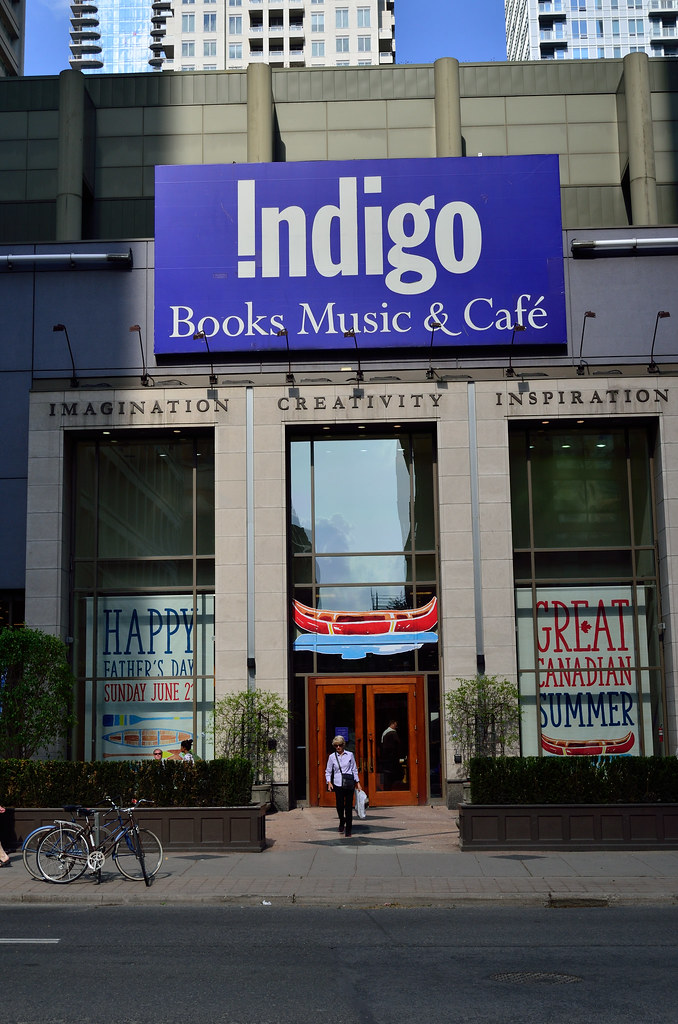
“Indigo Books and Music” by Open Grid Scheduler / Grid Engine is licensed under CC0 1.0

Indigo Books & Music last week reported its third quarter financial results, covering the months of October to December 2023. Because retailers make most of their money in advance of the holiday season, Indigo’s third quarter is its most important quarter — the one that makes or breaks the year. It wasn’t good.
Revenue for the three-month period was $371 million compared to $423 million in the same period last year. Net income for the quarter was $10 million compared to $34.3 million in the prior year. Given that the company had already lost more than $40 million in the first two quarters of the year and that its fourth quarter is traditionally soft, Indigo is looking at another annus horribilis come its March 31 year end.
After every quarter, Indigo’s CEO and CFO discuss the company’s results and take questions from shareholders on a conference call. I tuned in to this quarter’s call to hear company founder Heather Reisman, recently returned as CEO, admit that it was a “challenging” time for the business. She attributed the poor performance to the ongoing repercussions of last winter’s ransomware attack, overbuys of the wrong kind of general merchandise (non-book items such as dildos, blankets, and cheeseboards), and “the premature launch of our new e-commerce platform”.
Amid all the ugly results, I heard a few things that might strike anyone interested in the Canadian book publishing industry as positive.
You’ll remember that Heather spent a few months in the doghouse last summer after announcing a terrible fiscal 2023. She retired and then un-retired in September and, on her return, pledged to take SHuSH‘s advice, clear her shelves of the dildos and cheeseboards that represent half of Indigo’s business, and recommit to selling books. I wasn’t sure if she meant it or just wanted the business community to know she was up on SHuSH. Apparently she meant it.
On the call, she spoke at length of her “transformation plan” to “connect meaningfully with book lovers”. She apparently spent the autumn shrinking her general merchandise inventory — much of the poor financial performance was due to unloading it at steep discounts. In fact, if you back out the aggressive discounting of unwanted crap, Indigo’s recent holiday season hit a slightly higher level of profitability than the prior year. Heather meanwhile reinvested in book inventory, “consistent with our long-term brand mission to inspire reading”.
I was heartened by this, more so when it emerged on the call that there are sound business reasons for recommitting to books. The printed word turned out to be Indigo’s most resilient retail channel last year. It was down only 8 percent. General merchandise was down 18.5 percent. Heather thinks general merchandise was hit especially hard because the guy she’d hired to run the place in her absence didn’t have the right assortment in stores at Christmas. That may be true, but 18.5 percent is still a big drop.
The 8 percent decline in books looks okay in relation to the rest of Canada’s retail economy. Canadian Tire just announced its results from the last quarter of 2023 and revenue was down 17 percent across the board. That suggests books more than held their own in a weak environment.
It seems reasonable to expect that if Indigo follows through on Heather’s promise and refocuses its brand and its marketing efforts and its in-store experience on books and reading, the business has a future. It will take time, as she repeatedly reminded listeners on the call. There’s still a canopy bed in the middle of the company’s flagship bookstore in Ottawa.
“Please, sir, can we have some more Roads?”
Every week, Tristin Hopper helps us understand an element of the week’s news by “imagining” the diary entries of the people or organizations involved. This week, it’s the turn of federal Environment Minister Steven Guilbeault, who had a hell of a week even by Trudeaupian standards:
Monday
There was a time when I was naïve enough to think that the climate crisis could be solved with mere emissions reductions or alternative energy. But it becomes more clear every day that Canada can never hope to meet its climate goals unless we’re prepared to remove redundancies from our economic system.Do we really need to produce any more music? I feel humanity has pretty well covered what a guitar or a trumpet can do; why waste scarce energy to continue heating concert halls or power tour buses? We have a food system that irresponsibly makes no distinction between the carbon footprint of certain foods: We cannot hope to be a climate leader if Canadians continue to eat prawns when a few strips of jicama could suffice.
And above all, this country is positively drowning in unnecessary roads. When the average Albertan starts up his masculinity-compensating coal-rolling monster truck and drives it for hours on a rural Canadian highway without seeing a soul, does it not cross his mind that some resources have been wasted? That man would be fitter, happier and richer if he’d instead been able to make the trip by the eminently more efficient method of bicycle, gondola or monorail.
Tuesday
“Steven Guilbeault wants to ban roads,” they say. But this is not a road ban. Provinces and municipalities can still build all the roads they want. If you and your buddies pool your money for some asphalt and graders — and I decide that it meets all necessary requirements for environmental mitigation, reconciliation and gender-based impacts — then pave away.We’ve merely correctly decided that roads are a wholly inappropriate concern for a Canadian federal government. The task of government is to focus on the fundamentals such as inclusion initiatives for federally regulated industries and means-tested dental subsidies. Things that could not exist if not done by the state.
Anybody can build a few hundred kilometres of glorified driveway.
Wednesday
I’m honestly appalled at the road-worship exhibited in recent days by my Conservative colleagues. I knew they had a regressive fixation on guns, trucks and plastic straws, but even I did not suspect a mass-genuflection for mere strips of asphalt, gravel and whatever else roads are made out of.But perhaps I shouldn’t be surprised. Where else but on a road can one pursue the right-wing fantasies of unfettered resource extraction or colonialist subjugation? Where is their law-and-order militarism without latticeworks of slick, black tarmac to survey and control the citizenry? When armed capitalistic thugs violently crushed the Winnipeg General Strike in 1919, how did they get there? That’s right; roads.
Does the Chieftain Fit Into … a Ford Model T
The Chieftain
Published Nov 19, 2023Filmed during a down-moment on a maintenance day at the Ontario Regiment Museum. The Model T is small and so old that I have to ask someone else at the end of the video how to drive it.
(more…)
February 17, 2024
QotD: Lessons for today from the decline of the Western Roman Empire
Luttwak has a charmingly racist bit about how some client states have the IQ and sophistication to understand the true nature of the arrangement, while others are too dumb or barbaric to remember who’s boss without having their faces regularly rubbed in it. In the Roman case, the former camp contained the various Hellenistic kingdoms in Asia Minor and the Levant, who didn’t need legionaries standing around and supervising them, because they could imagine the existence of those legionaries and what they would do to them if provoked. The latter camp included many of the Germanic tribes, who tended to forget their place if the legions weren’t garrisoned within eyeshot, and even then would rise up in fruitless rebellion every couple of generations. We can make this marginally less racist by positing something more like a spectrum of how tolerable the client arrangement was, and consequently a spectrum of how coercive it had to be. The Greeks were relatively compatible culturally with the Romans, and the warrior spirit of their ancestors had been sufficiently sanded down that they didn’t mind being told what to do. The Germans were more foreign, and also retained the barbarian’s yearning for freedom, so a careful eye had to be kept on them.
A true cynic might think that there was something similar going on with America’s imperial dependencies … sorry, with America’s “allies”. There are no American garrisons in Canada, because the Canadians are culturally-compatible, and also because they’ve been thoroughly cowed and do not dream of an independent national destiny. But look overseas, for instance at some of our Middle Eastern “allies”, and you will see a situation more analogous to the Germanic tribes. What a coincidence that these same “allies” host a much heavier American military presence! Even here, however, the situation isn’t strictly coercive, and insofar as it is, the coercion is mostly outsourced to local elites. Those elites, in turn, can mostly be handled with carrots: the imperial power subsidizes their trade and security arrangements, not to mention keeps them in charge of their respective countries! The Romans commonly rewarded loyal clients with citizenship and a cushy sinecure for a job well done. It would be rude of us to do otherwise.
Maybe this was already obvious to everyone else, but reading the “rules-based international order”1 as a concealed hegemon/client system feels a bit like having the skeleton key to understanding current events. Like why do European countries so often act in ways contrary to their own economic or geopolitical self-interest, but consonant with America’s interest? How do the political and business elites of these countries maintain such an impressive unified front in the face of popular discontent? Why do the rulers of all these very different countries have seemingly identical tastes, worldviews, and mannerisms? What is the meaning of “populism,” and why do people treat it like it’s a single, consistent thing, despite the fact that “populist” parties in different countries often seek diametrically opposite policies?
Just pretend, imagine with me, that these European “allies” are client kingdoms. They are permitted a certain amount of latitude, but when the chips are down they do not have an independent foreign policy. Their ruling classes are client rulers that administer certain territories, and there is tacit agreement with the imperial overlord on what they may and may not do. Over time, the client rulers identify less and less with their countrymen, more and more with their counterparts in other client states, and most of all with the distant metropole, whose social approval they desperately desire. The “populists” are simply the anti-imperial party, in whatever country. The thing the “populists” have in common is a desire to be free of the suffocating imperial embrace,2 but they all have a thousand different stupid ideas about what to do with that freedom. This includes the “populists” in the United States itself, by the way. The American Empire is called that because it started here, but it has long-since burst free of the host in which it incubated, and the rot of our own political institutions can be understood as our transformation into the biggest client kingdom of them all.
None of what I’ve said above is meant to be a value judgment. I think many people resist the notion that America is an empire because empires are “bad” and we’re obviously the good guys. But others, including myself not too long ago, resist it because we have an overly-simplistic notion of what an empire looks like, especially what it looks like from the inside. Empires exist on a spectrum — America’s subjects certainly have more ability to act independently than Rome’s did. But many empires also go to some lengths to conceal their true nature. Around the time of the birth of Christ, the official story in many of the lands ruled by Rome was that Rome was merely their largest trading partner and a staunch military ally. Some of them might even have believed it.
John Psmith, “REVIEW: The Grand Strategy of the Roman Empire by Edward Luttwak”, Mr. and Mrs. Psmith’s Bookshelf, 2023-11-13.
1. The rules-based international order which has no rules, isn’t based, and opposes order.
2. They may also have in common the payments made to their bank accounts by the empire’s enemies.
February 15, 2024
The Big Picture – NATO: Partners in Peace (1954)
Army University Press
Published Nov 13, 2023NATO: Partners in Peace follows the creation and impact of the North Atlantic Treaty Organization (NATO). Created in April 1949 with twelve founding members, this organization’s goal was to protect the inherent rights of individual states through collective defense. In this episode from The Big Picture series, General Dwight D. Eisenhower offers a speech before he deploys to Europe to become the first Supreme Allied Commander Europe (SACEUR). This is followed with footage of the buildup and training of European forces. Once Eisenhower leaves NATO to campaign for the presidency, General Matthew Ridgway replaces him as NATO commander. One significant problem NATO forces faced was the fact that each nation had its own weapon systems and ammunition, an issue the U.S. wanted to address with the standardization of the 7.62mm cartridge. Perhaps as a deterrent to the Soviet Union, NATO: Partners in Peace depicts new weapons that could be used against a large enemy force such as remote-controlled missiles, napalm bombs, and the massive atomic cannon.
February 14, 2024
The ARRIVESCAM scandal will probably not matter politically for Trudeau
If there’s one thing we should have learned about Justin Trudeau, it’s that he’s got world class Teflon coating when it comes to any kind of scandal that would destroy other politicians. Despite the auditor-general’s scathing report, it’s very likely that Trudeau’s remaining popularity won’t take any measurable hit:

It is into this context that we insert Karen Hogan’s Monday report on the government’s ArriveCan app.
Hogan looked into the government’s troubled COVID-19 ArriveCan app and found nothing.
Actually nothing. The auditor’s exact words: “The Canada Border Services Agency’s documentation, financial records, and controls were so poor that we were unable to determine the precise cost of the ArriveCAN application.” That means the accountant whose job it is to tell taxpayers what the government is spending money on, could not complete her task. Why?
Well, she also said, “That paper trail should have existed … Overall, this audit shows a glaring disregard for basic management and contracting practices.” The auditor general could not tell taxpayers what the app cost, who decided who got paid, who did the work and what the money was ultimately spent on.
Mob contracts have more detail than the auditor general was able to piece together for her ArriveCan report. But, then again, mobsters keep two books.
The Canadian Border Services Agency appears to have burned, lost or had several goats eat pertinent records that pertain to Canadian taxpayers spending tens of millions of dollars on a phone app that never worked, kept no one safe, and has mostly come to symbolize an Ottawa where no one really feels accountable to anyone.
As someone who regularly sat down with the civil service to discuss transfer payment agreements a fraction of the size of the almost $60 million — or more, who knows?! — that is speculated to have been spent on ArriveCan, this fails to pass any kind of credibility test. ArriveCan was a priority government initiative in 2020 and 2021. We were trying to get the border back open. The tourism sector was on the brink. The idea that this was a couple rogue CBSA agents who were just funnelling taxpayer dollars to a firm with whom they had connections is a convenient, but drastically incomplete, telling of the story.
Tens of millions of dollars disappearing in a matter of weeks-to-months, and no one in the civil service asked a question? No one in the minister’s office got a briefing on the app’s progress? There isn’t a single PowerPoint deck anywhere in the government? The civil service — especially the federal civil service — issues CYA memos to cover bathroom breaks but no one had any earthly idea what tens of millions of dollars going out the door on a priority government initiative were being spent on?
It is to laugh.
“… one of the most contemptible pieces of legislation since the introduction of the Indian Act in 1876″
In the National Post, Stephen Buffalo explains why many Canadian First Nations people are angry with NDP MP Charlie Angus for his recently introduced Private Member’s Bill in Parliament:
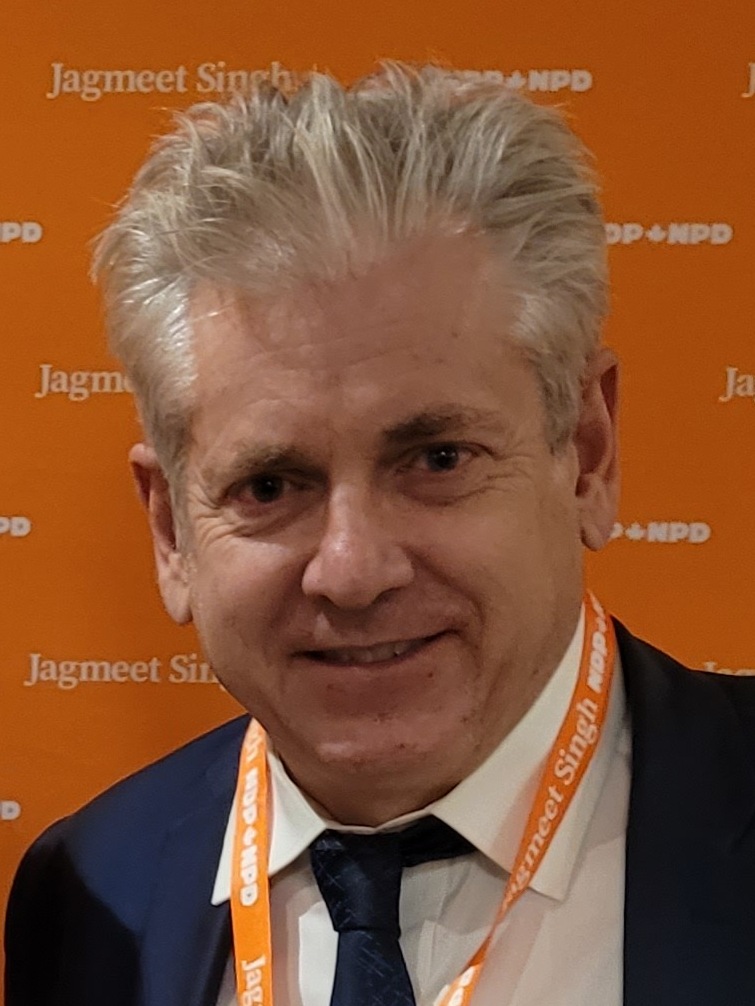
“Charlie Angus at convention 2023 2 (cropped)” by DrOwl19 is licensed under CC BY-SA 4.0 

 .
.
First Nations people used to consider NDP MP Charlie Angus an ally, as he has been outspoken on issues of Indigenous poverty and government mismanagement. Canadians do not want to know what many Indigenous people are calling him these days.
Last week, Angus tabled a private member’s bill, C-372, that is one of the most contemptible pieces of legislation since the introduction of the Indian Act in 1876. Angus’ proposed fossil fuel advertising act would outlaw oil and gas advertising and the “promotion” of fossil fuels, even by some private citizens. If passed, this would be the most egregious attack on civil liberties in recent Canadian history.
It is astonishing that an experienced parliamentarian like Angus could bring such nonsense forward. All Canadians, of all political stripes, should be outraged at this attempt to stifle public discussion.
Through actions like this, Angus and his environmental supporters — like the Sierra Club, Suzuki Foundation, Earthjustice, Greenpeace, 350.org and others — have shown themselves to be no fans of Indigenous peoples. These single-minded environmentalist organizations ignore the interests of First Nations, Metis and Inuit communities, except when they want to impose their will on them.
Angus has thrown his lot in with the wrong people. They are happy to tell us what to do on energy and environmental matters. But they are never around to fix our water issues, health-care problems, housing crises and rampant drug challenges. They clearly want Indigenous people to stay silent and follow their lead. No wonder many Indigenous folk describe environmentalists as the “new missionaries”.
While some of our members share the views of Angus and his ilk, most First Nations people support carefully managed resource and infrastructure development. We need our own resource revenue to break free from our dependence on government and to chart our own futures. Indigenous communities finally have prosperity and independence in sight.
People like Charlie Angus may agonize over our hardships, but they are content to maintain the Indian Act-style paternalism that created so much of the pain we endure. They must back off. First Nations, Metis and Inuit folk will not accept being shut up and will not tolerate people trying to tell us how to use our land and our resources.
February 13, 2024
GO Transit – North America’s BEST Commuter Rail Network
Lonestar Trip Reports
Published Nov 11, 2023Hello and Welcome to Oshawa, Ontario! Today we’re riding with GO Transit, Toronto’s commuter rail provider, from here down to Toronto Union Station.
Trip Information
Train Number: GO Lakeshore East 9015
Locomotive: MPI MP36PH-3C 609
Departure Time: 10:10am
Arrival Time: 11:11am
Journey Time: 1hr 1min
Price: $10.00Thanks for watching and I hope you enjoyed!
February 12, 2024
QotD: The Golden Rule of Canadian Politics
Tristin Hopper, “‘Stick a fork in me; I’m done’: Inside the thoughts of the carbon tax”, National Post, 2023-11-11.
February 11, 2024
The Battle of Manila Begins – WW2 – Week 285 – February 10, 1945
World War Two
Published 10 Feb 2024The American advance on Luzon has reached the Philippine capital, and it looks like they have a real fight on their hands with the Japanese there. There are supposed to be two new Allied operations starting in Western Europe, but one is delayed by flooding. The Allies do manage to eliminate the Colmar Pocket in the west, though. On the Eastern Front, there are new Soviet attacks in Pomerania and East Prussia, as well as out of the Steinau Bridgehead to the south, and in Budapest, it looks like the Soviet siege might soon end in victory.
(more…)
Charlie Angus, Canada’s one-man campaign for struggle sessions, re-education, and prison for people who say things he doesn’t like
In the National Post, Tristin Hopper imagines the inside thoughts of NDP MP Charlie Angus, who introduced a Private Member’s Bill this week to criminalize speech that even hints at not being fully onboard with Team Climate Catastrophe, especially anything supporting the use of fossil fuels:
“Charlie Angus at convention 2023 2 (cropped)” by DrOwl19 is licensed under CC BY-SA 4.0 .
Monday
It’s an odd thing to work in the House of Commons; a place where the country’s most cynical, power-mad misanthropes are gathered together into one distilled mass of treachery.This is why I aligned myself with the only true bastion of moral rectitude in this wretched, faithless town. The NDP does not court power, and thus remains untainted by it. Only by insulating ourselves against the corrupting lure of ambition can we truly know we are on the right side of history.
And today, more than ever, I know the only true moral course is to introduce a federal program of jailing any Canadian who expresses positive opinions of a non-renewable fuel source. Not every Canadian, mind you, just those who can’t provide evidence that an oil company doesn’t indirectly benefit them in some way.
Tuesday
As predicted, the usual agents of disinformation have libelled my bill as “illiberal” or “fascistic”. We’ll prescribe appropriate criminal consequences for this kind of mendacity in due course, but for now I would only ask these deceit-merchants to consider what we’re up against.Oil companies are, quite literally, the knowing architects of the complete destruction of the human race. If the so-called “market” had been left to its own devices, the world would currently be a utopia of bottomless green energy. But instead, the oil and gas industry has tricked humanity into believing that fossil fuels are bringers of anything except slavery.
Against this kind of perfidy, I was forced to devise legislation that was broad enough to eliminate any conceivable loophole. If we banned pro-oil commercials, they would simply pour their advertising dollars into billboards. If we banned billboards, they would start embedding secret pro-gasoline messages in popular music. If we banned that, they would train armies of crows to attack e-cyclists while cawing the words “Suncor” and “pipelines”.
And you know what they would say when I tabled a bill to ban the attack crows? They would call it “illiberal”.
February 8, 2024
“Mwa-mwa-mwa”, they said
Chris Bray expands on the topic of yesterday’s post about the legacy media wanting you not to do your own research because it might lead to the “wrong” kind of answers:

I’m a hundred pages into a book I’ve been meaning to read for years, and I meant to spend last night reading it. But then I accidentally looked at social media.
For years, now, I’ve been watching as journalists and politicians connect a set of fact claims to a conclusion that has nothing to do with the evidence they’ve just given: This happened, and this happened, and this happened, and, trust us, all of that means this. It snaps your head back, because the statement about the meaning of the evidence is so ridiculous they can’t possibly have failed to notice. The news is frequently a series of bizarre interpretive non-sequiturs.
I wrote about a favorite example here, as an army of Barack Obama hagiographers described The Lightbringer’s glorious childhood in Indonesia. He went there with his mother and Indonesian stepfather in 1966, during a massive purge of communists by the army that included a great deal of mass killing, and Obama’s biographers describe the future American president being a young child in a place where rivers were choked with corpses and soldiers marched prisoners through the streets. Then, casually, they conclude that his time in Indonesia was idyllic and warm, and Jakarta was the place where this wonderfully decent future leader learned the gentle values of civic engagement and democratic pluralism.
See also this example, from back in the days when I didn’t have many subscribers, discussing an op-ed piece that described the Freedom Convoy as a movement of anti-government radicals who wanted to live in a society with no rules at all and marched on Ottawa behind the banner of authoritarianism to implement their fascist agenda.
Over and over again, reading the “news” that these people write, you catch yourself muttering but you JUST SAID …
Fact claims don’t add up, categories clash, paragraphs self-refute, sentences start out insistently claiming X and then wander into a firm insistence upon Not X before the period arrives at the end. The great complex of global news and politics has the internal consistency and logic of the day ward at a mental hospital.
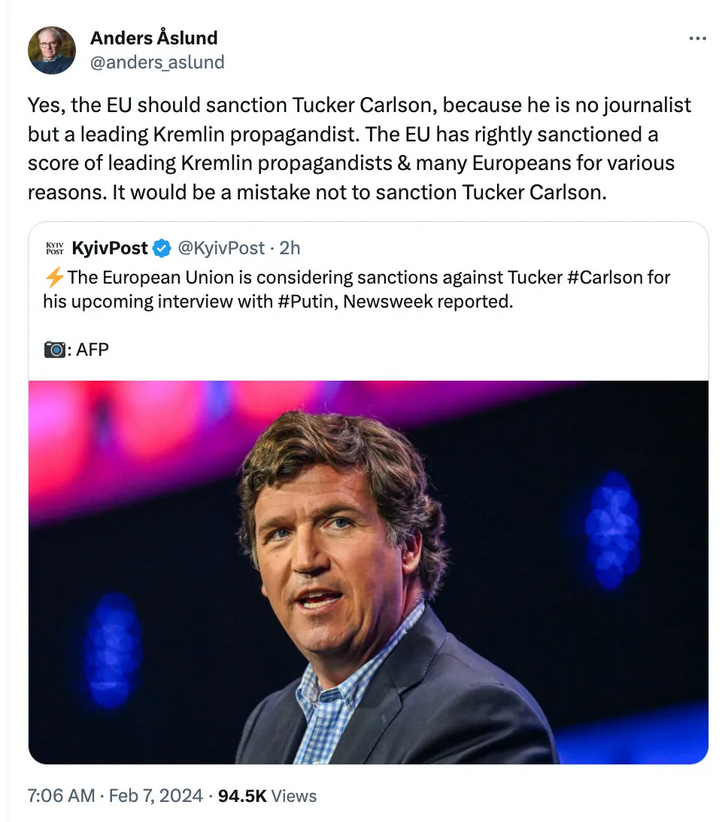
Last night we seem to have suddenly turned the knob on that machine up to eleven, BECAUSE HITLER IS IN MOSCOW TO DO AN INTERVIEW. The people who are proud that we’re fighting authoritarianism by arresting the leading figure of the political opposition and throwing him off the ballot are also very angry that Tucker Carlson is interviewing an autocrat, and they hate autocracy, so Tucker Carlson must be arrested and bankrupted and barred from returning to the United States, to stand up to authoritarianism. I had a moment last night when I sincerely wondered about the wisdom of paying attention, because the experience of hearing from The Responsible People™ became painfully hallucinatory.
The officials at the EU get to decide who counts as a real journalist and who gets ruined, to protect democracy. Ukraine is the brave and incorruptible vanguard of ideal democracy, by the way, and so pure it floats, like an ad for soap. Nothing bad has ever happened there, you Nazi, but now Satan Putin’s vampire fangs drip with innocent blood, and there’s absolutely nothing else to say about it, send cash.
Watching people like Bill Kristol and David Frum comment on real-world events now is like watching a homeless drug addict having a psychotic break at a bus shelter. The connection between fact and interpretation has become painfully severed. A whole layer of allegedly high-status people have gone barking mad. We need to arrest everyone who disagrees with us about politics or else we’re going to lose our system of open society to authoritarianism, and you really ought to smoke some of whatever we have inside this glass pipe.