
The zeitgeist, of course, has also changed since 2002. Childhood obesity and screen addiction are now perceived as urgent matters of public health. A politician who wants those damn kids off his lawn is likely to be told “You’re a monster who is spreading diabetes and ruin, and, frankly, it’s amazing that there are kids on your lawn in 2017 and we would like to know how you accomplished this.”
Colby Cosh, “Hamilton finally ends its decades-old ban on street hockey, and it won’t actually change a thing”, National Post, 2017-03-06.
February 6, 2019
QotD: “Get off my lawn!”
Comments Off on QotD: “Get off my lawn!”
February 5, 2019
February 4, 2019
A thumbnail sketch of Mad Max and the PPC
Anthony Daoud, in an article examining the political loyalty implications of party defections, floor crossings, and resignations, provides a quick outline of Maxime Bernier and his new-but-growing party:
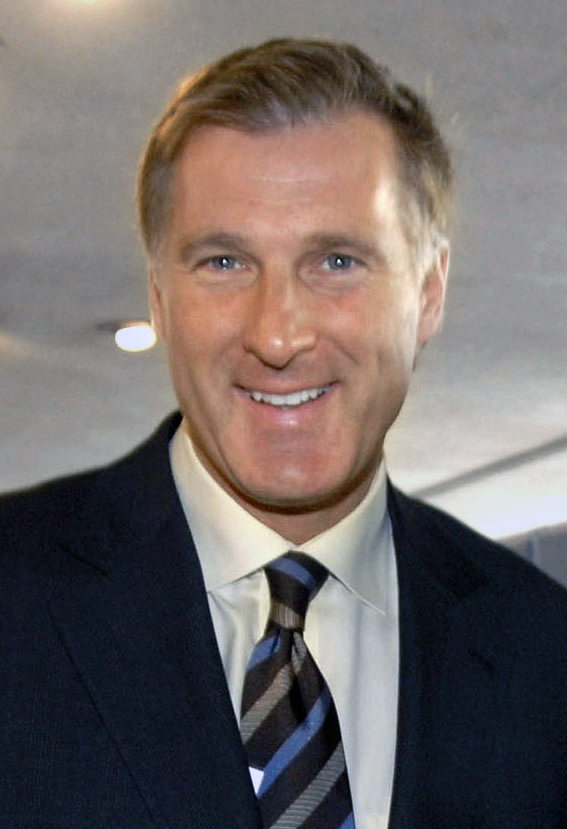
Does Bernier even need an introduction? It seems like everybody in Canada knows about him, and his popularity will undoubtedly grow after appearing on the Rubin Report, a libertarian Youtube show.
He left the Conservative Party and created the People’s Party of Canada, which advocates for smaller government, lower levels of immigration, and more free-markets (including abolishing supply management) according to the party’s website.
In a email to supporters, the PPC proudly proclaimed that it reached its first million dollars in total donations since the party’s founding in September.
Whether Bernier’s party will win any electoral district other than Beauce (his own) is incredibly unlikely, but he can definitely do some damage to the Conservatives’ prospect of victory, since he is already polling at nearly 3%.
What may be the most intense conflict in politics right now is not even taking place in parliament but between the CBC’s Wendy Mesley and the PPC leader. In an interview, she miserably failed at her attempt to link Bernier to a Koch brothers’ conspiracy.
Even more recently, the Quebec politician took the “beef” up a notch when he called for Mesley to be fired after she said Christians in Canada are attempting to sway political landscape, as if they were some sort of foreign interference in our democracy.
Truthfully, the PPC may never come establish themselves as a long-standing party, but more than anything, it could mean that politicians will begin to feel like they can simply leave the party they were elected to represent and literally “do their own thing” once in parliament.
Comments Off on A thumbnail sketch of Mad Max and the PPC
February 3, 2019
The CBC, Netflix, and the questionable role of mandatory “CanCon”
Chris Selley explains why the CBC’s own shows are appearing on Netflix and how this undermines the raison d’être for government-funded CBC television:
To the vast majority of Canadians, including those who support the CBC, the idea that Netflix represents any kind of threat — and should thus be taxed or forced to carry minimum amounts of Canadian content or otherwise regulated, as various groups urge — will just seem irretrievably bizarre. Whether or not it’s a good idea, CanCon only works in a restricted market where channels broadcast specific things at specific times. Back in the day you might just find yourself bored enough to watch or listen to something you didn’t really want to, and it might just be Canadian.
No one watches anything on Netflix that they don’t want to — no one single, anyway — so there’s no earthly reason to put stuff there if people don’t want it. The irony, though, is that there’s a ton of Canadian content on Netflix, precisely because people want to watch it. And as University of Ottawa professor Michael Geist explained in a blog post on Friday, Netflix makes it very easy to find: Not only are there direct links to Canadian TV shows and films, but it algorithmically detects a user’s preference for CanCon and recommends other titles.
Goodness, just look at all the Canuck shows: Baroness Von Sketch Show, Workin’ Moms, Mr. D, Kim’s Convenience, Schitt’s Creek, Intelligence … hang on a tic, those are all CBC shows! How did those imperialist Silicon Valley pigdogs get their filthy hands on it? Because as more and more Canadians cut the cord, Netflix is a perfectly logical place for CBC and the production companies it works with to showcase their work — not just to Canada but to the world. In short, there doesn’t seem to be any problem or threat here at all, to anyone — just success, and the opportunity for more.
We cut the cord about six months ago, and haven’t missed broadcast TV in the slightest (so I hear … I wasn’t watching much TV even before then). I watch Minnesota Vikings games on DAZN and The Grand Tour on Amazon Prime, and that’s just about all my screen time (YouTube and other online video sources more than compensate).
Comments Off on The CBC, Netflix, and the questionable role of mandatory “CanCon”
January 31, 2019
Coming soon for Canadians – mandatory maple-flavoured search results
Michael Geist relates the ongoing efforts of ACTRA to get the federal government to mandate high visibility for Canadian content in search engines:
The escalating battle being waged for new Internet taxes to fund Canadian content does not stop with proposals for new fees on Internet access and online video services. Cultural groups also want to increase the “discoverability” of Canadian content by mandating its inclusion in search results. According to the ACTRA submission to the broadcast and telecom legislative review panel, it has been calling for search engine regulation for the past 20 years:
ACTRA stated during the 1999 CRTC process that Internet search engines would become the gateway for consumers to access the vast array of entertainment and information now available from around the world. We argued then the CRTC should regulate them.
It now argues for mandated inclusion of Canadian content in search results for cultural content under threat of economic sanction:
Regulating search engines would be difficult, but ACTRA recommends the government approach search engines like Google, Bing and others, and request they ensure Canadians are offered some Canadian choices in their search results. While it is neither possible nor appropriate to interfere in the final selection made by individuals, Canadian consumers should have a real choice, including Canadian films, television programs and music. We expect companies would concur with the government’s reasonable request to be seen as good corporate citizens. If a particular search engine does not agree to this request, the government should impose an appropriate regulatory constraint or burden, such as amending the Income Tax Act to discourage Canadians from advertising on search engines that fail to comply.
Comments Off on Coming soon for Canadians – mandatory maple-flavoured search results
January 30, 2019
The high cost Canadians pay to support our oligopolies
In the National Post, Andrew Coyne compares the Liberal and Conservative parties’ respective claims to lower the cost of living for Canadians, and points out some examples that neither party is willing to address:
For example, there is the notorious system of agricultural quotas known as supply management — a price-fixing ring the government not only approves but organizes and enforces, whose effect is to double or even triple the prices of such basic food items as milk, cheese, eggs and chicken. For all their pretended concern for affordability, all parties and every MP, with the sole exception of Maxime Bernier, are publicly, nay fervently in favour of it.
But while the farm cartel gets a lot of ink, there are plenty of other examples. Canadians pay among the highest wireless telephone fees in the world, for starters — maybe even the highest — as study after study has found. The latest report from Tefficient, a European consultancy, found Canada’s carriers take in more revenue per gigabyte of data than their counterparts anywhere else in the world — 23 times more than in Finland.
Similarly, Canadians pay among the highest air fares in the world. The travel website Kiwi. com recently found flights from Canada on a full-service airline cost roughly five times as much per 100 kilometres as flights from the United States. The situation was a little better for domestic flights, where costs were only twice as high as in the U.S. The makers of Hopper, the travel app, note it is typically cheaper to fly from Vancouver to Hawaii than from Vancouver to Regina, though Regina is 3,000 km closer.
Finally, there are Canadian bank fees, also — you guessed it — among the highest in the world, particularly for mutual funds. What is the common thread among these three industries? All are highly concentrated oligopolies: three big wireless carriers, two big airlines and five big banks dominate their respective markets.
Rather than compete as vigorously as they might for Canadian consumers, these quasi-cartels are permitted, in effect, to harvest them. They do so, again, not only with the tolerance but the active participation of the government. Foreigners are effectively precluded from competing in any of them, whether by foreign-ownership restrictions or outright prohibitions on competition — foreign airlines may not fly from one Canadian city to another, for example.
None of the parties currently boasting of their desire to make life more affordable for Canadians proposes to change a line of this, either. Whatever else may be in (artificially) scarce supply, in Canadian politics there’s never any shortage of rank hypocrisy.
Comments Off on The high cost Canadians pay to support our oligopolies
January 29, 2019
Bell Canada wants the feds to crack down on Virtual Private Networks
Michael Geist discusses some revelations from Bell’s communications with the federal government during the NAFTA negotiations:
Just days after Bell spoke directly with a CRTC commissioner in the summer of 2017 seeking to present on its site blocking proposal to the full commission, it asked Canadian Foreign Affairs Minister Chrystia Freeland to target VPNs as Canada’s key copyright demand in the trade talks. Its submission to the government stated:
The Canadian cultural industry has long been significantly harmed by the use of virtual-private-network (VPN) services, which facilitate the circumvention of technological protection measures put in place to respect copyright ownership in other jurisdictions such as Canada…When the ability to enforce rights in national markets breaks down it inevitably favours the largest markets (which become the de facto “global” market) at the expense of smaller open economies like Canada. This harms Canada both economically and culturally.
Canada should seek rules in NAFTA that require each party to explicitly make it unlawful to offer a VPN service used for the purpose of circumventing copyright, to allow rightsholders from the other parties to enforce this rule, and to confirm that is a violation of copyright if a service effectively makes content widely available in territories in which it does not own the copyright due to an ineffective or insufficiently robust geo-gating system.
This is precisely the concern that was raised in the context of the Bell coalition blocking system given fears it would expand to multi-use services such as VPNs just as a growing number of Internet users are turning to the technology to better safeguard their privacy and prevent online tracking.
In fact, the Bell submission went even further than just VPNs, urging the government to consider additional legal requirements on ISPs to enforce copyright rules:
Notice-and-notice has been a very incomplete solution to the problem of widespread digital piracy. While we do not believe it should be eliminated, the Government should explore other ways to secure the cooperation of service providers whose services are used for piracy (such as the site-blocking regimes required in Europe and also in place in many other countries throughout the world).
Comments Off on Bell Canada wants the feds to crack down on Virtual Private Networks
January 25, 2019
Putting the federal cabinet on a radical diet
Earlier this week, Ted Campbell suggested that one (of many) problems Justin Trudeau faces is the sheer size of his cabinet: there are limits to the number of people who can be successfully managed to achieve an organization’s goals by a single person. This is the reason most armies limit the size of their smallest tactical units to at most ten soldiers … much more than that, and the average leader is unable to maintain direct control without delegating sub-groups to subordinates. Running a federal government is a much more complicated task than running an infantry section. He begins by praising what he feels was the best cabinet in federal history:
A friend and regular interlocutor, reacting to a comment I made about a week ago, suggesting that the Trudeau cabinet is still too large, challenged me to look at the “ideal” cabinet. Now, it is certainly no secret that I think the “best” government Canada ever had, in modern times, say during the past century, was a Liberal one, led by Louis St Laurent. It was firmly grounded in liberal political philosophy that was shared, and broadly accepted, by most Canadians; the St Laurent cabinet was determined to govern for the people, for each person, not just to govern the people; it was economically bold but, at the same time, fiscally prudent; it believed, firmly, in a principled foreign policy and a strong enough military to give it the muscle it would need, from time to time; it advanced increasingly progressive social policies, step-by-step, but always in moderation; it was about as competent and as honest as almost any government was ever going to be … bearing in mind that governments are composed of men and women much like us.
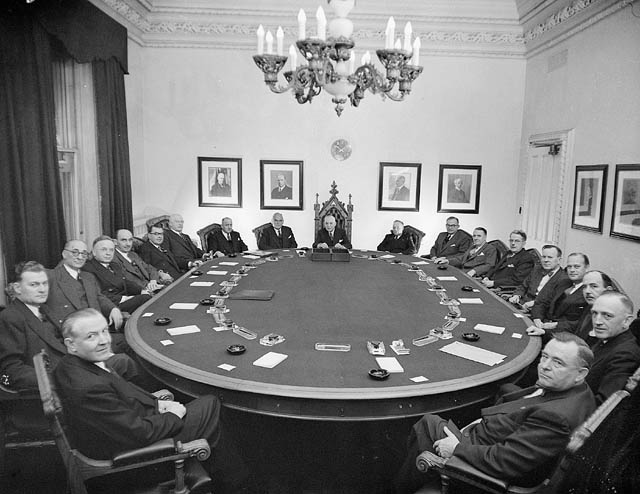
This was the St Laurent cabinet:
There is some doubt about the date of this picture; one Government of Canada source says 1948 and another says 1953; the few familiar faces around the table, Douglas Abbott, Brooke Claxton, Brigadier Milton Gregg VC, C.D. Howe and Lester B. Pearson all served throughout that entire period. What is not in doubt is that the cabinet was much smaller than what we see today: fewer than 20 members. Today’s cabinet has over 35 members.
The problems of large cabinets are grounded in two realities: more and more complex issues, especially social issues, and more choices. Louis St. Laurent had between 245 and 265 MPs in the whole House of Commons and he governed with between 118 and 191 Liberal MPs on the government side. Justin Trudeau has a bigger problem: any modern majority government has 170+ members and Canadians are much better informed (or at least aware) of what government might do for (and to) them. He, like every prime minister before him, responds to the challenge by giving every group a voice. The outcome is a larger and larger cabinet. It’s not Justin Trudeau’s fault, it wasn’t Pierre Trudeau’s fault, either.
The correct answer, in my opinion, is a two tier cabinet: senior and junior ministers or an “inner” and “full” cabinet.
Comments Off on Putting the federal cabinet on a radical diet
The Royal Canadian Regiment and The Battle of Paardeberg
The History Guy: History Deserves to Be Remembered
Published on 1 Jan 2019The forgotten history of a storied regiment. This is the second episode of a special holiday series featuring the History Guy’s hat collection. It was originally made as exclusive content for the channel’s patrons on Patreon. You can get exclusive content too by giving as little as one dollar a month to The History Guy at https://www.patreon.com/TheHistoryGuy.
This is original content based on research by The History Guy. Images in the Public Domain are carefully selected and provide illustration. As images of actual events are sometimes not available, images of similar objects and events are used for illustration.
All events are portrayed in historical context and for educational purposes. Those who do not learn from history are doomed to repeat it.
he History Guy: History Deserves to Be Remembered is the place to find short snippets of forgotten history from five to fifteen minutes long. If you like history too, this is the channel for you.
Comments Off on The Royal Canadian Regiment and The Battle of Paardeberg
January 24, 2019
The latest incarnation of the Canada Food Guide
It’s … not as bad as it could have been, says Chris Selley:

The Canada Food Guide reliably gets a rise out of Canadians who would prefer the government get off our lawns and stop trying to tell us how to live. And the long-awaited update, released Tuesday fully 12 years after the past one, is something of a feast for curmudgeons. In addition to new guidance on what foods we should be consuming — in brief: more plants, fewer animals — it suggests we consider such novel concepts as cooking foods ourselves more often, and eating foods with other people.
Have you considered that if you cook a larger batch of food, you’ll have more food left over to eat at future meals — perhaps having frozen the food and then defrosted it? If you struggle to drink as much water as the guide thinks you should, have you considered that you can “drink it hot or cold”?
I try to keep my curmudgeonly instincts in check. An exercise like this is bound to produce a few silly, infantilizing recommendations. Most countries like Canada have a food guide of sorts. It makes sense that a health ministry would have basic nutritional guidelines on the books to inform institutional policies, not least what kids get fed at schools. Goodness knows you needn’t follow them at home — and indeed, it would surprise me if very many of us do. Modern Western human beings do seem to love being told what to eat, but it’s generally by people with a hell of a lot more charisma than the authors of “Eat well. Live well.” Food porn this ain’t. Protein choices suggested in accompanying photographs include a few tragic slices of skinless chicken, a mighty kebab of three (3) cubes of mystery meat and nothing else, and a portion of salmon to which something brown has happened.
Comments Off on The latest incarnation of the Canada Food Guide
In Canada, “total revenue per GB is roughly 70 times higher than in India and 23 times higher than in Finland”
Canadians are used to being screwed by our telecommunications companies, but it’s worse than I thought, as Michael Geist illustrates:
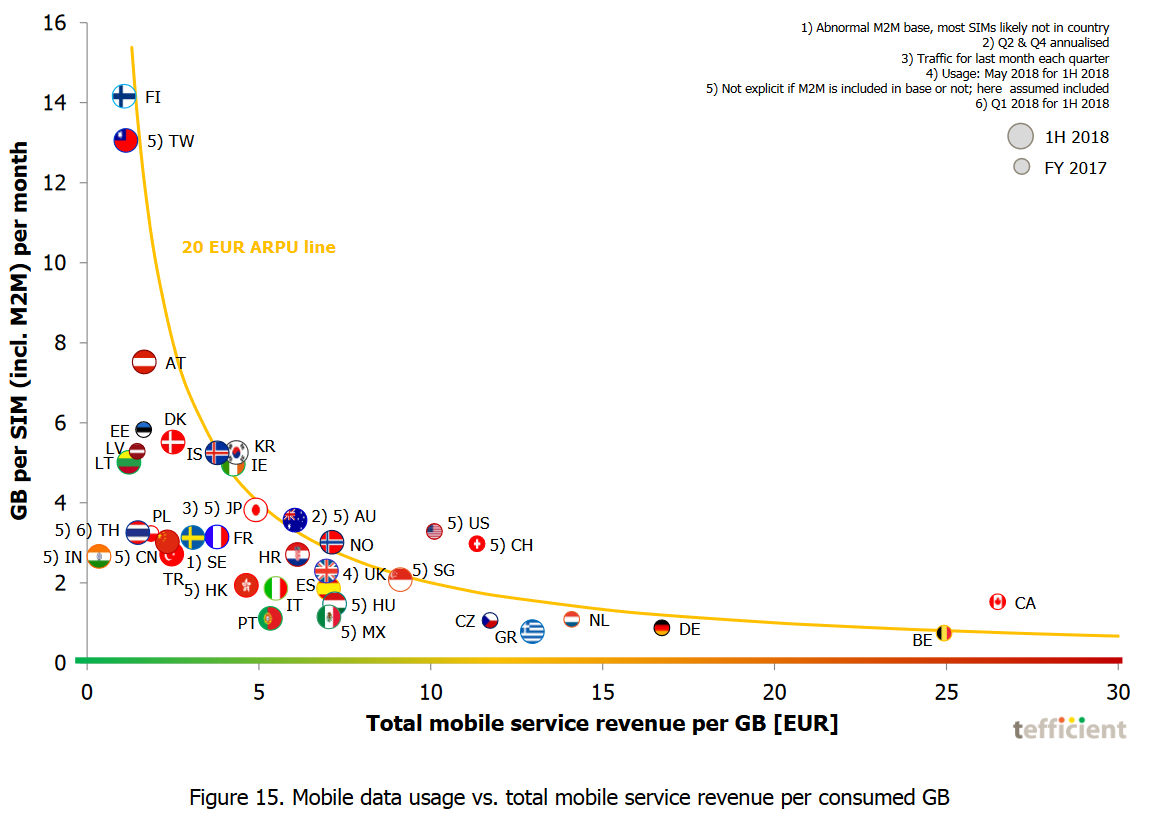
Tefficient, a European-based consultancy on the wireless market, released its latest report this morning comparing pricing and usage in the global wireless market. The data, which incorporates the most recent CRTC numbers on the Canadian market, shows Canada as a global outlier when it comes to the revenues generated by wireless carriers. The report notes the unsurprising correlation between high prices and low data usage:
There is a prerequisite for continued data usage growth, though: The total revenue per gigabyte can’t be too high – like in Canada and Belgium. The total revenue per gigabyte here is roughly 70 times higher than in India and 23 times higher than in Finland. And consequently, mobile usage is lower than average.
The charts show where Canada stands relative to other countries with carriers generating more revenue per GB than anywhere else in the world and consequently Canada lagging behind many other countries in wireless usage.
Source: https://tefficient.com/wp-content/uploads/2019/01/tefficient-industry-analysis-3-2018-mobile-data-usage-and-revenue-1H-2018-per-country-final-17-Jan-2019.pdf
Comments Off on In Canada, “total revenue per GB is roughly 70 times higher than in India and 23 times higher than in Finland”
January 20, 2019
Identifying the real victim in the Burnaby South byelection mini-scandal
Andrew Coyne suggests that we should sympathize with the true victim:
You have to feel for the Liberal Party of Canada, who are surely the real victims in the Karen Wang affair.
The party had innocently selected the B.C. daycare operator to run in next month’s byelection in Burnaby South based solely on her obvious merits as a failed former candidate for the provincial Liberals in 2017, and without the slightest regard to her Chinese ethnicity, in a riding in which, according to the 2016 census, nearly 40 per cent of residents identify as ethnically Chinese.
Imagine their shock when they discovered that she was engaging in ethnic politics.
In a now-infamous post on WeChat, a Chinese-language social media site, Wang boasted of being “the only Chinese candidate” in the byelection, whereas her main opponent — NDP Leader Jagmeet Singh — is “of Indian descent.”
The party was instantly and publicly aghast. Pausing only to dictate an apology to be put out under her name (“I believe in the progress that Justin Trudeau and the Liberal team are making for British Columbians and all Canadians, and I do not wish for any of my comments to be a distraction,” etc etc), party officials issued a statement in which they “accepted her resignation.” Her online comments, the statement noted, “are not aligned with the values of the Liberal Party of Canada.”
Certainly not! How she got the idea that the Liberal Party of Canada was in any way a home for ethnic power-brokers prized for their ability to recruit members and raise funds from certain ethnic groups, or that it would even think of campaigning in ridings with heavy concentrations of voters from a given ethnic group by crude appeals to their ethnic identity — for example by nominating a candidate of the same ethnicity — must remain forever a mystery.
Comments Off on Identifying the real victim in the Burnaby South byelection mini-scandal
January 18, 2019
QotD: Political colours in the US and Canada
We, Conservatives, were a coalition from the very beginning, in Canada. We were, of course, the Liberal-Conservative Party under Sir John A, reflecting the alliances formed between Ontario and Atlantic Canadian Tories and Louis Hippolyte Lafontaine’s moderate Parti bleu in Quebec. This was in contrast to the Liberals who were formed by the Clear Grits from Upper Canada and the Papineau’s radical Parti rouge in Quebec.
(So Quebec has always been central to both Conservative and Liberal political success in Canada and it was Quebec that gave us our modern Conservative blue and Liberal red icons ~ which are opposite to the Democratic blue and Republican red in the USA.)
Ted Campbell, “Our Conservative Roots”, Ted Campbell’s Point of View, 2017-03-05.
Comments Off on QotD: Political colours in the US and Canada
January 17, 2019
Jagmeet Singh and the federal NDP
Chris Selley on the political issues afflicting federal NDP leader Jagmeet Singh as he tries to win a byelection in British Columbia:

More and more New Democrats seem concerned that Jagmeet Singh mightn’t have been the best choice for leader, let alone deserving of a whopping 54 per cent first ballot victory. His various alleged crimes include rendering himself invisible for months, imposing draconian punishments on popular MPs, and going on TV to suggest we stop importing Saudi oil and get it from other countries instead — at a time when Alberta’s NDP government is fighting both for pipelines and for its continued existence.
[…]
Tom Mulcair was a pro. Dumping him appears to be the dumbest thing the NDP ever did. Still, if Singh wins his seat, there is reason to hope he might grow into the job. To skeptics he evinces a distinctly Trudeauvian brand of superficiality, and a similar gift for quotes that land well but fall to pieces if you actually read them back. That hasn’t hurt Trudeau, though — not much and not yet. Singh, a criminal lawyer, certainly boasts a more impressive resumé outside of politics. And goodness knows there are more than enough avenues for any NDP leader to attack a Liberal government that promised us the moon but left us conspicuously earthbound.
If Singh is an anchor on NDP fortunes, it doesn’t seem to be massively heavy one. Nanos Research has them at 15.4 per cent, as of last week — not good at all, but well within recovery distance of their 19.7 per cent performance in the 2015 election. Pre-campaign polls are generally held to be meaningless. Again assuming Singh wins his seat, he has plenty of time to introduce himself and his vision for the NDP.
It’s also possible, though, that the federal NDP in 2019 is a busted flush no matter who’s leading it. The combination of personal charisma and political circumstance that propelled it to Official Opposition status in 2011 might just be throttling back down toward cruising speed.
We shouldn’t overestimate just how improbable Jack Layton’s achievements were. He dragged the NDP to the political centre, where the votes are, marginalizing various breeds of crackpots along the way, while keeping the famously restive portside of the party relatively content. Then he stole a huge chunk of the Quebec nationalist vote in the dead of night.
When Jagmeet Singh was elected NDP leader, I really did think he’d be a significant challenge to Justin Trudeau due to the media’s apparent fascination with Singh (a love affair that appeared to be as deep and lasting as that of Justin’s teeny-bopper fan club for their darling), but it faded very quickly indeed. I guess as far as the Canadian media is concerned, there can only be one…
The byelection is looking pretty safe for Singh, as his Tory opponent beclowned himself quickly, and news broke on Wednesday that the Liberal candidate has withdrawn, after similarly beclowning herself:
BREAKING: Liberal Party says it has accepted Karen Wang's resignation as the party candidate in Burnaby South. That's in reaction to this story from @mdgmedia https://t.co/sPlEC9Djxr #cdnpoli pic.twitter.com/lZWbjPOMQ1
— Alex Ballingall (@aballinga) January 16, 2019
Comments Off on Jagmeet Singh and the federal NDP
January 16, 2019
Justin Trudeau is against using refugees as political props … at least when others do it
Politicians traffic in hypocrisy, example seven million and three:
There were no good reasons to make a big show of [Rahaf Mohammed] Alqunun’s arrival, in other words, and plenty of good reasons not to. Furthermore, Justin Trudeau has been very clear about what he thinks of using refugees as political props. He was at his most thespian back in 2015 when it was alleged Stephen Harper’s office had been sifting through applications from Syrian asylum-seekers in search of potential photo ops.
“That’s DIS-GUST-ING,” Trudeau hissed at a campaign stop in Richmond, B.C. “That’s not the Canada we want; that’s not the Canada we need to build.”
In the end, though, there was Foreign Affairs Minister Chrystia Freeland with her arm draped around Alqunun, announcing that this “brave new Canadian” would not be taking questions. Luckily, Freeland herself had arrived equipped with some crimson talking points.
“I believe in lighting a single candle,” she said. “Where we can save a single person, where we can save a single woman, that is a good thing to do. … And I’d like to also emphasize, this is part of a broader Canadian policy of supporting women and girls in Canada and around the world.”
“Canada is a country that understands how important it is to stand up for human rights, to stand up for women’s rights around the world,” Trudeau chimed in.
It would be well-nigh impossible to argue against hearing, at the very least, Alqunun’s claim for asylum. But at this point, she is certainly also a political prop — a living symbol of the Liberal view of Canada’s place in the world, and an always-welcome opportunity for self-congratulation.
Comments Off on Justin Trudeau is against using refugees as political props … at least when others do it


