Quotulatiousness

September 10, 2018

Speculation on an early federal election

Filed under: Cancon, Politics — Tags: , , , — Nicholas @ 03:00

Ted Campbell on the recent musings in the official party organ Toronto Star on the pros and cons of the Prime Minister going to the polls this fall rather than next year:

The Star, a pretty Liberal friendly journal, says, in an article by Robin Sears, a former NDP insider (in fact he was national director of the NDP for seven years), that “Liberal hawks, like those of a generation earlier, are heatedly debating a snap election call. Not entirely surprising, since [we] have not seen a decade since the ’50s when a government has not been forced by events, or decided to seize a strategic advantage, and called an early election … [and] … The Liberal hawks’ arguments are getting stronger. Neither of their opponents is ready, and each will likely be stronger a year from now. The Federal Court and Donald Trump have both just stuck a finger in the Prime Minister’s eye. This is an opportunity to return the favour with a much harder counterpunch, a strong new political mandate.“

[…]

I agree with Robin Sears … going [to] the polls sooner, in the fall of 2017, and running against Donald Trump (and the ghost of Stephen Harper) makes good political sense because it seems, to me, highly unlikely that Justin Trudeau and his gang that cannot shoot straight are going to get any better in the next year or so. In fact the Trudeau regime’s record, to date, suggests that a year from now the country might be in ruins.

Right now the NDP appears to be in shambles; Jagmeet Singh’s leadership is being questioned at pretty high levels, and the Conservatives are still reeling from Maxime’s Bernier’s defection. Waiting until October 2018 risks giving both the Conservatives and the NDP time to reorganize and present new, attractive programmes and, perhaps even new, more attractive leaders, too.

Will he go to the polls in 2017? Who knows? Parliament is due to reconvene, after the long summer recess, in a week ~ on 17 September. Many people were expecting a new Throne Speech outlining a pre-election platform filled with promises that will, most likely, never be kept, but Robin Sears makes a good case for Prime Minister Trudeau to go to the Governor General, next week, and to tell her that the situation is such that Canada’s government needs a new mandate.

September 9, 2018

“This isn’t hardball so much as Calvinball: a game where one player constantly makes up new rules as he goes along”

Filed under: Cancon, Economics, USA — Tags: , , — Nicholas @ 03:00

Andrew Coyne provides a useful set of clues to help ordinary folks understand the NAFTA “negotiations”:

Talks on a renegotiated North American Free Trade Agreement, which at various times in the past days, weeks and months have been said to be on the verge of either a deal or collapse, are now reported to be “progressing slowly.” An agreement was not expected by the end of the day Friday. Some reports said it was not expected till the end of the month. Or maybe December.

In other words, business as usual. Had you read none of the several thousand reports on the negotiations since they began more than a year ago you would be scarcely less informed than the most avid trade watcher. Some points to bear in mind as the talks grind toward their next “deadline”:

No one knows anything. Any number of authoritative commentators have weighed in on the failure of the talks, if they are in fact failing, and who is to blame if they are. But the truth is that unless you were in the room with the negotiators you have no idea what is really going on — assuming even they do. This is not because there have been no leaks or official accounts of the proceedings, but because…

Everyone is lying to you. Many a rookie reporter has had the same experience covering a labour negotiation. The talks are said to be coming “down to the wire,” facing a dramatic “midnight deadline.” Sources close to one side or the other confide there will be “no more concessions,” that a “strike is now unavoidable.”

So the deadline comes and goes and nothing happens: they keep talking. Or else the side that had vowed not to give an inch more caves and cuts a deal. Which is to say that while all sides dutifully proclaim their aversion to “negotiating through the media,” everyone negotiates through the media, all the time. The NAFTA talks are no different.

The NAFTA talks are completely different. There has never been a trade negotiation like this, because there has never been a president, or leader of any major country, like Donald Trump. It isn’t just that he lies all the time, or changes his mind on those occasions when he is not lying.

September 8, 2018

A key statistic in the debate over gun violence in Toronto … turns out to be an invention

Filed under: Cancon, Law, Media, Politics — Tags: , , , , — Nicholas @ 03:00

Matt Gurney on an important claim in the controversy about guns and crime in Toronto — that will probably not get anything like as much coverage because it doesn’t support the prohibitionists’ narrative:

Earlier this summer — a summer that has seen Toronto wracked by gun violence — a report came out that suggested lawful Canadian gun owners were to blame for at least some of the violence. The article was originally published by the Canadian Press, and was widely republished elsewhere, including at the CBC, the National Post, a dozen local newspapers, CTV News, and, yes, here at Global News. Since then, it has been widely cited in other news stories covering the issue, including in The Toronto Star and The Globe and Mail. The report was everywhere.

Here’s the problem. Newly released stats show clearly that it was wrong.

The article was based around an interview with a Toronto Police Services detective, Rob Di Danieli. Det. Di Danieli told the Canadian Press that Canadians who were lawfully licensed to purchase and possess firearms were increasingly a public safety issue. “They go get their licence for the purpose of becoming a firearms trafficker,” Di Danieli told the CP. “A lot of people are so ready to blame the big bad Americans, but we had our own little problem here.”

The CP article hangs on this revelation from the detective. It notes, in various places, “The number of guns obtained legally in Canada but are then sold to people who use them for criminal purposes has surged dramatically in recent years compared to firearms smuggled from the United States, Toronto police say,” and, “In recent years [investigators say they] have noticed a stark shift in where guns used to commit crimes are coming from,” and, “Legal Canadian gun owners are selling their weapons illegally, Di Danieli said, noting that police have seen more than 40 such cases in recent years.”

[…]

At the time the CP story first ran, there were no publicly available stats to support (or contradict) what di Danieli had told them. But now, those numbers are publicly available, thanks to Dennis R. Young, an Alberta-based researcher who filed a Freedom of Information request with the Toronto police and published their reply on his website. And these stats tell a very different story.

September 3, 2018

Montreal to host urban combat

Filed under: Cancon, Military — Tags: , , — Nicholas @ 03:00

… oh, sorry, that should be that Montreal will be hosting an experiment involving new technologies for urban combat:

Defence scientists from a number of countries will be in Montreal in mid-September to participate in an experiment to look at new technologies for fighting and conducting operations in cities.

The Contested Urban Environment 2018 experiment will take place from September 10 to 21, and involve Canadian defence scientists and Canadian Forces personnel conducting a series of technology research experiments in the city. They will be joined by participants from nations including Australia, New Zealand, the United Kingdom and the United States. The experiment is being conducted in support of advancing research around how to best conduct military operations in what is being called “complex urban environments,” according to the Department of National Defence.

Postmedia reported last year that Canada will contribute to specific areas of expertise in this field, including technologies in intelligence, surveillance, reconnaissance, communications and small arms.

Canada participated in a similar experiment last year in Australia. Approximately 80 scientists from the U.S, Australia, Canada, New Zealand and the UK took part in that experiment, which began Nov. 20 and ended Dec. 1. The Canadian contingent consisted of 10 staff from Defence Research and Development Canada. In addition, around 100 personnel from the Australian Defence Force were involved.

September 1, 2018

The legal tangle around the Trans-Mountain pipeline approval process

Filed under: Business, Cancon, Environment, Government, Law — Tags: , — Nicholas @ 03:00

Jay Currie suspects the process has been intentionally complicated to the point that there may not be a way out for this government:

What the Court essentially asked was, “Did the Federal Government consult enough?” and then concluded, “No, not enough.”

How much is “enough”? That is a question which this decision really does not answer. And I suspect it does not answer it because there is actually no answer which is even close to true.

In a normal process a reasonable level of public consultation would be reached when the public has been given an opportunity to comment on the matter at hand. Which is a bit vague but there is case law which fleshes out what such an opportunity might look like.

However, once environmentalists and First Nations are engaged it is not at all obvious that merely having the opportunity to comment is sufficient. Unlike a rezoning application, an application to build a pipeline (or, realistically, virtually any other large undertaking) creates the opportunity for First Nations to talk about everything from ancient hunting rights, to sacred grounds, to former village sites, to disruptions to present First Nation culture and so on. Having the environmentalists involved ensures that the relatively easy solution of simply paying the First Nations’ people for their consent, is off the table. That solution will be denounced by the enviros as cultural genocide and worse.

All of which creates, and might arguably have been intended to create, a Gordian knot when it comes to considering major projects. Consultation becomes an endless task and one which has no defined parameters. The decision today indicates that an extensive consultation process is not enough but it does not indicate what might be enough.

Delightfully, the shareholders of Kinder Morgan – which owns TransMountain – voted today to sell the project to Canada’s feckless Federal Government for several billion dollars.

I suspect the CEO danced a little jig relieved that he no longer had to guess at how far consultations have to go. But Canada is stuck with a completely dysfunctional system which is being exploited by environmentalists and First Nations to prevent infrastructure from being built. That will have to be fixed.

August 31, 2018

Farewell, buck-a-beer publicity stunt, we hardly knew ye

Filed under: Business, Cancon, Politics — Tags: , , , , — Nicholas @ 03:00

Chris Selley on the all-too-brief publicity stunt of cheaper beer for Ontario:

President’s Choice is ending its buck-a-beer promotion on Sept. 3, just days after it started: We get one week, one long weekend and then out of the pool, party’s over, back to class. PC-branded beer will rocket back up to $1.38 a bottle when you buy 24 at The Beer Store or $1.65 when you buy 12, which highlights just how steep — and presumably unsustainable — the discount really was. We shall see how long the two other participating breweries’ offers last, but they made it quite clear, as did PC, that this was a limited-time offer prompted by Doug Ford’s most shamelessly blunt populist pledge.

My goodness, though, what a commotion it will leave in its wake. Some brewers quite understandably took the opportunity to note the impact of aluminum tariffs on their bottom lines, to complain that Ford’s government was playing favourites by giving away expensive product placement in LCBO stores for $1 beer, and to note the government is actually raising taxes on beer.

Others, however, waxed utterly scandalized. “How about buck a pound of steak? Who would eat that?” asked one Toronto brewer who had perhaps not entirely thought through his rhetorical question. “We haven’t even given two thoughts about this,” Great Lakes Brewery’s communications manager, Troy Burtch, told the Toronto Star. “Why would anyone do this?” Burtch and Great Lakes have signalled their total uninterest by tweeting incessantly about it.

The Canadian Taxpayers’ Federation went after some of the affronted craft brewers for accepting taxpayer subsidies for their higher-end products. People on social media lined up for and against buck-a-beer, vowing to boycott the participants or those complaining about the program.

The whole thing was a dumb Ford Nation stunt, no question. But good grief. You can hardly blame the breweries, either for participating or for not: they were just trying to wring as much publicity as they could from the situation. No one is really any worse off, or at least not much. What we were really seeing among the chattering classes was a rerun-by-proxy of the June 6 election: to drink Ford’s swill was to vote Ford Nation; to boycott it was to stand bravely against their entire agenda.

August 29, 2018

The Conservative convention, bought and paid for by the friends of supply management

Filed under: Business, Cancon, Economics, Politics — Tags: , , , — Nicholas @ 03:00

Colby Cosh relates the details of how well stage-managed the Conservative convention in Halifax was … from the point of view of the beneficiaries of supply management:

A copy of a “briefing binder” that the Dairy Farmers of Canada had given to representatives of supply-managed agriculture was carelessly discarded, found by a Calgary delegate named Matthew Bexte, and splattered onto the internet. The contents of the binder describe the strategy and outline the available forces of the supply-management squad. The resolutions being discussed by the convention included one favouring the repeal of expensive tariff protection for Canada’s egg, dairy, and poultry cartels, and the binder lists the particular responses and tactics to be used depending on how far the offending free-trade resolution advanced in the debate.

Which it didn’t. The motion in favour of letting Canadian suckers buy foreign cheese in dangerous unregulated quantities died noisily in a “breakout session,” never even reaching a vote, much less the plenary session of the convention. As the National Post’s uncannily versatile Marie-Danielle Smith documented before the briefing book was leaked, free-trade delegates had already caught the scent of a rat, complaining that the motion had been suppressed through strategic delay by operatives working for party leader Andrew Scheer.

The Dairy Farmers of Canada briefing describes this motion-suppression tactic as “Scenario 2,” calling it a “sub-optimal” outcome: “It buys us (supply-managed farmers) a reprieve, but doesn’t put the issue to rest.” According to the briefing notes, if the motion had passed in the Friday breakout session, that would plunge the world into “Scenario 3.” Under Scenario 3, a Friday evening reception at an Irish pub, with free food and potables, would come into play: quota-sucking farmers and their public-relations goons would have been given a chance to mingle with well-lubricated CPC delegates, with “infographics on a slideshow” pulsing subliminally in the background.

The hope here would be to prevent a devastating “Scenario 5,” in which the destruction of supply management came before the whole CPC assembly for a vote and won it. The prospective talking points accompanying Scenario 5 warn that “Members of the Conservative Party of Canada have sent a clear signal that they do not support Canadian farmers” and they hiss menacingly that “Canadians will remember the position taken by Conservatives today.”

Fortunately, even in the event of a flat-out Scenario 5, there would still be what the book calls the “Safety Net.” The safety net is that annual party conventions are meaningless, expensive balderdash anyway. Or, as the Dairy Farmers of Canada (DFC) book puts it: “The powers of the Leader are far-reaching in preventing a policy from being in the party platform. DFC has been told by the Leader’s office that he will exercise this power … regardless of the outcome at convention.”

Good old Andrew … he knows who put him in his current position and has signalled in advance that he’ll “stay bought”. Too bad for Canadian consumers, but great news for the leeches who benefit from the market distortions of supply management.

August 27, 2018

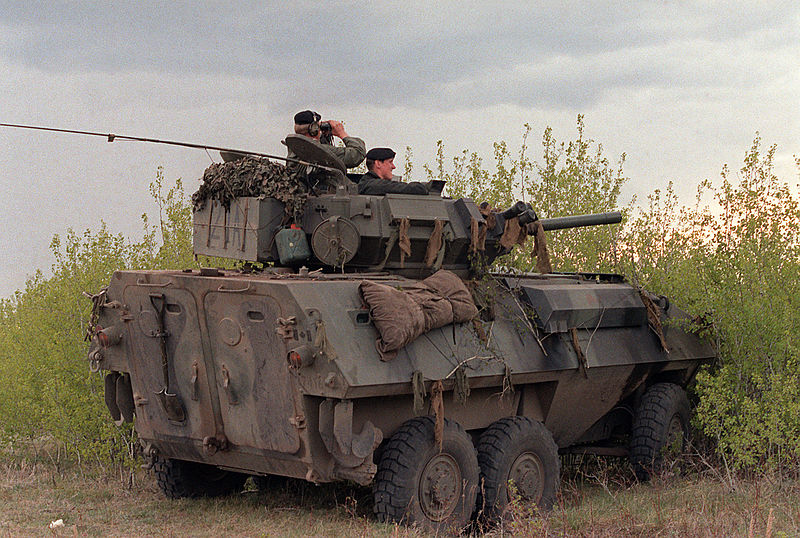
Upgrading Canada’s LAV III armoured fighting vehicles

Filed under: Cancon, Military, Technology — Tags: , , — Nicholas @ 03:00

From the LAV III Wikipedia page:

Canadian Army LAV III convoy near Khadan, Afghanistan – 2010-01-25
Photo by Staff Sgt. Christine Jones via Wikimedia Commons

The LAV III, originally named the Kodiak by the Canadian Army, is the third generation of the Light Armoured Vehicle (LAV) family of Infantry fighting vehicle built by General Dynamics Land Systems first entering service in 1999. It was developed in Canada and is the primary mechanized infantry vehicle of the Canadian Army and the New Zealand Army. It also forms the basis of the Stryker vehicle used by the US Army and other operators.

[…]

In July 2009, the Canadian Department of National Defence announced that $5 billion would be spent to enhance, replace and repair the army’s armoured vehicles. Part of the spending would be used to replace and repair damaged LAV III’s due to wear and tear from operations in Afghanistan. As much as 33 percent of the army’s light armoured vehicles were out of service. Furthermore, the LAV III’s will be upgraded with improved protection and automotive components. The Canadian Armed Forces has lost over 34 vehicles and 359 were damaged during the mission in Afghanistan. The Canadian army has lost 13 LAV’s and more than 159 were damaged by roadside bombs or enemy fire. Of the $5 billion announced, approximately 20% of it will be used to upgrade LAV III models. The upgrade will extend the LAV III life span to 2035. The remaining $4 billion is to be spent on a “new family of land combat vehicles”. The Department of National Defence considered the purchase of vehicles meant to accompany the Leopard 2 and to sustain the LAV III into combat. […]

On October 21, 2011 the Canadian government announced a $1.1 billion contract to General Dynamics Land Systems to upgrade 550 LAV III combat vehicles. The government said the upgrade is needed to improve protection against mines and improvised explosive devices (IEDs), which have been the cause of a number of Canadian deaths in Afghanistan. The improvements will also extend the service of the vehicles up to 2035 and will boost troop mobility. The upgrades include a new and more powerful engine, increased armour protection, steering and brake systems. The turret hatches on the LAV III would be made larger and improved fire control, thermal, day and low-light sights, and data displays. The weight of the vehicle would increase from 38,000 pounds (17,000 kg) to 55,000 pounds (25,000 kg). The first of 66 upgraded LAV IIIs was delivered on February 1, 2013. The success of the upgrade program and budget pressures led to the cancellation of the Close Combat Vehicle replacement program later that year.

In September 2012 the original contract valued to at $1.064 billion to upgrade the 550 LAV III’s variants, an infantry section carrier, a command post, an observation post and an engineer vehicle to the LAV 6.0 configuration, was modified. This included an additional $151 million to upgrade 66 LAV III’s to the LAV 6.0 reconnaissance variant or ‘recce’.

On February 10, 2017 General Dynamics Land Systems – Canada of London, Ont. was awarded a $404 million order to work on 141 LAV Operational Requirement Integration Task (LORIT) vehicles. This contract will upgrade the remaining LAV III fleet in the Canadian Army to the LAV 6.0 configuration. This brings the Canadian Army’s Light Armoured Vehicle III Upgrade (LAVUP) program to a total cost of $1.8 billion.

Final completion and delivery of the Canadian Army’s Light Armoured Vehicle III Upgrade (LAVUP) to upgrade the LAV III to the LAV 6.0 is expected to be completed by December 2019.

Canadian combat engineers in light armoured vehicules cross the river on a German floating bridge in Tancos, Portugal, during JOINTEX 15 as part of NATO’s exercise TRIDENT JUNCTURE 15 on November 2, 2015.
Photo by Sgt Sebastien Frechette via Wikimedia Commons

Ken Pole has more on the program at Canadian Army Today:

The LAV UP, also known as LAV 6.0, project is expected to push their operational life to 2035.

That effectively was set in motion in November 2008 when the Department of National Defence (DND) confirmed that it wanted to combine three programs into one general set of upgrades to all armoured vehicles. That led to a $1.064-billion contract award to GDLSC in October 2011 to modernize 550 LAV IIIs to enhance not only their survivability, but also their mobility and lethality.

Under the contract, 409 vehicles were to receive turret and chassis upgrades while 141 LAV Operational Requirement Integration Task (LORIT) variants were scheduled to receive only the turret upgrade. A contract amendment in February 2017 added $404 million to upgrade the LORIT chassis as well.

Now the focus within the Directorate of Land Requirements (DLR) is on the Light Armoured Vehicle Specialist Variant Enhancements (LAV SVE). Major Philippe Masse, the project director, brings operational chops from Afghanistan, although he’s quick to say that he’s had a lot to learn about the vehicles since he was assigned. He’s taken a clean-sheet approach, conducting extensive discussions with combat engineers, artillery officers, and gunners.

Masse’s career includes nine months as commander of a light infantry platoon tasked with force protection of the Kandahar Provincial Reconstruction Team and later as second-in-command of the Royal 22nd Regiment battlegroup’s parachute company for its final combat rotation on Operation Athena.

The LAV III infantry carrier and command post variants are the two largest elements of the fleet and are often tasked additional roles. However, the two specialist variants, the Engineer and the Observation Post Vehicle, used by Artillery’s forward detachments, will be “enhanced” under this project.

[…]

There is extra pressure on the LAV SVE package because it was specifically identified in the Strong, Secure, Engaged policy document. “We’re on track; the options are getting a lot of priority,” Masse said. “We’re already engaged with General Dynamics Land Systems because they basically own the intellectual property of the fleet…. When you want to integrate new stuff, they’re among the first phone calls you have to make.”

While integration of a complex system is always a challenge, one of the team’s considerations will also be ease of maintenance, especially for soldiers in the field. “We’re looking to align that, if possible, with existing in-service support contracts that we already [have],” he said. “The bottom line for us is reliability.”

August 26, 2018

Maxime Bernier’s proposed new federal party

Filed under: Cancon, Politics — Tags: , , — Nicholas @ 03:00

Andrew Coyne on the plan to create a new conservative party at the federal level:

No one with any familiarity with the modern Conservative Party could disagree with much of what its former-almost-leader Maxime Bernier now has to say about it.

“Intellectually and morally corrupt” might be a bit over the top, but “avoids important but controversial issues”, “afraid to articulate any coherent policy”, offers “a bunch of platitudes that don’t offend anybody but don’t mean anything [or] motivate anyone” while pandering to interest groups and buying votes “just like the Liberals”? Checks out, as many Conservatives would be the first to say.

Neither is there anything objectionable in principle about Bernier’s proposal to launch a new party of the right. Obviously it would not be in the partisan interest of the Conservative Party, but whether it would be harmful to the broader cause of conservatism, as so many reflexively insist, is less clear.

As I’ve argued before, the splitting of the left-of-centre vote between two (later three, and four) parties since 1935 has not stopped the Liberals from winning 16 out of 25 elections in that time. It may even have helped. The presence of two parties saying broadly similar things has entrenched progressivism as the default mode of Canadian politics, leaving the Conservatives, to the extent they have occasionally demurred, looking like the outliers.

Rather than simply splitting a fixed percentage of the vote, that is, the two parties may have combined to expand the pool of voters from which they both fish. An upstart conservative party, more robust in its advocacy, might play the same role as the NDP on the left, pushing out the boundaries of acceptable opinion and freeing the established Conservative Party to compete more aggressively for the median voter — in part by pulling the median to the right. If nothing else it would restore some balance to the equation.

But to say that a new conservative party might be a useful addition to the political landscape is not to say that this is that party, or that now is the time, or that Bernier is its leader.

The New Democrats have never come all that close to forming a government, but over the years, they’ve gotten the other two major parties to adopt and implement almost everything they’ve ever demanded … eventually. That does show that a party doesn’t necessarily need to win the vote to win the issues. As Jay Currie suggested a few days back, a new Bernier-led small-C conservative party might not automatically lead to another term for Justin Trudeau:

Bernier does not have to play the traditional Canadian political game. The world has changed. First off, he does not have to run a candidate in every single riding in Canada. While he said he would today, he needs to rethink that position. Thirty or forty will be more than enough to ensure his new party has a national presence. But, and this is important, he can make a virtue of this necessity by making sure not to run against the many actual conservatives who currently sit, silently, in Parliament. Even better, he can endorse them.

Using a targetted riding strategy would put paid to the idea that a vote for Max is a vote for the Liberals.

With a targetted riding strategy Max can also avoid the always looming disaster of a crazy person – actual Nazi, major anti-Semite, massive homophobe – gaining a nomination in a hopeless riding and then being pinned to the party by a hostile media. Finding 30 or 40 really excellent candidates and then backing them hard pre-Writ might create the conditions for multiple wins.

Which ridings to target will be a tough choice but other than making sure to have a couple in Toronto, Vancouver and Montreal – for media exposure – they should be ridings without a currently sitting Conservative and where the demographics do not massively favour the Liberals (thus suburban and rural). And they need to be air accessible because Bernier is going to spend his campaign on an airplane.

Most importantly, Bernier needs to create a positive message. One of the problems the Conservatives have is that they are barely against most of the Trudeau Liberal positions and don’t seem to have any of their own. Bernier needs to define a Canadian message. Free Trade, economic expansion, jobs are one side of it, Canadian unity instead of division could be the other. Bernier’s objection to increased immigration and the fragmentation of multiculturalism will resonate if he can package them in a “making Canada stronger” theme.

Right from the go Bernier should avoid any suggestion that his party will form a government. Instead he should be talking about keeping the politicians in Ottawa honest and in touch with Canadians. Balance of power is the goal.

The Wolseley Expedition and the making of Canada

Filed under: Cancon, History, Military — Tags: , , , , — Nicholas @ 02:00

The History Guy: History Deserves to Be Remembered
Published on 2 May 2018

In the early days of the Canadian confederation, one of the greatest officers of the British Victorian Army takes 1000 soldiers on an impossible march through the wilderness that helps to define modern Canada.

All events are described for educational purposes and are presented in historical context.

Patreon: https://www.patreon.com/TheHistoryGuy

The History Guy: History Deserves to be Remembered is the place to find short snippets of forgotten history from five to fifteen minutes long. If you like history too, this is the channel for you.

August 23, 2018

Lost model of the Avro Arrow found off Prince Edward County

Filed under: Cancon, History, Military, Technology — Tags: , , , — Nicholas @ 03:00

Call me a cynic, but this is likely to kick off yet another round of myth-making about the Avro Arrow:

An iconic piece of Canada’s aviation history has been pulled out of the depths of Lake Ontario and the recovery team is hoping to find more beneath the waves.

Divers brought what is believed to be a model of the Avro Arrow to the surface last week off Prince Edward County and brought it to the Canada Aviation and Space Museum on Tuesday.

Since last September, a series of models have been found at the bottom of Lake Ontario.

The model is about three metres long — a 1/8 scale of the actual plane, according to Erin Gregory, assistant curator at the museum.

“It looks like a rocket with large triangular wings,” she said.

1/8 scale model of the Avro Arrow recovered from Lake Ontario off the shores of Prince Edward County
Photo by OEX Recovery Group, via CBC.

The Canadian Conservation Institute and the aviation museum, will oversee the conservation and restoration of the test models.

What they found last week, is not the full replica of the Arrow, the search group was hoping to find. Instead they believe it is a smaller model, meant to test the delta wing design — the triangular shape the plane was known for.

“The delta wing was a relatively new concept at that point, so it required a lot of testing to determine whether or not it would perform well, particularly at supersonic speeds,” said Gregory.

The Avro Arrow holds a special place in the hearts of Canadian conspiracy theorists – it’s “artisanal Canadian myth-making, hand-woven, fair-trade, and 100% organic”. As I said back in 2004, this is the only truly Canadian conspiracy theory (Colby Cosh calls it our “Napoleon-hat” complex).

August 19, 2018

The Dieppe Raid, from Canada at War, 1962

Filed under: Cancon, France, History, Military, WW2 — Tags: , , — Nicholas @ 02:00

piddflicks
Published on 19 Aug 2012

An excerpt from the brilliant 1962 series Canada At War by the National Film Board of Canada focusing on the disastrous raid on Dieppe, 19 August 1942, where more than two-thirds of the 6,000 soldiers were killed, wounded or taken prisoner.

August 18, 2018

“The urge to erase the past is totalitarian”, especially when “it’s the current year”

Filed under: Cancon, History — Tags: , , , — Nicholas @ 05:00

Mark Steyn on the most recent efforts to obliterate the past:

I’m with Blatch – the great Christie Blatchford, my esteemed colleague from the glory days of The National Post. She’s had enough of it, and so have I – whether it’s the toppling of Field Marshal Smuts in Cambridge, President McKinley in California, Sir John A Macdonald in Victoria. The urge to erase the past is totalitarian. Yet what Pol Pot did, by re-making the world and proclaiming Year Zero, is now the default setting of every social-justice nitwit.

[…]

I’m sick of replacing something – “the Langevin Block”, “the Langevin Bridge” – with nothing – “the Office of the Prime Minister and the Privy Council”, “the Reconciliation Bridge”. The latter is just fatuous pap, and the former is not a name but merely a description of what’s taking place inside the building. But that’s all we can do, because we can’t even take the risk of re-naming the joint. Because today’s hero-of-the-day – the first transgender nominee for Governor of Vermont, say – will inevitably be revealed in thirty years’ time to have been unsound on intersexual Muslima cloning or whatever. Because getting “woke” is one thing, but staying “woke” and “woke”-to-the-minute is all but impossible:

‘Queer Eye’ Star Jonathan Van Ness Under Fire After Saying ‘Not All Republicans Are Racist’

The “leaders of violence” are those engaged in a systematic assault on not just national history but our entire civilizational inheritance. And the wimp conservatives who string along with this are merely licensing the next provocation. In Canada, much of this drivel derives from fainthearted ninnies twenty years ago who meekly accepted charges of “cultural genocide” – which is exactly like genocide, except for the peripheral detail of not requiring any actual corpses. Here’s me two decades ago:

    Only a generation or two back, governments thought they were doing native children a favour by teaching them the English language and the principles of common law and the great sweep of imperial history, that by doing so they were bringing young Indians and Inuit ‘within the circle of civilised conditions’. It’s only 40 years ago, but that’s one memory the government of Canada will never recover. No civilised society legislates retrospectively: if you pass a seat-belt law in 1990, you don’t prosecute people who were driving without them in 1980. Likewise, we should not sue the past for non-compliance with the orthodoxies of the present.

But we did. So surrendering on “residential schools” led to the re-classification of Canada’s first prime minister as “a leader of violence” by the City of Victoria. And, if Sir John is a leader of violence, how can the very city be named for the Queen who knighted him and sent a wreath to his funeral? Shouldn’t Victoria be renamed Reconciliationville? Or, per the Langevin Block, “the City of the Office of the Mayor and the Municipal Council”?

And what about Casimir Gzowski, who laid Her Majesty’s wreath upon the “leader of violence”‘s coffin? Shouldn’t his busts and memorials be removed, too? And Sir Casimir Gzowski Park in Toronto be renamed Transgender Bathroom Park?

And what about Sir Casimir’s great-great-grandson, beloved Canadian radio host Peter Gzowski? Shouldn’t he be removed from the CBC archives? Or at any rate shouldn’t Gzowski College at Trent University and the Gzowski branch of Georgina public libraries be renamed just in case somebody is triggered by the thought that they might be named not after Peter but after the great-great-grandpa who had the effrontery to lay the queen of violence’s wreath of violence on the leader of violence’s grave or violence?

This is not an assault on historical figures; this is an assault on history itself – on the very idea that ancient societies have a past, or roots, or historical continuity, or anything other than the fashions of the moment.

August 17, 2018

“…when he asked her about [Jagmeet] Singh’s CBC appearance, ‘Notley laughed out loud'”

Filed under: Cancon, Politics — Tags: , , , — Nicholas @ 03:00

Colby Cosh is apparently fascinated by the internecine fight shaping up between the NDP Premier of Alberta, Rachel Notley, and the federal NDP leader, Jagmeet Singh:

Federal NDP leader Jagmeet Singh taking part in a Pride Parade in June 2017 (during the leadership campaign).
Photo via Wikimedia.

If I am being honest, the thing about the Singh-Notley quarrel that interests me most is not the range of possible political consequences. Nor is it the brute economics of Canadian oil. No, I am most interested in the rhetorical style of it. Last week, on CBC’s Power and Politics, federal NDP Leader Jagmeet Singh was discussing Saudi Arabia’s strange diplomatic meltdown and started speculating about Canada’s need to look for imported oil from other countries. Western viewers — no doubt the CBC technically has some — were well aware that Singh had opposed the controversial Energy East pipeline.

[…]

With Saudi Arabia acting like the cranky, unstable extended family it is, Energy East is looking a bit like a missed opportunity — not only for landlocked Alberta, which has a permanent stake in the multiplication of oil export options, but for the entire country. So it did not take long for people to start laughing at Singh’s musings about where, oh where on this great planet Earth, Canada might obtain some oil.

I am using the word “laughing” literally. On Friday, the Edmonton Journal’s politics columnist, Graham Thomson, had a sitdown with Alberta NDP Premier Notley, and when he asked her about Singh’s CBC appearance, “Notley laughed out loud … ‘It struck me that that was a thing that maybe he should have thought through before he said it.’ ”

The premier went on to add “What happened with Jagmeet is that he’s learning that things are not as simple as they sometimes seem” and insisted that “to throw (workers) under the bus as collateral damage in pursuit of some other high-level policy objective is a recipe for failure, and it’s also very elitist.” The e-word! For New Democrats, that’s rough talk.

[…]

Her rough treatment of Singh is unlikely to hurt his by-electoral cause in Burnaby, so the Notley-Singh fight can still be dismissed as mutually beneficial political theatre. Still, Singh tried to defend himself, sort of, in a Monday interview with our Maura Forrest. “I know that Premier Notley’s in a tough political fight,” he said, “but I’ve always felt, and I believe, that personal attacks are beneath her. That’s not my way and I think she’s better than that.”

I will never stop being confused and amused by the way politicians speak in these situations. Read for pure ostensive meaning, Singh is not accusing Notley of making a personal attack on him: in fact, he’s specifically saying that she is incapable of such a thing. But then why should she need the excuse of a tough political fight? Of course, we all know that saying someone is “better than that” is another way of calling them a jerk — perhaps the cruellest.

QotD: TINA

Filed under: Cancon, Economics, Politics, Quotations, USA — Tags: , — Nicholas @ 01:00

I believe, and I have alluded to this several times, that we must anchor all our policies in North America. We are, I have said, again more than once, bound by what some wag called TINA²: we are Trapped In North America and There Is No Alternative. (TINA X TINA = TINA²) That’s the crux of it … no matter what some romantics might wish we are and must remain for generations anchored in North America. We are not big enough and rich enough to be powerful enough to face the world on our own, treating the USA as just another great power ~ as, arguably, Australia does. Geography, economics, personal issues ~ we are kith and kin ~ and the power imbalance make us dependent upon America to a degree that some, including me, find unhealthy.

But, until we can grow our population to 100 million, until we can grow up and appreciate that we need substantial hard (military) power in order to promote and protect our vital interests around the globe, until we can become a global free trader, and until America’s decline is more marked then There Is No Alternative … we are Trapped In North America ~ trapped in Donald Trump’s America, for now, anyway.

Ted Campbell, “Anchor, cornerstone or stumbling block?”, Ted Campbell’s Point of View, 2018-07-17.

« Newer PostsOlder Posts »

Powered by WordPress