Matsimus
Published 1 Jun 2018The Textron TAPV (Tactical Armoured Patrol Vehicle) is an armoured car currently in use by the Canadian Army. It is based on the M1117 Armoured Security Vehicle, developed for use by the military police of the US Armed Forces.
The Tactical Armoured Patrol Vehicle (TAPV) program began in 2009, and in 2012 the contract was awarded to Textron Systems, Inc. On August 16, 2016, Textron systems delivered the first Tactical Armoured Patrol Vehicle (TAPV) to the Canadian Army. An eventual 500 vehicles will be purchased, with the option to order an additional 100.
Sorry for the re-upload, thanks to those who want to make my life more difficult.
Hope you enjoy!!
Want to support my channel? Check out my Patreon Donation page! https://www.patreon.com/user?u=3081754
DISCORD IS BACK! Come hang out!
https://discord.gg/Hsg9gtSI have Twitter…..sadly:
https://twitter.com/MatsimusGaming
November 4, 2019
Canadian Army TAPV – Tactical Armoured Patrol Vehicle
The Ross in the Great War: The Mk III (and MkIIIB)
Forgotten Weapons
Published 1 Nov 2019http://www.patreon.com/ForgottenWeapons
Cool Forgotten Weapons merch! http://shop.bbtv.com/collections/forg…
While the MkII (1905) iteration of the Ross rifle had resolved most of the major mechanical problems from the MkI, it retained a number of characteristics that the Canadian (and British) military was not fond of. In particular, it was not suited to the use of stripper clips. Starting with experimentation on sporting rifles, Ross substantially redesigned the action for the final 1910 pattern – aka the MkIII.
The MkIII used a rotating bolt as before, but with six locking lugs in two rows of three, instead of two large lugs as the MkI and II. The magazine was replaced by a conventional single-stack design, with a stripper clip guide built into the receiver, and with a nicely adjustable rear aperture sight. This would be the model to equip the Canadian infantry who went to Europe to fight in 1914 and 1915 – and it is there that a new set of problems would begin to plague the Ross.
In keeping with its sporting legacy and reputation for outstanding accuracy, the MkIII Ross was made with a rather tight chamber, optimized for the excellent-quality Canadian production .303 ammunition. Britain had been forced to massively increase ammunition supply as the war lengthened, and British standards had widened to accept ammunition that was really of rather questionable quality. The SMLE rifles used by British forces had chambers made to accommodate this, but the Rosses did not. Canadian ammunition was supposed to follow the Canadian troops, but it was usually diverted to other services because of its high quality, and the Canadians left with ammo that was difficult to chamber or extract in the Ross.
This led to men having to beat open rifle bolts, which led to damage to locking lugs, in a viscous circle of escalating problems. By the time of the German gas attack at Ypres, Canadians were ditching their Rosses for Lee Enfields by the thousands, despite specific orders to the contrary. General Haig finally had enough of the issues, and ordered the Ross removed from combat in 1916, to be replaced by the SMLE (which was finally available in sufficient numbers to arm the Canadian troops).
Contact:
Forgotten Weapons
6281 N. Oracle #36270
Tucson, AZ 85704
November 3, 2019
Alberta and the Liberals
Andrew Coyne summarizes the deep-seated anger in Alberta toward the federal Liberals … and the rest of Canada:
The point sometimes arrives in politics when a complex of different issues coalesce into one; when people stop listening to the arguments in favour of or against each, and instead allow their emotions to dictate a single response to the lot. We are at such a point in Alberta.
Pipelines, carbon taxes, equalization, the Canada Pension Plan — to which familiar litany we can now add the departure of Encana’s headquarters from Calgary — have become, not so much issues in themselves, but arguments in another, grander meta-controversy. All of the questions raised by each (is there a problem? if so, how is it to be solved? who pays? etc) have been pureed into a single narrative: of a Liberal government that is at best indifferent and at worst hostile to Alberta, whose re-election confirms the rest of Canada is as well.
There is, it should be said, some truth in this. Whether the Liberals have failed to win more than a handful of seats in Alberta in over a half a century because of their historic disdain for the province, or whether the causation runs the other way, the chicken is as malignant as the egg. There’s no doubt some people in some parts of the country would cheerfully shut down the oilsands tomorrow, nor is it impossible to detect a strain of anti-Albertanism in some of the rhetoric on the subject.
Albertans, for their part, are not just in a fight to defend their major industry today, but have been for decades. It is inconceivable, to take the most obvious example, that the National Energy Program, that vast attempt to expropriate Alberta’s oil wealth for the benefit of central-Canadian oil consumers, would have been visited upon either Ontario or Quebec, were the situations reversed.
Ross MkII: Sorry, We’ll Get it Right This Time
Forgotten Weapons
Published 30 Oct 2019http://www.patreon.com/ForgottenWeapons
Cool Forgotten Weapons merch! http://shop.bbtv.com/collections/forg…
The many significant problems with the Model 1903 / MkI Ross rifle had quickly led to the development of the improved MkII design. This strengthened many parts, including the sights, nosecap, bolt latch, and more. The receiver was made thicker, and an extra set of cams added to make the bolt throw smoother. Primary extraction was added by way of angling the locking lugs. Mk II rifles began to come off the Ross Rifle Company production line in December of 1905.
Between its introduction and its replacement by the MkIII in 1912, the MkII Ross would undergo 5 changes in type, mostly involving different rear sights. However, a distinct “long” pattern was also made, designated the MkII**. This model had a longer barrel and some mechanical changes, and was also fitted with a rear aperture sight and stripper clip guide. These would be very successful in competition shooting at the time, and helped salvage the reputation of the Ross after the problems of the MkI.
Overall, 13,700 “long” MkII Rosses were made along with 124,000 of the “short” type. They did see use in World War One, as armament for Canadian artillery units. They were also used as training rifles by the military, and the US government also purchased 20,000 of the MkII3* pattern for use training the multitudes of new US soldiers joining up to fight in Europe.
Many thanks to the private collectors who allowed me access to their rifles to make this video!
Contact:
Forgotten Weapons
6281 N. Oracle #36270
Tucson, AZ 85704
November 2, 2019
Sir Charles Ross was a Jerk: The Martello Tower
Forgotten Weapons
Published 29 Oct 2019Note: These towers were built by the British, not the French. Sorry!
http://www.patreon.com/ForgottenWeapons
Cool Forgotten Weapons merch! http://shop.bbtv.com/collections/forg…
Sir Charles Ross was really a jerk sometimes. Not the sort of guy you would want to go into business with.
Contact:
Forgotten Weapons
6281 N. Oracle #36270
Tucson, AZ 85704
Here are the Wikipedia pages on Sir Charles Ross, Bart. and Martello towers.
November 1, 2019
The “Wokescreen” protecting the Prime Racist
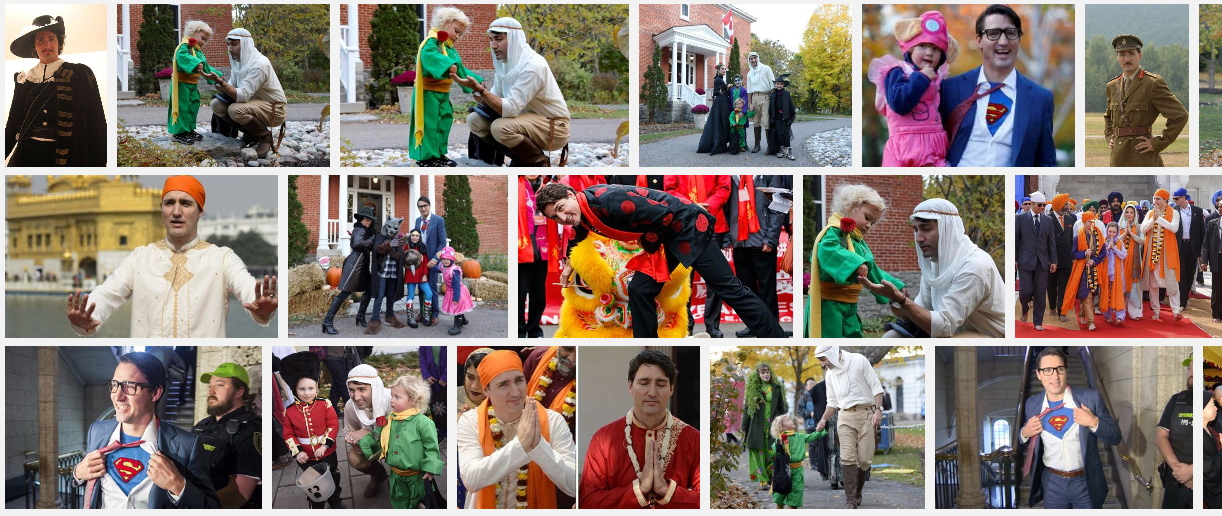
Justin “Blackface” Trudeau has been completely exonerated for any racist acts he committed, thanks to what Julie Burchill calls “the Wokescreen”:

Justin Trudeau with dark makeup on his face, neck and hands at a 2001 “Arabian Nights”-themed party at the West Point Grey Academy, the private school where he taught.
Photo from the West Point Grey Academy yearbook, via Time
Justin Trudeau seems as compulsively drawn to blacking up as his mother was to hanging around pop groups; after the third example of him doing so was revealed this year, he admitted that he had actually lost count of the number of times he’d done it. Nevertheless, he was defended by minority spokesmen and liberal commentators. This contrasts strikingly with the fate of Atlantic Records UK president Ben Cook, who was forced to resign earlier this month after old photographs of him in blackface emerged. As Cook is responsible for launching the career of Ed Sheeran, some might say he had it coming. But it’s weird how Trudeau, an ostentatiously woke politician, has survived and thrived, while Cook has limped away in disgrace. You’d think the former had betrayed both his beliefs and his followers far more.
[…]
So how come Trudeau got away with it? It’s part of a broader dodge – what the commentator Daniel Norris calls the Wokescreen. From behind this magical canopy, cliques can rob women of their hard-won private spaces (transgender activists) and enjoy the brutish thrill of racism (Corbynite anti-Semites) and because they’ve ticked the box which says Brotherhood Of Man it doesn’t make them bad people! Those people over there are the bad ones – like Jacob Rees-Mogg’s 12-year-old son.
It’s a mystery. But an even bigger one is why blackface is quite rightly unacceptable while drag gets bigger by the day. You’d have to be living in an Amish community not to have heard of RuPaul’s Drag Race, while Channel 5’s Drag Kids follows a process which we squares call “grooming”. Yet no one turns a hair. I’ve said it before and I’ll say it again: if the Black and White Minstrels are insulting and reactionary, why aren’t drag queens? If someone can explain to me why race-based parody is bad and sex-based parody “a bit of fun”, I’d love to know. Woke me up and tell me why!
Ross MkI: Canada’s First Battle Rifle
Forgotten Weapons
Published 28 Oct 2019http://www.patreon.com/ForgottenWeapons
Cool Forgotten Weapons merch! http://shop.bbtv.com/collections/forg…
Sir Charles Ross was heir to a very wealthy Scottish family, and was a talented if temperamental engineer. He took an interest in firearms and their design, and worked with American and English connections to produce a line of his own straight-pull sporting rifles. Upon returning from the Boer War he looked to expand into the military market.
At this same time, the Canadian government was looking to replenish its arms supplies after the war, and requested Enfield rifles form the British. The request was turned down, as Britain did not have enough supply to spare any for the Canadians. The Canadians were expected to construct their own factory to make rifles of he standard British pattern. Well, the Canadian government was not eager to invest that sort of capital into the project. They investigated buying arms elsewhere, but the consensus was that Canada’s armaments should come from either Britain or from within Canada itself. No good solution was apparent until Sir Charles Ross stepped in.
Ross offered to fund the construction of a factory himself, and use Canadian labor and industry to manufacture Ross rifles for the military. This seemed like an excellent solution — for zero initial cash outlay, the Canadian government would get rifles both designed and produced domestically! The rifles would be chambered for the standard .303 British cartridge, thus handling the British objections about arms compatibility (Ross pointed out that the British themselves used something like 7 different patterns of rifle at the time).
In 1902, Ross and the Canadian government signed a contract for 12,000 rifles to be made in 1903 and 10,000 per year thereafter, at the price of $25 each. In addition to the Canadian military, the Royal North West Mounted Police also adopted the new Ross rifle. Deliveries did not actually begin until 1905, and when they did plenty of disturbing problems arose. The rifles proved fragile and unreliable — and a weak bolt latch periodically allowed the bolt to fall completely out of the rifle on parade drill — not a good start!
Only 10,000 of the Mark I Ross rifles were made, and an improved Mark II pattern would follow as quickly as Ross could make it a reality.
Many thanks to the private collectors who allowed me access to their rifles to make this video!
Contact:
Forgotten Weapons
6281 N. Oracle #36270
Tucson, AZ 85704
October 21, 2019
“On Monday Canadians will have a choice between five left-of-centre social-democratic parties”
Except for Maxime Bernier’s invisible-to-the-mainstream-media PPC, the other parties contesting today’s election are all remarkably similar except for the colour of their signs and the mediocrity of their leaders:
As Mrs Thatcher used to say, first you win the argument, then you win the vote. So not engaging in any serious argument has certain consequences. John Robson puts it this way:
As Canada’s worst election ever staggers toward the finish line, a theme has finally emerged. Despite the best efforts of the party leaders to say nothing coherent or true at any point, we know what it’s about. Everyone is running against the Tories. Including the Tories. Makes you wonder what they’re so afraid of.
On Monday Canadians will have a choice between five left-of-centre social-democratic parties: the crony left (Liberals), the hard left (NDP), the eco-left (Greens), the secessionist left (Bloc) and the squish left (Conservatives). The only alternative to the crony-hard-eco-secessionist-squish social-justice statism on offer is a disaffected Tory, Maxime Bernier. John Robson again:
Bernier may be an imperfect human being and a flawed politician. It happens. But whatever his blemishes, his party exists because the Tories abandoned their beliefs and their base long before 2017 on every important conservative issue from free markets to traditional social values to strong national defence.
A billboard in Toronto, showing Maxime Bernier and an official-looking PPC message.
Photo from The Province – https://theprovince.com/opinion/columnists/gunter-berniers-legitimate-position-on-immigration-taken-down-by-spineless-billboard-company/wcm/ecab071c-b57d-4d93-b78c-274de524434cM Bernier would like to rethink immigration policy, but that makes him a racist so he shouldn’t be allowed in the debates because, per John Tory, while he’s free to rent the Scotiabank Arena, public buildings such as the CBC studios have a “higher responsibility”.
It’s a good thing for the other guys that Bernier was snuck in to a couple of debates because otherwise they’d be running against an entirely mythical beast — a red-meat conservative behemoth stomping the land for which there’s less corroborating evidence than of Justin in blackface but which is nevertheless mysteriously threatening to steamroller your social-justice utopia into the asphalt. Ah, if only that were true: I hope voters in the Beauce will return Max, and I hope our small band of readers in Longueuil-Saint Hubert will persuade their neighbours to turn out for our pal Ellen Comeau; but this is not shaping up as a breakthrough night for the People’s Party.
Nevertheless, sans Max, what’s left? Virtue-Dancing With The Stars: Elizabeth May says Trudeau wants to eliminate CO2 completely, but not until 2030! Justin Trudeau says that Scheer didn’t believe in gay marriage before 2005! Jagmeet Singh says that May’s selling out to the billionaires by promising to balance the budget by 2047, whereas he won’t balance the budget ever! Yves-François Blanchet says Singh’s ten-point plan to eliminate bovine flatulence by last Tuesday is too little too late compared to the Bloc’s plan to reduce Canada’s carbon footprint by declaring Quebec independent … oh, wait, sorry, that was almost an intrusion of something real: I meant “by declaring Quebec fully sovereign when it comes to jurisdiction over selecting its own pronouns for the door of the transgender bathroom: je, moi, mon …”
And at that point in the debate Lisa LaFlamme moves on to the next urgent concern of Canadian voters: Are politicians’ aboriginal land acknowledgments too perfunctory? Should they take up more time at the beginning of each debate? Say, the first hour or two?
John Robson argues that all five candidates are running against proposals that no one’s proposing because deep down inside they know that lurking somewhere out there is not a mythical right-wing Bigfoot but mere prosaic Reality, which sooner or later will assert itself. I’m not so sure. I think it’s more an enforcing of the ground rules, a true land acknowledgment that public debate can only take place within the bounds of this ever shriveling bit of barren sod. Those who want to fight on broader turf – such as M Bernier – cannot be permitted to do so.
October 20, 2019
October 18, 2019
Colonel Daniel Stepaniuk’s one-man campaign to wipe out (some) religious observance in the Militia
Christie Blatchford on the oddly partial actions of the officer in charge of more than a dozen Ontario militia regiments as far as religion is concerned:

The Lorne Scots (Peel, Dufferin and Halton Regiment) on parade in Brampton, Ontario on 24 September, 2016.
Photo by Nicholas Russon.
An army brigade commander has told the 14 Ontario reserve regiments under his charge that they must cancel any “church parade” they have planned.
Despite a lack of complaints about the parades, which see soldiers march to their regimental church, Col. Daniel Stepaniuk urged his commanding officers to stop participating in “any event where the primary purpose is liturgical, spiritual or religious … even if the service is non-denominational.”
A custom in the Canadian Army since the time of Confederation, the parades aren’t as common as they once were, though many units still have at least one a year, often tied to Remembrance Day ceremonies.
[…]
First of all, there is the glaring contradiction with Stepaniuk’s harsh stand on church parades and a parade that happened in Toronto last April.
A group of soldiers — I counted between 15 and 20 — were issued weapons, allowed to march in their military uniforms and were escorted by an armoured vehicle in the annual Khalsa parade for Canada’s Sikh community. It is considered a holy day.
The soldiers were from the Lorne Scots, one of Stepaniuk’s reserve units based in Brampton. The CO of the unit said at the time that he signed off on the weapons only after his commander (that would presumably be Stepaniuk, or perhaps the brigadier-general above him) approved the soldiers’ participation.
So weapons worn at a Khalsa Day parade good, though against the rules (The Canadian Armed Forces Manual of Drill and Ceremonial), according to army spokeswoman Karla Gimby.
But soldiers going anywhere near a church, bad, and against rules five years old that no one cared to enforce until now.
But most of all, in such small incremental strikes, does Canadian history and tradition lose strength.
October 15, 2019
Looking past October 21st
Jay Currie has already wasted his vote at the advanced polls (the same way I’m going to waste mine come election day), and now he’s considering what our parliament will look like on October 22nd (here’s a hint … we both know our guy isn’t going to be PM):
On October 22 we’re going to wake up to a politically very different Canada assuming that JT is unable to win a majority. The first thing which will change is Trudeau’s position. He could be Mr. Dressup with a majority but in a minority position – assuming he can form a government at all – his Teflon coating will have worn off. It is just possible that the bought and paid for Canadian media will rouse itself from its slumber and begin to ask slightly harder questions.
The second thing which will change is that third, fourth and even fifth parties will matter. For Trudeau to form a government he will need at least the NDP’s support and, perhaps, the Greens. To get that he is going to have to buy into a lot of nonsense which will be extremely bad for the country. The Liberals have plenty of idiotic policy but they don’t hold a candle to either the NDP or the Greens for economically useless virtue signalling.
Scheer would have an easier time of it in a minority position. His only possible ally would be the Bloc and while the Bloc wants to break up Canada they are financially sound and not nearly as eager as the NDP or the Greens for open borders and looney carbon taxes.
The key thing to remember is that regardless of who forms the government, that government is not going to last very long. In a sense, this election is about the next, more decisive, election. If Trudeau loses as big as he looks to be doing the Liberal Party will be looking for another leader. If Scheer ekes out a workable minority he will be looking to call an early election (in the face of the idiotic Fixed Terms act we have saddled ourselves with) to crush that new leader.
For Singh, especially if he picks up seats as well as popular vote, the election will cement his place as the NDP leader and silence the people who are talking about his unelectability. Lizzie May will be hailed as an emerging force in Canadian politics if she manages to pick up a couple more seats on Vancouver Island and, I suspect, that is exactly what she is going to do. (Old, white, retired, rich people just love a party committed to never changing anything.)
And what about Max? Obviously, he needs to hold his own seat. Which may be tough but I think he will pull through. I very much doubt he will win any other seats for a variety of reasons having nothing to do with Max or his policies. New parties take a while to gain traction. For Max, the biggest issue is how he does in the popular vote. Sitting at 1% is not going to cut it, but pop up over 4% and the table changes. Anything beyond that and Max will be the election night story.
October 13, 2019
Modern journalism encompasses “activism,” “advocacy,” “partisanship,” “satire,” “hoaxing,” “unbearable self-promotional bluster,” “pranks,” “torquing of facts,” “invective,” “demagoguery” and “stunts”
I’ve always been pretty cynical about the media, so it was no surprise to me when the federal government decided to start explicitly subsidising the rest of the media (they already fund the CBC), and part of the fun was deciding who qualifies for those juicy subsidies. I mean, “journalism” today is a pretty broad category that covers a lot more than the traditional TV, radio, magazine, and newspaper formats. I’m sure everyone is shocked — Shocked! — to discover that the government is playing favourites among the many media outlets over not just who gets subsidies, but even who gets accredited to cover political events.

Jack Layton, leader of the federal New Democratic Party of Canada, on January 2, 2006 in a media scrum outside a campaign rally at the Kent Street legion in Ottawa, Canada.
Photo by Thorfinn Stainforth via Wikimedia Commons.
As we’re in the late stages of a federal election campaign, the question of who is considered to be a “journalist” merits closer attention, as Colby Cosh explains:
Two media outlets of a right-wing character, Rebel Media and the True North Centre for Public Policy, have been denied accreditation for post-debate press appearances at the last minute. The Parliamentary Press Gallery, acting on behalf of the federal Leaders’ Debates Commission, has somehow decided that their delegates are advocates rather than journalists. Oh-ho.
Here, an agent of the state seems to have pushed the “So who’s a journalist?” question really to the forefront, and introduced a distinction between journalism and activism that may not be tenable. The history and practice of journalism, even at the highest levels of public and professional esteem, includes entities and activities that fall into all of the following categories: “activism,” “advocacy,” “partisanship,” “satire,” “hoaxing,” “unbearable self-promotional bluster,” “pranks,” “torquing of facts,” “invective,” “demagoguery” and “stunts.”
If we must march toward state licensing of journalism in double-quick time, and this seems to be happening whether I like it or not, arguments about the definition of journalism will have to recognize these realities. But, of course, the word “journalism” as used from day to day is mostly just a status marker (really, a label concocted for academic use). “Journalism” will resist any historically aware attempt to bound it with a list of scientific-type taxonomic criteria.
This, of course, does not rule out an ignorant or fanciful attempt to set criteria. But most of the concepts in the list I made above, a list of things some people would like to exclude from journalism, are themselves ideas founded on fuzzy judgments of value, or of mere taste.
The media outlaws who found the debate gates shut in their faces got together and sought an injunction requiring the commission to allow them to appear in the magic chamber of questions after the debate. No one had really explained the decision to exclude them; no one could point to a solid pre-existing definition of journalism that they did not meet (surprise!), or to a relevant formal policy of the commission. It really gets the attention of a judge when the state behaves in an arbitrary way, and this proved to be the case, foreseeably, at the oral hearing for the injunction. Which was granted.
But an injunction is a temporary emergency remedy that does not require a full hearing of the facts — only the possibility of immediate incorrigible harm. The question haunting the Dominion — the question of who is a journalist — remains athwart our path.
October 11, 2019
A spectre is haunting the Liberal war room: the spectre of Jagmeet Singh
In the wake of the English language debate, NDP leader Jagmeet Singh is suddenly getting more of the kind of attention I thought he’d get from the media after he became party leader. Back in January, while he was campaigning for a seat in Parliament in a BC byelection, I wrote:
When Jagmeet Singh was elected NDP leader, I really did think he’d be a significant challenge to Justin Trudeau due to the media’s apparent fascination with Singh (a love affair that appeared to be as deep and lasting as that of Justin’s teeny-bopper [media] fan club for their darling), but it faded very quickly indeed. I guess as far as the Canadian media is concerned, there can only be one …
Now it appears that the Liberal Party backroom braintrust has suddenly woken up to the threat that Singh and the NDP are going to retain and even increase their support among left-leaning voters the Liberals had been taking for granted:
An even bigger risk for Trudeau is if lots of so-called low-information voters — who make their decisions late in a campaign — decide to cast a ballot for the charming Singh’s New Democrats.
But the biggest risk of all to the Liberals and Conservatives is if lots and lots of citizens give the finger to both parties and decide to vote NDP or Green to express their dissatisfaction with the status quo.
It looks like a long shot now with the economy humming along and a low unemployment rate.
But the same circumstances existed in B.C. in 2017. And plenty of voters decided that these were the right conditions for bringing the NDP back to power.
Nobody is expecting that Jagmeet Singh will be prime minister after the October 21 election.
But if he captures far more seats than the CBC poll tracker is projecting, it will be because of his genial nature and his ability to speak like a human being.
Surely, the Liberals realize that. The class differences between Trudeau and Singh are profound — and there are far fewer voters in Trudeau’s realm than Singh’s.
October 10, 2019
Justin Trudeau scrambles to escape from the consequences of his mistakes
It must be awful to be a Justin Trudeau fan these days, where he seems to spend more time looking awkward as his personal mis-steps keep coming back to haunt him. I’d never vote for the guy — but I wouldn’t vote for his main opponent, the Milk Dud either — but I thought he was a better politician than he’s turning out to be in this election campaign without the dependable strawman of Stephen Harper to struggle against. While I think he’s unfit to be Prime Minister, Barrett Wilson argues he wasn’t even fit to be a teacher:
It should be well established by now that this man is unfit to serve as our Prime Minister.
But if corporate corruption, obstruction of justice, internet censorship, persecution of journalists, buying off the media, and frickin’ blackface weren’t enough to convince you that Trudeau is unfit. Perhaps this latest insanity will.
Trudeau and his campaign team somehow felt it was a good idea for the disgraced Liberal leader to appear on a pre-taped and rehearsed children’s television show today called “New Mom, Who Dis?” The appearance was cringeworthy at best, as host Jesse Cruickshank shamelessly flirted with the PM, but it was also cynical, manipulative, and exploitative, as Trudeau fielded two questions from two young black twin girls.
The first twin asked Trudeau, “Why did you paint your face brown?”
Trudeau answered: “Ooh. Um, it was something I shouldn’t have done because it hurt people. It’s not something that you should do and that is something that I learned. I didn’t know it back then and I know it now, and I’m sorry that I hurt people.”
The second twin followed up: “But did you paint your nose and your hands brown?”
Trudeau: “Mmmhmm. Yeah. And it was the wrong thing to do.”
The clip deserves to be watched more than once just to understand and appreciate how clearly scripted, deeply cynical, and frankly sick, the whole thing is.
The only thing missing from this little skit are #Trudeau's fake tears💧 #TrudeauBlackface pic.twitter.com/q3PTC8vbWv
— Mattea Merta 🇨🇦 (@MatteaMerta) October 9, 2019
Okay. So, this will take a second to unpack. Somehow, Justin Trudeau felt it would be a good idea to use a children’s television show and two young children of colour as a stage for a preplanned apology for his blackface exploits from when he was 29-years-old. Don’t worry everyone. He’s learned from his days of trying to manipulate strong, principled women of colour such as Jody Wilson-Raybould. It’s much easier to exploit young children!
And, by the way — who doesn’t know that blackface is wrong when they are 29-years-old? The culture in 2001 rejected such racist tropes. If Trudeau were actually that stupid at 29, when his brain was fully developed, then how in the hell should he ever lead a G7 country at 47? He can’t even be trusted to properly instruct young school children.
What other stupid things has this guy done that Canada’s enemies could use as blackmail (no pun intended).