
Critical Drinker After Hours
Published 30 Jul 2026In the mood for an Amazon show that’s actually good, unlike Rings of Power? Then Clarkson’s Farm, arguably the best reality show on TV right now, has got you covered. Join me for a quick review of this absolute gem.
July 31, 2026
Drinker’s Extra Shots – Clarkson’s Farm
Comments Off on Drinker’s Extra Shots – Clarkson’s Farm
July 30, 2026
QotD: The three most important books on management
There are three management books — and only three — that need to be read. They also need to be read by everyone. The Peter Principle, Up the Organisation and Parkinson’s Law. Which state, in reverse order, that bureaucracies will always grow until they eat the organisation, that management’s proper job is preventing them from ever starting and that if they’re there then you promote them out of the way. In our case, in this grassroots political movement which is the Hang the Lanyards Party, promote them to transcendence and their eternal rewards.
[…]
This is also what needs to be done with every bureaucracy from time to time. Those management books insist — nay prove — that every organisation always ends up like this. For the driving force of any organisation is the survival of the organisation. To be, not to do, is the aim.
Yes, this does apply to private sector ones but we’ve a natural corrective for those. Other organisations which arrive and not yet having created an all encompassing bureaucracy they outcompete them. So the old bureaucracies die, the new ones grow until they too start hiring power skirts and the decay sets in.
A government bureaucracy does not have that outside force culling it when its time has come. Therefore we must be the merciful farmer taking them out given that we’ve killed off the wolves that thin the herd of the old and lame.
As we can see 65 years is long enough for such a bureaucracy to reach this stage. Rather Brave New World in fact as that was the age at which all reported to be turned off.
So, every bureaucracy, every department, gets closed after 60 to 65 years. Some sooner, just to keep people on their toes. Yes, every. Say, the Department of Education. Or of Defence. Once we’ve killed it and fired everyone just leave be for a few years. If we still have some problems that really do need to be dealt with we can always hire a few, give ’em a corner of a desk somewhere, and we get the vigour and growth of a new organisation actually trying to solve things.
Until, obviously, the arrival of power skirts and the renewal process starts again.
Tim Worstall, “Closing US AID is What We Should Do To All Government”, It’s all obvious or trivial except …, 2026-04-29.
Comments Off on QotD: The three most important books on management
July 27, 2026
QotD: The art of management
A nanosecond’s reflection will tell you that the techniques needed to manage computer programmers, movie actors, and the boom-town roughnecks that inspired Conan the Barbarian are going to be very different. What if we restrict our analysis to just one category, say the computer programmers?2 Well, consider another similarly restrictive category: children. The great limitation of parenting books is, as every parent of more than one child knows, that children are extremely different from one another. One child may need strict discipline, while another actually needs to be encouraged to take rules less seriously; one needs to be reassured constantly and showered with love, while another needs to have firm boundaries. The techniques that work brilliantly with one child will not work unmodified with another. If the goal is the Aristotelian mean, then some need to be nudged to one side, and others in the opposite direction.
If that’s the way it is with kids, imagine how much more so this all applies to adults, who in addition to having different innate personalities and temperaments and aptitudes also carry with them extensive life histories, experiences, and scar tissue. Any generic advice, any “management turpentine”, needs to be heavily customized to the personalities and the dynamics of a particular team. But the catch is that mastering the ability to apply this sort of generic management advice in a particular situation is pretty much just the same thing as mastering management itself.
To a very great degree, management just is the art of taking a set of discordant personalities and welding them into a harmonious whole. A great manager sizes up his or her team, sees the ambitious go-getter, the resentful and self-defeating genius, the timid and awkward newbie with leadership potential, the lazy slob who secretly glues them all together — sees not just these categories but sees the individuals and the unique ways they subvert these archetypes, and instantly and intuitively knows how to fuse them into a machine for achieving a common purpose. Or as Hilaire Belloc once put it:
There is one element in the [management of men] which is all-important, and the possession of which is a gift, like the gift of verse or “eye” in a sport. It is not to be prayed for. It is not to be acquired. It is granted by the unseen powers. This element is that which you have in the good management of a pack of hounds, or in any other kind of good generalship. It consists in a mixture of detailed and general appreciation; for when those two faculties are combined — the faculty of seeing the individual, the faculty of seeing the whole — you have the genius of the human helmsman; as rare a sort of genius as there is among men.
But why does he say that this particular talent is not to be acquired? Go back to Johnson’s line about the management turpentine and read it again, but this time note how deftly the magic trick is performed. Do you see it? Hey presto, there are only two options as to what a book on painting could be about — “Form and Structure and Meaning,” or where to buy turpentine. This is important, because left to your own devices you might prefer a third possibility: namely a book about how to make great art. But as soon as you say it, it becomes clear why that option needs to be hidden from view — no such book has ever existed, no such book can exist, you can’t learn to make great art from a book.
John Psmith, “REVIEW: Scaling People by Claire Hughes Johnson”, Mr. and Mrs. Psmith’s Bookshelf, 2023-08-28.
- Fewer and fewer every day though. A United States military friend recently pointed out to me that the high ratio of senior Russian officers killed in Ukraine and Syria speaks well of their military culture, because it means that even their general officers make a custom of occasionally leading from the front (there’s a long history of this in the Russian armed forces). He then reflected bitterly that an American general being killed was simply unthinkable, since to a man they sit in air-conditioned offices and command their troops over satellite link.
- Johnson’s book is marketed towards those managing computer programmers, which is interesting since she worked on the operations side of the house and as far was I know has never been in charge of a crew of engineers.
Comments Off on QotD: The art of management
July 24, 2026
Brian Lilley: “Carney has run out of time”
While Prime Minister Mark Carney has been playing to the anti-American crowd at home, President Donald Trump has pretty clearly run out of patience with Canada’s dilly-dallying:

🚨 Trump just dropped a tariff ultimatum on Mark Carney — and Canada’s PM is officially out of time. Instead of cutting a real deal, Carney’s played delay tactics: dodge serious talks and pray Democrats win midterms to weaken Trump.
Foolish strategy. Here’s why it’s blowing up 👇
Trump’s threat: 50% tariffs on $28 BILLION in Canadian exports (hockey sticks to whisky, honey to flowers) unless Canada brings real solutions by Aug. 19.
U.S. Trade Rep Jamieson Greer: This is about forcing real negotiations.
Carney says he’s “intensifying” talks. But sources on BOTH sides say Canada’s offers are just vague “promises to discuss”. No substance.
Insiders call it “ragging the puck” — stalling in hopes a weaker Trump post-midterms gives Canada a sweeter deal.
Meanwhile, manufacturing jobs are bleeding: 17K lost last month alone. Over 50K since Carney became PM.
Ordinary Canadians are paying the price while politicians play games. 😡
Carney’s team hasn’t even used obvious bargaining chips:
* Provincial bans on U.S. booze (keep ’em in place, but not leveraged)
* Preferred access to Canada’s critical minerals
* Fixing cheese import disputesThese could be packaged to get tariffs lifted. Why sit on them?
Reality check on dependency:
🇨🇦 Canadian exports to U.S. = 19.9% of our GDP
🇺🇸 U.S. exports to Canada = just 1.4% of their GDPTrump’s claim Canada “needs us to survive” is exaggerated — but we’re far more exposed.
Delaying hurts us way more.
Why the foot-dragging?
Carney has little incentive to end the fight. Angry Canadians at Trump = more Liberal votes.
Politics over prosperity. Classic.
Question for Canadians:
Should Carney drop the delay tactics, use our leverage, and get a deal done ASAP? Or keep waiting for U.S. midterms?
What’s your take?
Reply below 👇
Who’s really paying for this? Workers or politicians?
Jen Gerson points out that by being relative pushovers every time it’s clear that Trump really means something, it’s confirming American belief that we’ll always be pushovers:
Parody cover of Mark Carney’s Value(s) seen on the net.
This week’s announcement of 50 per cent tariffs on a raft of goods is more proof that the Liberals’ ironclad strategy of “say tough things in public but then capitulate quietly on issue after issue” isn’t panning out. And I write that knowing full well that the statute being used to implement the tariffs is old, tenuous, and may not hold up. I’m not talking about them, for a moment. I’m talking about us.
Where do we even start with Prime Minister Elbows Up? Dropping the Digital Services Tax and retaliatory tariffs? The apology for the terrible sin of running a Ronald Reagan ad? And now we have the business of the Gordie Howe Bridge: to recap, Canada fronted $6.4 billion to build the span between Windsor and Detroit, which was to be paid back over decades through bridge tolls. At the last minute — and presumably at the behest of the rich MAGA donor who owns the competing bridge — Donald Trump announced the bridge would not open until the U.S. got a better deal. After more quiet negotiations, such a deal was struck.
Initially, Carney claimed that the U.S. would take a split of the operating profits — but only after the debt was paid off, something which was expected to bring real profits down to a very small amount. Effectively, he said the deal would give the Americans chump change.
Subsequent reporting suggested this wasn’t the case at all; that the Americans are to take their cut from operating revenue, which presumably will have the effect of dramatically extending our payback period.
In short, it’s a major concession, made worse by the fact that Carney appears to have lied.
And, frankly, I’m not sure which of these two pills is harder to swallow. Regular press conferences aside, Team Canada has been rather shockingly non-communicative about what the hell is going on with USMCA re-negotiations. I give the government some credit for the need to maintain “strategic silence” in order to pursue “strategic patience”, but if your entire brilliant communications strategy for rallying the Canadian public in the face of unprecedented American economic aggression amounts to “Shush. Just trust us. Carney’s super smart. He’s got this,” well, then, you really can’t lie and be dumb about it.
Carney came to power 18 months ago with an explicit “Elbows Up” promise that is deteriorating into a punch line. I don’t object to choosing not to rise to the bait of every provocation. But when “doing nothing” is accompanied by caving on everything, what you have is no longer “strategic patience.” It looks a lot more like “showing the Americans that we have no appetite for retaliation.” We’ve indicated with crystal clarity that aside from the odd mean speech, and the fact that Canadians are Big Mad, we will extract no material consequence for anything they choose to do. And absent consequence, they will continue to escalate past the point of diminishing returns.
Why?
Because they can.
Because they don’t care.
Because they take delight in their own contempt for our demonstrated weakness.
Comments Off on Brian Lilley: “Carney has run out of time”
July 21, 2026
Making out like a bandit – Christopher Nolan’s sweet deal for The Odyssey
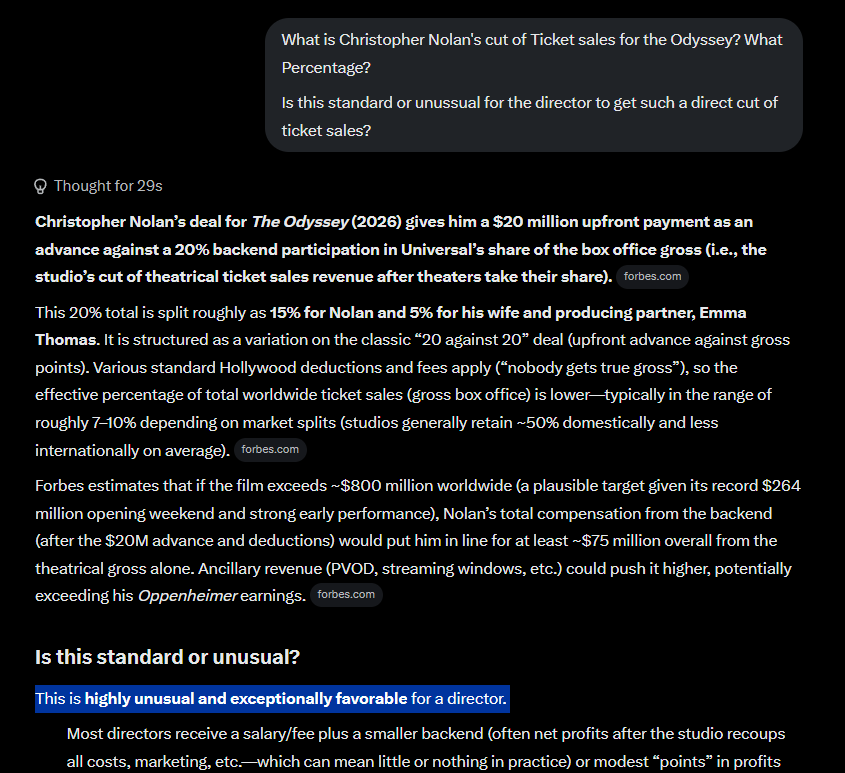
Hollywood accounting is always a murky pool to wade into … unlike accounting in the real world, it’s very, very difficult for outsiders to understand how the money is spent and where the profits go. Christopher Nolan’s new film seems to have broken new ground in Hollywood accounting, very much to Nolan’s benefit:

So Nolan is getting 15% off direct revenue, (not profits, gross, and his wife another 5%) from the Odyssey, basically risk free, AFTER his 20 million up front.
That’s a better cut than a lot of mob bosses take off drug dealers (which tend to vary between 5 and 30% depending on how much violence they can command).
And probably core stars (Damon and Hathaway mostly) are getting some smaller percent of the same deal.
This is unheard of. Basically a violation of fiduciary duties to the investors.
Studio execs paid all these people to make this movie this way against their own investors’ interests.
So if another 10-30% of gross is divided across Damon, Hathaway, Holland, Pattinson, and Theron … You know the real stars (Zendaya, Nyong’o, and Page don’t draw crowds and aren’t getting that) …
Then you might have to effectively cut all revenue first by 50% for theaters, then by another 40-50% for the star power.
It other words … The Odyssey would need to make 800 million – 1 billion before it could even hypothetically start to turn a profit for investors.
All the Woke casting etc. Is actually a cover for basically outright money laundering and embezzlement by the entertainment class. And because its “sticking it to the Chuds” business news and institutions are covering for the fact a bunch of studios just defrauded Universal Studios’ parent Comcast, to possibly the tune of hundreds of millions.
Comcast is a publicly traded company. That’s 401Ks and pension funds.
And all the woke stuff is in there so that no studio execs, corporate leaders, media, or corporate watchdogs will call them out for basically transferring hundreds of millions of retiree dollars into their own pockets.
All the discussion of “Will the Odyssey make its money back” is missing the point that there is almost NO WAY for the Odyssey to actually produce a reasonable return to investors … BY DESIGN.
It is a pure, basically fraudulent, wealth transfer from American middle-class investors to Hollywood insiders irrespective of whatever money the film does or does not make … intentionally.
And all the woke window dressing is chaff, or a bonus to prevent any institutions from having the nerve to call them out lest they get called, racist, sexist, and transphobic.
Comments Off on Making out like a bandit – Christopher Nolan’s sweet deal for The Odyssey
Business idea – socialist-themed holiday camp
This idea is a banger, but it won’t attract the audience who really could benefit from the experience: the camp experience is what they want you to have, not for themselves.
New startup idea: a socialist-themed holiday camp where affluent Westerners pay premium prices to experience the system they keep voting for.
Picture it. You arrive at Camp VS (Virtue Signal) and hand over your passport (you won’t need it, exit visas take eleven years to process). Staff assign you to a concrete panel block, 320 square feet, shared with two other families you’ve never met. The heating works from 6 to 8 a.m. The elevator works never. Authentic Khrushchyovka construction, guaranteed.
Your daily itinerary: Wake at 5 a.m. Stand in the bread line until noon in minus 15 Celsius. The bread runs out at 11:40, but the queuing builds character, and character is the only thing not in shortage. Afternoon activities include a second line for toilet paper (there is no toilet paper) and a mandatory lecture on how the shortages prove capitalism sabotaged the harvest.
For guests seeking the deluxe package, we offer the Gulag Experience: rock-busting in a quarry under armed supervision, with optional whipping for anyone who fulfills less than 110 percent of quota. Aleksandr Solzhenitsyn wrote 1,800 pages about this amenity. Rave reviews, in a sense.
Every fourth guest works as an informant. You won’t know which one. Complaining about the food earns you a midnight interview with camp security, and the food gives you plenty to complain about: it’s cabbage. All of it. Abolish market prices and you abolish economic calculation, so nobody can know what to produce, in what quantity, or for whom. The planners guess. The planners guess cabbage.
Checkout is where the theme really lands. You can’t. The wall around the camp faces inward, and East Germany shot 140 people at theirs between 1961 and 1989 to keep paying customers from leaving the workers’ paradise.
The irony here is that this business would only survive under capitalism, because it needs voluntary customers, market prices, and profit signals to exist at all. Run it as an actual socialist enterprise and within a year the camp has no bread, no rocks, and no guests. Just like the original.
QotD: Why Tiktok?
This was hugely successful – so successful, in fact, that Tiktok was able to cheat, overriding its own algorithmic guesses about which of its billion cable-access television channels you’d stare at the longest with a “heating tool” that lets the company trick some of those theater kids into thinking that Tiktok was actually more suited to them than other platforms […]
For zuckermuskian social media bosses, Tiktok became an object of fierce envy. Here was the ultimate Tom Sawyer robo-fence-painter, a self-licking ice-cream cone that motivated people to convince each other to make money for you. Facebook, Instagram and Twitter took a hard pivot away from showing you the things that the people you loved had to say, in favor of showing you short videos of people whose parents didn’t give them enough affection in their childhood, desperately shoving lemons up their noses in a bid to win your approval (and a revshare split with the platforms).
It worked. Sorta. Thing is, some of those “content creators” are actually very good, and none of them appreciate being jerked around. They quite rightly see their reason for being on the platforms as improving their own lives, not the bottom line of the platforms’ owners and executives. They may be more “engaging” than your friends, but they’re also a lot mouthier and feel entitled to a say in how the platform operates.
What’s a billionaire solipsist to do? Obviously, the answer is “AI creators”. An “AI creator” is like a “creator” in that it works to maximize your engagement with the platform – and thus the number of ads that can be crammed into your face-holes – but, unlike a “creator”, it makes no demands upon the platform and exists solely to serve the platform’s shareholders and executives. It’s the perfect realization of the solipsist fantasy of a world without people […]
But there’s a problem with this plan: your friends are not a liability for a platform. Your friends are the platforms’ single most important asset. Your friends are why the platforms are so “sticky”. The platforms don’t “hack your dopamine loops” – they just take your friends hostage, and even though you love your friends, they are a monumental pain in the ass, and if you can’t even agree on what board-game you’re going to play this weekend, how are you going to agree when it’s time to leave Facebook, and where to go next?
So long as you love your friends more than you hate Zuckerberg or Musk, you will remain stuck to their platforms. The platform bosses know this, and they inflict pain on you that is titrated to be just below the threshold where you hate the platforms more than you love your friends.
But as much as the platform bosses rely on your love of your friends, they still view your friends as liabilities, thanks to those friends’ unreasonable insistence on structuring their relationship with you to maximize their own satisfaction, rather than how much time you spend looking at ads. So the platforms are deliberately disconnecting you from your friends by minimizing the fraction of your feed that is given over to posts from people you follow, and replacing those friends with a succession of ever-more fungible posters: trolls, creators, and chatbots.
Cory Doctorow, “Tiktokification shall set us free”, Pluralistic, 2026-04-17.
Comments Off on QotD: Why Tiktok?
July 20, 2026
Carneynomics in action
Even though the relic media are all singing from the government’s hymn book — because they might lose their generous subsidies if they don’t — a few dispiriting details about the real state of Canada’s economy still slip through:
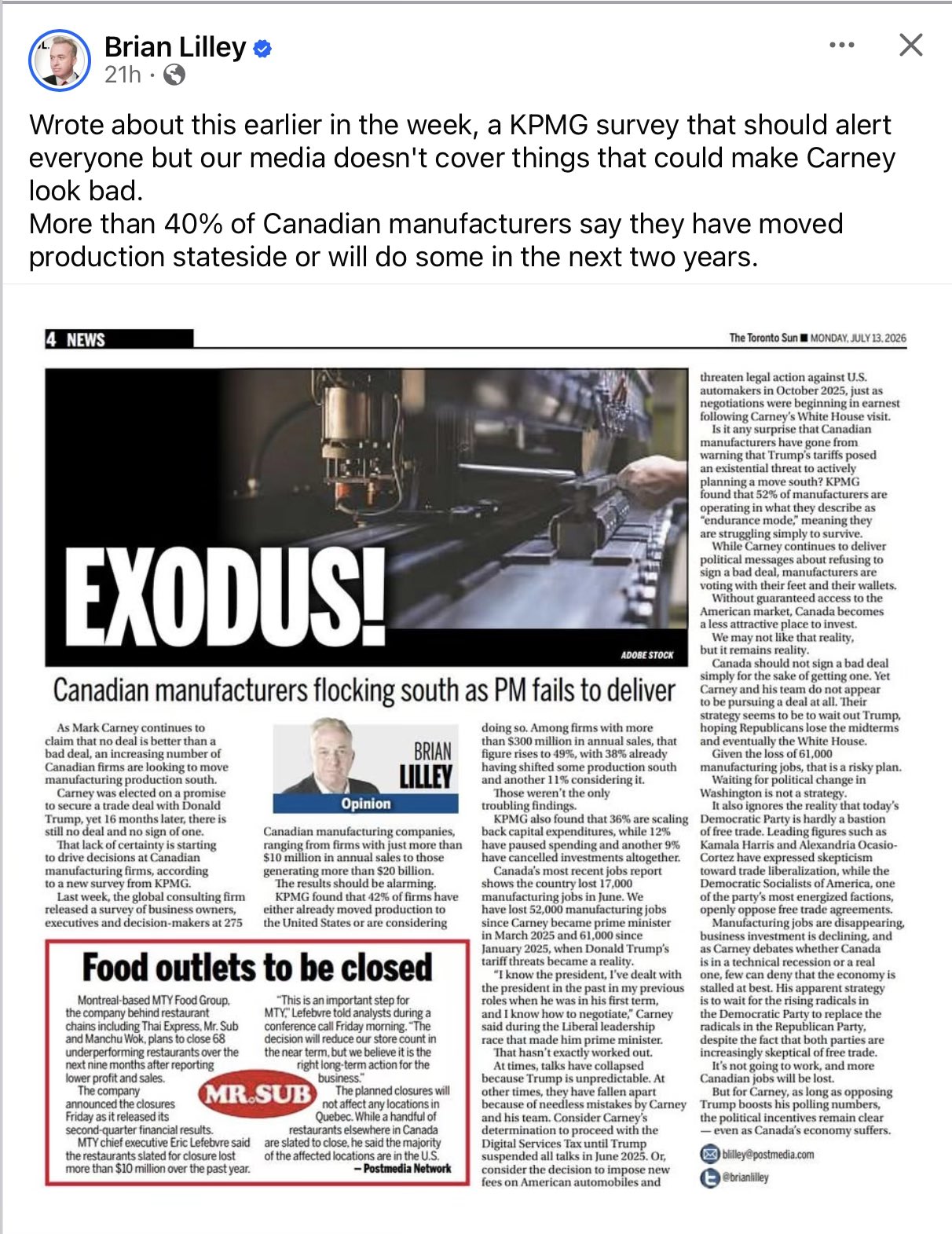
This is the Carney economy in one picture.
He sold himself as the adult in the room. The banker. The international dealmaker. The man who could handle Trump and restore confidence.
Instead, Canadian manufacturers are preparing their exit.
According to the KPMG survey, 42% of manufacturers have already moved some production to the United States or are considering doing so. Another 36% are cutting investment, 12% have paused spending and 9% have cancelled projects altogether.
Manufacturing jobs are disappearing. Investment is drying up. Factories are moving south.
Businesses respond to incentives, costs and uncertainty. They do not remain in Canada because Mark Carney gives polished speeches about nation-building. They go where taxes, energy prices, regulation, labour costs and access to markets make production worthwhile.
Carney promised competence. What Canadians are getting is stalled trade talks, falling investment, disappearing jobs and another Liberal government that seems incapable of understanding how private-sector wealth is actually created.
A great many Canadians now see Carney as an incompetent ideologue in a good suit, surrounded by the same Liberal machine that helped create this mess.
And what consequences does he face?
Very few.
Carney is rich. His family is secure. His pension, investments and connections are intact. He will never worry about a mortgage payment, a grocery bill, a lost factory job or whether his children can afford a home.
The people who pay for his failures are workers, families, small-business owners and young Canadians whose futures are being shipped across the border.
That is the ugliest part of modern government. The people making the decisions are often insulated from the consequences. They can damage an economy, lose jobs, drive away investment and still retire wealthy, respected and welcomed back into corporate boardrooms.
A résumé is not an economic policy. A banker’s vocabulary cannot hide factories closing and investment leaving.
Canada is not being built. It is being hollowed out, while the people responsible remain comfortable.
This is why I thought the announcement on Friday that a Republican senator is calling for Carney’s assets in the US to be seized and to refuse him a visa … it’s beyond weird that a Canadian Prime Minister would have over 90% of his personal assets invested in the United States rather than in Canada. This gives Trump another handle on Carney, if he chooses to use it.
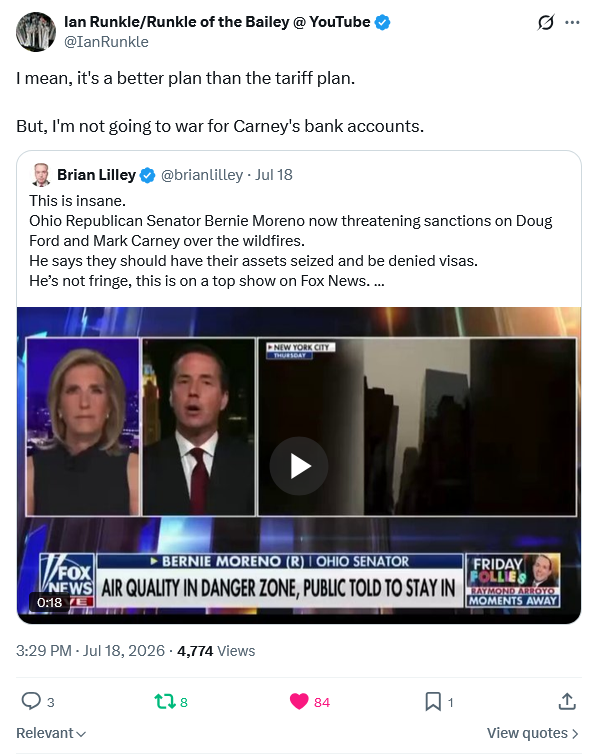
On her Substack, Melanie in Saskatchewan envisions how this may play out:

AI image from Melanie in Saskatchewan
So let me make a prediction: Any day now, your government will solemnly discover the importance of proper forest management.
There could be a task force, or a federal strategy, a minister standing solemnly in front of some trees. Perhaps an announcement that Ottawa has been “working around the clock” on a comprehensive plan that, by a miraculous coincidence, became urgent only after the American president threatened tariffs and a U.S. senator started talking about sanctions.
Should that happen, Canadians will be entitled to ask a very simple question: What finally changed Ottawa’s mind?
Was it concern for Canadians living through evacuations, destroyed communities and weeks of choking smoke? Was it the economic damage caused by recurring fire seasons? Was it pleas from provinces, northern communities and forestry workers for better prevention, mitigation and emergency capacity?
Or did the urgency arrive only when Washington threatened to slap another charge on Canadian exports and Senators possibly sanctioning Canadian officials like yourself? You personally have A LOT at stake if you are sanctioned since the majority of your wealth investment portfolio is in America.
The timing on this matters a great deal. It matters whenever a government suddenly treats a long-standing domestic problem like a national emergency only after somebody powerful outside the country attaches a financial consequence to it.
Trump has accused Canada of “wilful negligence” in maintaining its forests and says he intends to ask you what Canada plans to do. Your emergency management minister responded that governments have invested billions in fire prevention and forest sustainability since 2020. That defence deserves to be examined very closely and very carefully, because Canadians can reasonably ask what those billions purchased, where they went and why so many communities remain frighteningly vulnerable. To say it plainly … Canadians simply do not see any value for the dollars spent.
You announced spending of $317 million to lease 10 water bombers and heavy helicopters for rapid deployment to provinces because the wait time for them to be built is too long. So, here’s a fun little arithmetic exercise for Ottawa: water bombers are built right here in Canada — jobs, sovereignty, the whole patriotic package you’ve been selling — yet the federal shopping list remains stubbornly empty.
With $317 million, you could buy three heavy scoopers and have pocket change left for spotter planes or a helicopter, or — and this is where it gets embarrassing — you could roll out 45 to 55 single-engine Fire Boss aircraft, scattering an actual national fleet across every province that needs one. But apparently the government prefers its firefighting budgets theoretical. It is here that I will remind you, Fort Mac, Jasper and Lytton should have already provoked this response to act years ago.
The United States is hardly in a position to lecture anyone without hypocrisy. It is enduring its own brutal wildfire season, and fires do not stop at customs booths to declare their country of origin. Climate, drought, lightning, forestry practices and emergency capacity all play a role. There is plenty of responsibility, contradiction and political theatre to go around here. America has somehow managed to turn airborne smoke into an international trade dispute, because apparently even oxygen now requires a customs declaration. But that doesn’t absolve Ottawa. Again … Fort Mac. Jasper. Lytton. The warnings were already there. The time to act was then, but Ottawa chose navel gazing instead. In my books, that means today’s consequences lie with the governing Liberals.
Markets reject Carney’s official carbon price, so Canadians have to pay more
Canada is one of the last remaining bastions of Net Zero zealotry … in fact, Prime Minister Mark Carney may be the only national leader trying to turn back the tide of economic reality over this:
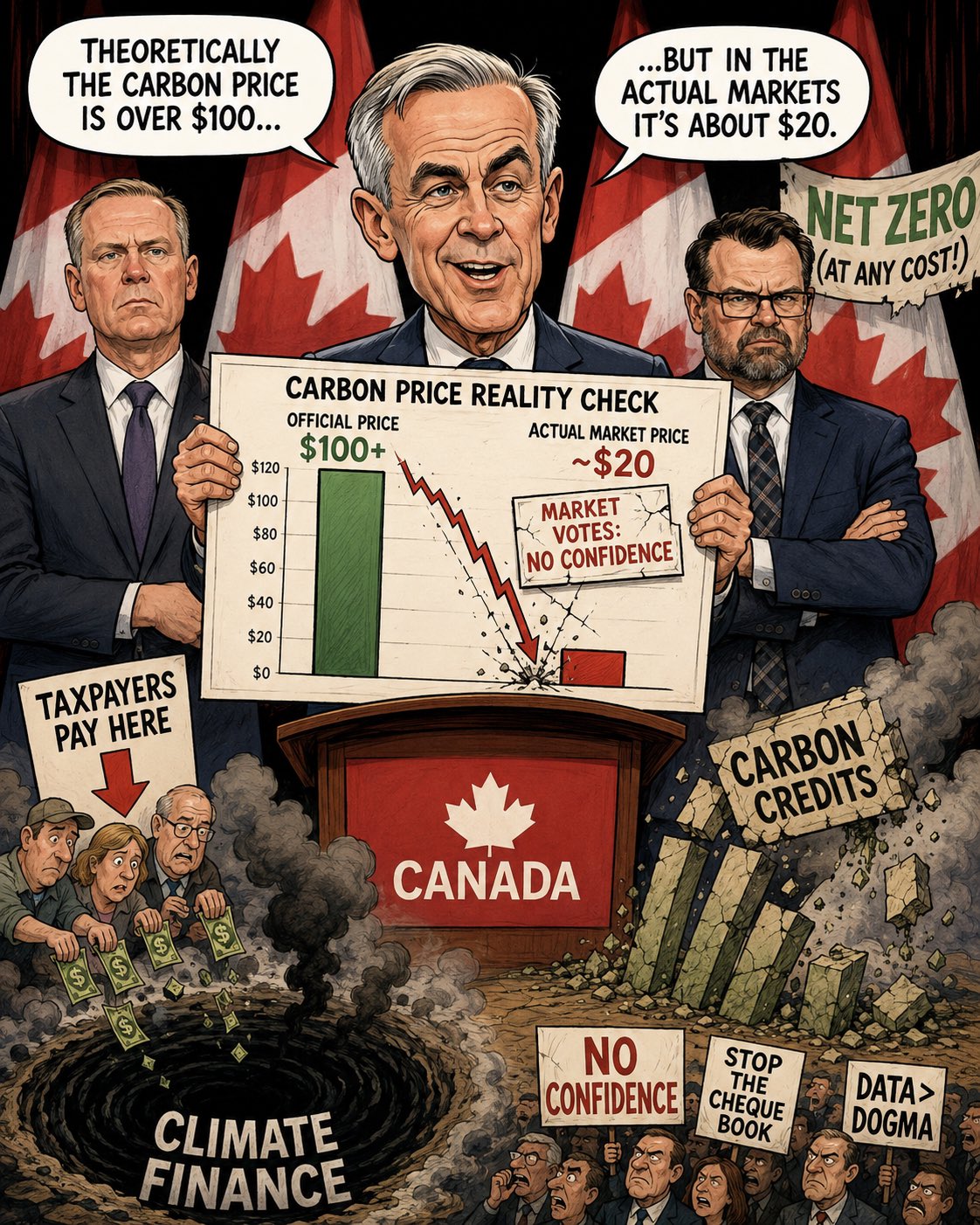
AI image posted by L. Wayne Mathison on X.
Mark Carney wrote a book called Value(s) lecturing the world about fairness, responsibility, sustainability and humility. His real governing value appears to be this: when markets reject his climate scheme, force Canadians to rescue it.
Carney now admits the official carbon price is supposedly above $100 while actual credits have traded near $20. Any honest banker would recognize the message. The market does not believe these credits are worth the imaginary price politicians assigned to them.
Carney’s response is classic central-planner arrogance. He will not reconsider the product. He will rig the price, tighten the rules, compel companies to buy it and call the resulting coercion “investment certainty”.
He praised carbon pricing in Value(s) as one of the most important and effective ways to reduce emissions. Then the consumer carbon tax became politically poisonous, so he scrapped it. The industrial version survives because its costs are easier to bury inside electricity, transportation, groceries, construction materials, wages and lost investment.
Carney also boasts that Canada continues sending climate-finance money abroad while other G7 governments pull back. Canadian families are struggling with food, housing and energy, yet our philosopher-banker remains determined to finance his international reputation with their money.
His book preached humility. His government practises price fixing.
His book preached responsibility. His government transfers the risk to taxpayers.
His book preached fairness. His policies protect the climate-finance class while ordinary Canadians absorb the costs.
Carney spent years wrapping political ideology in the language of banking. Now the numbers are exposing the sales pitch. When a theoretical $100 asset trades for $20, the market has delivered its verdict. Ottawa can falsify the price, but it cannot manufacture genuine value.
Value(s) may be hundreds of pages long. Carney’s philosophy fits into one sentence:
When reality refuses to validate the climate fantasy, force Canadians to pay until it does.
July 18, 2026
Jevons and Baumol, and why they matter now
On the social media site formerly known as Twitter, Matt Ridley talks about the ideas of William Stanley Jevons and William Jack Baumol, whose ideas have become far more important over the last few decades:
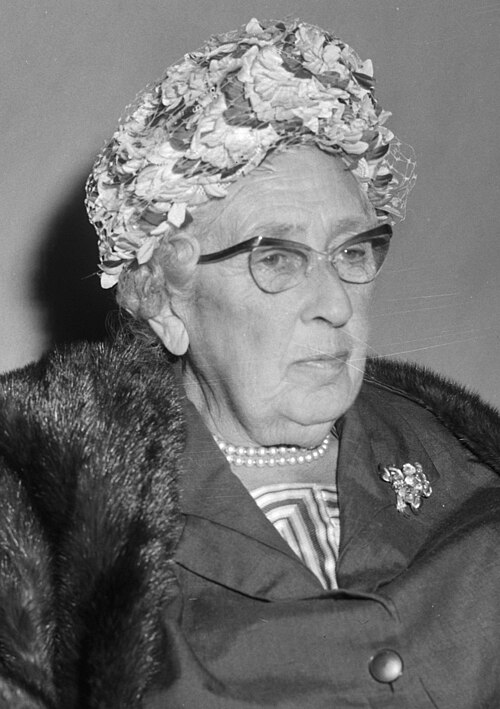
English mystery novelist Agatha Christie (1890-1976) at Schiphol Airport in Amsterdam on 17 September, 1964.
Photo by Joop van Bilsen for Anefo via Wikimedia Commons.
Agatha Christie once remarked that she had never expected to grow rich enough to own a car or poor enough not to have servants.
The reason this strikes us as bizarre today boils down to two names that you hear invoked a lot in the tech industry: Jevons and Baumol. One is shorthand for the expansion of products or professions with rising efficiency, the other for the shrinkage of products or professions with stagnant efficiency.
There’s a pleasing chronological symmetry between these twin ideas: William Stanley Jevons coined the Jevons paradox in 1865; William Jack Baumol described Baumol’s cost disease exactly a century later in 1965.
… For every industry that experiences efficiency gains, there’s another that does not. And this latter industry inevitably becomes less affordable. Baumol’s first example was string quartets: violinists are no more productive but you have to pay them more to prevent them running off to become software engineers. The productive industries drive up the labour costs in the rest of the economy.
Marc Andreessen jokes that if a hole appears in the wall of your house in California these days it is probably cheaper to glue a flat-screen television over it than hire a builder to repair it: a Jevons-deflated cost beats a Baumol-inflated one.
The big question of our age is can AI drag Baumol-shaded industries back into the sunlight of Jevons? Can it make things like healthcare, education, or government switch from rising costs to falling costs?
I fear not in the case of government because of a bureaucratic version of the Jevons and Baumol effects. As Cyril Northcote Parkinson put it in an article in the Economist in 1955: “Politicians and taxpayers have assumed (with occasional phases of doubt) that a rising total in the number of civil servants must reflect a growing volume of work to be done. Cynics, in questioning this belief, have imagined that the multiplication of officials must have left some of them idle or all of them able to work for shorter hours. But this is a matter in which faith and doubt seem equally misplaced.”
Since 1997, the British public sector has seen zero increase in productivity. That is to say, the average civil servant generates about the same output today as he did three decades ago.
Think about this for a second. Thirty years ago fax machines were high-tech, the internet was in its infancy, emails were new, Wi-Fi was scarce, mobile phones were voice-only. How is it remotely possible to be no more productive today than then?
We know the answer. Each email is now copied to a dozen people, each report is pasted and copied till it is twice as long, each Zoom call has five times as many attendees, each mobile call is followed up by three times as many WhatsApp messages – and each day at the desk is interrupted by a training session on transgender anticolonial sustainability. That’s a sort of Jevons-Baumol effect: a Jevol?
Comments Off on Jevons and Baumol, and why they matter now
July 13, 2026
Teddy Roosevelt versus the “Robber Barons” of the Gilded Age
In the Coolidge Review, Burton W. Folsom, Jr. outlines the way President Teddy Roosevelt and his Progressives tried to rein in the wealthy industrialists who had helped create the Gilded Age:
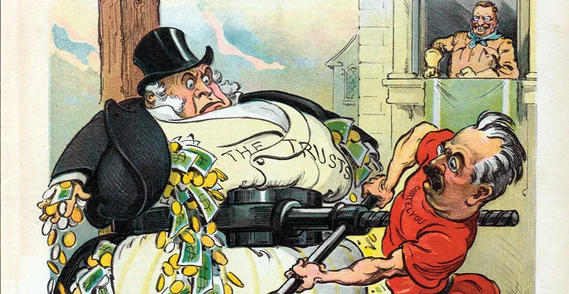
Theodore Roosevelt looks on with glee as his commerce secretary puts the screws to trusts.
(Puck magazine, Alamy Stock Photo, via The Coolidge Review)
The early twentieth century marked the height of the progressive movement, which sought to check the power of free markets and business. To understand what progressives did in the early 1900s, we need to understand what happened in the late 1800s, the period often called the Gilded Age.
After the Civil War, the United States experienced spectacular economic growth. The industries leading the way included railroads, oil, and steel. This expansion made the United States a global economic power. The profits of those businesses enriched the wealthiest — and the average American. That’s in part because bigger, more efficient businesses can offer cheaper prices. Between 1870 and 1880, for example, railroad freight prices fell by half. By 1890, they had fallen by half again. And by 1900, they had been cut nearly in half once more.
Similar advances occurred in many other industries. In the Gilded Age the United States saw perhaps the greatest burst of invention and economic development any country has ever experienced.
[…]
Progressives relied on three tools to restrain business.
The first was the Sherman Antitrust Act. Passed in 1890, this law was used sparingly for a decade. Government enforcement proved difficult in part because the act’s language was vague: the Sherman Act outlawed any contract or “combination” in “restraint of trade or commerce”. In 1895 the U.S. Supreme Court interpreted the law narrowly. In a case involving a sugar-refining business, the Court held that the Sherman Act did not apply to manufacturing. Theodore Roosevelt later wrote in his autobiography that the ruling produced “governmental impotence”.
But soon after entering the White House in 1901, Roosevelt seized on the Sherman Act to engage in “trust busting”. He directed the Justice Department to dissolve the Northern Securities Company, a railroad holding company that Hill had created. This time, the Supreme Court upheld the government’s intervention. Referring to the 1895 ruling, Roosevelt crowed, “This decision I caused to be annulled by the court that had rendered it”, giving the federal government the power “to deal effectively with the trusts”. Roosevelt’s Justice Department soon targeted Standard Oil, which was eventually broken into thirty-four separate companies.
The second tool progressives used against business was the Interstate Commerce Commission. Although railroad rates had declined dramatically for decades, progressives objected to the way those rates were structured. Railroads tended to give the largest discounts to customers that transported the most goods. The railroads still profited from these volume discounts, and smaller customers still paid much lower rates than they had earlier. But progressives argued that it was unjust for smaller shippers to pay higher rates than larger businesses.
In his 1905 annual message to Congress, President Roosevelt demanded legislation to put “a complete stop to rebates in every shape and form”. The 1906 Hepburn Act accomplished that goal. The law was expanded to give the Interstate Commerce Commission the power to inspect railroads’ financial records, eliminate targeted rebates, and set “just and reasonable” rates. In other words, the federal government now had significant pricing power over railroads, America’s largest business sector.
The progressives’ third tool was the federal income tax. In 1909 Congress approved the resolution for a constitutional amendment to establish an income tax. The Sixteenth Amendment took effect in 1913, after three-quarters of the states had ratified it. That was the year Coolidge was elected president of the Massachusetts State Senate.
From the beginning, the tax system was progressive, imposing higher rates on larger incomes. In 1913 most Americans paid no federal income taxes, while the top marginal rate — for income exceeding the equivalent of $16 million in 2026 dollars — was only 7 percent. But within five years, tax rates had soared, with the top bracket paying 77 percent.
Comments Off on Teddy Roosevelt versus the “Robber Barons” of the Gilded Age
July 12, 2026
QotD: “This isn’t exactly the way I expected open source to win”
Decompilers in themselves are not a new technology. Security researchers have employed them for years to analyze compiled malware. There’s been some limited use by others, notably by hobbyists decompiling abandonware games. But there were a couple of issues that prevented this from becoming common practice.
One is simply that running decompilers was difficult. It wasn’t as simple as feed in binary, get out source; it needed a person with specialist skills prepared to do spelunking through wildernesses of machine code and object formats. The other problem was that decompilation didn’t give you anything like the explanatory comments that had been in the original code, so you could easily wind up with code that you could read without being able to understand or modify it.
Now large language models are busily smashing both of those barriers flat. They’re better at the kind of detail analysis required to run the human side of a decompilation than humans are. More importantly, in the process of decompiling code, they rather automatically build a global model of how it works that can easily be expressed by high quality comments in the extracted code. All you have to do, basically, is ask for the comments.
I’m going to reinforce that latter point because it may not be obvious how good LLMs are at this, and how much better they’re going to get. When they decompile code and comment it for you, they’re not just working from that one piece of code you have put in front of them — they’ll have in their training set hundreds, possibly thousands of pieces of code similar to it and with comments. This will give them superhuman levels of insight not just into what it does at the microlevel, but what it means to the humans who wrote it, and what technical assumptions it’s embodying.
Compilation no longer guards your secrets. Or, to put it more precisely the expected time span in which you can still count on it to obscure them is measured in months. Possibly weeks.
What does this mean?
It means you’re in an open-source world now. All it’s going to take for anybody to bust your proprietary IP open is care enough to spend tokens on the analysis.
You will maximize your chances of survival as a software business if you get out ahead of this rather than trying to fight it.
This isn’t exactly the way I expected open source to win. But, you know, I’ll take it. Good enough.
ESR, The social media site formerly known as Twitter, 2026-04-08.
Comments Off on QotD: “This isn’t exactly the way I expected open source to win”
July 11, 2026
Don’t boast about your online pirating skillz
Larry Correia interacts with a proud book pirate on the social media site formerly known as Twitter:
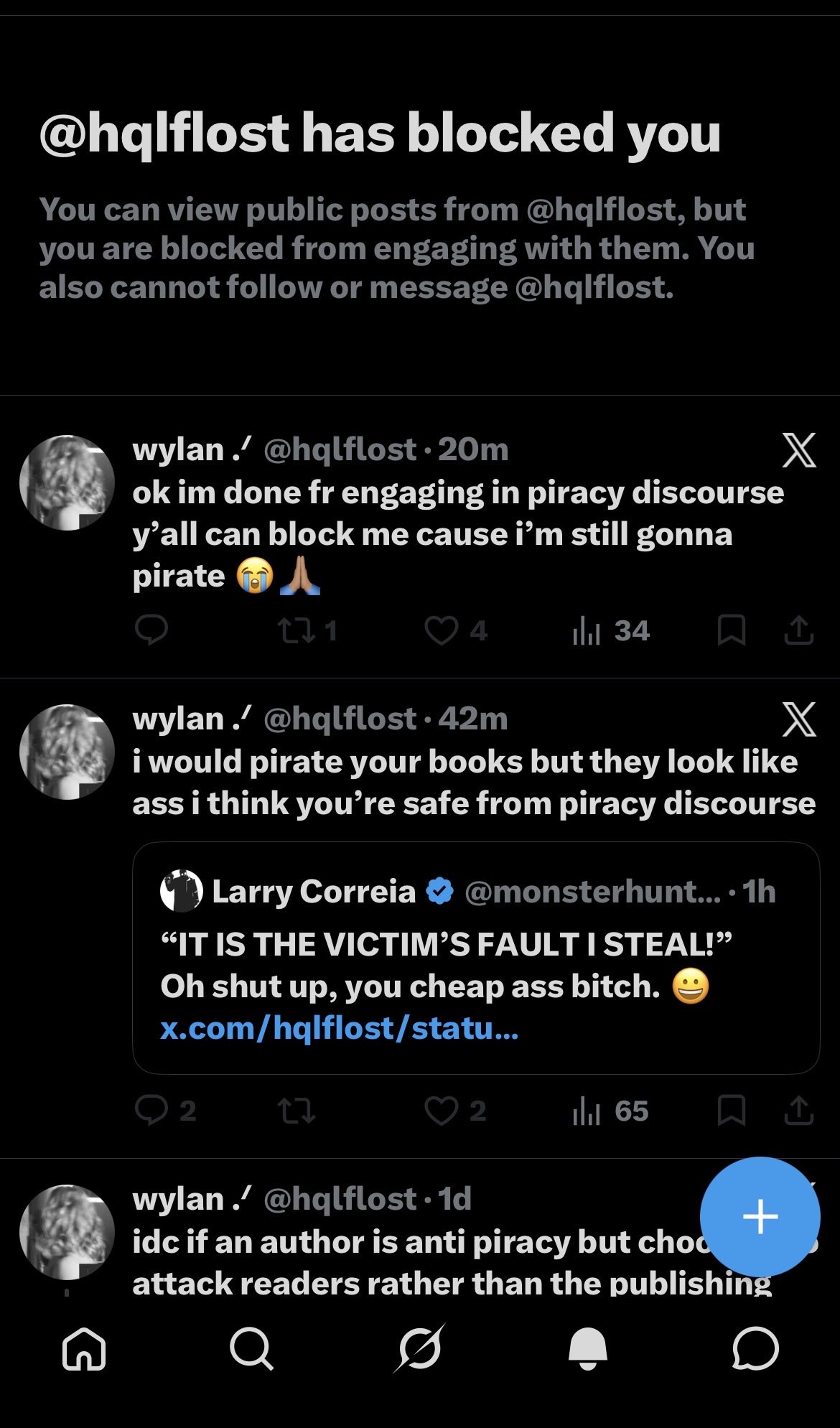
You’d better run, pussy. 😀
Listen, authors are gonna get pirated. We know this. I don’t freak out about it.
But if you are gonna steal, just admit you are a thief and own it. Don’t make a bunch of bullshit posturing excuses why it’s the victim’s fault you’re robbing him. Spare us your commie manifesto about the poor and oppressed, and how you are so brave to stand up for the masses against those cruel wealthy authors taking advantage of the poor (and for most writers, lol wut? They are broke, dummy!)
BUT WHAT ABOUT TEH POORS?!?
Go to the library!
But then we have to listen to these thieving shit weasel cry but what about the RURAL POOR. Which extra fucking pisses me off because now they’re appropriating my culture, because I grew up poor in the sticks. And I choose to live in the country now. Fuck your commie gibberish. Rural people are used to driving long distances to do everything.
Reading is like the cheapest hobby! If you are pirating you are rich enough to have internet.
You aren’t Robin Hood. You’re just a cheap bitch. There’s tons of free books online. My “greedy corporate oligarch” publisher Baen has a free online library with hundreds of titles.
Or KU is like $12 a month for UNLIMITED books. You can read 20 hours a day for a few cents an hour if you feel like it.
If you want to steal, great. Whatever. I don’t give a shit. That’s on you. But just do it with some fucking dignity and spare us from this retarded class warfare justification bullshit. That’s way more pathetic than being a thief.
Comments Off on Don’t boast about your online pirating skillz
July 10, 2026
Defensive driving is more important today than ever before
At some point, the Canadian and provincial governments decided that the safety of their citizens was a lower priority than ensuring that temporary foreign workers — many of whom apparently understand little or no English or French — had to be given commercial trucking licenses and set loose on the King’s Highways:
Absolutely insane‼️
But this is something I’ve been raising the alarm on for years.
The Canadian trucking industry, which almost a third of it is gray/black market now, have been captured by foreigners and empowered by Ottawa.
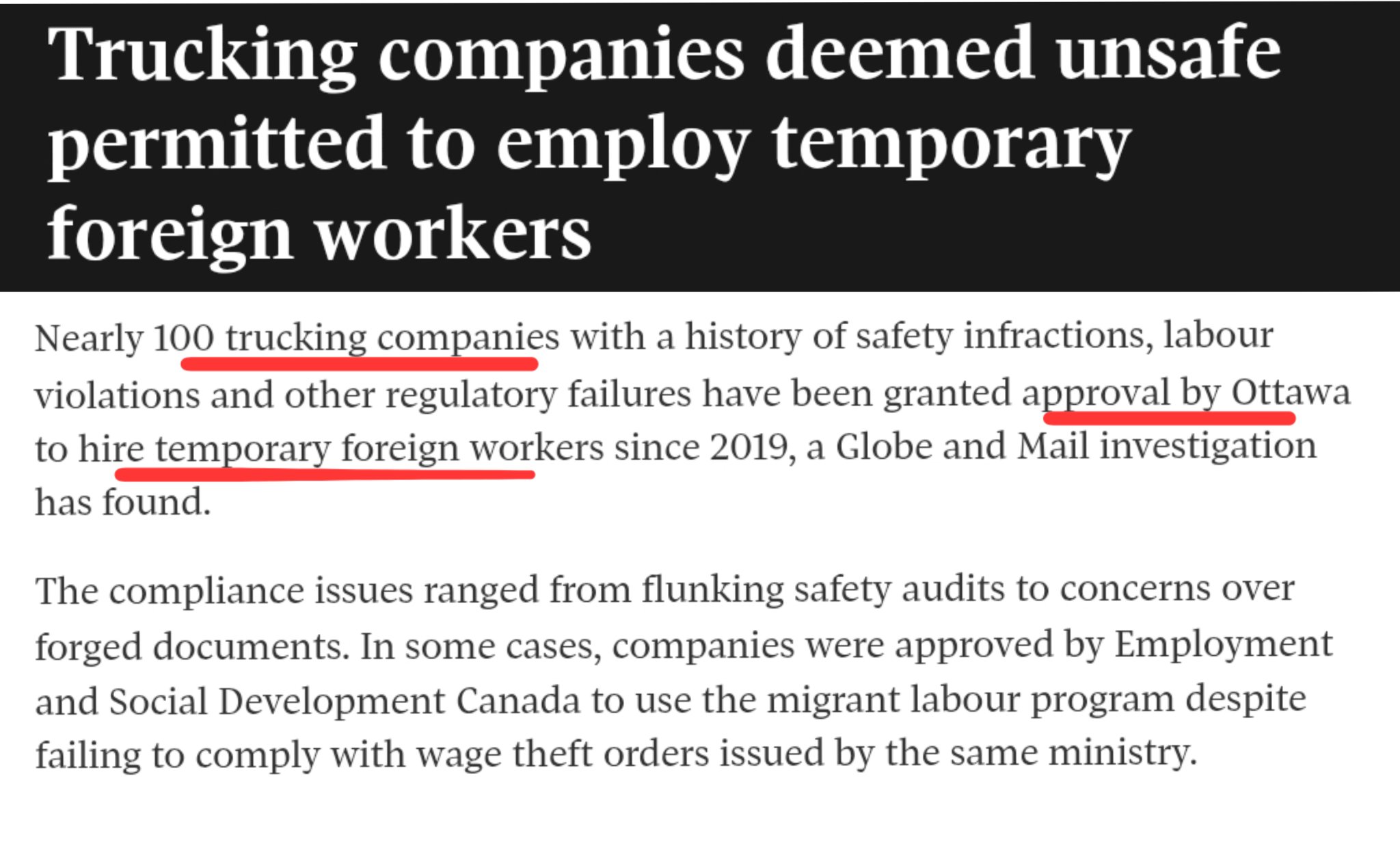
100 trucking companies with a history of safety infractions, labour violations and regulatory failures were approved by the Liberals to mass immigrate temporary foreign workers.
Canadians are losing their lives on our roads every day by foreigners who shouldn’t be in Canada that the Liberals allowed scam organizations to bring in and who shouldn’t be behind the steering wheel to begin with. Then the Liberals and activists judges won’t even deport these people.
Many trucking companies that lose license to operate or get hit with infractions would just change provinces of operations and name – sometimes not even the name, and would just keep operating because there is no proper systems raising red flags and no one investigates. Complete incompetence.
Many operate in Alberta, Saskatchewan and Ontario and move around these provinces.
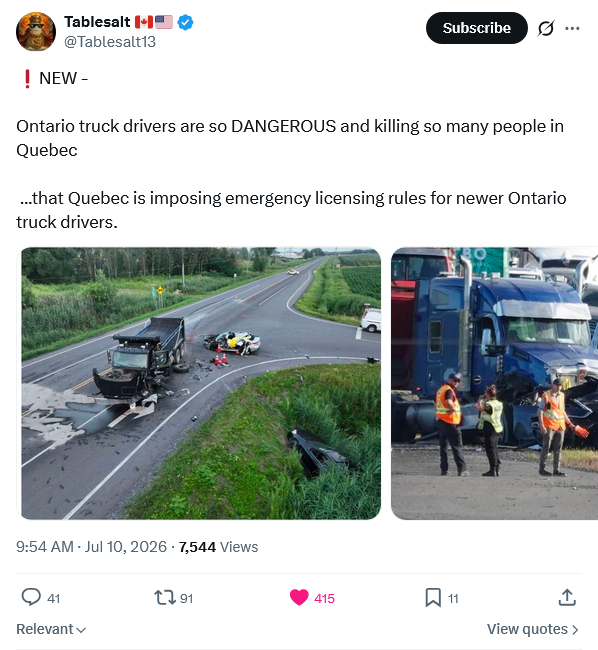
Update: Quebec has taken official notice of the situation.
Comments Off on Defensive driving is more important today than ever before
July 5, 2026
Progressives are only against “some people” getting wealthy
Rob Henderson posted an accurate assessment of how progressives view certain kinds of wealthy people as being undeserving of their fortunes:
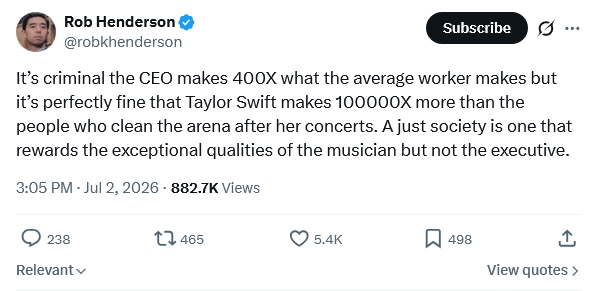
Konstantin Kisin explained why this is the case:
This is because the anti-capitalist left is not actually against people being crazy rich. They’re against certain types of people being crazy rich.
Artists and athletes make sense to them because they’ve played music and sports and because their success can be explained by “luck” and “talent”. Messi’s wealth is not offensive to them because they understand Messi is much better at football than they are.
But when it comes to business, the anti-capitalist leftist has no framework for understanding why Jeff Bezos might be super rich since 99% of them have never ever created a product, business or service that was of value to other people. They’ve never taken entrepreneurial risk. They’ve never employed people and felt the burden of responsibility that comes with that. They’ve never pick up a business and given it a play in the way they’ve picked up a ball or a guitar.
They *literally* don’t understand wealth creation. They think there is a fixed amount of money and the only thing a business does is split it unfairly.
It’s why they rage at Elon and other successful business leaders. Because they genuinely don’t understand why they’re wealthy.
Also, and this is just as important, athletes and artists are disproportionately young, attractive, “diverse”, left wing etc. Business leaders are “evil” middle aged white men whose success offends the average anti-capitalist leftist because they don’t understand a) what it is they do and b) that Elon Musk has the same talent advantage on them as Messi does, it’s just harder to measure.


