
Critical Drinker After Hours
Published 30 Jul 2026In the mood for an Amazon show that’s actually good, unlike Rings of Power? Then Clarkson’s Farm, arguably the best reality show on TV right now, has got you covered. Join me for a quick review of this absolute gem.
July 31, 2026
Drinker’s Extra Shots – Clarkson’s Farm
Comments Off on Drinker’s Extra Shots – Clarkson’s Farm
July 30, 2026
QotD: The three most important books on management
There are three management books — and only three — that need to be read. They also need to be read by everyone. The Peter Principle, Up the Organisation and Parkinson’s Law. Which state, in reverse order, that bureaucracies will always grow until they eat the organisation, that management’s proper job is preventing them from ever starting and that if they’re there then you promote them out of the way. In our case, in this grassroots political movement which is the Hang the Lanyards Party, promote them to transcendence and their eternal rewards.
[…]
This is also what needs to be done with every bureaucracy from time to time. Those management books insist — nay prove — that every organisation always ends up like this. For the driving force of any organisation is the survival of the organisation. To be, not to do, is the aim.
Yes, this does apply to private sector ones but we’ve a natural corrective for those. Other organisations which arrive and not yet having created an all encompassing bureaucracy they outcompete them. So the old bureaucracies die, the new ones grow until they too start hiring power skirts and the decay sets in.
A government bureaucracy does not have that outside force culling it when its time has come. Therefore we must be the merciful farmer taking them out given that we’ve killed off the wolves that thin the herd of the old and lame.
As we can see 65 years is long enough for such a bureaucracy to reach this stage. Rather Brave New World in fact as that was the age at which all reported to be turned off.
So, every bureaucracy, every department, gets closed after 60 to 65 years. Some sooner, just to keep people on their toes. Yes, every. Say, the Department of Education. Or of Defence. Once we’ve killed it and fired everyone just leave be for a few years. If we still have some problems that really do need to be dealt with we can always hire a few, give ’em a corner of a desk somewhere, and we get the vigour and growth of a new organisation actually trying to solve things.
Until, obviously, the arrival of power skirts and the renewal process starts again.
Tim Worstall, “Closing US AID is What We Should Do To All Government”, It’s all obvious or trivial except …, 2026-04-29.
Comments Off on QotD: The three most important books on management
July 18, 2026
Jevons and Baumol, and why they matter now
On the social media site formerly known as Twitter, Matt Ridley talks about the ideas of William Stanley Jevons and William Jack Baumol, whose ideas have become far more important over the last few decades:

English mystery novelist Agatha Christie (1890-1976) at Schiphol Airport in Amsterdam on 17 September, 1964.
Photo by Joop van Bilsen for Anefo via Wikimedia Commons.
Agatha Christie once remarked that she had never expected to grow rich enough to own a car or poor enough not to have servants.
The reason this strikes us as bizarre today boils down to two names that you hear invoked a lot in the tech industry: Jevons and Baumol. One is shorthand for the expansion of products or professions with rising efficiency, the other for the shrinkage of products or professions with stagnant efficiency.
There’s a pleasing chronological symmetry between these twin ideas: William Stanley Jevons coined the Jevons paradox in 1865; William Jack Baumol described Baumol’s cost disease exactly a century later in 1965.
… For every industry that experiences efficiency gains, there’s another that does not. And this latter industry inevitably becomes less affordable. Baumol’s first example was string quartets: violinists are no more productive but you have to pay them more to prevent them running off to become software engineers. The productive industries drive up the labour costs in the rest of the economy.
Marc Andreessen jokes that if a hole appears in the wall of your house in California these days it is probably cheaper to glue a flat-screen television over it than hire a builder to repair it: a Jevons-deflated cost beats a Baumol-inflated one.
The big question of our age is can AI drag Baumol-shaded industries back into the sunlight of Jevons? Can it make things like healthcare, education, or government switch from rising costs to falling costs?
I fear not in the case of government because of a bureaucratic version of the Jevons and Baumol effects. As Cyril Northcote Parkinson put it in an article in the Economist in 1955: “Politicians and taxpayers have assumed (with occasional phases of doubt) that a rising total in the number of civil servants must reflect a growing volume of work to be done. Cynics, in questioning this belief, have imagined that the multiplication of officials must have left some of them idle or all of them able to work for shorter hours. But this is a matter in which faith and doubt seem equally misplaced.”
Since 1997, the British public sector has seen zero increase in productivity. That is to say, the average civil servant generates about the same output today as he did three decades ago.
Think about this for a second. Thirty years ago fax machines were high-tech, the internet was in its infancy, emails were new, Wi-Fi was scarce, mobile phones were voice-only. How is it remotely possible to be no more productive today than then?
We know the answer. Each email is now copied to a dozen people, each report is pasted and copied till it is twice as long, each Zoom call has five times as many attendees, each mobile call is followed up by three times as many WhatsApp messages – and each day at the desk is interrupted by a training session on transgender anticolonial sustainability. That’s a sort of Jevons-Baumol effect: a Jevol?
Comments Off on Jevons and Baumol, and why they matter now
July 12, 2026
This used to be active sabotage … now it’s standard EU practice
Ten years back, I posted an excerpt from a WW2 American espionage manual showing workers in occupied Europe how to bureaucratically sabotage their organizations to harm Nazi Germany’s war efforts. At the time I joked that it also sounded like a lot of company meetings in the modern world. Brivael Le Pogam uses the same set of guidelines to illustrate just how much the EU has embraced these sabotage methods as their standard operating practices:
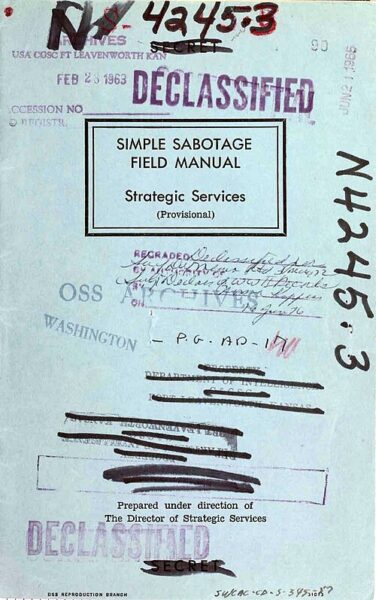
Link goes to full text at Wikisource
🚨 The OSS Simple Sabotage Field Manual (1944) describes how to paralyze an organization without explosives.
The European Union seems to have taken it as its official instruction manual. Here are the disturbing similarities:
1. “Insist on everything going through official channels.”
✅ 27 states, 24 official languages, 3 seats, thousands of committees and agencies. Even a directive on lightbulbs goes through 7 levels of validation.2. “Hold meetings. Speak at length with anecdotes.”
✅ 45-minute speeches in the European Parliament on minor topics. Strasbourg and Brussels locals applaud politely.3. “Refer everything to committees. Make them as large as possible (never fewer than 5 people).”
✅ The trilogue, COREPER, working groups, expert committees … A simple decision turns into a 3-to-7-year obstacle course.4. “Bring up unrelated matters repeatedly.”
✅ Talking agriculture? Let’s add the Green Deal, LGBT rights, Palestine, and the carbon border tax. Nothing is ever straightforward.5. “Haggle over the precise wording of communications.”
✅ Months of negotiation over a semicolon in a 400-page regulation. The word “should” vs. “must” can stall everything.6. “Reopen decisions that have already been made.”
✅ Directive adopted? We reopen it 2 years later for “revision”, “strengthening”, or “adaptation to the geopolitical context”.7. “Advocate caution and deliberation. Avoid all haste.”
✅ “We need more time to study the impact”, “let’s consult stakeholders more”, “better safe than sorry”. Result: nothing moves quickly.8. “Question the legitimacy of every decision.”
✅ “Is this really within the EU’s competence?” (even when it’s already in the treaties). Subsidiarity invoked when convenient, forgotten when not.The EU doesn’t need Russian or Chinese saboteurs. It has turned itself into a machine for slowing down Europe, exactly as the manual recommended to weaken the enemy.
The funniest part? All of this is done legally, democratically, and with the best intentions.
Automatically translated from the original French by X.
July 10, 2026
Defensive driving is more important today than ever before
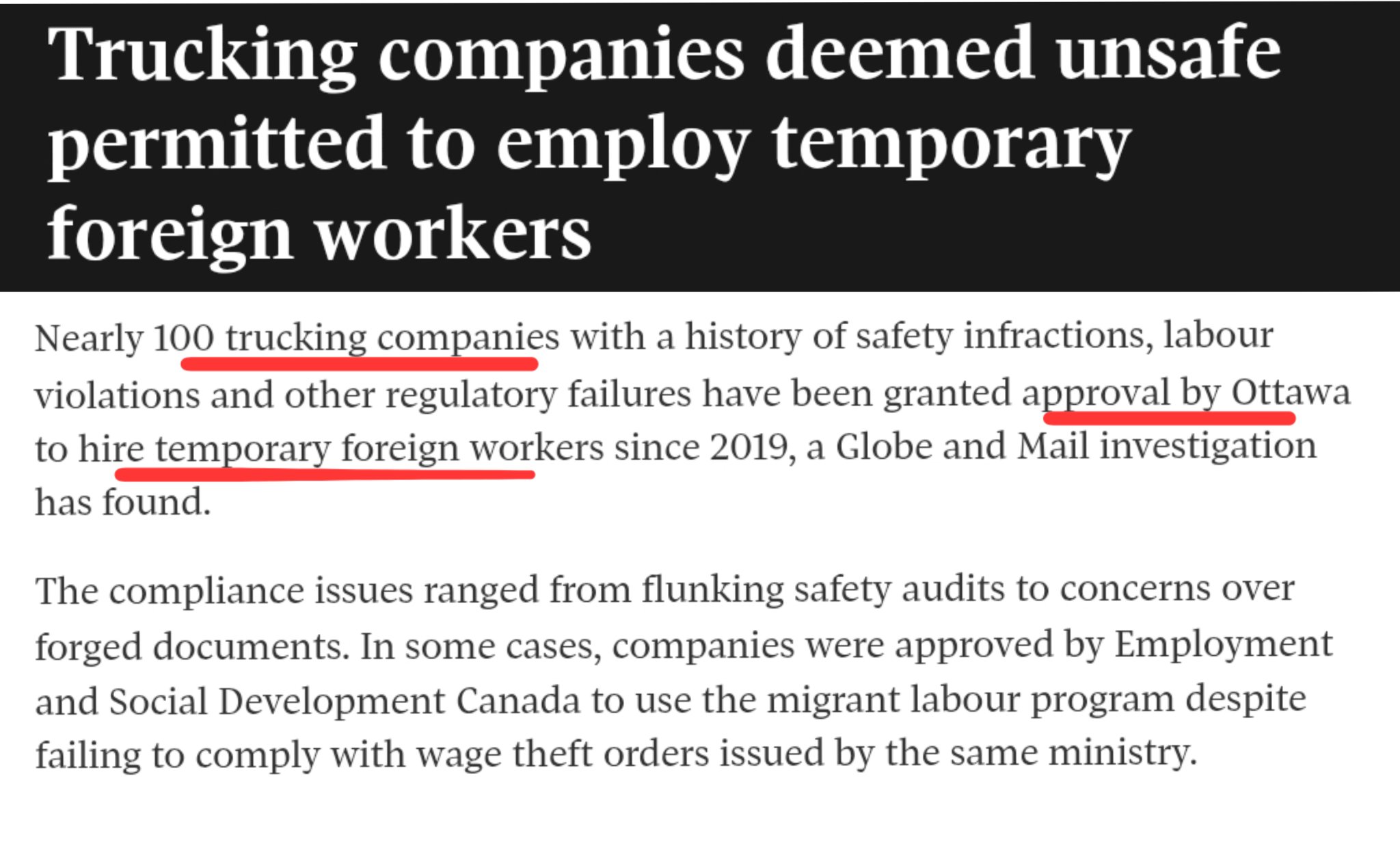
At some point, the Canadian and provincial governments decided that the safety of their citizens was a lower priority than ensuring that temporary foreign workers — many of whom apparently understand little or no English or French — had to be given commercial trucking licenses and set loose on the King’s Highways:
Absolutely insane‼️
But this is something I’ve been raising the alarm on for years.
The Canadian trucking industry, which almost a third of it is gray/black market now, have been captured by foreigners and empowered by Ottawa.
100 trucking companies with a history of safety infractions, labour violations and regulatory failures were approved by the Liberals to mass immigrate temporary foreign workers.
Canadians are losing their lives on our roads every day by foreigners who shouldn’t be in Canada that the Liberals allowed scam organizations to bring in and who shouldn’t be behind the steering wheel to begin with. Then the Liberals and activists judges won’t even deport these people.
Many trucking companies that lose license to operate or get hit with infractions would just change provinces of operations and name – sometimes not even the name, and would just keep operating because there is no proper systems raising red flags and no one investigates. Complete incompetence.
Many operate in Alberta, Saskatchewan and Ontario and move around these provinces.
Update: Quebec has taken official notice of the situation.

Comments Off on Defensive driving is more important today than ever before
July 6, 2026
QotD: Cloud people and dirt people
One example of this is in how the political class understands hierarchy. Every Washington politician and appointee lives in a world where hierarchy is well understood and respected. The appointed class have an array of titles that indicate their position in the hierarchy. Elected officials, of course, have their office and their committee assignments, along with their seniority. This is a world every one of them inherited when they entered politics. It is how it has always been.
In this world, a senator tells his staff to do something and he just assumes they will do it, assuming it can be done. If it cannot be done, then he is going to have them find out why it cannot be done and report back to him. An appointee works the same way within the bureaucracy. They have a staff, usually of appointees, and that staff carries out the orders of the director or secretary. Even though nothing of public good is done in Washington, the petty tasks are carried out with precision.
In this regard, the political class is a petty aristocracy. Senator Lindsey Graham, for example, commands absolute loyalty from his staff. Not only does his staff do what they are told, they faithfully keep his secrets. He has been in the Imperial Capital for a quarter century, without a hint of scandal, despite the obvious. Congress operates a private slush fund to settle sexual harassment claims. Over 260 claims have been paid, without a word about the details. That’s loyalty.
Scan the biographies of the political class and the thing you will be hard pressed to find is anything resembling real world experience. Few have ever worked in the dreaded private sector. Those that have, worked in the law or maybe finance. These careers were just alternative paths to the place they wanted to be all along. There are no sons of the soil in Washington.
The Z Man, “Us And Them”, The Z Blog, 2020-10-06.
July 2, 2026
Reining in the administrative state – Humphrey’s Executor overruled by the Supreme Court
One of the two US Supreme Court rulings this week that sparked controversy was the court’s decision to overrule a 1935 precedent that enabled the growth of the administrative state:

Panorama of the west facade of United States Supreme Court Building at dusk in Washington, D.C., 10 October, 2011.
Photo by Joe Ravi via Wikimedia Commons.
The Supreme Court this week restored an old-fashioned constitutional idea: if a principal federal officer exercises executive power, the president must be able to remove him. The justices’ 6–3 ruling in Trump v. Slaughter, which struck down a law prohibiting the president from firing members of the FTC except for cause, is the logical endpoint of a 15-year series of cases that have steadily chipped away at Humphrey’s Executor, the 1935 decision that blessed for-cause removal protections for the heads of so-called independent agencies.
The Court didn’t mince words. Chief Justice John Roberts wrote that “Humphrey‘s framework, in short, has not withstood the test of time”. Then came the sentence that will launch a thousand administrative-law articles: “If anything more is left of Humphrey‘s, we overrule it”. The New Deal compromise that invented quasi-legislative agencies has finally met Article II of the U.S. Constitution.
That’s good, because the Federal Trade Commission isn’t a debating society. It, along with its alphabet-agency brethren, writes rules with the force of law, investigates private parties, adjudicates violations, and sues in federal court on behalf of the United States. Whatever labels Congress attached to that body in the Progressive Era, the FTC — like the FCC, SEC, NLRB, and so on — today exercises executive power. And the Constitution vests “the executive power” in one president, not in commissioners serving staggered terms, answerable to no one whom voters can fire.
This ruling isn’t a gift to Donald Trump or his successors. It’s a restoration of constitutional accountability. Congress can create executive-branch agencies and specify what they may do, but it cannot create a fourth branch of government and then pretend its officers are independent of the only person the Constitution makes responsible for executing federal law.
Roberts put the point crisply at the end of Slaughter: “Subordinates who exercise the President’s power are subject to removal by him”. That’s a unitary, not an imperial, presidency, and it’s a hallmark of republican government. The president remains constrained by statutes, appropriations, courts, Congress, elections, and the Constitution itself. If the people dislike how the FTC enforces the law, they should be able to blame — and replace — the president, not chase a goulash of insulated mandarins.
Justice Neil Gorsuch’s concurrence adds the important next step. Killing Humphrey’s Executor doesn’t cure every constitutional disease in the administrative state. It simply reallocates the power Congress poured into independent agencies. As Gorsuch warned, “the fourth branch’s powers still exist; they have just been reassigned to the President”. If agencies possess vast legislative and judicial authority, the answer isn’t to hide those powers from presidential control, but to restore legislative powers to Congress. Make Congress great again!
June 28, 2026
Multiculturalism in Australia: theory and practice
Australia, like the rest of the Anglosphere (with the notable exception of the United States) has adopted multiculturalism as a secular national religion, yet all is not well Down Under, as Celina illustrates:
Pauline Hanson’s National Press Club address last week has thrust the conversation of multiculturalism back into the centre of Australian politics. With One Nation now the most popular party in the polls, her pledge for a “monoculture” is no longer being pushed into the fringes. Yet, as it stands One Nation doesn’t really have any concrete policy on how to abolish multiculturalism.
Firstly, we must distinguish what is meant by multiculturalism in relation to politics. Multiculturalism is not just the presence of different cultural practices in Australia. That is a deliberate straw-man. “Abolish multiculturalism and you lose your Bah mi or Chinese takeaways” is a lazy reductionism pushed by people who are either stupid or as a sarcastic question from the left about the lack of One Nations ability to provide actual policy.
Multiculturalism, as it operates in Australia, is the institutionalisation of minority ethnic and religious lobbying. It is a system in which governments treat organised ethnic, religious and minority identity-based groups as permanent stakeholders with privileged access to policy-making. These groups receive taxpayer funding, sit on advisory bodies, submit formal recommendations, and see their priorities turned into law on hate speech, anti-discrimination, social cohesion and diversity policy. The broader Australian public is expected to accept the resulting consensus.
The Machinery That Actually Exists
Australia maintains a Minister for Multicultural Affairs, an Office for Multicultural Affairs inside the Department of Home Affairs, an Australian Multicultural Council, and a Ministerial Forum on Multicultural Affairs. States have their own legislation: the Multicultural NSW Act, Victoria’s Multicultural Victoria Act, South Australia’s Multicultural Act, Queensland’s Multicultural Recognition Act and others. They create recurring funding streams, annual reporting obligations, advisory councils and grants programs that sustain an entire ecosystem of peak bodies, settlement providers and advocacy organisations.
Commonwealth multicultural grants run into tens of millions annually. Additional streams exist for “social cohesion”, security upgrades for specific communities and settlement services. Peak bodies such as the Federation of Ethnic Communities’ Councils of Australia (FECCA), the Executive Council of Australian Jewry (ECAJ), the Australian Federation of Islamic Councils (AFIC) and the Hindu Council routinely prepare submissions, appear before inquiries and maintain ongoing relationships with ministers and bureaucrats. Personnel overlap between federal and state advisory structures is visible and recurring.
This is what political scientist Theodore Lowi called “interest group liberalism“.1 Lowi’s insight was that the pluralist system does not represent the public interest but rather rewards whichever organised groups can gain access to the machinery of government. The democratic problem is that the state has granted specific groups a structural position that ordinary, unorganised citizens do not enjoy. This results in something called mobilisation of bias, as coined by E.E. Schattschneider. described this form of power as the “mobilisation of bias“, where “some issues are organised into politics while others are organised out“.2,3
- https://en.wikipedia.org/wiki/Interest_group_liberalism
- https://www.powercube.net/analyse-power/forms-of-power/hidden-power/
- (2011). “Mobilization of bias”. In K. Dowding (Ed.) Encyclopedia of power (pp. 424-424). SAGE Publications, Inc., https://doi.org/10.4135/9781412994088.n234



Comments Off on Multiculturalism in Australia: theory and practice
June 25, 2026
Why Britain voted for Brexit
Pat Condell explains some of the reasons British voters chose Brexit over staying in the EU back in 2016:

Why did we vote for Brexit ten years ago? Because we understood that the core purpose of the European Union is to destroy the independent countries of Europe by opening the borders and transforming a diverse continent of sovereign nations into a single homogenous political bloc governed by a committee of unelected bureaucrats, as a model for the planned global dictatorship.
Obviously, you’re not going to get many votes for that if you just lay it out for people, so you start with something innocuous like trade.
You say “Let’s harmonise our trade arrangements and everything will run more smoothly.”
And people say “Yes, that sounds like a good idea.”
Then you say “While we’re at it, let’s give this small group of people the power to organise all this from one place, and everything will run more smoothly.”
“Well, I suppose that makes sense. We want things to run smoothly.”
Then it’s “Actually, let’s give these people the power to make our laws and override our parliament and justice system, and everything will run much more smoothly.”
“Hold on a second, I don’t know about that …”
“You fascist. You racist. You xenophobe. You bigot. You pig ignorant little Englander. You vermin. You scum.”
Although that attitude certainly helped to tip the balance, the most important reason we voted for Brexit is that politicians had no right to sign away the governance of the UK to a foreign entity, but that is what they did, while pretending it was about trade. They lied to us, and they tried to cheat us out of our country.
That is why we voted for Brexit, and it’s why we’re now being punished for our disobedience by traitors who refuse to secure the border and who are allowing our country to be flooded with millions of unwanted and incompatible immigrants and illegally invaded and occupied by an army of dangerous military age men in whose presence no woman or child is safe.
Forced mass immigration from hostile and barbarous cultures is punishment for Brexit. Our country is being purposely destroyed for not voting the way we were told.
Comments Off on Why Britain voted for Brexit
June 23, 2026
They don’t do “democracy” in Europe for any important issue: the voters might get it wrong
It used to be a joke that voting never matters because the voters can’t be trusted with that kind of power. Over time, the joke stopped being at all funny, because that’s exactly what has happened in most western countries at the national level, but most blatantly in the European Union, where voters can express their will in a clear majority, yet see exactly the opposite policies implemented by Brussels:

EU delenda est
2005: the day they decided your “no” didn’t count
May 29, 2005. The French vote. Referendum on the European Constitutional Treaty.
Result: 54.68% NO.
Turnout: 69%.
Not a vote of abstainers, not a misunderstanding.
A people speaking out, massively, with full awareness.
Three years later, the same text — or nearly so — came into force. Without asking their opinion again.
Here’s how.
The context.
The Constitutional Treaty was the great federal leap: a text that gave the EU the attributes of a state. A flag, an anthem, a “constitution”, a foreign minister, supremacy written in black and white. Chirac, full of confidence, calls the French to the polls. The “yes” campaign mobilizes everything: the state, the major parties, the media, big business, the institutional unions.
And the French say no. For reasons the elite refused to hear: fear of social dumping (the infamous “Polish plumber”, the Bolkestein directive), a sense of a machine slipping out of their control, rejection of a project decided from on high and ratified by acclamation. Five days later, the Dutch say no in turn. 61%.
The treaty is dead. Officially, it’s called a “period of reflection”. In reality, it’s time to find a workaround.
The workaround has a name: Nicolas Sarkozy.
2007 campaign. Sarkozy proposes a “simplified treaty”. And above all, he lays out the adoption method: it will be the parliamentary route. No referendum. Parliament will vote in place of the people.
That’s his promise. He is elected.
And he keeps it against the people who had already decided.
The sleight of hand: the Lisbon Treaty.
Signed in December 2007.
They remove the symbols that scared people: no more “constitution”, no flag in the text, no “minister”.
They keep the essentials: permanent presidency of the Council, extension of qualified majority voting, retreat from unanimity, the Union’s legal personality, European diplomatic service. The institutional substance of the rejected text, repackaged.
The most cynical part is that they admitted it. Valéry Giscard d’Estaing, the architect of the Constitution, wrote it himself: the tools are the same, we’ve simply changed their order in the box. The stated goal: make the text unreadable so no government would be forced to submit it to a referendum. Technique replacing the popular verdict.
February 2008. Versailles.
Congress convenes to amend the French Constitution and allow ratification. Then Parliament ratifies Lisbon. The government left, which had campaigned for “no”, abstains and lets it pass. The French, they are never consulted again.
The “no” of 2005 has just been converted to “yes” by procedure.
And for those who might doubt the method: Ireland, for its part, was constitutionally required to vote. It says no in June 2008. They make it revote in 2009 until they get the right result. Vote until you get it right.
And that’s where it all connects.
This isn’t a procedural anecdote. It’s the founding act of a legitimacy problem that France has never settled.
Because the question of 2005 is exactly the one today. When Brussels signs 96 billion in development aid, when the NDICI directs billions to foreign “civil societies”, when the Global Gateway promises 300 billion the real question is never “should we do it?”.
It’s: who decided, and with what legitimacy?
The answer, we’ve known it since 2005: an administration that believes the people, when they answer wrong, must be circumvented, not heard. Hayek called it the fatal conceit.
The idea that a center knows better than the peoples what is good for them including against their explicit vote.
The French never accepted Lisbon. They were never asked.
And a structure built by going over the head of a lost referendum doesn’t carry a democratic deficit: it carries a birth defect.
The American Constitution starts with “We the People”.
Ours, the European version, started with a people who said no and an apparatus that decided it didn’t count.
Auto-translated by X from Brivael Le Pogam’s original French post.
Comments Off on They don’t do “democracy” in Europe for any important issue: the voters might get it wrong
June 21, 2026
Gad Saad discovers that Canada has an “exit tax” … and it’s insane
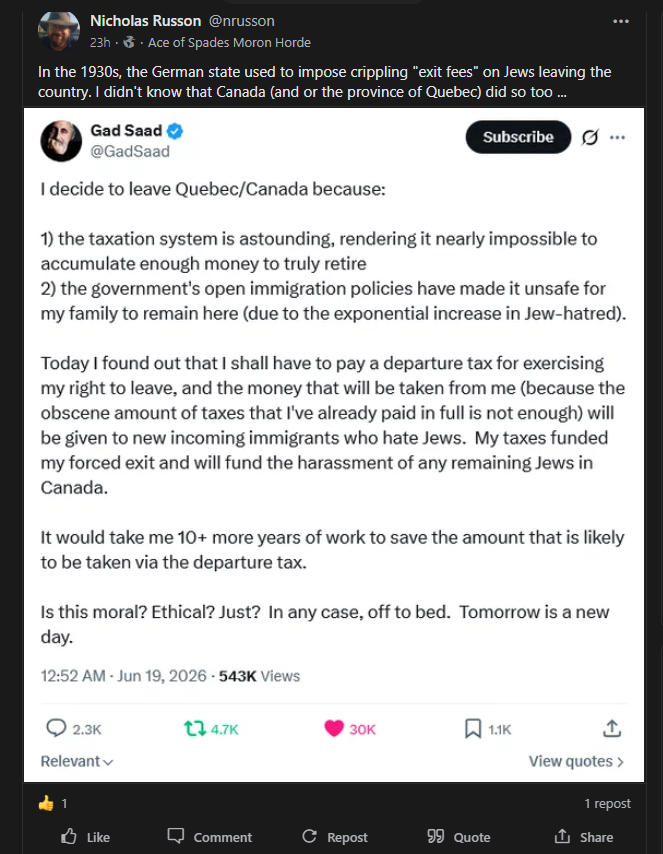
The other day, I shared a post from Gad Saad that alerted me to something I’d never heard of before: a steep tax the federal and provincial governments levy when a Canadian emigrates to another country:
On the social media site formerly known as Twitter, Vesper provides more information:
The Great Scam
After what @GadSaad posted yesterday, something I had no idea existed … an “Exit Tax” I did some digging. This is what I found.
Canada’s departure tax is one of the biggest scam taxes on the books. Apparently when you leave the country, the government treats you as if you sold every investment you own, even if you sold nothing.
You get hit with a tax bill on money you never touched, never withdrew, never spent. They literally invented a fake sale to justify taking your money.
Here’s what makes it even worse. The stocks they’re taxing? Those are foreign companies. Apple, Samsung, whatever you hold, those grew because of what those businesses did in their own countries, their own markets, with their own workers.
Canada had absolutely nothing to do with it. Zero. But they still want a cut just because you happened to live here while you owned them. They did nothing and still want to be paid like they did.
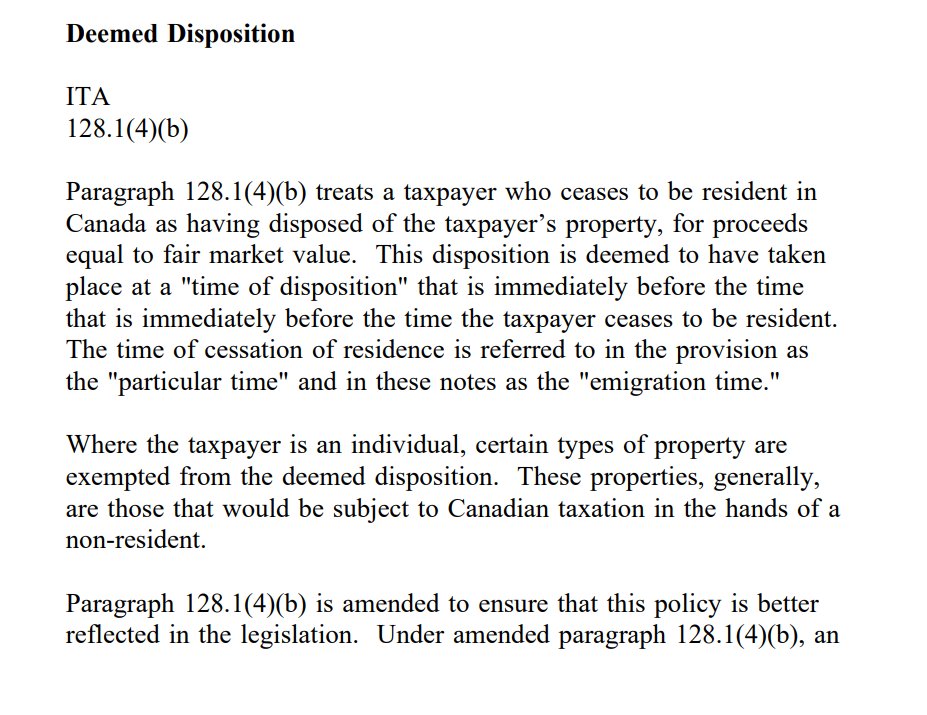
And before 1996 this didn’t even exist the way it does now. Chrétien’s government expanded it that year and buried it in section 128.1(4)(b) of the Income Tax Act like they hoped nobody would notice. Italy doesn’t do this. Portugal doesn’t. Belgium, Switzerland, the UK, none of them pull this shit.
You paid income tax every year. You paid sales tax. Property tax. You held up your end of the deal the whole damn time. And when you decide to go live somewhere else, they hit you with a bill for money that was never real to begin with.
Canada under any Liberal is a Scam!

And followed up with:
FYI- Just to make clear why I posted that image instead of Clause 17 it was meant to make an additional point, that I’m not sure Gad was informed about. The system is one-directional and rigged.
That image explains that The exit tax locks in your gains the day you leave at whatever the market says that day. You have no choice, no timing, no flexibility.
If your portfolio drops 30% the week after you leave, too bad. Canada already took their cut on the higher number. The gain was real to them the moment you packed your bags. The loss that came after is entirely your problem.
If you want to see the stocks section it’s this
You can read it for yourself:
Update: After some online mockery, Gad Saad explains that he’s not just upset on his own behalf.
People are astoundingly stupid. My comments about the departure tax is not that I should be treated differently from anyone else. I am making a point about the extent to which taxes are confiscatory. As I have previously explained, there was a time when ZERO cents of income tax were levied in Canada and the US. Then bit by bit, that “temporary” measure, to be applied to only a few, and at a very low percentage rate of your income, becomes a mammoth monster that takes more than 50% of your earnings. It can occur because there are no repercussions if governments do not balance their budgets (other than voting them out). Hence, what starts off as a small temporary tax on a few becomes an existential theft that is orders of magnitude larger than the so-called illegal extortion tax of the Mafia. It can exist only because the great majority of people BENEFIT from this form of parasitic taxation. But someone has to pay for everyone else, and when you are that someone, you are not necessarily pleased to be funding the ultimate Ponzi scheme. I’m making a moral, philosophical, and ethical argument. It’s not just about me.
Comments Off on Gad Saad discovers that Canada has an “exit tax” … and it’s insane
June 17, 2026
Why California’s high speed train system will probably never be finished
This is an older post from March, but nothing in it has significantly changed … the legal and regulatory structure of Californian governance will ensure that what work gets done on the high speed rail infrastructure will only be done at the slowest speed yet at the highest possible costs:

The California high-speed rail authority, literally owns thousands of parcels of land that are in various stages continued litigation, tenant improvements, eviction, and constant maintenance.
For example, there are many homes and apartment complexes in the plant path that have been purchased years ahead of construction. Removing those tenants is a slow and expensive process. (let’s ignore the extra stress on housing that all of these destroyed properties are causing)
In some cases, these are low rent apartments with a lengthy eviction process. During that process, the state of California is the landlord and has to maintain the property codes the same as any other landlord. This means repairs, adding smoke detectors, fixing roofs, vegetation management, landscaping, paying off tenants to leave early, boarding up Windows, constant trash cleanups, towing vehicles etc.
But the High Speed Rail Authority doesn’t just have to maintain these properties at normal cost. Every single bit of that work has to be done at California prevailing wage rates. The work can only be done through qualified contractors that have passed through a long series of idiotic mazes to qualify to perform the work.
An average rate per hour (charge rate) for a worker to perform any service on these properties is approximately $200 an hour for labor only. The cost go up for specialized work, like electricians, plumbers, or machine operators.
Properties that are literally worthless are being maintained at huge expense just so the next round of homeless transients can break into the property and cause more damage. For reasons I can’t explain, the process to finally demo and remove the structures takes years.
I’m only mentioning the tip of the iceberg regarding my firsthand knowledge.
Completely separate from those outlandish costs are the inflation caused by the construction. The prevailing word on the street is that nothing is getting done. The truth is that a lot is getting done and none of it efficiently.
The amount of concrete being poured daily and monthly to build gigantic overpasses for both the rail and roadways is not understood. In these work areas, every concrete mixing company is fully scheduled out and cannot offer building materials for other basic services such as building a house often times for weeks when the average lead time for many of these services used to be one day. And that’s just the schedule, never mind the huge cost increases from straining the supply chain and labor pool.
The amount of concrete and steel that has gone into the structures so far is massive.
Dozens and dozens of new water wells have been dug just for dust control. Thousands upon thousands of acres of highly productive tree fruits and nuts have been torn up and shredded.
Utility scale solar fields have been uprooted and sometimes relocated at extravagant costs.
Every type of business you can imagine has gone through either a closure, relocation, or a long-term tenant agreement with the rail authority. In some cases, it’s just a buyout where the business closes its doors forever. The owners get something all of the workers get nothing.
Don’t get me started on how thick the layers of bureaucracy are for these minute tasks that occur on all of these properties.
The inefficiency is far beyond your wildest dreams. In many cases, this is not related to fraud in any way it’s just absolute ignorance, red tape, and failed leadership.
Comments Off on Why California’s high speed train system will probably never be finished
June 9, 2026
Confucian deference to authority and tradition lead to autocracy and rebellion, time after time
Chinese history is not one of my areas of interest, so I have not read deeply in any specific area. Lorenzo Warby, on the other hand, has a much better grasp of the sweep of historical events in China and some of the philosophical and cultural elements that persist through the centuries:

All political and social philosophies rest, implicitly or explicitly, on some claims or claims about the nature of humans.
Consider the thought of Kong Qiu (c.551 BC – c. 479 BC), known as Kǒngfūzǐ (孔夫子) (Great Master or Wise Teacher Kong), hence Confucius. He held that human nature is naturally good and that it is therefore a reasonable aspiration to create a society of harmony, a society without conflict, if everyone just behaves with the propriety appropriate to their place in society — in particular, according to their placement in the web of social connections. His constant concern for the rites (li 禮) is for people to show the correct forms of, and orientation towards, those socially embedded interactions.
This leads very naturally to a very authoritarian, hierarchical view of politics as enforcing social harmony, particularly as people vary in their willingness and capacity to cultivate such virtuous propriety. The notion that politics is legitimately an arena for bargaining between competing interests — the Western idea of “normal politics” — becomes not a natural way to do politics, but a failure to achieve proper harmony.
Master Kong developed his ideas — that were further developed by disciples and commentators — in a civilisation with no tradition of warrior assemblies, self-governing cities, or deliberative assemblies of any kind. A ruler’s court is a place where officials report, and may even debate, but the ruler decides. You can see this narrow view of politics in comments by Master Kong in the Analects such as:
8.14 The Master said, “If you don’t have a particular [government] position, then don’t meddle with any of its business.”
14.26 The Master said, “If you don’t have a particular [government] position, then don’t meddle with any of its business.” Master Zeng [Zengzi] commented, “The gentleman does not allow his thoughts to go beyond what his position calls for.”
In such a political culture, judicious quotes based on mastery of a shared literature become a way of communicating to superiors while giving minimum offence. Conversely, political rhetoric has little or no value, because there are not the deliberative assemblies to be swayed by argument. Master Kong deprecated glib persuasiveness, on the grounds that it tended to hide one’s real character (or lack thereof).
Where command-and-control hierarchy is the dominant method of political action, hoping for propriety to pervade the hierarchy has obvious resonance. Putting such propriety as a mechanism for social harmony is a way to, ironically enough, be persuasive — which requires a positive view of human nature. But it also hugely elevates the moral claims of governorship. Hence comments such as:
2.1 The Master said, “To rule by virtue is like the way the North Star rules, standing in its place with all the other stars revolving around it and paying court to it.”
12.17 Ji Kangzi asked about the way of governing [zheng]. Confucius replied, “To govern [zheng] is to correct [zheng]. When you set an example by correcting your mistakes, who will dare not to correct his mistakes?”
This concern for harmonious propriety is not a world away from ibn Khaldun‘s concern for asabiyya. Nor is it so far from recognising the importance of a coherent civic culture in order to maintain robust institutions, which rest on norms and rules. This is a factor that much of mainstream Economics fails to seriously grapple with, leading to incompetent analysis of immigration.
The problem is that this cultural and institutional framework turns the thought of Master Kong, his disciples and commentators, into what is, in effect, one-trick moral propriety politics, however sophisticated other aspects of this tradition may be. The choices of governance are narrowed down to punishment and example:
2.3 The Master said, “If you guide the people with ordinances and statutes and keep them in line with [threats of] punishment, they will try to stay out of trouble but will have no sense of shame. If you guide them with exemplary virtue [de] and keep them in line with the practice of the rites [li], they will have a sense of shame and will know to reform themselves.”
They are reduced to trying to make autocratic command-and-control politics work as a successful long-term project: as the repeated dynastic collapses in Chinese history show, they did not succeed. Indeed, the recurring pattern of Chinese political reformers and reform programs ending badly reflects that such fail to break out of that autocratic command-and-control pattern, so end up being swallowed by its incentive structures — including the long-term pathologies of bureaucracy and the inherent fears of autocrats.
The most thorough attempt to implement ideas based on rú (儒) classicism (“Confucianism”) in Chinese history was the disastrous reign of Wang Meng (r.9-23), who provides an object lesson in overweening Theory leading to disastrous policies. Ironically, Master Kong himself was against such grand theorising:
9.4 The Master stayed away from four things: he did not put forth theories or conjectures; he did not think that he must be right; he was not obdurate; he was not self-centered.
The episode is a particularly disastrous example of Etienne Gilson‘s principle that the conclusions of the master are the premises of the disciple, thereby all too readily reducing struggles with complexity to a simplifying dogmatism: a trap that scholarly commentary on The Analects often tried to avoid.
The thought of Master Kong also wanders very close to someone is morally better, not only because learned, but because smart and learned. For instance:
5.9 The Master said to Zigong, “Who is the better man, you or Hui [Yan Hui]?” Zigong replied, “How dare I compare myself with Hui? Having learned one thing, he gives play to ten, while I go only as far as two.” The Master said, “You are not as good as he is. Neither of us is as good as he is.”
This arrogance of the appropriately credentialed periodically led to mass outbreaks of infuriated peasants removing educated heads from elite bodies. The most recent manifestations of this were the Cultural Revolution in China and the megacidal Cambodian horrors under Pol Pot but you can see versions of this reaching back into Chinese history — for example, the massacres by Huang Chao’s rebellion (874-884) towards the end of the Tang dynasty (618-907) and the earlier peasant revolts that brought down Wang Meng.
We can also see the same self-righteous exploitive arrogance of those credentialed with “morally proper knowledge” afflicting contemporary Western societies along with bureaucratic pathologies that have also been a feature of Chinese history — remembering that we Westerners copied the Chinese pattern of bureaucratic selection through examination without considering the long-term patterns of Chinese history. Fortunately, national populism generates a less violent outlet for popular frustrations than Chinese peasant revolts.
Update, 10 June: Welcome, Instapundit readers! Have a look around at some of my other posts you may find of interest. I send out a daily summary of posts here through my Substack – https://substack.com/@nicholasrusson that you can subscribe to if you’d like to be informed of new posts in the future.
June 8, 2026
Milton Friedman – accessory to Grand Theft Taxation
I’ve only read a small part of Milton Friedman’s work, but I have great respect for him and think that overall, he was a very strong proponent for smaller, less intrusive government. But there’s one terrible thing that he was instrumental in implementing that almost outweighs everything else:

Milton Friedman’s greatest regret.
The federal government discovered the perfect crime in 1943: make employers collect taxes before workers ever see their paychecks. You think you earn $60,000 per year, but you actually earn $75,000 and hand over $15,000 to politicians without ever touching it. The psychological difference is enormous.
Before payroll withholding, Americans wrote quarterly checks directly to the Treasury. Picture yourself sitting at your kitchen table, writing a $3,750 check to the IRS every three months. The pain was immediate and visceral. Politicians faced constant pressure to justify every dollar because citizens felt the extraction in real time.
Withholding transforms this concrete loss into an abstract accounting entry. Your employer becomes an unpaid tax collector, and you never experience the actual cost of government. Worse, most people celebrate their tax refunds as government generosity rather than recognizing them as interest-free loans they provided to politicians. The Treasury collects your money throughout the year, spends it immediately, then returns your own cash and receives gratitude.
This system enables the explosion in government spending you witness today. Defense contractors billing $640 for toilet seats, agricultural subsidies for corn syrup, and congressional salaries for 535 people who rarely show up to work. When taxation feels painless, voters stop demanding accountability for how their money gets spent.
Milton Friedman helped design withholding as a wartime emergency measure and later called it his greatest regret. Free market economists recognized that the psychological pain of direct taxation creates political pressure for fiscal restraint. The temporary always becomes permanent in government hands, and the emergency justification disappears while the extraction mechanism remains forever.
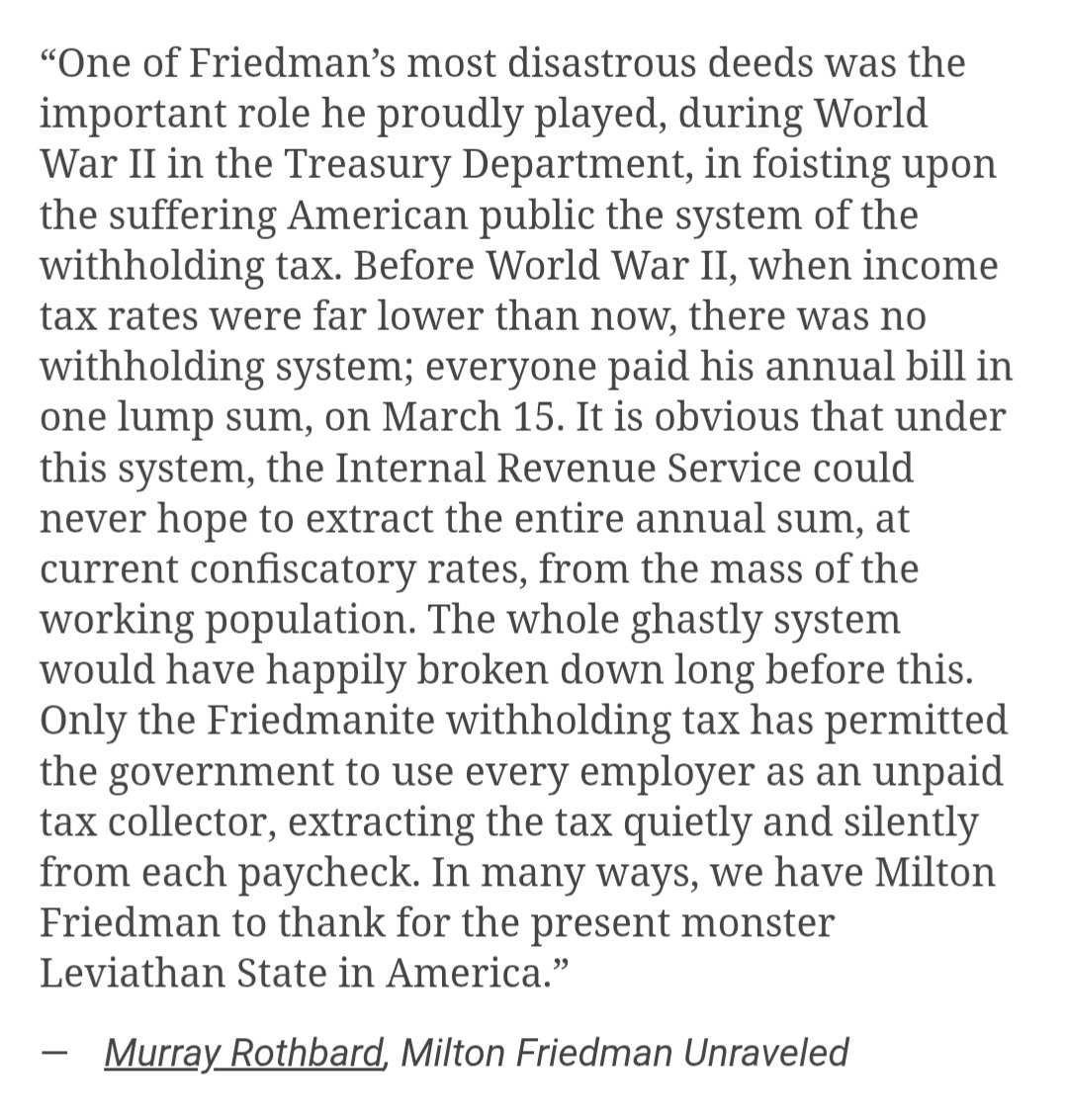
Libertarian economist Murray Rothbard was far more scathing about Friedman:
Comments Off on Milton Friedman – accessory to Grand Theft Taxation
June 6, 2026
QotD: Richard Nixon – more sinned against than sinning?
The Nixon White House, museum display panels announce, was consumed by “a climate of deep suspicion”. The infamous Plumbers took action against “perceived political opponents within the Federal Government”. A video display allows visitors to choose clips on the theme of Nixon’s “Conspiracy Thinking”. Paranoid, the president mindlessly lashed out at enemies that he hallucinated. This is still the official history, in museum exhibits curated by the National Archives and Records Administration.
On Friday morning, the consistently pro-Nixon docents hadn’t heard about the important Feb. 8 story in The New York Times that describes a plot within the government to spy on the Nixon White House, with Navy Yeoman Charles Radford stealing documents and sending them to the Pentagon as insurance against budget and policy meddling from the person serving as the president of the United States.
The revelation from a newly declassified document, longtime journalist James Rosen concluded, “bears directly on allegations by President Trump and his supporters about the existence of what was once called the permanent bureaucracy, better known today as the ‘deep state’. … Nixon proved to a team of federal prosecutors and grand jurors not only that such a beast existed but also that he, guilty as he was in Watergate, had been its victim.”
Chris Bray, “The Nixon Library Is Wrong About Nixon And The Deep State”, The Federalist, 2026-02-13.
Comments Off on QotD: Richard Nixon – more sinned against than sinning?


