
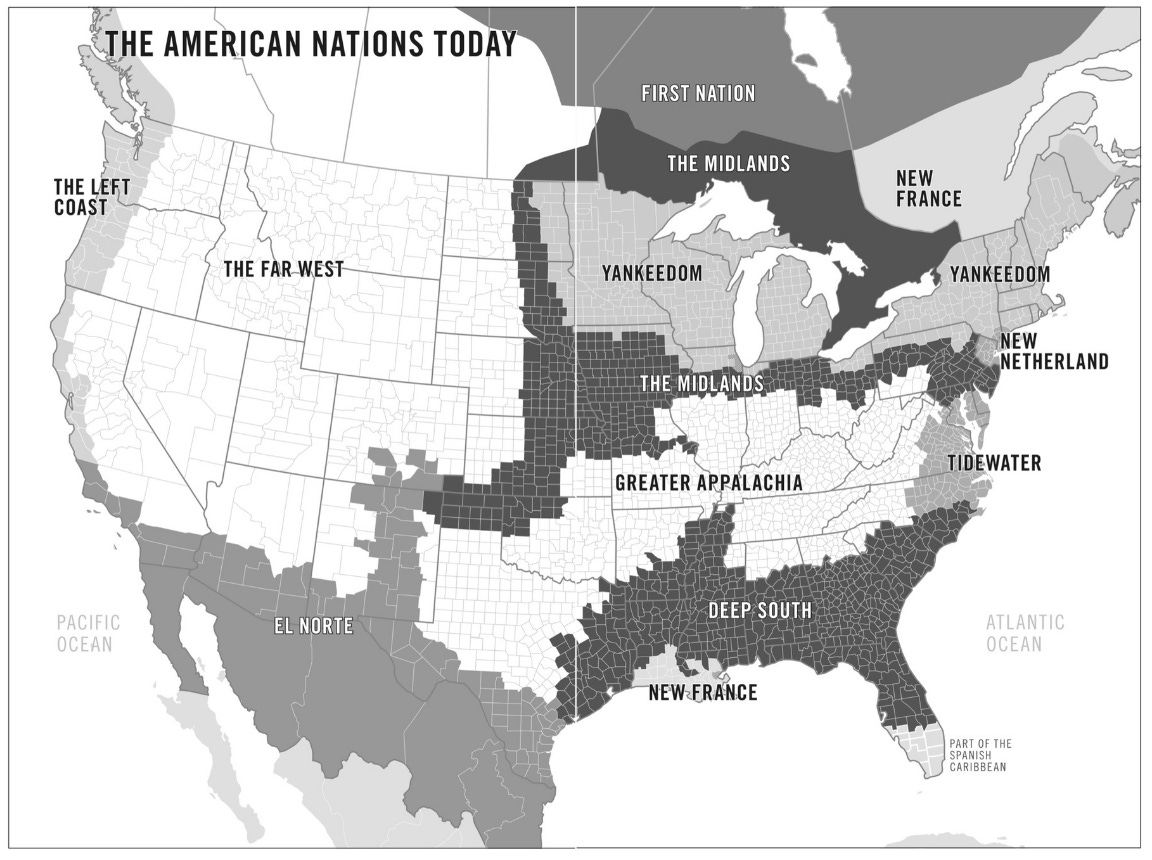
There’s a long tradition of describing the outlines of these regional cultures as they currently exist — Kevin Phillips’ 1969 The Emerging Republican Majority and Joel Garreau’s 1981 The Nine Nations of North America are classics of the genre — but it’s more interesting (and more illuminating) to look at their history. Where did these cultures come from, how did they get where they are, and why are they like that? That’s the approach David Hackett Fisher took in his 1989 classic, Albion’s Seed: Four British Folkways in America, which traces the history of (you guessed it) four of them, but his attention is mostly on cultural continuity between the British homelands and new American settlements of each group,1 so he limits himself to the Eastern seaboard and ends with the American Revolution.2
Colin Woodard, by contrast, assigned himself the far more ambitious task of tracing the history of all America’s regional cultures, from their various foundings right up to the present, and he does about as good a job as anyone could with a mere 300 pages of text at his disposal: it’s necessarily condensed, but the notes are good and he does provide an excellent “Suggested Reading” essay at the end to point you towards thousands of pages worth of places to look when you inevitably want more of something. Intrigued by the brief discussion of the patchwork of regional cultures across Texas? There’s a book for that! Several, in fact.
Woodard divides the US into eleven distinctive regional cultures, which he calls “nations” because they share a common culture, language, experience, symbols, and values. For the period of earliest settlement this seems fairly uncontroversial — you don’t need to read a lot of American history to pick up on the profound cultural differences between, say, the Massachusetts townships that produced John Adams and the Virginia estates of aristocrats like Washington, Jefferson, and Madison, let alone the backwoods shanties where Andrew Jackson grew up. As the number of immigrants increased, though (and this began quite early: several enormous waves of German immigrants meant that by 1755 Pennsylvania no longer had an English majority), it doesn’t seem immediately obvious that the original culture would continue to dominate.
Woodard’s response to this concern is twofold. First, he cites Wilbur Zelinsky’s Doctrine of First Effective Settlement to the effect that “[w]henever an empty territory undergoes settlement, or an earlier population is dislodged by invaders, the specific characteristics of the first group able to effect a viable, self-perpetuating society are of crucial significance for the later social and cultural geography of the area, no matter how tiny the initial band of settlers may have been”. (The nation of New Netherland, founded by the Dutch in the area that is now greater New York City, is the paradigmatic example: both Zelinksy and Woodard argue that it has maintained its distinctively tolerant, mercantile, none-too-democratic character despite the fact that only about 0.2% of the population is now of Dutch descent.)3 But his second, and more convincing, approach is just to show you that the people who moved here in 1650 were like that and then in the 1830s their descendants moved there and kept being like that and, hey look, let’s check in on them today — yep, looks like they’re still like that. Even though between 1650 and now plenty of Germans (or Swedes or Italians or whoever) have joined the descendants of those earliest English settlers.
Most of the book is given over to the six nations — Yankeedom, New Netherland, the Midlands, Tidewater, the Deep South, and Greater Appalachia — that populated the original Thirteen Colonies and still occupy most of the country’s area. Told as the story of the distrust or open bloody conflicts between various peoples, American history takes on a ghastly new cast: have you ever heard of the Yankee-Pennamite Wars, fought between Connecticut settlers and bands of Scots-Irish guerillas over control of northern Pennsylvania? Or the brutal Revolution-era backcountry massacres committed not by the Continental Army or the redcoats but by warring groups of Appalachian militias? What about the fact that Pennsylvania’s commitment to the American cause was made possible only by a Congressionally-backed coup d’état that suspended habeas corpus, arrested anyone opposed to the war, made it illegal to speak or write in opposition to its decisions, and confiscated the property of anyone who suspected of disloyalty (if they weren’t executed outright)? Gosh, this is beginning to sound like, well, literally any other multiethnic empire in history. (It also offers some fascinating points of divergence for alternate history.)4
Jane Psmith, “REVIEW: American Nations, by Colin Woodard”, Mr. and Mrs. Psmith’s Bookshelf, 2024-02-19.
- Including plenty of Jane Psmith-bait like discussion of who was into boiling (the East Anglians who adopted coal early and moved to New England) vs. roasting (the rich of southern England who could afford wood and moved to the Chesapeake Bay), discussions of regional vernacular architecture, the distinctive sexual crimes each group obsessed about (bestiality in New England, illegitimacy in Chesapeake) and so on — I love this book.
- Incidentally, if you’ve only read Scott Alexander’s review of Albion’s Seed, do yourself a favor and read the actual book. Yes, Scott gives a perfectly cromulent summary of the main points, but it’s a such gloriously rich book, full of so many stories and details and painting such a picture of each of the peoples and places it treats, that settling for the summary is like reading the Wikipedia article about The Godfather instead of just watching the darn movie.
- Yes, there is a book for this, and it’s apparently Russell Shorto’s The Island at the Center of the World, which I have not read and don’t particularly plan to.
- Off the top of my head:
- The Deep South tried to get the United States to conquer and colonize Cuba and much of the Caribbean coast of Central America as future slave states;
- There were a wide variety of other secession movements in the run-up to the Civil War, including a suggestion that New York City should become an independent city-state that was taken seriously enough for the Herald to publish details of the governing structure of the Hanseatic League;
- In 1784 the residents of what is now eastern Tennessee formed the sovereign State of Franklin, which banned lawyers, doctors, and clergymen from running for office and accepted apple brandy, animal skins, and tobacco as legal tender. They were two votes away from being accepted as a state by the Continental Congress.
February 27, 2026
QotD: American cultural regions
February 25, 2026
QotD: The notion of “history”
We are closer in time to them than they were to the men who built the Pyramids — by a long shot — and think about that for a second. That’s the vast scope of merely literate human history. Human settlement itself goes back at least another 6,000 years before that, and probably a lot longer.
So far as we can tell, well into historical time men had no real conception of “the past”. Even those men who had recently died weren’t really gone, and again I find Jaynes useful here, but he’s not necessary; it’s obvious by funeral customs alone. They had a basic notion of change, but it was by definition cyclical — the sun rises and sets, the moon goes through its phases, the stars move, the seasons change, but always in an ordered procession. What once was will always return; what is will pass away, but always to return again.
Linear time — the sense of time as a stream, rather than a cycle; the idea that the “past” forecloses possibilities that will never return — only shows up comparatively late in literate history. Hesiod wrote somewhere between 750 and 650 BC; his was the first work to describe a Golden Age as something that might’ve actually existed (as opposed to the Flood narratives of the ancient Middle East).
Note that this is not yet History — that would have to wait another 300 years or so. Whereas a Thucydides could say, with every freshman that has ever taken a history class, that “We study the past so that we don’t make the same mistakes”, that would’ve been meaningless to Hesiod — we can’t imitate the men of the Golden Age, because they were a different species of man.
Note also that Thucydides could say “Don’t make the mistakes of the past” because “the past” he was describing was “the past” of currently living men — he was himself a participant in the events he was describing “historically”.
The notion that the Golden Age could return, or a new era begin, within the lifetime of a living man is newer still. That’s the eschaton proper, and for our purposes it’s explicitly Christian — that is, it’s at most 2000 years old. Christ explicitly promised that some of the men in the crowd at his execution would live to see the end of the world (hence the fun medieval tradition of the Wandering Jew). And since that didn’t happen, you get the old-school, capital-G Gnostics, who interpreted that failure to mean that it was up to us to bring about our own salvation via secret knowledge …
… or, in Europe starting about 1000 AD, you get the notion that it’s up to us to somehow force Jesus to return by killing off all the sinners. I can’t recommend enough Norman Cohn’s classic study The Pursuit of the Millennium if you want the gory details. Cohn served with the American forces denazifying Europe, so he has some interesting speculations along Vogelin’s lines, but for our purposes it doesn’t matter. All we need to do is note that this was in many ways The Last Idea.
Severian, “The Ghosts”, Founding Questions, 2022-05-17.
February 23, 2026
Grand Strategy of the Roman Empire PART TWO
Adrian Goldsworthy. Historian and Novelist
Published 27 Aug 2025This should have posted earlier this morning, but for some reason did not.
This is the follow up to last week’s discussion of grand strategy, looking at the reactions and criticisms of Luttwak’s ideas, followed by some of my own thoughts.
February 21, 2026
Books for boys (unlike the vast majority of books for children these days)
Just pointing out that boys and girls have different interests is enough to get you labelled as a right-wing extremist, if not an outright white supremacist/homophobic transphobe. Progressives believe, as a matter of deep conviction, that children are tabula rasa and any indication of interest on their part in male-coded activities is proof of patriarchal brainwashing. This is clearly nonsense, but we’re deep in the propagandized years where even pointing out elements of reality will get you added to terrorist watchlists if it doesn’t actually get you arrested and charged. But boys are interested in different things than girls are and trying to force them to be interested in the things that girls like will almost always turn that boy against whatever you’re trying to shove down his throat.
Boys don’t read as much as girls do, but when almost everything they’re given to read is girl-coded, it makes it even more uninteresting to boys. Yet the tiny minority of books that do appeal to boys are not made available in libraries and schools for fear of somehow leading in the direction of “toxic masculinity” or something.
Among the few publishers who do produce books intended to interest boys is Raconteur Press, who explain here why historical adventure books appeal to boys:
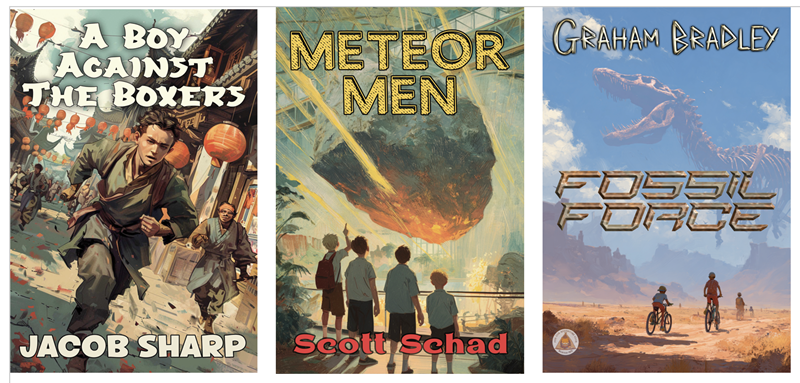
In an era dominated by screens and instant gratification, fostering a deep appreciation for history in young readers can feel like an uphill battle. Yet, historical fiction — especially in the form of thrilling boys’ adventure books — offers a powerful gateway. By weaving real historical events into gripping narratives, these stories not only entertain but also educate, encouraging boys to discover the past, develop essential skills, and cultivate a lifelong love of reading and exploration. Books like A Boy Against the Boxers by Jacob Sharp, Meteor Men by Scott Schad, and Fossil Force by Graham Bradley, all from Raconteur Press, exemplify this approach. Each integrates historical elements in unique ways, showing how adventure can transform history from dry facts into vivid, relatable experiences.
Discovery and Learning Through Historical Events
Historical fiction immerses young readers in the past, making abstract events tangible and personal. By placing protagonists in real-world scenarios, these books help boys “live” history, fostering empathy and understanding that textbooks often lack. For instance, in A Boy Against the Boxers, fourteen-year-old Eddie Donahue is thrust into the heart of the 1900 Boxer Rebellion in Peking (now Beijing). The story draws on actual events like the 55-day Siege of the International Legations, where foreign diplomats and civilians were trapped by anti-Western nationalists. Eddie witnesses martial arts demonstrations, evades violent chases, and participates in scavenging supplies and firing an old black powder cannon known as the “International Gun”. Through Eddie’s eyes, readers learn about the geopolitical tensions of turn-of-the-century China, the unlikely alliances among nations (which would soon fracture in World War I), and the brutal realities of siege warfare. This viewpoint helps boys grasp how ordinary people — much like themselves — navigated chaos, turning history into a lesson in resilience and global interconnectedness.
Similarly, Meteor Men blends scientific discovery with American Civil War history. The five boys — Cinch, Frank, Keith, Joel, and Ronaldo — start as amateur meteorite hunters, using library research and borrowed gadgets like a magnetic probe mounted on a radio-controlled plane. Their quest leads to an unexpected find: a buried Union ironclad riverboat and its Confederate counterpart, solving a fictionalized mystery tied to real Civil War naval battles, such as those on the Mississippi River. Drawing from actual historical markers and artifacts (like the USS Cairo, the only surviving Union armored riverboat), the boys learn about steam-powered warfare, the role of ironclads in river combat, and the human cost of the conflict. From a boy’s perspective, this reveals history as a puzzle to be solved, emphasizing how everyday curiosity can uncover forgotten stories and honor the soldiers who fought.
My own interest in history as a child was nursed by the Ladybird picture books my parents and grandparents bought me (with topics like Alexander the Great, Richard the Lionheart, Henry V, and other interesting-to-boys subjects). One that I still have, in diminished form is a very battered copy of British History in Strip Pictures by James Mainwaring, which must have been published in the late 1950s or early 1960s, as I got it in 1965 and it was already quite battered:
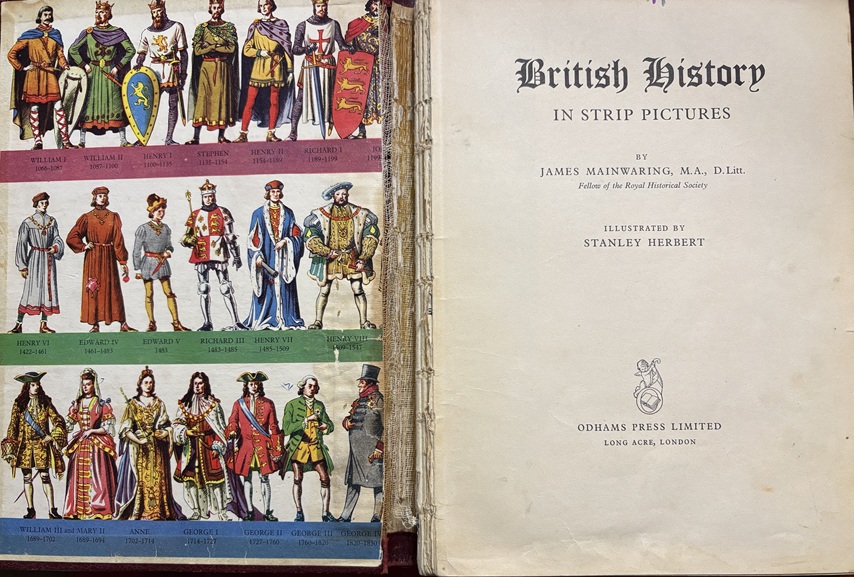
The body of the book got separated from the cover many years ago, and the first few pages got lost, sadly.
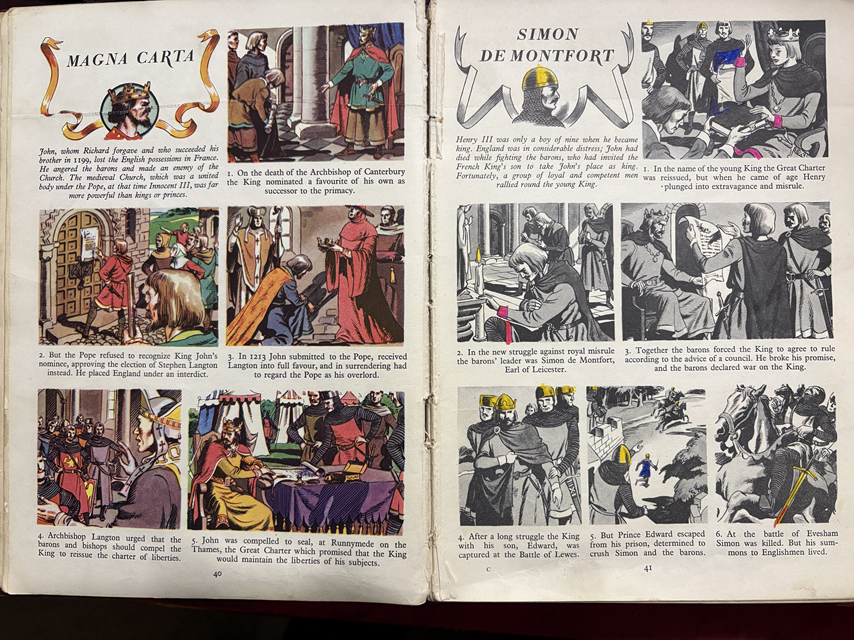
It might have been jingoistic “whig history for children”, but I loved it (please pardon the occasional attempts to colour the black-and-white images … I couldn’t help myself at that age):
The Bomber Mafia by Malcolm Gladwell
Based on the few books of his I’d heard of, I wouldn’t have expected Malcolm Gladwell to dip into military history … and from what Secretary of Defense Rock says, it might have been better if Gladwell had steered clear of this particular topic anyway:
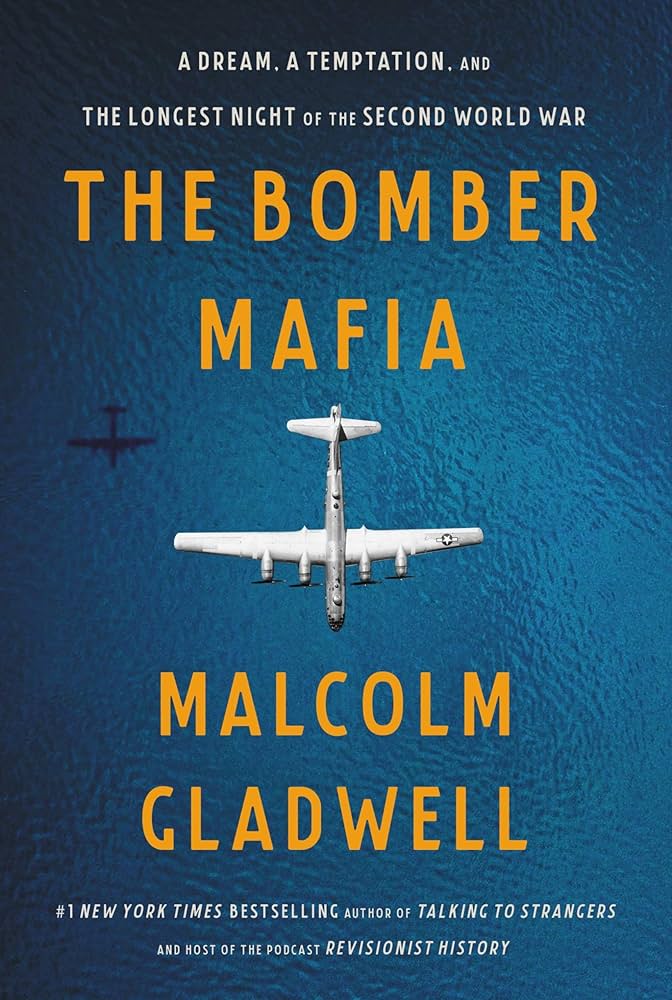
I recently received The Bomber Mafia as a gift for my birthday, and it was bad, so bad that I felt compelled to write this review. In so many ways, the book is everything that is wrong with the “pop history” genre: a bestselling author with a massive built-in audience, with a hit podcast to cross-promote the material, and a framing promise to reveal a supposedly “great untold story” about the strategic and moral struggles of American airmen in World War II. The problem in this case is that Gladwell’s narrative about Curtis LeMay, Haywood Hansell, and the evolution of strategic bombing repeatedly collides with the existing scholarship and often ignores it altogether. From his treatment of the raids of Münster and Schweinfurt–Regensburg to his use of the United States Strategic Bombing Survey and his confident claims about what compelled Japan to surrender, The Bomber Mafia exemplifies the worst tendencies of popular history: sweeping pronouncements built on selective reading, caricatured context, and a startling indifference to both primary sources and a vast secondary literature.1
I was only vaguely familiar with Malcolm Gladwell and his work, but for those who don’t know (like me until recently), he has been a staff writer for The New Yorker since 1996, has written a bunch of New York Times bestselling books on sociology, psychology, and economics, and also hosts a very popular podcast called Revisionist History.2 This is all to say he is widely known and already has a big audience that is generally receptive to his projects. The book was originally based on four episodes he did on this topic in July 2020, and then turned into print, so it isn’t so much an actual book as it is a printed podcast.3
Unsurprisingly, both the audiobook and print editions were widely acclaimed upon release. Writing in the Wall Street Journal, Yale professor Paul Kennedy praised the book as “a wonderful book”.4 The journalist Michael Lewis described it as “a riveting tale”, while the bestselling biographer Walter Isaacson called it “a wonderful narrative”.5 The book was named a Kirkus Reviews Best Book of the Year and selected as an Editors’ Choice by The New York Times Book Review. It also enjoyed significant commercial success, reaching number two on The New York Times Best Sellers list.6 To promote the book, Gladwell made appearances on Jimmy Kimmel, MSNBC, and CBS’s Sunday Morning show. MSNBC even stated in the segment title that this is “A great untold story”, which is hilarious, given that I don’t know how much ink has been spilled on the strategic bombing campaigns.7
But it should be noted that the book has been criticized by virtually anyone who has seriously studied this topic. Much of the criticism of the book has come from the fact that it hardly focuses on the Japanese and German perspectives, misinterprets why members of the air tactical school focused on precision bombing, and the actual role strategic bombing played in the surrender of Japan.8 All of that is valid, but what was initially more startling to me was how little use was made of primary or secondary sources. So many important works are left out makes me wonder how much research Gladwell even put in.9 To write about strategic bombing in World War II and not include Michael Sherry’s The Rise of American Air Power, Richard Overy’s The Bombing War, Donald Miller’s Masters of the Air, Ken Werrell’s Blankets of Fire or Death From the Heavens, Geoffrey Perrett’s Winged Victory, and barely using any of the official histories is borderline negligence.10 Anyone doing research on strategic bombing and Air Power in World War II almost certainly would have come across these.
- Popular history is a form of historical writing aimed at broad audiences that usually prioritizes storytelling over real scholarship. See Gerald Strauss, “The Dilemma of Popular History,” Past & Present, no. 132 (1991): 130–49, and more recently, Ben Alpers, “The Promise and Perils of Popular History,” Society for U.S. Intellectual History, August 17, 2021.
- The show itself isn’t really a conversation with experts and historians (though they do appear) so much as storytelling.
- I would also preface that I generally don’t have a problem with this premise. There is definitely a segment of the historical profession that dislikes pop history for reasons tied as much to credentials as to content. Much “popular history” is produced by journalists, independent writers, or commentators rather than credentialed academic historians, and that fact alone generates suspicion. In some cases, this skepticism is warranted: weak sourcing, thin engagement with the scholarship, and overconfident claims do real damage. But the problem is not who writes history so much as how it is written. Plenty of non-historians have produced outstanding historical works by taking the craft seriously — immersing themselves in primary sources, engaging honestly with existing scholarship, and resisting the temptation to oversimplify for the sake of narrative punch. Conversely, academic credentials have never been a guarantee for insight or even accuracy. If a writer does the work, respects the evidence, and treats complexity as something to be explained rather than avoided, there is no real reason to dismiss the result simply because of the writer’s background.
- Paul Kennedy, “The Bomber Mafia’ Review: Architects of a Firestorm”, The Wall Street Journal, April 30, 2021.
- Summary of reviews in paperback.
- “Hardcover Nonfiction – May 16, 2021”. The New York Times.
- Malcolm Gladwell: ‘Bomber Mafia’ Looks At A Great Untold Story From WWII.
- Some critical reviews include David Fedman and Cary Karacas, “When Pop History Bombs: A Response to Malcolm Gladwell’s Love Letter to American Air Power”, Los Angeles Review of Books, June 12, 2021; Saul David, “Malcolm Gladwell’s The Bomber Mafia is misleading history-lite”, The Daily Telegraph, April 25, 2021, and Steve Agoratus, Air & Space Power History 68, no. 4 (2021): 52–53.
- This is also coming from a guy who famously wrote that achieving world-class expertise in any field is, to a large extent, a function of accumulating roughly 10,000 hours of deliberate practice, as described in his book Outliers: The Story of Success.
- Gladwell doesn’t really deal with British strategic bombing; there’s just a brief chapter on Arthur Harris. If interested, see Noble Frankland, Bomber Offensive, the Devastation of Europe (New York: Ballantine Books, 1971) Max Hastings, Bomber Command: The Myths and Reality of the Strategic Bombing Offensive, 1939-45 (New York: Dial Press/James Wade, 1979), and Norman Longmate, The Bombers: The RAF Air Offensive against Germany, 1939-1945 (London: Hutchinson, 1983).
February 19, 2026
An American anarchist
I’ve never met Christopher Schwarz, but I’ve read a lot of his writing in books, magazine articles, and blog posts. He’s forgotten more about hand tool woodworking than I’ll ever know, and he’s amazingly generous in sharing his knowledge with others. He calls himself an anarchist, which often puzzles people who only know of anarchism from media-presented bomb-throwing nihilists and conspiratorial Russian stories. Here he explains what he means when he uses the term:
“Chris Schwarz and Meredith Schwarz” by jessamyn west is marked with CC0 1.0 
 .
.
I get asked a lot about what I mean by the word “anarchism”, and if I could please explain what I mean when I use that word.
My answer is always unsatisfying. Here’s why.
For the love of creamed corn, why would I publicly discuss ideas that are – for now – a crime in our country? Why would I say – for example – that I think that copyrights and patents on things that use public money are bullshit? That wars are founded on lies? And that the state – in general – seems to be a menace to peaceable living?
That would be stupid. Dumb nuts.
Also, I am a practitioner of anarchism, not a philosopher.
If you want to know more about American anarchism (and aesthetic anarchism, specifically), you need to ask a philosopher, not a front-of-house worker. Read Native American Anarchism (Hachette Books, 1983) by Eunice Minette Schuster for an easy on ramp. Or Josiah Warren’s Equitable Commerce (1852) for the full banana.
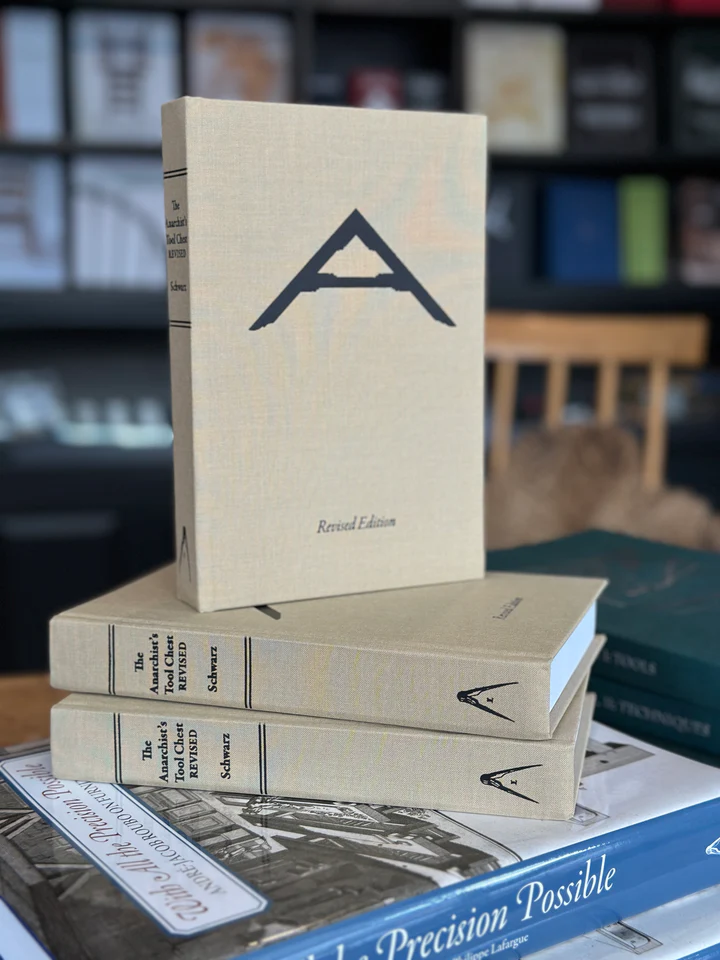
The Anarchist’s Tool Chest: Revised Edition by Christopher Schwarz – Link.
Or follow the trail of breadcrumbs left in The Anarchist’s Tool Chest to figure it out yourself. The book describes how to disrupt the furniture industry by building things that never need to be replaced. It’s also about how to jailbreak yourself from a tool industry that offers up aluminum jigs as a substitute for skill.
That book is not the only path. There are other ways to throw a bunch of ball bearings into the guts of the IKEA robots.
Buy antiques or used furniture. The other week I was in Savannah, Georgia, and visited one of my favorite antique stores. The price of handmade antiques has hit bottom. So-called “brown furniture” can be bought for less that the cost of the materials used to make it.
Even though I make furniture for a living, I sometimes save time and money by purchasing vintage industrial furniture for our warehouse, fulfillment center and workshop. Megan’s giant oak desk from the 1960s cost us zero dollars (we just had to move it from an insurance office). Our printer and scanning station? An old workbench from Pennsylvania. Our associate editors’ shared desk? A giant vintage drafting table from Sweden.
And if you think for a moment, there are other industries and organizations that can be farted upon by your actions. The clothing industry is even worse than the furniture industry when it comes to making flimsy crap and abusing workers.
Yes, you can buy ethically made jeans, shirts and socks. Yes, you will pay a premium for these items. And if you can afford that path, great. If you can’t, then buy secondhand clothing.
I’ve always wanted a pair of R.M. Williams boots but could never afford them on a writer’s salary. Last year I found a used pair for about $100 where the owner had ragged out the elastic part of the slip-on boots. It was a stupid easy fix. And now I have boots I shall wear at my funeral.
The other side of the equation is that I’m denying the new-boot-goofin’ industry my dollars. Forever. I don’t have to buy a pair of shoddily made boots that can’t be re-soled and will have to be replaced in a couple years. All my future “boot money” will go to our local cobbler so she can re-sole them every few years.
February 18, 2026
QotD: Defending the borders of the Roman Empire
The thing is, approximately none of this logic applied in the Roman situation. First of all, as we’ve already noted, a huge fraction of the threats the Romans faced were “low-intensity”: border skirmishes, slave raids, pirates and brigands, that sort of thing. Static fortifications, walls and towers, are often more than sufficient for dealing with these problems. Paradoxically, that actually increases the mobility and responsiveness of the main forces. If they aren’t constantly running back and forth along the border dealing with bandits, that means they can respond with short notice to “high-intensity” threats (like major invasions and rebellions) that pop up, and are probably better rested and better provisioned when the emergency arrives. So, far from diluting their strength, a lightly-manned series of linear fortifications actually enabled the Romans to concentrate it.
Secondly, those linear fortifications can also be very useful when that major invasion shows up, even if they are overrun. A defense system doesn’t have to be impenetrable in order to still be very, very useful. One thing it can do is buy time, either for the main army to arrive or for some other strategic purpose. The defenses can also act to channel opposing forces into particular well-scouted avenues of attack, or change the calculus of which invasion routes are more and less appealing. Finally, in the process of setting up those defenses, you probably got to know the terrain extremely well, such that when the battle comes you have a tactical advantage.
[…]
The third, and perhaps most important, reason why the Roman frontier fortifications were actually very smart is that they were carefully designed to double as a springboard for invasions into enemy territory. Luttwak coins the term “preclusive defense” to describe this approach. The basic idea is that an army can take bigger risks — pursue a retreating foe, seize a strategic opportunity that might be an ambush, etc. — if it knows that there are strong, prepared defensive lines that it can retreat to nearby. Roman armies were constantly taking advantage of this, and moreover taking advantage of the fact that the system of border fortifications was also a system of roads, supply lines, food and equipment storage depots, and so on. The limes were not a wall that the Romans huddled behind, they were a weapon pointed outwards, magnifying the power that the legions could project, helping them to do more with less.
John Psmith, “REVIEW: The Grand Strategy of the Roman Empire by Edward Luttwak”, Mr. and Mrs. Psmith’s Bookshelf, 2023-11-13.
- I, an ignoramus, assumed this was all downstream of the Maginot line’s bad reputation, but Luttwak says it’s actually the fault of Clausewitz.
February 12, 2026
QotD: Books for children written for “the narrative” instead of for children
C.S. Lewis, the master of escapist fiction, was prophetic in warning against such noxious paternalism from authors. “Of all tyrannies, a tyranny sincerely exercised for the good of its victims may be the most oppressive”, he wrote. “It may be better to live under robber barons than under omnipotent moral busybodies. The robber baron’s cruelty may sometimes sleep, his cupidity may at some point be satiated; but those who torment us for our own good will torment us without end for they do so with the approval of their own conscience.” Let’s hope Barbie director Greta Gerwig, who has been tapped up to direct the next year’s Chronicles of Narnia series, is taking note.
In the meantime, we have the books, the first of which, The Lion, the Witch and the Wardrobe, was published 75 years ago today. When I read this to my son, it transfixed him in a way that all those morally improving Disney and Pixar movies could not — and in a way that I recognised too from my own childhood. The Narnia books are weird and archaic and they are far from comforting. But they leave unanswerable questions and imaginative territory to roam for a lifetime.
What would compel a child to climb into a claustrophobic wardrobe, full of moth-eaten coats and spiders, as apt a symbol as any for the human psyche? C.S. Lewis knew all too well. There are real and terrible things to escape from. And the land of magic, mystery and hope that Peter, Susan, Edmund and Lucy arrived in would soon reveal that it too was blighted. By facing up to this, conquering its climate of terror, the child would become an adult. If they didn’t pass into the dark and through it, they would remain infantilised.
This partly explains the backlash against Lewis. Two years ago, it was reported that the Government’s counter-terrorism unit, Prevent, had classified his works along with some by his friend J.R.R. Tolkien as potentially leading to “radicalisation”: the kind of wormtongue deception worthy of the villains of Narnia or Middle Earth. It demonstrates that, at its best, fantasy can be the mirror that shows us who we are and what we’ve become. But then, there is a long history of people taking leave of their senses when it comes to Narnia. The books have been banned in the US for being both too Christian and not Christian enough. One critic ranked the books (with delicious venom) as worse than 120 Days of Sodom or Mein Kampf. Being shot by all sides might indicate a writer is on the right track.
For his part, Lewis lambasted “those who do not wish children to be frightened […] Since it is so likely that they will meet cruel enemies, let them at least have heard of brave knights and heroic courage. Otherwise, you are making their destiny not brighter but darker.” He knew of the existence of shadows from early in life. There is a spine-chilling passage in his memoir, Surprised by Joy, in which he recalls waking up one night with toothache when he was 10. He called out his mother’s name and she did not come. She was dying in another room. His father was never the same and sent Lewis off to a boarding school run by a deranged sadist. “With my mother’s death, all settled happiness, all that was tranquil and reliable, disappeared from my life.”
As a result, Lewis developed a fear and mistrust of the adult world in those years — and it was well-placed. Scarcely more than a boy, Lewis was sent to the trenches. He was seriously injured in the Battle of Arras (he would have shrapnel, from a shell that obliterated a colleague, embedded permanently in his body) and, like Tolkien, he watched many of his friends die. “One cannot help wondering why,” he wrote to his father.
Darran Anderson, “Save Narnia from the woke witch”, UnHerd, 2025-10-15.
Update, 13 February: Welcome, Instapundit readers! Have a look around at some of my other posts you may find of interest. I send out a daily summary of posts here through my Substack – https://substack.com/@nicholasrusson that you can subscribe to if you’d like to be informed of new posts in the future.
February 9, 2026
Why This Is The Greatest Lord Of The Rings Scene Ever
The Critical Drinker
Published 6 Feb 2026Since its the 25th anniversary of the trilogy, I figured I’d reminisce about my favourite ever scene from all three movies. And explain why I’m objectively right about it.
QotD: The pre-modern versus the modern concept of “self”
In contrast, most modern societies believe in a self that is “buffered”. In this view there are a few limited, low-bandwidth ways that the external world can act on one’s innate nature, for instance via drugs or other body chemistry, and even these are often seen as revealing or disclosing previously hidden innate characteristics of one’s personality rather than as imposing something alien. Taylor argues quite convincingly that these two ways of viewing the self — porous vs. buffered — inexorably produce two different ways of viewing society and the world: premodern and modern. For example: if selves are porous, then we need to be extremely vigilant against the invasion or violation of our minds by hostile spirits, and we must be suspicious of what we want, because it might not really be what we want, but rather what something else wants through us. Conversely, if selves are buffered then our desires are just part of who we are, and in order to be true to ourselves, we need to explore them and act upon them.
It may have been reasonable to believe in a buffered self back in the days before the internet, but recent developments have made it clear that (as in so many things) the primitive superstitions were actually correct, and the enlightened modern view was just a lamer and dumber kind of superstition.1 Science fiction has long been fascinated with stories of infohazards — images or jokes or snippets of cognition that act like a Gödel sentence for the human mind and leave people braindead or mind-controlled. But such things long since slipped the shackles of fiction — we now have internet creepypasta that induces girls to become murderers and a genre of pornography that turns boys into girls.2 The noösphere is a vast ocean, and its abyssal depths teem with lifeforms and thoughtforms that seek to possess you and live out their blasphemous unlife through your mortal husk.
John Psmith, “REVIEW: Demons, by Fyodor Dostoevsky”, Mr. and Mrs. Psmith’s Bookshelf, 2023-07-17.
- Or maybe society is already correcting itself on this point. Many like to make fun of the “fragility” and “snowflake” nature of Gen Z, and I’ve argued before that these critics miss the point that they’re actually being “flexed on” (in the parlance of our times) because loudly asserting an exaggerated harm is a power move (think: upper class women in an honor culture claiming to feel threatened, and how that’s actually itself a threat).
But here’s a different take on it: maybe “trauma” as it’s popularly conceptualized is actually modernity groping its way back to a porous understanding of the self! We no longer believe in spirits or curses, but our psyches are self-evidently susceptible to immaterial external influence, so we create a new concept that aligns empirical psychic porosity with the dominant metaphysical and ideological currents.
- I had a long debate with myself on whether to include either of those links. Do I really want to expose more people to an infohazard? Ultimately I decided to do it because this stuff is already so widespread. In both cases I’ve linked to a page that links to the subject matter in question rather than linking directly, so you have one more chance to bail out.
February 7, 2026
The Probability Broach: L. Neil Smith’s libertarian fever-dream
Feral Historian
Published 6 Feb 2026Equal parts political manifesto and wacky adventure story, The Probability Broach is usually not the first title people think of when they hear “libertarian sci-fi” but it almost always makes the list after further reflection. While ideologically-motivated fiction tends to preach more than entertain, L. Neil Smith makes his world so bonkers and whimsical that we almost can’t help seeing our own in a similar light, and in so doing reminds us that things are as they are ultimately because we chose to make it this way.
There’s some jumpcuts in this due to lack of good b-roll, but I suspect that most people who make it past the half-way point on this one are just listening anyway.
The artwork is from the graphic novel adaptation from Big Head Press https://www.bigheadpress.com/tpbtgn
I ordered a copy but the government-run postal system didn’t get it to me in time to use its illustrations of later chapters.00:00 Intro
01:05 The Setup
03:15 Whiskey Rebellion
05:36 Confederacy
07:50 Property, Culture, and Capitalism
15:01 Cultural Assumptions
19:20 Interventionism
21:04 Choices, not Systems
(more…)
February 5, 2026
The Mote in God’s Eye: A No-Win Scenario
Feral Historian
Published 26 Sept 2025For whatever reason books by [Larry] Niven and [Jerry] Pournelle always end up being a lot harder to cover than I expect. It’s not that the core ideas are buried in dense convoluted storytelling or unusually compelling characters (often quite the opposite) but rather I think that the core ideas are always a little uncomfortable to face head-on. And Mote is great example.
Niven and Pournelle create a scenario not only of the cyclical rise and fall of a civilization, but one that through a combination of biological and cultural factors points to the impossibility of long-term coexistence between Humanity and the Moties.
00:00 Intro
01:26 Aristocracy and Contact
04:11 The Moties
08:48 Crazy Eddie
10:18 The Middle Path?
12:53 The Gripping Hand
(more…)
January 30, 2026
QotD: Slavery in the Islamic world
The widespread neglect of the history of slavery in North Africa and the Middle East, which Captives and Companions seeks to redress, partly reflects a culture of American exceptionalism; slavery in other parts of the Americas (it was abolished in Brazil only in 1888) also receives little attention.
Partly, too, it reflects a tradition of denial in the Islamic world itself. Marozzi recalls a professor at Bilkent University in Turkey admonishing a younger historian not to dig too deep: “Our ancestors treated their slaves very well; don’t waste your time”.
In the West, meanwhile, Islamic slavery is an unfashionable — and often suspect — subject: one is reminded of West Germany in the 1980s, when any overemphasis on Soviet crimes against humanity could appear as an attempt to whitewash or relativise the Holocaust. Marozzi is careful not to dwell too much on comparisons between Islamic and Atlantic slavery, except as regards the scholarly attention which they have received. Still, many readers will pick up his book hungry for such comparisons. So here they are.
In both Islamic and Atlantic slavery there was a marked racial — anti-black — component. Slavery was sustained by similar religious and philosophical justifications: the biblical “curse of Ham”, for example, and the idea that geography and climate made sub-Saharan Africans naturally suited for servitude. “Chattel slavery”, Marozzi emphasises, existed in the Islamic world too. Both involved horrific violence and displacement. Both were complex and sophisticated enterprises, often with serious money at stake.
People have always been hesitant to draw any comparisons between Islamic and Atlantic slavery, albeit often for entirely opposite reasons to historians today. Whereas the Jewish-American writer Mordecai Manuel Noah was a vocal supporter of the enslavement of Africans in America, he was also bitterly opposed to the enslavement of Americans in North Africa — and therefore a strong supporter of America’s involvement in the Barbary wars.
Gladstone, meanwhile, thought that Turks killing and enslaving Europeans was far worse than “negro slavery”, which had at least involved “a race of higher capacities ruling over a race of lower capacities”. However dubious his family connections, Gladstone was born after Britain had abolished the slave trade.
The lack of attention given to Islamic slavery is all the more dismaying when one considers just how much longer it survived.
Most of slavery’s 20th century holdouts were in the Islamic world. Iran abolished slavery in 1928; Yemen and Saudi Arabia in 1962; Turkey — which we like to consider more “Western” than the others — in 1964. Mauritania half-heartedly abolished slavery in 1981. Slavery was still a feature of elite life in Zanzibar as late as 1970. When 64-year-old President Karume took an underage Asian concubine, he justified it by declaring that “in colonial times the Arabs took African concubines … now the shoe is on the other foot”.
The Royal Harem in Morocco, meanwhile, was only dissolved on the death of Hassan II in 1999. In the Islamic world, human beings were bought and sold, and forced to do demeaning and painstaking labour, within living memory; some people languish there still.
The key difference between Atlantic and Islamic slavery concerned status. Slaves in the Islamic world could rise to high places: 35 of the 37 Abbasid caliphs were born to enslaved concubine mothers; the slave eunuch Abu al Misk Kafur was regent over Egypt from 946 to 968. Slave dynasties, most notably the Mamluks, were amongst the most powerful in the Islamic world.
The polyglot governor of Hong Kong, Sir John Bowring, when he inveighed against “slavery in the Mohamedan states”, had no choice but to acknowledge that a slave in the East could attain the “highest social elevation” — a far cry from the black slaves of the West Indies. Some slaves, too, were amongst the worthies of Islam, such as the first Muslim martyr, Sumayya bint Khabat.
Slavery occupied a complex place in Islamic law. The Quran, on the one hand, permits men to have sex with female slaves. But on the other, the emancipation of slaves is smiled upon as one of the noblest things a Muslim can do. The Abyssinian slave Bilal ibn Rabah was freed by Abu Bakr and became the first caller to prayer; another freed slave, Zayd ibn Haritha, was briefly the Prophet’s adopted son.
The Quran also expressly forbids Muslims from enslaving fellow Muslims. Nonetheless, as Marozzi shows, this prohibition has not always been strictly observed. The Mahdi (of General Gordon fame) claimed to represent pure, Islamic orthodoxy, but he had no qualms about enslaving Muslim Turks.
Likewise, it mattered little that the Prophet Muhammad had explicitly forbidden castration of male slaves. For over a millennium his tomb in Medina was guarded by a corps of eunuchs. This, too, was an institution which survived into living memory: in 2022 a Saudi newspaper reported that there remained one living eunuch guardian.
Samuel Rubinstein, “The dirty secret of the Muslim world”, The Critic, 2025-10-17.
January 29, 2026
Starship Troopers: Service Isn’t The Point
Feral Historian
Published 5 Sept 2025There’s a long-running argument over whether Heinlein’s book describes military service as the exclusive path to citizenship, or if “federal service” is a much broader basket of enfranchisement. While a close read of the book makes it unquestionably clear which is correct, it misses the greater point. Heinlein was writing about the role of civic virtue in the stability of a republic, his citizenship-through-service framing is the literary conceit for discussing that larger question.
For a more detailed examination of the nature of Federal Service, I recommend James Gifford’s essay on the subject: https://www.nitrosyncretic.com/rah/ft…
00:00 Intro
00:45 What is Federal Service?
02:18 An Exploration of Enfranchisement
03:13 Expanded Universe
05:38 But Why?
06:59 Starside R&D
09:07 “Unreasonable Facsimile”
10:54 Filtering Civic Virtue
(more…)
January 25, 2026
QotD: Dostoevsky’s views on revolutionaries in Demons
Does that seem unrealistic? That ringleader was actually based on a real life student revolutionary named Sergey Nechayev, whose trial Dostoevsky eagerly followed. Nechayev wrote a manifesto called The Catechism of a Revolutionary, here’s an excerpt from that charming document:
The revolutionary is a doomed man. He has no personal interests, no business affairs, no emotions, no attachments, no property, and no name. Everything in him is wholly absorbed in the single thought and the single passion for revolution … The revolutionary despises all doctrines and refuses to accept the mundane sciences, leaving them for future generations. He knows only one science: the science of destruction … The object is perpetually the same: the surest and quickest way of destroying the whole filthy order … For him, there exists only one pleasure, one consolation, one reward, one satisfaction – the success of the revolution. Night and day he must have but one thought, one aim – merciless destruction.
The ideas don’t matter, because at the end of the day they’re pretexts for desires — the desire to dominate, the desire to obliterate the world, the desire to obliterate the self, the desire to negate.3 Just as in their parents’ generation the desire for status came first and wrapped itself in liberal politics in order to reproduce and advance itself, so in their children the desire for blood and death reigns supreme, and the radical politics serve only as a mechanism of self-justification and a lever to pull. This is not a novel about people, and it’s also not a novel about ideas. It’s a novel about desires, motives, urges, and the ways in which we construct stories to make sense of them.
John Psmith, “REVIEW: Demons, by Fyodor Dostoevsky”, Mr. and Mrs. Psmith’s Bookshelf, 2023-07-17.
- To Dostoevsky’s own surprise, when he wrote the main bad guy of the story, he turned out a very funny, almost buffoonish figure. He may be the most evil person in literature who’s also almost totally comic.
- Dostoevsky is notorious for dropping hints via the names of his characters — applied nominative determinism — and this one’s name means something like “supremacy”.
- Or as another famous book about demons once put it:
I am the spirit that negates
And rightly so, for all that comes to be
Deserves to perish wretchedly;
‘Twere better nothing would begin.
Thus everything that your terms, sin,
Destruction, evil represent —
That is my proper element.


