
The Tank Museum
Published Jan 9, 2026If you watch films like We Were Soldiers and Platoon, Vietnam was all about Hueys dropping off Air Cav with M60 door gunners giving fire support and M16 toting grunts humping through the jungle. Tanks and AFVs barely get a look-in. In fact, armour was vitally important in Vietnam. The South Vietnamese, the US Marines and Army, all used AFVs in some of the worst tank country in the world in ways that definitely weren’t in the owner’s handbook. This is the story of armour in Vietnam, told through three incredible vehicles
First, the M48 – part of the famous US Patton family. Designed with the battlefields of Europe in mind, it was the US Marine Corps that insisted on bringing them to Vietnam. With 110mm of frontal armour, and a hull designed to deflect mine blasts, the M48s proved their worth time and time again.
Next, the M113 (or “tracks”) – an armoured personnel carrier that was the most numerous and, arguably, the most effective AFV on the battlefield. Designed to be air portable, the M113s had aluminium armour and weighed just 12 tons. As an APC, the M113 was basically a battle taxi intended to drop off its passengers and perhaps provide a bit of fire support with its pintle mounted .50 Cal. However, the soldiers in Vietnam skipped reading the owner’s handbook and set about turning them into ersatz tanks.
And finally, one of the most bizarre vehicles to ever emerge on the battlefield – the M50 Ontos. The Ontos was small – only 12.5 feet long and lightweight at 9.5 tons, making it easy to move by air. Yet despite its diminutive size the Ontos bristled with 6 M40 106mm recoilless rifles. They were small, ferocious and devastatingly effective.
00:00 | Introduction
00:46 | The Beginning
03:02 | The Patton
08:04 | The ACAV
11:39 | “The Thing”
13:33 | The Other Side of the Hill
15:28 | The End is NighThis video features archive footage courtesy of British Pathé.
In this film, Chris Copson and Paul Famojuro reveal the untold story of armour in Vietnam. Whilst media portrayals of the Vietnam War tend to focus on other aspects of the armed forces, armoured fighting vehicles played an incredibly important role. The M48, a tank designed for Europe, ended up surviving mine strikes while crashing through the jungle. The M113, a lightly-armoured personnel carrier, was upgunned to serve in armoured assaults. And the M50 Ontos, a thing so ferocious a nearby shot would have the North Vietnamese abandoning their positions. This is the story of Armour in Vietnam.
(more…)
May 24, 2026
US Tanks & Armour in the Vietnam War
May 20, 2026
The Korean War Week 100: Mark Clark in Command – May 19, 1952
The Korean War by Indy Neidell
Published 19 May 2026Mark Clark is the new UN Commander and will run the war in Korea, replacing Matt Ridgway, who leaves for Europe to take over NATO Command. The Koje-Do POW camp situation is resolved, but is a black eye for the UN, as are the allegations that the US has been practicing germ warfare in Korea and Manchuria, backed up by “confessions” from captured American airmen.
00:00 Intro
01:13 Recap
01:29 Demand and Response
05:35 What Went Wrong at Koje-Do?
12:06 Germ Warfare?
13:55 Mark Clark
15:45 ROK and Ammunition
19:53 Philippine Raids
21:16 Summary
21:28 Conclusion
22:09 Call to Action
May 19, 2026
“That is not diplomacy. That is national self-harm wearing a lanyard.”
On the social media site formerly known as Twitter, L. Wayne Mathison responds to a post about the Canadian government’s amazing nonchalance about protecting Canada’s sovereignty:
Canadians voted in a federal election, not in a referendum to turn the country into a Davos policy lab with a maple leaf sticker slapped on the front.
The line “we will never be the 51st state” is easy politics. Most Canadians agree. But then the same elbozos turns around and flirts with every other form of sovereignty dilution they can find.
Join the EU? Canada is not in Europe. Geography still matters, apparently. Joining the EU would mean importing another layer of bureaucracy, regulation, courts, trade rules, and political obligations from people Canadians cannot remove from office. That is not independence. That is outsourcing control with better stationery.
Give China influence over resources? That is even worse. A serious country protects strategic assets: energy, minerals, food, ports, telecom, data, and critical infrastructure. You do not hand leverage over your future to an authoritarian state and then call yourself sophisticated. That is not diplomacy. That is national self-harm wearing a lanyard.
The real issue is this:
Canada’s elites love sovereignty when it means rejecting America.
They seem much less interested in sovereignty when it means resisting Brussels, Beijing, the UN, global finance, or climate bureaucrats.
So the question is fair:
Who voted for Canada to stop acting like a country?
Not Canadians. Not directly.
This is elite mission creep. They run on patriotism, then govern like national borders are an administrative inconvenience.
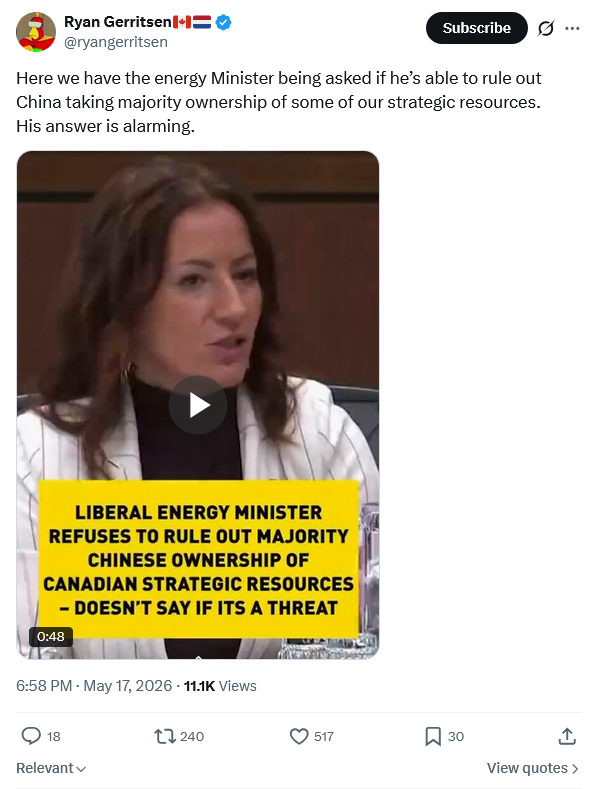
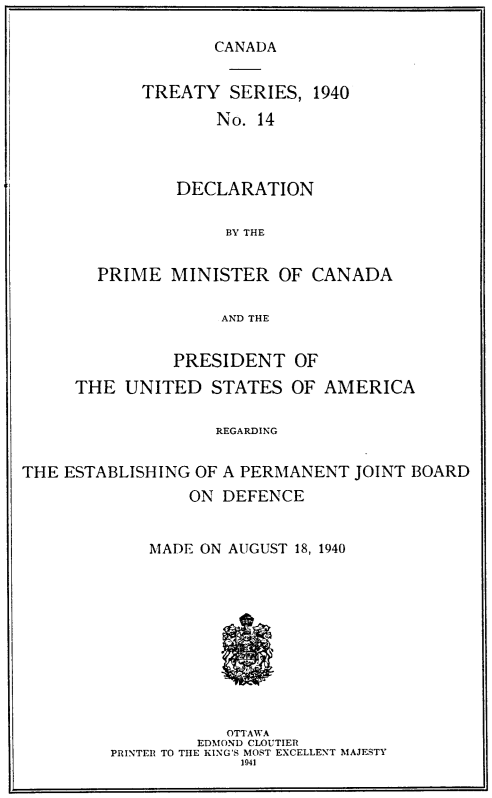
Other items that popped up in the news over the weekend included the United States Department of War announcing that they will be “pausing” their participation in the Permanent Joint Board on Defence, a US-Canadian body that has been continuously operating since 1940 when US President Franklin Delano Roosevelt and Canadian Prime Minister William Lyon Mackenzie King established it in a meeting in Ogdensburg, New York. Is this a big deal? Some people certainly think so:
In a bit of a sudden, surprise move, Under Secretary of War Elbridge “The Biggest Cheese” Colby has announced on X of all places that the Unites States would be pausing participation in the Permanent Joint Board on Defence, the Oldest and most Foundational node of the Canada-US security partnership.
[…]
As we all know, on August 17, 1940, U.S. President Franklin D. Roosevelt and Canadian Prime Minister William Lyon Mackenzie King met in a railway car in Ogdensburg, New York. They issued the Ogdensburg Declaration, an agreement to create a joint board to study sea, land, and air defense problems.
For over 80 years the PJBD has serves as one of the major intersects of the Canada-US relationship. It has been the forum where we have been able to engage and work collaboratively on matters of National Security, Continental Defence, and Critical Infrastructure.
Obviously, given how late it is for me, I sadly can’t dive head first into things. However, I did wanna get something out there. It’s no doubt a very petty move to make, part of a long line of petty moves between everyone in the last year. The pressure is obviously there to push Canada along, and the inclusion of the Prime Ministers Davos speech by Colby should go as a sign to one of the areas that is troubling the current administration.
Trying to apply pressure through such acts though isn’t something that I think will be successful. Granted, being a bit of a dick and doing petty shit in hopes of manipulating opinions, only for it to backfire due to a general miscalculation, is something this Administration does on the regular, and so I can’t be surprised to see it done here.
Nor is it surprising for the performative PM and his government to be utterly blindsided when one of their petty performances triggers a strong negative reaction from the United States.
Another issue that the Liberals in Ottawa seem to think both uncontroversial and straightforward is one of their batch of anti-civil-liberties bills before Parliament, in this case Bill C-22, which the US Congress considers to be a dangerous attempt to control US companies who do business in Canada:
The government’s plans for lawful access have gone off the rails. In recent days, Signal has warned it would pull out of the Canadian market rather than comply with Bill C-22. Windscribe, the Toronto-headquartered VPN provider, has said it would relocate its headquarters out of Canada and NordVPN has warned it would consider following suit. Apple and Meta have both raised public concerns about the bill’s effect on encryption and cybersecurity. The Canadian Chamber of Commerce, the Cybersecurity Advisors Network, civil liberties groups, and a long line of legal and security experts have all called for changes. The chairs of the U.S. House Judiciary and Foreign Affairs Committees have written to Public Safety Minister Gary Anandasangaree warning that the bill threatens U.S. national security and the integrity of cross-border data flows. Even the bill’s own oversight body, the National Security and Intelligence Review Agency, has told the SECU committee it does not have the access it needs for effective oversight. If the government thought it could push through the bill largely unnoticed, it has been proven painfully wrong as there are now trade frictions with the U.S., the prospect of leading companies exiting the Canadian market, and weaker cybersecurity protections for ordinary users.
[…]
The bill nominally protects against the worst outcome through a systemic vulnerability safeguard, which says that core providers are not required to comply with a regulation if compliance would require the introduction or maintenance of a systemic vulnerability. But the safeguard falls apart on careful reading. First, the term “systemic vulnerability” lacks specificity in the statute, which means the government could define encryption and vulnerability narrowly enough to hollow out the protection. Second, Sections 5(5) and 7(5) state that providers are not required to comply where doing so would result in a systemic vulnerability, but Sections 12 and 13 unconditionally require compliance with orders and provide that orders prevail over inconsistent regulations. The net effect is that providers are stuck with contradictory provisions in a system shrouded in secrecy and which could lead to the weakening of security systems. That is why Signal, Windscribe, NordVPN, Apple, Meta, the Canadian Chamber of Commerce, the Cybersecurity Advisors Network, and the U.S. Congress are raising the alarm.
The best approach to address these risks is to go back to the drawing board on Part 2 of the bill. Committee hearings should be extended to ensure that the long list of expert witnesses, industry voices, and international counterparts who have asked for changes receive a full hearing. Further, real amendments should be on the table that better balance law enforcement needs with Canadians’ privacy rights. Failure to do so will result in some of the world’s most privacy-protective services exiting the market, leaving behind a law that is vulnerable to constitutional challenge with millions of Canadians facing genuine privacy and cybersecurity risks.
May 18, 2026
Isoroku Yamamoto – the admiral and the postwar legend
Big Serge examines the popular memory of Japanese admiral Isoroku Yamamoto, the architect of Japan’s early naval war successes against the United States from 1941 onwards, contrasting the postwar image with the man himself:
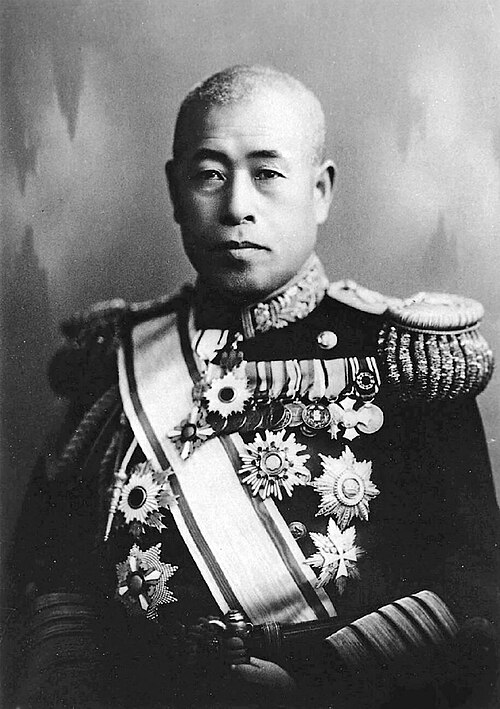
Admiral Isoroku Yamamoto, Commander-in-Chief of the Imperial Japanese Navy’s Combined Fleet.
Photo from the National Diet Library via Wikimedia Commons.
Japanese leadership in the Second World War enjoys noticeably lower name recognition than their German counterparts. Most people with a cursory knowledge of the war know the core German leadership group around Hitler — Himmler, Goering, Goebbels, Speer, and perhaps Heydrich and Bormann — and the all-star lineup of German generals like Rommel, Manstein, and Guderian. In contrast, the only particularly notorious member of Japan’s nebulous leadership group is General Hideki Tojo, who served as Prime Minister for most of the war and became the centerpiece defendant in the postwar trial. As far as Japanese commanders go, the list of name-brand personnel has but a single entry: Isoroku Yamamoto.
Yamamoto’s life and career present a fascinating trajectory that shapes a particular, sympathetic view of the man. A veteran of the Russo-Japanese War, he spent much of his 30’s in the United States, studying at Harvard and serving as naval attache in Japan’s Washington embassy. He therefore had a first hand understanding of America’s industrial depth, and was famously pessimistic about Japan’s prospects in a a war against the United States. “Anyone who has seen the auto factories in Detroit and the oil fields in Texas”, he argued, “knows that Japan lacks the power for a naval race with America”. In one of his more famous and widely recited (though often badly translated) remarks about a war with the United States, he told Prime Minister Fumimaro Konoe in September 1940:
If I was told that I had to do it, then you will certainly observe the Navy going all out for half a year to a year. However, I do not hold conviction about the outcome after 2-3 years.
This quote certainly seems remarkably prescient, in light of Japan’s initial wave of operational successes, which slowly faded away as American combat power ramped up. Far more famous still is his remark, after the attack on Pearl Harbor, that Japan had “awakened a sleeping giant, and filled him with terrible resolve”.
All of this shapes the perception of Yamamoto as a quasi-tragic figure who understood that Japan was unlikely to defeat the United States in the Pacific War, counseled against the conflict, and then dutifully tried to play a losing hand as well as he could once war had been thrust upon him against his own advice. Yamamoto was furthermore a critic of the Japanese Army’s war in China and a particularly vocal opponent of the Tripartite Pact with Germany and Japan, lending credence to the idea that he was war-averse.
This is the Yamamoto of American popular memory, and indeed of a great deal of Japanese postwar writing: a sort of samurai Cassandra, too perceptive and cosmopolitan for the militarist regime he served, a man who fired the opening shot of the Pacific War with a heavy heart and no illusions.
It is certainly true that Yamamoto had an appropriately pessimistic assessment of Japan’s prospects in an extended conflict with the United States. What is less often appreciated is that Yamamoto did not, on the basis of this assessment, conclude that Japan ought not to fight. He concluded instead that, if Japan was going to fight, it had to fight differently — with greater boldness, more risk, and an aggressive search for a decisive stroke. He did not spend the eighteen months before Pearl Harbor advocating for peace. He spent them designing what was, on balance, the single most aggressive operational scheme that was possible — and then only barely — within Japan’s kinetic parameters.
This is the critical distinction between Yamamoto-the-man and the Yamamoto of postwar hagiography. He was not a pacifist, reluctant or otherwise. He was a Japanese naval officer of strong patriotic conviction, deeply committed to his service and his nation, who happened to understand the arithmetic of industrial war better than most of his colleagues. Notwithstanding his appreciation for America’s vast industrial base, he shared a broader Japanese disdain for American martial proclivities, dismissing American naval officers as a club of “golfers and bridge players”. His understanding of the United States did not produce pacifism. It produced, rather, a particular kind of operational philosophy — one which held that Japan’s best hope in a war with the United States was to front-load its risk-taking, to achieve a string of dramatic early victories that would either compel American negotiation or, failing that, push the eventual American counter-offensive as far into the future as possible. In either case, the operational prescription was the same: bold, high-risk operations aimed at decisive results.
May 17, 2026
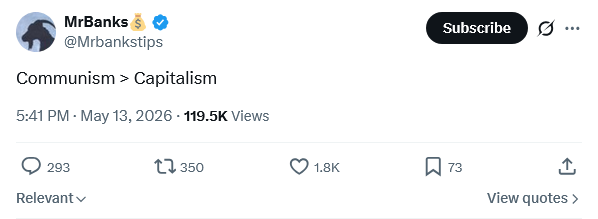
“Communism > Capitalism”
Once again, thanks to the auto-translation feature on the social media site formerly known as Twitter, Brivael Le Pogam responds to a fan of the most evil economic system yet devised by man:
“Communism > Capitalism”
Brother. You’re tweeting this from an iPhone. Designed in California. Made in a Chinese factory that only exists because Deng Xiaoping realized in 1978 that Maoism mostly produced corpses and decided to do capitalism in disguise.
The greatest reduction in poverty in human history (China 1980-2020) happened at the exact moment when China stopped doing communism. The greatest famine in human history (China 1958-62, 45M dead) happened at the exact moment when they started.
Same country. Same people. Same territory. Two systems. One built smartphones, the other built mass graves. Pick your side.
Communism’s trophy board:
USSR: collapsed
China: pivoted to capitalism, prospered
Vietnam: pivoted to capitalism, prospered
Cuba: still rationing soap in 2026
North Korea: eating tree bark
Venezuela: sitting on the world’s largest oil reserves, imports gasoline
Cambodia: killed 25% of its own populationCommunism isn’t an ideology. It’s a hiring program for people incapable of finding a real job, dressed up as economic theory. When you can’t build, you redistribute. When redistribution fails, you hunt for saboteurs. When you run out of saboteurs, you become someone else’s saboteur.
100 million dead. Zero examples that work. The most expensive LARP in human history.
But please, keep tweeting “Communism > Capitalism” from your capitalist phone, on your capitalist app, funded by capitalist ads. We need the comedy.
May 16, 2026
Indonesian M95/51 Mannlicher Carbine & Short Rifle Converted to .303 British
Forgotten Weapons
Published 27 Dec 2025When Indonesia won its independence in 1949, its military had a real mess of different equipment. The SMLE was adopted as the first standard rifle, but these were in short supply and a lot of Arisakas and Dutch Mannlichers were also in the country’s possession. Looking for a weapon for rural police using the now-standard .303 British cartridge, the Indonesian government decided to revisit a program to convert 6.5mm M95 rifles and carbines to .303 — something initially done with Australian help in 1941.
With Australian advisors from Lithgow, the Indonesian PSM factory gear conversions in 1951, and continued them into early 1955. In total, 13,999 M95/51 conversions were made, 9,904 of them carbines and 4,905 short rifles. They were made by reboring the original 6.5mm barrels to .303 and reaming the chambers out (although this does result in a slight double shoulder to fired cases). The carbines (with 19″ barrels) were fitted with a variety of muzzle brakes, and made for an as-yet unidentified pattern of bayonet. The short rifles (with 26″ barrels) were given new 2-position rear notch sights, but left using standard Dutch M95 bayonets.
The guns were used in police and possibly military training roles until removed from service in 1961. A batch was sold as surplus in 1962 to InterArms, and another batch was found in the late 1970s and sold to Odin in the early 1980s. The InterArms guns tend to be in better condition, and have intact Indonesian markings, where the Odin guns are generally rougher and have the government property marks ground off.
(more…)
May 13, 2026
The Korean War Week 99: The War’s Most Humiliating Crisis – May 12, 1952
The Korean War by Indy Neidell
Published 12 May 2026The world turns it’s eyes to the UN POW camp at Koje-Do island when the Communist POWs in one of the compounds kidnap the Camp Commandant, an American General no less, and issue demands that they say must be met before his release. Can this be settled diplomatically, or is the army going in in force?
00:00 Intro
00:54 General Dodd Kidnapped
04:09 Koje-Do Phase Two
07:04 Dodd on Trial
13:18 The POWs Demands
18:30 Summary
19:03 Conclusion
19:54 Call to Action
May 11, 2026
“We’ve entered the pre-violence rhetorical phase of the classic communist cycle”
You have to have noticed that progressives all seem to have recently decide en masse that we need to liquidate eliminate expropriate the billionaire class. It’s been done in the past, and modern progressives seem to be unable to spot the pattern, even as they work hard to bring it back to life by constantly scapegoating the wealthy (machine translated from Brivael Le Pogam’s original French post):

Lydia is putting her finger on something that no one wants to name clearly: we’ve entered the pre-violence rhetorical phase of the classic communist cycle.
The script is documented, archived, and it repeats itself identically for a century. Before every mass massacre carried out in the name of Marxism, there are always 5 to 15 years of public designation of a category of people as “the enemy to be taken down”. Not a debate on public policies. Not a critique of inequalities. A methodical dehumanization of an entire class.
In the USSR in the 1920s, it was the kulaks. Lenin wrote as early as 1918 that it was necessary to “exterminate the kulaks as a class”, an expression repeated word for word by Stalin ten years later. Result: 4 million peasants deported, several million dead in the Holodomor.
In Maoist China, it was the landlords and “class enemies”. Mao orchestrates public “struggle sessions” where neighbors, children, former employees are forced to denounce, humiliate, and beat. Tally from the land reform alone: 1 to 2 million executions, not counting what follows.
In Cambodia, it was the “new people”: city dwellers, intellectuals, people wearing glasses. Khmer Rouge propaganda designated them for years as parasites before massacring them. 1.7 million dead in 4 years.
Now look at what’s happening in the United States in 2026.
Hasan Piker, who reaches millions of young men on Twitch, speaks openly of the “blood of f***ing capitalists”. Not in 1968 in a Trotskyist cell, in 2026 on the platform most watched by 18-25 year olds.
Zohran Mamdani, elected mayor of New York, films viral videos in front of billionaires’ buildings, exactly where Brian Thompson, CEO of UnitedHealthcare, was assassinated last year by Luigi Mangione. The latter was turned into a pop icon by a part of the American left in less than 48 hours. T-shirts, fan art, romanticization of the murderer.
This isn’t “political passion”. It’s phase 1 of the protocol. The public designation of a category of humans as legitimately hateable, followed by the valorization of those who take action.
The “normal” reaction of a healthy democracy should be the immediate social and professional isolation of these voices. What’s happening: they top podcast charts, they’re elected officials, and they get favorable media coverage.
History doesn’t stutter. It copy-pastes. And the first victims are always surprised to discover, too late, that the speech they found “a bit excessive but oh well” was actually the clear warning that a pit was being dug for them.
Lydia is right to say it. And she’ll be even more right in five years when we reread these tweets.
And more:
And if you’re reading this thinking, “This doesn’t concern me, I’m not a billionaire”, stop for two seconds and really think about it.
Because that’s exactly what the Russian peasants told themselves in 1918 when people started talking about the “bourgeois”. They applauded, or they looked the other way. It wasn’t their problem. They weren’t rich.
Ten years later, they were called kulaks. And “kulak“, in Stalinist practice, meant any peasant who owned one more cow than his neighbor, who had dared to hire a seasonal worker, who had a slightly better-kept barn. 4 million deported. Several million dead.
That’s exactly what the small Chinese shopkeepers told themselves in 1949, when Mao went after the “great landowners”. Not their problem. They just ran a little store. Five years later, they too were classified as “class enemies”, stripped of everything, publicly humiliated, sometimes beaten to death by their own neighbors.
That’s exactly what the Cambodian schoolteachers told themselves in 1970, when the Khmer Rouge talked about “urban exploiters”. Not their problem. They barely earned enough to live on. In 1975, knowing how to read was enough to sign your death warrant.
The communist mechanism NEVER stops at the ultra-rich. Never. It’s a historical law as solid as gravity.
Why? Because fundamentally, the communist doesn’t hate wealth. He hates individual emancipation. He hates the very idea that a man can build something that belongs to him, decide his own life, refuse the collective. Private property isn’t an economic detail to him — it’s the metaphysical enemy. Because someone who owns something is someone who can say no.
So if you have an apartment you spent 15 years paying off, you’re concerned. If you have a small business, a shop, a sole proprietorship, you’re concerned. If you have a savings plan, a bank book, stocks, you’re concerned. If you have a family home in the provinces, you’re concerned. If you work hard to pass something on to your kids, you’re at the top of the next lists.
Billionaires are just the first course. Always. Because there are few of them and they’re easy to point out. They’re the appetizers for the machine. The main course, historically, is you.
And meanwhile, a lot of people read threads like this, nod their heads, and don’t share. Don’t comment. Don’t take a stand. Out of fear of being labeled “right-wing”, “reactionary”, “too political on LinkedIn”. Out of comfort. Out of social cowardice.
Know that this silence has a precise historical cost. Every time a society has tipped into this madness, it did so because the reasonable majority stayed silent too long, thinking it would all blow over on its own.
It never blows over on its own.
May 8, 2026
QotD: North Vietnamese intelligence failures in the Tet Offensive
Finally, a real intelligence failure on the NVA‘s part contributed to the US failure. The main reason US analysts were sure the North Vietnamese lacked the forces was because the NVA did, in fact, lack the forces. They called Tet the “general uprising”, and they were counting on widespread popular support — including, it seems, entire ARVN units defecting. That’s the only way they’d have sufficient force to knock ARVN out of the war …
… and it didn’t happen, because they, the North Vietnamese, had faulty intel.
The Americans suffered from the “intel to order” problem too, of course, which we in the civilian world call “telling the boss what he wants to hear”. But the NVA had it much worse, since that’s a much greater structural problem among Commies. Indeed, the Americans got at least one high-level defector during Tet — a lieutenant colonel I think — who only defected because the units he was supposed to command in the “general uprising” didn’t exist. They were purely paper fantasies, straight out of some commissar’s head.
And that’s what made [US Army military analyst Joseph] Hovey’s report so easy to dismiss. Hovey himself said it — it looks like they’re planning to do X, Y, and Z, but that would only make sense if they’re making a big mistake about the balance of forces. The US had pretty good intel on the ARVN and the political mood of South Vietnam. But they for some reason assumed that the NVA had basically the same information, so all of the NVA’s calls for a general uprising — which the NVA absolutely meant, and indeed were counting on — were easy for US analysts to dismiss as mere propaganda.
Severian, “Book Rec: Tet, Intelligence Failure”, Founding Questions, 2022-06-30.
May 6, 2026
The Korean War Week 98: No Peace at Panmunjom – May 5, 1952
The Korean War by Indy Neidell
Published 5 May 2026At the end of last week the UN presented a peace package proposal to the Communists at the peace talks, but that package has been rejected. The only issue still left to clear up is that of POW repatriation, but that seems insurmountable, at least for the time being. In the field, there are ambushes, skirmishes, and night patrols, but still no larger scale actions, and the temperature at Koje-Do POW camp continues to rise and rise, perhaps nearing a boiling point.
00:00 Intro
01:34 Recap
02:09 The Package Rejected
03:58 Night Patrols
08:32 The Fighting
14:13 Koje-Do
15:58 Summary
16:15 Conclusion
May 5, 2026
QotD: Why China never adopted war elephants
Trautmann (2015) finds the solution in land-use patterns: China had simply converted so much of its pasture and forest to crop-land, in a densely settled city-and-agriculture land-use pattern that incorporating large numbers of elephants was not just prohibitive, but also culturally foreign. And there’s something to this, though I don’t buy it completely. Absolutely, Chinese land-use patterns would make elephants a lot more expensive to maintain than in India or even Rome. Highly productive farmland would likely have to be turned over to elephant pasture. That said, Chinese rulers had embraced the chariot and cavalry, so such things could be done, if the military or political calculus made them worth doing. But they weren’t done.
Instead, I tend to think that the same basic calculus that applied for Rome applies neatly for China – elephants fare poorly in societies with access to large numbers of disciplined infantrymen who can be trained in anti-elephant tactics. And this was certainly true of China, which had disciplined infantry to spare. Also, Han armies seem to have relied on close integration of missile weapons and polearms, meaning that they had the same sort of integrated light infantry support that the legion of the Roman Republic did. Later Chinese armies, as Trautmann briefly notes, had no problem defeating elephants in battle.
As with Rome, in China, elephants seem to have been a military solution looking for a problem to solve – and never found it. For one Chinese dynasty after another, the major military threats were either peer competitors (during periods of political fragmentation) whose disciplined infantry armies were no more vulnerable to elephants than Rome’s, or else steppe nomads. Given the tremendous logistical difficulties of operating even small armies out on the open steppe, attempting to take war elephants there would have been the height of stupidity. Elephants weren’t going to stop the Mongols – to be fair, not much stopped the Mongols (we’ll get into India, Mughals and elephants next time).
Bret Devereaux, “Collections: War Elephants, Part II: Elephants against Wolves”, A Collection of Unmitigated Pedantry, 2019-08-02.
May 3, 2026
Useful intellectual idiot case study: Malcolm Caldwell
Occasionally, Substack suggests a writer or a particular post that its algorithm deems likely to be of interest to me. This post from a few weeks ago by Mark Manson definitely fit the bill. He ranges over a variety of cases starring intellectuals suddenly discovering reality, starting with a particular British useful idiot’s collision with reality:
On December 19th, 1978, Malcolm Caldwell, a professor at the University of London boarded a plane to Cambodia for a historic trip. It was an opportunity so rare, so special, that Caldwell genuinely believed it could potentially change the world.
Three days later, Caldwell would die in one of the dumbest ways imaginable.
Malcolm Caldwell was the consummate intellectual. He had spent his entire life studying Southeast Asian history and economic development. He had written hundreds of articles and over a dozen books on the subject. He was a professor and researcher at one of the most prestigious universities in the world and was celebrated and supported for his views.
Much of his work dealt with English colonialism in Asia and its dire political consequences. As a result, Caldwell evolved into a staunch Marxist, far to the left of the leftiest leftist who ever lefted.
Just to give you an idea how far left we’re talking, Caldwell visited North Korea in the 1960s and came away saying good things about it. When the Vietnam War started, Caldwell tried to host a fundraiser in London … for the Vietcong.
So when communist revolutionaries took control of Cambodia, Caldwell showed enthusiastic support. The new communist leader of Cambodia was a man by the name of Pol Pot and he had radical new ideas of how to achieve a communist utopia — ideas that had existed in Marxist thought but had yet to actually be attempted in any communist country. Caldwell had been waiting for decades for a communist revolutionary who fully implemented his Marxist dreams. Caldwell came to believe Pol Pot was his man.
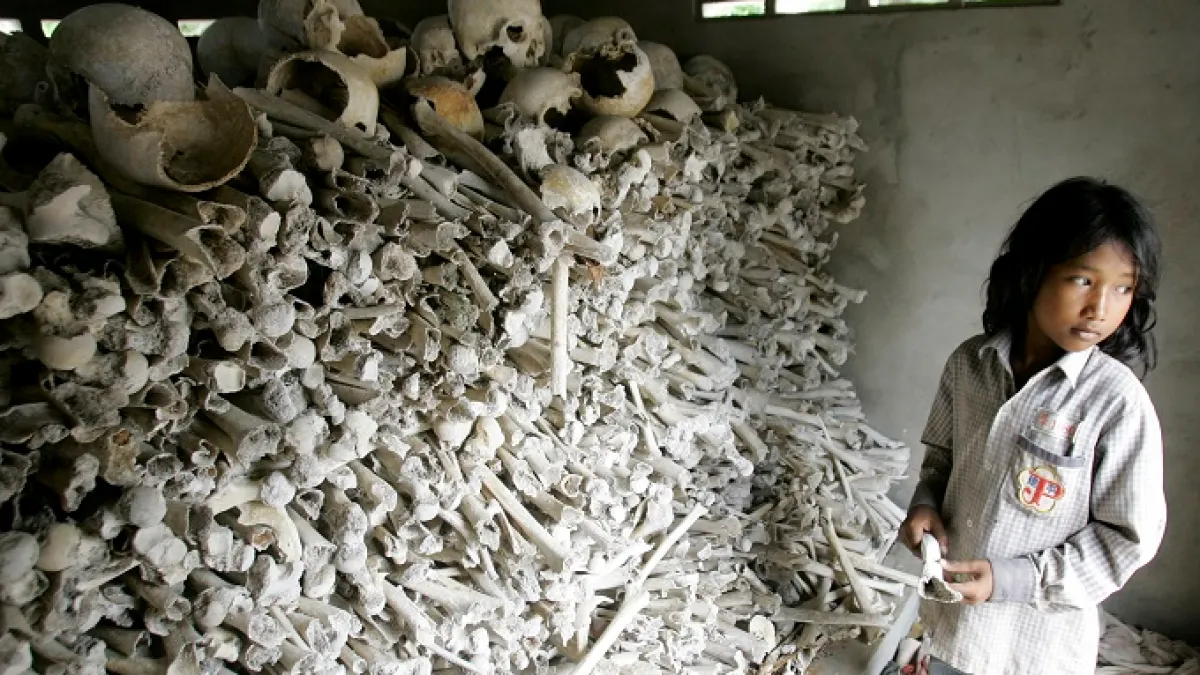
Bones recovered from the Killing Fields in Cambodia. Pol Pot’s regime killed nearly 2 million people in less than five years.
Image from Mark Manson.But the truth was that Pol Pot was as insane as he was cruel. And it was pretty obvious to anyone paying attention. Upon taking power, Pol Pot nationalized the all land, kicked out or killed all foreigners, and began a sweeping genocide against the educated class. In the four years Pol Pot was in power, it’s estimated that he was responsible for the death of more than 20% of the country’s population.
But when news of the genocide and atrocities began to leak out of Cambodia, Caldwell refused to believe it. He defended Pol Pot’s regime and wrote off the atrocities as simply more western capitalist propaganda. His unwavering support eventually earned him an exclusive invitation to visit Cambodia by Pol Pot’s government. Caldwell accepted. And in December of 1978, he boarded that fateful flight to Asia.
Once there, Caldwell toured the country. He met the leadership and learned about their policies firsthand. But the climax of his trip was the last evening — a private audience with Pol Pot himself. Reportedly, Caldwell was “euphoric” with excitement and anticipation. Once in private, Caldwell and Pol Pot had a long intellectual conversation. In his enthusiasm, Caldwell began sharing some of his ideas for the Cambodian regime. He began to offer feedback and dare I say, potentially even a little criticism. Pol Pot, not used to being lectured to by a professor, promptly had Caldwell killed that night.
Malcolm Caldwell is what I like to refer to as an intelligent idiot. A man with an encyclopedic breadth of knowledge and understanding, a world-class mind with powerful thoughts, and yet absolutely no idea how to apply any of it.
April 30, 2026
China’s weaker-than-it-seems strategic position
On the social media site formerly known as Twitter, ESR expands on a post by Tom Kratman about the strategic weakness of the current Chinese government:
Tom didn’t explain his second assertion, but it’s important so I’m going to do it.
China is in the worst strategic position of any great power in history because it is critically dependent on resources it has to import, and it doesn’t have control of the sea lanes over which it imports them.
China is neither food nor energy self-sufficient. It needs to import pork from the United States, grain from Africa, coal from Australia, and oil from the Middle East to keep its population fed and its factories running.
Naval blockades at about three critical chokepoints (Hormuz, Malacca, Sunda) would cripple the Chinese economy within months, possibly within weeks. China does not have the blue-water navy required to contrast control of those chokepoints. The moment any first-rate naval power or even a second-rate like India decides China needs to be stopped, it’s pretty much game over.
As a completely separate issue thanks to the one-child policy, Chinese population probably peaked in 2006 and has been declining ever since. Every year in the foreseeable future they will have fewer military-age males than they do now. Most of those males are only sons; their deaths would wipe out entire family lines, giving the Chinese people an extremely low tolerance for war casualties.
Then there’s the glass jaw. The Three Gorges Dam. Which is already in some peril even without a war — you can compare photographs over time and see that it’s sagging. If anyone gets annoyed enough to pop that dam thing with a bunker-buster or a pony nuke, the resulting floods will kill millions and wipe out the strip of central China that is by far the country’s most industrially and agriculturally productive region.
The Chinese haven’t fought a war since 1971. They lost. Against Vietnam. The institutional knowledge that could potentially fit their army for doing anything more ambitious than suppressing regional warlordism does not exist.
I could go on. But I think I’ve made Tom’s statements sufficiently understandable already.
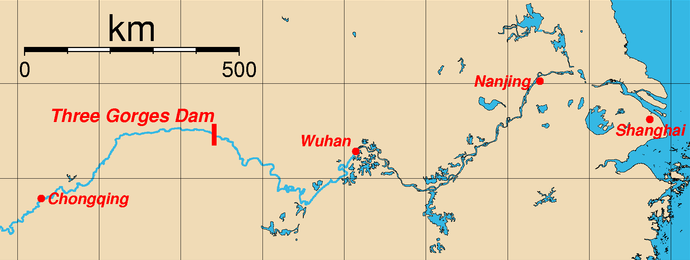
The position of the Three Gorges Dam on the Yangtze River in Hubei Province, showing the major cities downstream of the dam.
Image by Rolfmueller via Wikimedia Commons.
And Tom Kratman responds:
Almost perfect; you missed four tricks.
1. People, when we talk about blockading China, imagine that we’re talking about a civilized stop and search. Uh, uh; we will designate a no go zone and sink without further warning anything that enters it.
2. Our blockade will be distant, well out of range of those Oh-they’re-just-too-terrible-for-words (but never tested) DF-21s. [Wiki] (You did sort of address this, but not in so many words.)
3. We can blow the levees on the Yellow River, too, to kill many millions more and destroy still more industry (it flows above ground).
4. China not only doesn’t have the navy to contest with us, it can never have that navy. Why not? Because there’s only so much wealth to go around; China is surrounded on all sides by enemies with anywhere from decent to quite good armies, any or all of which might take a stab (pun intended) at carving China up like a turkey. They must put a lot more money and effort and manpower into stymying those than they can ever put into meeting us and Japan.
April 29, 2026
The Korean War Week 97: A Peace Proposal Package – April 28, 1952
The Korean War by Indy Neidell
Published 28 Apr 2026There is what should be major news this week as the UN gives the Communists a peace proposal package at long last that addresses the remaining three issues to solve. It does not seem that it will be accepted by the Communist side, though, with the only sticking point being the issue of POW repatriation. There’s also still more unrest and protest at Koje-Do POW camp. And it looks like we’ll be getting a new UN forces commander, since Matt Ridgway will soon head to Europe to take over NATO command there.
00:00 Intro
00:24 Recap
00:56 Truman and Ike
02:34 April 28th
07:14 POW Rations
10:37 Notes
11:05 Summary
11:20 Conclusion
April 26, 2026
South Korea’s switch from an exporting heavyweight to a cultural juggernaut
In the latest SHuSH newsletter, Kenneth Whyte looks at the importance of a South Korean government report to changing the structure of the South Korean economy and making the country far more visible culturally on the world stage:
South Korea, in the latter half of the twentieth century, was building its economy almost entirely by exporting manufactured goods, everything from home electronics to ships to automobiles. That changed, as the story goes, when the country’s Presidential Advisory Board on Science and Technology released a report on digital technology in May 1994. It noted that a single Hollywood film, Jurassic Park, with its computer-generated dinosaurs, generated the same amount of foreign sales as 1.5 million Hyundai cars. The darling of Korean industry, Hyundai was exporting 640,000 cars a year in 1994. So one film was worth more than two years of heavy industrial production requiring enormous plant, equipment, capital investment.
The report stunned Koreans — “literally sent shock waves across the country”, writes Doobo Shim, a Seoul-based professor of media and communication. At the time, culture and entertainment were viewed as ephemeral and unlikely to contribute to Korea’s core mission of “improving the material conditions of the people”. The country decided it needed to change its game in order to thrive in the twenty-first century economy.
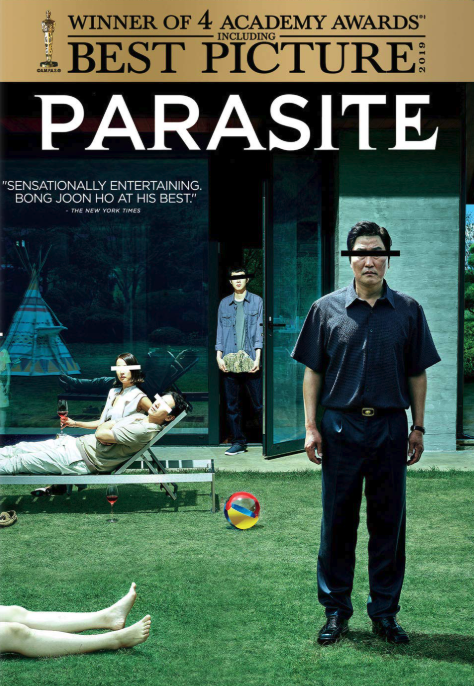
It wasn’t a straight line from the Presidential Advisory Report to Parasite, Squid Game, BTS, Blackpink, and Han Kang’s Nobel prize, but it’s straighter than you might think. Seoul is now a top-five world cultural center, and arguably top two if we’re talking pop culture and anything that appeals to under-thirties. How it happened tells us a great deal about Canada’s relative failure to develop home-grown cultural and entertainment industries.
The Presidential Advisory Board report alone did not alter Korea’s strategy. The country was starting from way behind. First came democratic reforms and media deregulation. That birthed new commercial TV channels and a variety of independent publications. Now with an independent (from government) domestic media sector, Korea tried to protect it by limiting the amount of foreign cultural product in its market. That didn’t work. In 1993, 90 of the top 100 video rentals in the country were from Hollywood; only five were domestic. Sound familiar, Canada?
Protection wasn’t going to work, anyway. Another factor at play was the Uruguay Round, an international accord negotiated between 1986-1994 that decisively liberalized the global economy, forcing all 123 signatory countries to open their markets for a vast range of goods and services, including communications services and entertainment product. It was clear to Korea that efforts to protect heritage and culture by shutting out the world had no future. It needed to upgrade its efforts in the cultural sphere if it wanted to avoid being swamped by content from multinational companies, and not just American ones. Satellite television services out of Japan and Hong Kong were already making inroads in Korea.
Another thing: Korea had noticed that Japan, its nearest rival in the home electronics sector, was making investments in content. Sony had bought Columbia pictures and CBS records. It was the nineties, the age of synergy, or vertical integration. Companies making devices — video players, portable music players — also wanted to own what played on them. Korean firms such as Samsung and Daewoo, makers of TVs and VCRs, felt a need to be vertically integrated, too.
So the Presidential Advisory Report landed on fertile ground. Korean businesses felt an imperative to pay attention to content. The Korean government felt itself under siege from foreign cultural and entertainment product. “Gone are the days”, said one expert interviewed in the newspaper Dong-A Ilbo, “when the government could appeal to the people to watch only Korean programs out of patriotism”.
All that notwithstanding, the report mostly resonated because it presented culture as an opportunity. It asked Koreans to recognize the potential of arts and entertainment to improve the material conditions of the people. Instead of resisting the emerging global marketplace, the power of multinational corporations and platforms, and the free movement of talent, it needed to master this new system, compete commercially, and take Korean culture to the world.


