
The Korean War by Indy Neidell
Published 23 Jun 2026Since the beginning of the war UN air power has studiously avoided hitting North Korea’s hydro-electric complex, since the power the dams provide is mainly for civilian use, but that changes this week! Meanwhile on the ground, the focus has turned to capturing Communist POWs for information, but that task has suddenly proved impossible now that the UN POW camps are firmly back in UN control, and it seems the Communists now prefer even death to capture.
00:00 Intro
00:29 Recap
00:59 Taking Prisoners
03:18 The Shropshires
05:54 Ammunition Shortage
08:41 Targeting Power Plants
14:55 Summary
15:10 Conclusion
15:58 Call to Action
June 24, 2026
The Korean War Week 105 – Destroy Suiho Dam! – June 23, 1952
Comments Off on The Korean War Week 105 – Destroy Suiho Dam! – June 23, 1952
June 21, 2026
Jean Rapail’s The Camp of the Saints, translated by Robert Laffont
Copernican reviews Jean Raspail’s The Camp of the Saints which was reprinted in an English translation by Robert Laffont earlier this year:

It is time that I throw my own hat into the ring regarding this particular piece of polemic fiction. It’s particularly topical given the recent events in the UK and the Western World. A look at toxic progressive empathy taken its natural conclusion.
Written by Jean Raspail and published in 1973, Camp of the Saints is a book infamous among those the media describes as “Far Right” and virtually unknown outside of that. Were history set upon an even keel, Camp of the Saints would sit on the bookshelf of every high school right next to the classic works of the same genre: notably 1984, Brave New World, and Fahrenheit 451.
This book was so dangerous that for decades, now, the English translation has been out of print, available only as an expensive antique, or through the Internet Archive, [as] a single shoddy .pdf. The corporate owners of the English translation rights have, despite considerable interest, refused to republish it. That was until September of 2025, when a new translation was created and distributed.1
As of now, what was once an antique book is now cheap and in-print. What’s more, it’s been converted to an audiobook available on Audible.2 It took the destruction of Western Culture for us to see published the one work of dystopian fiction that warned us of it.
Given its relevance, it makes sense that over ten percent of the run-time consists of various forwards from the author, translator, and the publisher, that describe the political and cultural push against its own publication. It’s worth it to read (or listen) through the numerous forwards to better understand the context and the author.
An Introduction to the Text
Among the dangerous books written in the late 20th century, Camp of the Saints takes the self-destructive anti-nativism of the neoliberal world order and draws it forward to its own natural conclusion. Like other works of fiction, it takes popular ideas and asks the question: “What if these beliefs are taken to their ultimate logical end?”
The book is written from the perspective of an omniscient historian who witnessed the events of the text; he knows that his work will be censored, silenced, or redacted. In the context of the book, the accurate recollection of the events described is inherently destructive to the (now) dominant anti-racist political regime. The force of political progressivism will destroy any such history on the basis that it may “incite racial hatred” or “create division”.
A fascinating bit of forethought in that those are the exact reasons why Camp of the Saints was itself banished from public view for the last half-century: Liberal cultural diversity transitioned smoothly to violent censure and virulent “anti-White” or “anti-Western” genocidal hatred.
The book is a dramatization of the Fall of the West. Not in pitched battle, but as it has lost its spiritual core to rampant idealism. The “other” is always to be given deference over our own people. The sympathy that is demanded for the “other” is also silenced and denied for our own. At what point do a people become so spiritually deracinated that they lose all legitimacy to exist? At what point do they become so deluded as to lack totally a theory-of-mind of the “other”, and at what point does sympathy for the foreigner overwhelm survival?
Camp of the Saints answers these questions in sometimes graphic detail. Some of the horrors written on those pages hadn’t happened to innocent Western children yet … but now, fifty years on, and they have happened. Many times over, in many places and nations, across the West.3 In comparison to the reality of the West in the 21st Century, Camp of the Saints is a tame warning.
The book begins with a great migrant fleet setting off from Calcutta, India. The poor, the starving, the diseased, and the malformed set out for the West- A land where milk and honey flow freely and where the rivers are rich with Fish. The people of India want a better life for themselves, even if they have to walk, unarmed, onto foreign lands to get it. They, like many peoples, believe that their land is simply poor and that Western nations are simply rich. Failing to understand that it is not some “magic dirt” that made France, England, Australia, and the United States rich, but rather it was the French, English, Australians, and Americans. The West doesn’t horde “magic dirt” but “magic people”, so to speak. Were the West to be flooded with Indians, it would become just like India, not magically make the invading Indians wealthy and intelligent.4
I doubt that it’s possible to explain that fact to third-world migrant retards.
To conclude a spoiler-free version of the review: You should read it. It should have been taught in high schools for the last 50 years. You should probably buy a copy before the beast of Progressivism finds a new way to censor it. If you buy the Audible copy, use a tool to convert it to an .mp3 file so that it can’t be deleted from your personal library after the fact.5 There’s a reason it’s been censored for the last 30 years or so. It’s dangerous, subversive, and intelligent in a way that modern dystopian authors wish they could be.
- Here is a direct link [https://www.amazon.com/Camp-Saints-Jean-Raspail/dp/B0FG4MJS8K] to where you can purchase the book on Amazon. A shoutout to Vauban Books for doing the work that every other publisher has been unable, or too scared, to do.
- I kind of enjoy audiobooks. Though Camp of the Saints can be particularly tricky to listen to over reading directly due to its complex cast and jumping around in the timeline.
- The Rape Gang Inquiry Report by Rupert Lowe is particularly poignant and well-timed here.
- A fact that is in stark relief as of 2026, with over 10% of their population (official sources say it’s close to 7%, but I don’t believe them) now being Skaven imports from India … and the wealth, safety, culture, and prosperity of Canada now vanishing at an alarming rate.
- The “Open Audible” tool is works for this, but it isn’t free.
June 20, 2026
“Get off your high horse”
Devon Eriksen responds to a post from a Japanese man who claims not to understand American racism:
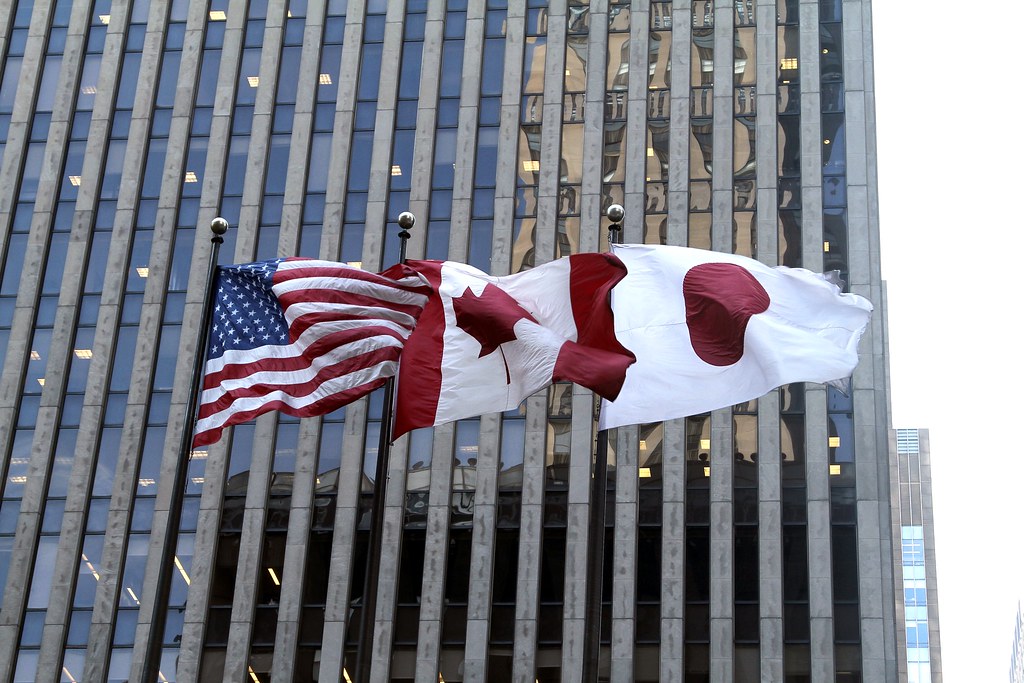
“United States, Canadian and Japanese Flags on Seventh Avenue” by Jim, the Photographer is licensed under CC BY 2.0 
 .
.
NOBUNAGA🇯🇵🏯_夏樹蒼依 @japan_nobunaga
Honestly, racism is one of those things many Japanese people struggle to understand.
If we see a white person, we think, “Oh, they’re white.”
If we see a black person, we think, “Oh, they’re black.”
If there were blue people, we’d probably think, “Oh, they’re blue.”
And that’s about as far as it goes.
If someone is nice, we think they’re nice.
If someone is an asshole, we think they’re an asshole.
If we like them, we like them.
If we don’t, we don’t.
We grow up being told not to cause trouble, not to fight, and to get along with the people around us.
Maybe that’s why judging someone by their race feels so foreign to a lot of Japanese people.
We’re usually too busy judging people by whether they’re good people or not.
This is what we, in America, call a “Luxury Belief System”.
That means something you can believe, and advertise your belief in, precisely because your privileges shelter you from the negative consequences of believing it.
You, @japan_nobunaga, live in a nation that is 99% Japanese, just like you.
You have plenty of time to evaluate gaikokujin as individuals. There are only a few of them around, and they probably aren’t going to stab you while you are trying to figure out the content of their character.
So you have the luxury of telling everyone “look at me, I am not a racist, I am an enlightened being who makes no judgments about wolves” … because you do not live near any wolves, and run no risk of being bitten.
In America, we have another saying … “Get off your high horse”.
This does not mean a literal horse.
But it is meant to make you think about how the daimyo‘s son, on his expensive thoroughbred stallion, does not understand why the peasants have muddy boots.
If you get down off the horse, and walk, you will understand why the farmer’s boots are muddy.
There were some dissenting comments to the original post:
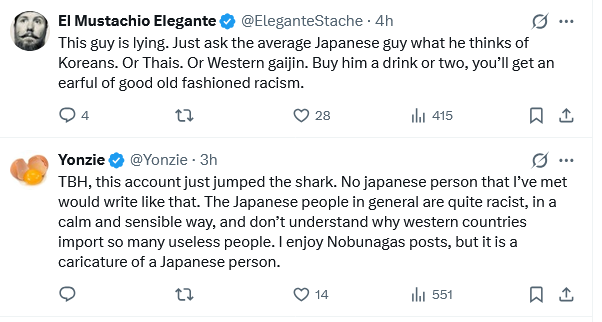
I’ve heard similar stories of Japanese racism toward other East Asian peoples, never mind what they said (and probably still do say) about American black servicemen.
Comments Off on “Get off your high horse”
QotD: The word “alchemy”
My favourite thing in this chapter is an etymological nugget that I suspect is too good to be true, but which I desperately want to believe. The word “alchemy” comes from the Arabic al-kīmiyāʾ (الكيمياء), which in turn comes from the Greek khēmeia (χημεία), but that’s where our knowledge of this word stops. χημεία has no known Indo-European origin, and no obvious cognates that would suggest a borrowing. There are some hand-wavy theories that it might derive from khēmet, the word for Egypt in ancient Egyptian, but it’s a stretch to put it mildly. Needham proposes the Chinese 金 meaning “gold” as the ultimate source. In modern Mandarin, this word is pronounced like jin, but the Classical Chinese pronunciation is better preserved by the Southern dialects, which variously render it as gum, gim, or, in Hakka and Southern Min, as kim. The list of English words with Chinese origins is short,1 and it would be nice to add this one.
But the Chinese alchemists by and large weren’t after gold, their goal was eternal life instead. In fact aurifaction originated as an instrumental “warm-up” exercise for the main event. Everybody knew that the reason gold was the most perfect metal was because it was a harmonious and balanced combination of the elements. So if the same harmoniousness and lack of internal contradiction could be achieved within a living organism, then the consequences would obviously be physical immortality and superhuman abilities. Elemental harmony, biological harmony, social harmony — in the light of Chinese metaphysics these goals were all reflections and intimations of one another. And the first two at least could be brought about by the same methods: the application of various potions and elixirs designed to increase or reduce the influence of a particular element. The same principle forms the cornerstone of Chinese medicine today.2
John Psmith, “REVIEW: Science in Traditional China, by Joseph Needham”, Mr. and Mrs. Psmith’s Bookshelf, 2023-08-14.
- My favourite of these, since it seems so unlikely, is “ketchup” deriving from 茄汁 (“tomato sauce” in Cantonese), perhaps via the Malay kicap.
- Needham’s third lecture is about the most recognizable and well-traveled example of Chinese medicine — acupuncture — and contains the intriguing assertion that naloxone administration totally cancels acupuncture’s efficacy for pain relief. This suggests that acupuncture’s mechanism of action may have to do with stimulating the body’s production of naturally-occurring opioids. There’s some evidence the placebo effect could be related (fascinatingly, naloxone also appears to eliminate the placebo effect).
Comments Off on QotD: The word “alchemy”
June 19, 2026
US history is unique, it does not map onto the histories of other nations
I’ve noticed this pattern myself, but I hadn’t considered that a lot of Americans don’t just use the patterns of their national history when looking at other western nations:
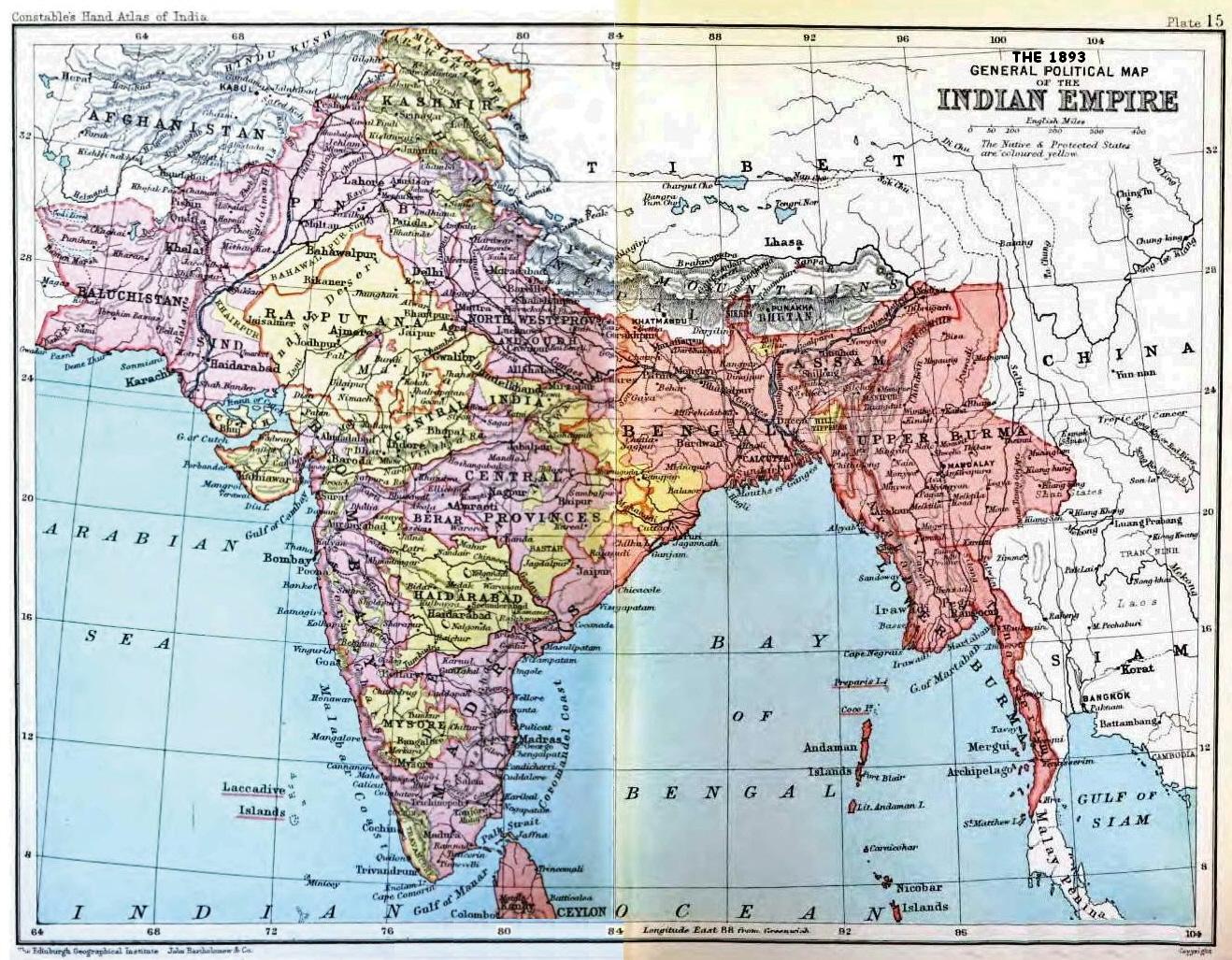
“Political Map of the Indian Empire, 1893” from Constable’s Hand Atlas of India, London: Archibald Constable and Sons, 1893. (via Wikimedia Commons)
Not every place in the world can be examined through the historical template of the United States.
One of the reasons conversations about India are so difficult for folks in the West to untangle is that many of the frameworks Americans use to understand power, intergroup dynamics, identity, and historical injustice do not map onto India. Not at all.
For Americans who have adopted a critical lens, the template derived from American history is fixed. A dominant demographic majority group seeks to preserve power while marginalized demographic minorities fight for recognition and inclusion. Because this template is so fixed in the imagination, there is a tendency to view and interpret dynamics and events in other countries in exactly the same way. I have seen it myself. “We’ve all seen how this works”, someone will say, and proceed to apply the American template to a different place.
And the history of the Americas (both North and South) is dominated by European (white) Christian colonization. As a result, Americans are familiar with the legacies of European empire and Christian missionary expansion. By contrast, the history of Islamic conquest and rule, which shaped large parts of Asia, Africa, and Europe for centuries, occupies far less space in the American imagination. So too does the contemporary influence of petrodollar-funded religious institutions, transnational Islamist movements, and the global circulation of Islamist narratives.
This does not mean these forces explain everything. It does mean that many Americans have little historical or conceptual framework for understanding how they might shape politics, memory, education, or intergroup relations in places like India.
India’s history is not the same as that of the Americas.
For centuries, India experienced successive waves of colonization. The first came through a series of Muslim invasions and dynasties, culminating in the Mughal Empire. The second came through British colonial rule, predated by British mercantile and missionary efforts. Yet unlike many colonized societies, the civilizational majority was never fully displaced, converted, or absorbed. Hindu traditions, practices, languages, stories, temples, and collective memories survived.
This is perhaps the single hardest aspect of India for many Americans to grasp because it has no real analogue in American history: the Hindu demographic majority is also the historically colonized population.
For many Western observers, this creates immediate suspicion because it violates the assumptions embedded within our familiar frameworks. The expectation is that majorities defend power while minorities challenge it.
As a result, contemporary debates about textbooks, public memory, historical figures, temples, and national identity are often seen and interpreted by folks in the West through frameworks that retrofit Indian history into contemporary American critical analysis through the reductive binaries of majority/minority, right/left, which are memeable and digestible, but obscure much more than they reveal about power, history, equity, policy, foreign influence, etc.
When Hindus argue that violent and painful aspects of Mughal conquest have been whitewashed in public education, they are frequently accused of attempting to rewrite history to justify the alleged “Hindu right wing” suppression of a minority group today. (Please do read my analysis of religious-based violence in India. It’s not what you think it is. Link.)
Yet Americans themselves are familiar with the process of revisiting historical narratives to advance truth and reconciliation. We have debated how slavery is taught, how Indigenous history is taught, how immigration is taught, and how women and minority groups have been represented in textbooks and in classrooms. We generally accept that historical narratives evolve as new evidence emerges and as previously marginalized perspectives are taken seriously.
What makes India different is that the group seeking rigorous reconsideration of historical narratives is often the majority population. For many Western observers, this creates immediate suspicion. The assumption is that majorities seek dominance while minorities seek justice.
But history does not always work that way.
The result is that efforts by Hindus to recover historical memory are often denounced as nationalism (which is falsely equated with white or Christian nationalism in the United States) before they are examined on their own terms. Questions about historical representation become questions about political motives. Efforts to revisit narratives become “evidence of extremism” or, even more bizarre, “anti-intellectualism”. And figures who have occupied a central place in Hindu memory for centuries are presented as newly invented symbols of contemporary political power.
The result is that the Indian voices most readily amplified in Western media are often those whose analyses are already legible within familiar Western frameworks. Their arguments are immediately understandable, which lends them “credibility”. Perspectives that do not fit those frameworks are frequently dismissed as “Hindu nationalist” before they are seriously considered.
One need not agree with every argument made in these debates to recognize that they are, in fact, debates. The question is not whether history should be examined. The question is whether everyone is permitted to participate in that examination without having their motives presumed in advance.
Comments Off on US history is unique, it does not map onto the histories of other nations
June 17, 2026
The Korean War Week 104 – Order Restored at Koje-do – June 16, 1952
The Korean War by Indy Neidell
Published 16 Jun 2026The saga of Koje-Do POW camp comes to its end this week after Bull Boatner’s troops crack down hard and finally take full control there. Operation Counter continues with fighting for Hill Eerie, and South Korean President Syngman Rhee is stirring up so much trouble that the US is considering intervening in South Korean politics to stop him.
00:00 Intro
00:40 Recap
01:11 Operation Counter
03:31 The Chinese Account
05:22 Koje-Do
10:46 Rhee Again
12:50 US Presidential Election
15:58 Summary
16:25 Conclusion
18:13 Call to Action
Comments Off on The Korean War Week 104 – Order Restored at Koje-do – June 16, 1952
June 10, 2026
The Korean War Week 103 – The Outpost War – June 9, 1952
The Korean War by Indy Neidell
Published 9 Jun 2026The US 45th Division launches Operation Counter in the field this week, to take some enemy outposts, Bull Boatner finishes his plans for his operation to take total control at Koje-Do POW Camp, and in the US, the Presidential primary season finishes, though it’s still anybody’s guess who the actual Democratic and Republican candidates will be.
00:00 Intro
01:21 Recap
01:52 Primary Season
05:18 Operation Counter
09:20 Communist Artillery
12:09 Boatner
20:10 Summary
20:20 Conclusion
Comments Off on The Korean War Week 103 – The Outpost War – June 9, 1952
June 9, 2026
Confucian deference to authority and tradition lead to autocracy and rebellion, time after time
Chinese history is not one of my areas of interest, so I have not read deeply in any specific area. Lorenzo Warby, on the other hand, has a much better grasp of the sweep of historical events in China and some of the philosophical and cultural elements that persist through the centuries:
All political and social philosophies rest, implicitly or explicitly, on some claims or claims about the nature of humans.
Consider the thought of Kong Qiu (c.551 BC – c. 479 BC), known as Kǒngfūzǐ (孔夫子) (Great Master or Wise Teacher Kong), hence Confucius. He held that human nature is naturally good and that it is therefore a reasonable aspiration to create a society of harmony, a society without conflict, if everyone just behaves with the propriety appropriate to their place in society — in particular, according to their placement in the web of social connections. His constant concern for the rites (li 禮) is for people to show the correct forms of, and orientation towards, those socially embedded interactions.
This leads very naturally to a very authoritarian, hierarchical view of politics as enforcing social harmony, particularly as people vary in their willingness and capacity to cultivate such virtuous propriety. The notion that politics is legitimately an arena for bargaining between competing interests — the Western idea of “normal politics” — becomes not a natural way to do politics, but a failure to achieve proper harmony.
Master Kong developed his ideas — that were further developed by disciples and commentators — in a civilisation with no tradition of warrior assemblies, self-governing cities, or deliberative assemblies of any kind. A ruler’s court is a place where officials report, and may even debate, but the ruler decides. You can see this narrow view of politics in comments by Master Kong in the Analects such as:
8.14 The Master said, “If you don’t have a particular [government] position, then don’t meddle with any of its business.”
14.26 The Master said, “If you don’t have a particular [government] position, then don’t meddle with any of its business.” Master Zeng [Zengzi] commented, “The gentleman does not allow his thoughts to go beyond what his position calls for.”
In such a political culture, judicious quotes based on mastery of a shared literature become a way of communicating to superiors while giving minimum offence. Conversely, political rhetoric has little or no value, because there are not the deliberative assemblies to be swayed by argument. Master Kong deprecated glib persuasiveness, on the grounds that it tended to hide one’s real character (or lack thereof).
Where command-and-control hierarchy is the dominant method of political action, hoping for propriety to pervade the hierarchy has obvious resonance. Putting such propriety as a mechanism for social harmony is a way to, ironically enough, be persuasive — which requires a positive view of human nature. But it also hugely elevates the moral claims of governorship. Hence comments such as:
2.1 The Master said, “To rule by virtue is like the way the North Star rules, standing in its place with all the other stars revolving around it and paying court to it.”
12.17 Ji Kangzi asked about the way of governing [zheng]. Confucius replied, “To govern [zheng] is to correct [zheng]. When you set an example by correcting your mistakes, who will dare not to correct his mistakes?”
This concern for harmonious propriety is not a world away from ibn Khaldun‘s concern for asabiyya. Nor is it so far from recognising the importance of a coherent civic culture in order to maintain robust institutions, which rest on norms and rules. This is a factor that much of mainstream Economics fails to seriously grapple with, leading to incompetent analysis of immigration.
The problem is that this cultural and institutional framework turns the thought of Master Kong, his disciples and commentators, into what is, in effect, one-trick moral propriety politics, however sophisticated other aspects of this tradition may be. The choices of governance are narrowed down to punishment and example:
2.3 The Master said, “If you guide the people with ordinances and statutes and keep them in line with [threats of] punishment, they will try to stay out of trouble but will have no sense of shame. If you guide them with exemplary virtue [de] and keep them in line with the practice of the rites [li], they will have a sense of shame and will know to reform themselves.”
They are reduced to trying to make autocratic command-and-control politics work as a successful long-term project: as the repeated dynastic collapses in Chinese history show, they did not succeed. Indeed, the recurring pattern of Chinese political reformers and reform programs ending badly reflects that such fail to break out of that autocratic command-and-control pattern, so end up being swallowed by its incentive structures — including the long-term pathologies of bureaucracy and the inherent fears of autocrats.
The most thorough attempt to implement ideas based on rú (儒) classicism (“Confucianism”) in Chinese history was the disastrous reign of Wang Meng (r.9-23), who provides an object lesson in overweening Theory leading to disastrous policies. Ironically, Master Kong himself was against such grand theorising:
9.4 The Master stayed away from four things: he did not put forth theories or conjectures; he did not think that he must be right; he was not obdurate; he was not self-centered.
The episode is a particularly disastrous example of Etienne Gilson‘s principle that the conclusions of the master are the premises of the disciple, thereby all too readily reducing struggles with complexity to a simplifying dogmatism: a trap that scholarly commentary on The Analects often tried to avoid.
The thought of Master Kong also wanders very close to someone is morally better, not only because learned, but because smart and learned. For instance:
5.9 The Master said to Zigong, “Who is the better man, you or Hui [Yan Hui]?” Zigong replied, “How dare I compare myself with Hui? Having learned one thing, he gives play to ten, while I go only as far as two.” The Master said, “You are not as good as he is. Neither of us is as good as he is.”
This arrogance of the appropriately credentialed periodically led to mass outbreaks of infuriated peasants removing educated heads from elite bodies. The most recent manifestations of this were the Cultural Revolution in China and the megacidal Cambodian horrors under Pol Pot but you can see versions of this reaching back into Chinese history — for example, the massacres by Huang Chao’s rebellion (874-884) towards the end of the Tang dynasty (618-907) and the earlier peasant revolts that brought down Wang Meng.
We can also see the same self-righteous exploitive arrogance of those credentialed with “morally proper knowledge” afflicting contemporary Western societies along with bureaucratic pathologies that have also been a feature of Chinese history — remembering that we Westerners copied the Chinese pattern of bureaucratic selection through examination without considering the long-term patterns of Chinese history. Fortunately, national populism generates a less violent outlet for popular frustrations than Chinese peasant revolts.
Update, 10 June: Welcome, Instapundit readers! Have a look around at some of my other posts you may find of interest. I send out a daily summary of posts here through my Substack – https://substack.com/@nicholasrusson that you can subscribe to if you’d like to be informed of new posts in the future.
Road to Rangoon, Ep. 1 – Slim’s Hammer and Anvil
HardThrasher
Published 8 Jun 2026The Road to Rangoon Ep1: Hammer & A Hard Place — The Battle for Burma Begins By the start of the monsoon rains in 1944, British and Indian forces of General Sir William “Bill” Slim’s XIVth Army had been pegged back inside India. Five months later, after the battles of Imphal and Kohima, the Fourteenth Army had not only retaken the ground it had lost, but inflicted catastrophic losses on the Imperial Japanese Army.
The question was: what now? There would be no more forces coming from Europe, no additional fire power or support, and apparently no belief in the men by the Imperial General Staff in London or the US Army high command in Washington. Could the DUKE forces push into Burma through monsoon rains, jungle, mountains, disease, impossible supply lines and against an enemy willing to die for each yard of ground? Could Slim, Mountbatten, Oliver Leese, the US-led Northern Combat Area Command — NCAC — turn victory in India into the reconquest of Burma?
In this opening episode of “The Road to Rangoon”, we begin the story of the epic advance that would throw the Imperial Japanese Army out of Burma (modern day Myanmar) and become familiar with some of the places, names and concepts that will shape our story.
We look at the geography of Burma and eastern India, the aftermath of Imphal and Kohima, the state of the Japanese Burma Area Army under General Kimura Heitarō, the role of XIVth Army, XV Corps and NCAC, and the Allied plans that became Operation ROMULUS, Operation CAPITAL, Operation DRACULA and EXTENDED CAPITAL. This is the story of how the Burma Campaign moved from defence to attack — and how Slim planned one of the most ambitious offensives of the Second World War.
(more…)
Comments Off on Road to Rangoon, Ep. 1 – Slim’s Hammer and Anvil
June 3, 2026
China’s pirate fishing fleets
John Carter was really impressed with a recent self-published novel by Frank Kidd, and takes the time to set up the real-life situation the novel imagines being kinetically addressed:
A few years ago a photograph taken by a pilot over the Pacific went viral. It showed a mysterious red glow spreading ominously out over the water.
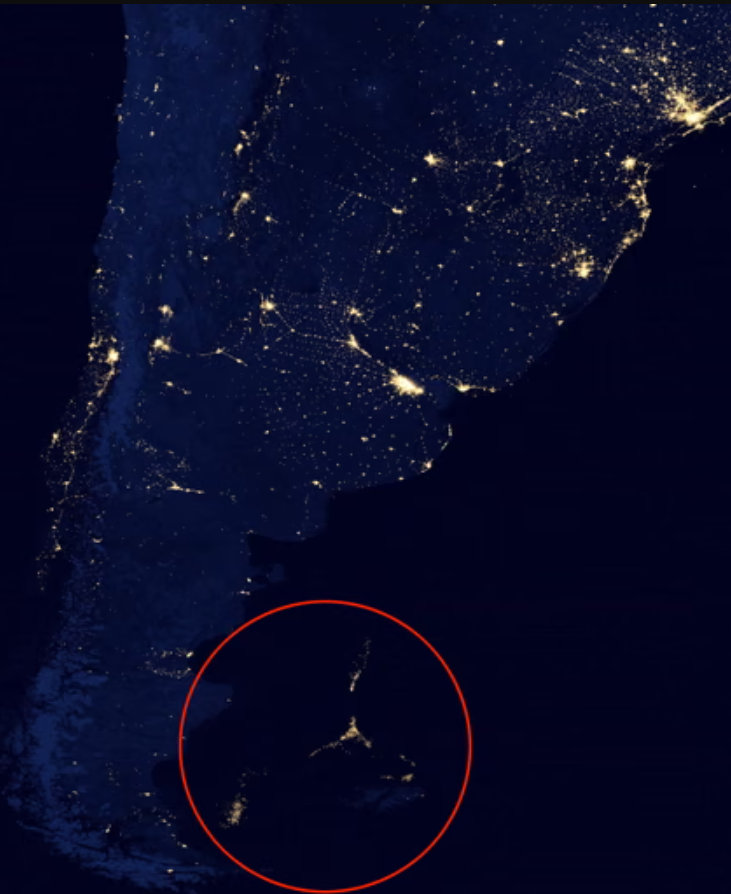
Initially people thought it was aliens, and to be fair, they weren’t far off. The glow belonged to the closest thing humanity has yet invented to a Tyranid hive fleet: a Chinese fishing fleet raping the seas in search of seafood. The glow is from huge banks of LEDs, which the ships use to draw marine life to the surface, where they trawl it up with nets. Much, maybe even most of the indiscriminate catch is discarded.
China has over half a million fishing vessels. Their vast fleets comprise thousands of ships, and can often be seen from orbit.
The triangular lights inside the red circle are a Chinese fishing fleet.
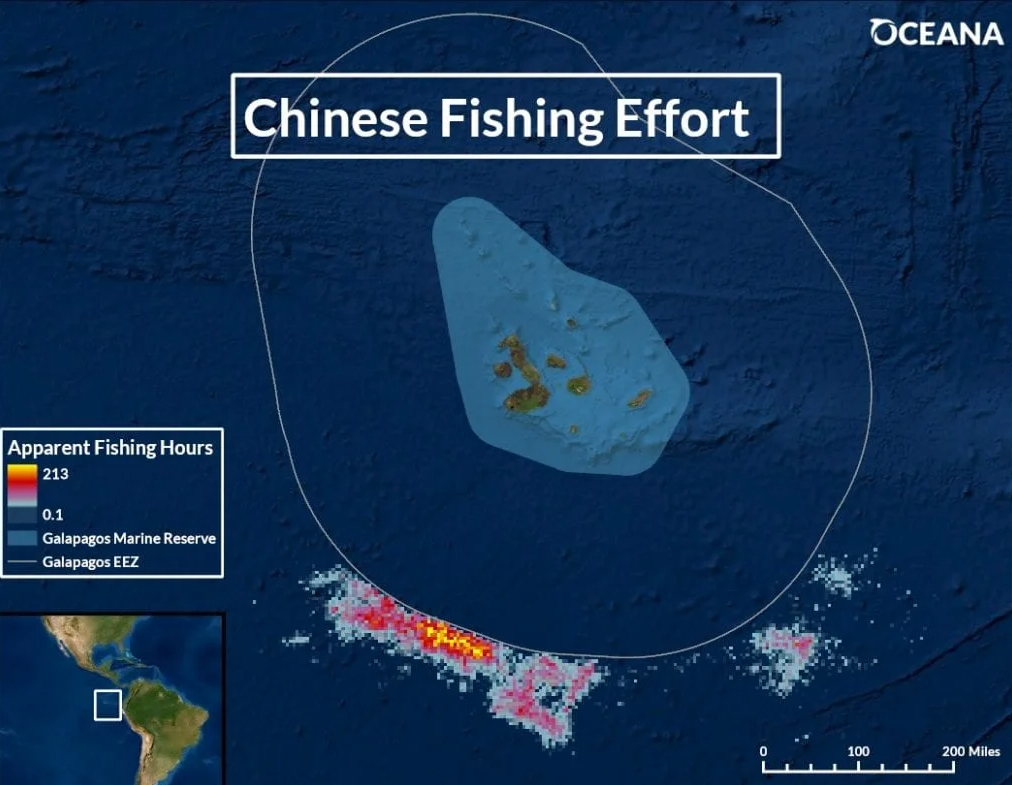
China has long since eaten its way through its own territorial waters, and therefore sends its fleets out into the rest of the world’s oceans. As a rule marine life is much more abundant close to the shore, since this is where most of the nutrients are. Fishing in another country’s territorial waters is illegal under international law. The Chinese do not care. Their fleets park just on the edge of a country’s Economic Exclusion Zone, and then turn off their Automatic Identification System transponders so that they can sneak inside and poach. Turning off an AIS transponder is also illegal: maritime law requires these to be activated at all times, for collision avoidance and search and rescue. Organizations which track this regularly observe Chinese ships on EEZ borders disappearing from the AIS network, and reappearing a few hours later on the right side of the border.
Here we see the scum pillaging the ocean around the Galapagos. Yeah. I know. Billions must die.
The consequences for local fishermen are disastrous: the Chinese scoop up all the fish, and lead the local fisheries towards ecosystem collapse. When they’re done pillaging they just move on, leaving an oceanic wasteland in their wake.
Environmental groups generally don’t seem very bothered about this, perhaps because the ocean is a CO2 sink whether or not there are fish in it, and the only thing that matters about the environment is how much carbon is in the air. National governments are reluctant to take action, because they are often dependent upon Chinese investment for their economic growth. The only people who really seem to care are fishermen and Internet racists.
This is the set-up for Frank Kidd‘s immensely satisfying debut mercenary novel, Once Upon A Time In Argentina.


Comments Off on China’s pirate fishing fleets
The Korean War Week 102 – American Bioweapons on Korean Soil? – June 2, 1952
The Korean War by Indy Neidell
Published 2 Jun 2026The Chinese continue their campaign of accusing the US of practicing germ warfare in North Korea and Manchuria. Meanwhile in South Korea, Syngman Rhee has declared martial law in Pusan as part of his campaign to remain in power.
00:00 Intro
00:50 Recap
01:23 Germ Warfare Charges
11:17 Bull Boatner
15:34 Holding POWs
17:58 Summary
18:13 Conclusion
19:21 Call to Action
Comments Off on The Korean War Week 102 – American Bioweapons on Korean Soil? – June 2, 1952
June 2, 2026
Low IQ, mens rea, and actus reus
For those like me whose legal Latin isn’t great, “mens rea” is “the mental state of a defendant who is accused of committing a crime”, while actus reus is a “guilty act” (from Wikipedia). On his Substack, William M. Briggs discusses how legal systems decide when an accused person’s IQ is so low that they lack the ability to understand that their action is illegal:
A gang of gypsies in England gang raped a young girl (and another previously) at knifepoint while filming the deeds, laughing all the while and even posted one of the rapes on social media. At their trial, Judge Nicholas Rowland excused their crimes because he said the criminals were “‘very young’, had low intelligence, a ‘limited understanding of consent’ and were susceptible to ‘peer pressure'”.
[Rowland] said that the second boy fell into the bottom one per cent in IQ for his age, and he had been diagnosed with ADHD, while the third boy had ‘low intellectual capacity’ and he had a ‘limited understanding of consent’.
Iryna Zarutska, 23, was riding a train in Charlotte, when Decarlos Dejuan Brown Jr rose up, slit her throat, and as he was exiting the train gleefully declared he “got” his white woman. Brown had been arrested some 14 times before he murdered Zarutska, for crimes including armed robbery. He was freed each time. For the murder, he was found by Experts to be “incompetent to stand trial”.
Brown and the gypsies were not alone. Recently, there were these cases:
Many states have humane destruction laws that apply when animals (usually dogs) have attacked or killed humans. Florida, for instance, confiscates vicious dogs and puts them down. When any animal kills and eats a man it is usually put down, and most think it wise and prudent to do so. But some curiously argue the animals cannot help themselves, that it is their nature to attack and kill and even eat people, and who are we to judge?
In any case, it is clear that dogs, nor any animal, are not as intelligent as man. Just as it is clear obvious truth that some men are not as intelligent as others. Yet this fact does meet resistance from Equalitarians and Universalists, both forgiving every sin except the sin of claiming sin exists.
[…]
The Eighth Amendment reads: “Excessive bail shall not be required, nor excessive fines imposed, nor cruel and unusual punishments inflicted“.
Since 2002, executing a dumb criminal is “cruel”, yet executing an intelligent criminal is not cruel nor unusual. This is odd because, as any dog owner can attest, even dogs can know right from wrong, and even stupid men know murder is wrong.
Scalia wrote in his dissent that an Expert (a psychologist) on one of the appeals testified Smith had “an IQ of 59”. Smith also, and in this case, really had “16 prior felony convictions for robbery, attempted robbery, abduction, use of a firearm, and maiming”. He noted previous courts ruled only the profoundly retarded, those “idiots” who “had an IQ of 25 or below”, had a “‘deficiency in will’ rendering them unable to tell right from wrong”.

On the general topic of IQ, but not directly related to violent crime, ESR discusses the relationship between IQ and the caste system of India:
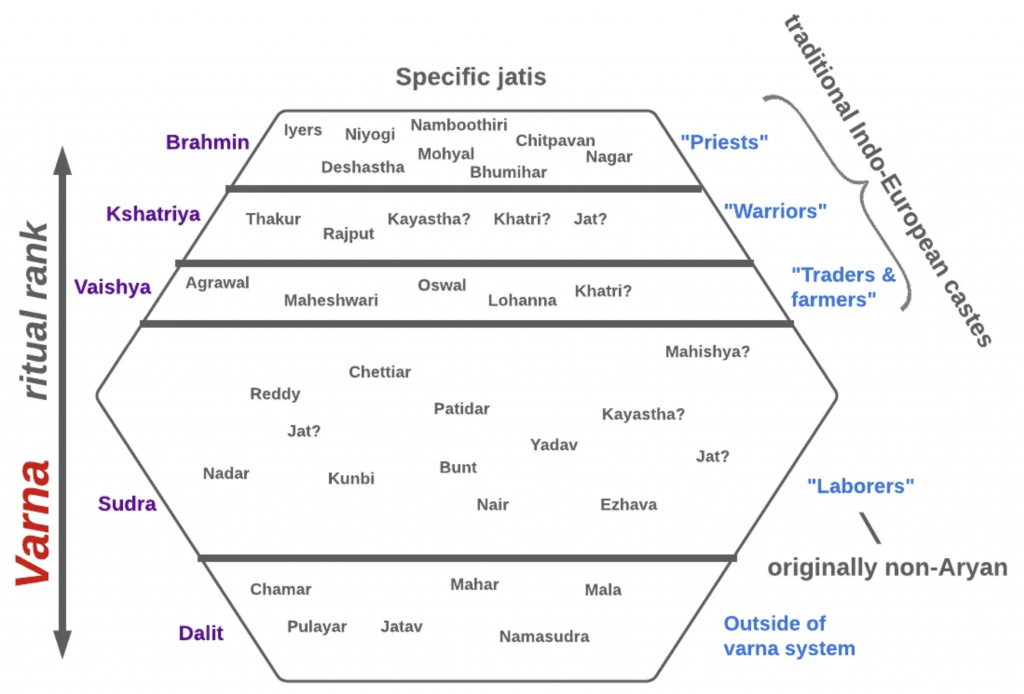
The caste system as a layered varna system with five classes and numerous integrated jati communities.
Razib Khan
That feeling when your knowledge about how average IQ varies with caste rank in India stops being peculiar arcana and suddenly becomes deeply relevant to US domestic politics …
Anybody who has studied the matter knows that castes in India have been maintaining almost perfect endogamy for thousands of years. About the only significant category of exceptions is that if you have an exceptionally beautiful daughter you *might* succeed in getting her taken as a concubine by a higher-caste man, so their offspring might jump a rank.
With no significant gene flow between jatis, divergences in important traits like IQ and time preference not only don’t smooth out, but actually amplify due to genetic drift and differing selective pressures.
Highest-caste Indians have an IQ distribution a lot like Europeans. Low-caste Indians … don’t. They’re not quite as genetically handicapped as the dimmest populations in sub-Saharan Africa, thankfully, but the spread is wide.
This doesn’t mean all low-caste Indians are stupid; Gaussian distributions don’t work that way. It does mean that importing 10,000 low-caste Indians has very different implications for the host society then importing 10,000 Brahmins.
Segue to the recent news stories about American families getting killed by illiterate Indian truck drivers doing crazy stupid things on the roadways. Those truck drivers are not Brahmins.
This is a recent phenomenon because, until one of our political parties decided to import the entire Third World for vote-farming purposes, we were cream-skimming India. Now we’re not, and this makes a serious difference.
Update: Fixed broken link to ESR’s X post.
Comments Off on Low IQ, mens rea, and actus reus
May 27, 2026
The Korean War Week 101 – Another Week, Another POW Riot – May 26, 1952
The Korean War by Indy Neidell
Published 26 May 2026In the wake of the kidnapping of the Koje-Do POW camp commandant, UN Commander Mark Clark is busy really working on expanding security at all the POW camps in Korea and gaining total internal control of them. However, the damage done to the UN’s global reputation by the whole incident is considerable, and at the negotiating table the Communists denounce the UN and UN Chief Delegate Turner Joy leaves his post to return to the states. The war in the field goes on as always, with the Philippine Battalion Combat Team seeing success in the field.
Comments Off on The Korean War Week 101 – Another Week, Another POW Riot – May 26, 1952
May 25, 2026
Did The Taranto Raid Inspire Pearl Harbor?
TimeGhost Cartographic
Published 24 May 2026In November 1940, the British Royal Navy launched a daring carrier strike against the Italian fleet at Taranto. The attack shocked the world, crippled Italian naval power in the Mediterranean, and demonstrated just how devastating naval air power could be against battleships at anchor. But the consequences of Taranto didn’t end in Italy.
In this episode, we explore the aftermath of the raid, the race to understand how it had been achieved, and why military observers around the world paid such close attention to what happened there. From British convoy operations in the Mediterranean to Japanese investigations into shallow-water torpedo attacks, this episode examines how one raid would echo far beyond the harbor at Taranto.
How did the British make the attack possible? What lessons did foreign observers take away from it? And why did some nations react to the raid very differently than others?
Comments Off on Did The Taranto Raid Inspire Pearl Harbor?
May 24, 2026
The PRC would need a literal “short, victorious war” to defeat the US
On Substack, Tom Kratman looks at the economic and strategic weakness of the Peoples Republic of China should it get into a serious shooting war with the United States:
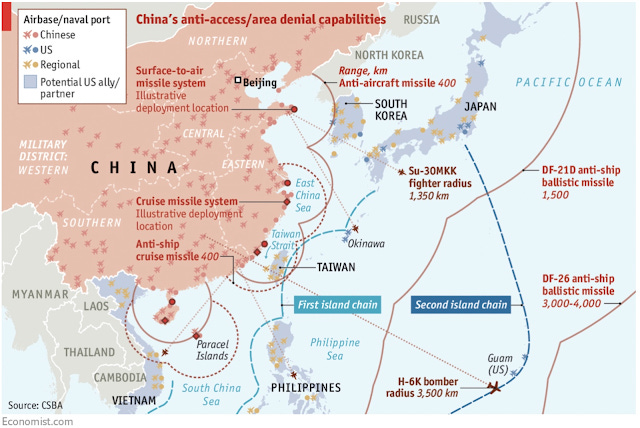
China’s strategic position is appalling, and at least the higher party cadres and senior military leadership have to know that it is. Why? China is utterly dependent on both imports and exports to keep their economy going and to feed themselves. By that latter, I don’t just mean they need to import food, though they do to the tune of one third. That’s bad enough, but they also need to import fertilizer to grow the inadequate amount of food they grow for themselves. No, nitrogen and phosphates aren’t a huge problem; they are net exporters. Potash is a problem. Loss of potash imports probably cut their grain production by about ten percent. This would be painful, but survivable with a touch of rationing and some weight loss.
Except for one thing, oil and natural gas. Cut those off and grain production drops by a third within two years and probably forty percent after that. On top of the loss of the third that they must import, that’s serious hunger.
And another thing, farm machinery and transportation. China only produces about a quarter of its oil needs domestically. Cut those off and mechanization of farming must be reduced.
Add in that this kind of food reduction also means they must stop feeding food animals.
Moreover, while a good deal of their transportation net runs off of electricity, which can be produced by the coal China does have, at what we might call the strategic level, getting the food from the farms to the railheads and from the railheads to markets to kitchens requires liquid fuel. China’s ability to produce liquid fuel from coal exists, but it is tiny.
Add in the increased need for liquid fuel for their military in this case.
A long series of interrogatories to Grok suggests that China’s total food production and importation collapses by seventy percent or more within two or three years if they go to war with us.
It won’t be sudden; they probably have about a year’s worth of food in storage against such a day. But within three years? We’re talking an entire civilization in kwashiorkor1 and marasmus2.
How do they keep that industrial civilization going in the absence of food and energy imports, or the exports that have kept their economy going? They likely don’t.
Although China’s population appears to be in accelerating collapse, they still have a lot more people than we do. Surely that represents … nothing. For a war fought largely at sea it represents nothing. Yes, they can, at least for the moment, build more ships faster than we can. However, we can build things to sink ships faster than they can build ships. Thus, we’ll keep our existing naval supremacy.
There’s a worse factor in there, though; in China sons are just a lot more important than daughters. No, I don’t care if this upsets western feminist sensibilities; we are not talking about the west but about China. Daughters, assuming they marry, go on to take care of their husband’s family. Sons take care of the parents. It is the rare Chinese family with an extra son to spare.
But can’t they build enough ships to overwhelm our blockade in the short term, at least? No, they can’t. China is surrounded by enemies on land, Vietnam, India, and Russia predominant among them, though none of the neighbors – barring, maybe, North Korea – really likes China or doesn’t fear it. No, however much public kissy face they may engage in for foreign consumption, China and Russia have long-standing, intractable issues between them. China is a threat to Russia and vice versa in ways we are not.
So all the manpower and money spent on a navy is largely wasted. They’re not going to get a navy large, powerful, and competent enough to take us on and, if they really try to, we will manufacture a war – the United States is good at this – to trim them down to size before they can. Worse, every increment of money and manpower they spend on the navy is money and manpower not spent on the much more important army and air force.3
- Caused by protein deficiency.
- Caused by deficiency in all macronutrients.
- The Navy is much more important to us because we have no serious land enemies in this hemisphere.
Update, 25 May: Welcome, Instapundit readers! Have a look around at some of my other posts you may find of interest. I send out a daily summary of posts here through my Substack – https://substack.com/@nicholasrusson that you can subscribe to if you’d like to be informed of new posts in the future.


