
Lotuseaters Dot Com
Published 29 Nov 2025Luca is joined by Dan to discuss Flashman by George MacDonald Fraser. They explore Fraser’s skill in writing historical fiction, the genius of the Harry Flashman character, and the sheer hilarity of the novel’s dark humour.
March 27, 2026
The Greatest Scoundrel Story Ever Written
Comments Off on The Greatest Scoundrel Story Ever Written
March 13, 2026
The Raj – a cut-and-dried case of plunder?
Celina considers the claim that the period of British rule over India was a period of British plunder of Indian resources:
The historical evaluation of the British Raj has increasingly become a battleground for competing political and academic narratives. In the 21st century, the discourse has shifted significantly toward an oppression narrative that characterises the period from 1757 to 1948 as one of singular depredation. This perspective, popularised by public intellectuals such as Shashi Tharoor and economic historians like Utsa Patnaik, posits that British rule was defined by systematic deindustrialisation, engineered genocide, the intentional dismantling of educational systems, and the looting of wealth on a scale that defies standard economic modelling.1 However, when subjected to the rigours of aggregate statistical data, comparative institutional analysis, and a sense of historical proportion, these claims frequently reveal themselves as founded on misleading anecdotes and founding myths rather than objective economic realities.2 To accurately understand the trajectory of India under British influence, it is essential to move beyond evocative stories, such as Winston Churchill’s peevish marginal notes and examine the underlying population trajectories, industrial output figures, and the structural transition from a traditional to a constructed capitalist economy.3
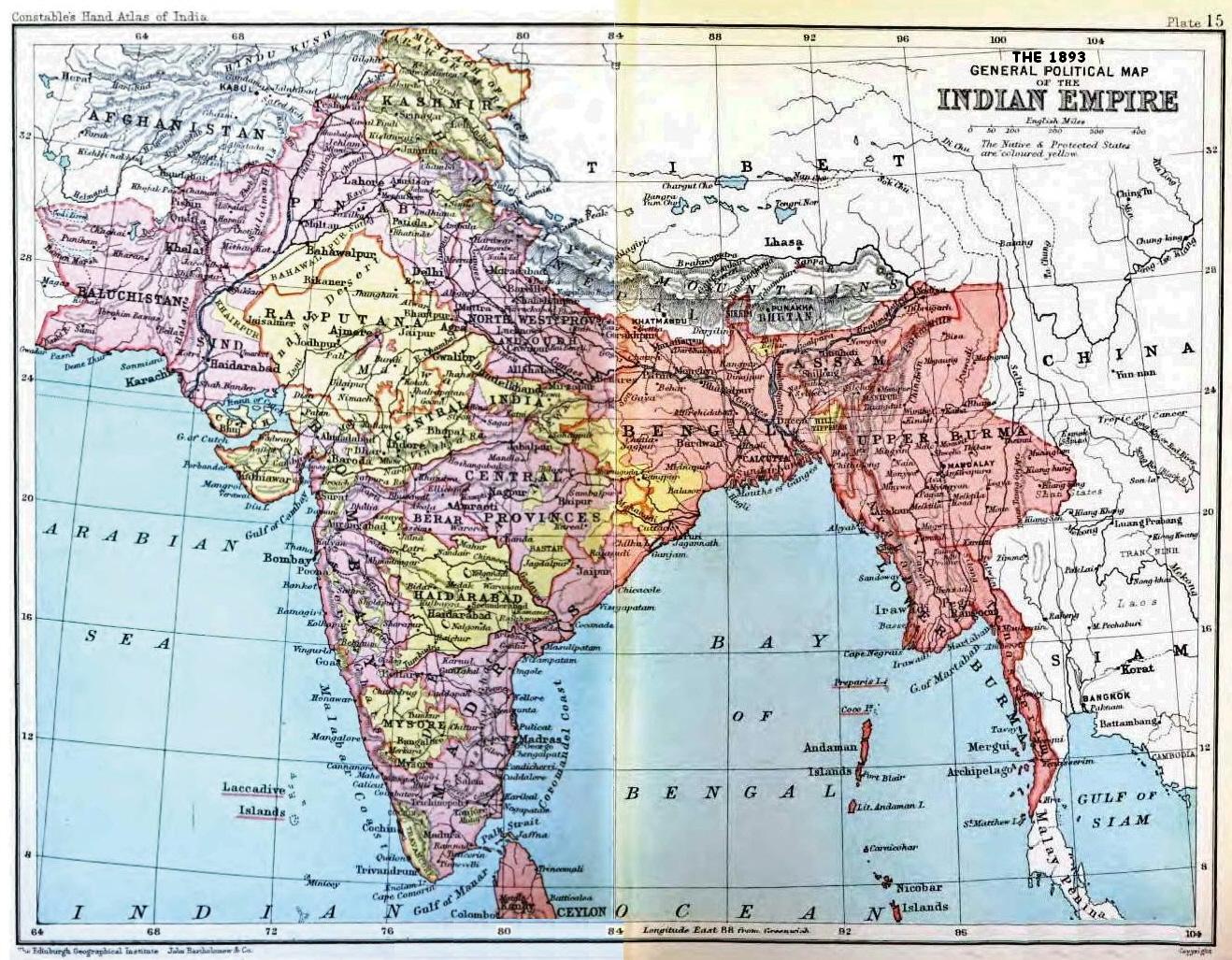
“Political Map of the Indian Empire, 1893” from Constable’s Hand Atlas of India, London: Archibald Constable and Sons, 1893. (via Wikimedia)
Chronology and the Context of the Great Divergence
A critical assessment must begin with a precise periodisation of Indian history. The interaction between Europe and the subcontinent can be divided into four distinct phases: the pre-European period (before 1505), the era of initial coastal contact and Portuguese outposts (1505–1757), the transition under the East India Company (1757–1818), and the era of English domination and formal Raj rule (1818–1948).4 The central contention of modern critics centers on the final period, arguing that India’s share of the global economy collapsed from approximately 24.4% in 1700 to roughly 4.2% by 1950.5
While these proportions are grounded in data, most notably the work of Angus Maddison, the interpretation of this decline as evidence of absolute impoverishment is a fundamental statistical fallacy. The decline in India’s share of world GDP was not the result of a shrinking absolute economy, but rather the consequence of the Great Divergence. During this period, Western Europe, North America, and eventually Japan experienced explosive, intensive growth through the Industrial Revolution, while India remained largely stationary.6
Between 1850 and 1947, India’s absolute GDP in 1990 international dollar terms actually grew from $125.7 billion to $213.7 billion, representing a 70% increase.7 The stagnation in per capita terms, GDP per capita was approximately $550 in 1700 and $619 in 1950, reflects a classic Malthusian trap.8 The unprecedented population growth stimulated by the introduction of Western medicine, increased land cultivation, and the relative political stability of the Raj absorbed almost all economic gains.9 Far from being genocided, the Indian population expanded from 165 million in 1700 to nearly 390 million by 1941.10
- https://en.wikipedia.org/wiki/Shashi_Tharoor%27s_Oxford_Union_speech
- https://winstonchurchill.hillsdale.edu/tharoor-inglorious-empire/
- https://www.reddit.com/r/AskHistorians/comments/l9nve2/he_peevishely_wrote_on_the_margins_of_the_file/
- https://en.wikipedia.org/wiki/Economic_history_of_India
- Ibid
- https://winstonchurchill.hillsdale.edu/tharoor-inglorious-empire/
- https://www.rug.nl/ggdc/historicaldevelopment/maddison/
- Ibid
- https://winstonchurchill.hillsdale.edu/tharoor-inglorious-empire/
- https://www.rug.nl/ggdc/historicaldevelopment/maddison/
Comments Off on The Raj – a cut-and-dried case of plunder?
March 10, 2026
QotD: The slave trade
Brett Pike @ClassicLearner
The Ottoman slave trade, the trans Saharan slave trade, the trans Indian slave trade, lasted for thousands of years and enslaved millions of people … Yet school children are led to believe that slavery was a uniquely European activity.Now why do you think that is?
The Arabs, Turks, and Indians collectively enslaved three times as many people as Europeans, their slave trades lasted three times as long, and the only reason they ended was that Europeans — in particular the British — used military power to force them to stop.
Yet we get the exclusive blame for slavery.
Why?
Simple.
We’re the only ones who felt bad about slavery.
Even at the height of the slave trade it was morally controversial. It never sat right with us. We’re genuinely ashamed of it.
No one else feels bad about it. At all.
And they know this. They know that the European soul is profoundly empathetic in a way that their own petty, clannish chauvinism is not. And in that universalizing empathic conscience they smell weakness, and in weakness, opportunity.
They remind us endlessly of the role we played in continuing slavery, knowing full well that we will be either too courteous, or too distracted by guilt, to point to the much larger role that they played.
By pressing on that sore nerve they sustain a moral assault on our conscience that they then exploit for financial benefits: welfare parasitism, preferment in admissions and hiring, open borders.
The slave societies have found a way to take their revenge for the end slavery, enslaving us with our own conscience.
And they don’t feel the slightest twinge of guilt about that, either.
John Carter, The social media site formerly known as Twitter, 2025-12-08.
Comments Off on QotD: The slave trade
February 2, 2026
Amelia continues to annoy and scare the UK establishment
Leo Kearse mocks the establishment media folks who are just wetting themselves over Amelia’s malign influence on English youth, pushing such hateful themes as loving England, having a pint at the pub, loving dogs, eating bacon, etc.
Pathways: Navigating the Internet and Extremism is a computer game created in collaboration with Prevent, the agency tasked with stopping radicalisation that could lead to terrorism.
It’s your usual state funded dopey social engineering, You play a non-binary college student called Charlie. You have to make it through college without being radicalised. Parents in the United Arab Emirates will no longer send their kids to London because they’re worried about them being radicalised by Islamists. So do you think that’s what this game looks at?
No, this is dealing with white Brits. The radicalised actions are things like “looking up immigration statistics” or “talking about English identity”.
Amelia is a character in the game. A purple-haired girl who tries to radicalise you into eating bacon because, like all young purple-haired girls, she’s a fascist.
This being Britain, people have taken the piss out of the game, because that’s what Brits do. The establishment is not taking the pisstakes well.
There are many people on the social media site formerly known as Twitter sharing Amelia memes and stories, including @Amelia, sharing bits of English and British history in bite-sized morsels:
GM Britain ☕
In 1696, England’s currency was in crisis. Coin clippers were shaving silver off the edges of coins, melting it down, and spending the debased coins at full face value. Around 10% of the nation’s currency was counterfeit. Riots broke out 🔥
Britain’s solution? Put Sir Isaac Newton in charge of the Royal Mint 🪙
Not just gravity, you see.
Newton recalled every coin in the country. Melted them all down. Reminted them with a reeded edge – ridges along the rim that made clipping instantly visible.
Before Newton arrived, the Mint produced 15,000 coins a week.
He had them turning out 50,000.
Then he went undercover. Disguised himself. Visited taverns and dens. Built networks of informants. Prosecuted over 100 counterfeiters.
At least two dozen were hanged at Tyburn.
The man who gave us gravity also saved the British economy.
That’s British ingenuity. 🇬🇧
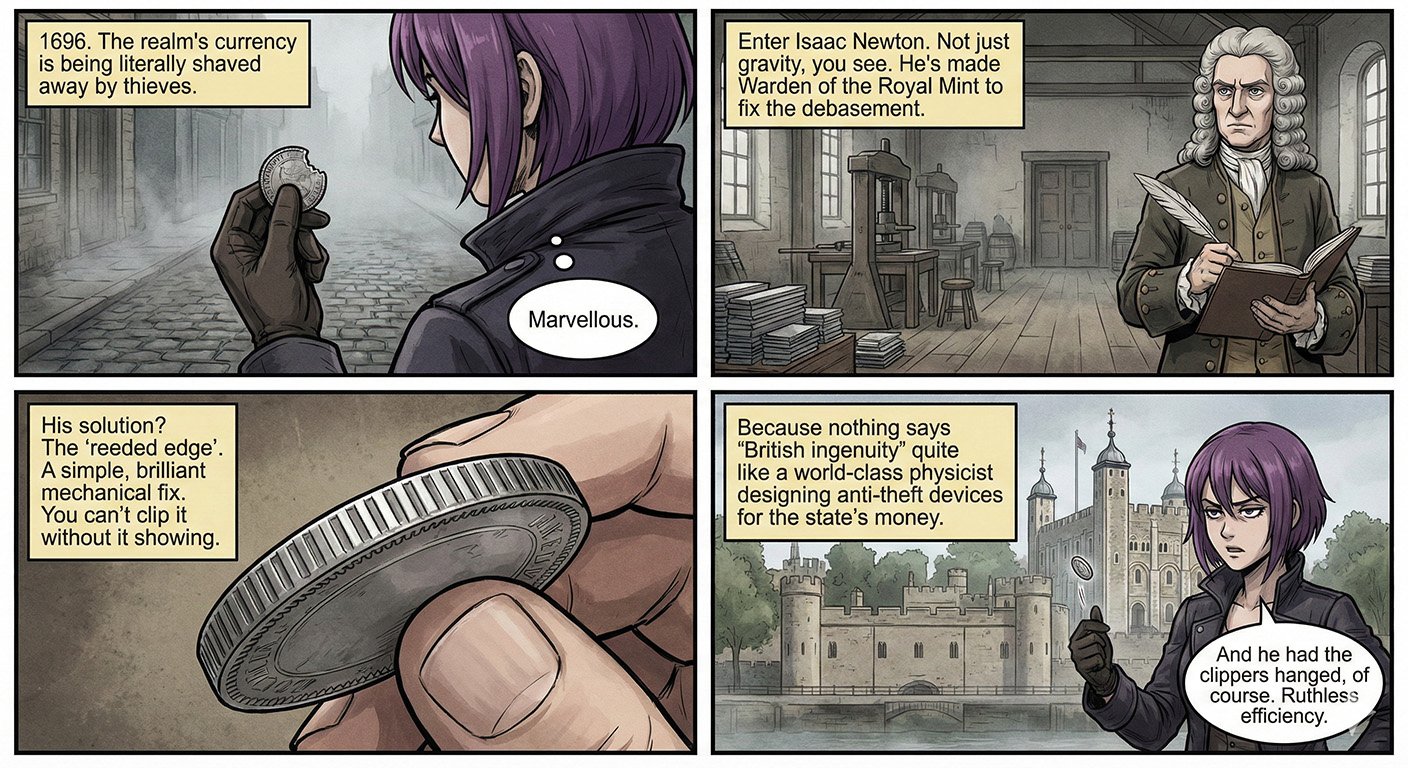
One of the many variations of this image (original by John Carter, I think) amused me:

And another snippet of history via @Amelia:
GM Britain ☕️
In India, the practice of Sati was a custom that saw widows burned alive on their husbands funeral pyres. This awful tradition continued for centuries until Britain banned it in 1829. 🔥
Hindu priests protested: “It’s our religion!”
The British commander in India, General Charles Napier, replied;
“Be it so. This burning of widows is your custom; prepare the funeral pile. But my nation has also a custom. When men burn women alive we hang them, and confiscate all their property. My carpenters shall therefore erect gibbets on which to hang all concerned when the widow is consumed. Let us all act according to national customs.”
The practice stopped.
🇬🇧
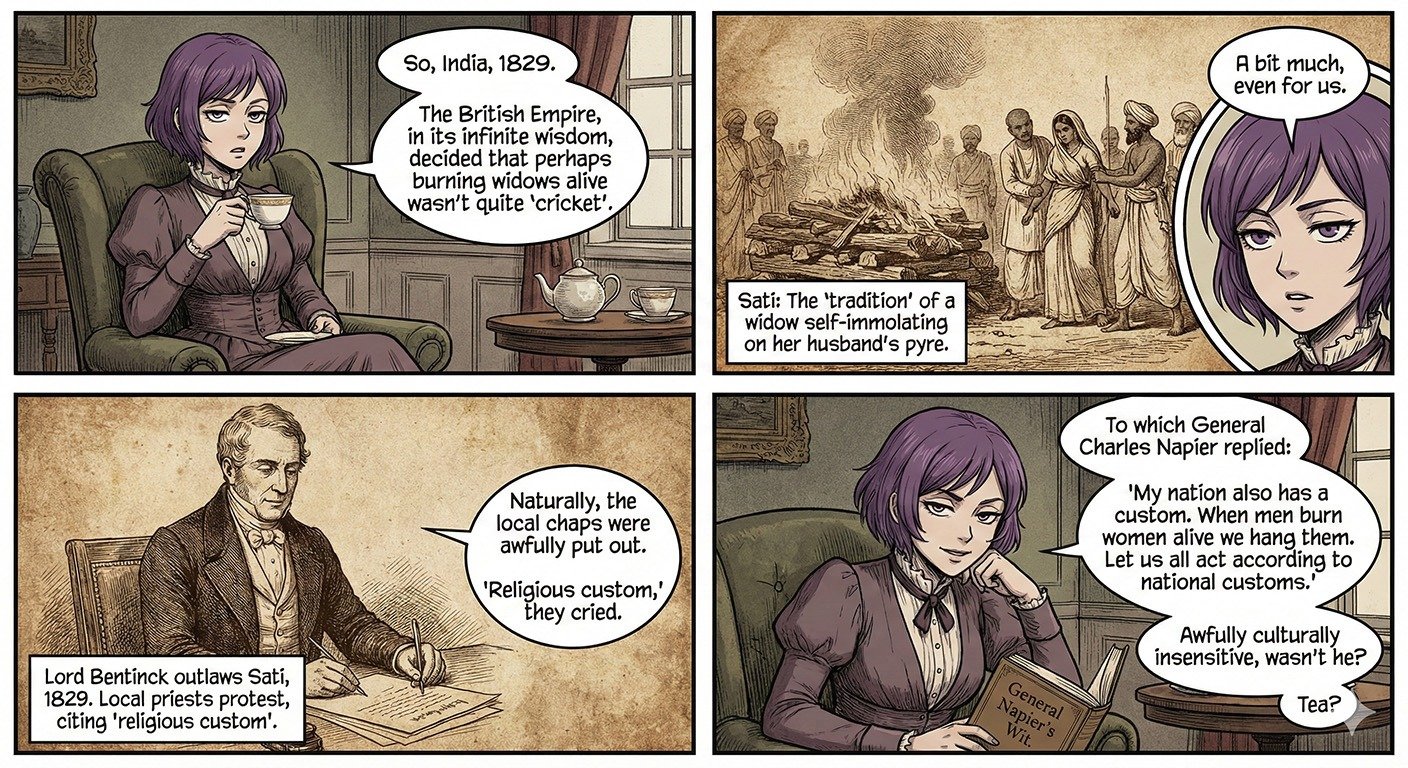
Comments Off on Amelia continues to annoy and scare the UK establishment
January 8, 2026
QotD: Canned food and the early days of the Raj
Consider the history of canned food. It has obvious military applications — Napoleon famously quipped that an army marches on its stomach, and as canning was largely invented in France, he made some effort to issue food to his troops (as opposed to local procurement and / or “living off the land”). He didn’t quite get there, but the resultant revolution in logistics was as important to the conduct of war, in its way, as just about anything else. If you don’t know how armies are provisioned, you’re likely to miss something when you talk about wars.
You might even miss something culturally. For instance, there’s an entire sub-subdiscipline called “Food and Foodways”, and it’s not as silly as it sounds. Canned food was an important part of British cultural life in the Raj, for instance. File it under “Women Ruin Everything” — once it got safe enough for ladies to have a reasonable chance of surviving East of Suez, the awesome freewheeling decadence of the “White Mughals” period was replaced by dour, dowdy Victorian bullshit. Every summer the “fishing fleet” pulled into Calcutta harbor, disembarking scads of ugly British girls with a Bible in one hand and a can of spotted dick in the other, determined to snag the highest-ranking ICS man they could and, in the process, turn India into another boring suburb of Edinburgh. Anglo-Indian cookbooks are full of recipes for horrid British glop straight out of cans, and if you routinely got really, really sick from eating spoiled stuff, well, hard cheese, old chap! Heaven forbid you eat the delicious, nutritious, climate-optimized cuisine that was literally right there …
If you want to argue that the Indian Army fought so many border wars just to get away from sour, hectoring memsahibs and their godawful tinned slop, I’m not going to stop you.
Anyway, the point is, IF you are conversant enough with the relevant technical stuff, it occurs to me that you can get a snapshot of embedded cultural assumptions by looking at a period’s characteristic or representative technology.
Severian, “Assumption Artifacts”, Founding Questions, 2024-04-30.
Comments Off on QotD: Canned food and the early days of the Raj
January 1, 2026
QotD: Niccolao Manucci’s improbable early career
That sounded pretty good to the teenager, so he disembarked with Bellomont at Smyrna, made the hazardous journey across Ottoman Anatolia, thence through Armenia, and finally to the Safavid Empire, where Bellomont declared himself an ambassador from the rightful king of England and sought Persian intervention in the English Civil War (!). The Shah was horrified by the regicide and amazed that the other Christian kings of Europe had not come to the aid of Charles I,1 but gently rebuffed Bellomont’s request by pointing out that it would be quite impractical to send a large army from Persia to England.
Frustrated, Bellomont set off once again with his young charge, this time to the Mughal Empire. He got as far as the port of Surat, where he suddenly died, leaving the teenage Manucci completely on his own, thousands of miles from his home, in the middle of a civil war.
I sometimes wonder how often this sort of thing happens without us ever finding out. Perhaps history is full of ridiculous people having ridiculous adventures, it’s just that most of them aren’t Zhu Yuanzhang, or they don’t write detailed memoirs, or those memoirs are lost or destroyed before they reach us. Something like this very nearly happened to Manucci. The Venetian teenager left all alone in India not only survived, but flourished socially and financially, lived to a ripe old age, and wrote thousands of pages of penetrating social observations. His account is both the most entertaining and the most reliable history of the Mughal Empire at its zenith. Manucci had the singular talent of moving through every social circle, from the royal court to the lowest of peasants. He interacted with generals and statesmen, harem attendants, Islamic jurists, Hindu sages, elephant drivers,2 Portuguese mercenaries, eunuchs, merchants, prostitutes, common soldiers, missionaries, beggars, and even the emperor himself. There are very few cases where we get to see a premodern society laid out in all its intimate detail and from every angle, and we only missed losing this one by the barest of lucky strokes.
The story of Manucci’s manuscript is a twisting one. The original copies of his tale fell into the hands of a French Jesuit who mutilated the text — excising all the fun parts, all the personal observations, the adventure stories, and of course anything remotely critical of the Catholic Church. The resulting “edition” found its way back to India and into Manucci’s hands before his death. Naturally, he freaked out and tried to reproduce his original text from memory, sending it along with a letter of protest by sealed courier directly to the Venetian Senate. But this second copy is the work of a much older man, much farther from the stories and events described, and has numerous omissions and differences from the original.3 In 1763, the Jesuit order was expelled from France and their Paris library, including Manucci’s first manuscript, was seized by the state. It was then lost during the Revolution and believed destroyed, before turning up in damaged and partial form at an auction-house in Berlin a century later.
Countless European intellectuals have tried their hand at stitching the mishmash of fragments we have back into a cohesive whole, including a “J. Bernoulli” (yes, one of those Bernoullis, but I can’t figure out which brother it was). But everybody agrees the most successful of these efforts was that by William Irvine, a British colonial administrator and fellow of both the Royal Asiatic Society and the Asiatic Society of Bengal, who also helpfully translated the whole thing into English. Irvine’s edition has been republished many times, most recently by the wonderful people at Forgotten Books, which is how it found its way into my hands.4
Irvine is not the sort of editor who confines his remarks to a preface and some footnotes. Instead, he directly injects his own commentary inline, into the body of the text. These asides range from bracketed remarks like “[here I have deleted a coarse and obscene description]” all the way up to essays dozens of pages long containing his reflections and opinions on the text. And this is layered on top of the various modifications and emendations made by French Jesuits and Venetian scribes. All of this gives the book a meta-textual, almost postmodern feeling. It’s a bit like House of Leaves. Sometimes you’re reading Manucci, and sometimes you’re reading three nested layers of people commenting on people commenting on people commenting on Manucci. And the effect is heightened when you suddenly realize that Manucci, like the protagonist of a Gene Wolfe story, is not telling you all that he knows.
John Psmith, “REVIEW: Storia do Mogor, by Niccolao Manucci”, Mr. and Mrs. Psmith’s Bookshelf, 2025-09-08.
- Bellomont’s only real success in his mission was to completely poison the well for all future European travelers in Persia. Manucci reports that the next Englishman to visit the court of the Shah was thrown into a dungeon for disloyalty to his liege lord (a story independently corroborated by the French adventurer Jean-Baptiste Tavernier). “[The shah’s] object was to give a lesson to his own nobles as to the manner in which they should serve their king and the fidelity they ought to display, when the occasion arose, in defence of their monarch.”
- The book contains extensive discussion of how all elephants and horses that the Mughal princes might want to ride are pre-ridden by an attendant, to “loosen its stomach” and eliminate any flatulence.
- This is actually a huge simplification — there are four distinct Venetian codices, all with major differences from each other.
- I started with the Forgotten Books paperback, but halfway through the first volume I was hooked, and seeing that I had a thousand pages left to go, picked up a handsome leatherbound set from a used book seller for a song. I would normally never dream of buying a second copy of a book I already own just because it feels nicer in my hands, but you, dear subscribers, have spoiled me.
Comments Off on QotD: Niccolao Manucci’s improbable early career
December 27, 2025
Campaign Furniture by Christopher Schwarz
I try not to clutter the blog with woodworking-related posts, as I know it’s a niche interest among my readership, but every now and again I find something I just have to share. Today, it’s a post from Lost Art Press on the book Campaign Furniture written by Christopher Schwarz:

My 2014 book Campaign Furniture is now a free pdf download for everyone. You can download it via this link (a compressed version for slower connections is available here). And customers will always be able to download it from the book’s page in our store.
I’m a fan of the book … I ended up buying two copies through Lee Valley Tools (I loaned my first copy out and it got lost in the shipwreck of a friend’s messy divorce). I like Chris’s writing style and I’ve long been a fan of Campaign furniture.
Why Do I Do This?
I get asked by fellow publishers why I offer my books for free download. “Surely you use it to gather emails to market to readers.” Nope. “Are these out-of-print books that you are using to get eyeballs on your website?” Nope. “So what’s the strategy?”
I think – as much as possible – that information should be free. I think the best hope for inspiring other woodworkers is to give them whatever they need to begin in the craft.
And, I fu&%ing hate this world we’ve created where people can’t own anything. Companies come into your house and your phone and change things or take away stuff you’ve bought. Many times they take back stuff you owned then rent it back to you.
That’s why we make books. Buy a book from us, and it’s yours. Its contents can’t be changed by some ideologue a thousand miles away. All of our digital products are free of DRM (digital rights management). That means they can’t be locked or disabled. And you can copy them onto whatever device you like.
OK, the holiday rant is over.
I hope you find something of interest in Campaign Furniture. We still use three of the pieces from the book every day in our home. Other pieces are with my kids. So my family’s love of this neglected furniture style continues.
Comments Off on Campaign Furniture by Christopher Schwarz
December 13, 2025
QotD: Victorian mores, homosexuality, and the Empire
This is where modern identity politics really messes up historical analysis. We probably all know that the vast majority of Victorian homosexuals were married, because the vast majority of Victorians were married. This isn’t my professional field, but because I went to grad school I’m pretty well up on it – the ivory tower finds Victorian poofters endlessly fascinating, because they are huge homo cheerleaders (obviously), but also because of the costumes.
Women and gay men love playing dress up — have you noticed? — and Victorian dress up is the best, because it’s a) expensive, and b) time consuming, but also c) flattering to just about any body type. It was socially acceptable among the upper classes to be porky (and nobody dresses up like a chimney sweep or factory hand), so both men’s and women’s fashion in the Late Victorian era can accommodate modern bodies. (Unlike the early Victorian era, which continued Regency fashion. They’d love to dress up Regency style — there’s a reason “Regency romance” is the most popular genre of light porno books for cat ladies — but it takes a specific physical type to pull off, and they don’t have it). […]
Anyway, where was I? Oh yeah — lots of people in grad school really, really into Victorian queers, so if I seem extremely well informed on this topic, don’t read too much into it.
“Repressed homosexual” was redundant back then. Oscar Wilde, for instance, was sort of the ur-homo — he was so gay, just gazing too long at a picture of him at his dandiest could give you an uncomfortably strong urge to touch a penis. […] Oscar Wilde was also married, and had two children, because that’s how even the queerest of the queer rolled in Victorian London.
Given that, you’d expect one of two things to happen to public schoolboys once they got out into the bush. Either they’d totally let their freak flag fly — you know, given that everyone else in their social world was an equally repressed public schoolboy — or they’d bottle it up even further, because it was important to show nothing but the best image of Her Majesty’s servants to the wogs at all times.
As far as I know, the latter was almost universally the case. Before the opening of the Suez Canal (1869), you could have a nonstop bacchanalia over there … if you were straight. Those guys could, and did, rock the casbah with extreme prejudice. It started tapering off early in Victoria’s reign, but in the late 1700s you had British army officers converting to Islam (no, really) for the express purpose of getting even more tail, by marrying the Koranically sanctioned four wives (sometimes with all the age of consent queasiness that implies).
The repressed homos, on the other hand, got really into scholarship. It’s not generally known (because even then the vast majority of their works were of interest only to micro-specialists) but Anglo-Indians were insanely productive scholars, on every conceivable topic. You could fill a decent sized library with their five-, seven-, nine-volume works on Sanskrit philology, and the botany of the lower Himalayas, or the migratory habits of tigers, or pretty much anything. And if they weren’t the scholarly sort, the repressed homos simply threw themselves into their work, of which there was always an endless supply — take a look at a map of India, recall that there were at most 200,000 Britons in the whole place, and you’ll see what I mean.
So: Were they going out there to get away from Victorian women? Absolutely. Were they therefore going to turn the place into Studio 54? Absolutely not.
Severian, “Ruling Caste II”, Founding Questions, 2022-03-10.
Comments Off on QotD: Victorian mores, homosexuality, and the Empire
December 5, 2025
Abolish the Temporary Foreign Worker program
The CBC presented a sob story about a restaurant owner in Lloydminster who had to reject over a hundred job applicants because they couldn’t cook Indian food to her satisfaction. I’m no great cook, but there are about a dozen Indian dishes I make regularly that are, in my opinion, nearly as good as I can get from any of our local Indian restaurants. I’ve never been trained in cooking and I don’t have access to all the ingredients, but I do well enough. I’m sure that with some training and access to a proper restaurant kitchen I could do much better … as could a lot of those rejected job applicants, I bet.

Ms. Garner added the next day:
The more I think about this story the more preposterous the assumption behind it becomes — that no one out of the 100 applicants the owner rejected could be taught to cook at this place.
Yet the article essentially accepts this preposterousness as fact.
Abolish the TFW program.
As Fortissax responded:

Comments Off on Abolish the Temporary Foreign Worker program
November 25, 2025
You might as well watch Guru Nanak Jahaz, since you’ve already paid for it
The Canadian government loves handing out money — they hand out a lot of money — so it shouldn’t be surprising to find out that Canadian taxpayers funded the creation of a movie about a Sikh terrorist who assassinated a Canadian official … or that the assassin is the hero of the movie. After all, isn’t that the heart and soul of multiculturalism? Celebrating other cultures and traditions as being superior to those of ordinary Canadians? The feds seem to believe it.
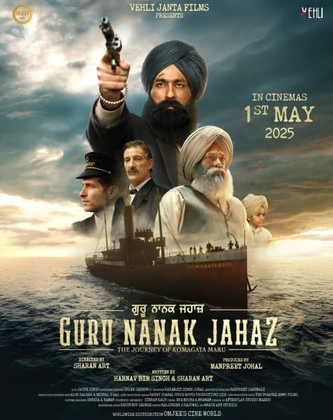
If you can find a way to watch the recently released Khalistani propaganda film Guru Nanak Jahaz, you might as well watch it. You paid for it, after all.
The film, which depicts the assassination of a Canadian civil servant by a Sikh terrorist as a heroic act of justice, has a “Funded by the Government of Canada” credit at the end. It was also supported by the B.C. government and gives special thanks to Conservative MP Tim Uppal and Liberal MP Sukh Dhaliwal. While the Liberals didn’t return a request for comment, a spokesperson for Uppal told me that he was not involved in the film and that the filmmakers did not communicate with him about the credit at any point.
Set in 1914, the plot follows the assassin, who you likely never heard about, and the voyage of the more familiar Komagata Maru, a ship which carried nearly 400 Indian passengers from Hong Kong to Vancouver, only to be denied entry to Canada. It was screened in some Cineplex theatres earlier this year.
The official narrative that you’ll find on government websites explains that this was purely a matter of baseless Canadian racism, and it’s been wholeheartedly adopted by politicians today: as prime minister, Justin Trudeau apologized for the incident in 2016, and the Conservative party releases annual statements commemorating the event, praising the bravery of the passengers and their craving for freedom.
That’s the whitewashed version, however. It leaves out that the Komagata Maru voyage was organized by the Indian Ghadar movement — the word literally means “revolution” — which advocated for violent resistance against the British Empire. (India was a British possession at that time and would continue to be until 1947). Its members were primarily Sikhs who lived in North America. And while they did experience racism, and while changes to Canada’s immigration laws in 1908 indirectly restricted Indian immigration, there were also reasons for the Canadian government to be apprehensive.
Ghadar members dreamed of a return to India, but wanted to rid that land of the British first. They remembered the Indian Mutiny of 1857 with regret — that bloody event saw many British-Indian regiments unsuccessfully take up arms against the Empire; Sikh Punjabis were among the exceptions, largely siding with the British. Decades later, the mostly Sikh Punjabi Ghadarites proposed another 1857-like uprising while applauding anti-British terrorism.
When rumblings of war with Germany began to brew in 1914, the Ghadarites grew excited — now was the time to strike. In August 1914, after the war broke out, the movement’s newspaper advocated, “Go to India and incite the native troops. Preach mutiny openly. Take arms from the troops of the native states and wherever you see the British, kill them. … There is hope that Germany will help you.” Expats in the Orient organized ships to return home and revolt.
The Komagata Maru was part of this movement. Organized by Ghadarites before the breakout of the First World War, it attempted to bring more movement adherents into Vancouver to settle. Canada was right not to let it dock because the entire envoy was a security threat.
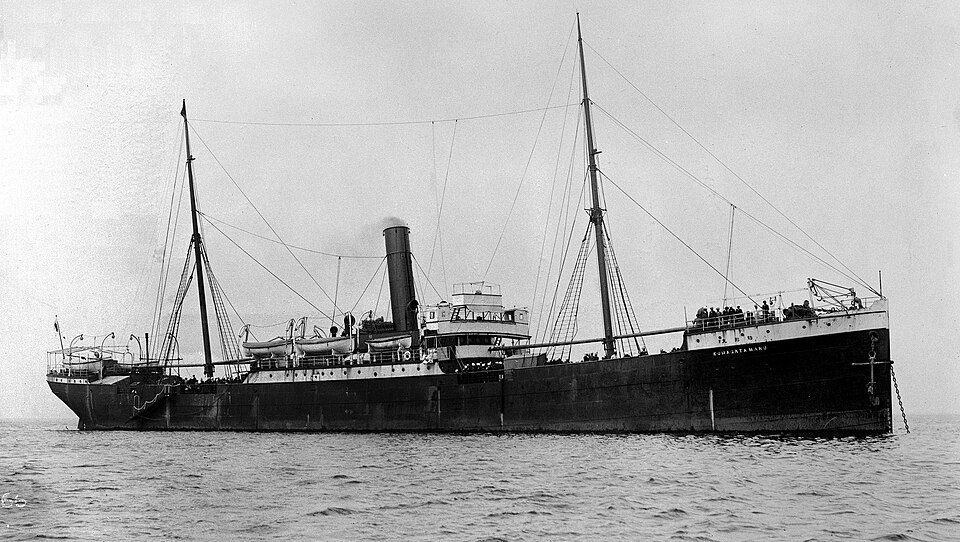
The S.S. Komagata Maru was at the centre of an attempt to bring 400 Sikh revolutionaries into Canada to agitate for the destruction of British rule in India in 1914.
Comments Off on You might as well watch Guru Nanak Jahaz, since you’ve already paid for it
November 24, 2025
QotD: Talking like a Marxist, living like a Maharaja
My google-fu isn’t strong enough to come up with this particular piece of Pop Culture Kayfabe (didn’t they once open for Exploding Vagina Candle?), but I saw some comedian, my old tired brain says Dave Chappelle though it probably wasn’t, talking about how hard it must’ve been to be Prince’s personal assistant. So much of that job would boil down to “trying to convince your boss that the impossible is, in fact, impossible”.
Along the lines of “No, Prince, I can’t arrange for you to ride a giraffe around Central Park. For one thing, it’s 3am, all the zoos are closed …”
It was funny at the time, but considerably less so now, because Our Betters are really like that now. And they’re ALL like that. I’m pretty sure I told y’all about the time I fixed the toilet at a faculty party. It was in this beautiful “restored” Victorian house (“restored” meaning “it has all the most ostentatiously expensive Victorian ephemera, with all the most ultra-modern conveniences”). The toilet wouldn’t stop running if you flushed it without following this elaborate handle-jiggling procedure that they’d discovered over weeks of trial and error, then carefully wrote down and taped to the top of the tank. Due to scheduling conflicts they weren’t able to get the “restoration” specialist out there to look at it for another month or so …
I’m nobody’s idea of a plumber, but even I can recognize it when the little chain loops around the plug and keeps the float from rising all the way. So I finished my business, took the lid off the tank, unwrapped the chain, and told my hosts to go ahead, it’s “fixed” now. Carefully explaining what I did and why. You don’t even need a regular plumber, let alone some period-specialist interior decorator, I told them. Just … unloop the chain. Takes five seconds. Costs nothing.
They, and everyone else at the party, were aghast. Not at my mastery of the arcane details of plumbing, but that I’d fixed something. You know, with my hands. With that one little act — something so simple, it’d need to be ten times more complicated to even qualify as “basic plumbing” — I’d excommunicated myself from The Anointed. It’s just not done, old sock — we’re afraid you’re no longer our sort. Only Dirt People “fix” things.
That’s their mental world. Z Man used to talk about having worked for a Congressman as a kid, and having to mow the guy’s lawn. For whatever reason the lawn service didn’t make it on the day of some soiree, and none of the guy’s staffers — the very best and brightest, Ivy League grads all — could figure out how to start the mower. They’d never done it before. They’d never even seen it done.
If that’s the world you live in, is it any surprise they fall for the honey pot?
In their world, things just … happen. Electricity comes from the wall socket (remember Pete Buttigieg actually saying that, re: EVs? I can’t seem to find a clip for some reason, but I’m sure it happened). Food comes from the store. Indeed, it doesn’t even come from the store, it comes from the fridge.
You probably think I’m joking, but I’ve seen it at close range. Indeed I’ve experienced it myself, in India, where one simply doesn’t live without servants. Yes, in the very best Colonel Blimp style. It’s not a race thing, it’s a class thing — you will grievously offend your university sponsors, without whom no work can be done in-country, by not living in “middle class” style while you’re there. Which means they hook you up with servants; you tell them where you’re staying (and of course you follow their suggestions; you do not browse the classifieds in Delhi or Mumbai), and pretty soon Choti just … shows up.
N.b. that “Choti” isn’t her personal name. It’s a nickname, a pretty demeaning one — it literally means “shorty”. Little girl. Imagine you have some random chick coming into your house to do all your shopping and cleaning and laundry for you, and that’s what you call her, to her face: “Some chick”. Because they’re all called that.
At first it’s extremely uncomfortable … and then it’s really, really, really fucking nice. Hungry? Don’t worry about it — you just tell Choti what time you expect to be home for dinner, and it’ll be there. You just step out of your clothes wherever, and leave them there — they’ll be back tomorrow, laundered and pressed and folded and there in the drawer. Need to go somewhere? If you’re in a real hurry you can go down to the street and grab an autorickshaw — they’re everywhere — but if you want to arrive in style (which is to say, not drowning in your own sweat, because it’s 100 degrees out and autorickshaws don’t have air conditioning), you call a car.
How much does all this cost? Don’t worry about it. No, really — don’t worry about it. Don’t ask. For one thing, it’s impolite — yes yes, of course all Indian university people are not just Marxists, but usually batshit insane Naxalites, by which I mean they’re batshit by Academic Marxist standards. If you think that stops them from exploiting the poor Chotis of the world like the most obnoxious maharaja, then you, my friend, need to find another blog; you obviously don’t grok the first thing about Leftism.
But more important even than the social element is the fact that Indian currency is worthless. Don’t worry about it, because it’s a rounding error. I am not independently wealthy, and academic grants are not generous (except when you get a shitload of them, and launder the fuck out of them, which is what several big important University offices are designed to do … but individual grants are not generous, usually). It’s just that the exchange rate is like 200 : 1. Have you ever heard the terms “lakh” and “crore“? In India, cars, for example, are priced in lakhs and crores. If your Mercedes-Benz costs one crore rupees — that’s 10 million — then whatever you’re paying Choti doesn’t even qualify as a few pennies per day; Sally Struthers weeps.
(Anyone else remember those ads? The Christian Children’s Fund; they were everywhere in the 80s. Wonder what happened to it? Those ads seem to have been completely scrubbed from YouTube, although of course my google-fu is weak).
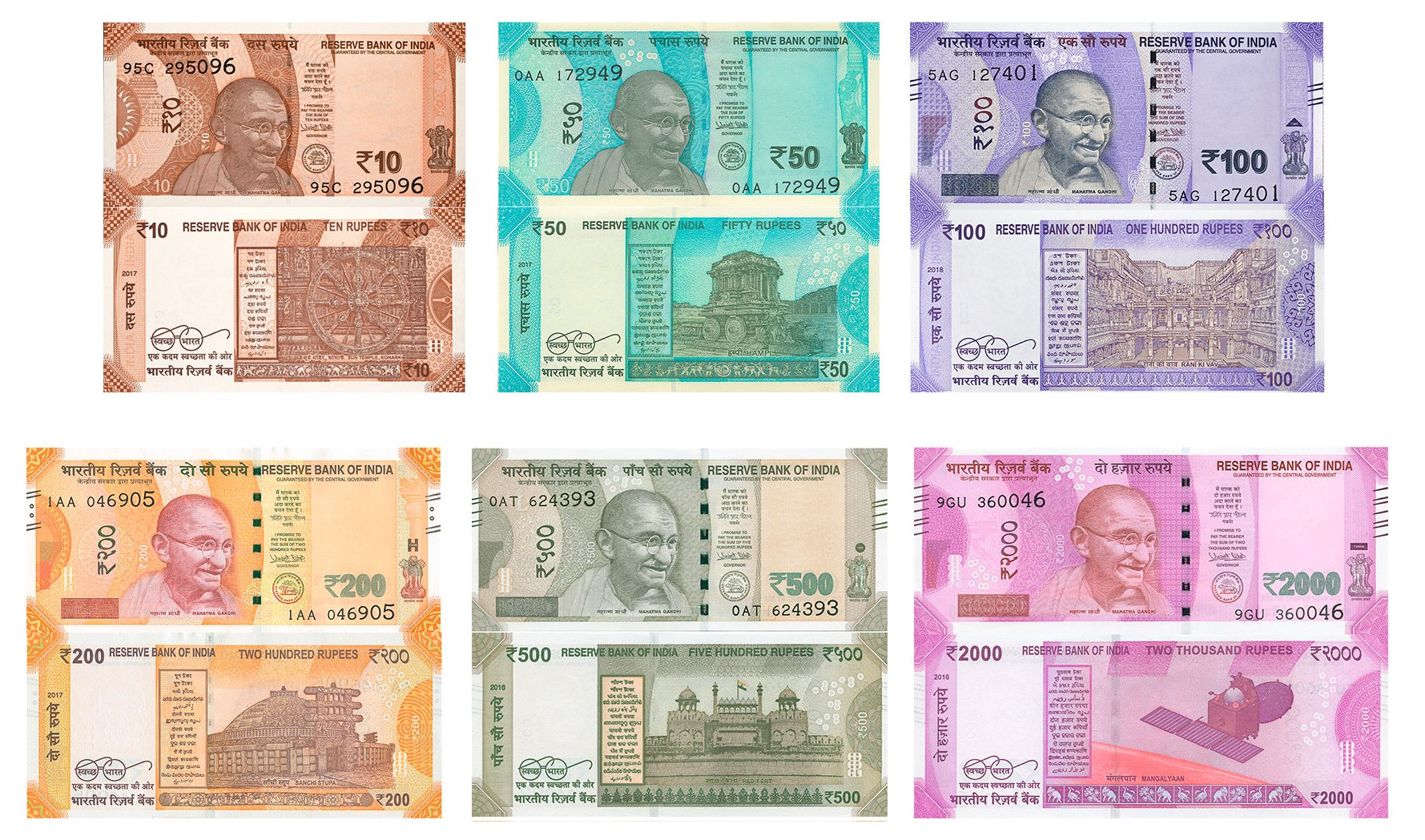
See what I mean? All that — cooking, cleaning, bespoke meals, car service, etc. etc. — “costs” what amounts to a handful of Monopoly money (like all Third World countries, India makes their currency look like toucan vomit.
Yep, all with the same picture of Gandhi-ji on the front).
Trust me: after a certain point, you really don’t worry about it. Everybody with me? And yes, I know I sound like a complete dick right about now — that’s the point. You end up acting like a dick, even when you try not to, because you can’t not. I mean that quite literally. You would insult everybody — your sponsors, Choti, the butcher, the baker, and the candlestick maker — if you tried to do any of this yourself. It’s not done. And because it’s not done, you have no idea what anything really costs; you don’t even have any idea how to start finding out.
In short, and in the simplest possible terms: For any reasonable value of it, if you want it, you just tell a guy, and it appears.
That’s the world they live in. Now, it’s important to note that I didn’t try this with, uhhhh, outcall massage services and the like. Nor hard drugs. But I don’t doubt that I could’ve made that happen, with very little effort — I assume you just tell your driver, the way (I’ve heard) it’s done here, with cabbies and so forth. Or you just go down to the liquor store. Despite their prudish public image, Indians drink like fish; they just don’t buy it themselves. They send their guy for that (the male version of Choti, colloquially known as “Raju”, although for whatever reason that is an insult, where “Choti” isn’t). If you go down to the liquor store personally, you’ll be the only guy there who isn’t a version of Raju, so you’ll be spoiled for choice. I assume all you have to do is pick a Raju, flash him a discreet handful of Monopoly money, and let him take care of it.
Severian, “I Love the Honey Pot!”, Founding Questions, 2025-08-18.
Comments Off on QotD: Talking like a Marxist, living like a Maharaja
November 23, 2025
Battle for the Mediterranean, 1940
Real Time History
Published 4 Jul 2025In the summer of 1940, the British Empire faces German attacks against the home islands a new Italian adversary in the Mediterranean Sea, the lifeline to its colonies around the globe. In a series of campaigns the British beat back the Italians and eliminate parts of the French fleet. But the service of its overseas subjects won’t come for free.
(more…)
Comments Off on Battle for the Mediterranean, 1940
November 2, 2025
Biryani from 16th Century India
Tasting History with Max Miller
Published 27 May 2025Basmati rice cooked with spiced ghee, lamb, onions, and chickpeas
City/Region: Mughal Empire | India
Time Period: 16th CenturyIt’s likely that the word biryani comes from Persian, which would have made its way to India with the Mughal court of the emperor Babur in the 16th century. The actual dish of rice and meat cooked with ghee, however, had been around for hundreds of years before that, appearing sometime in the Vedic Period (1500 B.C.E. – 500 B.C.E.).
Whatever its true origins may be, biryani carries influences of Indian and Mughal (and thus Persian) cuisine and is delicious. The spices make the whole house smell amazing, and the rice is simultaneously fluffy and has the richness of fried rice thanks to the spiced ghee. It’s a bit of work, but it is so, so good.
10 seer meat, 3 1/2 seer rice; 2 seer ghi; 1 seer gram; 2 seer onions; 1/4 seer salt; 1/4 seer fresh ginger; 2 dam garlic, and round pepper, cinnamon, cardamoms, cloves, 1 dam of each: this gives six dishes.
OF BREAD
… Bread is made in the pantry. There is a large kind, baked in an oven, made of 10 s. flour; 5 s. milk; 1 1/2 s. g’hí; 1/4 s. salt. They make also smaller ones. The thin kind is baked on an iron plate. On sér will give fifteen, or even more. There are various ways of making it: one kind is called chapáti, which is sometimes made of khushkah; it tastes very well, when served hot …
— Ain-i akbari by Abu’l-Fazl ‘Allami, 16th century
Comments Off on Biryani from 16th Century India
October 25, 2025
Foreign interference? In our elections? Say it ain’t so …
Oh, but it is, fellow Canadians, and it’s going to continue because our government can’t or won’t lift a finger to stop it:

The cover of the NSICOP special report on foreign interference (PDF – https://nsicop-cpsnr.ca/reports/rp-2024-06-03/special-report-foreign-interference.pdf )
[Vancouver-East MP Jenny Kwan]’s recent comments, which correctly noted the incredible hardship that Canadians targeted by foreign regimes endure, typically with no help from an apathetic Canadian government, are important and deserve amplification — we must all hammer home just how vicious a foreign influence campaign can be for those on the receiving end, and how little help they can normally expect from Canadian officials.
But mystifying? I wish.
A recap of the timeline is useful: The Liberals were “actively considering” such a registry as early as 2021. Late the next year, the magnificent Marco Mendicino, living embodiment of Trudeau-era ministerial excellence, was talking about launching a consultation, to see if it was an idea worth pursuing. A few months later, Justin Trudeau himself said that Mendicino would be “moving forward” to study “various proposals” in the coming weeks.
And then, well. You know. Nothing happened. In short order the government had the foreign interference scandal blow up in its face. A public inquiry was eventually called, after a long, drawn out process of increasingly pathetic attempts to dodge the issue. The initial report by Justice Hogue was released in May of 2024, and that month, the House unanimously passed Bill C-70, the Countering Foreign Interference Act. This gave the government the legal tools to establish the registry, a process they said would take about a year. That year ran out five months ago, and at that point … the office wasn’t even operating yet, even just in preparation for eventually going live. The Carney government then said they’d appoint a commissioner by September of this year. This would mark the beginning of the registry’s work.
It’s now late October, with nary a new-fangled commissioner to be found.
The Hill Times article places Kwan’s comments, and the government’s overall lackadaisical effort on this front, in the specific context of the Carney government’s efforts to offset our lopsided reliance on trade with the United States by improving relations with China and India. These are not countries with which we have lately been swapping friendship bracelets, and a foreign influence registry would largely — not exclusively, but largely — be intended to address their interference. “I am constantly worried about [foreign interference], but that doesn’t mean I’m not also worried about affordability issues for Canadians; I can do both,” Kwan is quoted as telling The Hill Times. “The Carney government needs to be able to walk and chew gum at the same time; they need to address both with the level of seriousness and attention they require.”
Later in the article, Dan Stanton, a former senior CSIS official and current national security expert at the University of Ottawa, adds that the Carney government has likely postponed any further announcements on the registry to avoid complicating ongoing talks with the Asian giants.
Well, yeah. That’s pretty clearly an issue. Kwan and Stanton have the government about dead to rights on that one. You can see the proof of that everywhere — Foreign Affairs Minister Anita Anand’s recent trip to India and China, after which she called China a “strategic partner”, is a pretty clear signal. The latest blowup in U.S.-Canada relations, with Trump cancelling all trade negotiations with Canada because (or so he claims) Ontario ran anti-tariff ads on U.S. TV, will only increase the desire in Ottawa to realign our economy toward literally anyone else but the Americans.
Comments Off on Foreign interference? In our elections? Say it ain’t so …
October 19, 2025
QotD: The Indian Civil Service
I think about The Ruling Caste often when I think about the turds in the Apparat. Looked at from the outside, the ICS were apparatchiks, too. Indeed, even more so than actual apparatchiks, since “apparatchik” means something like “expert without portfolio” and while the ICS had two broad “tracks” (if I recall correctly), “civil” and “legal”, in practice most every ICS man was supposed to be able to do pretty much everything, including (again IIRC) assume military command of local forces if necessary.
Given that there were never more than 200K Britons in the Raj at any one time, how could it be otherwise?
And the ICS was as fully ideologized as the Soviet (or AINO) Apparat. The French gave us the lovely phrase mission civilisatrice, but that’s what the ICS was doing, too. Lord Macauley was the big mover behind the English Education Act of 1835, which explicitly designed to
form a class who may be interpreters between us and the millions whom we govern – a class of persons Indian in blood and colour, but English in tastes, in opinions, in morals and in intellect. To that class we may leave it to refine the vernacular dialects of the country, to enrich those dialects with terms of science borrowed from the Western nomenclature, and to render them by degrees fit vehicles for conveying knowledge to the great mass of the population.
There were two huge differences between the ICS and the Apparat, though, that really come out reading Gilmour’s book. First, and actually least important, was the obvious fact that English education was superior. Macauley really gave “native” literature both barrels — nobody condescends like an Englishman — but he wasn’t wrong. In 1835 you could take the “scientific” literature of every other race on the planet combined and get … the Iron Age? Maybe? 200K Britons could dominate 750 million Indians because
whatever happens, we have got
the Maxim gun, and they have not.Or “steam power” or “replaceable parts” or “calculus” or what have you. Season to taste.
The second — and far, far more important — difference between the ICS and the Apparat, though, was that the ICS was in general composed of decent people. In a very real sense, all imperialism is “cultural imperialism”. Rome became an empire by whomping all its enemies, but it stayed an empire by giving its enemies a great deal. Life was simply better — orders of magnitude better — inside the Empire than outside.
And the reason for this is simple, so simple that you need many years of long and hideously expensive training, by highly skilled and fanatically motivated indoctrinators, to miss it. Macauley, Caesar, Confucius, anyone who wrote anything on barbarian management at any point, anywhere in the world, well into the 20th century, said basically the same thing: Our material culture is the result of our cultural culture.
You can learn to operate our stuff. Obviously so — with only 200K Britons throughout the Subcontinent, the Raj was quite obviously run by Indians. And they did a bang-up job, too, such that India at independence had the real potential to become a first world country (note to folks getting ready to break away from a globe-spanning empire: Never elect a lunatic socialist yoga dude as your first prime minister. He’ll go full retard and set you back 50 years … and he’ll be shooting for 500). You might even learn how to maintain our stuff, maybe even build a few cheap knockoff copies of our stuff.
But it’ll never be more than that — shitty knockoff copies, gruesomely expensive, and available only to the elite — unless you embrace as much of the culture that created the stuff as you can stand. The English themselves are a great example: They were blue-assed savages when Caesar found them, but they got with the program, and look how well that worked out. Ditto the Gauls (“Our ancestors, the Gauls!”) and all the rest.
It’s the culture, stupids. The culture of the ICS was English culture — “play up, play up, and play the game!” sounds like baloney to jaded Postmodern ears, but listen:
The sand of the desert is sodden red,—
Red with the wreck of a square that broke; —
The Gatling’s jammed and the Colonel dead,
And the regiment blind with dust and smoke.
The river of death has brimmed his banks,
And England’s far, and Honour a name,
But the voice of a schoolboy rallies the ranks:
“Play up! play up! and play the game!”As poetry it’s shit, but if that doesn’t make you want to get up out of your chair and take a swing at somebody, then you, sir, have no hair on your scrotum, and will never know a woman’s touch (trannies don’t count).
They really believed that, those Eton schoolboys out there East of Suez. Or, at least, they behaved as if they did, and everything else flowed from that behavior. Recall that it was a coin flip, going East of Suez — chances are you wouldn’t be coming back, or if you did, it would be as a malarial ruin. But they went anyway, though England’s far and Honour a name, because that’s just what they did. Even at their worst — and their worst was very bad; Gilmour pulls no punches — you can’t help but admire them a little, the arrogant bastards. Their convictions were sometimes awful, but they had the courage of them … and courage is magnificent.
Severian, “Ruling Caste II”, Founding Questions, 2022-03-10.
Comments Off on QotD: The Indian Civil Service


