
The causes of the Indian Mutiny of 1857 are many and varied — there’s a whole separate wiki article on it — but the one “everyone knows” is the cartridge to the Enfield rifle. The Enfield was a muzzle loader. The soldier had to tear the cartridge with his teeth in order to load it. The cartridges were greased with a mixture of cow fat and lard. That was the rumor, anyway, and since Indian soldiers (called “sepoys”) were primarily Hindu and Muslim, biting the cartridge would violate everyone’s ritual purity.
This is a near-perfect synecdoche for the Raj’s problems. British Army officers weren’t stupid — lots of them commented on the issue. But they were isolated. For one thing, lots of them weren’t regular army — they were attached to the East India Company army, a separate formation, and within the Company’s army were different formations with different service requirements. And the army — whichever army — was deeply isolated from the civilian administration. For one thing, India’s huge, and there were never more than about 200,000 British in the whole place. The army was mostly on the frontier; the Government hung around primarily in a few big cities: Bombay, Calcutta, the summer capital at Simla (way up in the Himalayas).
So stop me if this sounds familiar: The civilian administration didn’t really know anything about the group upon which their peace, their security, their very lives depended. Actively despised them, in fact — oh, those wogs and their silly customs. But also look at it from the bottom up: What could the civilian administration really have done, with the best will and deepest knowledge in the world? […]
What could the leadership really have done at that point? Send a select group of brahmins and imams to tour the grease factory? The rumor would be that the British set up a Potemkin factory just for them; the real factory was using cow and pig fat. Reissue the old rifle? Recall that they already changed their drill — a pretty big deal in any army; a huge deal in a mid-19th century one — and that just added to the paranoia. Anyone who has ever been on the Internet knows how these things work once they get started: Evidence of an evil conspiracy is evidence of an evil conspiracy, but no evidence of an evil conspiracy is even more evidence of an evil conspiracy!
The root cause of the Mutiny, in other words, wasn’t political or economic (despite what Karl Marx said). It wasn’t even “cultural” in a lot of senses, and you can tell by the actions of the mutineers — or, rather, the non-actions. They simply had no idea what to do. They had no leadership (though some of them tried to install one of the remaining Mughal rulers in Delhi as an expedient; there’s a great book about it). The “Mutiny” was really just generalized beefing and score-settling on a continent-wide scale. They all had grief with the British, of course, and that was a convenient rallying cry. Once the British were gone — and see above, there were never very many of them — the guys down south quickly realized they had nothing in common with the guys up north. Ditto the guys on the east coast, the west coast, the hill country, the jungles …
Again, stop me if this sounds familiar: Stuffing a bunch of alien groups together inside artificial boundaries under a capricious, purposefully out-of-touch “government” that obviously hates every single one of those alien groups more than each one of the groups hates all the others, is kind of a bad idea. With the exception, of course, of that capricious government’s goon squad, the one group they obviously favor because that group can be counted on to knock heads on all the other groups whenever the government lets them off the chain (I’m talking about the Sikhs, obviously).
It doesn’t matter, in other words, what the rifle cartridges were greased with, or if they were greased at all. In this historical timeline, the precipitating cause of the Sepoy Rebellion was “the Enfield Rifle”. In the next timeline over, it’s something else — something equally minor — but the rebellion still happens, at pretty much the same time and in pretty much the same way.
In other words: It’s not that the British were alien to their subjects. Most groups in most places have been ruled by aliens, and trust me, the brahmin caste is far, far more alien to the castes below it than the British were to all of them combined. Nor was it that the British were high-handed administrators, as incompetent as they were arrogant. They were actually pretty good administrators, all things considered — “government competence” is always one of life’s lower bars, but the Raj cleared it easily. The guys running the “princely states” that made up the majority of the “British” Raj were every bit as alien to “their” people as the British, and in general spectacularly incompetent too.
Severian, “The Ruling Caste”, Founding Questions, 2022-03-09.
October 1, 2025
QotD: The Indian Mutiny of 1857
September 19, 2025
Edmund Burke, lawfare, and the East India Company
In The Coolidge Review, Amity Shlaes discusses “the most outrageous campaign of lawfare in the history of the Anglosphere”, as Edmund Burke assailed Warren Hastings, the first governor general of India:
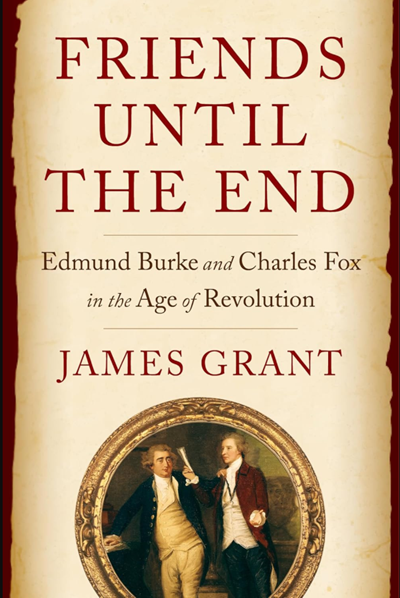
Why do even principled statesmen — and there are some in this administration, too — not dig in their heels and try to arrest the chain of revenge? Why do even cautious, logical men and women succumb to the passion of lawfare?
The most outrageous campaign of lawfare in the history of the Anglosphere, the impeachment and trial of the first governor general of India, Warren Hastings, was mounted by Mr. Incrementalism himself, Edmund Burke. The father of modern conservatism spent nearly a decade of his time in Parliament—from 1787 to 1795—crusading against Hastings, antagonizing allies all around.
Impeaching the “Wicked Wretch”
There were reasons to investigate what was going on in India: Hastings exploited the fact that the East India Company was, at that time, an adjunct of the Crown. That connection between a powerful company and a government — a far more powerful company than, say, Intel — was the trouble, for as Burke would put it, it created “a state in disguise of a merchant“.
Burke chose to prosecute Hastings — and failed. The “wicked wretch”, one of Burke’s slime phrases for Hastings, emerged from the ordeal with a pension, not a conviction. Burke biographer Russell Kirk has argued that the public flaying of Hastings served posterity — in England at least. After Burke’s death, at “every grammar and public school”, the story of Burke and Hastings “impressed upon the boys who would become colonial officers or members of Parliament some part of Burke’s sense of duty and consecration in the civil social order”. That slowed another chain, the chain of abuse by Britons of Indians. After Burke, England recognized that, as Kirk puts it, she had a “duty to her subject peoples in the East”.
Still, even Kirk’s excellent biography leaves readers wondering: Was Hastings truly the archest of the arch villains, as Burke maintained? And is this the right way to go about it all? A book that Burke penned in the same years that he waged his Hastings war, Reflections on the Revolution in France, influenced a far greater number, and in a greater number of lands, than the Hastings story. Burke might have had the same reach with a Reflections on the Abuses of the East India Company.
All the more welcome then is James Grant’s Friends Until the End, which gives the best-yet account of the chain reaction in Burke’s soul that drove him to weaponize government, what his crusade cost him, and what such crusades may cost all of us.
[…]
Next, however, came a challenge that deeply frustrated Burke. Scanning the empire’s horizon for a place to commence a model reform, Fox and Burke settled on the East India Company, which abused the some thirty million Indians it oversaw with the same admixture of plunder, condescension, and cruelty familiar to Catholics of Ireland. The pair put their hearts into the Indian reform: Fox promised a “great and glorious” reform to save “many, many millions of souls”. They also put their minds into the project. To track the East India Company, Burke personally purchased sufficient shares to win him rights to attend and vote at quarterly meetings. He steeped himself in knowledge of a land he’d never seen, learning names of “numerous Indian nawabs, rajas, nizams, subahs, sultans, viziers, and begums“.
Such prep work, as Grant points out, enabled the Whigs to identify the correct solution: de-mercantilization. “Separate the company’s two incompatible missions: sovereign rule and moneymaking”, Grant writes. The compromised statute that emerged from the House of Commons was not as neat: A seven-man commission would rule India, while a board would govern East India’s commercial operations. But the commercial board would be a subsidiary to the commission. And in marshaling their votes for the measure, the pair still confronted the formidable obstacle of East India shareholders in Britain, furious at the threat to their fortunes that such reform represented. Fox might emancipate Hindus, their opponent William Pitt warned, but he must also “take care that he did not destroy the liberties of Englishmen”.
The king and his allies in any case defeated Fox’s India Bill, as it was known, in the House of Lords. The king, who had that prerogative, booted Fox and Burke from paid posts. In the 1784 general election, Burke held on to his seat in Parliament, as did Fox (by a hair), but so many Whigs, now labeled “Fox’s martyrs”, were ousted by voters from Parliament that the Whigs’ opponent, Pitt, became prime minister. Burke’s disillusionment ran deep: “I consider the House of Commons as something worse than extinguishd”, he wrote.
It was thus, at the age of fifty-nine and merely an opposition parliamentarian, that Burke risked his high-stakes lawfare. He commenced impeachment proceedings with a four-day anti-Hastings polemic. Of course, Burke universalized his point: The Hastings trial was “not solely whether the prisoner at the bar be found innocent or guilty, but whether millions of mankind shall be made miserable or happy”. And of course he raised the stakes for fellow lawmakers by appealing to their honor: “Faults this nation may have; but God forbid we should pass judgment upon people who framed their laws and institutions prior to our insect origin of yesterday!” The House must join him in impeachment, the Lords convict Hastings.
The House did join him, handing to the Lords charges that Hastings had “desolated the most flourishing provinces”, “pressed, ruined, and destroyed the natives of those provinces”, and violated “the most solemn treaties”. In thousands of hours of speeches before a jury from the House of Lords, the eager prosecutor, Burke, dwelt on Hastings’s cruelty to the Rohillas, an Afghan tribe from land bordering Nepal. He also charged that Hastings had taken revenge on a crooked tax collector, Nandakumar, for alleging that he — Hastings — had taken a bribe, seeing to it that Nandakumar was convicted and hanged for forgery. Not all of this was proven. And, as the jury of Lords slowly considered the charges, as the months and years passed, Burke found himself more and more isolated. Fox, Burke’s initial ally in the undertaking, faded. By the time the Lords’ jury voted not to convict, eight years on, a full third of their original number had already passed away.
September 1, 2025
Who Killed Pakistan’s First Prime Minister, Liaquat Ali Khan? – W2W 42
TimeGhost History
Published 31 Aug 2025October 1951: Pakistan’s first Prime Minister is gunned down on stage, and the world is left asking — who ordered his death? Was it the British, the Americans, or his own allies in Pakistan? Dive deep into a tangled web of espionage, conspiracy, and Cold War politics as we follow the murder mystery that set the course for South Asia’s future.
(more…)
July 24, 2025
The vicious competition for Indian civil service jobs
Once upon a time in most of the Anglosphere, the advantage of civil service jobs was that they were nearly impossible to get fired from and had a relatively good pension at the end of a long career. Private sector jobs were far less permanent, but paid more, had better benefits, and more prestige. Over the last fifty years, little of that is still true — civil servants still have fantastic job security, but they’re also better paid, have better benefits, and for many there are opportunities to retire and get re-hired back into a similar position with even higher pay while collecting a generous pension. The private sector no longer pays better nor offers significantly better benefits, so lots of people look to get into the civil service who once would have shunned positions like that.
It’s apparently much worse in India:

In India, government jobs pay far more than equivalent jobs in the private sector — so much so that the entire labor market and educational system have become grossly distorted by rent-seeking to obtain these jobs. Teachers in the public sector, for example, are paid at least five times more than in the private sector. It’s not just the salary. When accounting for lifetime tenure, generous perks, and potentially remunerative possibilities for corruption, a government job’s total value can be up to 10 times that of an equivalent private sector job. (See also here.)
As a result, it’s not uncommon for thousands of people to apply for every government job — a ratio far higher than in the private sector. In one famous example, 2.3 million people submitted applications for 368 “office boy” positions in Uttar Pradesh.
The consequences of this intense competition for government jobs are severe. First, as Karthik Muralildharan argues, the Indian government can’t afford to pay for all the workers it needs. India has all the laws of, say, the United States, but about one-fifth the number of government workers per capita, leading to low state capacity.
But there is a second problem which may be even more serious. Competition to obtain government jobs wastes tremendous amounts of resources and distorts the labor and educational market.
If jobs were allocated randomly, applications would be like lottery tickets, with few social costs. Government jobs, however, are often allocated by exam performance. Thus, obtaining a government job requires an “investment” in exam preparation. Many young people spend years out of the workforce studying for exams that, for nearly all of them, will yield nothing. In Tamil Nadu alone, between one to two million people apply annually for government jobs, but far fewer than 1% are hired. Despite the long odds, the rewards are so large that applicants leave the workforce to compete. Kunal Mangal estimates that around 80% of the unemployed in Tamil Nadu are studying for government exams.
Classical rent-seeking logic predicts full dissipation: if a prize is worth a certain amount, rational individuals will collectively spend resources up to that amount attempting to win it. When the prize is a government job, the “spending” is not cash, but years of a young person’s productive life. Mangal calculates that the total opportunity cost (time out of the workforce) that job applicants “spend” in Tamil Nadu is worth more than the combined lifetime salaries of the available jobs (recall that jobs are worth more than salaries, so this is consistent with theory). Simply put, for every ₹100 the government spends on salaries, Indian society burns ₹168 in a collective effort of rent-seeking just to decide who gets them.
The winners are happy but the loss to Indian society — of unemployed young, educated workers who do nothing but study for government exams — is in the billions. Indeed, India spends about 3.86% of GDP on state salaries (27% of state revenues times 14.3% of GDP). If we take Mangal’s numbers from Tamil Nadu, a conservative (multiplier of 1 instead of 1.68) back-of-the-envelope estimate suggests that India could be wasting on the order of 1.4% of GDP annually on rent-seeking. (Multiply 3.86% of GDP by 15 (30 years at 5% discount) to get lifetime value, and take 0.025 as annual worker turnover.) Take this with a grain of salt, but regardless, the number is large.
July 22, 2025
Battle for Gaza 1917: The Palestinian Campaign of WW1
The Great War
Published 14 Feb 2025The ongoing Israel-Palestine conflict has its roots in another war more than a century ago. When the First World War began in 1914, the territory of today’s Israel and Palestine was part of the Ottoman Empire. But in 1917 the British Empire began a campaign that would change history: there would be bitter fighting in Gaza, wild cavalry charges, even talk of a modern crusade. And it would lay the foundations for a century of violence.
(more…)
July 17, 2025
QotD: War elephants in India
This may seem a strange approach to use to end a discussion of war elephants – after all, these are war elephants – but as will soon become apparent, war elephants are almost impossible to fully understand outside of the social and political context in which they are most useful.
First, we are going to look at how elephants fit into the ancient and medieval political systems which used them as weapons of war. I want to stress very strongly here that what I am presenting is essentially the main argument of Trautmann’s Elephants and Kings (2015), not something I dreamed up. For the sake of brevity, I am leaving out a lot of detail here – but you know where to go to find the argument in full.
Last time, we introduced a problem: while awesome, war elephants were very expensive and relatively easy to counter on the battlefield. This answered the question of why the Romans and Chinese mostly ignored the elephant as a weapon-system despite having access to it, but it raised a second question: if the elephant was at best a limited weapon, why did its use persist in India? After all, if the Romans could figure out how to beat these things, surely the Indians could too!
Part of the answer, of course, is that some of the logistical problems that existed for states located at the edges of elephant’s natural range simply don’t apply to states closer to the source. Indian kings could (and did!) deploy elephants in far greater numbers than Seleucid or Roman armies could. In particular, North Indian rulers, rather than relying on long distance trade, could acquire elephants through trade relations with “forest peoples” in their own hinterland. We have reports of armies with not hundreds but thousands of elephants from, for instance, the Nanda or Maurya empires. Nevertheless, while these factors simplified elephant logistics, they hardly made the use of the animals cheap.
What Trautmann instead observes is that the rise of war elephants occurred specifically in the context of kingship in India. Indeed, elephants were associated with kingship through royal elephant hunts and domesticated elephants kept for show even before war elephants were developed. Around 1400 B.C. the chariot arrives in India, bringing with it a military aristocracy where the nobles – and the noblest of all nobles is, of course, the king – rode into battle.
(I keep finding myself recommending it, but I’ll again note – for a good rundown of the value of chariots as royal symbols more than battlefield weapons, check out chapter 2 of Lee, Waging War (2016).)
That was the context the war elephant emerged into. By the fifth century or so, the war elephant seems to be displacing the chariot as the quintessential vehicle of the warrior-aristocrat (and thus the ultimate warrior-aristocrat, the king). Interestingly, the Mahabharata (fourth century B.C., but with components that may date as early as the ninth) preserves some of this shift, with a mix of aristocrats on chariot and aristocrats on elephant. As chariots faded (they were tactically inferior to true cavalry which was arising at this time), elephants progressively became the vehicle for the important warriors.
It’s not hard to see the appeal. For the warrior-aristocrat, battle isn’t just about winning, but is also about social status and position. Put another way: why does anyone put up with warrior-aristocrats, who get to live in luxury and boss everyone around? The implicit reason (sometimes explicit) across cultures is that it is the martial prowess – typically the personal, physical combat skill – that justifies the existence of the military aristocrat. You need Sir-Better-Than-You (to use a European framing) because you need someone who has mastered a difficult combat art (mounted combat) and is very, very good at it.
The warrior-aristocrat needs to be seen being a warrior aristocrat. For this purpose the elephant (much like its chariot forerunner) is perfect. Fighting from the back of an animal is a difficult skill which requires a lot of training the common folk do not have time to do. It also requires being able to afford and maintain a very expensive military asset commoners cannot afford. And not only does it allow the warrior-aristocrat to have an out-sized impact on the battle, but it literally elevates him over his fellow men so he can be seen (and it could not have escaped anyone that this was a physical realization of his actual high status). So long as the elephant remained even moderately militarily valuable, it was a perfect vehicle for a warrior-aristocrat to display his power and prowess.
And even more so for the king. Not only can the king ride his own elephant, but with his vast resources, he can procure elephants for his retainers. What is more impressive than a warrior aristocrat who has his own elephant? A warrior-king who has hundreds or thousands of elephants and his own warrior aristocrats to mount them. The thing is, a king’s actual power derives from the perception of his power – showing off the king’s military might makes him more likely to be obeyed (in ways – like tax collection – which allow him to further enhance his military might). This isn’t just a vanity project for the king (though it is that too) – extravagant displays of royal power are a key component of remaining king (the key big-word idea here is legitimacy).
This pattern in turn becomes self-reinforcing: as kings use elephants to show off (and thus reinforce) their power, elephants become symbols of royal power all on their own. Trautmann (2015) tracks this spread, particularly in South-East Asia – as the Indian model of kingship spreads into that region, war elephants spread with it. Whereas in places where there is plenty of contact, but the institution of Indian-style kingship doesn’t spread, war elephants are used rarely, if at all.
This in turn answers another quandary: why war elephants appealed to Hellenistic (that is, the heirs of Alexander) monarchs. Macedonian monarchy was not a form of Indian kingship – it had grown up in Macedon and been influenced by exposure to the Great Kings of Persia all on its own – but it was very similar in many ways. Compatible, we might say. Macedonian monarchs did not ride elephants (they rode horses), but they did need to be seen demonstrating martial excellence before their armies, just like Indian kings. In that context, the display of wealth and royal power implied by fielding a large elephant corps could be powerful, even if the king himself didn’t ride on an elephant. This is, perhaps most vividly demonstrated with Seleucus I Nicator, who earned himself the nickname “The Elephant King” and even produced coins advertising that fact […] This tie between elephants and kings seems to have been quite strong. Trautmann (2015) notes that even within India, states without kings (oligarchies, independent tribes and cities, etc) only rarely acquired elephants and never in the same sort of numbers as kings. So even when elephants are cheaper – because they are close by – unless you need elephants as physical symbols of the power and legitimacy of the king and his warrior-aristocrats, they are largely not worth the effort to procure.
The one great exception is Carthage – by the time it was using war elephants, Carthage was a mixed republic (much like Rome), and yet employed elephants extensively. Unfortunately, we have no sense of if Carthage – like Rome – would have abandoned elephants given time. The earliest attestation we have of Carthaginian war elephants is 262 B.C. (although they would have encountered them earlier from Pyrrhus of Epirus) and Carthage is completely gone in 146 B.C. It is possible Rome simply caught Carthage in the same “trying them out” phase of elephant use Rome would undergo in the second century B.C. and that Carthage may too have largely abandoned war elephants had it not been destroyed.
Bret Devereaux, “Collections: War Elephants, Part III: Elephant Memories”, A Collection of Unmitigated Pedantry, 2019-08-09.
July 3, 2025
Bill Slim, the most forward-looking British commander of WW2
At The War Room, Dr. Robert Lyman explains how and why General (later Field Marshal) William Slim was able to turn around British and allied military fortunes in Burma and drive the Japanese out of India to their eventual defeat:
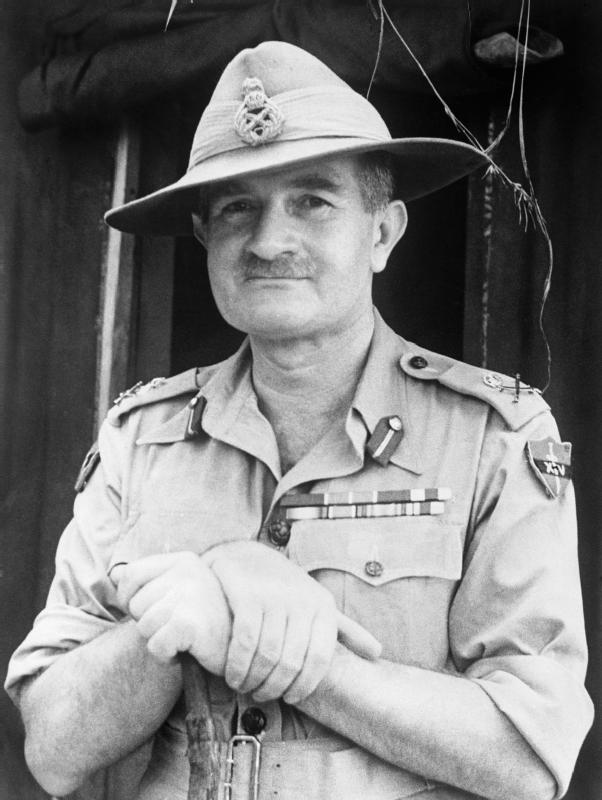
Field Marshal Sir William Slim (1891-1970), during his time as GOC XIVth Army.
Portrait by No. 9 Army Film & Photographic Unit via Wikimedia Commons.
“Burma and the Birth of Modern Warfare” is the subtitle to my 2004 book and PhD about General Slim’s command of the 14th Army in Burma during the last war, titled Slim, Master of War, a use of Sun Tzu’s description of a “heaven-born” commander. It may appear a rather grand claim, and perhaps it is, but the purpose of the subtitle reflects that fact that Slim’s conduct of operations in India and Burma in 1944 and 1945 represented an entirely new style of warfighting to that experienced by the British Army during the war. Instead of looking back to the lessons of World War One, Slim’s conduct of operations looked forward to reflect a style of warfare that would only be adopted as formal doctrine by the British Army in the 1980s. In the mid-1940s it remained alien to the vast bulk of similar British military experience and understanding.
My argument wasn’t that Slim was the best general who had ever commanded men in the history of warfare. That may or may not be true, but for the sake of my argument is irrelevant. My proposition, rather, is that:
Slim was the foremost British exponent in the Second World War of the “indirect approach” and that in his conduct of operations in 1944 and 1945 he provided a clear foreshadowing of “manoeuvre warfare”.
My idea, which first saw expression in my 2004 book, has been developed since then in my subsequent writings, including that of Japan’s Last Bid for Victory, which deals with the great events in the Assam and Manipur in 1944 (2011) and A War of Empires (2021). A major reason for the continuing amnesia in British military thinking about the warfighting characteristics of the Burma Campaign – apart from the fact that it is a long way to go for a staff ride – seems to be the fact that Slim’s style of warfighting remained largely alien to the British Army’s doctrinal precepts until the late 1980s. Until then, Slim’s strategic conceptions had been considered an aberration, and Slim himself regarded merely as the epitome of a fine military leader, and nothing more. Then, in a doctrinal revolution which began in the 1980s, the old firepower-based foundations – which themselves were largely a product of Montgomery’s approach to war in 1944 and 1945 – in which the supreme military virtue was the effective and coordinated application of force, were replaced. This revolution in doctrine and thinking about warfighting exchanged the old foundations with new ones based on an entirely different conception, that of manoeuvre at the operational level of war, in which notions of subtlety, guile and psychological dislocation came to be emphasised in an entirely new and refreshing way. My belief is that it was the effective and pragmatic employment of manoeuvre at the operational level of war by Slim in Burma that was the direct cause of the extraordinary victories the 14th Army achieved in 1944 and 1945 and which led to the two greatest defeats the Japanese Army suffered in the field in the Second World War, the first at Imphal-Kohima in India in 1944 and the second at Mandalay-Meiktila in Burma in 1945. My argument I suppose is that Slim’s exercise of command in Burma makes him not merely a fine example of a “manoeuvrist” commander but in actuality the template for modern manoeuvrist command.
[…]
First, the 14th Army was the only truly joint formation in the British armed forces during WW2. Nothing else, in North Africa, Italy or North-West Europe came close to it. Slim insisted on nothing less than full integration. Not only were headquarters joint, but operational and tactic delivery was also joint. At every level of command air and land headquarters were completely interlinked. I became convinced of this fact when I discovered that the RAF and the Army even shared messes! Strategic air transport, winning the air war, the operational reach and flexibility provided by air power underwrote Slim’s conception of battle, to the extent that the senior RAF officer in the theatre ruefully concluded in 1945, and I quote, that:
Slim was quicker to grasp the potentialities and value of air support in the jungles of Burma than most Air Force officers.
There was no snobbery and no shibboleths with Slim: if it worked, it was pressed into action.
[…]
Professor Dixon argues [in On the Psychology of Military Incompetence] that, unusually for a senior commander of his ilk in WW2, Slim was non-ethnocentric. He had no intrinsic prejudices about the virtues of one race over another. Slim, after all, was an officer of the Indian Army, and I have yet to come across any evidence that British regimental officers of the Indian Army regarded their soldiers in any way inferior to themselves. He was commonly known to those who served under him as “Uncle Bill” from the special affinity British troops had to him: the remarkable fact, however, was that at least 87% of his Army of several hundred thousand men recalled him as “Cha Cha Slim Sahib”: 14th Army was, after all, very largely Indian, Gurkha and West and East African. I certainly cannot think of any other Indian Army general who had such an impact on British troops. He became, of course, Chief of the Imperial General Staff following Field Marshal Montgomery, in 1948, which securely establishes this feat. On that note, I cannot conceive of “Uncle Bernard” when referring to Field Marshal Montgomery!
The Burma campaign was as much a struggle for mastery of logistics as it was a struggle for mastery on the battlefield, and it was about risk as much as it was about adherence to logistical principles. Slim had an implicit understanding of the constraints placed on warfare by the demands of logistics. Great efforts were made to increase the quantity of supplies to Burma. Railways were extended, roads built and surfaced, sunken ferries refloated and repaired, barges and rafts built for use on the numerous waterways. In this regard Archibald Nye, the VCIGS under Alan Brooke, regarded Slim’s mastery of logistics to be the most significant measure of his greatness as commander of 14 Army in Burma:
He never had enough to do what he had to do and this … is the measure of his greatness.
The practice of war in Burma by Slim was so startling in its modernity, and unlike any other pattern of warfighting by operational level British commanders in the war. My view of Slim as a commander can be interpreted at two levels. He was, first of all, a great commander and leader. Being a master of strategy, of logistics, of technical proficiency and so on are important in themselves when considering the nature of leadership in war, but by themselves they remain insufficient. Successful military command requires someone who can, through dint of personality and inspirational leadership, wield all of the components of fighting power together so that an extraordinary result transpires. What marks Slim out from the crowd was much more than just his winning of a succession of extraordinary battles. His strength lay in his ability to produce a decisive effect from scratch; to mould thousands of disparate individuals together into a single team with a single goal; to persuade a defeated army that it had the potential to turn the tables on their enemies; to master the complexities of terrain, climate and administrative deficiency so that self-help, resourcefulness and ingenuity could become as much prized as fighting skill. In these individual areas, and more, Slim proved the master. His genius for war was the consequence of his ability to bring together all of these elements to create an extraordinary result, the visible sign of which was the greatest defeat suffered by the Japanese on land during the Second World War.
July 1, 2025
Tibet’s Last Stand: The Snow Lion vs. The Dragon – W2W 34
TimeGhost History
Published 29 Jun 2025The fate of Tibet is decided on the roof of the world as Mao’s China sets its sights on Lhasa. This episode traces the dramatic showdown between the snow lion and the dragon — from imperial legacies and British invasions to the last years of de facto Tibetan independence. Discover how realpolitik, Cold War indifference, and the carrot-and-stick tactics of Mao’s regime sealed Tibet’s fate. Watch as the Dalai Lama faces impossible choices, world powers look away, and the dream of independence is crushed beneath the weight of history.
(more…)
June 27, 2025
India’s FAL: The 1A1 Inch/Metric Hybrid
Forgotten Weapons
Published 5 Feb 2025For political reasons, India decided to adopt the 7.62mm NATO cartridge when it needed to replace its No1 MkIII SMLE bolt action rifles with a modern self-loader. They chose the FN FAL as the rifle to adopt, but wanted a license to produce it domestically at the Ishapore rifle factory. FN insisted on the Indians buying Belgian tools as part of the agreement, which India was unwilling to do. So instead, Ishapore used the samples it had of both British L1A1 and Belgian FAL rifles to produce its own reverse-engineered drawings.
The resulting plans use a mixture of British (“inch”) and Belgian (“metric”) parts, and are not interchangeable with either standard pattern. As a result, the Indian 1A1 rifle is a clone of the FAL that is not actually parts compatible with the FAL. That did not prevent Ishapore from producing hundreds of thousands of them, with production apparently ending only in 2012.
Thanks to Sellier & Bellot for giving me access to this 1A1 example to film for you!
(more…)
June 2, 2025
The progressive case for unlimited immigration
Theophilus Chilton takes on the progressive arguments for bringing in as many “high quality” immigrants as humanly possible from his own professional background:
One of the constants that you can count on in any debate about the value of immigration (of every sort) is the inevitable assertion about the NECESSITY of immigration. Immigrants POWER AMERICA. Without them, NOTHING WOULD HAPPEN! They are ELITE HUMAN CAPITAL without which the White American chuds who did things like build the atom bomb and otherwise created modern technological civilisation would barely be able to keep the lights on in their single-wides. It’s not just that immigrants want a new life or might be useful — they are an absolutely necessity and the ones coming here are the cream of the world’s crop.
As a result, the recent move by Marco Rubio and the State Department to revoke visas from Chinese students in American universities (especially those associated with the CCP or who are in positions to commit especially damaging industrial espionage) will certainly not be well-received by this crowd. For example, witness Alex Nowrasteh, who’s whole schtick is to burble on about “meritocracy” and whine about “affirmative action for White Americans” while filling a useless sinecure at the Cato Institute that he got by being the token immigrant. He is appalled that we’d act in our own national interest rather than in the interests of a bunch of random foreigners.
Immigration man have big sad
Many people who know me on X already know this, but most readers here may not. Before I made a radical life-changing vocational choice a few years ago, I used to be a scientist in Big Pharma. For a little over two decades, I worked in the biotech/biopharma industry, covering a wide range of drug development stages and product types. I’ve developed vaccines (which is why I was skeptical about the Covid vaxx from the very beginning). I’ve developed small molecule drugs. I helped to bring to market several of the pharmaceuticals that millions take regularly and which you see advertised on television. I’ve done everything from bench scale analytical work to protein purification on 5000-liter batches used in support of human clinical trials. I’m proficient in literally dozens of different analytical techniques. Before that, in both undergraduate and graduate school, I specialised in synthetic organic small molecule development across a number of different subspecialties. And I’m good at all of this.
One other thing that I did throughout was work side-by-side with, and later manage, LOTS of visa holders and immigrants, especially from “tech heavy” countries like India and China, the stereotypical “H1-Bers”. As a result, I consider myself to be a pretty good judge of the value which visa holders bring to tech fields.
My judgment is, and has been for decades, that their value is minimal and it certainly does not live up to the hype. Indeed, one of the constants that I observed among most Indian, Chinese, and other visa holders was that they did not really, truly understand the science that was involved with the products being developed and the techniques being used to develop and test them. Most of these folks were the living embodiment of cramming to pass the test. When the test methods and the SOPs being employed were straightforward, these folks were great. They had a robot-like efficiency that comes with repetitively doing the same thing over and over and over again. Unfortunately, for anything requiring innovative or independent thinking, they’d be totally lost. If results from a test deviated from expectations and required some commonsense interpretation? That’s where the wheels came off. I mean, there was little to no capacity to deal with anything that wasn’t completely textbook.
Even basic scientific sense was often missing. At one job, there was an Indian guy who would takes dumps in the bathroom and then walk straight out back to his manufacturing suite in the cell line division without even washing his hands. I know this because I observed it for myself several times. I mean, even if you don’t care about getting fecal coliform bacteria all over door handles and whatnot, at least don’t carry them back into the suite where you’re helping to grow batches of genetically engineered E. coli. I assume he was properly gowned before going in, but still, there’s just that basic lack of sense there.
And then there are the ethics (or lack thereof) displayed by many visa holders (especially Chinese and Middle Eastern). Data manipulation, tweaked results, etc. etc. These tend to occur because both of those groups are under intense social pressure within their own cultures to “get the right results” rather than just dealing with the results you get. The “tiger mom” mentality carries over into the workplace. There is a reason for why these two groups are disproportionately overrepresented on the FDA’s debarment list. Indians can be subject to serious lapses in integrity as well, though theirs tend to revolve more around cutting corners and mistreating underlings, as I illustrated in a thread on X about three years ago where I recounted my time working for an Indian-owned company.
Over the years, my observations have been substantiated and reiterated by any number of people in various tech-heavy industry to whom I’ve related them. Whether it’s pharma or IT or medicine or metallurgy or whatever else, the familiar story is told. It’s really, really difficult to reconcile this mass of lived experience with the theoretical assertions made by people like Nowrasteh that immigrants are this valuable resource that we absolutely need to be or remain competitive in world markets.
In effect, the goal with this type of white-collar mass immigration is to “roboticise” tech fields which can’t be given over to AI or actual robotics just yet. The formula is to import masses of workers who can simply follow a script and save companies money on labour costs. If you think about it, this is really a low IQ, high time preference approach by corporations whereby they sacrifice real innovativeness and future competitiveness for short-term savings. I’d argue that the entry of H1-B and other visa holders in large numbers into American tech industries which accelerated around the late 2000s-early 2010s has actually led to a slowdown in real innovation. We may have tons of new apps for our phones, but fewer truly groundbreaking advances in tech across the board.
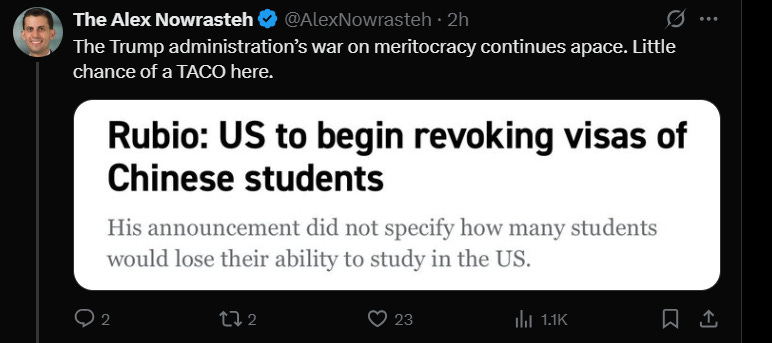
Fighting at Yenangyaung, 17-19 April 1942
Dr. Robert Lyman on the battle at Yenangyaung between 17-19 April 1942 early in the Burma campaign:
… the Yenangyaung battle is a fascinating one, with its own small degree of controversy, I decided to lay it out in this post. A mystery of the battle is the differing accounts of the Chinese attacks on the 19th April. In the British accounts (including Bill Slim’s in Defeat into Victory) the Chinese are blamed for failing to attack in the morning as they had promised, adding further jeopardy to the fate of the encircled 1st Burma Division. But was this true? The Japanese, Chinese and American accounts differ, so I thought I’d lay out the story to allow you, dear reader, to come to your own conclusion.
The fabulous map of Yenangyaung produced by the late Ian Lyall Grant.
The scrap at Yenangyaung was the final Corps-sized battle before the order to evacuate Burma Corps was given in early May. The Japanese had pushed out of Rangoon in mid-March, driving up the Irrawaddy on the left and against Toungoo on the right. Allied plans for the defence of Burma were inadequate, both Chinese (on the right) and Slim’s Burcorps (on the left) effectively fighting separate battles. Attempts by General Harold Alexander, the Army Commander, to control the battle and constrain the advancing Japanese ultimately came to naught. Alexander, Slim and Lieutenant General Joe Stilwell, nominally commanding the Chinese 5th Army, tried every trick in the tactical rule book to bring a halt to the relentless Japanese advance, and to destroy them in battle. After a month of fighting in which the Chinese were pushed out of Toungoo, the British lost control of Prome and an attempt to consolidate a defensive line across the country failed, the Japanese moved up the Irrawaddy in an attempt to turn the British flank, breaking in at the oilfield town of Yenangyaung on 17 April. At the time Slim’s Burma Corps was attempting to withdraw to the north from Allamyo. The Japanese infiltration into Yenangyaung cut the British in half. The 1st Burma Division was now cut off in Yenangyaung. The battle by the already weakened division (amounting to probably no more than 4,000 troops) into the Yenangyaung pocket over the period 17 and 19 April proved to be the severest trial yet faced by British troops in the short Burma campaign, the pressure applied by the Japanese exacerbated by the intense heat and the lack of water.
It was critical that Slim defeated this Japanese infiltration, rescue the 1st Burma Division from encirclement and retain the integrity of his Corps. If Yenangyaung were lost the Japanese would be free to sweep north to threaten Mandalay. It was crucial therefore that the divisional commander – Major General Bruce Scott – held on for as long as he could. But Slim had no reserve. The only hope of relief lay in assistance from the Chinese far to his right. He concluded that if he could engineer a attack into the pocket by the Chinese, across the Pin Chaung, combined with a breakout attack by 1st Burma Division, they might have a chance of escape. Nothing else looked likely to succeed.
When asked, Stilwell agreed to Alexander’s request for help to be provided to Slim, and gave him Lieutenant General Sun Lijen’s 38th Division – responsible for the defence of Mandalay – for the task. Chiang Kai-shek had given Sun responsibility for defending Mandalay. At midnight on 16 April Sun received an order from General Lo Cho-yin, “to dispatch his 113th Regiment to Kyaukpadaung, there to be commanded by the British General Slim …” Sun’s friend, Dr Ho Yungchi, recorded that by 3 a.m. he had arrived at Lo’s HQ at Pyawbe to discuss the order. Lo explained that the British were in serious trouble “in the oil town of Yenangyaung and had sent repeated requests for help”. By 6.30 a.m. it was agreed that Sun would personally take command of the 113th Regiment, while the two remaining regiments stayed to defend Mandalay. Sun and 1,121 men of 113th Regiment (commanded by Colonel Liu Fang-wu) arrived at Kyaukpadaung on the morning of 17 April.
Slim recalled: “The situation was not encouraging, and I was greatly relieved to hear that 113 Regiment of the Chinese 38th Division was just arriving at Kyaukpadaung. I dashed off in my jeep to meet their commander and give him his orders … this was the first time I had had Chinese troops under me … I got to like all, or almost all, my Chinese very much. They are a likeable people and as soldiers they have in a high degree the fighting man’s basic qualities – courage, endurance, cheerfulness, and an eye for country.”1
At Yenangyaung, Slim’s plan was for Sun’s 38th Division to attack from the north on the morning of 18th April while the 1st Burma Division, within the pocket, fought its way out. As Slim and Sun Lijen talked, discussing the details of the attack planned for the following morning Slim decided that he would place the Stuart tanks of the 7th Armoured Brigade directly under Sun’s command. It was only a move a man confident in the capabilities of his allies could make. Slim commented that “I was impressed by Sun and it was essential to gain his confidence. His division had no artillery or tanks of its own, and I was therefore arranging that all the artillery we had this side of the Pin Chaung and all available tanks should support his attack.” The commander of the British armoured brigade – Brigadier John Anstice – accepted this arrangement and according to Slim “he and Sun got on famously together”. What’s more, the soldiers worked well together too, Slim recording that the “gunners and tank crews, as is the way of British soldiers, soon got on good terms with their new comrades, and, in spite of language difficulties of an extreme kind, co-operation was, I was assured by both sides, not only close but mostly friendly.”2 Accordingly, at 6.15 a.m. on 18 April, Major Mark Rudkin of 2nd Royal Tank Regiment (2RTR) reported as instructed by Anstice to 38th Division HQ:
There was little activity except for the cooking of breakfast and it seemed most unlikely that the attack could start on time. I asked the British liaison officer with the Chinese what was happening and he informed me that as the Chinese realized that they would not be ready to attack at 0630 hours, they had put their watches back one hour, so that officially they were still attacking at 0630 though the time would in reality be 0730. They had, therefore, not lost “face” by being late.
The plan was that a troop of tanks would follow the leading troops of the leading Chinese battalion and give what support it could. Another troop was to follow the leading infantry battalion and assist the leading troop if required. The tanks would be almost entirely road bound owing to the going off the road.
At 0730 the assaulting Chinese moved forward off the ridge on a front of about four hundred yards, the leading troop keeping very close behind on the road. On foot near the tanks was a Chinese interpreter who carried out liaison between the tanks and infantry.
After advancing about half a mile the leading tank was hit by a Japanese 75-mm gun situated on the road just north of the Pin Chaung which was firing straight up 300 yards of road. The tank was disabled but there were no casualties.
The Chinese advance continued and by afternoon had almost reached the line of the ford on the Pin Chaung which was still held by the enemy. The Chinese had had heavy casualties, especially amongst officers, as it was the custom for Chinese officers to lead, whatever their rank. It was finally decided to hold positions about half a mile north of the crossing and continue the attack next day.3
With the first attack a failure, the Japanese retained their grip on both the ford and the village of Twingon. The situation for the surrounded remnants of the 1st Burma Division was desperate; the Japanese close to achieving a complete victory. Slim and Sun then worked through a plan for another attempt to be made the following morning, 19th April. This day also began badly, however. The Chinese attack was scheduled to begin at 7 a.m. British accounts subsequently recorded that a Chinese attack did not materialise at this time. Slim subsequently recorded in Defeat into Victory that the failure to attack must have been a function of the administrative difficulties faced by the Chinese. He wrote that with the Chinese “lack of signalling equipment, of means of evacuating wounded and of replenishing ammunition, and their paucity of trained junior leaders it was not surprising that to sort themselves out, reform, and start a fresh attack took time”.4 Slim was invariably impressed with what he saw of the Chinese soldier in action, but considered their support and command functions to be shockingly poor and a source of constant frustration to themselves, and to all who had occasion to operate with them.
Slim, and most other British published accounts, including the Indian and British Official Histories, record that the attack finally went in at 3 p.m., when Colonel Liu’s 113th Regiment successfully captured the ford and penetrated into Yenangyaung.5 “When the Chinese did attack they went in splendidly” wrote Slim in admiration. “They were thrilled at the tank and artillery support they were getting and showed real dash. They took Twingon, rescuing some two hundred of our prisoners and wounded. Next day, 20th April, the 38th Division attacked again and with tanks penetrated into Yenangyaung itself, repulsing a Japanese counter-attack. The fighting was severe and the Chinese acquitted themselves well, inflicting heavy losses, vouched for by our own officers.”
1. Slim, Defeat into Victory (1956), p. 63.
2. Ibid., p. 65.
3. Bryan Perrett, Tank Tracks to Rangoon: The Story of British Armour in Burma (London: Robert Hale, 1978)
4. Slim, op. cit., p. 70.
5. Bisheshwar Prasad (ed,) The Retreat from Burma 1941 – 42 (Calcutta, Combined Inter-Service Historical Section, 1954), p. 296.
May 10, 2025
“Train how you fight” – British plod edition
At Restoration, Connor Tomlinson looks at how British police forces are training and what it tells us about who they think they’ll be fighting:
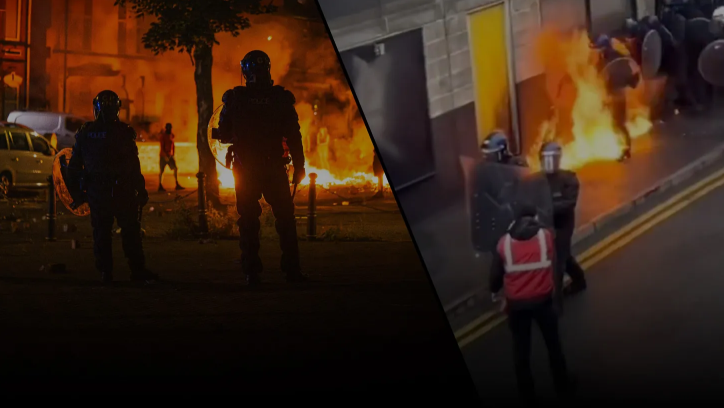
Britain’s police aren’t training to stop riots—they’re preparing to crush the public.
One of the infamous quotes from George Orwell’s Nineteen Eighty-Four is, “If you want a picture of the future, imagine a boot stamping on a human face — forever”. He forgot to add, “on TikTok”. Last Thursday, the Metropolitan Police posted a montage of officers at the Metropolitan Police Specialist Training Centre in Kent, undergoing riot training. The caption read, “Bricks, bottles and fire bombs – our officers prepare for every eventuality at the Met’s elite training centre in Gravesend so they can keep you safe. Stronger tactics means safer communities.” It seems they had one specific “eventuality” in mind, as the mock rioters were wearing the Union flag. There wasn’t a keffiyeh or “Only good TERF is a dead TERF” sign in sight.
But fear not. The same Met Police who defended now-proscribed group Hizb ut-Tahrir’s demonstration after October 7th, saying “The word jihad has a number of meanings“, now insist that “The fact one of the t-shirts has a union flag on it is entirely coincidental”. Well, that’s me convinced. In fact, the Met are exhausted by your conspiracy theories, writing that “It’s disappointing we are increasingly having to challenge this sort of misinformation which only serves to increase divisions and tensions”. But the plummeting public trust in Britain’s police and justice system are of its own making. Britain’s security state is setting itself in opposition to the largely law-abiding indigenous host majority, while gaslighting them about the non-existence of a two-tier justice system that favors tribal minorities.
One might think, as Sam Bidwell suggests, the police should preoccupy themselves with preventing street conflicts not between Britain’s indigenous host and immigrant populations, but between its Indian diaspora and Pakistani enclaves. On April 22, Pakistani Islamist group Lashkar-e-Taiba killed 26 and injured 20 more in Indian-controlled Kashmir. Both nations cancelled the other’s visas, and are in the process of expelling foreign nationals before they expire. Pakistan has suspended all trade with and air travel from India. Hindu nationalist Prime Minister Modi has warned, “India will identify, track and punish every terrorist, their handlers and their backers, [and] we will pursue them to the ends of the earth.”
Thanks to decades of mass immigration and multiculturalism, Britain is home to powerful Indian and Pakistani ethno-political lobbies. Around 3 million Indians and 1.9 million Pakistanis live legally in the UK. They are substantially younger than the white British host population, and already brought Leicester to an ungovernable standstill in 2022 when Muslims and Hindus rioted for a month over a cricket match. Last Friday, both factions gathered outside the Pakistani Embassy in London for a mixture of a protest and a dance-off, replete with Indian, Pakistani, Israeli, and Palestinian flags. Most alarming was when Colonel Taimur Rahat of the Pakistani military appeared to make a throat-slitting gesture toward Indian protestors.
Both subcontinental factions have sympathetic politicians. They weaponize domestic antidiscrimination law to pursue foreign policy goals: for example, listing the denial of an independent Palestine and Kashmir as an example of Islamophobia, in guidance adopted by local councils. Conservative-party candidates committed to a Hindu Manifesto at the last general election, promising to further liberalize visa rules for dependents and elderly parents of Hindus already in Britain. Indian-heritage cabinet ministers, like Priti Patel and Rishi Sunak, instigated an unprecedented rise in Indian migration after Brexit. Patel described these migrants as “living bridges”, using Prime Minister Modi’s term.
April 20, 2025
Did Britain Bomb The Wrong Targets in WW2? – Out of the Foxholes Live
World War Two
Published 19 Apr 2025Today Indy and Sparty answer questions on the French colonies, Pykrete and iceberg aircraft carriers Japan’s invasion of India, and they talk about Britain’s misguided strategic bombing strategy.
(more…)
April 3, 2025
1947 Newscast: Spies, Aliens, and Collapsing Empires! – W2W 18
TimeGhost History
Published 2 Apr 20251947 is a pivotal year: The British Empire crumbles as India and Pakistan gain independence amidst violence and mass migration. Truman launches a Cold War against Soviet communism, while spies infiltrate governments worldwide. Nations sign treaties reshaping Europe; Chuck Yeager breaks the sound barrier, and rumours swirl of aliens crashing at Roswell. Join us for the headlines that reshaped history!
(more…)
March 29, 2025
Why India and Pakistan Hate Each Other – W2W 015 – 1947 Q3
TimeGhost History
Published 23 Mar 2025In 1947, the British divide the Raj into two nations, India and Pakistan, triggering one of the deadliest mass migrations in history. Sectarian violence between Hindus, Sikhs, and Muslims leaves at least 200,000 dead and displaces millions more. Hastily drawn borders turn neighbours into enemies. The partition’s bloody legacy will lead to decades of tension, war, and bloodshed.
(more…)


