
In 1835 Thomas Macaulay had argued in his famous essay Minute on Education that “We must at present do our best to form a class who may be interpreters between us and the millions whom we govern; a class of persons, Indian in blood and colour, but English in taste, in opinions, in morals, and in intellect. To that class we may leave it to refine the vernacular dialects of the country, to enrich those dialects with terms of science borrowed from the Western nomenclature, and to render them by degrees fit vehicles for conveying knowledge to the great mass of the population.”
Macaulay was arguing that British Government should spend money on educating those it found under its rule. So it came to be as Britain ruled over the most heavily-populated and most valued part of its empire for another century.
Jawaharlal Nehru, the Prime Minister who led India to independence from Britain, studied at Trinity College, Cambridge, and at the Inner Temple, and was closely connected to the Fabian Society. Nehru’s rival, Muhammad Ali Jinnah, the founder of Pakistan, studied law at the Lincoln’s Inn, and was strongly influenced by English utilitarianism and French positivism. Nehru was an agnostic who requested a secular burial (this was denied him), while Jinnah was a gin-drinker whose religious attachments were more a matter of identity than belief.
Nehru and Jinnah led India and Pakistan to independence as the brown-skinned Westerners Thomas Macaulay had envisioned a century earlier. South Asian in appearance and pedigree, the leaders of these two nations nevertheless personified a fundamental truth about the Western orientation of the new Asian states. Pakistan was aligned with the United States, while socialist India was nominally non-aligned but clearly tilted toward the Soviet bloc. Though the populace of these nations were mostly illiterate, poor and detached from the cosmopolitan currents of the world, their elites were integrated among the English-speaking peoples. Nehru’s daughter, Indira Gandhi, attended Somerville College, Oxford. His grandson, Rahul Gandhi, whose mother is Italian, studied at Harvard and Trinity College.
Razib Khan, “Why the West lost India’s culture wars”, UnHerd, 2021-04-13.
July 15, 2021
QotD: Macaulay’s prescription for ruling India
July 1, 2021
QotD: Life at “Flyover State” in the 1990s
“Blandly utilitarian” was about the best that one could say about the least offensive campus architecture; “brutalist monstrosities” was closer to the truth for most of it. And as with the campus, so with the town — the off-campus housing was beautiful old Victorian houses ripped up and made into “efficiency” apartments, crammed cheek by jowl with poured-concrete boxes that looked like barracks for low-ranking Party members in the Pyongyang suburbs. The public parks were nicely landscaped, but each featured some publicly-subsidized “art” that made you want to gouge your eyeballs out. Every single space had wheelchair ramps, and was festooned with enough signs to give M. Night Shyamalan wood. It was hideous.
As with the built environment, so with human behavior. Everyone on the faculty looked like a refugee from 1968, but instead of toking righteous bud, they’d been taking sriracha enemas. The shopkeepers who catered to them were seemingly locked in a contest to out-obnoxious each other over their leftwing politics, and as for the few tradesmen who provided vital services, they had the warm and welcoming vibe of a DMV supervisor. Not that I blame them for this — I ended up hanging out with a lot of those guys at a townie bar, and trust me, being called out to work at a professor’s home is exactly the kind of experience you think it is. Hurry up and fix the leaky pipe, bigot, while I lecture you about your privilege … then try to stiff you on the bill. (Same thing in reverse for the students). So they came off like cops, assuming that everyone they met was a dyed-in-the-wool asshole until proven otherwise.
Life in a college town, then, is soulless, instrumentalist, transactionalist — everything’s for sale, but everything had best be spelled out, in writing, in triplicate. Nobody’s from there, nobody stays there, so everything is always on the arm. No one and nothing is ever on the level; everyone is always looking to chisel everyone else. And, ironically, the longer someone stays there, the more likely xzhey are to push this attitude to near-platonic perfection — eggheads all believe, with all their hearts and souls, that they deserve to be at Harvard, so when Harvard doesn’t come calling, the days and months and years become an intolerable insult. How dare they expect me to live like this, in a place designed to cater to my every whim, making only 100 large per year! It’s an outrage!!
Looking back on it, I see now why I hated the 1990s so much. Eggheads are incredibly conservative about everything but their politics, but in this one case, they really were as “progressive” as they fancy themselves. Before just about anyone else, they embraced the globohomo ethos of rootless piracy. Then as now, they all claimed to hate “sportsball” (if you’ll forgive an anachronism for clarity’s sake) with the heat of a thousand suns, but they could’ve given LeBron James lessons on how to be a backstabbing, glory-hogging, money-chasing, utterly mercenary douchebag. As early as the late 1980s, they found the idea of remaining loyally in one institution, building it up as a service to the community, as laughable as modern sportsballers find sticking in one city in order to be a role model. Fuck that, give me mine!!!
Severian, “Everything Is Ugly New”, Rotten Chestnuts, 2021-02-15.
June 21, 2021
QotD: The young Richard Nixon
The Orthogonians’ base was among Whittier’s athletes. On the surface, jocks seem natural Franklins, the Big Men on Campus. But Nixon always had a gift for looking under social surfaces to see and exploit the subterranean truths that roiled underneath. It was an eminently Nixonian insight: that on every sports team there are only a couple of stars, and that if you want to win the loyalty of the team for yourself, the surest, if least glamorous, strategy is to concentrate on the nonspectacular — silent — majority. The ones who labor quietly, sometimes resentfully, in the quarterback’s shadow: the linemen, the guards, the punter. Nixon himself was exemplarily nonspectacular: the 150-pounder was the team’s tackle dummy, kept on squad by a loving, tough, and fatherly coach who appreciated Nixon’s unceasing grit and team spirit — nursing hurt players, cheering on the listless, even organizing his own team dinners, entertaining the guests on the piano, perhaps favoring them with the Orthogonian theme song. It was his own composition.
Nixon beat a Franklin for student body president. Looking back later, acquaintances marveled at the feat of this awkward, skinny kid the yearbook called “a rather quiet chap about campus,” dour and brooding, who couldn’t even win a girlfriend, who attracted enemies, who seemed, a schoolmate recalled, “the man least likely to succeed in politics.” They hadn’t learned what Nixon was learning. Being hated by the right people was no impediment to political success. The unpolished, after all, were everywhere in the majority.
Rick Perlstein, Nixonland: The Rise of a President and the Fracturing of America, 2008.
June 20, 2021
QotD: Cargo cult thinking in education
The problem of course is that college is not the cause of prosperity, but a marker (with prosperity) of other traits — focus on long-term goals, discipline, hard work, and yes knowing 2+2=4. This sort of woke BS just makes it worse, because it attacks the real roots of prosperity. There are real barriers to poor blacks achieving prosperity — eg how do you focus on long-term goals when you don’t know where you are sleeping tonight or when you have no role models who do so — but the purity and objectivity of math is not among these.
This sort of cargo cult thinking can be seen all the time in Progressive economic proscriptions. The government push for home ownership is another — middle class people own homes so if low income people owned homes they would become middle class. Now, this has a bit of accuracy in that, like the stock market, the elite have goosed the housing market to always go up. But leaving that aside for a moment, owning a home vs renting is a terrible decision for many people — it piles on a lot of financial risk but perhaps more importantly it limits geographic mobility which used to be critical to lower-income people improving their lot.
Warren Meyer, “Are the Woke a False Flag Operation of White Supremacists?”, Coyote Blog, 2021-02-16.
June 11, 2021
Latin and Greek are the next sacrifices to the great god Antiracism
In the latest edition of It Bears Mentioning, John McWhorter considers the Princeton University classics department decision to get rid of the requirement for students to read classic texts in the original languages:
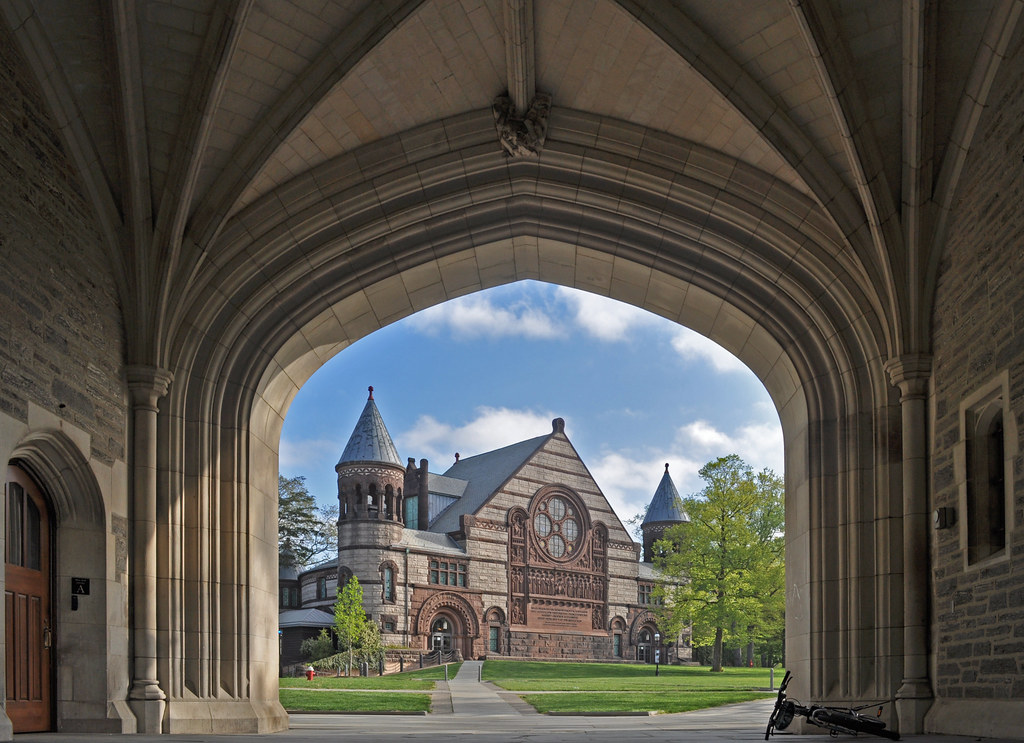
“USA – New Jersey – Princeton” by Harshil.Shah is licensed under CC BY-ND 2.0


I have written recently about the Princeton classics department’s decision to eliminate the requirement that students engaging closely with Latin and Greek texts be able to … read them in Latin and Greek. The new idea is that the department will attract more majors by opening up to ideas from students who may be full of beans but just not inclined to tackle complex, ancient languages. And sub rosa, the idea is clearly – as we can see from words in the official statement like underrepresented, perspectives, and experiences – that of especial interest will be black students, especially in light of today’s racial reckoning which the department openly acknowledges was the primary spur for this change.
My disappointment with this decision is because it is part of a tradition of arguments that we do black people a favor by exempting them from certain kinds of faceless, put-up-or-shut-up challenges to entry. Back in the aughts, the classic example was brilliant, fierce black lawyers confidently arguing that because black firefighter applicants don’t do as well on the entrance exams required for the job, the exams are racist and should be eliminated. More recently there has been the idea that if black kids are rare at top-ranked public schools in New York City like Stuyvesant because few excel on the standardized test one must ace to be admitted, then the solution is to eliminate the test as “racist”. The Princeton decision is a variation: to get black kids into classics, it’s supposedly immoral to expect them to master the intricacies of Latin and Greek, languages which I suppose we can see as foreign, “white” to them as well. Rather, they must be admitted in shining expectation that their class comments will be bracingly “diverse” in good old English.
My Atlantic colleague Graeme Wood is more sanguine about the Princeton decision. He argues sagely that a certain kind of student happens to enjoy working their way through languages like Latin as a kind of puzzle (I openly admit being that type), but that there are others who don’t go in for that particular task and yet are itching and well-equipped to engage and analyze classical texts regardless. Graeme notes that we do not consider it an educational tragedy that specialists in English history are not required to be able to read Old English. (Although I wonder if this analogy would hold if the idea were someone specializing in England of the first millennium, where all of the relevant linguistic matter was in Old English [and Latin].)
I can go with him here to an extent. On the one hand, as I have argued here, to engage work only in translation is, of course, to lose a lot. Yet, in making that argument here, I was referring to my own reading War and Peace in English, as I myself was not inclined to hack through it in Russian (although my being black was not the reason for this disinclination [couldn’t help it!]). The question is how important we consider that loss to be.
Having no facility in languages myself, I’m more sympathetic to the students’ viewpoint than I might otherwise be, but depending on someone else’s translation of the text being studied has unexpected risks, as Sarah Hoyt explained from her own translation studies:
The discussion […] reminded me of when I was sixteen and embarked on a class called “Techniques of Translation”.
Although I had studied French and English and German, the translations I’d done so far were of the “I took the pen of my neighbor” variety. I thought the class would teach me to smooth out the sentence to “I took my neighbor’s pen” and that would be that.
I was wrong. Oh, it taught that also, but that was a minor portion of it. The class mostly hinged on the moral, ethical and — most of all — professional dilemmas of being a translator. I know any number of you are translators, formal or informal, but any number of you are also not. So, for the ones who are not, let me break the news with my usual gentleness:
There is no such thing as translation.
The French have a proverb “to translate is to betray a little” — or at least that’s the closest meaning in English. It’s fairly close to the true meaning, but slightly askew, of course. Every language is slightly askew to other languages.
The idea that there exists in every language a word that is exactly the equivalent of other languages is sort of like assuming that aliens will — of course — live in houses, go to school, ride buses, understand Rebecca Black’s “Friday”. [This was originally written in 2011.]
Language is how we organize our thoughts, and each word, no matter how simple, carries with it the cultural freight and experience of the specific language. Oh, “mother” will generally mean “the one who gave birth to” — except for some tribal, insular cultures where it might mean “the one who calls me by her name” or “my father’s principal wife” — but the “feel” behind it will be different, depending on the images associated with “mother” in the culture.
So, when you translate, you’re actually performing a function as a bridge. Translation is not the straightforward affair it seems to be but a dialogue between the original language and the language you translate into. If you’re lucky, you meet halfway. Sometimes that’s not possible, and you feel really guilty about “lying” to the people receiving the translation. When on top of language you need to integrate different cultures and living systems (which you do when translating anything even an ad) you feel even more guilty, because you’re going to betray, no matter how much you try. At one point, a while back, I had my dad on one phone, my husband on the other, and I was doing rapid-fire translation about a relatively straight forward matter. And even that caused me pangs in conscience, because my dad simply doesn’t understand how things are done here. I had to approach his experience and explain our experience in a way he wouldn’t think I was insane or explaining badly. That meant a thousand minor lies.
June 3, 2021
John McWhorter on Affirmative Action
In the latest post at It Bears Mentioning, John McWhorter outlines the history of Affirmative Action in American schooling and explains why it’s no longer doing anything useful and should be re-oriented to actually help disadvantaged students of all races:

John McWhorter’s Twitter thumbnail image
I do not oppose Affirmative Action. I simply think it should be based on disadvantage, not melanin. It made sense – logical as well as moral – to adjust standards in the wake of the implacable oppression of black people until the mid-1960s.
When Affirmative Action began in the 1960s, largely with black people in mind, the overlap between blackness and disadvantage was so large that the racialized intent of the policy made sense. Most black people lived at or below the poverty line. Being black and middle class was, as one used to term it, “fortunate”. Plus, black people suffered open discrimination regardless of socioeconomic status, in ways for more concrete than microaggressions and things only identifiable via Implicit Association Testing and the like. In a sense, black people were all in the same boat.
Luckily, Affirmative Action worked. By the 1980s, it was no longer unusual or “fortunate” to be black and middle class. I would argue that by that time, it was time to reevaluate the idea that anyone black should be admitted to schools with lowered standards. I think Affirmative Action today should be robustly practiced — but on the basis of socioeconomics.
A common objection is that this would help too many poor whites (as if that’s a bad thing?). But actually, brilliant and non-partisan persons have argued that basing preferences on socioeconomics would actually bring numbers of black people into the net that almost anyone would be satisfied with.
I’m no odd duck on my sense that Affirmative Action being about race had passed its sell-by date after about a generation. At this very time, it had become clear, to anyone really looking, that the black people benefitting from Affirmative Action were no longer mostly poor – as well as that simply plopping truly poor black people into college who had gone to awful schools had tended not to work out anyway. It was no accident that in 1978 came the Bakke decision, where Justice Lewis Powell inaugurated the new idea that Affirmative Action would serve to foster “diversity”, the idea being that diversity in the classroom made for better learning.
I highly suspect that most people have always had to make a slight mental adjustment to get comfortable with this idea, as standard as it now is in enlightened discussion. Do students in classes with a certain mixture of races learn better? Really? Not that there might not be benefits to students of different races being together for other reasons. But does diversity make for better learning? Has that been proven?
As you might expect, it has not – and in fact the idea has been disproven, again and again. No one will tell you this when the next round of opining on racial preferences comes about. But this doesn’t mean it isn’t true.
May 29, 2021
QotD: Academia and capitalism
One of the mistakes folks on the Left make about capitalism is to describe capitalism as mostly about competition. In fact, capitalism is mostly about cooperation, it’s a self-organizing process where people who don’t even know each other cooperate to deliver products and services, facilitated by markets and the magic of prices. Sure, competition exists but it is not the fundamental feature, but an enabler that makes sure the cooperation occurs as efficiently as possible. Capitalism in fact is about zillions of voluntary trades and transactions every day that each make both parties better off — or else both sides would not have agreed to it. Capitalism in fact is a giant positive sum game, a fact that many on the Left simply do not grasp.
Warren Meyer, “Does the Zero-Sum Nature of Academic Success Contribute to the Left-wards Bias of Academia?”, Coyote Blog, 2018-11-09.
May 28, 2021
QotD: Declaring war on college
Stop the thing where high schools refuse to let people graduate until they promise to go to college. End draft deferment for people who go to college — hopefully there won’t be a draft, but do it anyway, as a sign that studying at college isn’t any more important than the many other jobs people do that don’t confer draft exemptions. Make universities no longer tax-exempt — why should institutions serving primarily rich people, providing them with regattas and musical theater, and raking in billions of dollars a year, not have to pay taxes? Make the bill that does this very clearly earmark the extra tax money for things that help working-class people, like infrastructure or vocational schools or whatever.
Scott Alexander, “A Modest Proposal For Republicans: Use The Word ‘Class'”, Astral Codex Ten, 2021-02-26.
May 24, 2021
“The revolution will be defeated when people stop being scared”
Sean Gabb discusses some outrageous elements of the ongoing cultural revolution against freedom of speech in Britain, the United States and many other western nations:

David Hume Tower at the University of Edinburgh (listed building number 50189).
Photo by Enric via Wikimedia Commons.
If I am a self-employed plumber or electrician, I can speak my mind and laugh at the complaints. If, like the great majority in this country, I am a salaried employee — whether in the state or private sectors is unimportant: the pressures to conformity are the same in both sectors — I must be careful what I say. I am scared of the sack. I am scared of sudden redundancy. I am scared of missing out on promotions. I am scared of generally unfair treatment because of my opinions. I therefore hide my opinions. The Peter Tatchells among us then look round complacently, telling themselves and each other that silence equals agreement, and that the few squeaks of opposition are from “disreputable extremists.”
This explains the present unbalanced debates over slavery and colonialism. Take these examples:
- First, in September 2020, the David Hume Tower at Edinburgh University was “denamed”. Someone had bothered to read the 1748 essay “Of National Characters”, and found in one of its footnotes an unfashionable statement about race. It was at once set aside that Hume was a philosopher of at least considerable note. More important was the “non-overt disrespect, offence, and racism that Black students have to go through at the University of Edinburgh”.
- Second, the Music Department at Oxford is presently worried that its curriculum “structurally centres white European music”, and that this causes “students of colour great distress”. It therefore wants to change its focus from the European classical tradition to things like “Artists Demanding Trump Stop Using Their Songs”. It also wants to discourage students from studying musical notation, as this is a “colonialist representational system”.
I could give a third illustration, and a fourth. I could fill a pamphlet with more. Some would be more alarming, though few less absurd. But these two can stand well enough for all the others. What makes these debates so irritating is that they are not debates. One side can put its case just as it pleases. The other is reduced to accepting all the main charges and begging for mitigation: “What Hume said was evil and unpardonable — but he was important for other things.” Or: “I feel your pain, but Mozart owned no slaves, and everyone knows that Beethoven was really black.” Because it has been so humbly begged, full mitigation will, in both cases, be granted. Hume will continue to be studied in the universities. Music students at Oxford will continue to use the standard notation and to analyse the usual classics. But preventing these things was never part of the agenda. The agenda was and is to transform what were honoured or unquestioned parts of our civilisation into things useful but more or less suspect, things subject to a toleration that may be varied or withdrawn at any time without notice.
It should be plain that we are, in both England and America, living through a revolution. This is not a normal revolution as these things are considered. Unlike in France or Russia, there has been no overthrow of an established order, no burst of state violence, no establishment after that of an overtly new order. There are no secret police. There are no labour camps. No one is beaten to death in a police cell. All the same, we are living through a revolution. It is a revolution that has involved the gradual capture of education, the media, the administration, the charities and the more permeable religious institutions, and the recent aligning of the larger or more glamorous business concerns. I see no point in discussing its ultimate objects. I am not sure if these are wholly agreed. But its provisional object is the destruction of our traditional identity, and of our liberty so far as this stands in the way of that provisional object.
These two elements of the provisional object are equally important. Our civilisation is being pulled apart because doing so strips away the mass of associations that, left in place, might hold up the more alarming parts of the transformation. Opposition is so feeble not only because that is all that will be tolerated: feeble opposition is all that can be tolerated. This is a revolution in which opponents are not murdered, but only scared into silence. They are scared into silence chiefly by fear of destroyed or blighted careers. The revolution will be defeated when people stop being scared. Then, there will be vicious and unrelenting public mockery, and commercial boycotts, and shareholder rebellions, and lost elections, and the general feeling of solidarity and impunity still sometimes found in a football stadium.
April 25, 2021
The causes and effects of “ostrich parasitic syndrome”
Barbara Kay on Canadian academic Gad Saad, who sometimes lets his “inner honey badger” get out on social media:

Gad Saad 2010 JMSB Faculty Portrait
Saad, 57, is a professor of marketing at the John Molson School of Business at Montreal’s Concordia University. His domain is evolutionary psychology as applied to business — a niche field, to be sure. He’s written such papers as “Gender differences in information search strategies for a Christmas gift,” and “Menstrual cycle effects on prosocial orientation, gift giving and charitable giving,” which provide valuable information to guide marketing strategies.
You’d be hard pressed to find any academic in Canada who’s more deeply steeped in knowledge about the ineluctable differences between the sexes. (Speaking of “the sexes,” business schools may be the last places left in academia to use those words to designate men and women and acknowledge their differences. Perhaps because their students want to succeed in the real world.)
[…]
Since then, Saad has understood the absolute necessity for critical thinking and freedom of speech. In the present, unhealthy climate, feelings rule, while critical thinking’s value declines daily. Just as our immune systems are designed to cope with novel intruders or atrophy, if we live in an intellectual bubble — as university students do now, rarely confronting opposing views — our cognitive immune systems atrophy, Saad says.
The consequence is what Saad calls “ostrich parasitic syndrome” (OPS). This disorder, in his words, “causes a person to deny realities that are otherwise as clear as the existence of gravity.” Science, reason, infinite data, common sense — all are rejected.
Cognitively disarmed, OPS sufferers accept alternate realities: climate change is “related to terrorism” (Bill Nye, the “science guy”); it is “gross and racist” to suggest Islam is connected to Islamism (Ben Affleck); the Israeli military “dehumanizes” Palestinian women by choosing not to rape them (not a typo: this was the thrust of an award-winning thesis by a radically leftist Israeli sociologist); men can literally be women (nearly everyone says this now, for fear of being labelled transphobic).
It used to be that you could “stand off on the sidelines” when you called out postmodern BS. No longer. There’s no middle ground anymore. You call out the BS or you keep schtum. If you choose the former, as Saad’s writing and actions demonstrate, you need to cultivate your own inner honey badger. Nothing else works.
April 2, 2021
QotD: Sex and the grad student lifestyle
- Show up; and
- Bring beer.
For 75-90% of women under 40, step 2 is optional. It would’ve been for Chloe. Especially in a bar full of grad students, who despite their extensive academic training on “the rhetorics of hegemony” and whatnot, still aren’t quite sure how the naughty bits fit together. She might’ve had to draw the guy a map, but surely that’s no problem for someone so assertively in control of her own sexuality as was Chloe …
And that’s just normal people, who know what pronouns to use and never hesitate when choosing a public restroom. The real freakazoids actually have it much easier, since loudly proclaiming a deviant sexuality is a status symbol in the ivory tower. Perhaps your deepest, most secret fetish involves cocktail onions and a Shop-Vac … and let me stop you right there, I do NOT wanna know, I’m only bringing this up to say that hey, I sympathize, love is real and you’re having a hard time finding yours.
You should consider academia, my friend, where not only are such things not shameful, but they’re positively celebrated. If you’ve actually got video of yourself doing the nasty under those conditions, they’ll pretty much hand you a PhD in Performance Art on the spot …… and yet, nobody does.
I’m not saying people don’t have sex in grad school. If I myself wasn’t getting my ashes hauled every day in the ivory tower, I assure you it wasn’t for lack of trying. What I am saying is that academia is the only place on earth where not only is your fetish — whatever it is — not shameful, but easily satisfied. Those of us who actually enjoy the missionary position with committed partners of the opposite-sex used to joke that ours was the only sexual deviancy so perverse, you’d be shunned by all your colleagues if you admitted to it. These people, on the other hand, talk like their gonads rule their lives, but they never actually do anything about it.
I have no idea why, but finding out would tell us a lot about the psychology of the average Leftist.
Severian, “Gettin’ Busy in College Town”, Rotten Chestnuts, 2020-12-04.
March 12, 2021
QotD: The modern university campus
… but pretty soon you’ll notice that it’s a very battered, grimy sort of heaven. Nobody’s from there, nobody stays there, everyone’s just passing through on the way to something better. Certainly including the faculty: Every single professor not currently at Harvard
thinksknows xzhe deserves to be at Harvard, and will get there someday. Everything’s on-demand in a college town, because everything’s rented. That “distressed” look hipsters love so much isn’t an affectation on campus; it’s a logical outcome of the transient lifestyle. Why fix a pothole, paint a building, trim a tree, teach a class anyone could ever actually use? Anyone who complains will be gone next semester anyway.Get yours before it’s gone, and if that means skipping town one day ahead of the bill collectors, remember: Capitalism is evil.
It’s not just campus, either. The rest of the lifestyle is just as evanescent, just as ugly. Think of the food. Whatever you do, you can’t eat what the Normals eat, drink what the Normals drink. Here again, foodie culture isn’t a hipster affectation on campus. It’s deadly serious status-jockeying with your temporary — always temporary — peers. You’ve got to win now, because next semester they’ll be gone, probably to Harvard, those cheating, ass-kissing bastards. Sure, it looks, smells, and tastes like cold dog puke, but at least you’re the first to eat it!
Severian, “Politics for Fugly People”, Rotten Chestnuts, 2018-08-24.
March 10, 2021
QotD: Honest mottoes for university majors
Art History: Spending 4 years of your life getting wasted and bullshitting about the art of dead white men is less fun than it sounds. Less employable than philosophy.
Biology: All the stresses and high workloads of a STEM major, none of the employability of a STEM major. On the plus side, very little math.
Biomedical Engineering: 90% of your peers are here because they want to become doctors. Statistically, most of them will flunk out by sophomore year or change to easier majors. But you’re different, right? Right?
Business: Easy major that sounds practically relevant (Hint: it isn’t).
Chemistry: I hope you like graduate school.
Communications: The second best major for joining a dying field.
Computer Science: Is programming your passion? Want to learn how to write good, maintainable, bug-free programs? Want to be up to date on the latest frameworks and debugging tools? LOL. What is this, a trade school? Nah, you’ll spend 4 years of your life doing actually important stuff, like proving the Turing Completeness of your toaster. Still employable, for some reason.
Creative Writing: You can communicate your angst in a lot of creative and interesting ways! Don’t worry, you won’t run out of angst anytime soon.
Economics: The least Marxist of the social sciences. Come because you want to learn how the world actually works. We don’t teach undergrads that, but we do teach you to solve fun puzzles with hard math! If by “fun puzzles” you mean “IS-LM models” and by “hard math” you mean “basic calculus.”
Education: The less said, the better.
English: Please tell me you double-majored in Education.
Geology: Come because you like rocks and “saving the planet,” leave to join a petroleum company.
History: Those who don’t know history are doomed to repeat it. Those who do know history are unlikely to do much better, since they have the decision-making prowess of the type of person who majored in history.
Kinesiology: Enter, ye of absolutely non-existent academic ambition.
Mathematics: I hope you didn’t take this major because you liked numbers. Most of your professors can’t count past 10.
Nursing: All the stresses of med school, minus all the prestige. But hey, you can actually get a job!
Philosophy: Come in as a freshman asking dumb, ill-formed questions like “What is the meaning of life?” Come out 4–6 years later asking deep, sophisticated questions like: “What is ‘is’ in the Hegelian dialectic of the Kantian framework in a postmodern age?”
Physics: You get to do a lot of math.
Pre-Law: Statistically, the major that leads to having one of the lowest possible LSAT scores.
Psychology: A recent study (n = 13, p = .04999) says that psychology majors are smarter, hotter, richer and more statistically savvy than every other major. That study will probably fail to replicate, but hey. So will just about everything else you remember from class.
Sociology: Learn about how society is fucked. Also, Marx is great.
Linchuan Zhang, “If college majors had honest mottos, what would they be?”, Quora, 2018-01-08.
February 24, 2021
Solzhenitsyn was far from the first to warn about the evils of Soviet rule
Theodore Dalrymple had a discussion recently with a Marxist professor:
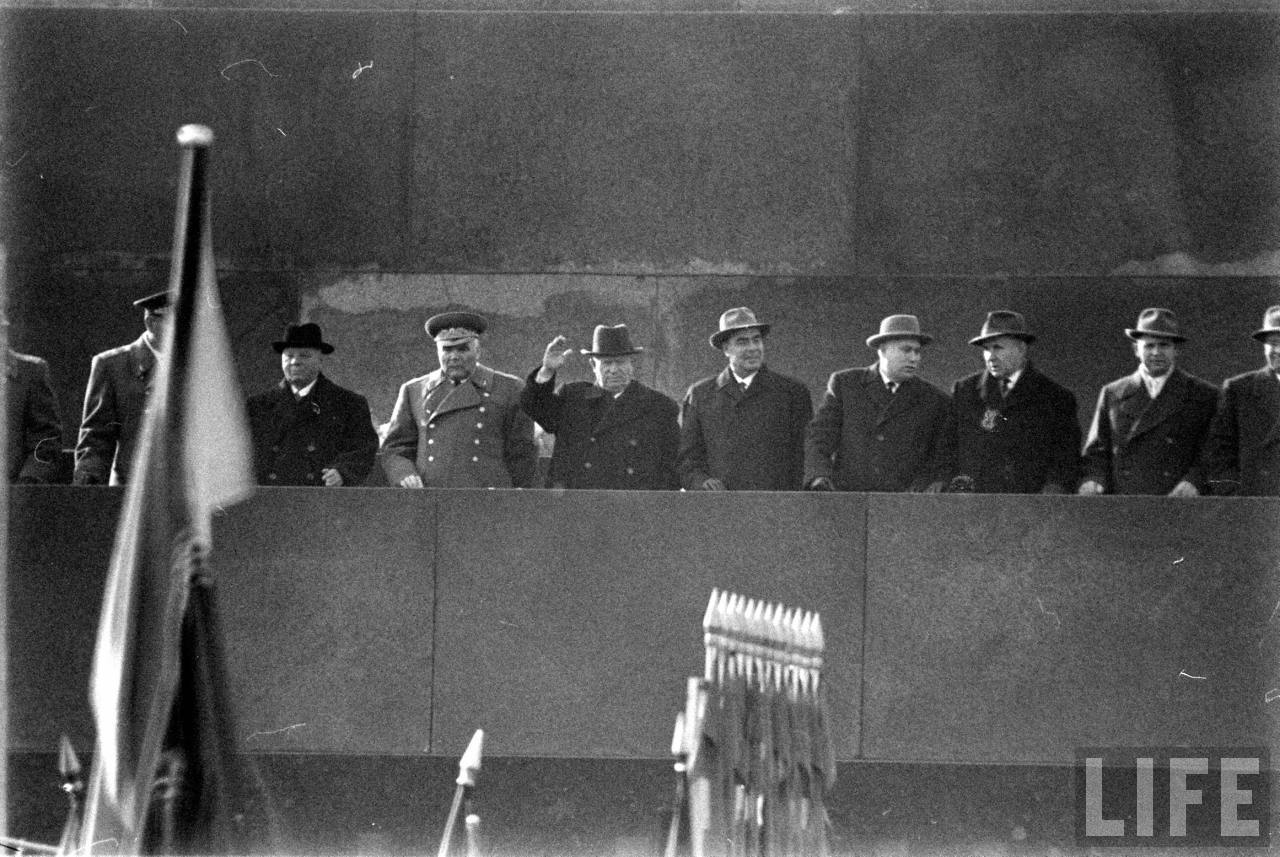
Krushchev, Brezhnev and other Soviet leaders review the Revolution parade in Red Square, 1962.
LIFE magazine photo by Stan Wayman.
The professor was an intelligent man, and probably cultivated too. How was it possible, in the Year of Our Lord 2021, for such a person still to believe that, until the advent of Stalin, the Russian revolution was a good thing, to be emulated or repeated elsewhere?
How could anyone of his intelligence fail to realise that, though as ever there was much wrong with the world, attempts to put everything right at once by the implementation of petty intellectual schemes are fraught with danger, and have a history of mass slaughter behind them?
I think the answer must lie in the psychology of religion: when religious faith is replaced by a philosophy that prides itself on its rationality, it soon turns religious in the worst possible sense. it becomes an atheist theocracy.
Everything was known about the Soviet Union from the first. It is simply not true that Solzhenitsyn revealed anything to the West that, in essence, was not, or could not have been, known before.
I have, in desultory fashion for a number of decades, been collecting books about Russia and the Soviet Union from just before the Revolution until the Second World War, and while it is true that many of them are laudatory, with titles that now seem hilarious to us such as The Soviet Union Fights Neurosis, a very large number books of various genres, from essays to histories to memoirs to novels and short stories, were published that exposed the viciousness of Bolshevism from the very first — a viciousness that anyone with any imagination could have anticipated from Lenin’s literary style alone.
Leninist viciousness was viciousness of a new and more thoroughgoing type that acted on the mind as a virus acts on a computer (viciousness, both actual and potential, is, alas, a constant of human history because of our flawed nature).
Solzhenitsyn was right about the difference between Macbeth, who from personal ambition killed people, but only a few, and the ideologically-motivated mass-killings of the Soviet Union and elsewhere — the difference being precisely in the effect of ideology.
But what was really different about Solzhenitsyn, apart from his literary talent, was that Western intellectuals were now prepared to believe what he said, whereas shortly before they had rejected as mere propaganda evidence of a very similar nature produced by others.It was so startling to meet someone who still believed that a “pure” revolution could take place, and that such a person was teaching history of all things, in a reputable, or at any rate reputed, university, that, like Karl Kraus confronted by Hitler, I could think of nothing to say.
I had no idea whether he still taught undergraduates, or whether in doing so he suppressed at least some of his views (as a judge is supposed to suppress his own private opinions): but I confess that the charge against Socrates, that of corrupting youth, came into my mind.
February 22, 2021
QotD: Modern academic “life”
… and never more than to people who know themselves un-beautiful, therefore not good, therefore false, and locked in it. Forever.
These people hate us, not because we’re better looking, more socially skilled, or whatever — this is, after all, the Internet — but because we’ve got options. We’re not all fighting over who gets to be Big Fish in an ever-shrinking pond. We’re different things to different people; we haven’t collapsed our social context down to faculty mixers and the one or two non-hamplanet grad students who are silly enough to apply each semester. We can go days, maybe even weeks, without obsessively comparing ourselves to our peers. We don’t care that we’re not “Chad” or “Stacy,” because we’ve got other settings on the emotional dial than “smugness” and “jealousy.”
But we need to start caring. I don’t mean getting obsessive over our appearance. I mean that, since this is in many ways an aesthetic battle, aesthetics will help us win. I half-jokingly suggested a “Normal Guy Uniform” a while back – an all-white ball cap with the New England Patriots’ logo on it. I’m not really kidding now. The Left wins, in large part, because they’re fugly losers that no normal person could possibly consider a threat … until they bash your skull in, or get you fired, or send a SWAT team to your house.
Severian, “Politics for Fugly People”, Rotten Chestnuts, 2018-08-24.


