
One of many reasons I never went anywhere in my career as an academic historian is that I actually like history. I find it interesting. That’s because I find people interesting, and history is, above all, the study of people and how they be.
Your average academic historian lives entirely in xzheyr own head. They hate and fear people. They have no interest in how people actually are, only in how they should be. Thus, academic history quickly devolves into the worst kind of Social Justice Mad Lib, a never-ending, ever more frantic search for ever more obscure terms to complete the equation: “Despite [barbarities], the [micro-group] were actually only doing it because they were oppressed by the Pale Penis People, because [reasons].”
For example:
This is one of those things that’s true even if it’s not true, because Clown World, but I actually looked this guy up and yeah, he’s real — he’s a “Professor of Practice in Media and Activism at Harvard University”, which is exactly what it sounds like: basically, a tenured pest, who makes very nice bank making students protest shit for class credit. The “new book” referenced in the screenshot isn’t on Amazon yet, so maybe that’s not real, but again, Clown World — even if it’s not real, it’s real, because that’s exactly the kind of thing academic historians do. You probably remember it well from your own college days, if you were in college at any time between about 1985 through 1995, the heyday of “everyone you’ve ever heard of was secretly gay!” pseudo-scholarship.
Severian, “On Boredom”, Rotten Chestnuts, 2021-08-17.
November 19, 2021
QotD: People who are interested in history versus “academic” historians

November 12, 2021
One Pretendian’s “cultural Munchausen syndrome”
In Thursday’s NP Platformed newsletter, Colby Cosh updates us on the story of Carrie Bourassa, who had effortlessly surfed to high profile, well-remunerated positions at the University of Saskatchewan and with the federal government largely on the basis of her claimed First Nations background:

Carrie Bourassa with media.
Lead photo in Geoff Leo’s article for the CBC – https://www.cbc.ca/newsinteractives/features/carrie-bourassa-indigenous
Newspapers have a slightly nasty characteristic: it’s easy for them to get pre-emptively mad when institutions are a little slow to do the right thing, and it’s also easy for them to forget to give credit when those institutions get around to it.
So let’s acknowledge that the federal government and the University of Saskatchewan are dealing — as best they can, almost certainly — with their shared Carrie Bourassa problem.
Two weeks ago, CBC News investigative reporter Geoff Leo published an astonishing tour de force. His feature article established, beyond almost any doubt, that Bourassa, a high-profile Indigenous scholar who told and published countless stories of racist treatment and childhood adversity, is actually a fabulist from a wealthy white family. The Institute of Indigenous Peoples’ Health soon put Bourassa, its scientific director, on unpaid leave. The U of S suspended her with pay, probably having no better immediate alternative.
[…]
Since Prof. Bourassa was put on ice in her lucrative Aboriginal-health jobs, Indigenous folk have been labouring to explain in the press what was wrong with her concoction and aggressive peddling of a fake Métis upbringing on the mean streets of Regina. Drew Hayden Taylor’s Globe and Mail op-ed about Bourassa’s “cultural Munchausen syndrome” is instructive and funny, but we hope it is all right to tell Aboriginal-Canadians that no white settler with a lick of sense would consider Bourassa’s tapestry of falsehoods to be harmless “fibs”. This may be a self-serving observation, but her confabulations about her personal history wouldn’t be consistent with the standards of a newspaper, let alone those of a university.
About a year ago, the Saskatchewan Health Research Foundation gave Bourassa an award (not her first) and published a capsule summary of her career. If you read it, you will notice how she was, from time to time, offered career advancement out of the blue by Indigenous supporters who had been taken in by her stories. Even a white grad student living on ramen in a basement apartment might be a little ticked about this. The University of Saskatchewan’s original claim that Prof. Bourassa hadn’t benefited from claiming Aboriginal ancestry is pathetic hokum: Bourassa tellingly accused her own sister of “looking for … a way to make some money” by accepting Indigenous scholarship funds during her PhD studies.
And it probably occurred to the USask brass sometime between the two press releases that an investigative reporter like Leo, in taking on a topic, always looks a couple articles ahead. Bourassa, for example, claims to have suffered from tuberculosis in her late 20s — a useful credential, unfortunately, for someone studying the field of Indigenous health. It’s useful because the disease has been nearly eliminated among non-Indigenous Canadians: the incidence rate for First Nations is 40 times higher, and the cases tend to be concentrated in remote northern Indigenous communities. Even if we overlook Bourassa’s propensity for creative autobiography … well, if she contracted TB, she was certainly very unlucky.
QotD: The looming quantum computing apocalypse
We’re reaching peak quantum computing hyperbole. According to a dimwit at the Atlantic, quantum computing will end free will. According to another one at Forbes, “the quantum computing apocalypse is immanent.” Rachel Gutman and Schlomo Dolev know about as much about quantum computing as I do about 12th century Talmudic studies, which is to say, absolutely nothing. They, however, think they know smart people who tell them that this is important: they’ve achieved the perfect human informational centipede. This is unquestionably the right time to go short.
Even the national academy of sciences has taken note that there might be a problem here. They put together 13 actual quantum computing experts who poured cold water on all the hype. They wrote a 200 page review article on the topic, pointing out that even with the most optimistic projections, RSA is safe for another couple of decades, and that there are huge gaps on our knowledge of how to build anything usefully quantum computing. And of course, they also pointed out if QC doesn’t start solving some problems which are interesting to … somebody, the funding is very likely to dry up. Ha, ha; yes, I’ll have some pepper on that steak.
Scott Locklin, “Quantum computing as a field is obvious bullshit”, Locklin on Science, 2019-01-15.
November 10, 2021
The organizational priorities of Canadian universities make for interesting reading
In Quillette, Jonathan Kay examines the 89-page agenda from a Universities Canada meeting, comparing the issues most people would identify as likely being of high urgency for a gathering of Canadian university administrators with the actual issues the organization considers urgent and important:
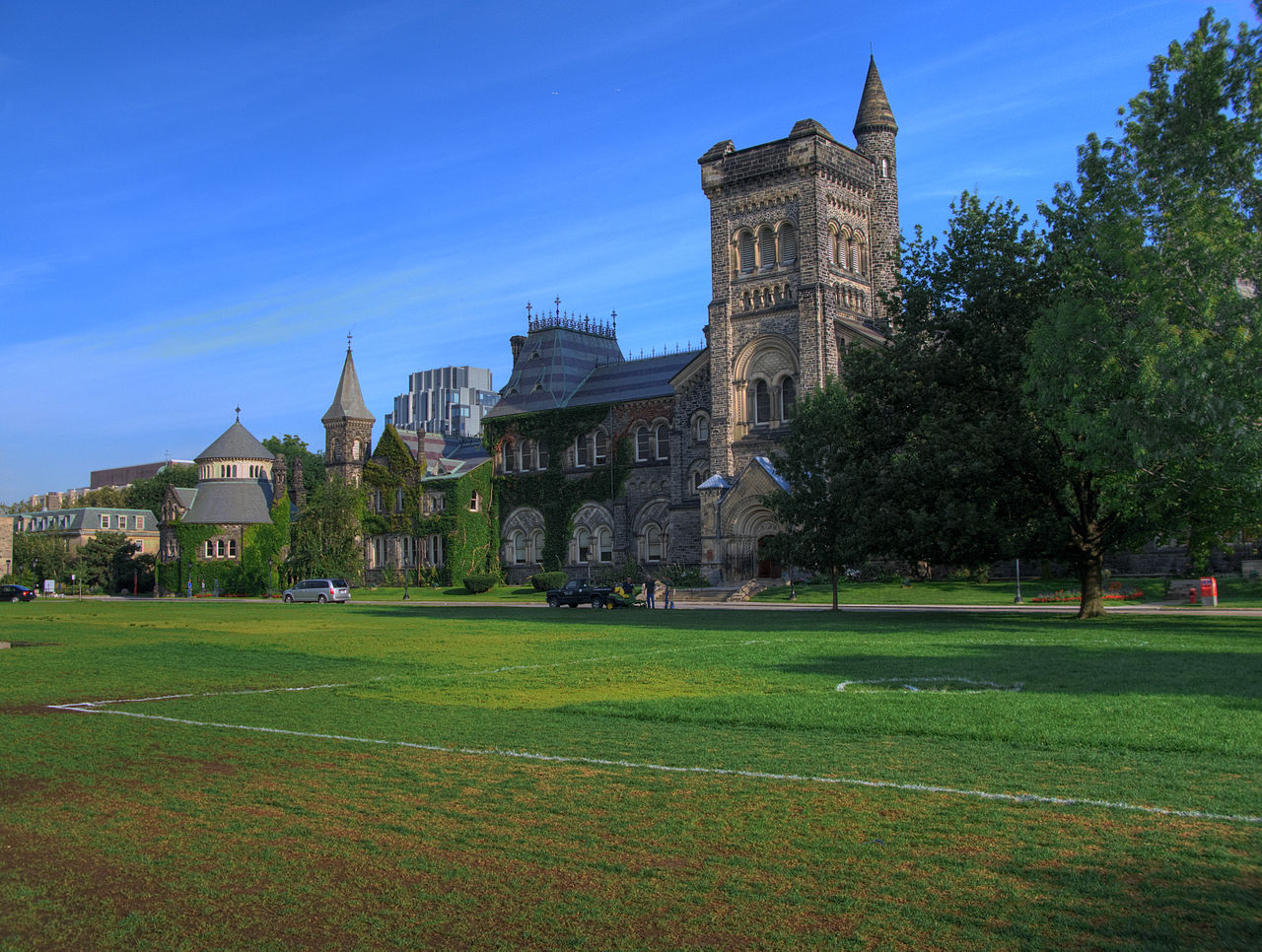
University College, University of Toronto, 31 July, 2008.
Photo by “SurlyDuff” via Wikimedia Commons.
Last week, 53 top Canadian academic administrators convened in Ottawa for a biannual membership meeting of Universities Canada, a group dedicated to “providing university presidents with a unified voice for higher education.” The 89-page meeting agenda, which was leaked to me after the event, makes for an interesting read.
The pandemic has been a challenging period for Canadian universities, as the adoption of virtual classrooms has caused some families to wonder whether the traditional bricks-and-mortar education model is worth the price. Many Canadian schools are financially dependent on foreign students, an income source that’s now in flux thanks to COVID. In April, Laurentian University in Ontario declared itself insolvent, cut dozens of programs, and laid off about 100 professors — an unprecedented development.
And yet none of these issues is listed on the October 27th Universities Canada meeting agenda. Laurentian University isn’t mentioned at all, in fact. And the only substantive reference to the COVID pandemic consists of an aside to the effect that “women are disproportionately being impacted negatively during the pandemic”. Instead, all of the agenda’s main action items are dedicated to social justice.
The first item updates attendees on Universities Canada’s multi-year effort to draft a statement on “Social Impact Principles”. A subsequent action item details the “Scarborough National Charter”, a document aimed at “mov[ing] from rhetoric to meaningful concrete action to address anti-Black racism and to promote Black inclusion.” There’s also a related item titled “Equity, Diversity, and Inclusion,” under which members were asked, by formal motion, to affirm their commitment to an affirmative-action doctrine known as “Inclusive Excellence”.
Later in the document, there appears an action item relating to “Principles of Indigenous Education”, detailing the by-now year-and-a-half-long consultation process aimed at renewing Universities Canada’s original Indigenous Education manifesto (which itself was announced with much fanfare in 2015 after a year of work). Among the proposed editing refinements are that language be added “recognizing [the] intersectionality of Indigenous identities”; and that a new preamble be added “acknowledging that Universities Canada and its member universities are located on Indigenous lands across Turtle Island.” The final version, it’s predicted, will be ready by April 2022.
But the agenda’s real centrepiece is a 46-page standalone report commissioned by Universities Canada, called Building a Race-Conscious Institution: A Guide and Toolkit for University Leaders Enacting Anti-Racist Organizational Change.
The report’s main theme is that university leaders must decisively reject the idea of “colour-blindness” (which the author asserts should properly be termed “colour evasion”) in favour of becoming “race-conscious individuals” who “explicitly reflect on their ethno-racial identity and group membership.” The author also exhorts university presidents to “actively examine their personally mediated racial biases, consider their individual experiences with respect to racism, and acknowledge their relative race-related marginalization or privilege in the larger society.” To persist in colour evasion, the author warns, is to erect “discursive barriers to antiracist organizational change.”
And colour evasion is just one of 10 listed “dominant ideologies and pervasive narratives [that] undermine efforts to counteract racism.” Among the other “barriers” listed by the author are “equal opportunity”, “tradition”, and “tolerance”. The report also contains tangents on “white fragility”, “allyship”, and the “ethics of care” prescribed by “critical feminist and antiracist scholars” — as well as instructions regarding the use of certain words and phrases. For instance: “Representation gaps among students, scholars, and staff in higher education are not ‘achievement’ gaps, but rather ‘opportunity’ gaps.”
November 6, 2021
QotD: Michael Bellesisles
Bellesisles, you might recall, is the guy whose revolutionary revisionist thesis was that the Founders weren’t really all that enthusiastic about guns, and didn’t own that many, and that whole 2nd Amendment thing was just an afterthought. Yeah, right. That one was written conclusion first, and since no remotely objective look at the evidence could ever possibly support it, he resorted to making lots of “evidence” up. But the reaction of the rest of the profession was interesting: They lauded Bellesisles to the skies. He won the Bancroft Prize for his work, which is the biggest one you can get in American history. Now, I’m sure you’re saying “of course they praised him, he was telling them exactly what they wanted to hear!”, and you’re right …
… but only to a point. Because eggheads are — as you might imagine — the pettiest, most envious bunch of little bitches this side of a junior high cheerleading squad, there’s no piece of research so meticulous, no conclusion so solid, that someone isn’t going to tear into it in one of the professional journals, for base personal reasons if no other. Lest you think I’m kidding, I personally know of a woman at a big league school whose husband was seduced, and her marriage ruined, by an open, obnoxious lesbian colleague, all because she, the hetero, had dared to question some of the lesbian’s work at a conference in their mutual field.
That’s the level of pettiness we’re dealing with here. And I can’t say for absolute certain that Bellesisles received no criticism whatsoever; he doesn’t work in my field, so even though I was certain that Arming America was bullshit of the purest ray serene, it wasn’t my problem, professionally speaking. But whatever, point is, in my fairly well-informed opinion, merely “telling them what they want to hear” doesn’t account for the entire profession ignoring the huge, blinking, neon red flags surrounding Arming America. Rather, I suggest it’s more of a Pauline Kael thing.
I actually kinda pity Kael — much like John Montagu, the 4th Earl of Sandwich, she was a fairly big wheel back in her day, but if she’s known at all now, it’s for something entirely peripheral to her life’s work. In Kael’s case, it’s her declaration that it was impossible for Richard Nixon to have won in 1972, since “nobody I know voted for him” (it was one of the biggest blowouts in American electoral history). The Arming America thing is, I think, like that — nobody in academia owns a gun, or knows anyone who owns a gun, or knows anyone who knows anyone who owns a gun. So, yeah, they know all the scary statistics about how there are sixty gorillion more guns than people in America, but all of that iron belongs to the Dirt People, far away over the horizon. They’d never in a million years even be in the same zip code as someone who thinks Arming America was absurd on its face. Hence, it never occurred to them to question it.
It helped that Bellesisles was telling them what they wanted to hear, no doubt, but the main reason nobody challenged it was that they lacked the cognitive toolkit to even consider the possibility he might be wrong.
Severian, “Are They Trying to Lose?”, Rotten Chestnuts, 2021-07-15.
October 30, 2021
“Pretendians” … members of the Wannabe tribe … people who fake First Nations ancestry for personal gain
I missed Thursday’s NP Platformed newsletter when it first came out, where Colby Cosh praised a CBC “longread” which dug into the oft-trumpeted heritage of a prominent Saskatchewan university official and did a thorough job of demolishing her claims to First Nations ancestry. This might have seemed unwarranted cruelty, except that those false claims had materially aided her rise to her current position with the university and the federal government:
Carrie Bourassa with media.
Lead photo in Geoff Leo’s article for the CBC – https://www.cbc.ca/newsinteractives/features/carrie-bourassa-indigenous
The result is not only astonishingly well-written and funny — it’s unanswerable. Bourassa has been caught telling utterly insupportable stories about her own past, making lurid claims of racial abuse and colonial trauma in a fanciful Indigenous household bearing no resemblance to the wealthy white one in which she actually grew up. When she got wind that the CBC was working on a story, Bourassa used the resources of the institute to organize a PR defence and arrange for an “open letter”, whose signatories are surprised and offended to find their names attached.
And if the story’s soundness is doubted, one need only refer to the rebuttal that Bourassa published yesterday. Read it and hear the scratching of ticked-off boxes. “I refuse to be victimized by this man who calls himself a journalist. This entire smear campaign stems from lateral violence … nothing less than tabloid journalism … it is apparent that I must adhere to western ideologies.”
But Bourassa’s response, while slinging the jargon generously, does nothing to refute Leo’s reporting. The Saskatchewan scholar lashes herself to the mast of a late-life Métis adoption, which does nothing to explain her tales of making mukluks and beadwork with her “half-breed” “gramps” at age seven.
No prior news item about Aboriginal stolen identity has ever been as strong and complete as this one — and that is why it is worthy of our attention, and of the resources dedicated to it. Bourassa has earned fantastic sums as a researcher and administrator of public funds. Most of this would have been utterly unavailable to her as an ordinary white social worker from the vodka-drinking parts of Saskatchewan. She is in a paramount position of importance in a national bureaucracy dedicated to Indigenous well-being and cultural preservation: her endless nose-stretchers about Aboriginal identity make her position completely untenable.
So will anything be done about it? If the federal government and the University of Saskatchewan are willing to overlook the case made here by the CBC, they will overlook absolutely anything. Falsely claiming Aboriginal descent is one sinful thing; lying floridly and repeatedly to audiences about your personal history of suffering racist treatment is another. (Can one “adopt” experiences? We suppose one can, with a little imagination!) Bourassa seems determined to fight, and to exploit her position to do it. So the institutions to which she has attached herself may have to act — or suffer a disastrous blow to their credibility among First Nations and settlers alike.
October 4, 2021
Teaching history versus teaching to pass history tests
Severian discusses the problem of university students who know how to do well on multiple-guess tests, but don’t have the intellectual tools to work out answers if they’re not presented the same way as they were in class:
(Not Severian’s old employer, Flyover State) University College, University of Toronto, 31 July, 2008.
Photo by “SurlyDuff” via Wikimedia Commons.
Having realized I made a horrible mistake going into the Ed Biz, I used my last few semesters before pulling the pin as a kind of freelance lab. I’d ask a series of questions with canned answers about, say, the Battle of Gettysburg: The high ground occupied by Union forces was called a) Cemetery Ridge, b) Heartbreak Ridge, c) Federal Ridge, d) Ridge over Troubled Waters, and so on. Then I’d put in a “tie it all together”-type question, like so: In this famous Union victory, a failed assault against higher ground proved decisive. Was it a) Gettysburg, b) Chancellorsville, c) Port Hudson, d) Stalingrad. Note that the correct answer was actually spelled out in the previous questions …
… and I’m sure you can guess how the average student did. Just for fun, go ahead and guess how many students in a typical class of 30 picked “Stalingrad”. I’ll save you the suspense: Whatever you guessed, it’s too low. The reason is: Not knowing how to handle a question that isn’t straight regurgitation, students assume it’s a trick. Since they’ve never heard of the Battle of Stalingrad, that must be the answer (alternate explanation: They knew they skipped a lot of classes, and since they’ve never heard of a Civil War battle at Stalingrad, I must’ve covered it on one of those days they were sleeping off a hangover at 2pm, so it must be the right answer).
Since he teaches high school, Education Realist is more concerned with the “false positives”, the kids who ace the standardized test yet are dumb as fence posts … or, to be fair to them, are just slightly-brighter-than-average, but get the Certified Genius™ stamp on their high school transcripts, because they trained their asses off to ace the standardized tests. Me, I’m more interested in what this says about social decline.
My hypothetical question about the unnamed battle, above, isn’t genius-level stuff. It’s pretty basic, obviously, and at the start of my professing career I never would’ve tried it — NOT because I was so much more conventional back then (though I was), but because I considered it an insult to my students’ intelligence. Back then, I’d expect the average high school freshman to be able to figure that out, with no real strain on the brain …
It takes very long, very diligent, very expensive training to make kids into mere flowchart-followers. It takes even more of all that, plus a kind of sick genius, to turn them into the meat robots I saw at the end of my career, who were so robotic — and I swear this is true — that I could confound quite a few of them simply by switching up the word order. The powerpoint presentation said “The Union won the Battle of Gettysburg”, but the test said “The Battle of Gettysburg was won by ___”, and some large percentage of them would be stumped.
This has been a public service announcement, for all of you who’ve ever felt compelled to come up with some elaborate 4D chess theory about why our overlords do such seemingly stupid, indeed bizarre, things. These are the test-acers … and those are the kinds of tests they’re acing.
October 2, 2021
Signs of “white privilege” apparently include swearing and wearing second-hand clothing
It’s gotten to the point that I half expect to be told that even breathing is a clear indicator of “white privilege”. Brendan O’Neill reports on a mandatory University of Kent diversity and inclusion course that declares white people swearing or wearing second-hand clothes are clearly evidence of their “privilege”:

Plato’s Closet used clothing store in Oshawa, Ontario. Obviously a nest of racial privilege.
Detail from Google Street View.
So now wearing second-hand clothes is a sign of “white privilege”. Just when you thought you’d heard it all from the loopy identity lobby, they come out with the idea that putting on a vintage dress or a musty old man’s shirt you bought from Oxfam is proof that you enjoy racial favouritism. This crackpot claim is made in a course being foisted on students at the University of Kent. If you can wear second-hand clobber without this being held up as yet another example of the “bad morals of [your] race”, then you are apparently white and you’re definitely privileged.
I have so many questions. First, who exactly is going around saying to ethnic-minority people who dare to don vintage fashion, “Oh God, how typical of your race to wear second-hand clothes?”. I am going to say “nobody”. When racist toerags do accost people who look different to them, it is usually not to critique their Seventies florals or dad’s old blazer. Secondly, it will surely be news to all the less well-off white kids who have little choice but to wear second-hand clothes – “hand-me-downs” – that their repurposed trainers and patched-up jumpers are proof of their privilege. Some of us who crazily cling to the belief that class and income remain the key shapers of privilege in our society might even say that the wearing of second-hand clothes in such circumstances is proof of the absence of privilege. Mad, I know.
The Kent course, titled “Expect Respect”, is only the latest example of students being inculcated into the ways of moral conformism. It’s a mandatory module, which takes four hours to complete, and is designed to raise students’ awareness about white privilege, microaggressions, pronouns and other riveting topics. The module includes a “white privilege quiz” – such fun! – in which the freshers are grilled over the societal benefits enjoyed by whitey. Apparently if you can swear without being called a disgrace to your race or go shopping without being followed or harassed, then you enjoy white privilege. Students who correctly identify all the indicators of racial privilege get a gold star. Presumably those who don’t get branded with the letter “R” for racist.
The list of things that are apparently signs of white privilege grows longer and more demented by the day. Saying “I don’t see colour” is white privilege. Eating French food is white privilege. Drinking milk is white privilege. Saying “I don’t have white privilege” is white privilege. Of course it is. “For white people to dismiss the benefits they’ve reaped because of their whiteness only goes to show how oblivious – and privileged – they really are”, says one writer. This is the Kafkaesque trap of identity politics. There’s no winning in this slippery game. Refuse to acknowledge another person’s race and you’re racist. But obsess over another person’s race and presumably you’re also racist. Saying “I don’t see difference” is racist. But saying “Oh you seem different, where are you from?” is racist too. Confess your white privilege, and clearly you’re privileged. Deny it and you’re really privileged. It’s like being an old lady on a ducking stool in medieval times. Float, you’re a witch. Die, you’re a witch.
September 28, 2021
QotD: I have literally no idea what this means
Judith Butler, “Further Reflections on the Conversations of Our Time”, Diacritics, 1997, as quoted by Christina Hoff Sommers, 2019-01-04.
September 22, 2021
The Extremely Bizarre Engineering Rituals of Canada (And the Fascinating Way They Came to Be)
Today I Found Out
Published 31 Jul 2021This video is #sponsored by NordVPN.
Sources:
Andrews, Gordon, Canadian Professional Engineering and Geoscience: Practice and Ethics, Thomson Nelson Canada Ltd, 2005
Kipling, Rudyard, “The Hymn of Breaking Strain”, 1935, http://www.cuug.ab.ca/~branderr/risk_…
2 Esdras 4:5-10, https://thekingjamesversionbible.com/…
Bateman, Chris, The Secrets of Engineering’s Strange and Mysterious Initiation Ritual, TVO, April 24, 2018, https://www.tvo.org/article/the-secre…
“Background: The Calling of an Engineer, The Ritual of the Calling of an Engineer”, https://www.ironring.ca/background-en/
Anderson, Bill, “Why Engineering is Purple”, April 16, 2019, https://profbillanderson.com/2019/04/…

September 10, 2021
Why even highly gifted young quarterbacks rarely succeed as they move toward the NFL
Severian at Rotten Chestnuts looks at the early career life-cycle of football quarterbacks:
At all levels of American football below pro, the “option” is a major facet of the game. This is an offensive play where the quarterback can either run the ball himself, pitch it to another player, or throw it downfield, as he thinks best. It certainly helps if the quarterback is a strong-armed, accurate passer, but the key criterion here is speed. If you get defenders cheating up in order to stop the run, you don’t have to be as strong or accurate with your throws. What matters is that the QB can pass — meaning, he can throw it X yards downfield, within a few yards’ radius of a given spot — not how often he does so. The closer he can get it to the spot, and the further downfield that spot is, the better, but so long as he’s in the vicinity the option system works well.
This starts very, very early in a player’s career. The lower down the skill ladder you go, the more prominent the “option” offense. In “Pop Warner” leagues — kids below age 12, basically — the option pretty much IS the offense, since few kids can throw the ball very far, much less with accuracy. Throwing a football with both velocity and accuracy is extremely difficult, and it doesn’t help that sound throwing mechanics feel brutally unnatural — you know you’re doing it right when it feels like your shoulder is going to pop out of its socket at the very instant your elbow ligaments snap and hit you in the face … which, unfortunately, is exactly what it feels like when you’re doing it wrong, and your shoulder IS about to pop out at the same moment your elbow ligaments snap.
What happens, then, is that kids generally learn how to throw with very poor form … but coaches generally aren’t going to correct them, either because they don’t know the proper mechanics themselves, or because they are focused exclusively on winning games. Who cares if little Kayden, Brayden, or Jayden is going to blow his arm out hucking it like that when he hits high school? That’s Coach Smith’s problem. All that matters now is that he can get it to X spot with radius Y.
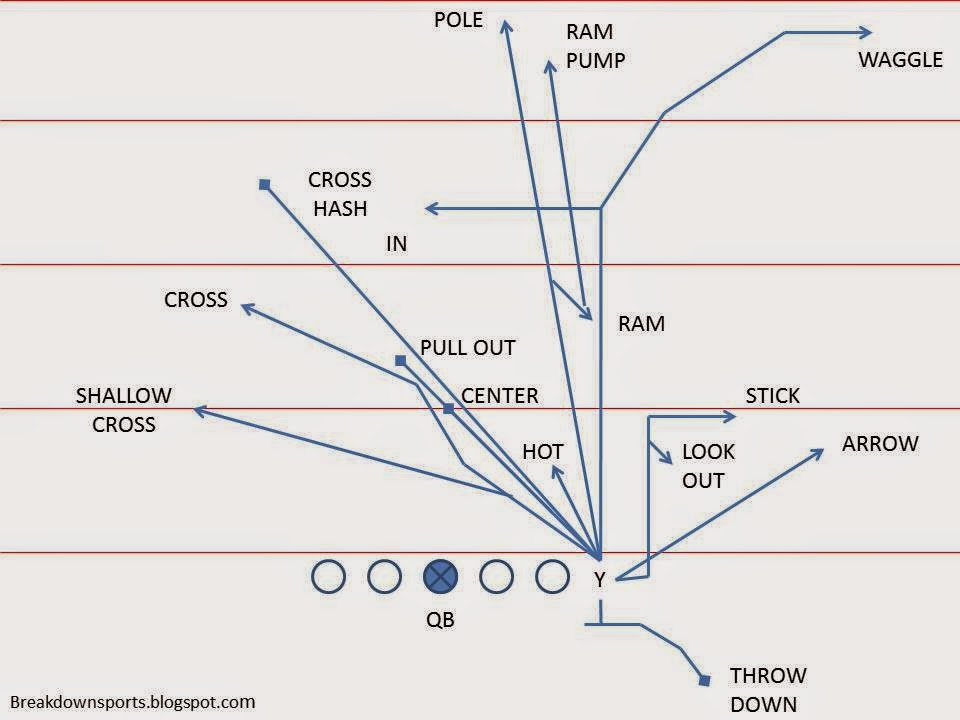
Thus the possible career path of any kid who can throw a football reasonably well quickly diverges. If he’s too slow to run the option effectively, his coaches will try to turn him into an “air raid” style quarterback, which means he throws on every play, mechanics be damned, because we need to win now, and what the hell, he can get it there, can’t he? But even the “air raid” style of play is enormously more difficult to coach, because that means you need to be able to coach a whole corps of wide receivers to run a whole bunch of increasingly complex routes. Here, look:
That’s what’s known as a “route tree”, and all of your receivers — five guys, usually, on every play, plus their backups — need to know how to run every one of them, every time. Which means your playbook is going to be huge, because you (theoretically, anyway) need a play for each one of those routes, for each receiver on the field. And obviously your quarterback has to have something going on upstairs, because he needs to memorize five different guys’ routes for every single play, plus audibles and checkdowns (changing any given player’s route, or even the entire play, on the fly), and so on.
I’m sure y’all see where I’m going with this, but it’s important to note that the key selection — whether a given kid shall be an “option” quarterback, or an “air raid” quarterback — has been made by someone else, much lower on the skill ladder. It would be great if one and the same kid could do both to a high degree of skill, but since human neurons apparently don’t work like that, it’s natural for everyone involved to take the path of least resistance.
And again, I’m not blaming coaches for this. Forget things like “getting fired for losing too many games”, and just consider the sheer amount of work. Stipulating for the sake of argument that you’ve got 50 man-hours in a week to get ready for a game, how do you best allocate them? Getting your QB to throw with proper mechanics alone probably takes a significant chunk of that time, and even though he’ll have to do a lot of it on his own — throwing passes at a tire in the backyard until his arm feels ready to fall off — you’re still spending a LOT of time on something that will make no appreciable difference to the game’s outcome this Friday night. And then throw in the other stuff — how much time does it take just to “install” (as the term d’art is) a game plan that has all those routes in it, much less coaching all the receivers up to where they can run them all?
Nah, brah. Just hand Jonquarious the ball and let him run it, and if he has to huck it downfield every now and again, let him do it his way. Again, this will make no difference at all to the outcome of this week’s game — he’ll either run it or he won’t; make the throw or not — but it frees up a lot of man hours to do all the other stuff a coach has to do that we haven’t talked about yet, such as defense.
September 7, 2021
QotD: Calvin was right
Hobbes: “‘The Dynamics of Interbeing and Monological Imperatives in Dick and Jane: A Study In Psychic Transrelational Gender Modes.'”
Calvin: “Academia, here I come!”
Bill Watterson, Calvin and Hobbes.
August 28, 2021
QotD: Social media capitalizes on “the biggest Faculty Lounge Fallacy of them all”
Even when they’re pretending to Care Very Much about, say, “systemic racism” in “America”, it would never occur to them to go down to the ghetto that, in many notorious cases, is literally right next door to do anything about it. They could find out everything they ever wanted to know — and then some!! — about “the Black Experience” by driving down MLK Blvd. at three in the morning, but somehow they never do. The way you win at victim bingo in the ivory tower is you find the most obscure group, the furthest away, to chastise your peers for not caring enough about. If what you say could possibly have any real-world application in the lives of anyone anybody you know had even the possibility of ever meeting, you lose.
Such is Social Media, so it’s no surprise that the Twitterati all fall victim to the biggest Faculty Lounge Fallacy of them all: That saying something is the same as doing something. Or, in other words, and not to put too fine a point about it, they act like passive-aggressive little bitches, like cat ladies around the company water cooler. You could get Johnny from Accounting to stop leaving his half-eaten sandwich in the lunch room fridge by simply asking him to stop … or you can have daily hen parties about it for weeks, months, years, squawking about how some people need to get some common courtesy … and meanwhile Johnny from Accounting goes on doing it, oblivious.
The genius of Facebook, Twitter, etc. — and it IS genius; sick, evil, twisted genius — is that they figured out how to monetize this.
Severian, “Internet Tough Guys”, Rotten Chestnuts, 2021-05-10.
August 4, 2021
QotD: The Bell Curve of the benefits of (modern) education
On the far left of the curve is a newborn — who has learned literally nothing, knows nothing, and has received no benefit from education.
As we learn from our parents at home and our teachers at school, we progress along the curve with benefits accumulating along the way.
But something happens somewhere between sophomore year Vivisecting the Deconstructed Patriarchy 201 at Bleeding Heart College and achieving the dream of earning that Ph.D. from the University of Charging More Than a Mortgage for your dissertation on Imposing Ruthless Meaninglessness on Others.
Somewhere just on the right side of the bell curve, we devolve along the curve with detriments accumulating along the way.
By the time you’re as well educated as Dr. Swannie Jett, you’re so untethered from reality that you’re basically impervious to knowledge.
Stephen Green, “Insanity Wrap #198: Looted & Burned Target Store Puts Up Mural Celebrating Arson”, PJ Media, 2021-05-03.
July 27, 2021
John McWhorter on “antiracism” in theory and practice at the University of California
John McWhorter doesn’t just comment on this issue from mere distant concern, because he was working at UC Berkeley and watched it happen before his eyes:
John McWhorter’s Twitter thumbnail image
When I taught at UC Berkeley in the 1990s, it was an open secret that there was a two-tier undergraduate student body. Namely, black and Latino students tended to be considerably less prepared for the workload than white and Asian students.
No one talked about it openly, but plenty attested to it when they were sure the wall didn’t have ears, and to notice it was not racist – it was simple fact. Of course there were weak white and Asian students; of course there were excellent black and Latino students. But a tendency was unmistakable. It was painfully obvious that brown students were admitted according to very different standards than white and Asian ones.
Proposition 209 barred racial preferences of that kind in the UC system as of 1998, and of course, fewer brown students were admitted to the flagship schools Berkeley and UCLA after that. There were still plenty of brown students – the “resegregation” so many furiously predicted never happened. But not as many as before. And there has remained, for almost a quarter century now, a contingent who have never gotten over thinking UC would be better by going back to the way it was.
First there was the addition of a “hardship” bonus to the admissions procedure, with standards relaxed for applicants who could attest to having faced obstacles to achievement such as the death of a parent or serious illness. Formally this was supposed to apply to kids of all races. But immediately evaluators started weighting black and Latino hardship heavier than that suffered by white and Asian kids, as in rejecting an Asian applicant who had gone through the same kinds of hardship as a Latino one who was admitted.
I criticized this in the media, and will never forget when the suits assigned a kind, academically accomplished administrator to take me to lunch to “talk to me”. The poor man did his duty and … sat there lying to me. I genuinely felt sorry for him. But this showed how impenetrably committed to antiracism – or at least what they think is antiracism – these admissions officials are.
But even this kind of thing hasn’t been able to return Berkeley and UCLA to the good old days of having a “representative” number of brown students (apparently “representative” means in lockstep with their proportion of the state population). The problem is that pesky SAT, and at last, UC has gotten rid of it. The SAT will no longer be used to evaluate students for admission or even for scholarships.
A lot of people must have clinked their glasses of Pinot over this. But what they’ve done is not antiracist at all.


