Look around you – if we in the West and we humans, in general, had been invaded by aliens, what would be different?
- Our schools in America teach that the system under which America lives, from constitutional protections to (relatively … very relatively) free markets are evil and the cause of all evils in the world.
- Our schools further teach that all the problems in the world at large are the fault of “Imperialists” to include not just America, but the West which is America’s mother culture. They ignore the sins of other nations, many of which, still today, commit female mutilation and slavery, to concentrate ONLY on the West and the sins of the West, thereby obviating any possible pride the students might have in their own culture.
- Further, the schools, under the guise of environmentalism, promote the view that humanity is the worst plague on the planet. Without pointing out that any species can drive others to extinction, or that humans are the only species capable of self-regulating their impact on the environment, they concentrate on those extinctions humans have caused and fantasize that without humans the world would be a paradise.
- Without pointing out the difficulty of global censuses or that in fact we don’t and can’t know how large the world population is, our learning institutions, our cultural institutions, even our entertainment continually scare us with the idea of overpopulation. Without taking into account that there are more trees now in North America than when the colonists arrived, they picture humanity as creating deserts. Schools push middle schoolers to sign agreements never to reproduce.
- As if this weren’t enough, feminists picture women – in Western, well off, more or less equalitarian (at least before the law as it existed before feminist tampering made it take sides with women most of the time) systems – as perpetual victims, stoke a sense of outrage and anger at any and all males, and encourage women to consider normal intercourse “rape” and marriage a prison.
- As if this weren’t enough, the insanity has descended to preaching that there is no such thing as biological sex, and that one’s gender is a sort of “mood” which can be determined before a child is even fully developed. Parents giving hormones to children, to change their sex before the age of reason (let alone physical or emotional maturity) and effectively encouraging castration/neutering and precluding future generations aren’t considered deranged abusers. In fact, educational and medical establishments will encourage parents to thus destroy their progeny and will take the children away if the parents don’t do it, on the flimsiest of pretexts based on stereotypes, such as a boy who disdains male toys, or a girl who doesn’t like dolls. The rich panoply of human expression is ignored in a – dare we say it – alien attempt to make individual people fit stereotypes.
- Three generations into this, our leading lights in intellectual life, be it fiction, non-fiction, academia or even research, get plaudits and advancement ONLY from conclusions and policies that objectively hurt humans and prevent humans from reproducing. A subset of this is hate of the West, the most successful culture in the world, ever, in terms of extending life, preventing early death, preventing or curing disease and preventing and curing famine. Another and even more vociferous subset is the hatred of America, which took all of Western virtues and made them more so.
If aliens, hostile to the very idea of humanity and wanting to prevent us from prospering, let alone going into space (another cause that all so called “progressives” hate with a burning passion and try to prevent by all means possible, from telling us that there is still need on Earth so we shouldn’t spend money on going to space, to telling us that we must first learn to “take care of this planet” to just sustained screaming that the human plague shouldn’t propagate) had managed to take control of our culture, what would they do differently?
Sarah Hoyt, “What if We Have Been Invaded by Aliens?”, PJ Media, 2017-07-21.
September 16, 2019
QotD: If we’d been taken over by aliens, how would we know?
September 11, 2019
Environmental virtue signalling – it’s other people who need to change, not me
Heather Mac Donald notes that, as with so many other things, young people who like to virtue signal about their environmental concerns don’t consider it incumbent on them to change … it’s always other people whose habits must be changed, by force if necessary:

FridaysForFuture Demonstration, 25 January 2018 in Berlin.
Photo by C. Suthorn via Wikimedia Commons.
The claim about youth’s transformative commitment to radical environmental change is — based on informal observation — bunk. The cardinal rule when it comes to environmental virtue-signaling is that people give up what they’re willing to give up. Young people are no different. If being environmentally sound required sacrificing anything that a self-described environmental warrior actually valued, the conversation would quickly change to a different topic. One’s own habits are necessary; it’s everyone else’s that need to change.
This always-unreached threshold for environmental sacrifice is particularly notable on the part of celebrity Greens, with their fortress-like SUVs, multiple residences, and massive carbon footprints — whether it’s the cavalcade of yachts and private jets that brought such luminaries as Leonardo DiCaprio, Mark Zuckerberg, and Katy Perry to Google’s three-day climate-change summit in Sicily this July; environmental crusaders Prince Harry and Meghan Markle jetting off to Elton John’s French estate; or Reliable Sources host Brian Stelter’s “quick day trip” to Los Angeles from New York just ahead of the CNN climate-change debate. A police caravan drives New York City mayor Bill de Blasio 11 miles from his mayoral mansion in Manhattan to his favorite gym in Brooklyn. “Everyone in their own life has to change their own habits to start protecting the earth,” he has intoned, but taking the subway is not one of those changes appropriate for him.
Most young people have not yet reached such a flamboyant level of energy use, but if they could, they undoubtedly would, with as little sense of anachronism as that of Al Gore in his energy-guzzling mansion. These are the consumers who keep football fields of computer servers buzzing round the clock to support their social media habits. If being green meant turning off one’s phone for 22 hours a day or foregoing the latest smartphone upgrade, the reasons why such sacrifices are not required would spout from every Gen Z-er and millennial’s lips. Students from the University of California, Irvine, constantly run their air-conditioners in the apartment complex where I spend summers, regardless of how cool the temperature outside is. They drive with their windows sealed and the car AC on, no matter how fresh the day (this is the new driving norm for almost everyone now). The meteoric rise of food-delivery apps, producing torrents of plastic and paper waste and a constant circulation of cars and electric bikes, has been fueled by young people’s demand for convenience and instant gratification. Cooking is apparently unthinkable. At best, one buys precut and washed food in the inevitable plastic containers. A daily Starbucks habit is deemed consistent with railing against environmentally destructive corporate greed.
New York’s tap water is among the purest in the world. Yet a young neighbor of mine in New York, like progressives throughout the city, receives towering deliveries of bottled water, entailing huge energy outlays to package and transport, not to mention generating flotillas of discarded plastic. The swim team members in my gym turn on their showers in the locker room, then walk away or do nothing other than chat as water gushes down the drain. Uber drivers in college towns report that students regularly call a car to get to class, rather than walk or ride a bike.
September 10, 2019
QotD: Mere words are not “violence”
“I’m very concerned about a phenomenon called ‘concept creep’ – which has been happening to a lot of psychological terms since the 1990s”, he says. “When a word like ‘violence’ is allowed to creep so that it includes a lot of things that are not violence, then this causes a cascade of bad effects. It’s bad for the students themselves because they now perceive an idea that they dislike, or a speaker that they dislike, as having committed a much graver offence against themselves – which means that they will perceive more victimisation of themselves. And it’s also really bad for society because, as we are seeing in a spectacular way in the United States this year, when each side can point to rampant occurrences of what they see as violence by the other side, this then justifies acts of actual physical violence on their side. And there’s no obvious end to this mutual escalation process.”
He adds: “Everybody involved in education needs to be dampening down violence and the acceptance of violence. Telling students that words are violence is counterproductive to that effort.”
Jonathan Haidt, quoted by Naomi Firsht, “The Fragile Generation”, Spiked, 2017-08-31.
August 30, 2019
August 29, 2019
“‘Neo-liberalism’ is actually little more than … ‘market socialism'”
Peter Boettke responds to a New York Times opinion piece by Binyamin Appelbaum, blaming economists for the state of the western world:

A Mises Institute graphic of some of the key economists in the Austrian tradition (Carl Menger, Ludwig von Mises, Friedrich Hayek, Murray Rothbard, and Hans-Hermann Hoppe.
Mises Institute via Wikimedia Commons.
But the problem is deeper than economists, it is ANYBODY put in this position of power and prestige, and to do so is fundamentally anti-democratic as was argued by Frank Knight in various writings, and then by Vincent Ostrom in The Intellectual Crisis of American Public Administration, and more recently in David Levy and Sandra Peart’s Escape from Democracy. We cannot fix this problem by replacing one set of “experts” with another set. We have to stop thinking of the relationship between economics and public administration along these lines altogether.
I try to lay out the argument in my SEA address on “Economics and Public Administration“, which also served as an attempt to summarize two decades of research that several of us have undertaken in this spirit. The critical argument in that text for this issue is that I argue that economics is a derived demand, if we conceive of the task of public administration one way, that will shape not only shape the supply and demand of economists, but dictate what it means to produce an economist — and thus, what is means to be an economist.
The problem with narratives like Appelbaum’s isn’t that he is suspicious of the pretensions of economists, it is that he is blaming the wrong culprit for the mess we’re in. Here it is important that everyone of these critics read Gregory Mankiw’s very important piece, published BEFORE the financial crisis, on the macroeconomist as scientists (read Chicago New Classical and Monetarists) and the macroeconomists as engineers (read MIT/Harvard Keynesian and New Keynesians). The Chicago folks — and the Austrian, Virginia, UCLA, etc. folks — did not go to DC, did not write laws, didn’t attempt to orchestrate economic miracles abroad, or stimulate growth at home. They taught, they lectured, the researched and wrote papers in journals and published books, and a subset of them wrote opinion editorials and did interviews in various forms of popular media. In short, they were teachers and students of society. They did not get paid to be experts for the government in general. They were not advisors. But others were — from Keynes to Larry Summers — the line is long. Just look at the number of central bankers that were PhD students under Stan Fischer at MIT. Can you trace that same lineage to Milton Friedman? How about to F. A. Hayek? Mises? Right, I didn’t think so.
“Neo-liberalism” is actually little more than an effort to bring neoclassical models of efficiency into the operation of governmental agencies — that in another era was called “market socialism” — just look at Abba Lerner’s The Economics of Control. He actually thought he had found the right way to combine socialist aspirations with the teachings of economics so he could ensure microeconomic efficiency and macroeconomic stability and provide economists with the tools to successfully steer the economic ship. That basic idea from mid-20th century to today has never disappeared in those halls of power — what has appeared is a waffling between liberal (in the American sense) Keynesianism, and conservative Keynesianism, but Keynesianism exists throughout. The Samuelsonian Neo-classical synthesis achieved the status he hoped for it … and provides the meaning behind his statement in the teachers manual “I don’t care who writes a nation’s laws … if I can write its economics textbooks.” Samuelson knew that if he could wrest control of the tacit presuppositions of public policy functionaries, then there thoughts and actions would be guided by what he taught about market failure, macroeconomic instability, and government as a corrective to our economic woes. It’s an amazing achievement what he did. For at least a generation, perhaps two, he controlled both the introduction to economics market, and the advanced training of PhD students in economics market.
Thinkers rose up in opposition to this hegemony from the older generation such as Knight, Mises and Hayek, but also among his contemporaries such as Alchian, Coase and Friedman, and of course a younger generation such as Becker and Lucas, but also Demsetz, Kirzner, etc. But, look at those names … they did not go to Washington DC to work for domestic policy agencies or the international agencies in economic policy. They were content in their jobs as economic scholars/teachers. They were humble students of society, and some among them rose to the status of social critics and intellectuals. But again none were master manipulators of the organs of power to try to shape the economy into the image of their ideal.
August 24, 2019
Remy: All My Loving (Beatles Parody)
ReasonTV
Published on 23 Aug 2019Remy discovers the hysterical, shrieking crowds are here for the entitlements.
Written and Performed by Remy
Produced and Edited by Austin Bragg
Music tracks and mastering by Ben Karlstrom
——————Reason is the planet’s leading source of news, politics, and culture from a libertarian perspective. Go to reason.com for a point of view you won’t get from legacy media and old left-right opinion magazines.
—————-
LYRICS:
Does adulthood dismay you?
Vote me and I’ll pay you
You won’t have to grow up it’s true
All your bills will be paid
Your adulthood delayed
And I’ll give all this money to youBob commuted to college
For discounted knowledge
So large debts he would not accrue
Lived at home, did some chores
Now he’ll also pay yours
Cuz I’ll give all his money to youAll this money
You will get from Bob
All this money
If I get this jobAll your work wages risen
Your debts all forgiven
Your childcare will be paid for too
Want free parental leave
Just takes one vote for me
And I’ll give all this money to youAll Bob’s money
I will give to you
All Bob’s money
If I win it’s true
All Bob’s money
All Bob’s money
All Bob’s money
I will give to you
July 30, 2019
QotD: Business versus economics
There often occurred to me the difference between the Professor of Economics and the business man, as judged by their financial success. The business man may not perhaps be on the same intellectual plane as the professor, but he bases his ideas on real facts and puts the whole power of his will behind their realisation. The professor, on the other hand, often has a false conception of reality and although perhaps having more ideas, is neither able nor anxious to carry them out; the fact that he has them is satisfaction enough. And so the business man has the greater financial success.
Erwin Rommel, edited by B.H. Liddell Hart in The Rommel Papers, 1953.
July 27, 2019
“[T]he more educated a Democrat is … the less he or she understands the Republican worldview”
Last week in the Guardian, Arlie Hochschild explained some of the mutual incomprehension of US Democrats and Republicans based on a recent study:
In a surprising new national survey, members of each major American political party were asked what they imagined to be the beliefs held by members of the other. The survey asked Democrats: “How many Republicans believe that racism is still a problem in America today?” Democrats guessed 50%. It’s actually 79%. The survey asked Republicans how many Democrats believe “most police are bad people”. Republicans estimated half; it’s really 15%.
The survey, published by the thinktank More in Common as part of its Hidden Tribes of America project, was based on a sample of more than 2,000 people. One of the study’s findings: the wilder a person’s guess as to what the other party is thinking, the more likely they are to also personally disparage members of the opposite party as mean, selfish or bad. Not only do the two parties diverge on a great many issues, they also disagree on what they disagree on.
This much we might guess. But what’s startling is the further finding that higher education does not improve a person’s perceptions – and sometimes even hurts it. In their survey answers, highly educated Republicans were no more accurate in their ideas about Democratic opinion than poorly educated Republicans. For Democrats, the education effect was even worse: the more educated a Democrat is, according to the study, the less he or she understands the Republican worldview.
“This effect,” the report says, “is so strong that Democrats without a high school diploma are three times more accurate than those with a postgraduate degree.” And the more politically engaged a person is, the greater the distortion.
What could be going on? Bubble-ism, the report suggests. Even more than their Republican counterparts, highly educated Democrats tend to live in exclusively Democratic enclaves. The more they report “almost all my friends hold the same political views”, the worse their guesses on what Republicans think.
So do they believe in sticking with their own? No. When asked in a Pew survey whether it’s important to live in a place “where most people share my political views”, half of conservatives and only a third of liberals agreed. Although in principle more tolerant of political diversity, highly educated – and mostly urban – Democrats live, ironically, with less of it.
Take the quiz or see more of the results here.
July 26, 2019
The young Boris Johnson at Oxford
Toby Young recounts his first encounter with the new Prime Minister of the United Kingdom at Oxford in 1983:

Boris Johnson, Secretary of State for Foreign and Commonwealth Affairs at an informal meeting of the Foreign Affairs Council on 15 February 2018.
Photo by Velislav Nikolov via Wikimedia Commons.
I first set eyes on Boris Johnson in the autumn of 1983 when we went up to Oxford at the same time. I knew who he was since my uncle Christopher was an ex-boyfriend of his mother’s and he had told me to keep an eye out for him, but I still wasn’t prepared for the sight (and sound) of him at the dispatch box of the Oxford Union. This was the world famous debating society where ambitious undergraduates honed their public-speaking skills before embarking on careers in politics or journalism, and Boris was proposing the motion.
With his huge mop of blond hair, his tie askew and his shirt escaping from his trousers, he looked like an overgrown schoolboy. Yet with his imposing physical build, his thick neck and his broad, Germanic forehead, there was also something of Nietzsche’s Übermensch about him. You could imagine him in lederhosen, wandering through the Black Forest with an axe over his shoulder, looking for ogres to kill. This same combination — a state of advanced dishevelment and a sense of coiled strength, of an almost tangible will to power — was even more pronounced in his way of speaking.
He began to advance an argument in what sounded like a parody of the high style in British politics — theatrical, dramatic, self-serious — when — a few seconds in — he appeared to completely forget what he was about to say. He looked up, startled — Where am I? — and asked the packed chamber which side he was supposed to be on. “What’s the motion, anyway?” Before anyone could answer, a light bulb appeared above his head and he was off, this time in an even more orotund, florid manner. Yet within a few seconds he’d wrong-footed himself again, this time because it had suddenly occurred to him that there was an equally compelling argument for the opposite point of view. This endless flipping and flopping, in which he seemed to constantly surprise himself, went on for the next 15 minutes. The impression he gave was of someone who’d been plucked from his bed in the middle of the night and then plonked down at the dispatch box of the Oxford Union without the faintest idea of what he was supposed to be talking about.
I’d been to enough Union debates at this point to know just how mercilessly the crowd could punish those who came before them unprepared. That was particularly true of freshmen, who were expected to have mastered all the arcane procedural rules, some of them dating back to the Union’s founding in 1823. But Boris’s chaotic, scatter-brained approach had the opposite effect. The motion was deadly serious — “This House Would Reintroduce Capital Punishment” — yet almost everything that came out of his mouth provoked gales of laughter. This was no ordinary undergraduate proposing a motion, but a Music Hall veteran performing a well-rehearsed comic routine. His lack of preparedness seemed less like evidence of his own shortcomings as a debater and more a way of sending up all the other speakers, as well as the pomposity of the proceedings. You got the sense that he could easily have delivered a highly effective speech if he’d wanted to, but was too clever and sophisticated — and honest — to enter into such a silly charade. To do what the other debaters were doing, and pretend he believed what was coming out of his mouth, would have been patronising. Everyone else was taking the audience for fools, but not him. He was openly insincere and, in being so, somehow seemed more authentic than everyone else.
To say I was impressed would be an understatement. A few years before arriving at Oxford I had watched the television adaptation of Brideshead Revisited, Evelyn Waugh’s Oxford novel, and had been expecting to meet the modern-day equivalents of Sebastian Flyte and Anthony Blanche: larger-than-life, devil-may-care aristocrats delivering bon mots in between sips of champagne and spoonfuls of caviar. But the reality was very different: warm beer, stale sandwiches and second-hand opinions. Lots of spotty students, all as gauche as me. Less like an Oscar Wilde play than a Mike Leigh film.
In Boris, though, it was as if I’d finally encountered the “real” Oxford, the Platonic ideal. While the rest of us were works-in-progress, vainly trying on different personae, Boris was the finished article. He was an instantly recognizable character from the comic tradition in English letters: a pantomime toff. He was Sir Toby Belch in Twelfth Night demanding more cakes and ale, Bertie Wooster trying to pass himself off as Eustace H. Plimsoll when appearing in court after overdoing it on Boat Race night. Yet at the same time fizzing with vim and vinegar — “bursting with spunk,” as he once put it, explaining why he needs so many different female partners. He was a cross between Hugh Grant and a silverback gorilla.
My uncle had described him as a “genius” and as a boy he’d been regarded as something of a wunderkind. There was the occasion when he was holidaying with his family in Greece, aged 10, and asked a group of Classics professors if he could join their game of Scrabble. They indulged the precocious, blond-haired moppet, only to be beaten by him. Thinking it was a one-off, they asked him to play another round and, again, he won. On and on it went, game after game. At the prep school he attended before going to Eton, Britain’s grandest private school, he was seen as a prodigy. A schoolmaster who taught him back then told his biographer, Andrew Gimson, that he was the quickest-learner he’d ever encountered. In the staff room, the teachers would compare notes about the “fantastically able boy.”
He was without doubt the biggest man on campus — the person most likely to succeed. He made no secret of his desire to be Prime Minister one day, and not just a run-of-the-mill, common-or-garden PM, but up there with Gladstone and Disraeli. And this was a scaling back of his ambitions — as a boy he’d told his younger sister Rachel that he wanted to be “world king.” (There was an intermediate stage during his teenage years when he harboured fantasies of becoming President of the United States — something that’s technically possible, given that he was born in New York.) He was by no means the only member of the Oxford Union to express such hopes during that period, but in his case you felt it might actually happen. Unlike so many other privileged undergraduates, with their vaulting sense of entitlement, Boris’s gargantuan self-belief seemed of a piece with his outsized personality. He had an electrifying, charismatic presence of a kind I’d only read about in books before. Our mutual friend Lloyd Evans, who knew Boris better than me at Oxford, put it well. “He’s a war leader,” he told Andrew Gimson. “He is one of the two or three most extraordinary people I’ve ever met. You just feel he’s going somewhere. People just love him. They enjoy going with him and they enjoy being led.”
To get a sense of Boris Johnson’s unique charm, here’s a brilliant pastiche of some of his TV appearances, stitched together as if it was his Olympic Games Welcome during his time as Lord Mayor of London (do watch, it’s hilarious).
July 13, 2019
QotD: The severe spotlight deprivation (SSD) sufferer
In one of Julie Burchill’s more vitriolic moments – and there have been some scorchers – she described an antagonist as suffering from “severe spotlight depravation”. This is also the malaise suffered by the largest group of academics at conferences. They bounce between sessions, coming alive during question time. Attending for the sole purpose of drawing attention to themselves, their questions rarely carry content, and are always delivered from a standing position, so that they can display their ill-fitting polyester suits and introduce themselves in great detail. Name, title and university affiliation are rarely enough. The audience receives an elevator pitch on the questioner’s fabulousness and depth of knowledge on the topic. Which topic? Well, any topic, really.
I confronted a SSD sufferer recently. I was delivering a keynote. The questioner was not – and his ostentatiously displayed knowledge was as dated as his shiny silver suit. After, he approached me in the lunch room and stated: “It will be great to see how your career develops from here.”
I had published 17 books when he offered that comment. He had not. If I was any more developed, my breasts would occupy two time zones. But the mediocrity of SSD sufferers rarely allows facts to inform the movements of their restless tongues.
Tara Brabazon, “Fifty shades of conference feedback”, Times Higher Education, 2017-07-06.
July 7, 2019
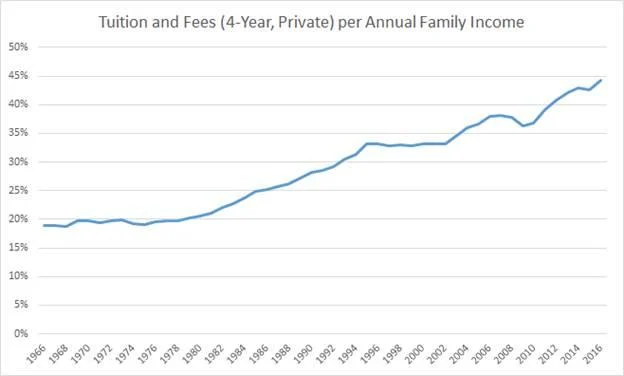
Cancelling student loans would be a really, really bad economic move
Art Carden explains why cancelling outstanding student loan debt — despite its huge popularity on the campaign trail — would be a very bad idea:

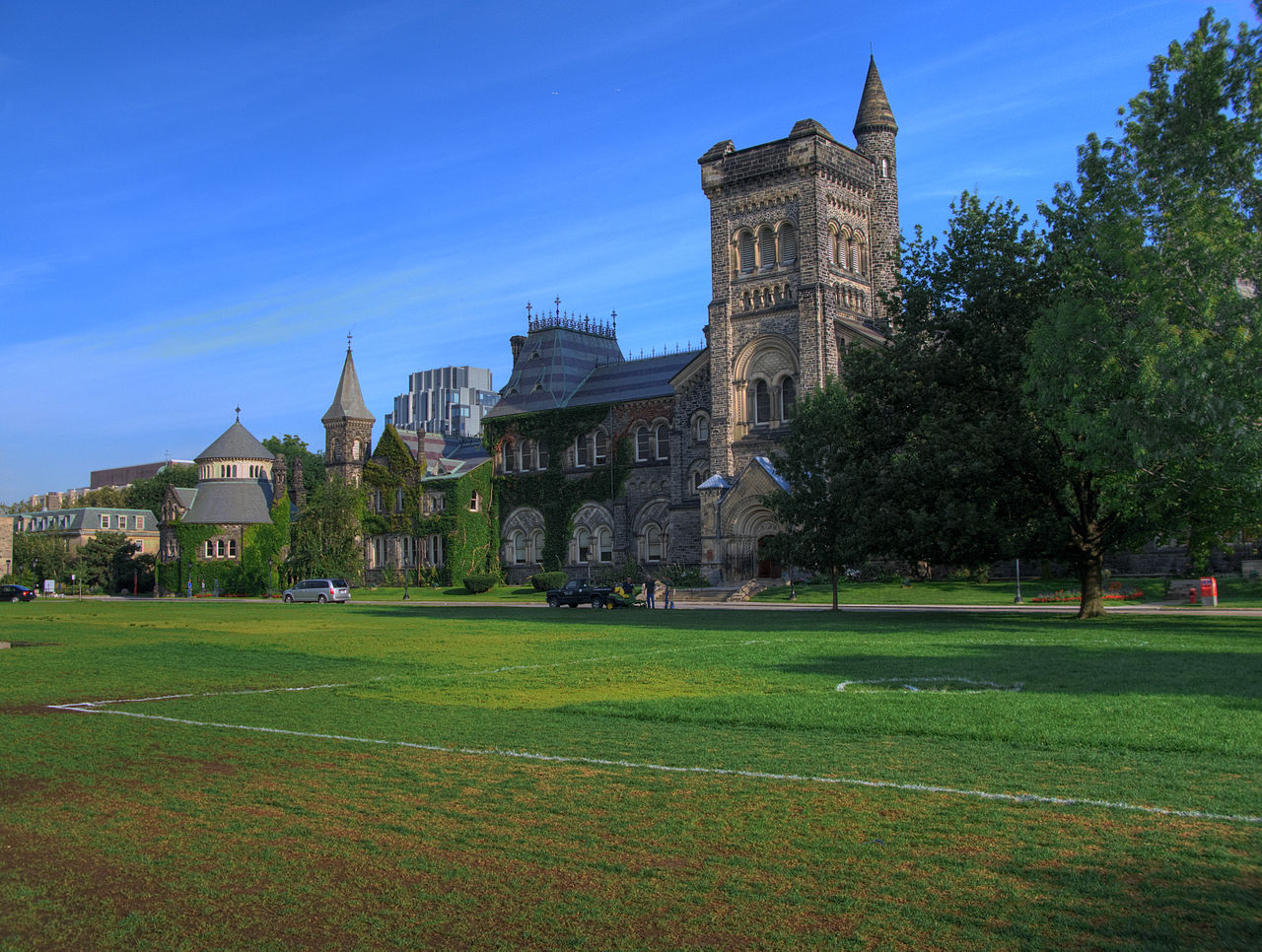
University College, University of Toronto, 31 July, 2008.
Photo by “SurlyDuff” via Wikimedia Commons.
It’s one of the rules of electoral success: advocate policies that concentrate the benefits on an easy-to-identify interest group (preferably one that is sympathetic in the public eye) and disperse the costs onto the entire electorate. It’s how we get Coke sweetened with corn syrup rather than actual sugar. It’s also how we get proposals to cancel student loans. As my AIER colleague Will Luther points out, the fact that two of the Democratic frontrunners have made debt cancellation such an important part of their campaigns suggests that the issue is going to be with us for a while.
But would it be a good idea to cancel student debt? And importantly, how does even the prospect of canceled student debt affect people’s incentives?
Regressive Tax
First, let’s consider the quality of the policy. A lot of commentators are pointing out that it’s fundamentally regressive, meaning that we’re basically taxing the poor to pay the rich. As economist Alexander William Salter puts it in the Dallas Morning News, it’s
a transfer of wealth to those with relatively high levels of expected lifetime income, at the expense of those with relatively lower levels of expected lifetime income.
The idea might have some merit, but it will make wealth and income inequality worse rather than better.
Even saying that the idea might have some merit is perhaps too charitable. In 2011, economist Justin Wolfers called it the “Worst. Idea. Ever.” in a Freakonomics post. Why? First, there’s the distributional effect. If we’re going to have policies that transfer wealth from one group to another, it doesn’t make much sense to transfer wealth from taxpayers generally to high-income college graduates. As Will Luther and so many others have pointed out, a college degree brings spectacular financial returns. As a group, college graduates aren’t “needy” by any reasonable definition.
July 6, 2019
QotD: How to learn
I can imagine an economics professor reading through The Literary Book of Economics in search of things he can use in his teaching. But I find it hard to imagine anyone else doing so on his own initiative, merely because he enjoyed reading it. There is a reason why a book is the length it is; a novel is not, with rare exceptions, a series of short stories. I conclude that most of the people reading [Michael] Watts’ book, most of the people it was written for, will be students reading it because their professor told them to. And, judging by my experience of students over the years, many of the students told to read it won’t.
That fits the pattern of most modern schooling at all levels. Someone else decides what you should learn, tells you what you must do to learn it, and makes some attempt to make sure you follow his instructions. It is not a model I think highly of. A much superior model in my view, if you can pull it off, is to get someone to learn something primarily because he finds it interesting. The best way of doing that is to provide students with things to read that are worth reading on their own, not things they read only because they are ordered to. Not even things they read only because they think the labor of reading them will pay off in future benefit.
That view of education is why both children of my present marriage were unschooled. It is also why all of my nonfiction books, with the partial exception of Price Theory, were targeted at the proverbial intelligent layman. They can be, and sometimes are, used as textbooks, but they were written with the assumption that if the reader did not find a chapter worth finishing he was likely not to finish it.
David Friedman, “Thoughts on Literature, Economics and Education”, Ideas, 2017-05-01.
July 3, 2019
A sneak peak at the new “History of Diversity” course outline at Woke State University
At Rotten Chestnuts, Philmon gives us a taste of the new mandatory American history program to be introduced this Fall at WSU:
… people from other parts of the world had heard about this wonderful place where they, too, could come and be diverse, and they started coming … from China, from Japan, from Mexico, and the Middle East, with only the distant dream of Diversity™ on their minds.
We also created great UniDiversities to increase our knowledge and awareness of Diversity™ (especially after the Democrats freed the slaves!)
But in 1972, the Republican (aka, “Nazi”) Party was founded by Richard Nixon specifically to ban Diversity™ and put to everybody who wasn’t white into concentration camps. Fortunately, the Democrats came roaring back with Jimmy Carter in 1976, who created the Department of Education that has vastly improved Education in the United States by teaching us all to be more Diverse™. Since then our education has become the best in the world! And! he graciously let 52 Americans be the guests of some nice Iranian students for more than a year just so they could become more diverse.
But then Ronald Reagan inexplicably won the election of 1980 (due to a clerical error at Trump, Inc*) and he immediately started a nuclear war with Russia. This was because he was not diverse and they were … well never mind, but it greatly reduced the Diversity™ in the world. Plus, Toxic Masculinity. Which is not Diverse™. Everyone should be more like women. That would be Diverse™.
After 12 years of cruel, oppressive Republican rule during which Reagan coerced some Germans to vandalize an historic, diverse wall, the great Bill Clinton was elected the First Black President™, which Americans thought finally ushered in Diversity™ once and for all.
But alas, it wasn’t to be, because G.W. Bush (aka “Hitler”) stole the election 8 years later by cleverly winning a majority of the votes in the Electoral College (like that was even legal!) and had the CIA fly planes into the World Trade Center and Pentagon so that he could attack Iraq. This was clearly because they were brown and he hated Diversity™, and also for oil. The United Nations had asked Saddam Hussein nicely 17 times to stop killing his own people, but it turned out he was doing it to reduce Iraq’s carbon footprint. Well this was the last straw (before California bravely banned them). Bush viciously attacked and removed Hussein from office because racism. And also blood for oil. Halliburton!!!! By the time he left office he personally had 100% control of all Iraqi oil, which he quickly lost to Dick Cheney (aka “Darth Vader”) in a drunken bet at a bar the night before the next election (Cheney then poured the oil all over Grand Teton National Park just so it could be drilled up again — also because he hates nature and especially fly-fishing).
After that, America came to its senses and elected Barack Obama, Savior of the Universe™, to be the Second First Black President™. Under his wise and kind rule, Americans began to get along Diversely like never before. Some people in Ferguson, Missouri even burned and looted a bunch of minority owned business just so they could get insurance money which they were owed by their former oppressors, who were now forever banished. It was almost the Paradise that Michael Moore proved Iraq was before G.W. Bush (aka “Hitler”) went in and started terrorism as we know it today (and stole all their oil).
July 1, 2019
A new Blackadder?
Colby Cosh retweeted a link to British Comedy Guide:

BBC promotional photo for Blackadder Goes Forth.
Photo via http://www.bbc.co.uk/comedy/content/images/2007/02/22/trench_1600_1600x1200.jpg
The stars of Blackadder have reportedly agreed to reunite for a new episode or series, after having met up in London to discuss the idea of bringing back the hit sitcom.
The Sun reports Rowan Atkinson, Tony Robinson, Stephen Fry and Hugh Laurie agreed on a return, after meeting together at the Soho House members club in London.
A source told the newspaper: “They were all having a great laugh and they are all old friends. So they just said, ‘Yes, let’s do it’. It is being written now. Rowan has been saying he is extremely excited.”
The new series will reportedly be set in the modern day, with Blackadder as a university lecturer.
Speaking in a recent newspaper interview, co-writer Richard Curtis said: “The thing about Blackadder was, it was a young man’s show criticising older people, saying how stupid those in authority were. So I did once think, ‘If we ever did anything again, it should be Blackadder as a teacher in a university, about how much we hate young people’.”
June 16, 2019
Encountering Richard Mitchell’s Less Than Words Can Say
In Quillette, Mark Andre Alexander recounts his first brush with “The Underground Grammarian”:
My first upper division English class shocked me when a dinosaur English professor, Dr. David Bell — a professor in Richard Mitchell’s mold, but not yet a curmudgeon — gave me my first C on a paper, busting my A-student self-image. That wake-up call helped me to see that, although I was published, I had much to learn about writing. Worse, in my first graduate course, Bell’s “Austen and Bronte,” I discovered that I had much to learn about reading, and that I lacked the acuity to appreciate Jane Austen’s clear, witty, and precise prose.
Not long before, I’d read Richard Mitchell’s first book, Less Than Words Can Say. I don’t recall how I stumbled upon him. I’d probably read some opinion column that referred to his work. In a publication announcement in the Underground Grammarian, Mitchell described it as “a melancholy meditation on the dismal consequences of the new illiteracy.”
He had wanted to title the book The Worm in the Brain, pointing to the dangers of administrative rhetoric. The publisher rejected that title as “too frightening and grisly,” But I knew I had found a fellow traveler when I read his Foreword:
Words never fail. We hear them, we read them; they enter into the mind and become part of us for as long as we shall live. Who speaks reason to his fellow men bestows it upon them. Who mouths inanity disorders thought for all who listen. There must be some minimum allowable dose of inanity beyond which the mind cannot remain reasonable. Irrationality, like buried chemical waste, sooner or later must seep into all the tissues of thought.
With that prophetic book, I first experienced the “cleansing fire [that] leaps from the writings of Richard Mitchell,” as George F. Will later described it.
Mitchell did title the first chapter “The Worm in the Brain,” in which he told the story of a colleague who would send him a note whenever there was some committee meeting. At first the note read something like, “Let’s meet next Monday at two o’clock, OK?” But when he aspired to become assistant dean pro tem, the simple, perfect prose changed. “This is to inform you that there will be a meeting next Monday at 2:00.” After achieving that appointment, the note read, “You are hereby informed that the committee on Memorial Plaques will meet on Monday at 2:00.” The worm in the brain had done its work.
I began to notice the worm in the brain during my everyday interactions with friends and colleagues at the university, especially the English professors. It often took the form of a label which created an image in the brain that prevented thought. One such professor, smart and engaging, returned a paper analyzing a passage in the U.S. Constitution. She gave the paper an A, but added, “I can’t help but feel that your argument is wrong, although I can’t explain why. I showed it to my husband, and he thought that it was a conservative argument.”
That statement invalidated the A, and I experienced my first taste of how subtly an abstract label can paralyze an otherwise thoughtful mind. Years later, while teaching at a business college, I saw a more pronounced form of the same phenomena. During a Business English class, I chatted with a bright student who volunteered for the NAACP. We would discuss all kinds of interesting topics, such as the similarities and differences between Martin Luther King and Malcolm X.
That is, until I noticed a change. She had stopped talking to me like a fellow human being and started talking at me like a white male. I stopped her and asked if she noticed what she had just done. She hadn’t, so I pointed out that she had shifted from talking to me to talking to an image inside her head. I told her that I would hold my hand up and block my face every time she did it. As the conversation proceeded, and I raised my hand, lowered it, and then raised it again, she became aware of the worm in her brain, a mental-emotional implant that prevented her from treating me as a colleague when certain topics were engaged.
Her implant was creating rubbish, of course, but it was insidious by nature because it disguised itself as something in the real world. Worms in the brain are like that.