
Feral Historian
Published 29 Sept 2023While we can classify significantly different regimes as “communist” based on their key similarities, we don’t have the same taxonomy for “fascism” as a political category. The term is either used so broadly it becomes meaningless, or defined so narrowly that it’s only relevant to Mussolini’s Italian Fascism.
But we can identify three key factors that, when all are present together, result in a system we can define as “fascist” in a sense that’s both historically based and general enough to be useful for analysis. In addition to laying out a simple model defining fascism, this video also dives into some history of Fascism and National Socialism, mixed with the kind of sci-fi analysis you’ve come to expect here.
00:00 Intro
00:35 Palp, Dolf, and Communists
04:05 Old Republic vs Weimar Republic
04:55 Party and State
08:57 Three-Point “Fascist Minimum”
09:24 “Third Way” Economics
15:12 Totalitarianism
19:19 Unifying Myth
22:53 Umberto Eco
24:46 Franco
26:25 Closing Miscellany🔹 Patreon | patreon.com/FeralHistorian
🔹 Ko-Fi | ko-fi.com/feralhistorian
September 29, 2025
The Galactic Empire and a (Revised) Generic Model of “Fascism”
September 15, 2025
The Cold War in Latin America Begins: Coups, Communists, and Castro – W2W 44
TimeGhost History
Published 14 Sept 2025Spy rings, covert operations, coups, street violence, and sudden regime changes. This is the turmoil that awaits Latin America after the Second World War. As new ideas from the East gain momentum, the United States tries to hold on to its role as the region’s self-appointed guardian. Which side will ultimately shape the future of this rich and populous region?
(more…)
September 14, 2025
September 10, 2025
The Korean War Week 64: Inexperienced UN Recruits Face Disaster – September 9, 1951
The Korean War by Indy Neidell
Published 9 Sep 2025The Battle of Bloody Ridge comes to its end, having very much earned its name. One issue the UN is really having though, is with replacement troops. They don’t have the training or experience that the war requires. And yet, a new offensive to test them further is just around the corner.
Chapters
00:00 Intro
00:53 Recap
01:22 Problems With New Troops
04:36 Company C Attacks
06:09 Operation Talons
07:32 Operation Minden
08:19 Flying Aces
08:57 San Francisco Conference
14:13 Summary
14:28 Conclusion
(more…)
September 8, 2025
September 3, 2025
The Korean War Week 63: The Battle of Bloody Ridge – September 2, 1951
The Korean War by Indy Neidell
Published 2 Sep 2025The South Koreans have won their fight northeast of the Punchbowl, but not that far away the Battle of Bloody Ridge is earning its name, with casualties rising into the thousands for both sides.
Chapters
00:41 Recap
01:11 A ROK Success
01:47 Bloody Ridge
06:17 Soviet Reinforcements
07:08 Operation Strangle
11:06 Summary
11:45 Conclusion
13:37 Call to Action
(more…)
August 24, 2025
Much of our prosperity is based on trust, and we’re rapidly losing it
Ted Gioia foresees a precipitous fall in trust coming at us very soon, and I’m afraid he might be being too optimistic:
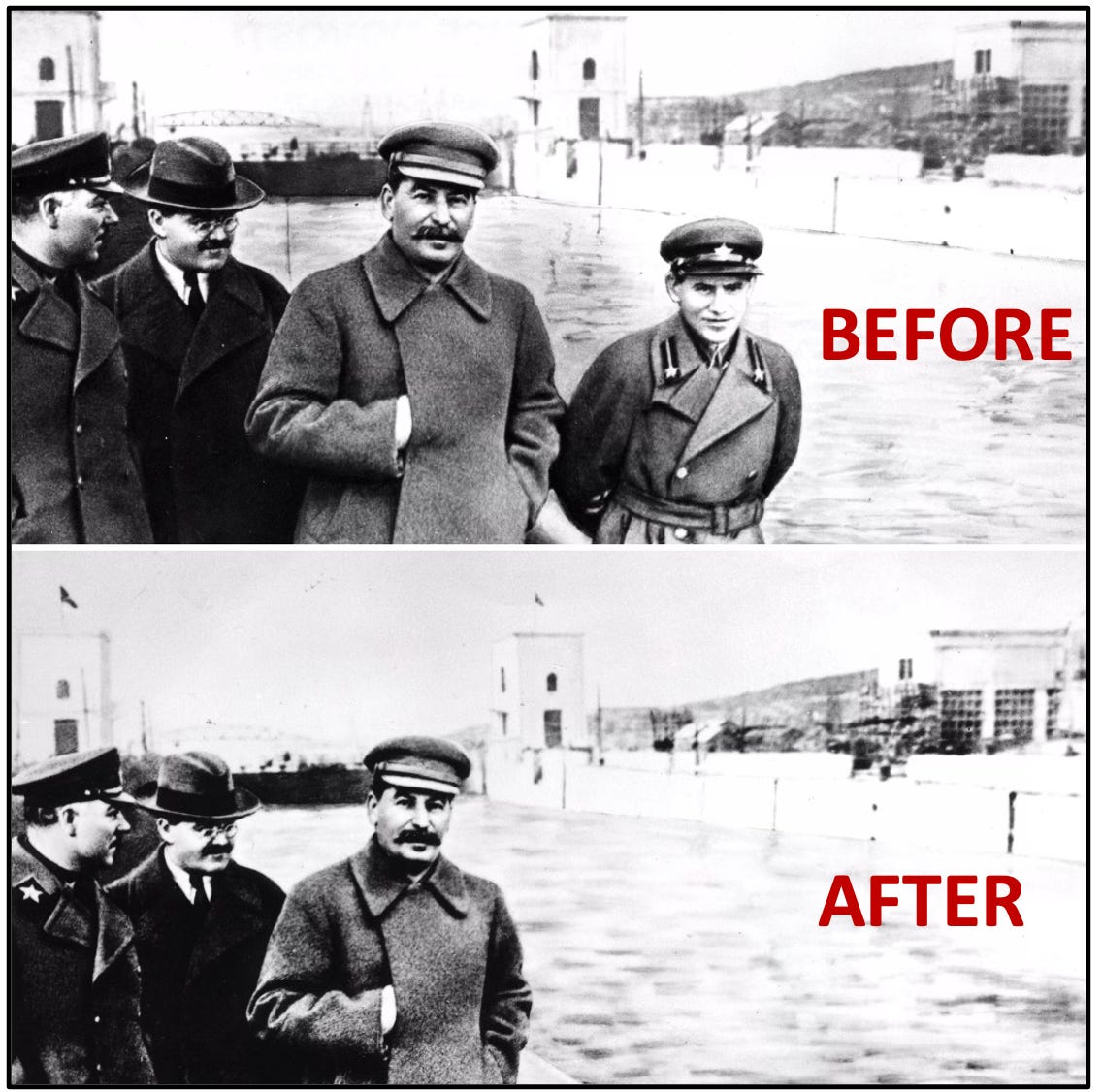
During the great purges of the 1930s, Stalin ordered the execution of a million people, including some of his closest associates. But it wasn’t enough to kill these victims — they also had to disappear from photographs.
In a famous case, Nikolai Yezhov got removed from his position next to Stalin in a photo taken by the Moscow Canal. This erasure alarmed many party elites because Yezhov, head of the secret police, had been one of the most feared men in the Soviet Union.
And now he got totally deleted.
Well, not totally. In those days of print media, original photos survived, and a paper trail made it difficult to erase history.
So this photo was later used to mock Stalin, and the pretensions of dictators. They can try to change reality, but that’s not possible.
Or is it? Maybe dictators now get the last laugh. Because in the last few months, reality has been defeated — totally, completely, unquestionably.
It is now possible to alter reality and every kind of historical record — and perhaps irrevocably. The technology for creating fake audio, video, and text has improved enormously in just the last few months. We will soon reach — or may have already reached — a tipping point where it’s impossible to tell the difference between truth and deception.
- Can I tell the difference between a fake AI video and a real video? A few months ago, I would have said yes. But now I’m not so sure.
- Can I tell the difference between fake AI music and human music? I still think I can discern a difference in complex genres, but this is a lot harder than it was just a few months ago.
- Can I tell the difference between a fake AI book and a real book by a human author? I’m fairly confident I can do this for a book on a subject I know well, but if I’m operating outside my core expertise, I might fail.
At the current rate of technological advance, all reliable ways of validating truth will soon be gone. My best guess is that we have another 12 months to enjoy some degree of confidence in our shared sense of reality.
But what happens when it’s gone?
Back in 2023, I asserted that trust is the most scarce thing in society. But that was before all these tech deceptions came online. Trust will soon get even more scarce — or perhaps disappear completely from the public sphere.
This is not a small matter.
Most discussions of this issue focus on the technology. I believe that’s a mistake. The real turmoil will take place in social cohesion and individual psychology. They will both fracture in a world where our shared benchmarks of truth and actuality disappear.
We will be — already are — in desperate need of Robert Heinlein’s Fair Witnesses:
A Fair Witness is an individual trained to observe events and report exactly what is seen and heard, making no extrapolations or assumptions. While wearing the Fair Witness uniform of a white robe, they are presumed to be observing and opining in their professional capacity. Works that refer to the Fair Witness emphasize the profession’s impartiality, integrity, objectivity, and reliability.
An example from the book [Stranger in a Strange Land] illustrates the role of Fair Witness when Anne is asked what color a house is. She answers, “It’s white on this side.” The character Jubal then explains, “You see? It doesn’t occur to Anne to infer that the other side is white, too. All the King’s horses couldn’t force her to commit herself … unless she went there and looked – and even then she wouldn’t assume that it stayed white after she left.”
August 23, 2025
T-55: 70 Years Old. Still in Service
The Tank Museum
Published 22 Aug 2025No tank in history has been produced in the quantities that the T-55 and its relatives have. Some sources suggest as many as 100,000 have been built since 1946, this tank is still seeing service across the globe. So how come this 80-year-old tank is still in service in 2025?
When looking at its predecessor, the T-34, the move to the T-55 looks like a massive leap in design. But there is a clear evolutionary progression – there is just a missing link. The T-44 laid the groundwork for future Soviet tank design – pioneering torsion bar suspension and a transverse engine.
It was soon decided that the T-44 would require a new 100mm gun to replace the 85mm. This new model would be called the T-54. While NATO classes both the T-54 and 55 as the same vehicle, the T-55 is a substantially better tank. A comprehensive series of upgrades made this an effective force on the battlefield.The T-55 would prove popular with forces around the world. It would even go head-to-head against itself in the Iran-Iraq War of the 1980s. Eventually the T-55 would become outdated as NATO technology became more and more advanced. But it is still in service in the conflict in Ukraine – why?
The Russian army, despite the stereotype of having unending stockpiles of weaponry, have been struggling to keep up with the astounding loss rate the Ukrainians have been able to inflict on them. This has resulted in older and older vehicles being dragged out of those large storage depots across Russia, mainly being used as mobile, protected artillery.
The T-55 has endured partly due to its sheer numbers, availability and upgradability. Its performance on the battlefield has varied, but its basic but effective design has proven itself again and again throughout the decades. It is worth reiterating how remarkable it that a vehicle conceived at the end of the Second World War is still even a consideration for armies 80 years on.
In this video, historian James Donaldson explores the history of the most-produced tank in history – the T-55. This Soviet design has its roots in the iconic T-34, evolving through the years to become an effective fighting machine that was sold around the world. Despite manufacturing ending in the 1980s, this tank is still a feature on the battlefield, with both sides making use of T-55s in the current conflict in Ukraine. It may not be engaging in tank-on-tank combat as initially intended, but the T-55 is still providing a useful, effective and relatively cheap addition to the arsenal of many armies in the 21st Century.
00:00 | Introduction
00:43 | The Missing Link
02:31 | Making the T-55
05:24 | Upgrades
08:34 | A Numbers Game
12:51 | In Action
16:41 | T-55 Today
(more…)
August 18, 2025
How One Treaty Split The World In Two – W2W 40
TimeGhost History
Published 17 Aug 2025After WWII, Britain and France face the decline of their empires and the looming Soviet threat. Desperate for security, they forge the Dunkirk and Brussels Pacts, but quickly realize they need American support. As old alliances shatter and Germany becomes the front line, the world divides into two camps with the formation of NATO and the Warsaw Pact. Secret deals, rearmament, and the fear of communist tanks rolling across Europe set the stage for decades of Cold War rivalry.
(more…)
August 17, 2025
August 12, 2025
German-Soviet Invasion of Poland 1939
Real Time History
Published 8 Aug 2025Germany and the Soviet Union both regarded the Polish state as a creation of the post-WW1 system, and both had claims on Polish territory. In the summer of 1939, Adolf Hitler decided to invade Poland in a fait acompli against the Allies. In a secret agreement between Germany and the Soviet Union they agreed on dividing up the Polish state and Eastern Europe.
(more…)
August 11, 2025
Stalin’s Death: The Day the USSR Changed Forever! – W2W 39
TimeGhost History
Published 10 Aug 2025March 1953: Stalin’s sudden death triggers a whirlwind of conspiracies, paranoia, and a deadly battle for control inside the Kremlin. As Beria, Khrushchev, and the Soviet elite scramble for power, the fate of the world’s largest superpower hangs in the balance. Was Stalin murdered by his inner circle, or did his own regime consume him? Discover the truth behind the downfall, the rise of Khrushchev, and the birth of the KGB in the Cold War’s most dramatic turning point.
(more…)
August 10, 2025
August 8, 2025
Debunking the idea that Japan was about to surrender anyway
Dr. Robert Lyman on the common misunderstanding of Japan’s situation in July and August of 1945 — no, they weren’t “on the brink of surrender so atomic bombing was unjustified” … instead, they were intending to make the assault on the Home Islands the biggest bloodbath ever:
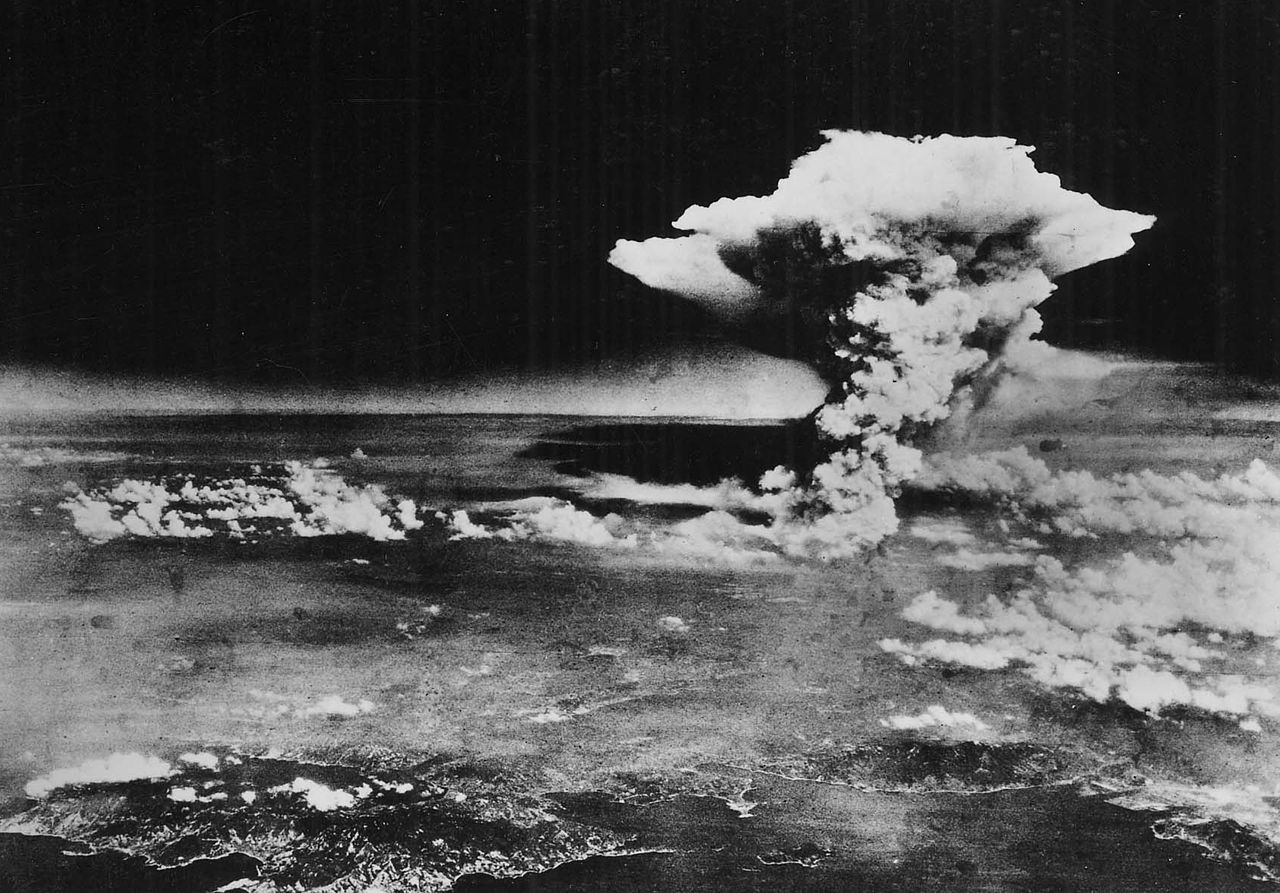
Atomic cloud over Hiroshima, taken from “Enola Gay” flying over Matsuyama, Shikoku, 6 August, 1945.
US Army Air Force photo via Wikimedia Commons.
It’s the anniversary of Hiroshima again today. I wasn’t going to write anything to mark the event (more coming next week on VJ Day), but I’ve been triggered already by nonsense on the radio which suggests that the atomic bombs on Hiroshima and Nagasaki were unnecessary, because Japan was about to surrender.
Nonsense. There is not a shred of real evidence to support this idea. In fact, the evidence that Japan wanted to keep on fighting is irrefutable. And yet this lie persists, despite the deluge of scholarly work demonstrating Japan’s commitment to the ritual suicide of its entire nation right until the end, when Hirohito pulled the plug. If you are in any doubt about the facts of the case, as opposed to the propaganda, read Toland’s Rising Sun (1970), Frank’s Downfall (2001), Spector’s In The Ruins of Empire (2007), Pike’s Hirohito’s War and, more recently, Stewart Binn’s Japan’s War (2025). All are excellent, clear, analytical and well researched. There are lots more, too.
Why does this canard keep on popping up? Is it because people don’t read? Or is it that they just don’t want to believe in the necessity of such a dramatic event to force Japan to surrender and thus bring about an end to the greatest man-made tragedy the world has ever suffered? The origins of this wishful myth in fact derives from hard right nationalist propaganda in post-war Japan (driven by Admiral Suzuki himself), quickly lapped up by the gullible and wishful thinkers in the West. Its one of the most enduring of the Hiroshima and Nagasaki myths, in part because it seems palatable to many, and because it is inherently anti-American.
What is the real story? In short, the Allies tried hard to persuade Japan to surrender. They demonstrated unequivocally to Japan that it was going to lose the war by defeating its armies and by beginning the long, slow and painful crawl towards the Japanese home islands. All the books I’ve mentioned note the extreme chaos of Japanese decision-making before and during the war. Who really was in charge? Who could one talk to, to secure a commitment to negotiate? In any case, the chaotic government under Koiso which replaced that of General Tojo following the fall to the Americans of Saipan in 1944, made not a single effort to engage with the Allies to seek terms. This government also collapsed on 5 April 1945. The replacement prime minister was Admiral Suzuki, and it was from this man that the myth seems to have arisen, after the war, that Japan was considering surrender and that the A-bombs were unnecessary. This is not true. During his entire time as Prime Minister he resolutely refused to do anything but continue to fight, unless the ending of the war could be secured on Japan’s terms. There were some initiatives to persuade the Suzuki government to surrender, but none of them amounted to much, because they didn’t engage directly with the government in Tokyo, and they didn’t derive from the Allied powers. The evidence that peace-feelers were being put out by various sources (such as the Vatican) in 1944 and 1945 is evidence only that the Japanese government ignored them. None were taken seriously in Tokyo.
Indeed, throughout the period of the Suzuki government, the war parties were dominant. In early June the military Supreme Command submitted a paper entitled The Fundamental Policy to be Followed Henceforth in the Conduct of the War, in which it demanded that the government confirmed that Japan would fight to the very last Japanese in an act of national suicide leading to the “honourable death of the hundred million”:
With a faith born of eternal loyalty as our inspiration, we shall – thanks to the advantages of our terrain and the unity of our nation, prosecute the war to the bitter end in order to uphold our national essence, protect the Imperial land and achieve our goals of conquest.
The proposition was passed, not unanimously, but overwhelmingly nonetheless.
There were some in the government – interestingly including Tojo himself – who saw that this was self-defeating, and that Japan must negotiate to secure acceptable peace terms. Naively, it was hoped that this would enable it to retain parts of its empire. Suzuki was part of this group who thought that Japan could negotiate favourable terms to end the war, in the form of a negotiated settlement such as that had brought about the end of the Russo-Japanese war in 1905, but when he suggested this in parliament on 13 June he was shouted down by the war mongers. Hirohito then endorsed an approach to the Soviets in late June. Bizarrely – though Moscow was neutral in the Far Eastern war at this point – Tokyo’s emissaries suggested that the USSR and Japan join forces to rule the world. It was yet more evidence of how Tokyo fundamentally misunderstood the world, and its enemies, and the way the war would have to end: complete and utter surrender by Japan.
Moscow, of course, scorned these “negotiations” as meaningless.


