
Why does nothing in today’s rock music sound like the Beatles?
It’s a pertinent question because the Beatles were so acclaimed as musical innovators in their time and still so hugely popular. And yet, nobody sounds like them. Since not long after the chords of the “Let It Be” died away in 1969, every attempt to revive the Beatlesy sound of bright vocal-centered ensemble pop has lacked any staying power among rock fans. It gets tried every once in a while by a succession of bands running from Badfinger to the Smithereens, and goes nowhere. Why is this?
Another, related question is: Why does so very little in today’s rock music sound like Chuck Berry?
Inventor of rock and roll, they still call him. And yet outside of occasional tributes and moments of self-conscious museumizing, nobody writes rock music that sounds anything like “Johnny B. Goode” anymore. Modern tropes and timbre are vastly different. Only the rock beat – only the drum part – survives pretty much intact.
It’s odd, when you think about it. The sound that electrified the late Fifties and Sixties is still revered, but it’s gone. The basic rock beat remains, but everything above it has been flooded out, replaced by something harder and darker.
We all sort of know, even as casual listeners, that rock has evolved a lot. There’s even a tendency for the term “rock and roll” to nowadays be specifically confined to the older sound, with “rock” standing alone to refer to the more modern stuff.
[…]
The sea-change happened between 1969 and 1971. The moving figures were: Jimi Hendrix. British Invasion bands like the Rolling Stones and Led Zeppelin and the Who. American West Coast bluesmen like Mike Bloomfield and Al Cooper. The San Franciso acid-rock scene. And many lesser imitators.
What they did was raze old-school rock-and-roll to the ground, replacing it with a bastard child of LSD and Chicago-style hard electric blues. That angry, haunting, minor-key idiom is what buried the Beatles and put a stamp on rock music so final that today the sound of any modern arena rocker – like, say, Guns’n’Roses – is recognizably the same thing musicians began to record around 1970.
(Which it should be pointed out, is a very long run for a mass-market pop genre. It’s as though in 1970 our radios had still been full of pop in forms dating from 1925 …)
Eric S. Raymond, “The blues ate rock and roll!”, Armed and Dangerous, 2017-12-28.
February 9, 2021
QotD: Nothing sounds like the Beatles
February 7, 2021
QotD: The greatest sin of the Baby Boomers
If that’s harsh on the Boomers, well, sorry, Moonbeam — History don’t care about your feelings. But “the Sixties” isn’t the gravest charge History can lay against you. This is: After all that, you gave the world us, Gen X, the Dumbest Generation of Narcissists in the History of the World. Yes, you guys are responsible for both “Rocky Raccoon” and “Smells Like Teen Spirit.”
Severian, “The Look”, Rotten Chestnuts, 2020-10-09.
February 4, 2021
Ace reads the upper middle class out of the conservative movement
At Ace of Spades H.Q., Ace himself explains why he doesn’t consider anyone who evinces loyalty to “the mores of the upper middle class” to be in any way, shape, or form “conservative”:
Never once do these bougie “cons” notice that the class whose class markers they are so eagerly collecting like Cub Scout merit badges are entirely created by progressives.
I’m going to say this more straightforwardly than I’ve ever said it. I’ve hinted around it, I’ve never said it straight up.
But here goes:
People loyal to the mores of the upper middle class are left-liberal. Period.
They should have no place in the leadership and “thought” leadership of any “conservative” movement. They are not conservative.
They are all pro-gay marriage.
They are all pro-abortion.
They are all in favor of shipping out every single working-class job to China, and, for those few remaining jobs which must be performed in America, shipping in workers from the third world to displace Americans.
They are all supporters of a soft version of the SJW progressive stack. They all believe in “White Privilege,” for an obvious reason — as the rich children of the prosperous upper-middle class, they’re actually the ones born to privilege, but they wish to obscure that fact. So they buy into the left’s claims about the “White Privilege” of 63% of the country, instead of focusing on the wealth privilege of 10%.
Jake Tapper will entertain he shares a kind of privilege with two thirds of the country but he will never acknowledge his real privilege, one shared by only 10% of the country.
And the social-climbing “conservative” media class is almost entirely born from the same prosperous class. They too do not want to talk about real privilege.
I always want to ask these guys, so desperate to peonize the working class: How far back in time do you have to go to find an ancestor who had a job which caused callouses to form on his hands?
Was it two generations ago? Three? It’s obvious the “conservative” media class has never had to work a shovel in their lives. The toughest job they’ve ever held was working in their dad’s law office, or valet parking Beemers at the country club.
And yes, they support the leftwing SJW claims about race. Bullshit like “minorities can’t be racist,” or at least not racist in a way that should be held against them.
That’s why they all rushed to defend notorious, swaggering racist Sarah Jeong, and refuse to even acknowledge the eyebrow-singing anti-white racism seen every single day in the media.
To acknowledge there’s such a thing as “anti-white racism,” and that it ought to be condemned, is, they’ve decided, an “alt-right” idea, and the alt-right is a lower class phenomenon, and, as I’ve noted, they really, really really need you to know they are not lower class.
The only way in which they are arguably “conservative” is that … they are in favor of oligarchical fascism directed by the billionaires signing their paychecks.
Which is of course not “conservative” at all. But that’s the one category in which they can make an arguable case for their “conservatism” — in always championing the Ruling Class’ right to rule over the downscale Dirties.
Is that the “conservatism” we want? A gonzo left-liberalism which is also thoroughly anti-republican, anti-egalitarian?
Also at Ace of Spades H.Q., OregonMuse quoted this rather timely Barry Goldwater statement:
I have little interest in streamlining government or in making it more efficient, for I mean to reduce its size. I do not undertake to promote welfare, for I propose to extend freedom. My aim is not to pass laws, but to repeal them. It is not to inaugurate new programs, but to cancel old ones that do violence to the Constitution or that have failed their purpose, or that impose on the people an unwarranted financial burden. I will not attempt to discover whether legislation is “needed” before I have first determined whether it is constitutionally permissible. And if I should later be attacked for neglecting my constituents’ “interests”, I shall reply that I was informed that their main interest is liberty and that in that cause I am doing the very best I can.
February 2, 2021
When the self-defined elites achieved class consciousness
At Rotten Chestnuts Severian adds to his ongoing series of posts identifying areas where Marx was right:
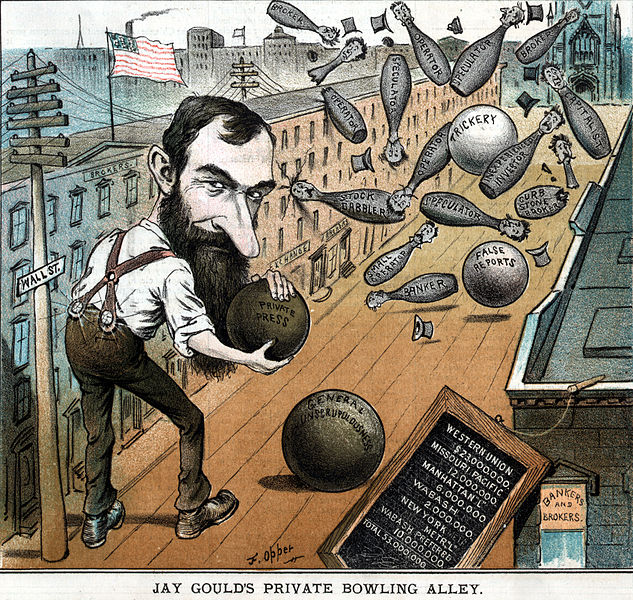
“Jay Gould’s Private Bowling Alley.” Financier and stock speculator Jay Gould is depicted on Wall Street, using bowling balls titled “trickery,” “false reports,” “private press” and “general unscrupulousness” to knock down bowling pins labeled as “operator,” “broker,” “banker,” “inexperienced investor,” etc. A slate shows Gould’s controlling holdings in various corporations, including Western Union, Missouri Pacific Railroad, and the Wabash Railroad.
From the cover of Puck magazine Vol. XI, No 264 via Wikimedia Commons.
… I liken Karl Marx to one of those bird-masked medieval Plague doctors — he sees the pathology clearly, indeed far faster and better than anyone else, but his proposed “cure” is far likelier to kill you than the actual disease. Worse, what makes Marx’s cure especially lethal is what ends up making his diagnosis essentially right: It’s a self-fulfilling prophecy.
The proletariat is achieving class consciousness, all right — look no further than the GameStop “short squeeze” for proof. But the only reason the proles are achieving class consciousness is because the “capitalists” forced them to, just like Marx said they would. The Elite and the Bureaucracy (usually, but not always, a distinction without a difference) finally achieved class consciousness through the combination of NAFTA and the Louvre Accords. Starting around 1990, then, the Elite self-consciously embraced their role as rootless, stateless, jet-setting parasites (with the wannabe-Elites in the Media, academia, and the bureaucracies signing up for tours of duty as fart-catchers, both to bask in reflected glory and in hopes of being promoted).
In short, our “Capitalists” — really, “financial-ists” or “spreadsheet gangsters,” since they don’t actually make anything, they just bust out existing firms via debt manipulation — behave exactly as Marx described factory owners behaving all the way back in the First Industrial Revolution.In my naivete, I used to think Marx’s ranting was hyperbole. I cited the example of Andrew Carnegie — a real bastard in his youth, who went on to be one of the world’s great philanthropists. That’s human behavior, I said, as opposed to the bloodthirsty caricature of Marx’s fantasies … but I was wrong, comrades. Carnegie happily would’ve sold his fellow Americans down the river, just as Bezos, Gates, and the rest of the pirates-in-neckties are happily selling us down the river now. Only two things prevented it back then: one structural, one cultural.
The structural one is simply technology, and therefore uninteresting. Britain’s “free traders” — you know, the Jardine-Matheson types who started the Opium Wars for fun and profit — would’ve happily outsourced Britain’s entire industrial base to China if they hadn’t been hampered by wind speed. By the time this was technically feasible — which is about 1860, if you’re keeping score — simple inertia had taken over. They didn’t retool until they had to, at which point instant communications and modern ships … well, you know the rest. Like I said, it’s vital, but boring.
The cultural one is much more interesting. You might be tempted to say, as I did, that Jardine and Matheson were always on the lookout for #1, of course, but were sincere British patriots for all that, just as Carnegie for all his faults was an authentic American. I doubt it, comrades. I sincerely doubt it. What kept these guys in check wasn’t patriotism, or even culture. Rather, it was fear.
January 31, 2021
QotD: Sixties music wasn’t what you think it was
Tom Jones is great, I love his stuff, but he’s not going to melt your face with his guitar riffs, and he’s there at #8, right in front of “Build Me Up, Buttercup.” Which is one hell of a catchy tune, and compared to “Love Theme from Romeo and Juliet” (#15) it’s practically Slayer, but rock it ain’t. Ray Stevens is at #61, for pete’s sake, with “Guitarzan.” If that hasn’t convinced you that The Sixties were nothing like they show in the movies (and that maybe the Viet Cong deserved to win), I don’t know what would.
Severian, “Entertainers (III): Hair Metal Attains Nirvana”, Rotten Chestnuts, 2020-10-08.
January 27, 2021
Misunderstood Moments in History – The Spartan Myth
Invicta
Published 27 Oct 2017Start your 30 day free trial here: http://ow.ly/eCd230fiZ7Q
The Spartans are immortalized in history as super soldiers bred for war. However most of what we think we know about them is a lie. Today we will unmask the truth behind the Spartan Myth.
The Great Courses Plus is currently available to watch through a web browser to almost anyone in the world and optimized for the US market. The Great Courses Plus is currently working to both optimize the product globally and accept credit card payments globally.
Documentary Credits:
Research: Dr Roel Konijnendijk
Script: Invicta
Artwork: Milek J
Editing: Invicta
Music: Total War OST, SoundnoteDocumentary Bibliography:
Paul Anthony Cartledge, The Spartans: The World of the Warrior-heroes of Ancient Greece
Nigel Kennell, Spartans: A New History (2010)
S. Hodkinson, Property and Wealth in Classical Sparta (2000)
J. Ducat, Spartan Education: Youth and Society in the Classical Period (2006)
S.M. Rusch, Sparta at War: Strategy, Tactics and Campaigns, 550-362 BC (2011)
E. Rawson, The Spartan Tradition in European Thought (1969)
S. Hodkinson & I.M. Morris (eds.), Sparta in Modern Thought (2012)
January 26, 2021
QotD: “A world organized around institutional mass slavery”
New hypothesis: It’s a category error, all right, but not because they didn’t think in terms of labor costs. It’s because they couldn’t think in terms of labor costs.
A world organized around institutional mass slavery is, in a very real sense, a timeless world. Herodotus (I think) actually says somewhere that nothing worth mentioning happened before him, and you can see echoes of this attitude even as late as the Antebellum South. You see their attitude described as “conservative,” but since that’s egghead shorthand for “evil” you can ignore it. They weren’t consciously backward-looking; rather, they were deeply rooted to their place and station. To the outsider, it looked like they were trying to hold time back, but to the insider, time — clock time, industrial time, the time of the Protestant work ethic — barely existed at all.
So with the Classical World. The Romans, for instance, are endlessly frustrating to their admirers (of which I am an ardent one). Their only economic fix, for instance, was debasing the currency, i.e. a primitive form of inflation. You guys could figure out how to hew an artificial harbor out of some desert rocks — a trick we’d have a hard time pulling off today — but you couldn’t figure out fiat currency? Or a better political system than the tetrarchy? Or that the forts-and-legions paradigm just isn’t cutting it? Or … etc.
Stuff like that is why Spengler said classical, Apollonian culture was fundamentally different from, and incompatible with, our Faustian culture. According to Spengler, the master metaphor for the Apollonian is the human body, which is beautiful but changeless (emphasis mine, not Spengler’s). You can improve your body somewhat, but only within certain tight limits, and the body’s fundamental form is always the same (we could time warp Julius Caesar into the Current Year and still recognize him as a fellow homo sap., no matter how different his mind might be).
The Faustian, though — that would be us — organizes his worldview around space, infinite space. Practically speaking, this results in our attitude of innovation-for-innovation’s sake. We send a man to the moon because we can, but such an idea would never occur to the Romans, for the same reason they didn’t apply all their awesome engineering knowledge to the problems of governance. Hacking a harbor out of the desert is a tremendous feat, but it’s a local feat — a one-shot deal, a very specific response to a very specific local problem, with no broader applications.
This, I suggest, is because the timeless world of institutional mass slavery naturally selects for the kind of man who is at home in the world of institutional mass slavery. It’s a world of very low future time orientation, because “time” hardly exists at all. Forget machinery for a sec; the Roman world was full of enormous problems that had teeny-tiny, head-slappingly obvious fixes. Julius Caesar, for instance, was considered some kind of prodigy because he could sight-read books. Which really was a noteworthy feat, because Romans didn’t even put spaces between their words, much less use any sort of punctuation marks. And they were radical innovators compared to the Ancient Egyptians, since at least Roman writing all ran left-to-right; hieroglyphics can be read in any direction, including vertically, and I’m pretty sure there are examples of them changing text orientations in the middle of the same inscription. It’s not hard to imagine some legion commander actually losing a battle because he had to stop and sound out an important communique from a subordinate …
… and yet the Romans, for all their technical skill, never even figured that tiny change out. See also: The Chinese doing fuck-all with movable type, vs. (Faustian) Europeans using it to conquer the world. China, too, was a timeless society. As Derb says somewhere, Classical Chinese isn’t even really writing; it’s more of an aide-memoire — designed to remind readers of stuff they already know, not to communicate new information.
Your post-Roman European, by contrast, lived in a world where high future time orientation was an absolute must. You don’t need hypotheses like the famous “lead in the drinking water pipes” to explain the seemingly bizarre things the Romans did, or didn’t do; all you need is time orientation, a fundamental attitude of “this is a variation on an old problem” vs. “this is an entirely new situation that requires a new response.” Life in the post-Roman world was solitary, poor, nasty, brutish, and short — every man for himself; think through the consequences of your actions very carefully before you do them, or die horribly. Those who failed to do so died. Bake that into the genetic cake for a few generations, and you get Renaissance Man, who’d see a million possible applications for the aeolipile.
Severian, “Bio-Marxism”, Rotten Chestnuts, 2020-09-24.
January 21, 2021
QotD: The Laurentian Elite and the “new Canada” of the 1960s
Because the Liberals were so successful in creating this new identity, conservatives, especially Western conservatives (understandably) felt alienated in this new Canada. Brimelow gave some intellectual heft and crafted a coherent theory around why conservatives felt this way.
The broader narrative Brimelow, and others, put forward is that Canada’s British heritage was central to our identity and sense of who we are, but that this identity was destroyed by the Liberals who then built a new one in their own image. In the 1960s, Canadian Liberalism became self-consciously post-British, and the 1960s really do represent an approximate decade in which the “old Canada” died and a “new Canada” was born. The 1960s weren’t just a time of social change, they marked the end of the British Empire, the start of the Quiet Revolution, and of course most symbolically saw the replacement of the Red Ensign with the Maple Leaf flag. The battles between Diefenbaker and Pearson (and Pierre Trudeau) work as a stand in for the divide between old British Canada and new Liberal Canada.
Ben Woodfinden, “True North Patriotism and a Distinctly Canadian Conservatism”, The Dominion, 2020-10-20.
January 12, 2021
QotD: The use and abuse of stigma
But stigma, and hence the fear of stigma, can be beneficial in a social creature such as Man. I want the good opinion of my neighbours, I do not want them to think I am rude or dishonest. Fearing the stigma of being thought so, I try harder to be polite and honest.
Of course, wanting the good opinion of others may, in certain situations, have bad effects. Wanting the good opinion of my superior in the Nazi Party would be very bad. But that does not mean that desiring the good opinion of others is always intrinsically bad. In the same way, fear of stigmatization is not always bad (and there can be no fear of stigma without the existence of the thing itself). For example, it might be that people are discouraged from taking drugs, drinking too much, or stealing for fear of being stigmatized.
Theodore Dalrymple, “Stigma and Sympathy”, The Iconoclast, 2020-09-23.
January 11, 2021
QotD: Conspiracy theories
In modern times, the conspiracy theory has been formalized. The assassination of John Kennedy is probably when this formalization process began. For example, a conspiracy theory needs a series of hard to accept coincidences. In the case of Kennedy, we have the amazing marksmanship of the shooter and then his unlikely assassination at the hands of a Jewish gangster, while he was in police custody. The Jack Ruby part is what made the whole thing perfect for the conspiracy theorists.
The first step in a conspiracy theory is that the obvious answer or the official answer must be eliminated as a lie or implausible. In the case of the Kennedy assassination, the start of the conspiracy dynamic was the dismissal of Oswald as the lone actor. It is a variation on the old Sherlock Holmes line. Once you eliminate the parsimonious explanation, then the more complex and convoluted explanations become more plausible. That opens the door to endless speculation.
We see this with the QAnon cult on-line. All of it starts with the assumption that the obvious answer is wrong. For example, it is plainly obvious that Bill Barr is covering up the FBI spying scandal. He’s had years to do what should have taken a few months. Instead of accepting that rather obvious and plausible explanation, the QAnon people reject it and instead weave wildly complex theories about how half of Washington is about to be charged with crimes.
Another aspect of the formal conspiracy theory is the liberal use of the associative property to connect unrelated events. Person A knows Person B and Person B once had lunch at the same place as Person C. If any of these three people can be tied to the event in question, then it is assumed the other two are connected. The weakest associations are enough to assume a conspiracy. The associative property is an essential element of the modern conspiracy theory.
In the case of Kennedy, for example, organized crime is a popular player, because Jack Ruby was a minor criminal. His tenuous association with organized crime opens the door for linking any number of underworld characters with the assassination. It also opens the door for all sorts of theories about the Kennedy administration’s connections to organized crime. The associative property then ties communism, organized crime and the Cuba situation to the assassination.
The Z Man, “Conspiratorial Rule”, The Z Blog, 2020-10-01.
January 5, 2021
Lockdowns are inducing a kind of cultural autism (but especially among our self-imagined “betters”)
Last month, Douglas Murray looked at how the various shades and degrees of lockdown in most western nations have disrupted normal socialization patterns and created odd and unusual social feedback to various stimuli:

A building burning in Minneapolis following the death of George Floyd.
Photo by Hungryogrephotos via Wikipedia.
This year has seen a series of extraordinary events. First and foremost are the unprecedented lockdowns, which have removed from almost all our societies not just our ability to congregate, but also almost all of our social antennae. It is not just actors, comedians or public speakers who have lost that mechanism: we all have to some extent.
“Will this statement/opinion/joke go down well or badly?” is a fine judgement call. In public and relative private we all try things out and experiment all of the time. Take away all audiences beyond your immediate household and we must all subject ourselves to some other way of testing which way the wind is blowing. The only such device left is the online world, which — as should be obvious to all by now — has its own problems.
And so, during the middle of the oddest mass psychological experiment in history, came the death of George Floyd in May and the rapid escalation of the Black Lives Matter movement. A movement that attempted to push, inveigle and eventually intimidate itself into almost every walk of life inside America and beyond.
In Britain, institutions as far away from the scene of the crime as the British Library and Cambridge University seemed to think that the death of an unarmed black man at the hands of a Minnesota police officer (currently awaiting trial on a charge of murder) demanded some kind of response, lest they be accused of being insufficiently devout.
In ordinary times, people might have been able to get a sense of where other people stood on such a matter. Did users of the British Library really feel any culpability for events in Minnesota? Were things so bad in the state of race relations in America and across the western world (only the western world, naturally) that a stance was required — indeed demanded — of everyone? For a time, it seemed so. Almost every major British institution, including all its universities, issued statements about the death of a man in police custody on another continent, in a jurisdiction over which we have precisely zero control, and similar levels of influence.
“Taking the knee” became one of the emblems of obedience, or subservience, to the cause. Soon, even questioning the reverence of that hallowed, brand new tradition was cause to be pummelled online. And when all gatherings of more than six were banned by law, what other world mattered?
December 29, 2020
QotD: Alfred Hitchcock’s The Birds
Camille Paglia: The analogy to today’s global virus crisis is very compelling. The Birds demonstrates the fragility and folly of all human artifice. When omnipotent nature turns on mankind, everything falls to pieces — from protective dwellings to personal dignity and social cohesiveness. Unleashing the birds like a black plague, Hitchcock attacks the sentimental illusions that allow us to survive and thrive in our daily routines. The film has a metaphysical sweep, exposing the terrifying great unknowns at the heart of human existence.
As for the present time, Western developed nations have become too smugly complacent about their advanced technology and prosperity. Our electronic systems and intricate international supply and distribution network function so smoothly that they have become invisible to the affluent upper-middle-class, comfortably working from home via computer. These arrogant masters of the machine attribute all human ills to unjust society — from hurricanes to global warming, as if puny mankind is capable of such staggering power. Like Greek tragedy, The Birds shows the grim reality — human helplessness in the face of nature and fate, as commerce, schooling, hospitality, and the pretty dance of courtship are reduced to horror and squalor.
December 18, 2020
QotD: Hunter S. Thompson’s view of humanity
Colby Cosh, “Q: Where’s Cosh?”, ColbyCosh.com, 2005-02-21
December 13, 2020
Islamism and the French Republic
Niccolo Soldo talks to Pascal-Emmanuel Gobry about the rise of Islamism in France and the dangers it poses:

Brigitte Macron and Emmanuel Macron, 11 November, 2018.
Photo from the office of the President of Ukraine via Wikimedia Commons, CC-BY-4.0.
Islamism presents an existential threat to the French Republic. Statements are being made, positions are being taken, and the smell of action is in the air to counter this threat. Will we see a follow through from Macron?
Your guess is as good as mine. Macron is hard to predict. Although there are many reasons to be pessimistic, from French elites’ general lack of follow-through to Macron’s own (I believe, sincere and deeply-held) commitment to so-called “liberal values”, I will note that it hasn’t been all talk. BarakaCity (the biggest Muslim NGO in France) whose leaders happen to think ISIS is misunderstood, was shut down by executive decree. CCIF, a prominent “anti-islamophobia” organization, dissolved itself after the government announced its intent to shut it down. So an important Rubicon has been crossed, at least in principle: the French government has rhetorically and legally committed itself to combating not just those who engage in Islamist violence, but those who engage in Islamist advocacy and activism.
Can France’s secularism hold on in light of this challenge? Islamism is rather dynamic, and secularism lacks the ingredients for fanaticism that only the irrational are able to muster. In many countries it seems that only the elites are strongly-wedded to secularism.
I’ll let you in on a little secret we don’t share with foreigners: nobody in France believes in “laïcité“, it’s all a code to say we don’t like Islam. We have a freaking concordat, for crying out loud!
The entire notion that there is this specific French culture of “laïcité” that goes beyond institutional separation of church and state was a retcon invented in the 1980s when the Muslim population became too big to ignore. Nobody — nobody — is fooled that banning the hijab in public schools as well as “large ostentatious crosses” is a neutral secularist measure.
Today some people are claiming that wearing religious garb in the National Assembly is a breach of laïcité, but after the War the Canon Kir sat as a member of Parliament in his cassock for twenty years and nobody had any problem with it. (My favorite Kir story: during a late-night parliamentary session, a Communist deputy asked him “How come you believe in God, even though you’ve never seen him?” “What about my asshole? You’ve never seen it, yet you know it exists!”)
The fig leaf of laïcité was useful, and perhaps still is, as politically correct cover for defending French identity, but over time it will have to be discarded. There are signs that it’s beginning.
The bottom line is that France has always been assimilationist. The idea is that assimilation was invented by the Republic, but it’s not true. When Louis XIV invaded a province, he would create schools with scholarships for poor, talented youth from those places to “turn them into Frenchmen.” The self-conscious project of the French Kings was to restore the Roman Empire, and this bequeathed to us the Roman concept of citizenship: laws, language, and culture. This is what is behind “laïcité.” This assimilationism therefore has deep roots, and it is perfectly legitimate that we demand of immigrants that they assimilate into our culture, which is inescapably Judeo-Christian.
H/T to Colby Cosh for the link.
December 12, 2020
QotD: Modernism
Myron Magnet, “Free Speech in Peril: Trigger warning: may offend the illiberal or intolerant”, City Journal, 2015-04.


