
Pessimists see in the lethargic teenagers of the affluent American suburbs seeds of decay. But I am not so sure we are yet at the point of collapse. As long as Europe and America retain their adherence to the structures of constitutional government, capitalism, freedom of religious and political association, free speech, and intellectual tolerance, then history teaches us that Westerners can still field in their hour of need brave, disciplined and well-equipped soldiers who shall kill like none other on the planet. Our institutions, I think, if they do not erode entirely and are not overthrown, can survive periods of decadence brought on by our material success, eras when the entire critical notion of civic militarism seems bothersome to the enjoyment of material surfeit, and an age in which free speech is used to focus on our own imperfections without concern for the ghastly nature of our enemies. Not all elements of the Western approach to warfare were always present in Europe. The fumes of Roman republicanism kept the empire going long after the ideal of a citizen soldier sometimes gave way to a mercenary army.
Victor Davis Hanson, Carnage and Culture, 2002.
July 10, 2021
QotD: The western military tradition versus wealth and decadence
July 6, 2021
QotD: Generational dislocation
Grant McCracken, “Gender Watch”, This Blog Sits at the, 2005-03-24.
Update: Link had rotted since I first posted this on the old blog. The link has been updated to the current location. H/T to WarEagle82 for calling this to my attention.
July 1, 2021
Woodrow Wilson, Isolationism, and the Birth of the Charleston | B2W:ZEITGEIST! I E.20 Harvest 1923
TimeGhost History
Published 30 Jun 2021Wilson won the Nobel Peace Prize for crafting the League of Nations at Versailles, but even he couldn’t bring America out of its isolationism. This season he pours out his disappointment in his first-ever radio address. Optimism still reigns in the world of popular culture though, this season the Charleston is born.
(more…)
John McWhorter reviews Facing Reality by Charles Murray
In the latest installment from It Bears Mentioning, John McWhorter considers Murray’s latest book to be his weakest:
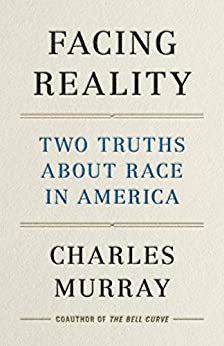
… Facing Reality is seriously disturbing. Murray gives a great deal of evidence for two points. One is that black people aren’t, on the average, as intelligent as other people. The other is that black people in America are more violent than others.
Those who on some level celebrate the latter as black people getting back at the white man in the only way they can, should know that the facts don’t lend themselves to that vigilante justice analysis. More specifically, black people kill each other more than members of other groups kill each other.
I find the violence point relatively unsurprising. Murray stays agnostic as to what the cause of it is; he proposes no genetic analysis, for example. And really, let’s try this. In the 1960s, a new and powerful fashion in black thought, inherited from the general countercultural mood, rejects championing assimilation to proposing that opposition to whiteness is the soul of blackness. Meanwhile, white leftists encourage as many poor black women as possible to go on welfare, hoping to bankrupt the government and inaugurate a fairer America. Soon, being on welfare in poor black communities is a new normal – hardly the usual, but so common that people grow up seeing not working for a living as ordinary. Then at this same time, a new War on Drugs gave poor black men a way of making half of a living by selling drugs on the black market, amidst a violent culture of gangland turf-policing. This feels more natural to them than it would have to their fathers because 1) the new mood sanctions dismissing traditional values as those of a “chump”, 2) it no longer feels alien to eschew legal employment, and 3) the Drug War helps make it that most boys in such neighborhoods grow up without fathers anyway.
The question might be just how black men amidst these changes would not have embraced violence in a new way.
* * *
The point about intelligence, however, is tough reading. Many will try the usual arguments – that race is a fiction (but while there are gray zones, humans do divide into delineable races genetically), that all races have a range from genuises on down (but the issue is that some races have more geniuses than others), that intelligence tests are “biased” somehow (but no one will specify just how, and this sort of bias is decades gone now).
The data, unless Murray is holding back reams of data with opposite results, cut brutally through all of this. It isn’t that black people are on the bottom on one big test in one big study, but that a certain order of achievement manifests itself in one study after another with relentless and depressing regularity. Asians on top, then come the whites, then Latinos, and then black people.
People will insist that none of this has anything to do with intelligence, but one thing cannot be denied – whatever it signifies, black people have a big problem performing on intelligence tests. The consistency of the results, if it is unconnected to intelligence, is clearly connected to something, or the results wouldn’t be so damnedly consistent.
June 29, 2021
History Summarized: Rise of Islam
Overly Sarcastic Productions
Published 16 Nov 2016Note to viewers: This video contains images of the *Blue Mosque* in Istanbul, which is Not the Hagia Sophia. The Hagia Sophia was a church, later converted into a mosque, but the Blue Mosque, which, to be fair, looks fairly similar to the Hagia Sophia, is a totally different building, and was built by the Ottomans.
HE LIVES! … by at least a few medical metrics. Blue went on a huge training montage for the entirety of Autumn and is back to talk about the history of Islam!
If you have any questions about anything in the video and would like to learn more, leave them in the comments and I’ll do my best to answer!
MERCH LINKS:
Shirts – https://overlysarcasticproducts.threa…
All the other stuff – http://www.cafepress.com/OverlySarcas…Follow us on Twitter @OSPYouTube!

June 28, 2021
QotD: Urbanization
Stewart Brand, “Environmental Heresies”, Technology Review, 2005-05
June 18, 2021
Innovation was minimal in the Roman Empire, because slave societies think they don’t need new inventions
Mark Koyama writes for the Foundation for Economic Education on the similarities and differences of the economy of the Roman Empire at its second-century peak and the booming European economies of the 17th and early 18th centuries:
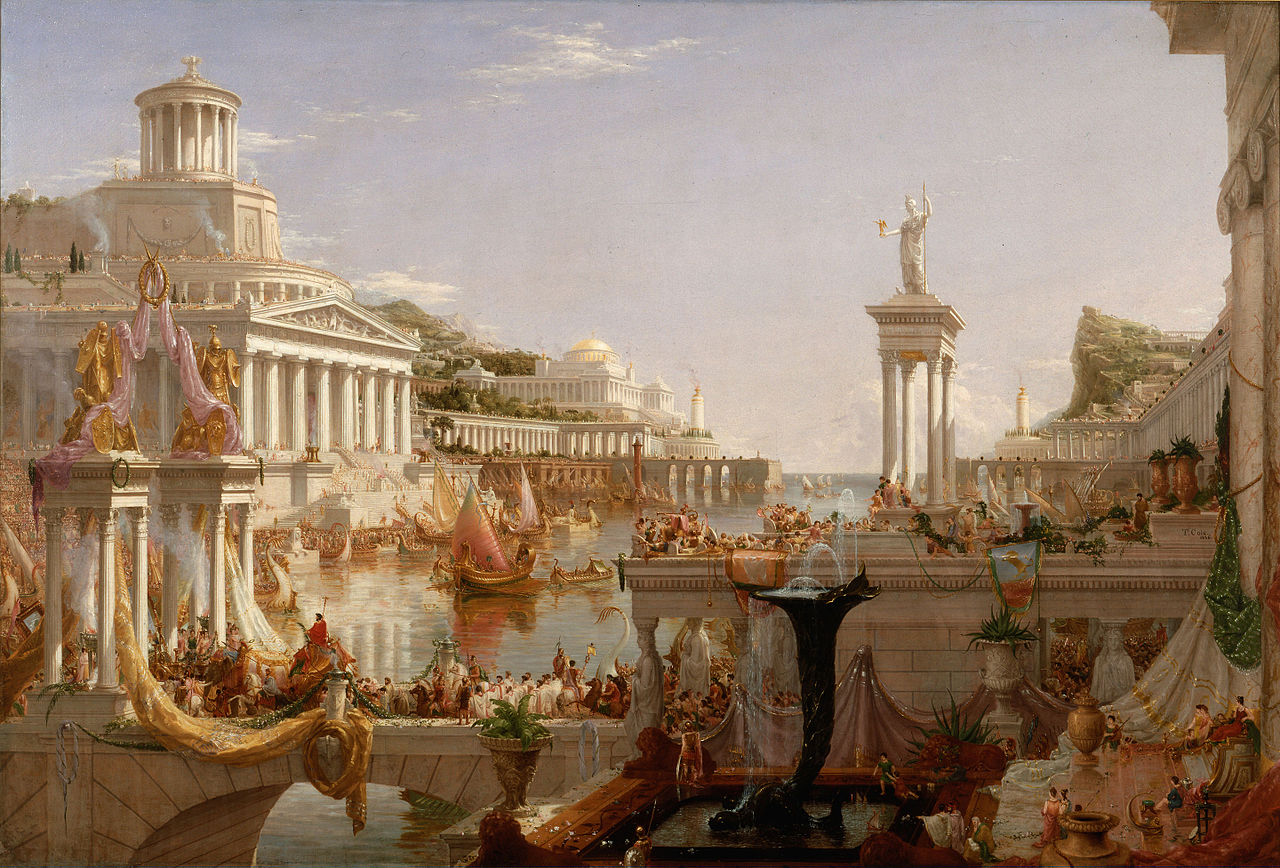
“The Consummation of Empire” from the painting series “The Course of the Empire” by Thomas Cole (1801-1848).
New York HIstorical Society collection via Wikimedia Commons.
The most obvious institutional difference between the ancient world and the modern was slavery. Recently historians have tried to elevate slavery and labor coercion as a crucial causal mechanism in explaining the industrial revolution. These attempts are unconvincing […] but slavery certainly did dominate the ancient economy.
In its attempt to draw together the various strands through which slavery permeated the ancient economy, [Aldo] Schiavone’s chapter “Slaves, Nature, Machines” [in The End of the Past] is a tour de force. At once he captures the ubiquity of slavery in the ancient economy, its unremitting brutality — for instance, private firms that specialized in branding, retrieving, and punishing runaway slaves — and, at the same time, touches the central economic questions raised by ancient slavery: to what extent was slavery crucial to the economic expansion of the period between 200 BCE and 150 AD? And did the prevalence of slavery impede innovation?
It is impossible to do justice to the argument in a single post. Suffice to say that after much discussion, and many fascinating interludes, Schiavone suggests that ultimately the economic stagnation of the ancient world was due to a peculiar equilibrium that centered around slavery.
One can think of this equilibrium as resting on two legs. The first is the observation that the apparent modernity of the ancient economy — its manufacturing, trade, and commerce rested largely on slave labor. The expansion of trade and commerce in the Mediterranean after 200 BC both rested on and drove the expansion of slavery. Here Schiavone notes that the ancient reliance on slaves as human automatons — machines with souls — removed or at least weakened, the incentive to develop machines for productive purposes.
The existence of slavery, however, was not the only reason for the neglect of productive innovation. There was also a specific cultural attitude that formed the second leg of the equilibrium:
None of the great engineers and architects, none of the incomparable builders of bridges, roads, and aqueducts, none of the experts in the employment of the apparatus of war, and none of their customers, either in the public administration or in the large landowning families, understood that the most advantageous arena for the use and improvement of machines — devices that were either already in use or easily created by association, or that could be designed to meet existing needs — would have been farms and workshops
The relevance of slavery colored ancient attitudes towards almost all forms of manual work or craftsmanship. The dominant cultural meme was as follows: since such work was usually done by the unfree, it must be lowly, dirty and demeaning:
technology, cooperative production, the various kinds of manual labor that were different from the solitary exertion of the peasants on his land — could not but end up socially and intellectually abandoned to the lowliest members of the community, in direct contact with the exploitation of the slaves, for whom the necessity and demand increased out of all proportion … the labor of slaves was in symmetry with and concealed behind (so to speak) the freedom of the aristocratic thought, while this in turn was in symmetry with the flight from a mechanical and quantitative vision of nature
Thus this attitude also manifests itself in the disdain the ancients had for practical mechanics:
Similar condescension was shown to small businessmen and to most trade (only truly large-scale trade was free from this taint). The ancient world does not seem to have produced self-reproducing mercantile elites. Plausible this was in part because of the cultural dominance of the landowning aristocracy.
The phenomenon coined by Fernand Braudel, the “Betrayal of the Bourgeois”, was particularly powerful in ancient Rome. Great merchants flourished, but “in order to be truly valued, they eventually had to become rentiers, as Cicero affirmed without hesitation: ‘Nay, it even seems to deserve the highest respect, if those who are engaged in it [trade], satiated, or rather, I should say, satisfied with the fortunes they have made, make their way from port to a country estate, as they have often made it from the sea into port. But of all the occupations by which gain is secured, none is better than agriculture, none more delightful, none more becoming to a freeman'” (Schiavone, 2000, 103).
Such a cultural argument fits perfectly with Deirdre McCloskey’s claim in her recent trilogy that it was the adoption of bourgeois cultural norms and specifically bourgeois rhetoric that distinguished and caused the rise of north-western Europe after 1650.
June 14, 2021
Movies based on “classic literature”
Severian considers the relative glut of movies more-or-less based on the classics of literature from his formative years:
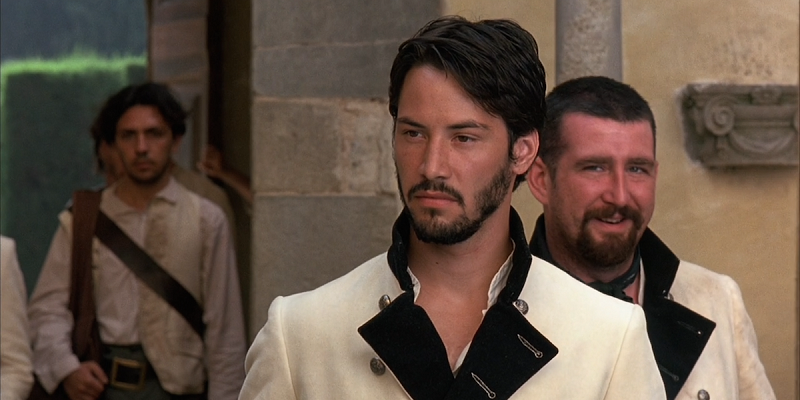
When I was a young buck, there was a fad for making movies out of “classic literature”. Scads of chick flicks, of course — Jane Austen’s complete works, the Brontës, and so on — but they also took a stab at Shakespeare. Mostly they stuck to the comedies — and trust me, watching Keanu Reeves trying to handle Much Ado About Nothing is hilarious, in all the wrong ways — but they’d occasionally give the tragedies a shot. Kenneth Branagh’s Hamlet is pretty good despite all the distracting cameos, his Othello is at least sincere (ye gods, imagine trying to make that today!), I think I’m forgetting a few. Mel Gibson gave Hamlet a go back in the early 1990s, and so on. Again, I’m pretty sure I’m forgetting a few.
It always struck me as odd. Unless they timed the theatrical releases to midterm and finals week, hoping to hoover up the dollars of desperate sophomores who didn’t do the homework, it didn’t make much sense, marketing-wise. We were a much more culturally literate people once, it’s true*, but there’s just not much of an audience for the Bard anymore. Nor was it a case of SJWs trying to destroy something good just on general principles. I’m sure Gwyneth Paltrow was bad as Emma, but the idea of retconning every single female in the Western Canon into a Strong, Confident Woman(TM) was still in its infancy. My only other guess was that, since college enrollments were skyrocketing, maybe the parents of all those first-gen college kids were feeling mal-educated and trying to catch up …? Lame, I know, but it was the best I could do.
Looking back on it now, I see my problem: I was looking at it from the demand side. Silly and naive as I was, I assumed that Hollywood’s primary concern was making money, so they went out and found what the people wanted to see, then gave it to them. For instance, I thought Titanic was going to be a huge flop. I mean, the boat sinks. We know that. How do you squeeze any dramatic tension out of it? I should’ve realized they’d be playing it as a doomed-lovers tragedy — girls love that shit, what with the big flouncy costumes and all. Once I realized that, I thought I had it all figured out — every girl I, personally, knew found the works of Jane Austen tedious, but that’s because (I reasoned) you have to supply the images for yourself. Put Hunky McBeef up there in breeches and a peruke, Waify Beecup in a Regency dress, and it’s chick crack …
Or so I thought. Looking back on it now, that’s as dumb as my opinion that Titanic would bomb. Hollywood doesn’t care what you want. I doubt if Hollywood has ever cared what you want, but if they ever did, that time probably ended in tandem with Clara Bow’s career. Hollywood wants what they want, and so will you, because whaddaya gonna do, not watch it? The reason they made all those “classic literature” films in the 1990s, then, wasn’t because they thought we wanted (or needed) some cultural uplift.
No, the reason was: By the 1990s, the last of the old guard in Hollywood was dying off, replaced by the new guard, the Baby Boomers. As we know, it’s not enough for Boomers to control everything while making a shitload of money. No no, for them everything has to be deep and meaningful. They thought of themselves as artistes, not entertainers, so they had to put out a bunch of highbrow stuff, and we had to watch it. This is the sole reason goofy-looking Kenneth Branagh and his horse-faced wife (at the time) were a big cultural force. They made Shakespeare sexy, by which I mean, they allowed the studio heads to think of themselves as the arbiters of culture, not the carny trash they were and are. That some decent movies got made because of it, is entirely incidental.**
*Last summer, during the worst of lockdown mania, I introduced my little nephews to Bugs Bunny. The real ones, from the 40s and 50s, not the crap they put out ten, twenty years ago. I am an educated man by modern standards, but a lot of that stuff flew over my head … and they used to show these in front of popular movies, on military bases, etc.! There’s the classic Wagner one, of course — kill da wabbit!! — but another one involves The Barber of Seville, which I haven’t seen performed and had to look up. Even the “throwaway” music was classical — they could assume, in other words, that your average workaday guy or GI had a fairly large repertoire of classical pieces in his head, enough to recognize bits from Strauss, Chopin, Schumann, etc.
**I do kinda regret bashing Sir Kenneth, as wiki tells me he now is. I enjoyed Hamlet (again, despite the annoying cameos), and some of his other work was pretty entertaining, even, in a limited way, visionary — a quirky little picture like Dead Again didn’t do much in 1991, but it would clean up now (a PoMo costume drama!). I’m one of the few people who liked Mary Shelley’s Frankenstein, which again despite terrible casting (Robert De Niro? Seriously?) was loads of fun. Shelley’s novel as written is ludicrous, therefore unfilmable, but Branagh admirably captured the spirit of it. It’s as Goth as can be, in the original sense of “Gothic”. Wonderful stuff.
June 12, 2021
Literate people who “never read books”
I recently added Kenneth Whyte’s SHuSH to my growing list of Substack blogs, and his latest entry considers people who can read but choose not to … and boast about it:
… I ran across a tweet by Neil Patel, a self-made marketing guru, explaining or, rather, bragging about how he doesn’t read books:
The only books I read are kids’ books and that’s to my daughter. People talk about reading books. You know what? I wrote a book and I was even a New York Times best-selling author, but here’s the thing: most books that you see in a book store, they’re written a year to two years before they were actually published and they go through this really long process. A lot of the times you’re reading outdated information. Even if the book has theories and strategies that aren’t outdated, heck, you can just go on YouTube and find that info in a five-minute clip. Why would you want to read 300 pages when you can just figure it out in five minutes. So I don’t spend my time reading books. Instead, I spend three hours a day reading blogs, Instagram, YouTube and all the other places where I can consume information faster, and you should, too.
It turns out Patel’s tweet was too dumb even for Twitter. Within hours, it had 87 retweets against 1,836 quoted retweets and 764 replies, indicating an extremely high ratio of people blasting him to people sharing his pensées.
Washington Post book critic Carlos Lozada had some of the best mockery: “Also do you realize that when you go in a bookstore, some of the books are so old that the authors are dead? How can you learn anything from a dead person? They can’t even tweet.”

I’ve found over the last few years that I’m spending less time reading books, although I still treasure my quiet reading time in the late evening. My tastes have changed a lot over the years, and I read almost no fiction works at all except for a few “unwoke” science fiction authors, and aside from books on hand tool woodworking almost everything else is history — and not much recently published history (for the same reason I avoid most modern SF novels … they’re far too woke for boring old fuddy duddy readers like me).
You’ve probably seen those internet ads that claim the average CEO reads a book a week. That’s bullshit marketed by Blinkist to flog fifteen-minute book summaries. There is no data to support it. The average American reads twelve books a year, and high-earners read fifteen, which is probably the best-case scenario for the average CEO.
Sure, Bill Gates and Mark Zuckerberg and Warren Buffett read a lot of books. I’ve run across a few lesser mortals in big offices who were enthusiastic readers. I was even part of a Bay Street book club for several years (I loved it). But most businessmen, in my experience, read very little, or not at all. Trump, who also had his name on a bestseller but never reads books, is far closer to the norm than Gates.
I was once at a dinner retreat with a dozen executives, all of whom had good university educations and generous salaries. They’d been asked by a moderator to come to the dinner with an example of something they’d read, a book or a poem or an essay that really spoke to them. Only three of the twelve mentioned books (and each mentioned a business book). Several mentioned newspaper or magazine articles they’d read. The rest relied on song lyrics, with two citing the same line from “Hotel California” as a commentary on their careers: “You can check out any time you like, but you can never leave.” None of us knew whether to laugh or cry.
Another thing I learned at that retreat, which struck me as related, was that all of the executives complained of having no time to think about the big picture: they were so busy doing their work that they seldom stopped to consider if there wasn’t a better way to do it, or if it was worth doing at all. They complained at this lack of perspective, but all were senior enough to be able to delegate day-to-day chores to others, leaving themselves time to think. I don’t believe they wanted to.
June 11, 2021
Latin and Greek are the next sacrifices to the great god Antiracism
In the latest edition of It Bears Mentioning, John McWhorter considers the Princeton University classics department decision to get rid of the requirement for students to read classic texts in the original languages:
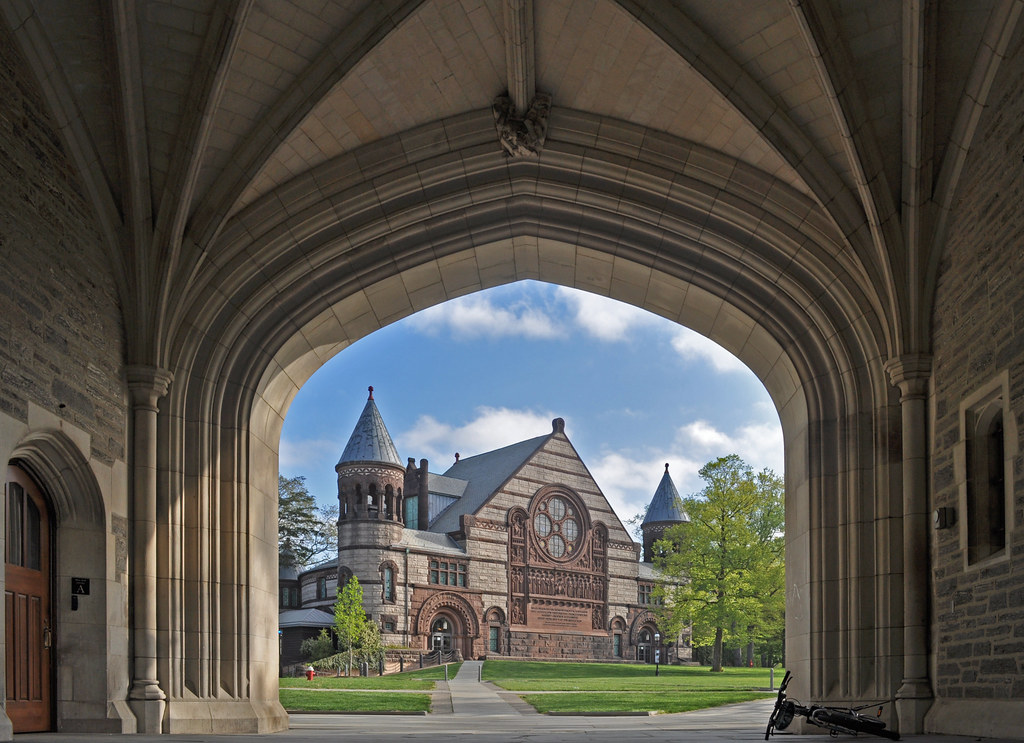
“USA – New Jersey – Princeton” by Harshil.Shah is licensed under CC BY-ND 2.0


I have written recently about the Princeton classics department’s decision to eliminate the requirement that students engaging closely with Latin and Greek texts be able to … read them in Latin and Greek. The new idea is that the department will attract more majors by opening up to ideas from students who may be full of beans but just not inclined to tackle complex, ancient languages. And sub rosa, the idea is clearly – as we can see from words in the official statement like underrepresented, perspectives, and experiences – that of especial interest will be black students, especially in light of today’s racial reckoning which the department openly acknowledges was the primary spur for this change.
My disappointment with this decision is because it is part of a tradition of arguments that we do black people a favor by exempting them from certain kinds of faceless, put-up-or-shut-up challenges to entry. Back in the aughts, the classic example was brilliant, fierce black lawyers confidently arguing that because black firefighter applicants don’t do as well on the entrance exams required for the job, the exams are racist and should be eliminated. More recently there has been the idea that if black kids are rare at top-ranked public schools in New York City like Stuyvesant because few excel on the standardized test one must ace to be admitted, then the solution is to eliminate the test as “racist”. The Princeton decision is a variation: to get black kids into classics, it’s supposedly immoral to expect them to master the intricacies of Latin and Greek, languages which I suppose we can see as foreign, “white” to them as well. Rather, they must be admitted in shining expectation that their class comments will be bracingly “diverse” in good old English.
My Atlantic colleague Graeme Wood is more sanguine about the Princeton decision. He argues sagely that a certain kind of student happens to enjoy working their way through languages like Latin as a kind of puzzle (I openly admit being that type), but that there are others who don’t go in for that particular task and yet are itching and well-equipped to engage and analyze classical texts regardless. Graeme notes that we do not consider it an educational tragedy that specialists in English history are not required to be able to read Old English. (Although I wonder if this analogy would hold if the idea were someone specializing in England of the first millennium, where all of the relevant linguistic matter was in Old English [and Latin].)
I can go with him here to an extent. On the one hand, as I have argued here, to engage work only in translation is, of course, to lose a lot. Yet, in making that argument here, I was referring to my own reading War and Peace in English, as I myself was not inclined to hack through it in Russian (although my being black was not the reason for this disinclination [couldn’t help it!]). The question is how important we consider that loss to be.
Having no facility in languages myself, I’m more sympathetic to the students’ viewpoint than I might otherwise be, but depending on someone else’s translation of the text being studied has unexpected risks, as Sarah Hoyt explained from her own translation studies:
The discussion […] reminded me of when I was sixteen and embarked on a class called “Techniques of Translation”.
Although I had studied French and English and German, the translations I’d done so far were of the “I took the pen of my neighbor” variety. I thought the class would teach me to smooth out the sentence to “I took my neighbor’s pen” and that would be that.
I was wrong. Oh, it taught that also, but that was a minor portion of it. The class mostly hinged on the moral, ethical and — most of all — professional dilemmas of being a translator. I know any number of you are translators, formal or informal, but any number of you are also not. So, for the ones who are not, let me break the news with my usual gentleness:
There is no such thing as translation.
The French have a proverb “to translate is to betray a little” — or at least that’s the closest meaning in English. It’s fairly close to the true meaning, but slightly askew, of course. Every language is slightly askew to other languages.
The idea that there exists in every language a word that is exactly the equivalent of other languages is sort of like assuming that aliens will — of course — live in houses, go to school, ride buses, understand Rebecca Black’s “Friday”. [This was originally written in 2011.]
Language is how we organize our thoughts, and each word, no matter how simple, carries with it the cultural freight and experience of the specific language. Oh, “mother” will generally mean “the one who gave birth to” — except for some tribal, insular cultures where it might mean “the one who calls me by her name” or “my father’s principal wife” — but the “feel” behind it will be different, depending on the images associated with “mother” in the culture.
So, when you translate, you’re actually performing a function as a bridge. Translation is not the straightforward affair it seems to be but a dialogue between the original language and the language you translate into. If you’re lucky, you meet halfway. Sometimes that’s not possible, and you feel really guilty about “lying” to the people receiving the translation. When on top of language you need to integrate different cultures and living systems (which you do when translating anything even an ad) you feel even more guilty, because you’re going to betray, no matter how much you try. At one point, a while back, I had my dad on one phone, my husband on the other, and I was doing rapid-fire translation about a relatively straight forward matter. And even that caused me pangs in conscience, because my dad simply doesn’t understand how things are done here. I had to approach his experience and explain our experience in a way he wouldn’t think I was insane or explaining badly. That meant a thousand minor lies.
May 24, 2021
“The revolution will be defeated when people stop being scared”
Sean Gabb discusses some outrageous elements of the ongoing cultural revolution against freedom of speech in Britain, the United States and many other western nations:

David Hume Tower at the University of Edinburgh (listed building number 50189).
Photo by Enric via Wikimedia Commons.
If I am a self-employed plumber or electrician, I can speak my mind and laugh at the complaints. If, like the great majority in this country, I am a salaried employee — whether in the state or private sectors is unimportant: the pressures to conformity are the same in both sectors — I must be careful what I say. I am scared of the sack. I am scared of sudden redundancy. I am scared of missing out on promotions. I am scared of generally unfair treatment because of my opinions. I therefore hide my opinions. The Peter Tatchells among us then look round complacently, telling themselves and each other that silence equals agreement, and that the few squeaks of opposition are from “disreputable extremists.”
This explains the present unbalanced debates over slavery and colonialism. Take these examples:
- First, in September 2020, the David Hume Tower at Edinburgh University was “denamed”. Someone had bothered to read the 1748 essay “Of National Characters”, and found in one of its footnotes an unfashionable statement about race. It was at once set aside that Hume was a philosopher of at least considerable note. More important was the “non-overt disrespect, offence, and racism that Black students have to go through at the University of Edinburgh”.
- Second, the Music Department at Oxford is presently worried that its curriculum “structurally centres white European music”, and that this causes “students of colour great distress”. It therefore wants to change its focus from the European classical tradition to things like “Artists Demanding Trump Stop Using Their Songs”. It also wants to discourage students from studying musical notation, as this is a “colonialist representational system”.
I could give a third illustration, and a fourth. I could fill a pamphlet with more. Some would be more alarming, though few less absurd. But these two can stand well enough for all the others. What makes these debates so irritating is that they are not debates. One side can put its case just as it pleases. The other is reduced to accepting all the main charges and begging for mitigation: “What Hume said was evil and unpardonable — but he was important for other things.” Or: “I feel your pain, but Mozart owned no slaves, and everyone knows that Beethoven was really black.” Because it has been so humbly begged, full mitigation will, in both cases, be granted. Hume will continue to be studied in the universities. Music students at Oxford will continue to use the standard notation and to analyse the usual classics. But preventing these things was never part of the agenda. The agenda was and is to transform what were honoured or unquestioned parts of our civilisation into things useful but more or less suspect, things subject to a toleration that may be varied or withdrawn at any time without notice.
It should be plain that we are, in both England and America, living through a revolution. This is not a normal revolution as these things are considered. Unlike in France or Russia, there has been no overthrow of an established order, no burst of state violence, no establishment after that of an overtly new order. There are no secret police. There are no labour camps. No one is beaten to death in a police cell. All the same, we are living through a revolution. It is a revolution that has involved the gradual capture of education, the media, the administration, the charities and the more permeable religious institutions, and the recent aligning of the larger or more glamorous business concerns. I see no point in discussing its ultimate objects. I am not sure if these are wholly agreed. But its provisional object is the destruction of our traditional identity, and of our liberty so far as this stands in the way of that provisional object.
These two elements of the provisional object are equally important. Our civilisation is being pulled apart because doing so strips away the mass of associations that, left in place, might hold up the more alarming parts of the transformation. Opposition is so feeble not only because that is all that will be tolerated: feeble opposition is all that can be tolerated. This is a revolution in which opponents are not murdered, but only scared into silence. They are scared into silence chiefly by fear of destroyed or blighted careers. The revolution will be defeated when people stop being scared. Then, there will be vicious and unrelenting public mockery, and commercial boycotts, and shareholder rebellions, and lost elections, and the general feeling of solidarity and impunity still sometimes found in a football stadium.
QotD: The internet is rewiring our brains
Yeah, I’m a history guy, not a biologist, and no, I can’t show you the specific spots on the fMRI that prove it, but look, you can test this yourself. Ever been around kids? It’s easiest to see in the early grades, so go to a daycare or afterschool program. Trust me, you can pick out right away, with 100% accuracy, the kids who spend more than 3 hours a day at daycare. This is not a knock on daycare providers, lots of whom are good, dedicated people doing hard work. Rather, it’s a knock on the situation, because if a kid’s in daycare that long, it means the parents both work long-hour, high-stress jobs. How do you think the kid’s home life is, under those conditions?
You know as well as I do that when the kid gets home from day care, he gets plunked in front of a tv, a video game, an iPad, a smartphone, some kind of glowing box. That’s what’s rewiring their brains. That’s not “ADHD,” which doesn’t really exist. “ADHD” is a cope, a bit of shorthand, to describe what’s actually going on, which is: These kids’ heads have been rewired. They need constant stimulation. Everything needs to be in five-minute chunks for them, because they’ve never known anything different. Asking them to sit down and pay attention for any length of time – say, in a 60 minute lecture, like our old Prussian (from the 18th century!) system requires – is like asking one of us to suddenly run a marathon, or bench press 300 lbs. It can’t be done; we don’t have the equipment.
Severian, “Bio-Marxism Grab Bag”, Founding Questions, 2021-01-21.
May 21, 2021
Andrew Potter – “the greatest gift you can give a generation is to ignore them”
In The Line Andrew Potter speaks up for those forgotten folks who were born after the end of the Baby Boom but before the Millennials appeared:

Generation X Word Cloud Concept collage background
Best Motivation Blog: What Generation Is X https://fatinsl.info/?arsae=https%3A%2F%2Fbestmotivationblog.blogspot.com%2F2020%2F04%2Fwhat-generation-is-x.html
… just as a sense of futurelessness, futility and invisibility catalyzed the original Generation X mentality in the early 90s (as well as the music, art, film and writing that mentality made manifest), this atavistic indignation spurred [Generation X author Douglas] Coupland to write his wonderful screed. It’s great stuff, with quotable lines in every paragraph. (I especially liked “Immunology is not a smorgasbord. How dare you make us subsidize your cluelessness with our bodies.”)
But I want to take issue with the claim that this is a case of Gen X getting screwed yet again. As a fully paid-up member of Gen X, I’ve grown to appreciate over the decades the extent to which the greatest gift you can give a generation is to ignore them.
Let’s back up a bit. Does Generation X even exist? Does any generation exist for that matter? Sociologists and demographers argue that the concept of a “generation”, be it Boomer, Millennial, Zoomer, what have you, is just the result of confusing cohort effects with generational effects. The idea of distinct generations might be good for selling soft drinks or cars or condos or nostalgia, but there is nothing remotely predictive or explanatory about it.
But as I’ve argued before, this just misunderstands what a generation is, and the role they play in our ongoing cultural self-understanding. Whatever else it is, a generation is something that has its own tastes and moods and fashions and jargon, its own sense of what is in and what is out, what is cool and what’s square, and who belongs and who does not. In short, more than anything else a generation is a scene. It is about who and what you claim as your own, and who claims you.
A big part of what helps define a generation are the battles it chooses to fight. The Boomers spent decades obsessed with their countercultural campaign against The Man, while Millennials have spent their time and energy mining the deepest recesses of identity politics. As for Generation X, our principal preoccupation was the question of authenticity and the fear of selling out.
It is hard to underestimate the role of technology in all of this. It is commonly argued that a generation is formed by the technological ecosystem in which it grows up, and while there’s obviously something to that, what is important for Gen X is not what our technology allowed us to do, but what it protected us from.
In particular, what we were protected from was surveillance. I don’t know a single person I grew up with who doesn’t thank their lucky stars that there were no cellphones with cameras around when we were growing up, that there was no Twitter or Facebook or YouTube or TikTok. I can’t imagine what it is like to grow up under the glaring distributed panopticon of social media, knowing that all your friends, everyone at your school, and even your parents are watching your every move, judging your every utterance.
May 13, 2021
Canada’s (subdued-but-real) class system
In The Line, Howard Anglin offers some observations on how Canada’s class system developed and how it can be very roughly delineated:
This comfortably flat image of our social hierarchy, however, belies a more complicated series of gradations that, while clearly marked, are rarely observed and almost never described accurately. Peter C. Newman mapped some of the terrain in his three volumes on The Canadian Establishment, but his account was already dated when he began it in 1975 and it was a work of history rather than social commentary by the time he finished in 1998. [Line editor Jen] Gerson’s own description of the Canadian class system explains why it can be hard for outsiders, and even insiders, to see it: “[W]e manage the cognitive dissonance presented by the haves and have-nots of housing,” she says, “by requiring our rich people to keep quiet. They should wear clothes that are well-cut and well-designed, but not flash. Buy the multi-millionaires car, but paint it in a sedate hue.”
Social sorting is intrinsic to human nature, perhaps even necessary — as the Bard has Ulysses remind us: “Take but degree away … and, hark, what discord follows!” — and it’s here in Canada too, if you look for it. Like the United States, Canadians early on replaced a class system based on titles with one based on the more easily-acquired currency of, well, currency. And, as in America, this immediately created a new opportunity for class to subtly reassert itself.
I used to joke that the only meaningful class division in Canada is whether you use “summer” as a noun or as a verb; lately I’ve developed the Starbucks test. In this analogy, Starbucks is Canada’s middle class, with Tim Hortons and fast food franchise coffee below, and specialty cafes and boutique chains (Matchstick, Phil & Sebastian, Bridgehead) above.
Unlike the crude measure of income, coffee choice better replicates a traditional class system because it carries an implicit sense of social solidarity, cultural assumptions and biases. During the days of the Harper government, Tim Hortons became a symbol to a certain sort of conservative as iconic as the Greek fisherman’s cap is to aging Marxists. The Maple Leaf red cup represented the honest values of rural and suburban working families, in contrast to the globalist elites with their overpriced green Starbucks. Starbucks was sipped at dog parks and served in board rooms; Tim Hortons got the job done on a cold winter morning: it was Don Cherry in a mug.
The Starbucks test is a silly heuristic, but it reveals something about the complex nature of class: an aristocrat may be penniless, and a billionaire may love his Tims. It also puts the middle class back in its traditional place as the uneasy middle-child of the social order.
In the old British system, there was pride in being working class. There was a bond of mutual support that grew out of the shared experience of hard labour and was reinforced by institutions like working men’s clubs, the British Legion, and the trade union movement. The middle-class striver with his airs and pretensions, his flash new car and his evolving accent, was a figure of general mockery, even more to the working men he left behind than to the upper classes he aspired to join. Class was about more than money; it was an identity. And there was nothing that gave you away as middle class more than worrying about being middle class — an anxiety exploited by Nancy Mitford in her tongue-in-cheek guide to “U” and “Non-U” language and behaviour. The Starbucks test reveals something similar, something more reflective of Canada’s reality than the Liberal vision of one big happy middle-class family.
Tim Worstall explained that the British middle class is still despised by the upper class and hated by the lower class. Not a model for encouraging aspirational working class folks to “move up”.
May 12, 2021
Looking at a highly influential document among progressive groups
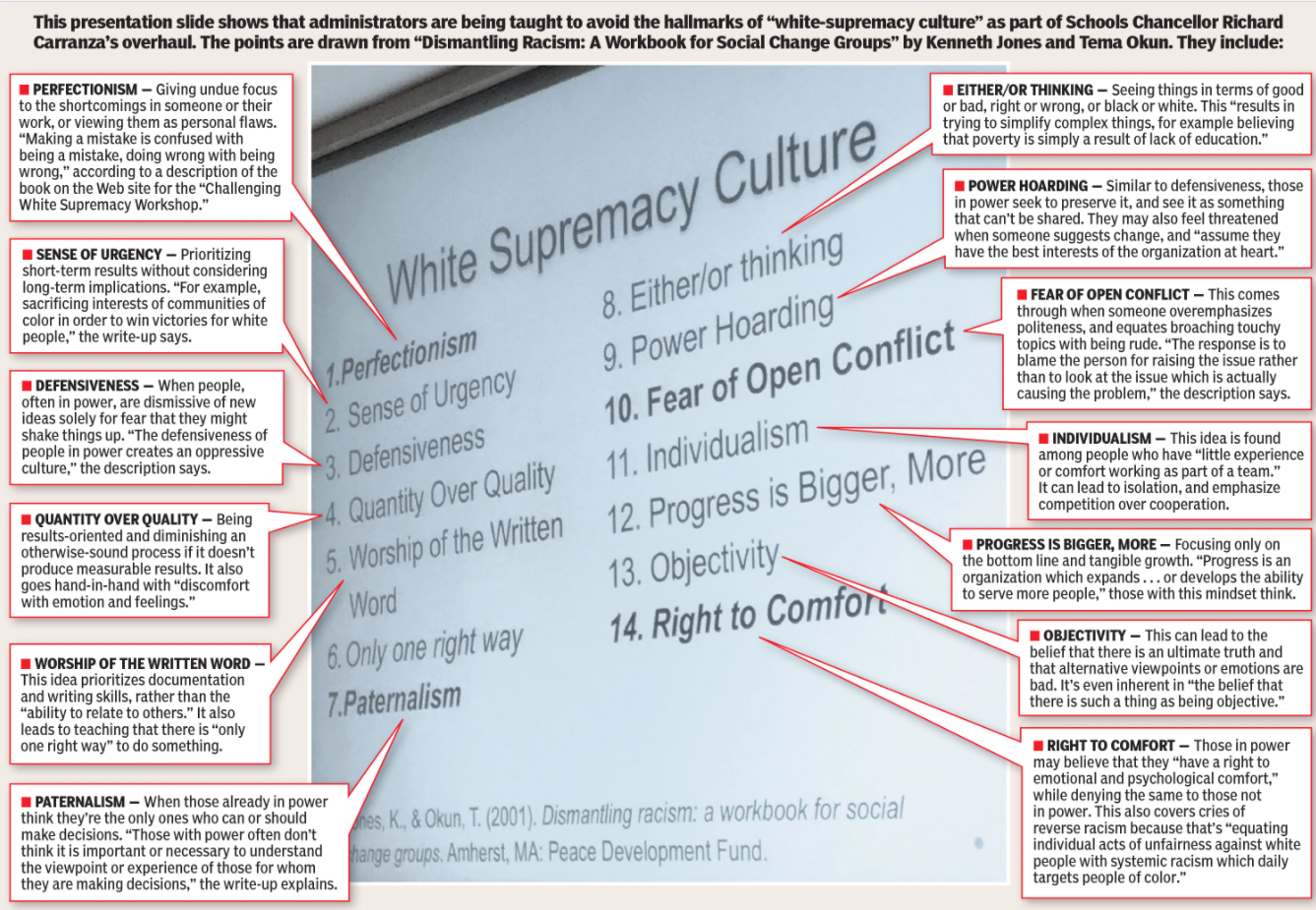
Matthew Yglesias on Tema Okun’s “The Characteristics of White Supremacy Culture” and its role in furthering progressive emotions over what they consider to be the most racist society in human history (that is, the modern west but especially the United States):
Click to see full-size image.
Debating abstractions is difficult and frustrating, and the discourse about “wokeness” and “cancel culture” has become a snakepit of semantic debates, bad-faith actors, and people of goodwill talking past each other.
So I want to talk instead about one specific document, not because I think it’s the most important document in the world, but because I don’t really see anyone who I read and respect talking about it even though I’ve seen it arise multiple times in real life.
I’m talking about “The Characteristics of White Supremacy Culture” by Tema Okun, which I first heard of this year from the leader of a progressive nonprofit group whose mission I strongly support. He told me that some people on the staff had started wielding this document in internal disputes and it was causing big headaches. Once I had that on my radar, I heard about it from a couple of other nonprofit workers. And I saw it come up at the Parent Teacher Association for my kid’s school.
It’s an excerpt from a longer book called Dismantling Racism: A Workbook for Social Change Groups that was developed as a tool for Okun’s consulting and training gigs.
But today, even though it’s not what I would call a particularly intellectually influential work in highbrow circles — even ones that are very “woke” or left-wing — it does seem to be incredibly widely circulated. You see it everywhere from the National Resource Center on Domestic Violence to the Sierra Club of Wisconsin to an organization of West Coast Quakers.
Which is to say it’s sloshing around quite broadly in progressive circles even though I’ve never heard a major writer, scholar, or political leader praise or recommend it. And to put it bluntly, it’s really dumb. In my more conspiratorial moments, I wonder if it’s not a psyop devised by some modern-day version of COINTELPRO to try to destroy progressive politics in the United States by making it impossible to run effective organizations. Even if not, I think the document is worth discussing on its own terms because it is broadly influential enough that if everyone actually agrees with me that it’s bad, we should stop citing it and object when other people do. And alternatively, if there are people who think it’s good, it would be nice to hear them say so, and then we could have a specific argument about that. But while I don’t think this document is exactly typical, I do think it’s emblematic of some broader, unfortunate cultural trends.
H/T to Colby Cosh for the link.


