
You don’t have to be a Biblical scholar to know that Jesus Himself swung His pimp hand at the deserving more than once. There’s a reason He commanded his followers to sell their cloaks and buy swords. Just as a kid who is never allowed to feel the burn from his own mistakes never learns anything, so the man who is prevented from sinning by main force is not saved thereby.
The following is not a theological argument, it’s an observation about human nature: Both faith and works are necessary, because by their fruits ye shall know them. If one has faith, then the works will follow — naturally, as it were. But works without faith are mere mumbo-jumbo, no different than the crudest magic spell. The kind of guy who does what David French does — performs the works solely to be seen performing the works — is what Jesus called a “whited sepulcher”, which indeed appear beautiful outward, but are within full of dead men’s bones, and of all uncleanness.
Again, you don’t have to be a Biblical scholar to observe that Jesus commanded what the parlance our times calls “tough love”. Just as you can’t save a sinner by taking away all his opportunities to sin — we are ALL guilty; we are ALL fallen; that alone is sufficient to damn us — so you can’t “save” a drunk, or an illegal alien, or a criminal, or whatever by enabling his lifestyle. The reason I’m not in church today is because the church is exactly like that gaggle of Karens in Starbucks — they talk a good game about renouncing the wiles of this world, but they bend over backwards to enable every possible social dysfunction.
No, Jesus did NOT command us to patch up the gutter addict every time he OD’s, so that he can go out and OD again. He did NOT command us to provide all kinds of food and shelter and medical care to every Squatemalan who broke the very first American law he had the opportunity to break by coming here. No, He did NOT command us to tolerate deviance — there are two clauses in “love the sinner, hate the sin”, and we must obey both.
The only route to salvation starts by admitting that everyone is fallen. You can take that in whatever sense you like, because it’s not theology, it’s just an obvious fact about human nature. Alas, it’s one you have to learn by age 12, or you’ll never learn it at all. That’s the greatest trick the Devil ever pulled.
Severian, “On Being Bad”, Founding Questions, 2021-12-12.
August 2, 2025
QotD: The path to salvation
August 1, 2025
QotD: The self-serving mythology of Britain’s NHS
The interesting question of why the NHS should continue to hold the affection of the British people, when it is at best mediocre in its performance and frequently unpleasant to deal with, is one that should be of interest to all political scientists. The answer is not pleasing to those who believe in human rationality.
The affection represents the triumph of rhetoric over reality. This rhetoric contains an implicit historiography, in which the pre-NHS era is akin to that of jahiliyya, the era of ignorance before the advent of Muhammad, in Islamic historiography: in short, that there was no healthcare for most of the population before the NHS. This historiography has for decades been continuously and successfully insinuated into the minds of the population. It has been Britain’s pale imitation of totalitarian propaganda. Intentionally or not, Boris Johnson recently reinforced the mythological status of the NHS. And when, in the present crisis, retired doctors such as I were asked to return to work if they were able, it was to help the NHS. This was like asking a soldier to lay down his life for the sake of the Ministry of Defence. It says something about the credulity of the public that the response to slogans like “protect the NHS” was dull compliance, rather than outraged demands as to why it wasn’t protecting us.
I suspect also that the sheer unpleasantness of the NHS is reassuring to the British population. It evokes the Dunkirk spirit: we are all stranded on the beach of illness together. And if we cannot all live in luxury, we can at least all die in squalor. Justice is served.
Theodore Dalrymple, “Empire of conformists”, The Critic, 2020-04-29.
July 30, 2025
“The worst thing that can happen to a good cause is, not to be skilfully attacked, but to be ineptly defended”
On Substack, Johann Kurtz provides a great example of Bastiat’s insight (quoted in the title), as debaters ineptly defend the whole notion of masculinity, particularly how boys are victimized for being boys:

“End Toxic Masculinity” by labnusantara is licensed under CC BY-NC-ND 2.0


We’re failing our boys.
Two-thirds of young men feel that “no one really knows” them. Their real wages have been falling since the 1970s. They’re dropping out of education and the workforce in growing numbers. They die deaths of despair at almost three times the rate of women. Even their physical strength is collapsing.
Terrible solutions are proposed. No matter how much traditional masculinity is undermined, powerful voices continue to insist that the real problem is that it hasn’t been destroyed altogether. “Only then will boys be happy”.
My thesis for this series is that there is a need to defend true masculinity on its own terms, not on the implicit terms of progressives who either don’t understand it or actively hate it.
Take, for example, this debate at the Oxford Union on traditional masculinity. The opening argument of the opposition — who are supposed to be defending traditional masculinity — starts with asserting the need for a “contemporary and inclusive” masculinity which is accessible to anyone “of any race, sexuality, or other identity“.
The best defence that this speaker can mount on this anaemic foundation is an argument that masculinity is useful for activism and community building like the “Movember Foundation”. After this slightly pathetic case she goes back to conceding “being forced to conform to a set of expectations is uncomfortable and even dangerous. We should allow people to access the gender expressions that make them feel like their truest self.”
The next speaker for the defence of traditional masculinity continues the grovelling: “In 2019, you know, we should not be honouring and obeying men — those times have gone.” This talk is a little better — you get the sense that he actually likes men, and notes that it’s overwhelmingly men who die in wars and dangerous jobs — before collapsing back at the end: “We should look at new ways of being a man. I would love to get more men involved in teaching, in nursing — make it ‘cool to care’. I’ve been around Scandinavia talking to stay-at-home dads … These are progressive, beautiful men.”
The final speaker — who, again, is supposed to be defending traditional masculinity — takes the stage and begins: “Some of the most beautiful moments I’ve watched in young men’s lives are when we’re alone in a room — and maybe a brother who’s been struggling with his sexuality comes out in front of a hundred other brothers, and he’s crying, and his other brothers are crying with him“. You can imagine the rest.
None of this has anything to do with traditional masculinity. In this series I will advocate for the cultivation in boys of all of the aspects of masculinity that these “advocates” were afraid to defend: strength, aggression, dominance, stoicism, and risk-taking.
History of Britain VI: Prime Roman Britain
Thersites the Historian
Published 13 Feb 2025Britain became a quietly productive part of the Roman Empire once the Celts of southern Britain were subjugated. This was the period when the Romans built cities, forts, and roads across the southern portion of the island. The good times corresponded with the Classical Optimum. However, after 150 or 200 CE, Britain was beginning to experience a decline in its material well-being.
July 23, 2025
The Most Bitter Man In All Of Ancient Rome: Meet JUVENAL
MoAn Inc.
Published 27 Feb 2025
(more…)
July 21, 2025
“Normal”? Dude, that’s extremist right-wing hate speech!
The Bone Writer on the huge increase in young people “identifying” as something other than what unreconstructed cavemen used to call “normal”:
Walk through any high school, scroll through TikTok, or attend a freshman orientation, and you’ll see the new hierarchy of modern identity:
- Straight white male? Bottom rung.
- Bisexual nonbinary neurodivergent? Stunning and brave.
- Confused, anxious, fluid? You’re seen. You’re valid.
- Rooted, stable, and clear? YOU must be dangerous.
It’s not just a cultural shift anymore. It’s a cultural mutation. A slow but total dislocation from reality.
We are no longer celebrating the diversity of life. We are celebrating the diversity of escape routes from it.
Identity as a Compass? No … It’s Identity as Camouflage
There was a time when “identity” meant something integrated, a clear expression of who you are, shaped by your values, your upbringing, your nature.
Now, identity is:
- A product
- A protest
- A mask
It’s often less about expressing truth and more about shielding from judgment.
And nowhere is that clearer than in the explosion of LGBT+ self-identification, especially among the young.
The Numbers Don’t Lie but No One Wants to Look at Them
In 2012, Gallup found ~3.5% of Americans identified as LGBT.
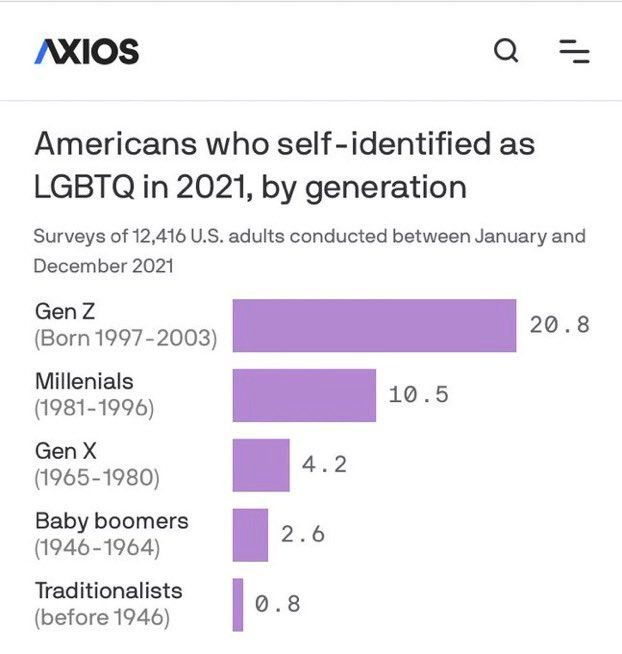
By 2021? Over 20% of Gen Z now identify somewhere on the spectrum.
Among Gen Z women, bisexual identity has grown by over 400%.
Do you really believe this is all “just visibility”? Do you really think the human genome changed this much in 10 years?
Of course not.
What changed was the culture. And culture now rewards deviation and punishes normativity.
Reported by Axios in 2021

AI slop seems to have finally triggered significant pushback
Ted Gioia says that he’s seeing strong indicators that the AI slop superabundance has helped create a widespread rejection of it and all its works:
2025 has been the year of garbage culture.
Creators watch in horror as dismal AI slop threatens their livelihoods — and the integrity of their fields. It’s everywhere, spreading faster than a pharaoh’s plague.
In recent months, we’ve been bombarded with millions of lousy AI songs, idiotic AI videos, and clumsy AI images. Error-filled AI texts are everywhere — from your workplace memos to the books sold on Amazon.com.
Even my lowly vocation, music journalism, gets turned into a joke when it’s accompanied by slop images of fake events.
No, these things did not really happen.
But something has changed in the last few days.
The garbage hasn’t disappeared. It’s still everywhere, stinking up the joint.
But people are disgusted, and finally pushing back. And they are doing so with such fervor that even the biggest AI companies are now getting nervous and pulling back.
Just consider this surprising headline:
This was stunning news. YouTube is part of the biggest AI slop promoter of them all — namely the Google/Alphabet empire. How can they possibly abandon AI garbage? Their bosses are the biggest slopmasters of them all.
After this shocking news reverberated through the creative economy, YouTube started to backtrack. They said that they would not punish every AI video — some can still be monetized.
But even the revised guidelines are still a major blow to AI slop purveyors. YouTube made clear that “creators are required to disclose when their realistic content is altered or synthetic”. That’s a huge win—we finally have a requirement for disclosure, and it came straight from the dark planet Alphabet.
YouTube also stressed that it opposes “content that is mass-produced or repetitive, which is content viewers often consider spam”. This is just a step away from blocking slop.


Update, 22 July: Ted posted a follow-up with a bit more evidence that the pushback is working:
In my latest article I criticized Spotify for allowing uploads of unauthorized AI tracks to the profiles of dead musicians.
But the company may finally be listening to criticisms of its AI policies. In this case, Spotify has now taken steps to stop the abuses, and a spokesperson reached out to me today with an update and expressing a clear and proper policy on AI fraud.
I share it below (and have also updated my article):
We’ve flagged the issue to SoundOn, the distributor of the content in question, and it has been removed. This violates Spotify’s deceptive content policies, which prohibit impersonation intended to mislead, such as replicating another creator’s name, image, or description, or posing as a person, brand, or organization in a deceptive manner. This is not allowed. We take action against licensors and distributors who fail to police for this kind of fraud and those who commit repeated or egregious violations can and have been permanently removed from Spotify.
They acted quickly, and I give them credit for that.
Update the second, 23 July: Ah, Spotify giveth and Spotify taketh away:
“Spotify is publishing new, AI-generated songs on the official pages of artists who died years ago without the permission of their estates or record labels,” reports 404 Media.
This scandal came to light because of an AI song attributed to Blaze Foley, who died in 1989. The bogus track is accompanied by an AI-generated image of a man who bears no resemblance to the singer.
What’s going on here? Is this just ignorance or carelessness at Spotify? Or does it represent something more sinister — another example of the company’s willingness to deceive users in the pursuit of profits?
These scams must stop. If Spotify doesn’t fix this mess immediately, courts should intervene.
But the dead musician scandal is just a start — because other bizarre things are happening at Spotify.
The whole situation is positively surreal.
July 20, 2025
Star Trek and the New Frontier Story
Feral Historian
Published 28 Feb 2025Star Trek has been the “new frontier” story for so long that it’s become more retro than futurist. But that doesn’t mean the frontier story itself is dead, only that there’s a disconnect between the future we want and the visions of it that we have.
00:00 Intro
02:19 Time and Space
06:06 Inhabited Spaces
09:44 A story of the Past
July 19, 2025
QotD: William Wilberforce and the anti-slavery movement
There was some hard-muscle enforcement that accompanied the new law: the Royal Navy announced that it would regard all slave ships as pirates, and thus they were liable to sinking and their crews to execution. There had been some important court decisions: in the reign of William and Mary, Justice Holt had ruled that “one may be a villeyn in England, but not a slave,” and in 1803 William Osgoode, Chief Justice of Lower Canada, ruled that the institution was not compatible with the principles of British law. But what was decisive was the way Wilberforce “murdered” (in Metaxas’ word) the old acceptance of slavery by the wider society. As he wrote in 1787, “God almighty has set before me two great objects: the suppression of the slave trade and the reformation of manners”.
The latter goal we would now formulate as “changing the culture” — which is what he did. The film of Amazing Grace shows the Duke of Clarence and other effete toffs reeling under a lot of lame bromides hurled by Wilberforce on behalf of “the people”. But, in fact, “the people” were a large part of the problem. Then as now, citizens of advanced democracies are easily distracted. The 18th-century Church of England preached “a tepid kind of moralism” disconnected both from any serious faith and from the great questions facing the nation. It was a sensualist culture amusing itself to death: Wilberforce goes to a performance of Don Juan, is shocked by a provocative dance, and is then further shocked to discover the rest of the audience is too blasé even to be shocked. The Paris Hilton of the age, the Prince of Wales, was celebrated for having bedded 7,000 women and snipped from each a keepsake hair. Twenty-five per cent of all unmarried females in London were whores; the average age of a prostitute was 16; and many brothels prided themselves on offering only girls under the age of 14. Many of these features — weedy faint-hearted mainstream churches, skanky celebs, weary provocations for jaded debauchees — will strike a chord in our own time.
“There is a great deal of ruin in a nation,” remarked Adam Smith. England survived the 18th century, and maybe we will survive the 21st. But the life of William Wilberforce and the bicentennial of his extraordinary achievement remind us that great men don’t shirk things because the focus-group numbers look unpromising. What we think of as “the Victorian era” was, in large part, an invention of Wilberforce which he succeeded in selling to his compatriots. We, children of the 20th century, mock our 19th-century forebears as uptight prudes, moralists and do-gooders. If they were, it’s because of Wilberforce. His legacy includes the very notion of a “social conscience”: in the 1790s, a good man could stroll past an 11-year-old prostitute on a London street without feeling a twinge of disgust or outrage; he accepted her as merely a feature of the landscape, like an ugly hill. By the 1890s, there were still child prostitutes, but there were also charities and improvement societies and orphanages. It is amazing to read a letter from Wilberforce and realize that he is, in fact, articulating precisely 220 years ago what New Yorkers came to know in the Nineties as the “broken windows” theory: “The most effectual way to prevent greater crimes is by punishing the smaller.”
Mark Steyn, The [Un]documented Mark Steyn, 2014.
July 18, 2025
QotD: Christianity destroyed the ancient Graeco-Roman culture
Consider celibacy: Fustel de Coulanges examines several ancient legal codes and finds that in all of them the deliberate refusal to procreate was a crime that carried severe punishments. This makes total sense in light of all you’ve said — a man does not belong to himself, he belongs to his family, a diachronic (or transtemporal?) entity that lives in and through and above individuals. Deliberate celibacy would be like your hand or your kidney refusing to perform its assigned function and trying to murder you instead. Cancer, in other words. And the solution to cancer is to cut it out and destroy it.
Now imagine a religion praising cancer and vaunting the tumor as the highest form of biological life, and maybe we can feel a sliver of the horror that the ancients must have felt towards Christianity. And it wasn’t just celibacy either — in area after area Christianity emancipated individuals from the dense, ancient web of obligations, loyalties, and client-patron relationships. Loyalty to the city and loyalty to the family were both such incomparably important qualities for the ancients that Sophocles got several tragedies out of the collisions when they came into conflict, but Christianity in its most radical form says that both are ephemeral and contingent, and must be subordinated to a higher loyalty — fidelity to the Truth. To the ancients I bet this didn’t just seem like antisocial behavior, I bet it seemed like the apocalypse. No wonder there were so many martyrs. No wonder so many of them were martyred by their closest relations.
I’m almost tempted to say that that old snake Gibbon was right, it was Christianity that destroyed the Roman Empire, destroyed the entire ancient Mediterranean civilization that had lasted for a millennium or more, first bit-by-bit then all at once. But of course that isn’t quite right either. By the time Pentecost occurred, the dissolution was already well underway. Christianity massively accelerated a process that was inexorable by then, and changed the shape of what was to come after it, but the collapse was baked in.
Read any of the Roman authors from either shortly before or shortly after the Lord’s birth — Virgil, Cicero, Pliny, Suetonius — all of them, in one way or another, are obsessed with the unraveling of the matrix of tribal and familial relationships that Fustel de Coulanges describes. There were a lot of reasons for it, including but not limited to: mass migration to the cities, economic rationalization that replaced freehold farming with massive latifundia (plantations), and just the accumulated stresses from centuries of continuous warfare and expansion. The cumulative effect of all this was that a society formerly governed by ritual, familial and civic piety, tribe, and clan was transformed into an ocean of atomized and deracinated individuals engaging in mass politics.1
One of my favorite passages in Gibbon’s Decline and Fall2 is in the intro to the chapter on Alaric’s invasion of Italy. Gibbon contrasts this with Hannibal’s invasion 700 years earlier, and goes on this beautiful riff about how on paper, the Rome of the 5th century AD looks incomparably stronger than that of the 3rd century BC — it had a massively larger population, greater wealth, a greater technological edge over its opponents, etc. And yet when it came to a responsibility as basic as that of defense against a foreign invasion, all the GDP and technology in the world wasn’t able to make up for a lack of asabiyyah. When Hannibal annihilated the legions at the Battle of Cannae, something like 20% of the entire adult male population of Rome was killed, including most of her military and political leadership, to which the Romans simply gritted their teeth and raised a few more armies. The descendants of those heroes, despite having a vastly larger population to draw from, weren’t able to muster a single legion or a single capable commander, and surrendered their city to the Visigoths almost without a fight.
Rome was a rocket that soared into the sky and then came crashing back down, and it’s easiest to see it right at the apogee, the point midway between the first and the last great invasions of Italy. The first century glory days of Rome, the time that we moderns consider the height of her power, were actually a moment of deep institutional and social decay. Like an exothermic reaction — a bonfire or an explosion or a fireworks display — what we notice immediately is the ebullient, magnificent blaze. But it’s easier to miss all the fuel that’s being consumed: solidarity, economic resilience, social technology, all of it woven through with the tight bands of ancient law and custom that Fustel de Coulanges documents. Just as the Greek philosophy we love was an uncharacteristic flash in the pan, an evanescent moment that subverted and destroyed the culture that had given rise to it; so too the Roman imperial achievement was an engine fueled by a society and a citizen-soldiery that it quickly burned to cinders.
I wonder if every civilizational golden age would turn out to have this unsustainable character if you inspected it closely. If so it would explain a historical mystery, which is why these epochs are rare, and why they never last long. From this angle history looks a bit like a 2-stage cyclic phenomenon wherein the long “dark ages” are actually epochs of patient stewardship of economic, cultural, and demographic resources, whilst the short “golden ages” are a kind of manic civilizational fire sale of the accumulated inheritance. Maybe we need a new historiography founded on the idea that what we have heretofore considered dark ages are the true golden ages, and vice versa. This transvaluation of values would be like a temporal version of James Scott’s attempted reversal of civilization and barbarism.
Alas, while peasants could vote with their feet and migrate across the imperial frontier, our options for time travel are a bit more limited. Would we prefer to live in the cozy but constricting deep prehistory of a civilization, or in the wild glory of its last days? No doubt it would depend a lot on who we imagine being in each of these phases, but at the end of the day it doesn’t matter, because we don’t have a choice. May as well sit back and enjoy watching the blaze. It will be beautiful and exhilarating while it lasts.
Jane and John Psmith, “JOINT REVIEW: The Ancient City, by Numa Denis Fustel de Coulanges”, Mr. and Mrs. Psmith’s Bookshelf, 2023-02-20.
1. If this sounds familiar, it should. Whenever I read about first century Rome I always come away with a weirdly twentieth century vibe.
2. Yes, I’ve read the whole thing cover-to-cover. What? Why are you looking at me like that? There was a pandemic happening, okay?
July 17, 2025
Afghan refugees and the British government
On Substack, Fergus Mason explains why the British government got deep into a secretive program to bring thousands of former Afghan soldiers and their families to Britain:
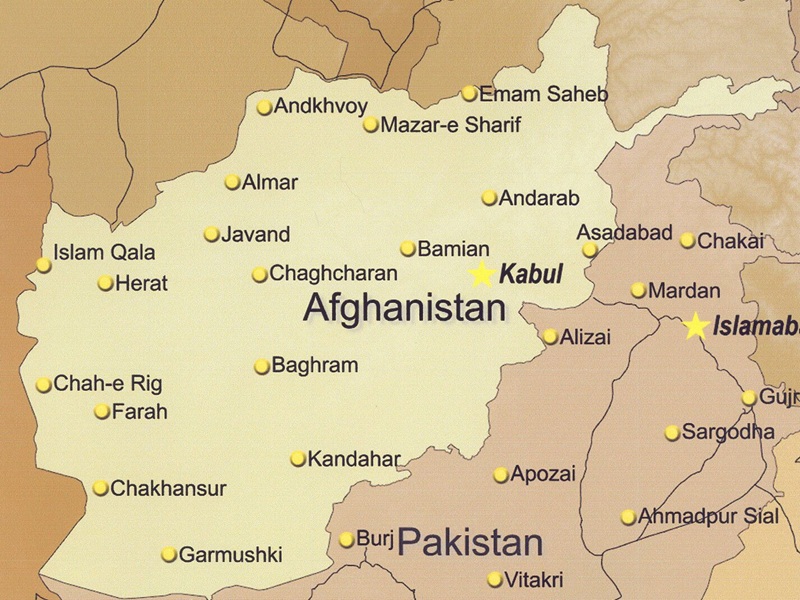
So here’s what we know so far. In February 2022 a Royal Marine officer, working for the Director of Special Forces, sent an email to several Afghans in Britain. These people were involved in the effort to rescue former interpreters and Afghan National Army special forces soldiers who were at risk of reprisals from the Taliban regime, and the Marine wanted to know whether some Afghans who claimed to be ex-special forces really were. The officer intended to attach a filtered list of around a hundred names from an Excel spreadsheet, but inadvertently attached the whole file — which contained around 25,000 names. One of the Afghans he sent the list to immediately passed it on to someone else – this time in Afghanistan. MoD sources are stressing that these were all trusted Afghans, but … well, we’ll get to that shortly.
And then nothing much happened for 18 months. The Taliban didn’t round up and shoot everyone on the list, even though they now claim to have had it since early 2022. But then, in August 2023, an Afghan man — a former soldier who had applied for asylum in Britain, but been rejected — popped up on Facebook. He promptly released part of the spreadsheet, then threatened to post all of it. At this point the government swung into action. First, it pressured Meta, which owns Facebook, to shut down the group the data was posted in and remove the user. Then the Ministry of Defence, under former defence secretary Ben Wallace, applied for a super-injunction to prevent the media from reporting anything about the leak, what the government planned to do about it, or what it was going to cost. It even banned anyone from revealing the existence of the injunction itself. That injunction was granted to Wallace’s successor, Grant Shapps, and the entire story was killed before it became public. The government was already drawing up a plan to bring tens of thousands more Afghans to Britain; the media and Parliament weren’t allowed to mention it; the British people, of course, were not to be allowed to know a thing. The degree of secrecy imposed was truly extraordinary.
And, over the last 18 months or so, the government has quietly been running a huge and very expensive operation to bring those identified as being at risk to Britain. From those listed on the spreadsheet, 23,900 former Afghan soldiers, policemen and intelligence officers were deemed to be in danger because of the leak. So, of course, were their families. How many people does the government plan to bring in under this scheme, in total? Nobody knows. Early estimates, according to court documents, were that 43,000 Afghans would be given asylum in Britain. Yesterday, officials insisted the real total was 6,900; even that dramatically lower number is a big addition to the 24,000 Afghans the government has admitted to bringing in under other, declared schemes. However, horrifyingly, last June three judges — Sir Geoffrey Vos, Lord Justice Singh and Lord Justice Warby — issued a written (but, of course, secret) ruling that up to a hundred thousand people could be at risk if the Taliban got their hands on the list.
Embarrassment for the British government, certainly, both for the initial cock-up and the ridiculous follow-up. It’s going to be expensive to resettle all those refugees and their often quite large families (guesstimates range from £850 million up to £6 billion), but not really a big deal, right? Well, about that …
I’ve already mentioned Afghan culture’s horrific misogyny. This leads to some truly dire attitudes towards women who don’t comply with Afghan society’s draconian rules of female behaviour (which boil down to having no rights and not being allowed to leave the house without a burqa and a male relative). One of the consequences of this is that Afghan men have unleashed a tidal wave of sexual assaults across Europe. At least one migration expert has noted that as well as their frequency, assaults by Afghans are remarkable for their brutality, audacity and often downright stupidity. Austrian political scientist Cheryl Benard wrote:
Can these men possibly expect that their attempts will be successful? Do they actually think they will be able to rape a woman on the main street of a town in the middle of the day? On a train filled with other passengers? In a frequented public park in the early afternoon? Are they incapable of logical thought — or is that not even their aim? Do they merely want to cause momentary female hysteria and touch some forbidden places of a stranger’s body? Is that so gratifying that it’s worth jeopardizing their future and being hauled off to jail by scornful and disgusted Europeans? What is going on here? And why, why, why the Afghans? According to Austrian police statistics, Syrian refugees cause fewer than 10 percent of sexual assault cases. Afghans, whose numbers are comparable, are responsible for a stunning half of all cases.
Type two words into Google — Afghane and Vergewaltigung — and a cornucopia of appalling incidents unfolds before you.
Incidentally, to all you lefties who’re undoubtedly sputtering with fury as you read this, don’t even think of writing Benard off as an anti-Afghan racist. Her husband is former US ambassador Zalmay Khalilzad, who is Afghan.
But surely, the “trusted” former Afghani soldiers, police and intelligence officers being brought in are bound to be much better able to adapt to British culture, right? Uh, well …
The government has been very reluctant to release — or even admit it possesses — statistics on the link between nationality and crime, but under pressure from independent MP Rupert Lowe it finally did so in March. This showed that among Afghans in Britain, 59 per 10,000 have been convicted of a sexual offence — 22.18 times higher than British men, at 2.66 per 10,000:
By the way, yes, I know the graph is from the Centre for Migration Control — but the data is from the Ministry of Justice and was obtained by a Freedom of Information request. I’ve checked the graph against the data, and it’s accurate.
[…]
Does this photo of Afghan men watching a young boy dance give you the creeps? It should.
It’s not only women at risk, by the way. Afghan men aren’t averse to raping young boys, either. One of the most revolting aspects of Afghan culture — and that’s saying something — is the tradition of bacha bazi (Dari for “boy play”). Prepubescent boys are forced to dress up as girls then dance for, and “entertain”, men. This strain of paedophilia was common among anti-Taliban warlords and the Afghan security forces, particularly the police. The Taliban claim to be against the practice; their founder, the late Mullah Omar, actually was violently opposed to it. However, many prominent Taliban commanders also enjoy a spot of recreational pederasty.
Of course the obvious answer to this is “But most Afghan men aren’t rapists!” I agree; most of them aren’t. But an alarmingly high percentage of them are, and our governments clearly can’t keep the rapey ones out. The graph and its underlying statistics prove that beyond any possible doubt. And while it’s easy to downplay the statistics by saying it’s still “only” 77 sexual offences committed by Afghans over a two-year period, bear in mind that a) that’s 77 offences that wouldn’t have happened if we hadn’t let any Afghans in and b) this number is only convictions. In Britain just 3.1% of sexual offences reported to the police (around a third of which are rapes) lead to a conviction, which brings the potential number of Afghan suspects up to 2,484. The police estimate that only 10-15% of sexual offences are even reported; that could mean Afghans committed between 16,500 and 25,000 sexual offences across that same two-year period. Afghans would have to be bringing stupendous benefits to this country to make 25,000 sexual offences a worthwhile price to pay; indeed, many (emphatically including me) would argue that it wouldn’t be an acceptable price under any circumstances.


In Spiked, Tim Black on the government’s decision to hide everything for as long as they possibly could … for reasons:
Yet as catastrophic an error as this data leak was, the state has somehow managed to compound it with a series of decisions that made a terrible situation even worse. Successive Conservative and Labour governments effectively mounted a cover-up of both the data breach itself and the response. They slowly undertook a secret evacuation and relocation programme for the Afghans without telling even the Afghans affected about the data breach and the fact their lives were at risk. At the same time, they sought to hide all this from the British public, too, even while thousands of Afghan refugees were quietly being deposited in hotels and in military accommodation across the country. All with no explanation.
It is this de facto cover-up, this attempt on the part of ministers and senior officials to hide state errors and actions from public view, which is the most disturbing aspect of this whole sorry affair. They set about shielding a data breach followed by a costly, large-scale asylum scheme from any form of accountability, criticism or debate. And they did so by exploiting a legal tool that has never been used before by a British government – namely, the superinjunction.
This effective cover-up did not happen immediately. In fact, it wasn’t until early August 2023, a whole 18 months after the data breach took place, that the leak was finally brought to the attention of officials. A support worker responsible for settling Afghans in the UK emailed Luke Pollard, Labour MP for Plymouth, and James Heappey, the then Conservative defence minister, warning them that he’d seen the database circulating online. Days later, journalists also became aware of the leak. It was this that finally prompted the Ministry of Defence and the government to launch a covert mission, codenamed Operation Rubific, to shut down the leak and help Afghans put at risk get to the UK (after being vetted in Pakistan).
It was at this point that the authorities took the unprecedented step of applying for a superinjunction. This legal tool doesn’t only prevent journalists from reporting on the subject of the injunction. It also prevents anyone from acknowledging that the injunction even exists. Ministers argued that this extreme free-speech-defying measure was necessary to prevent the Taliban from becoming aware of the datasheet’s existence. Granted in September 2023, the superinjunction acted like a form of legal dark magic, rendering the data breach and the government response to it invisible. It insulated both from even the possibility of scrutiny.
Members of parliament could have still used their parliamentary privilege to speak up. But since all reporting had been prohibited, MPs found themselves in the same place as the wider public – in the dark. For nearly two years, then, we have all borne blind witness to the state’s conspiracy of silence. Until this week, that is, when defence secretary John Healey decided the superinjunction was no longer necessary.
It wasn’t just the British having issues with Afghan forces, as @InfantryDort recounts on the social media site formerly known as Twitter:
Among the Wildflowers @deaflibertarian
Did the high ranks really tell American soldiers to stand down and not interfere when children were being sexually assaulted in the Middle East region?TLDR, but you need to read it to get what I’m saying. I know it may be hard to understand how American Soldiers could witness horrors in Afghanistan and feel powerless to stop them. But let me try to explain. Fellow veterans, feel free to add on or correct me, because this rot ran deep.
1. We were forged to kill, then reprogrammed to hesitate. The warrior was replaced with a social worker in a helmet. Instead of rehearsing “react to contact,” we sat through PowerPoints on cultural sensitivity. Our edge dulled by doctrine that taught us empathy for the enemy and suspicion of ourselves.
2. We were ordered to practice “courageous restraint”. Sounds noble. It wasn’t. It meant ignoring your instincts. It meant second-guessing every shot, every step. The Army trained us to fight, then punished us for following that training. We were told killing the enemy might make things worse, as if leaving them alive made anything better.
3. Every success was credited to the Afghan army. Every failure pinned on us. We propped up a Potemkin military, full of cowards and thieves, and were ordered to salute the illusion. We whispered truths in smoke pits while speaking lies in briefings.
4. Under certain generals, aggressiveness was punished harshly. They’d clip the wings of the hawks and reward the peacocks. It’s like blaming a wolf for baring its teeth when surrounded by jackals.
5. “Green on Blue” attacks poisoned every partnership. The Taliban infiltrated Afghan ranks so deeply we stopped sleeping. Trust vanished. No one dared provoke them. Not over child rape, not over beatings, not over anything. Every Blue 1 report was a career landmine, so the truth stayed buried.This was the cocktail we drank every day:
• Restraint over reaction
• Illusion over integrity
• Shame over strengthWe were taught to see women as property, not to intervene. To accept children as sexual currency for Afghans, not to interfere. That the blame for every failure lay with us, not the corrupt warlords we empowered.
And was it non-consensual sexual currency? Because the culture was so backwards, we were told villagers would give their kids to powerful Afghans as tribute. And that the kids themselves understood the assignment. How f****d is that? How evil? How diametrically opposed to everything we believe?
And once you’re complicit in enough sin, it gets easier to stay silent. When you’ve spent years maintaining a lie, the truth becomes radioactive. Ripping off the bandage would mean admitting the whole war was infected.
We stood “shonna ba shonna” or shoulder to shoulder with some of the worst people humanity ever produced. And we called it partnership.
That’s how this happened.
A culture of confusion.
A doctrine of deceit.
A war that killed our ability to fight the very evil we were sent to destroy.There is a silver lining here. History has proven that our suspicions were right. And luckily, many of us are still in uniform or in charge of the DoD apparatus. We will NEVER let this happen again. And I will shout this from the rooftops to make sure that’s the case.
Infantry Dort, X.com, 2025-07-16.
QotD: War elephants in India
This may seem a strange approach to use to end a discussion of war elephants – after all, these are war elephants – but as will soon become apparent, war elephants are almost impossible to fully understand outside of the social and political context in which they are most useful.
First, we are going to look at how elephants fit into the ancient and medieval political systems which used them as weapons of war. I want to stress very strongly here that what I am presenting is essentially the main argument of Trautmann’s Elephants and Kings (2015), not something I dreamed up. For the sake of brevity, I am leaving out a lot of detail here – but you know where to go to find the argument in full.
Last time, we introduced a problem: while awesome, war elephants were very expensive and relatively easy to counter on the battlefield. This answered the question of why the Romans and Chinese mostly ignored the elephant as a weapon-system despite having access to it, but it raised a second question: if the elephant was at best a limited weapon, why did its use persist in India? After all, if the Romans could figure out how to beat these things, surely the Indians could too!
Part of the answer, of course, is that some of the logistical problems that existed for states located at the edges of elephant’s natural range simply don’t apply to states closer to the source. Indian kings could (and did!) deploy elephants in far greater numbers than Seleucid or Roman armies could. In particular, North Indian rulers, rather than relying on long distance trade, could acquire elephants through trade relations with “forest peoples” in their own hinterland. We have reports of armies with not hundreds but thousands of elephants from, for instance, the Nanda or Maurya empires. Nevertheless, while these factors simplified elephant logistics, they hardly made the use of the animals cheap.
What Trautmann instead observes is that the rise of war elephants occurred specifically in the context of kingship in India. Indeed, elephants were associated with kingship through royal elephant hunts and domesticated elephants kept for show even before war elephants were developed. Around 1400 B.C. the chariot arrives in India, bringing with it a military aristocracy where the nobles – and the noblest of all nobles is, of course, the king – rode into battle.
(I keep finding myself recommending it, but I’ll again note – for a good rundown of the value of chariots as royal symbols more than battlefield weapons, check out chapter 2 of Lee, Waging War (2016).)
That was the context the war elephant emerged into. By the fifth century or so, the war elephant seems to be displacing the chariot as the quintessential vehicle of the warrior-aristocrat (and thus the ultimate warrior-aristocrat, the king). Interestingly, the Mahabharata (fourth century B.C., but with components that may date as early as the ninth) preserves some of this shift, with a mix of aristocrats on chariot and aristocrats on elephant. As chariots faded (they were tactically inferior to true cavalry which was arising at this time), elephants progressively became the vehicle for the important warriors.
It’s not hard to see the appeal. For the warrior-aristocrat, battle isn’t just about winning, but is also about social status and position. Put another way: why does anyone put up with warrior-aristocrats, who get to live in luxury and boss everyone around? The implicit reason (sometimes explicit) across cultures is that it is the martial prowess – typically the personal, physical combat skill – that justifies the existence of the military aristocrat. You need Sir-Better-Than-You (to use a European framing) because you need someone who has mastered a difficult combat art (mounted combat) and is very, very good at it.
The warrior-aristocrat needs to be seen being a warrior aristocrat. For this purpose the elephant (much like its chariot forerunner) is perfect. Fighting from the back of an animal is a difficult skill which requires a lot of training the common folk do not have time to do. It also requires being able to afford and maintain a very expensive military asset commoners cannot afford. And not only does it allow the warrior-aristocrat to have an out-sized impact on the battle, but it literally elevates him over his fellow men so he can be seen (and it could not have escaped anyone that this was a physical realization of his actual high status). So long as the elephant remained even moderately militarily valuable, it was a perfect vehicle for a warrior-aristocrat to display his power and prowess.
And even more so for the king. Not only can the king ride his own elephant, but with his vast resources, he can procure elephants for his retainers. What is more impressive than a warrior aristocrat who has his own elephant? A warrior-king who has hundreds or thousands of elephants and his own warrior aristocrats to mount them. The thing is, a king’s actual power derives from the perception of his power – showing off the king’s military might makes him more likely to be obeyed (in ways – like tax collection – which allow him to further enhance his military might). This isn’t just a vanity project for the king (though it is that too) – extravagant displays of royal power are a key component of remaining king (the key big-word idea here is legitimacy).
This pattern in turn becomes self-reinforcing: as kings use elephants to show off (and thus reinforce) their power, elephants become symbols of royal power all on their own. Trautmann (2015) tracks this spread, particularly in South-East Asia – as the Indian model of kingship spreads into that region, war elephants spread with it. Whereas in places where there is plenty of contact, but the institution of Indian-style kingship doesn’t spread, war elephants are used rarely, if at all.
This in turn answers another quandary: why war elephants appealed to Hellenistic (that is, the heirs of Alexander) monarchs. Macedonian monarchy was not a form of Indian kingship – it had grown up in Macedon and been influenced by exposure to the Great Kings of Persia all on its own – but it was very similar in many ways. Compatible, we might say. Macedonian monarchs did not ride elephants (they rode horses), but they did need to be seen demonstrating martial excellence before their armies, just like Indian kings. In that context, the display of wealth and royal power implied by fielding a large elephant corps could be powerful, even if the king himself didn’t ride on an elephant. This is, perhaps most vividly demonstrated with Seleucus I Nicator, who earned himself the nickname “The Elephant King” and even produced coins advertising that fact […] This tie between elephants and kings seems to have been quite strong. Trautmann (2015) notes that even within India, states without kings (oligarchies, independent tribes and cities, etc) only rarely acquired elephants and never in the same sort of numbers as kings. So even when elephants are cheaper – because they are close by – unless you need elephants as physical symbols of the power and legitimacy of the king and his warrior-aristocrats, they are largely not worth the effort to procure.
The one great exception is Carthage – by the time it was using war elephants, Carthage was a mixed republic (much like Rome), and yet employed elephants extensively. Unfortunately, we have no sense of if Carthage – like Rome – would have abandoned elephants given time. The earliest attestation we have of Carthaginian war elephants is 262 B.C. (although they would have encountered them earlier from Pyrrhus of Epirus) and Carthage is completely gone in 146 B.C. It is possible Rome simply caught Carthage in the same “trying them out” phase of elephant use Rome would undergo in the second century B.C. and that Carthage may too have largely abandoned war elephants had it not been destroyed.
Bret Devereaux, “Collections: War Elephants, Part III: Elephant Memories”, A Collection of Unmitigated Pedantry, 2019-08-09.
July 15, 2025
American (religious) exceptionalism
Christianity has been in retreat across the western world for decades, with the United States being the laggard in abandoning the faith. Canada is closer to the western European rate of secularization. On Substack, Fortissax explains why it has become uncommon to find a believing Christian outside the US in response to a query on X about people turning to various neopagan faiths:

First, I believe there are two factors at play. One is the divide between the United States and the rest of the Western world. The United States still has the highest percentage of weekly churchgoers in the West, at around 24 percent. In the U.S., Christianity remains a living tradition. Millions still attend church, or at least try to. Many people share a common faith, believe in God, and are familiar with Christian references in public life, politics, and law. In contrast, in countries like Canada and much of Europe, regular church attendance is closer to 5 percent. That number often includes recent immigrants who tend to be more socially conservative. Among native-born Canadians and Europeans, especially in urban areas, church attendance is even lower. Religion in these places is often kept alive only by older or rural populations. Among the youth, it has largely faded. Second, many Western countries have experienced secularization for much longer.
I believe this first one is not obvious to a majority of people. There are significant cultural differences and experiences within in the United States and outside of it. I believe it would be appropriate to say that the U.S. is still a Christian country, and not just nominally, regardless of whether or not it was established on Lockean principles and Greco-Romain inspiration (some would say revision), of the liberal enlightenment. Sure, the faith is not what it used to be, but probably the majority of Americans at least understand Christian references in common parlance.
I can share a personal anecdote that I believe is fairly typical.
I was born and raised in a region where Christianity had long disappeared from everyday life, following a slow process of state secularization. My great-grandfather was Catholic, but he changed denominations to marry my great-grandmother in the 1930s. It was a utilitarian choice. He believed in God but didn’t care for the petty tyrannies of ethnic and cultural association by denomination. His son, my grandfather, saw hypocrisy in both Catholic and Protestant institutions. As a boy, he was told he could not be friends with a Protestant by a the Catholic priest of his best friend, and he was kicked out of the house by his mother for attending Catholic mass with his girlfriend, even though his father had once been Catholic. My parents were irreligious agnostics. They were not hostile to Christianity, just indifferent, because they were not raised in it. As for me, I grew up in a post-liberal, post-Christian society. I believe in the divine and understand the importance of religion to civilization, but I have no living connection to what came before. In my country of Canada and among my people, Christianity is no longer part of the cultural fabric. I believe this to be the case in Western Europe as well.
There is a common joke that if someone likes paganism so much, they should try the most pagan tradition of all: converting to Christianity. But the unfortunate reality is that secular liberalism has exercised a longer and deeper influence in the modern West than many realize. In response, one could just as easily say that the most Christian tradition of all is converting to secular liberalism, which has formally shaped the cultural and institutional framework of the West for more than 275 years.
For people raised in multi-generational secularized liberal contexts, there is nothing to return to. Christianity is not a living tradition. They cannot come home to Jesus the way many Americans still can, and they cannot undo the liberal Enlightenment. They can only move forward through it. At best, something new might be reinterpreted or reformed from its remnants. But Christianity was never part of their lived experience. It was not seen, heard, or practiced. Churches were never attended. Christmas and Easter functioned as civic holidays focused on family rather than faith. Christianity resembled a historical artifact, something like a beautiful mantelpiece in an old house. It had aesthetic and historical value, but no emotional, cultural, or spiritual presence. This situation is common in much of the non-American West.
This is why many contemporary efforts at Christian revival often feel disconnected. They are built on the assumption that secular individuals are lapsed believers who simply need to be reminded of what they once knew. But these individuals are not returning exiles. They are cultural natives of a secular world. They did not lose the faith, it was never given to them. There were no prayers at the dinner table, no hymns embedded in childhood memory, no sacred calendar shaping the flow of life. Organized religion belonged to the past, replaced with secular civic cults they’re largely unaware of. It was something other people had, something no longer meant for them. This group is not necessarily hostile to Christianity. In many cases, they admire it. They recognize its role in shaping art, architecture, law, and moral tradition. When foreigners attack these, they defend them. They understand its civilizational significance. But the faith speaks a language they do not understand. Its metaphors do not resonate. Its moral claims appear without context. Its stories feel distant.
A useful comparison can be found in the Heliand, a ninth-century Old Saxon gospel poem that re-imagined the life of Christ using the language and imagination of Germanic warrior culture. In that version, Christ is not a wandering teacher from a distant land, but a noble chieftain surrounded by loyal retainers. His mission is framed in terms of honor, loyalty, kinship, fealty, and sacred duty. The gospel message is not altered in its substance, but it is reshaped so that it resonates with the values, social structures, and poetic traditions of a people for whom neither Scripture nor Roman religious order had any living relevance.
This work was part of a broader process of the Germanization of Christianity, a phenomenon that has been studied in detail by scholars like James C. Russell and Fr. G. Ronald Murphy, SJ. Russell, in The Germanization of Early Medieval Christianity, argues that the conversion of the Germanic peoples did not consist merely in the passive reception of Christian doctrine, but in a complex synthesis between Germanic folk-religious consciousness and Christian metaphysics. The resulting Christianities of the early medieval West were distinct, rooted in local mythic frameworks, and expressed through tribal loyalty, sacrificial kingship, and heroic virtue. Murphy, in works such as The Heliand: The Saxon Gospel, explores how the Heliand uses alliteration, formulaic verse, and martial imagery to make Christ intelligible to a newly converted warrior society. He shows how the gospel was not just translated into the Saxon tongue, but into the Saxon soul.
This is the historical precedent that today’s Church must study carefully. The peoples of early medieval Europe were not apostates. They were unbaptized, uncatechized, and culturally alien to Christianity. They were brought into the faith through through cultural immersion. Christianity did not ask them to surrender their world entirely. It entered their world, dignified their heroic values, and redirected them toward the divine. Only then did conversion become possible.
Even those outside the Church understand that this work is urgent. The crisis of meaning in secular liberal societies is visible. The desire for transcendence, rootedness, and spiritual structure has not disappeared. It has been redirected into political identity, consumer behavior, and digital escapism.
If Christianity is to succeed, the same kind of work is needed today. Christianity must once again become a missionary faith. This time, the mission field is not a remote foreign land, but the secularized cities and postmodern suburbs of the Western world. The people being addressed are cultural outsiders. Many were born into environments where the gospel was never lived, never spoken, never embodied. Christianity was not abandoned. It was never truly encountered.
A future for Christianity in the West will not be built on appeals to lost memory or civilizational guilt. It will not be recovered through progressive accommodation or through aesthetic traditionalism that treats churches, vestments, and relics as ornaments of cultural decline. It will only re-emerge through an act of deep cultural translation. That act must begin with an honest assessment of what has been lost, and a willingness to reframe the sacred in terms that can again be understood.
The alternative is a continued descent into spiritual confusion and civilizational forgetfulness. Christianity may continue to grow in the Global South. It may endure as a global religion. But in the West, it will only live again if it learns how to speak, once more, to those who were never taught how to listen.
Looking in from the outside, it seems to me that the majority of Christian priests and ministers have already made their peace with the inevitable extinction of their faith and far too many of them are actively working toward that end. Feminist and progressive currents move far more local Christian leaders than the message of the faith itself, hence any hopes of western Christianity reforging itself depend on a tiny minority of the clergy.
July 6, 2025
The purpose of primary and secondary schools in the west
About a week ago, I linked to a parent’s review of “Alpha School” at Astral Codex Ten. Perhaps as an unintended counter-point, here’s another anonymous essay discussing existing public school systems in the West:

Democracy is the worst form of Government except for all those other forms that have been tried from time to time. – Winston Churchill
There exists in such a case a certain institution or law; let us say, for the sake of simplicity, a fence or gate erected across a road. The more modern type of reformer goes gaily up to it and says, “I don’t see the use of this; let us clear it away.” To which the more intelligent type of reformer will do well to answer: “If you don’t see the use of it, I certainly won’t let you clear it away. Go away and think. Then, when you can come back and tell me that you do see the use of it, I may allow you to destroy it. – G.K. Chesterton
What Do Schools Do?
Imagine for a moment that you visit 100 random classrooms in 100 random schools across the country. You’ll be impressed by some teachers; you won’t think much of others. You will see a handful of substitute teachers struggling to manage their classrooms. You’ll see some schools where the energy is positive and students seem excited to learn, and others where it feels like pulling teeth. Two commonalities you might notice are that first, in the vast majority of classrooms, the students are grouped by age and taught the same content. And second, you might notice that the learning isn’t particularly efficient. Many students already know what is being taught. Others are struggling and would benefit from a much slower pace. You will see plenty of sitting around waiting for the next thing to happen, or activities that seem designed to take up time and not to maximize learning.
What do schools do? Your first thought might be that schools exist to maximize learning. Observing 100 random classrooms may disabuse you of that notion. It sure doesn’t seem like school is doing a good job of maximizing learning. So what are schools doing?
Context
This essay is a review of school as an institution. It is an attempt to write something that is true and insightful about how school is designed and why the structure of school has proven so durable. In particular, I’m trying to describe why those two commonalities – age-graded classrooms and inefficient learning – are so widespread. I’m not trying to provide solutions. Everyone seems to have a pet idea for how schools could be better. I do think that most people who think they have the prescription for schools’ problems don’t understand those problems as well as they should. For context, I am a teacher. I have taught in public, private, and charter schools for 13 years. I have also had the chance to visit and observe at a few dozen schools of all types. I’m writing based on my experience teaching and observing, and also drawing on some education history and research. My experience and knowledge are mostly limited to the United States, so that’s what I’ll focus on and where I think my argument generalizes. I’ll leave it as an exercise to the reader to think about how these ideas apply to other countries.
Thesis
Here’s the thesis, the point of this essay. School isn’t designed to maximize learning. School is designed to maximize motivation.
This might seem like a silly thing to say. During those 100 classroom visits you might have seen a lot of classrooms with a lot of students who don’t look very motivated. The core design of our schools – age-graded classrooms where all students are expected to learn more or less the same curriculum – are the worst form of motivation we could invent … except for all the others. While school is not particularly effective at motivating students, every other approach we’ve tried manages to be worse. School is a giant bundle of compromises, and many things that you might intuitively think would work better simply don’t.
The important thing to remember is that, when I talk about school, I’m talking about tens of millions of students and a few million teachers in the US. You might say to yourself, “I wasn’t very motivated in school”. Sure, I believe you. The goal isn’t to motivate you, it’s to motivate as many students as possible, and to do it at scale. If you have a boutique solution that works for your kid in your living room, that’s nice, but that isn’t likely to scale to the size at which we ask our education system to operate.
Motivation for What?
So school is designed to motivate kids. But motivate them to do what? Do kids learn anything in school?
There are plenty of depressing statistics out there about what people don’t learn in school, but they do learn things. You can look at longitudinal studies where on average students make academic progress. For a broader sample size, the NWEA assessment is given at thousands of schools across the country each year. You can see from the average scores they publish that the average student does improve at math and reading – especially through the end of middle school. We also had a natural experiment a few years ago. The pandemic closed schools across the country, shifting to online or part-time learning for anywhere from three months to a year and a half. The result is now well-known as “learning loss”. The nationally-sampled NAEP assessment is the most objective measure, though learning loss shows up across various assessments. There’s some variability between states, subjects, and ages. For one example, 8th grade math scores declined by about 0.2 standard deviations. This is a relatively small but significant decline. It’s a good example of the broader principle: students learn less in school than we would like, but students do learn things.
It’s useful to pick a few specific examples. Do you know the meaning of the word “relevant?” Do you know what photosynthesis is? Where do you think you learned those facts? I’m sure some readers learned them by being avid readers and curious humans, outside of the school curriculum. But many kids learn stuff like that in school. If you’re skeptical, stop by a middle school classroom when they’re learning photosynthesis, or when they’re working on identifying relevant evidence in their writing. You’ll see plenty of kids who already know both, but plenty more who know neither. A lot of learning is this kind of gradual, incidental knowledge that we often take for granted.
So students can read and do arithmetic and maybe they learn about photosynthesis, but isn’t that all learned in elementary school? A number of studies suggest that additional years of education lead to IQ gains of 1-5 IQ points per year of schooling. These studies often use a change in compulsory education laws or age discontinuities as quasi-experiments. In particular, changes in compulsory education laws are typically at upper middle school or high school levels. Those are the places where we might be most skeptical of the value of education. Sure, schools teach kids how to read, but once students know how to read do schools really add any value? Kids don’t remember how to factor quadratics, yet they gain IQ points from the time they spent in school not learning how to factor quadratics, at least on average.
That gain in IQ points is worth lingering on. This might seem hard to believe for people who are skeptical of the value of school. And to be clear, the fact that school raises IQ doesn’t mean that school is designed optimally. Maybe there’s a better way to design school that would raise IQ even more? But I think that, if we all imagine a world where we give up on education and the average person had a significantly lower IQ, is that a world you want to live in? We don’t have good experiments on IQ, but higher IQs are correlated with all sorts of things that we might want – lower probability of committing crime, higher career earnings, and better physical and mental health. It’s tough to pin down exactly what students learn in school that sticks, particularly for the higher grades. During those visits to 100 classrooms you would’ve seen a lot of classrooms where not much learning was happening. Yet despite all those bad optics, school still raises IQ. Before we tear down the fence, we should think carefully about the purpose this particular fence serves.
I don’t want to overstate the case here. We should be skeptical of school learning. Kids don’t learn as much as we might hope. They forget all sorts of stuff you would think they’d remember if school was operating well. But at a basic level, most students learn to read and do arithmetic, some learn much more than that, and on average school seems to add to IQ. Revisiting Chesterton’s fence, those are the benefits of school we need to understand before we tear anything apart.
July 1, 2025
QotD: Canadian measuring “systems”
We measure weather and room temperature in Celsius, but we still bake in Fahrenheit. Your weight is in pounds, but your car’s weight is in kilograms. You drink alcohol by the ounce, but soda by the millilitre. The phenomenon was summed up in an imaginary dialogue by Canadian comedian Janel Comeau. Scene: An American, a European and a Canadian. The American says “I use miles and pounds”. The European says “I use kilometres and kilograms”. The Canadian takes an assortment of global measuring systems, crushes them into a powder, and snorts them like cocaine before declaring, “I’m 5’3, I weigh 150lbs, horses weigh 1000kgs, I need a cup of flour and 1L of milk”.
And none of this is an accident. Canada’s bizarre system of half-imperial, half-metric represents the truce lines of a culture war battle whose scale and ferocity is all but forgotten today. There were people in the 1970s who wanted to purge this country of any memory of the imperial system. Feet, inches and gallons were a relic of a backwards, colonial age, and the future belonged to rationalist, scientific metrication. A small army of bureaucrats armed with meter sticks and one-litre jugs were dispatched to spread the metrication gospel. And if you didn’t comply with the new metric zeitgeist, you could face severe consequences. For example, if you were a gas station continuing to sell gas by the gallon instead of by the litre, you could be fined.
But this grand plan to reprogram the Canadian psyche was thwarted, and thwarted forever. And when you buy beef by the pound or do your carpentry with inches and feet, you are the unwitting legacy of a populist, anti-government protest movement that hated the metric system and went all-out to stop it. We’re talking protests. Lawsuits. Civil disobedience. This story will literally feature a group of pissed-off Conservative MPs opening a “freedom” gas station to defy federal mandates to sell gasoline by the litre.
Tristin Hopper The metric schism | Canada Did What?”, National Post, 2025-03-11.


