
Adrian Goldsworthy. Historian and Novelist
Published 23 Apr 2025This time we look at episode 11 — and only this episode as there is more to talk about when it comes to the historical background. Some of the plot doesn’t fit too well to the actual history, but there are some nice details that crop up and make it worthwhile. In the main, I get excited about a coin and a court.
September 15, 2025
HBO’s Rome – Ep 11 “The Spoils” – History and Story
Comments Off on HBO’s Rome – Ep 11 “The Spoils” – History and Story
September 14, 2025
History of Britain VIII: Welsh, Picts, and Irish in the Early Middle Ages
Thersites the Historian
Published 7 Mar 2025In this video, we look at the other major ethnic groups in the British Isles and trace their development, insofar as our limited sources allow.
Comments Off on History of Britain VIII: Welsh, Picts, and Irish in the Early Middle Ages
September 10, 2025
Space Nazis! Evil Empires and Historical Memory
Feral Historian
Published 30 Jun 2022A brief look at the echo of Nazi Germany and its impact on American sci-fi, with a focus on Star Wars because it’s endured for nearly half a century.
Comments Off on Space Nazis! Evil Empires and Historical Memory
September 9, 2025
Uh-oh. It’s not a good sign to see your town’s name in Not the Bee
We’ve lived in Bowmanville for ten years and in that time the demographics have changed substantially. Some of those changes have been positive, but others have definitely been negative:
Video out of Bowmanville, Ontario, shows Southeast Asian men (do with that what you will) flipping salmon out of a small stream during the annual salmon run back to their spawning locations.
Early September is peak salmon-fishing season. Fisherman across the continent catch millions of fish as they return upriver to spawn.
But it is highly illegal to catch salmon near their actual spawning sites (especially with nets), which includes Bowmanville (upriver from Lake Ontario). It is also unsafe, as the fish die off in mass numbers after spawning, making the meat inedible.
Despite this, migrants have been seen poaching fish in the area for several years (at least).
In the comment section, some people shared stories of their own, including this anecdote from Port Hope, Ontario.
Over the summer, SE Asian men went viral in Muskoka, Ontario, for filming themselves shooting up a local bridge and river. Locals say they have reported such incidents for years, but despite the danger and the leftover environmental pollution, authorities have been slow to act.



Comments Off on Uh-oh. It’s not a good sign to see your town’s name in Not the Bee
September 8, 2025
Ancient Historian Reviews Monty Python’s Life of Brian | Deep Dives
History Hit
Published 1 May 2025In this new video, classicist Honor Cargill-Martin delves into the iconic Monty Python’s Life of Brian. Is it historically accurate or is it a very naughty film?
00:00 Intro
00:53 Judea A.D. 33
01:55 Colosseum?
06:56 People’s Front of Judea
10:28 “What have the Romans done for us?”
16:05 Roman Grafitti
19:44 Hypocaust
23:30 Biggus Dickus
28:42 “Crucifixion?”
30:37 “… release a wrong doer from our prison”
32:09 “I’m Brian!”
(more…)
Comments Off on Ancient Historian Reviews Monty Python’s Life of Brian | Deep Dives
September 7, 2025
QotD: Generation X
… But Sailer’s right about Klosterman’s ability to grasp the obvious about Gen X. For instance:
The concept of “selling out” — and the degree to which that notion altered the meaning and perception of almost everything — is the single most nineties aspect of the nineties. The complexity, nuance, and application of the term sellout was both ubiquitous and impossible to grasp. Nothing was more inadvertently detrimental to the Gen X psyche.
Or, as I like to put it, we were so obsessed with “authenticity” that we took as our guru an exquisitely sensitive longhaired goof who fronted a band named after spooge. […] But Klosterman does have genuine insights sometimes:
The detail always noted in remembrances of the Bronco chase is the throngs of bystanders cheering for Simpson as the car rolled down the freeway, congregating on overpasses and holding makeshift cardboard signs proclaiming, “The Juice Is Loose”. It seemed perverse then and still seems perverse now. Yet this can also be understood as the primordial impulse of what would eventually drive the mechanism of social media: the desire of uninformed people to be involved with the news, broadcasting their support for a homicidal maniac not because they liked him, but because it was exhilarating to participate in an experience all of society was experiencing at once.
Sailer thinks that’s clever and perceptive, and I agree. Too bad you have to read some masturbatory bullshit about Zima to get to it.
Sadly, he doesn’t take that out a step (or, at least, he doesn’t get quoted doing so in Sailer’s review). Here’s Klosterman’s verdict on why Gen X, for all its faults, wasn’t so bad:
The enforced ennui and alienation of Gen X had one social upside: Self-righteous outrage was not considered cool, in an era when coolness counted for almost everything. Solipsism was preferable to narcissism. The idea of policing morality or blaming strangers for the condition of one’s own existence was perceived as overbearing and uncouth. If you weren’t happy, the preferred stance was to simply shrug and accept that you were unhappy.
True enough, but look: Of all the things that made the Boomers so fucking insufferable, right near the top was their utter inability to let go of their youth. Instead of seeing Forrest Gump as a metaphor so unsubtle, an anvil to the head seems sneakier, they thought it was a lighthearted celebration of a simpler, more innocent time. We knew better. Since they couldn’t let go of their youth, we made “being old and jaded long before our time” into our signature thing.
But where, my fellow alterna-dudes, is that attitude now, when it matters? We’re in the same position in 2022 as our parents were in 1992: Staring down the barrel of middle age, teeing off on life’s back nine, pick your metaphor. It’s time to put away childish things. Grow the fuck up already, the way we wish our parents would’ve done for us back in 1992. Instead, we’re letting our lunatic children smear their pathologies all over what’s left of America, because … ?
I know why Klosterman does it: That’s what they pay him for. What’s our excuse?
Severian, “A Meta-Review”, Founding Questions, 2022-02-24.
Comments Off on QotD: Generation X
September 2, 2025
Too much empathy can be more dangerous than too little
Spaceman Spiff explains why boundaries matter, in so many different areas of modern life:
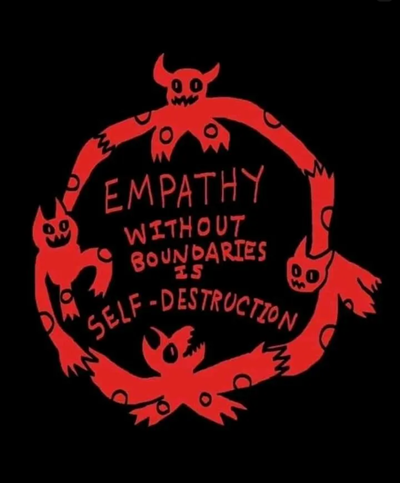
Empathy is a virtue many strive to demonstrate. But few will discuss its downsides. Why it is not universally good or useful. How it can be misdirected.
In some situations it is lethal. It can reflect a suicidal urge we now see in Western nations.
Much empathy in society is in fact sentimentality, which is dangerous. Sentimental ideas about mixing cultures, elevating poor performers through quotas, or tinkering with traditional gender roles have real world effects.
With such an emphasis on empathy, which many think of as niceness, we overlook the need for boundaries to maintain a functioning society.
This is the issue at the heart of much that is damaging us today.
Individual rights
We live in an era that champions individual rights to an almost autistic degree. This is a product of Western liberalism, which now seems to be entering its terminal phase as its effects ultimately destroy what made Western societies strong.
Since an individual’s rights trump everything we cannot easily enforce boundaries our ancestors could take for granted. Try challenging a gay pride parade or transgender material in schools on the grounds of public decency and the least you can expect is to lose your job.
Profound changes have happened just in the last few decades and all in the name of individual rights. The erosion of boundaries on behaviour is one of the most visible aspects of this.
Physical boundaries
The concept of boundaries is almost universal and spans everything from the mundane to the spiritual.
Most countries recognize the right to private property and inherent within this is the notion of boundaries. My car is mine and no one else’s, for example.
This is applied to our homes and gardens. These are ours and defendable from theft. Ultimately this in turn includes a neighbourhood or locale, even a region or state. All these things have visible boundaries that demarcate where they begin and end.
Most famously this applies to national borders, a traditional form of boundary in use for thousands of years. Failing to enforce this barrier is national suicide. The world is not like us and if it comes to us we will look like the world in return. Borders keep the barbarians out.
Everyone instinctively grasps these kinds of boundaries. We close our windows and have locks on our doors because of this understanding.
Using boundaries to exclude others feels natural.
Cultural boundaries
Less explicitly visible are cultural boundaries, often transmitted via tradition and convention. We have spent the last century attacking many of these as old fashioned, with little pause to consider why tradition emerges in the first place.
Marriage between men and women. Complementary gender roles. Sexual mores kept private. The sanctity of childhood, its innocence protected from intrusion.
As we removed constraints in the name of progress we destroyed much of the glue that held our societies together. We are now watching things unravel as people marry less and produce fewer children. We see widespread mental illness and anguish as the few basic certainties of life are destroyed in the name of progress.
People don’t know who or what they are when cultural boundaries are deleted. Women, men, natives, newcomers, the working class. Who are we really without some certainties in life?
Comments Off on Too much empathy can be more dangerous than too little
August 30, 2025
HBO’s Rome – Ep 9 “Utica” and Ep 10 “Triumph” – History and Story
Adrian Goldsworthy. Historian and Novelist
Published 26 Mar 2025This time we look at Episode 9, which begins with the aftermath of the Battle of Thapsus in 46 BC and also Episode 10 which focuses on Caesar’s Triumph — one rather than the four he celebrated over the course of several weeks in 46 BC. There is less history and more character-driven elements in these two episodes, so to make the video the same sort of length as the others in the series, I have combined the two.
00:00 Episode 9 “Utica”
19:48 Episode 10 “Triumph”
Comments Off on HBO’s Rome – Ep 9 “Utica” and Ep 10 “Triumph” – History and Story
August 24, 2025
QotD: Police culture
Cops form a culture all to themselves, like professional soldiers, and usually have little to do with those who are not cops. They do call us “civilians”. […] They also call us “assholes” and say that the public just consists of criminals who haven’t been caught yet. I know because I was there at one time.
Yeah, I understand the theory that they’re civilians, too. I repeat that it’s bullshit. What they are, in fact, is an occupying military force, with strategic bases in every hamlet in the nation — which is why they and their hangers-on lie to us and possibly to themselves about being civilians, too.
They are the very standing army that the Founding Fathers were afraid of.
L. Neil Smith, “Letter from L. Neil Smith” Libertarian Enterprise, 2005-05-01.
Comments Off on QotD: Police culture
August 21, 2025
Pure quill, 100% genuine Astroturf
You might almost think that Freddie deBoer isn’t a fan of pre-chewed, pre-digested “fandoms”:

brat summer was fake. That’s been my stance for a long while, and I’ve been encouraged recently to learn that I’m not alone in this belief — the belief that the whole Charli XCX “brat” phenomenon of 2024 was AstroTurf, a top-down media phenomenon driven fundamentally by marketing and the clicks-based media’s insatiable need for #content. There was clearly a carefully-coordinated rollout, with key pop culture websites and well-placed influencers shilling brat summer in suspiciously similar terms at the same exact time. And once the actual payola element was out there, once the PR apparatus had gotten the idea into the heads of early-middle-aged music and culture writers, those writers ran with it, in pursuit of the feeling of being out in front of a new craze and wanting to appear to be down with the kids. Someone told them brat was the new thing, they were filled with the FOMO anxiety that dictates their lives, and so they set about acting as though brat really was the new thing, faking it to make it.
This dynamic has been building for years now. The same basic Astroturf pattern was all over the “Barbiecore” moment. The movie itself was certainly popular and deserving of that popularity; it was fundamentally, existentially pretty good and frequently treated as much better than that, but it was still a fun and inventive story that was so much better than a movie based on a series of mass-produced plastic dolls had any right to be. But Barbiecore was fake. The Barbie discourse was fake. The idea that tweens were suddenly enraptured with the whole phenomenon, and particularly its confused brand of inoffensive feminism, was fake. There wasn’t some organic groundswell of pink-clad girl power erupting from the grassroots, but rather an omnipresent corporate campaign designed to manufacture the impression of inevitability. The movie itself was fine, sometimes clever, sometimes clumsy, good enough. But between the Mattel-driven branding blitz, the endless pink product tie-ins, and stunts like Ryan Gosling hamming it up at the Oscars, the film’s cultural footprint was artificially inflated. A popular movie was treated as a broader mass fandom movement that was in turn dressed up as a civilizational turning point, its supposed artistic influence dramatically overstated to serve commercial ends. In the end, Barbiecore didn’t demonstrate the power of art to shape culture so much as the ability of corporations to convince us that commerce is culture.
This is in fact the general condition of what’s now constantly sold as spontaneous collective vibes bubbling up out of TikTok comments and stan culture and the zeitgeist: prepackaged campaigns that combine paid marketing savvy with the cynical manipulation of our poptimism-obsessed cultural commentors, who are terrified of feeling left behind and always ready to buy into any new trend that’s sold as the obsession of the youth. There’s a press release behind every new trendspotting piece, a rollout schedule behind every claim of a new Gen Alpha aesthetic. There are people in glass towers in Manhattan and Los Angeles being paid six figures to decide what your summer will be, and then pretending that you, the amorphous online “fan,” actually decided it. It’s not the grassroots, it’s not organic, it’s not fun in the way subcultures used to be fun. It’s advertising.
Now, I’m a sad middle aged child of the 1990s who believes that selling out is real and bad and that authenticity is a fundamental and essential element of artistic creation and consumption; I believe in those widely-mocked old-school values, and I think my relationship to the art I create and consume is deepened because of that belief. But you don’t have to share my anachronistic artistic ethics to see why the death of organic pop culture appreciation matters. You just have to recognize that all of this ersatz fan enthusiasm creates a hollow kind of cultural participation. If every supposed craze is just a PR initiative with better branding, then what looks like bottom-up fandom is really just a slightly more insidious form of top-down messaging. You’re being asked to play along, to cosplay at authenticity, while the machine harvests your clicks and hashtags. Once again, the digital era’s ballyhooed capacity for citizen participation and “the long tail” has been crushed in favor of top-down control by giant corporations. The promise of the internet was that the gatekeepers would be dethroned, that cultural movements would erupt from the crowd. Instead, we’re living in a Potemkin village of virality where the audience is always the mark and the trick is always the same.
Comments Off on Pure quill, 100% genuine Astroturf
August 20, 2025
“All politics is local” … except when it isn’t
Lorenzo Warby on a recent study of the vast chasm between what European voters want in areas like crime and immigration and what their elected representatives want:
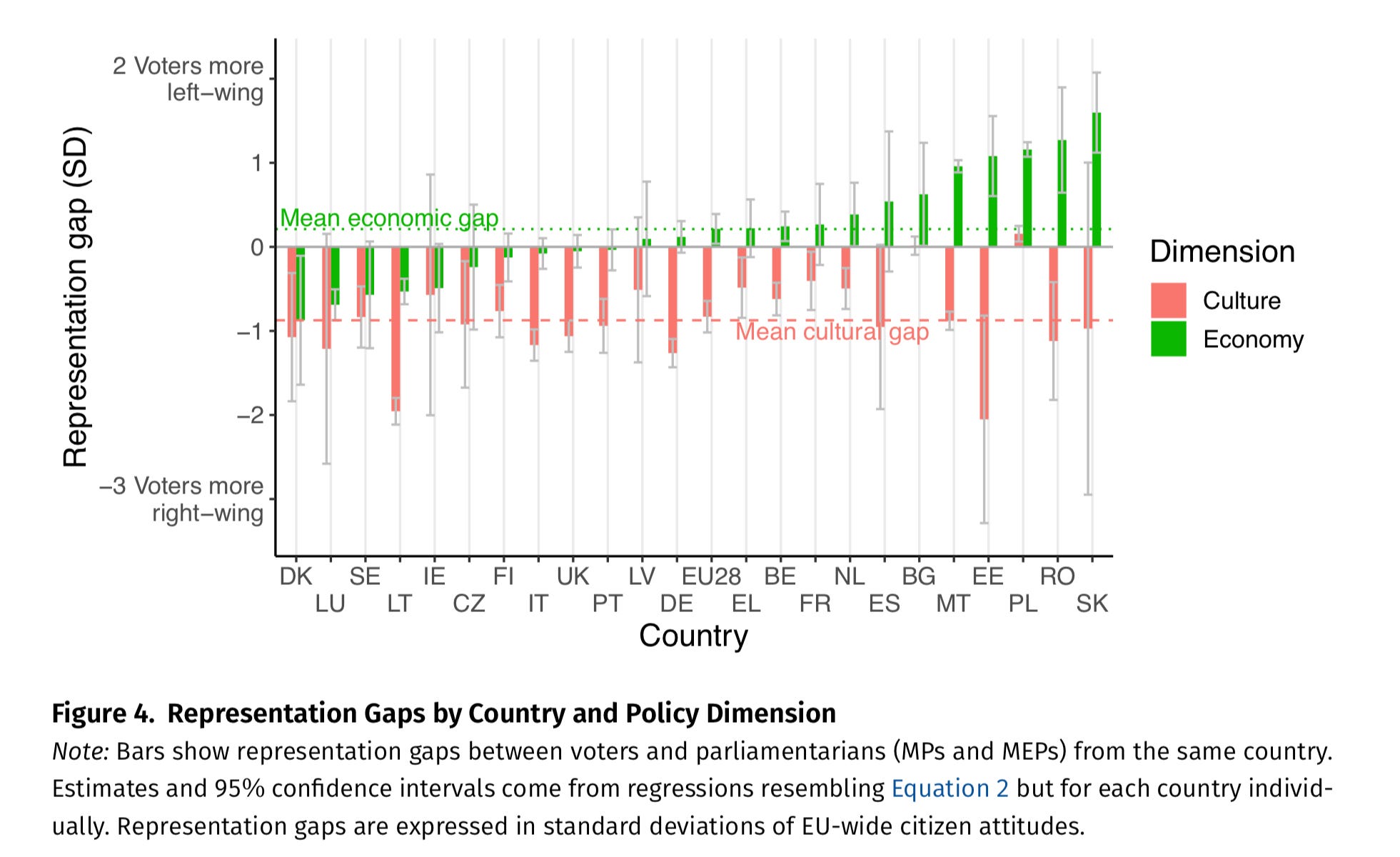
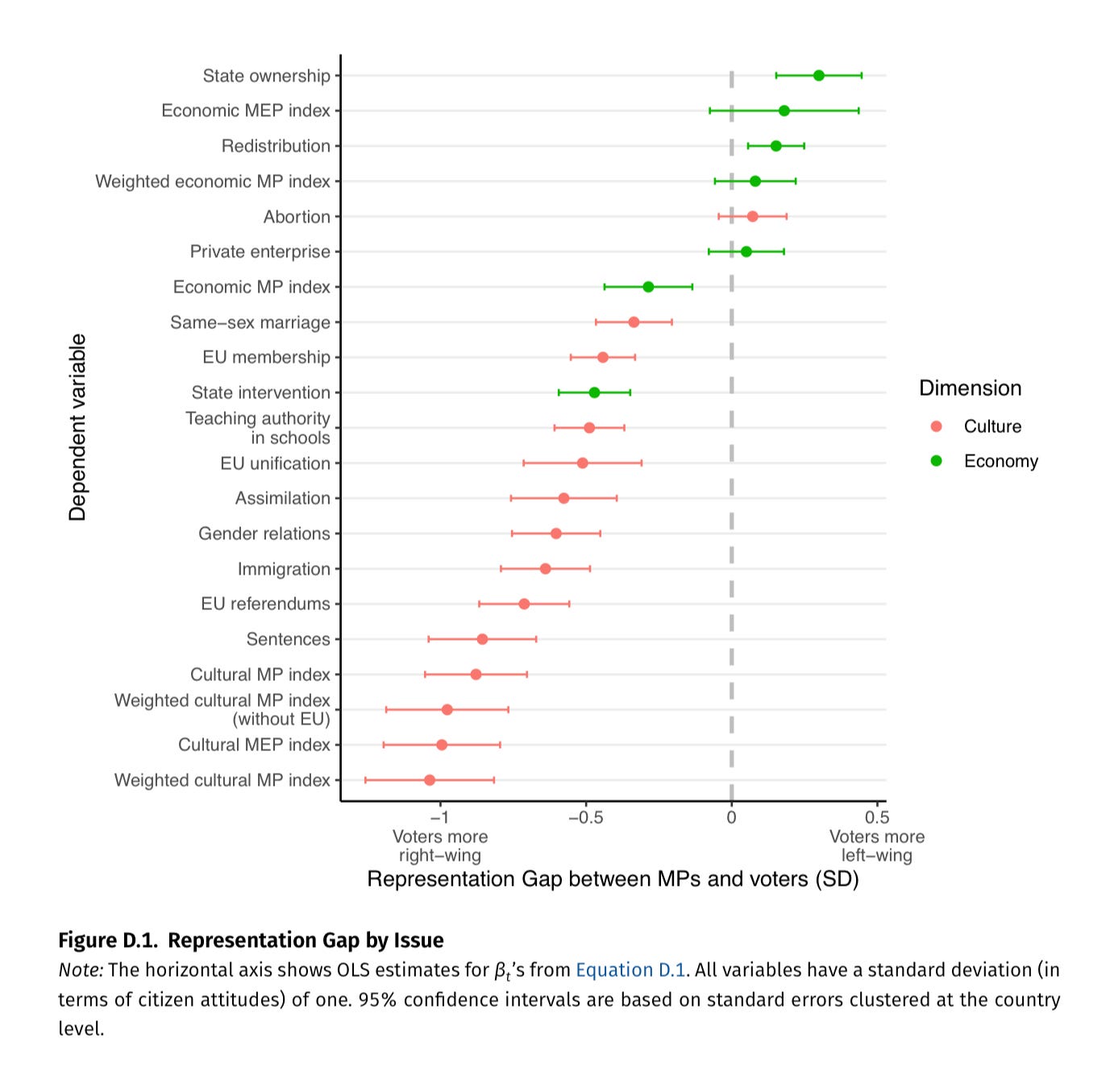
Economist Laurenz Guenther has performed the very useful exercise of quantifying how unrepresentative the views of European politicians are of their voters on cultural issues, such as crime and immigration. This is not true of economic issues, where the views of politicians tend to be quite representative of their voters.
In the case of economic issues, in some countries the politicians are more pro-market (“right”) then their voters, in others they are more dirigiste (“left”) than their voters, in others still they are very similar to their voters. There is simply no consistent pattern, and the average gap between voters and politicians across European countries on economic issues is fairly small.
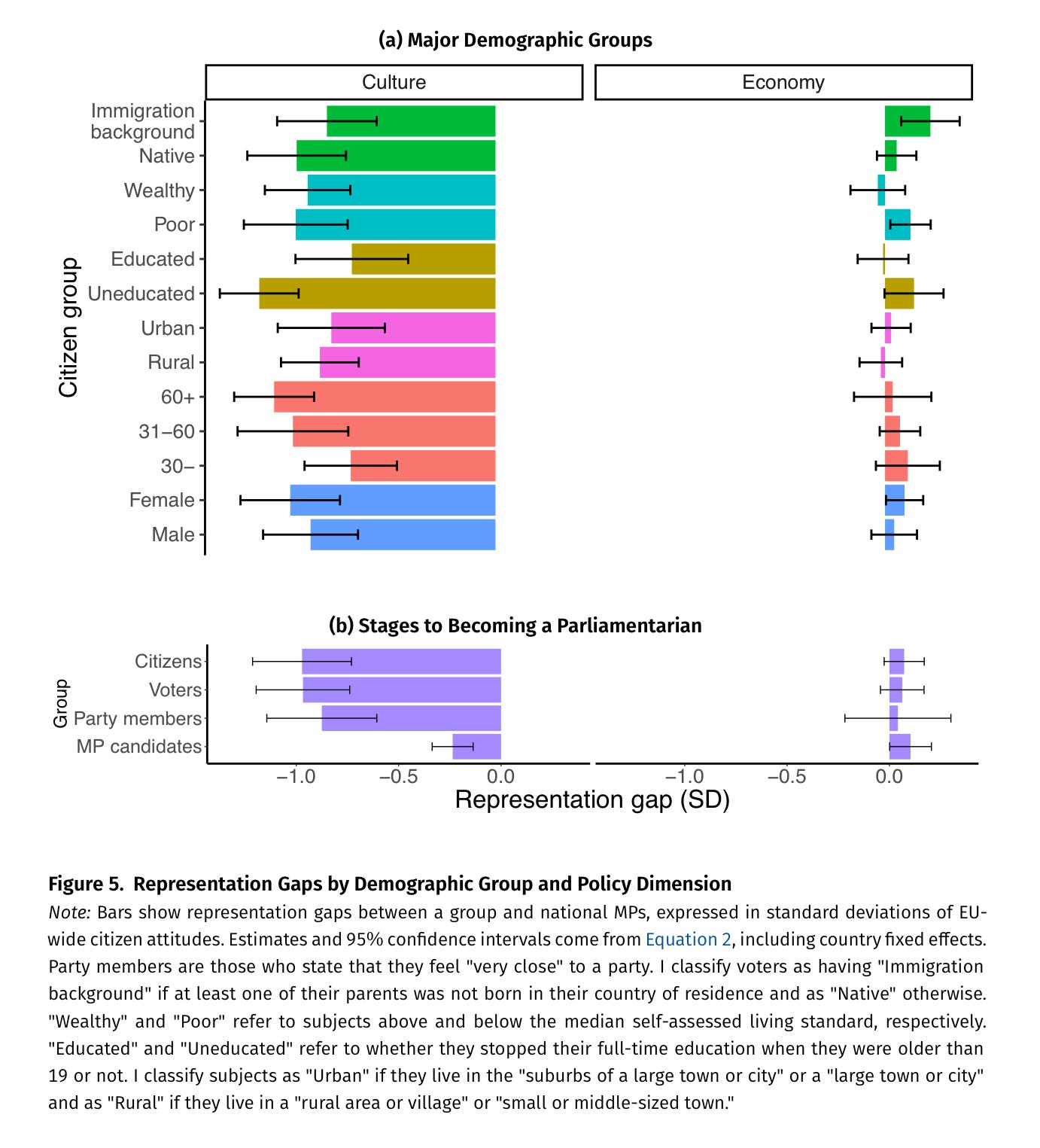
With cultural issues, such as crime and immigration, we get a very different pattern. There, politicians are consistently more socially liberal (“left”) than their voters and by a considerable margin. While education levels explain some of this difference, they do not explain very much, as politicians are significantly more socially liberal than even university-educated voters.
Moreover, politicians are unrepresentative even of their own Party members/base on cultural issues and, again, in being much more liberal than their core supporters. There is some factor or factors specific to being a contemporary politician that systematically separates them out from voters on cultural issues yet does not operate with economic issues.
Veteran politician Tip O’Neill famously said that all politics is local. This is particularly true of cultural issues such as crime and immigration, where the effects vary wildly by location. This is much less true of economic issues, which are much more economy-wide in their operation.
There are various features we can identify here. First, executive function(s) — including such features as patience (aka time horizon) — varies between people and is highly heritable. Localities that have lots of people with poor executive function operate very differently from those where it is very much normal for people to have strong executive function.
As the combination of physical robustness and weak executive function predicts criminal behaviour, this has a great deal to do with why crime varies so dramatically by locality. This is especially as crime is very much a power law phenomenon, where a small minority of (overwhelmingly) men commit the vast majority of violent crimes.
Source – Wikimedia Commons.
It also means that people who have spent their lives in social milieus full of people with high executive function can have little or no sense of what happens when one has to deal with weak executive function folk. This is the people unlike me problem that so bedevils contemporary politics and commentary.

Comments Off on “All politics is local” … except when it isn’t
August 17, 2025
QotD: The benefits of using auxilia units to the Roman Empire
The most obvious of these is manpower. Especially with a long-service professional army, capable and qualified recruits are in limited supply. The size of the Roman army during the imperial period ranged from around 300,000 to around 500,000, but in 14 AD (the year of Augustus‘ death) there were only 4,937,000 Roman citizens (Res Gestae 8.11), a figure which probably (a word I am using to gloss over one of the most technical and complex arguments in the field) includes women and children. Needless to say, keeping something close to a fifth of the adult male citizen population under arms continually, forever was simply never going to be feasible. After his victory in 31 BC at Actium, Octavian (soon to be Augustus) had acted quickly to pare down the legions, disbanding some, merging others, until he reached a strength of just 28 (25 after the three legions lost in 9 AD were not replaced). It was a necessary move, as the massive armies that had been raised during the fever-pitch climax of the civil wars simply could not be kept under arms indefinitely, nor could a short-term service conscript army be expected to garrison the hundreds of miles of Roman limes (“frontier, border”) in perpetuity.
Harnessing the manpower of the provinces was simply the necessary solution – so necessary that almost every empire does it. By their very nature, empires consist of a core which rules over a much larger subject region, typically with far greater population; securing all of that territory almost always requires larger forces than the core’s population is able or willing to provide, leading to the recruitment of auxiliaries of all kinds. But whereas many imperial auxiliaries, as noted above, turn out to be potential dangers or weaknesses, Rome’s auxilia seem to have been fairly robustly “bought in” on the system, allowing Rome to access motivated, loyal, cohesive and highly effective manpower, quite literally doubling the amount of military force at their disposal. Which in turn mattered a great deal because the combat role of the auxilia was significant, in stark contrast to many other imperial armies which might use auxiliaries only in subsidiary roles.
The auxilia also served to supply many of the combat arms the Romans themselves weren’t particularly good at. The Romans had always performed very well as heavy infantry and combat engineers, but only passably as light infantry and truly poorly as shock cavalry; they generally hadn’t deployed meaningful numbers of their own missile cavalry or archers at all. We’ve already talked a lot about how social institutions and civilian culture can be important foundational elements for certain kinds of warfare, and this is no less true with the Romans. But by recruiting from subject peoples whose societies did value and practice the kinds of warfare the Romans were, frankly, bad at, the Roman skill-set could be diversified. And early on, this is exactly what we see the auxilia being used for (along with also providing supplemental heavy infantry), with sagitarii (archers), funditores (slingers), exploratores (scouts) and cavalry (light, heavy and missile), giving the Romans access to a combined arms fighting force with considerable flexibility. And the system clearly works – even accounting for exaggerated victories, it is clear that Roman armies, stretched over so long a frontier, were both routinely outnumbered but also routinely victorious anyway.
As Ian Haynes notes, the ethnic distinctiveness of various auxilia units does not seem to have lasted forever, though in some cases distinctive dress, equipment and fighting styles lasted longer. Most auxilia were posted far from their regions of origin and their units couldn’t rely on access to recruits from their “homeland” to sustain their numbers over the long haul (although some number of recruits would almost certainly come from the military families of veterans settled near the forts). But that didn’t mean the loss of the expertise and distinctive fighting styles of the auxilia. Rather skills, weapons and systems which worked tended to get diffused through the Roman army (particularly in the auxilia, but it is hard not to notice that eventually the spatha replaces the gladius as the sword of the legions). As Ovid quips, Fas est et ab hoste doceri, “It is right to learn, even from the enemy” (Met. 4.428); the Romans do that a lot. The long-service professional nature of these units presumably made a lot of this possible, with individual cohortes and alae becoming their own pockets of living tradition in the practice of various kinds of fighting and acclimating new recruits to it. Consequently, not only did the Roman army get access to these fighting-styles, because the auxilia were actually integrated into the military system rather than merely attached to it, they also got the opportunity to adopt or imitate the elements of the fighting styles that worked.
Finally, the auxilia system also minted new Romans. We’ve already mentioned that auxilia veterans received Roman citizenship on retirement, but that wasn’t the extent of it. We can see in inscriptions that the degree of cultural fluency that soldiers in the auxilia gained with Roman culture was high; they often adopted Roman or Romanized names and seem to have basically always learned Latin (presumably because their Roman officers wouldn’t have spoken their language). While some units of the auxilia kept distinctive national dress as a sort of uniform, most of the auxilia seem to have adopted a style of dress that, while distinct from the legions, was generally in keeping with the Roman tradition of military dress (which was not quite the same as Roman civilian dress). They also partook of the Roman military diet (Roman soldiers kept a similar diet all over the empire, even if that meant shipping thousands of amphora of olive-oil and sour wine to northern England) which would have given them a diet in common with many work-a-day Romans too. Once retired, auxilia soldiers tended to settle where they served (rather than returning to their “home” provinces), which meant settling in frontier provinces where their citizenship set them apart as distinctively Roman, wherever they may have come from.
Exactly how many auxilia would have retired like this requires a degree of number crunching. Given a 20-year tour of service and zero mortality, we might expect around 7,500 men to pass through the auxilia each year. But of course, mortality wasn’t zero and so we have to expect that of our c. 20-year-old recruits, some number are going to die before retirement. Using some model life tables (following B. Frier, “Demography” in CAH^2 XI (2000)), we should figure that very roughly one third of our recruits will have died before reaching discharge. We then we need to adjust our recruitment figures to retain the same total strength and we get something like 9,000 new recruits each year to keep a strength of c. 150,000 with mortality counted for and 20 year tours. That gives us roughly 6,000 auxilia living to retirement each year. That may seem a small number, but that gradual accretion matters when it runs for decades and centuries and the newly enfranchised family units (recall that the citizenship grant covers children and sort-of-kind-of his spouse1) tend to settle on the frontiers, which is a really handy place to have communities of citizens. If we assume that these new citizen families mostly reproduced themselves (or more correctly that they went extinct or split with multiple children at roughly the same rate with no natural population growth), then we’d expect this process to produce perhaps something like 1.5 million new citizen households up until the Constitutio Antoniniana. Being very back of the envelope then, we might – once we account for women and children descendants of those soldiers – assume that on the eve of the general grant of citizenship in 212, there were perhaps 4 million Romans whose citizenship status was a product of service in the auxilia somewhere in their history; perhaps representing something like 7% of the entire population (including non-free persons). Were we to assume larger households (which seems wise, given that retired auxiliaries are probably more likely than average to be in an economic position to have a larger family), that figure would be even higher.
That is a very meaningful number of new Romans. And those figures don’t account for some of the other ways Roman citizenship tended to expand through communities both through manumission but also the political networks citizenship created (your Latin-speaking former-auxiliary citizen neighbors are a lot more likely to be able to help intercede to get you citizenship or get your community recognized as a municipia with that attendant citizenship grant). And not only are those new Romans by legal status, but new Romans who have, by dint of military training and discipline, absorbed quite a lot of Roman culture. As best we can tell, they tended to view the Roman Empire as their polity, rather than as a foreign or oppressive entity. They were “bought in” as it were. Again, this does not seem to have been the Roman intent, but rather an opportunistic, self-serving response to the need to maintain the loyalty of these troops; citizenship was, after all, a free benefit the emperor might bestow at no cost to the treasury (since citizens who lived outside of Italy still owed taxes) or himself.
Of course that fits the auxilia in to a later pattern in the provinces which becomes perhaps most apparent as the Roman Empire begins to collapse …
Bret Devereaux, “Collections: The Queen’s Latin or Who Were the Romans, Part V: Saving and Losing and Empire”, A Collection of Unmitigated Pedantry, 2021-07-30.
- Note on the coverage of the spouse. The grant of citizenship covered any biological children of the discharged auxiliary but did not extend citizenship to his wife. It did however, give an auxiliary the right to contract a lawful marriage with effectively any free woman, including non-citizens and the children resulting from such a union would be citizens themselves. Consequently, it extended one of the core privileges of citizenship to the non-citizen wife of a discharged auxiliary: the right to bear citizen children. Since the wife would be part of the retired auxiliary’s household (and then later, if he predeceased her, potentially in the household of her male citizen children) she’d be legally covered in many cases because a legal action against her would generally be an action against her husband/child. Given that a number of the rights of citizens simply didn’t apply to women in the Roman world (e.g. office holding), this system left the wife of a retired auxiliary with many, but not all, of the privileges of citizenship, so long as her husband and her marriage survived. That said, the legal status remained vested in her husband or her children, which made it more than a little precarious. One of these days, we can talk more about the structure of the Roman familia.
Comments Off on QotD: The benefits of using auxilia units to the Roman Empire
August 13, 2025
The Dispossessed: State Happens
Feral Historian
Published 21 Mar 2025Ursula K. le Guin’s The Dispossessed is one of the most in-depth examinations of how a large anarchist society might function, addressing both the problems it solves and those it creates for itself. It’s a must-read for anyone interested in the communist-leaning variants of anarchism in particular.
00:00 Intro
01:58 Anarres is not an Island
04:45 Shevek goes to Urras
07:00 Abolition of Property
08:30 Social Pressures and Pravic
12:30 Necessity and Ossification
14:45 Necessity of Conflict
15:45 Shevek’s Wild RideThis video is in part a companion to this one — Cloak of Anarchy : Gradations of Stat… from a few weeks ago. The original cut of that one had a brief mention of a couple details from The Dispossessed, but it really needed its own video.
Comments Off on The Dispossessed: State Happens
August 11, 2025
Smug Canadian boomer autohagiography rightly antagonizes the under-35s
Fortissax had an argument with one of his readers over a smug, self-congratulating meme about how wonderful Canada was in the 1990s and early 2000s:

What we lived through long before Trudeau was the Shattering, the breakdown of Canada’s social cohesion, driven by left-liberalism with communist characteristics applied to race, ethnicity, sex, and gender, and punitive almost exclusively toward visibly White men. My generation, those millennials born on the cusp of Gen Z, saw post-national Canada take shape not in the comfortable suburban rings of the GTA or the posh boroughs of Outremont and Westmount, but in self-segregated, ghettoised enclaves of immigrants whose parents never integrated and were never required to.
Memes like that are dishonest because they feed a false memory. The 2000s were not normal. Wages were stagnant, housing was already an asset bubble, and immigration was still flooding in under a policy that explicitly forbade assimilation. Brian Mulroney had enshrined multiculturalism into law in 1988. Quebec alone resisted, carving out the right to limit immigration under the 1992 Quebec–Canada Accord. After Chrétien, Stephen Harper brought in three million immigrants, primarily from China, India, and the Philippines in that order.
The Don Cherry conservatives of that era were Bush lite. They were rootless, cut off from their history, their identities manufactured from the top down since the days of Lester B. Pearson. They conserved nothing. For Canadian youth, it was the dawn of a civic religion of wokeness, totalitarian self-policing by striver peers, and the quiet coercion of every institution. My memories of that decade are of constant assault — mental, physical, spiritual — from leftists in power, from encroaching foreigners, and from the cowardice of conservatives.
Your 2000s might have been great. For us, they were communist struggle sessions. In 2009 we were pulled from class to watch the inauguration of Barack Obama, a foreign president, as a historic moment for civil rights. Our schools excluded us while granting space to every group under the sun: LGBT safe spaces and cultural clubs for Italians, Jamaicans, Jews, Indians, Indigenous, Balkaners, Greeks, Slavs, Portuguese, Quebecois, Iroquois, Pakistanis — every culture celebrated except our own. Anglo-Quebecers and Anglo-Canadians got nothing but an Irish club, closely monitored for “white supremacy” and “racism” by the HR grandmas of the gyno-gerontocracy of English Montreal. Students self-segregated, sitting at different cafeteria tables and smoking at different bus shelters. At Vanier, Dawson, and John Abbott College, these divisions were institutionalised. I remember walking into the atrium of Dawson, my first post-secondary experience, greeted by a wigger rolling a joint while a Jamaican beatboxed to Soulja Boy.
We became amateur anthropologists out of necessity, forced to navigate a nationwide cosmopolitan experiment from birth. We learned the distinctions between squabbling southeastern Europeans of the former Yugoslavia, and we did not care if Kosovo was Serbia or whether Romanians and Albanians were Slavic, they all acted the same way. We learned the divides within South Asia, the rivalries between Hindutva and Khalistani, the differences between a Punjabi, a Gujarati, a Telugu, a Pakistani, a Hong Konger, a mainlander, and a Taiwanese. We know the shades of Caribbean identity, the factions of the Middle East, and the intricacies of North African identity. We should never have needed to know these things, but we do.
For us, childhood in this cesspit was the seedbed of radicalism. We never knew an era when contact with foreigners was limited to sampling food at Loblaws. All we know is being surrounded by those who hate us, governed by a state that wants to erase us, with no healthcare, no homes, no jobs that are not contested by foreigners, and no money to start families.
Comments Off on Smug Canadian boomer autohagiography rightly antagonizes the under-35s
August 3, 2025
QotD: Undermining cultural taboos
One side of the debate argues that the only way to break a taboo is to break a taboo, so the only way forward to is to talk frankly about these things. In the case of crime, for example, the dissident must always interject the demographic facts about crime into the debate, even if it makes the beautiful people shriek. Since most people know the facts, the shrieking by the beautiful people actually advances the cause. This line of reasoning is extended to all taboo subjects universally.
The other side of the debate points out that the taboo breakers always end up in exile or condemned to some ghetto. In fact, their deliberate breaking of taboos ends up reinforcing the taboo, as no one wants to end up like the heretics. Instead, this camp argues the dissident must come up with clever language that subtly mocks the taboos, but narrowly adheres to the rules. The recent use of the word “jogger” is an example of complying with the taboo, while undermining it.
The taboo breakers counter that this just results in an endless search for approved language to hint at unapproved things. It is just a form of self-deception, where the clever think they are in revolt when in reality they are just asking permission. The optics guys counter this by pointing out the obvious. The taboo breakers are removed from the process, so in reality their tactic is just quitting the game. Rather than take on the system in a meaningful way, they mutter epithets in their ghetto.
The Z Man, “Strategy, Tactics & Discipline”, The Z Blog, 2020-05-19.
Comments Off on QotD: Undermining cultural taboos


