In their insistence on judging the value of a work of art principally in terms of its moral qualities, the publishers of today are heirs to a tradition of puritanism going back to Plato. But there has long been an anti-puritanical argument available too, the most notorious of them being the one articulated by Oscar Wilde: that to assess art in moral terms is to commit some sort of category mistake. “There is no such thing as a moral or an immoral book. Books are well-written, or badly written. That is all.” But that argument was never very persuasive by itself, and contains a large non sequitur. Why should that be “all”? Why can’t it be that part of what we’re saying in calling a book well-written is that it is morally exemplary? Surely it is those who call on us to leave our moral values at the door who have some explaining to do.
George MacDonald Fraser himself sometimes seemed to take Wilde’s view of the matter. He zealously repudiated, in his non-fiction, all attempts to defend his fiction as covertly anti-colonial, taking great pleasure in mocking critics who “hailed it as a scathing attack on British imperialism”. Was he “taking revenge on the 19th century on behalf of the 20th”? “Waging war on Victorian hypocrisy”? Were the books, as one religious journal was supposed to have claimed, “the work of a sensitive moralist” highly relevant to “the study of ethics”? No, he said, The Flashman Papers were to be taken “at face value, as an adventure story dressed up as the memoirs of an unrepentant old cad”.
Is Fraser’s avowed amoralism the whole story? In one respect, the Flashman books are certainly amoral: they embody no systematic view that colonialism was wrong, illegitimate, unjust. (Nor, come to it, do they embody the view that it was right, legitimate and just.) As Fraser appears to see it in his fiction, empire was simply the default mode of political life in much of the world. This indeed was the case for much of human history. To be colonised was generally a misfortune for the colonised, but the individual coloniser was neither hero nor villain, just a self-interested actor acting on what he believed to be the necessities of his time and place.
We live in a world where we are constantly exercised by the problem of complicity. We wonder: am I complicit in climate change because I just put on the washing machine? In a sufficiently inclusive sense of the word “complicit”, of course I am: one of countless agents whose everyday actions add a tiny bit more carbon to the atmosphere. But outside an ethics seminar, what I’d tell you is that I was just doing my laundry because the clothes were beginning to stink.
Fraser was a deft enough writer to force his characters to confront the larger, what we today might call “structural” questions, in terms that belong to their own times, not to ours. At a pivotal moment in Flash for Freedom, Flashman is enslaved himself in America. Thrown into a cart with a charismatic slave called Cassy, he gets to hear her relish the irony of his position: “Well, now one of you knows what it feels like … Now you know what a filthy race you belong to.” Is there any hope of escape, he asks her desperately. None, she replies, “there isn’t any hope. Where can you run to, in this vile country? This land of freedom! With slave-catchers everywhere, and dogs, and whipping-houses, and laws that say I’m no better than a beast in a sty!” Flashman has the grace to be silent; what can he say?
Nikhil Krishnan, “Harry Flashman’s imperial morality”, UnHerd, 2022-12-26.
April 5, 2023
QotD: Harry Flashman’s adventures were not intended as “covert anticolonialism”
March 20, 2023
“The New American Empire lasted, at most, twenty years, if one counts the two falls of Kabul as brackets”
Ed West on the brief — and largely unacknowledged by Americans — high-water mark of the 21st century’s biggest empire:
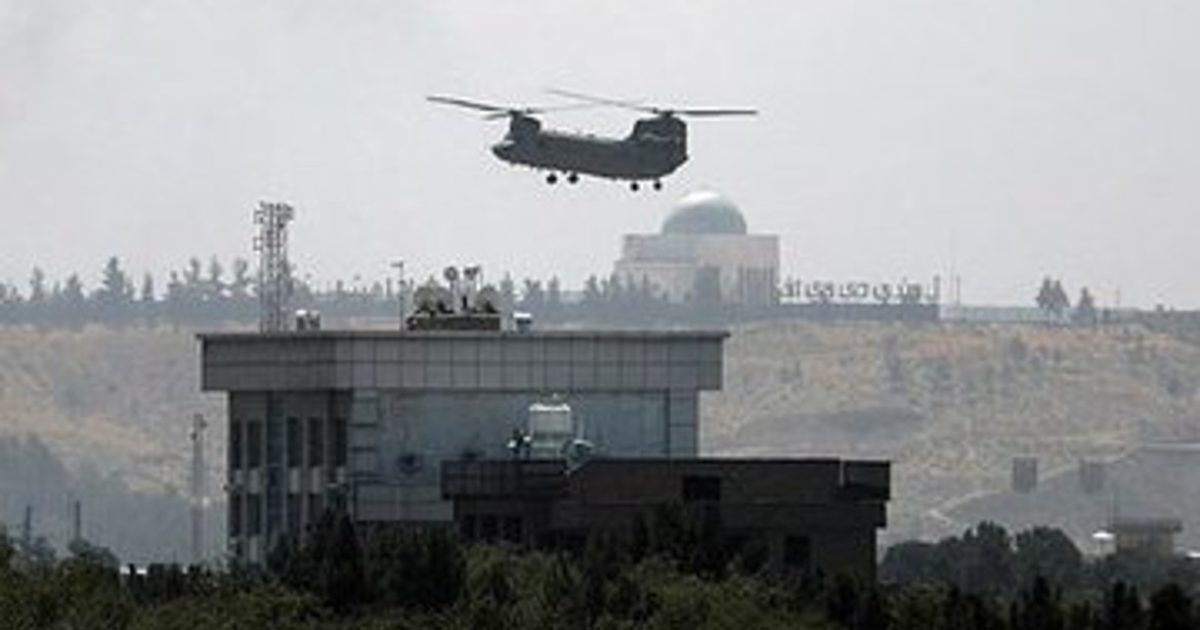
A Boeing CH-47 Chinook transport helicopter appears over the U.S. embassy compound in Kabul, 15 Aug 2021. Image from Twitter via libertyunyielding.com
This century has already seen its fair share of great delusions, society-changing disasters built on wishful thinking: you can loan mortgages to people who obviously can’t pay them back; you can cure pain with an opiate that won’t make people addicted; and now the unstoppable idea of equality of outcomes between races, a project doomed to failure and tragedy.
But none was perhaps so spectacularly disastrous as liberal imperialism. Twenty years ago, George W Bush sent the most powerful military the world had ever seen into the birthplace of Abraham to overthrow Saddam Hussein, and as Niall Ferguson wrote in the Wall Street Journal at the time: “the greatest empire of the modern times has come into existence without the American people even noticing”.
The New American Empire lasted, at most, twenty years, if one counts the two falls of Kabul as brackets. This was despite enormous technological supremacy, and genuine goodwill and benevolence among many of the state-builders.
The United States was “born liberal”, as historian Louis Hartz said, even if the crime wave of the late 20th century made that a dirty word, and the “New American Empire” would spread the benefits of liberalism to grateful beneficiaries around the world.
Yet what is so striking about the imperialists of the 21st century, compared to their forebears in the 19th, was just how little interest they seemed to show in the subject people. Their naivety about human nature, and their utopian belief that people around the world just wanted “freedom”, chimed with a lack of curiosity about humanity.
To think that people around the world might not be the same, that they might not want “freedom” nor have the social structure or culture that suited democracy, might be to venture into dangerous territory. To suggest that Iraq was incapable of democracy was insulting to Iraqis, since as the US president said ahead of the war: “There was a time when many said that the cultures of Japan and Germany were incapable of sustaining democratic values. Well, they were wrong. Some say the same of Iraq today. They are mistaken.”
Yet the defeated nations in 1945 had very old, well-established institutions and very strong national identities, something Iraq did not. The latter was extremely clannish, something no one seemed to consider. Sovereignty and strong institutions take generations to build, and cannot just be imposed by foreigners working on abstract principles like “democracy”.
Bush was not alone. That same year, John McCain had said: “There is not a history of clashes that are violent between Sunnis and Shias, so I think they can probably get along”. And on March 1, 2003, two weeks before the war started, Bill Kristol, editor of the Weekly Standard, had dismissed warnings about sectarian conflict: “We talk here about Shiites and Sunnis as if they’ve never lived together. Most Arab countries have Shiites and Sunnis, and a lot of them live perfectly well together.” On top of that, “Very few wars in American history were prepared better or more thoroughly than this one by this president.” He was totally wrong, while in contrast the American Conservative‘s pessimistic warnings about Iraq’s social fabric proved correct.
March 15, 2023
Mining the moon would be “harmful” to indigenous people, say activists
Among the many, many things that are said to be harmful to indigenous culture we’re now told to include any kind of Lunar exploitation as modern colonialism:

Artist’s conception of Helium-3 mining on the surface of the Moon.
Image from Inhabitat.com
Humans have boldly ventured beyond the Earth into space for more than half a century now. It’s a testament to the ambition of the modern world.
And today, humanity is still more ambitious. A new space race is underway between the US and China to mine the Moon for rare metals. NASA is even hoping to establish a long-term presence on the Moon and eventually send humans to Mars.
But it seems that some scientists-cum-activists, in hock to identity politics, want to rein in that ambition. Speaking ahead of a US conference on the ethics of space exploration, held by the American Association for the Advancement of Science (AAAS) last week, astrobiologist Dr Pamela Conrad told the Guardian that space exploration, particularly efforts to mine the Moon, is in danger of becoming an exercise in “colonialism” and “exploitation”. Conrad warned that “if something that’s not here [on Earth] is seen as a resource, just ripe to be exploited, then that [perpetuates] colonialism”.
Conrad’s fellow panellist at the conference, Dr Hilding Neilson, went even further. According to Neilson, a member of the Native American Mi’kmaq people, indigenous people have a deep connection with celestial bodies like the Moon. They therefore have a more profound and, by implication, superior “way of knowing” the Moon compared with those advocating space exploration. The latter merely see the Moon “as a dead object to be conquered”, Neilson says – meaning that those advocating space exploration are “essentially cheering on the history of colonialism”.
There are so many problems with this argument it’s difficult to know where to start. Both Conrad and Neilson appear to be using the specific and brutal practice of “colonialism” to describe – and demonise – humanity’s attempt to master nature in general. That’s a flawed enough approach to take to the history of our growing mastery of nature on Earth. But it’s even more flawed in the context of space.
After all, there’s one big difference between laying claim to the resources of other countries under colonialism and attempting to mine the Moon – nobody lives on the Moon! So no one would be “exploited” or “colonised” if humans were to mine it. Space exploration is therefore not the same as colonialism.
March 5, 2023
The clear drawbacks of depending too much on oral history
In The Line, Jen Gerson explains why you need to exercise caution when dealing with oral traditions:
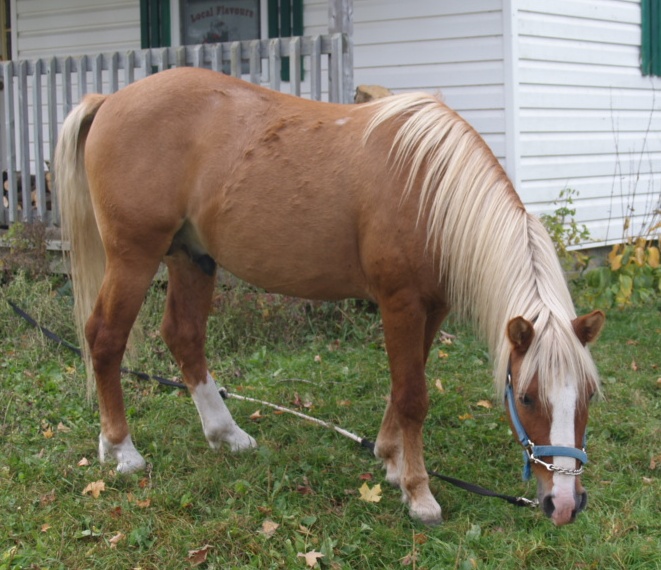
Lac La Croix Indian Pony stallion – Mooke (Ojibway for – he comes forth), October 2008.
Photo by Llcips09 via Wikimedia Commons.
A BBC travel feature published several weeks ago had the hallmarks of a classic progressive narrative. It was the tale of the “endangered Ojibwe spirit horse; the breed, also known as the Lac La Croix Indian pony, is the only known indigenous horse breed in Canada.”
The spirit horse was reduced to near extinction by European settlers who treat these magical creatures, deemed “guides and teachers”, as a mere nuisance to be culled and eliminated in favour of more profitable animals like cattle, or so the telling goes. A native breed of a beloved animal struggling to survive in the face of voracious colonial settlers.
Someone call James Cameron.
Unless you know a little evolutionary history, that is. In which case, you will already be aware that this story is pure pseudoscientific hokum.
Look, no one likes to be disrespectful about sensitive matters where the legitimately oppressed and aggrieved claims of First Nations peoples are concerned. This is a nation that is struggling to come to terms with its own horrific colonial past. This process is taking on many forms: witness the applause granted to singer Jully Black, who recently amended the national anthem “our home on native land”. Or, perhaps, the calls by one NDP MP to combat residential school denialism by passing new laws on hate speech — which would make questioning certain narratives not only an act of heresy, but also a literal crime.
Listening to stories, and respecting lived experiences and oral histories Indigenous people at the core of Canadian history and identity has given a new credibility to the traditional knowledge of First Nations people in academia, media, and in society at large.
But the story of the Ojibwe spirit horse is a clear example of the limits of oral history.
The horses now roaming the plains of North America are not a native species. The horse did evolve on this continent before migrating to Asia and Europe. However, the North American breed is believed to have been extirpated about 10,000 years ago (or thereabouts) during a mass extinction event that wiped out almost all large land mammals.
There is some evidence that isolated pockets of a native horse breed may have survived in North America much later than this, but the horses roaming about today are descended from those that were brought from Europe after the 15th century.
Of course, science is always evolving, but the overwhelming bulk of genetic and archeological evidence to date supports this theory. The native North American horse is long, long gone. The bands of horses freely wandering the backcountry are not wild, but feral; they’re the product of escaped or abandoned horse stock of distant European origin.
March 4, 2023
Nigel Biggar’s Colonialism: A Moral Reckoning
In The Critic, Robert Lyman reviews a recent book offering a rather more nuanced view of the British empire:
The book is a careful analysis of empire from an ethical perspective, examining a set of moral questions. This includes whether the British Empire was driven by lust or greed; whether it was racist and condoned, supported or encouraged slavery; whether it was based on the conquest of land; whether it entailed genocide and or economic exploitation; whether its lack of democracy made it illegitimate; and whether it was intrinsically or systemically violent.
Biggar’s proposition is simple: that we look at Britain’s history without assuming the zero-sum position that imperialism and colonialism were inherently bad, that motives and agency need to be considered and that good did flow from bad, as well as bad from good.
Whether he succeeds depends on the reader’s willingness to appreciate these moral or ethical propositions, and to re-evaluate accordingly. In my view, he has mounted a coolly dispassionate defence of his proposition, challenging the hysteria of those who suggest that the British Empire was the apotheosis of evil. Biggar’s calm dissection of these inflated claims allows us to see that they say much more about the motivations, assumptions and political ideologies of those who hold these views than they do about what history presents to us as the realities of a morally imperfect past.
He reminds us that British imperialism had no single wellspring. Most of us can easily dismiss the notion that it was a product of an aggressive, buccaneering state keen to enrich itself at the expense of peoples less able to defend themselves. Equally, it is untrue that economic motives drove all imperialist or colonial endeavour, or that economics (business, trade and commerce) was the primary force sustaining the colonial regimes that followed.
As Biggar asserts, both imperialism and colonialism were driven from different motivations at different times. Each ran different journeys, with different outcomes depending on circumstances. The assertion that there is a single defining imperative for each instance of imperial initiative or colonial endeavour simply does not accord with the facts.
Whilst other issues played a part, it was social, religious and political motives which drove the colonial endeavour in the New World from the 1620s: security and religion drove the subjugation of Catholic (and therefore Royalist) Ireland in the 1650s; social and administrative factors led to the settlement in Australia from 1788; and social and religious imperatives drove the colonisation of New Zealand in the 1840s.
In circumstances where trade and the security of trade was the primary motive for imperialism — think of Clive in the 1750s, for example — a wide variety of outcomes ensued. Some occurred as a natural consequence of imperialism. In India, Clive’s defeat of the Nawab Siraj-ud-Daulah in 1757 was in support of a palace coup that put Siraj’s uncle Mir Jafar on the throne of Bengal, thus allowing the East India Company the favoured trading status that Siraj had previously rejected.
This led in time to the Company taking over the administrative functions of the Bengal state (zamindars collected both rents for themselves and taxes for the government). Seeking to protect its new prerogatives, it provided security from both internal (civil disorder and lawlessness) and external threats (the Mahratta raiders, for example). The incremental, almost accidental, accrual of power that began in the early 1600s stepped into colonial administration 150 years later, leading to the transfer of power across a swathe of the sub-continent to the British Crown in 1858.
Biggar’s argument is that, running in parallel with this expansion came a host of other consequences, not all of which can be judged “bad”. We may not like what prompted the colonial enterprise at the outset (not all of which was morally contentious, such as the need to trade), but we cannot deny that good things, as well as bad, followed thereafter.
February 25, 2023
Rise of Franco – The Spanish Rif War 1921-1926
The Great War
Published 24 Feb 2023The Rif War between Spain and the Rif Republic gave rise to a young Spanish officer named Francisco Franco — who later would become Spanish dictator. After Spain had almost lost the war against the Rifi people, they got help from France and WW1 hero Philippe Pétain.
(more…)
January 14, 2023
Colonial History on the Mississippi River
Scenic Routes to the Past
Published 13 Jan 2023This video explores the surprising traces of French and American colonial history along the 150 miles of Mississippi River between St. Louis and Cairo, Illinois.
(more…)
December 12, 2022
The British Empire(s)
At Spiked, James Heartfield discusses the changing attitudes toward British imperial history:
Renewed interest in the history of the British Empire has generated a great amount of fascinating research and reflection. Over the past decade or more, there have been many books written about the empire – popular, academic, polemical and picaresque. There has been Akala’s Natives, William Dalrymple’s The Anarchy, Shashi Tharoor’s Inglorious Empire and Caroline Elkins’ Legacy of Violence, to name just a few.
Today’s approach to the British Empire is invariably critical – often stridently so. It marks a change to the attitude widely held half a century ago, when books on the empire tended to be elegiac farewells, like Paul Scott’s novel, The Jewel in the Crown, or Jan Morris’s Pax Britannica. Today’s critical approach to the empire is certainly a far cry from that which prevailed for a brief moment around the time that Margaret Thatcher was taking back the Falkland Islands. Back then, there was even an attempt at the moral rehabilitation of the empire.
[…]
But there are downsides to the self-excoriating criticism of Britain’s past. Often this approach to history turns into a debilitating exercise in self-loathing, an act of guilt-mongering. Many others have pointed out the limitations of this kind of morbid raking over the coals. But what is just as worrying is that the more we posture over Britain’s colonial past, the less we seem to understand it.
The moralistic framework in which we teach and discuss colonial history reduces our understanding to a single note of complaint. Hence, many historians today now write as if they have to make a case against the empire. This is just kicking at an open door. The empire has very few champions today. And the great British public is certainly not nostalgic for its return, despite some commentators arguing otherwise. Indeed, an ever growing majority think that the empire was a bad thing.
There is another problem with this approach to Britain’s colonial past. It situates readers outside of history. It encourages them to adopt a moralistic rather than historical approach to colonialism. They can do little more than judge the empire as evil. And in doing so, it flattens out the different periods of the colonial project into one long uniform timeline of subjugation. Collapsing distinct periods and stages together leads to a great confusion. For instance, in many accounts, there appears to be little difference between 18th-century British colonialism, which was dominated by slave trading, and the British colonialism of the late 19th century, which was marked by anti-slavery. It is important not to reduce the long history of the empire to a single motivating cause, be it the “English genius” of earlier celebratory accounts or today’s contention that it was all driven by “white supremacy”.
I seek to address these problems in my new book, Britain’s Empires: A History, 1600-2020. There I draw out the differences between the distinctive stages of Britain’s colonial history.
To do this, it is necessary to step back from moral judgement, which foregrounds our attitudes today, in order to try to understand what motivated people back then. That often means looking at a society’s changing social and economic organisation. Britain’s Empires is a history of the empire that holds on to a sense of historical change, and tries to understand the interrelation of its component parts.
The distinct eras of British colonialism are: the Old Colonialism (1600 to 1776); the Empire of Free Trade (1776-1870); the New Colonialism (1870-1945); and the period of decolonisation during the Cold War era (1946-1989). Britain’s Empires ends with an account of the “humanitarian imperialism” of the 1990s up until the present day. This periodisation aims to reflect the objective moments of transition.
December 10, 2022
United States Empire – The Spanish-American War
The Great War
Published 9 Dec 2022The Spanish-American War (fought in Cuba and the Philippines) kickstarted US global ambitions and expanded their influence far beyond the borders of the United States. At the same time the war marked the endpoint of the decline of Spain as a global power.
(more…)
November 21, 2022
City Minutes: Colonial America
Overly Sarcastic Productions
Published 22 Jul 2022Colonial-era North America was a busy place, so let’s take a quick look through some of the major players from the perspective of the lands & cities they inhabited.
SOURCES & Further Reading: Lectures from The Great Courses: “1759 Quebec – Battle For North America” from The Decisive Battles of World History by Gregory Aldrete, “The American Revolution” from Foundations of Western Civilization II by Robert Bucholz, “North American Peoples and Tribes” from Big History of Civilizations by Craig Benjamin, “The Iroquois and Algonquians Before Contact” from Ancient Civilizations of North America by Edwin Barnhart, “Iroquoia and Wendake in the 1600s”, “Indian-European Encounters 1700-1750”, “The Seven Years War in Indian Country” and “The American Revolution Through Native Eyes” from Native Peoples of North America by Daniel M. Cobb, Britannica articles “New York” & “Boston” https://www.britannica.com/place/New-… & https://www.britannica.com/place/Bost…
(more…)
October 11, 2022
Looking for a full definition of “Two-Spirit” is a fruitless task
In Quillette, Jonathan Kay tries to find a satisfactory definition of the term “Two-Spirit” but despite his best efforts comes up empty:
On August 28th, Justin Trudeau’s government announced “Canada’s first federal 2SLGBTQI+ action plan: Building Our Future With Pride“, which was described as “a whole-of-government approach to achieve a future where everyone in Canada is truly free to be who they are and love who they love”. One aim of the $100-million plan, the government explained, is to convince Canadians to adopt the term “2SLGBTQI+” in place of “LGBT” — on the basis that 2SLGBTQI+ “is more inclusive and places the experiences of Indigenous 2SLGBTQI+ communities at the foreground as the first 2SLGBTQI+ peoples in North America”.
The two characters given pride of place, “2S”, signify “Two-Spirit”, a term that’s been a form of self-identification among Indigenous North Americans since the 1990s. But the descriptor doesn’t appear to be in wide everyday use outside Canada. And so non-Canadian readers will sometimes ask me to explain its meaning — at which point, I have to admit that I can’t. And I’m hardly alone: While most Canadians know that the “Two-Spirit” category is connected to Indigenous identity in some way, there’s an unspoken rule against requesting more specific information.
Last week, the Elementary Teachers’ Federation of Ontario (ETFO), the province’s elementary-school teachers union, published what the authors present as a primer on Two-Spirit identity, a document written in close consultation with 2S-identified Indigenous people. Since the report’s target audience consists of workaday teachers who educate young students, I imagined that Niizh Manidoowag: Two-Spirit might finally provide me with a straightforward explanation of what the 2S identifier actually means.
Unfortunately, it doesn’t. In fact, one of the main themes of the 32-page document is that the task of defining the Two-Spirit concept is (quite literally) beyond the powers of Western language and epistemology. And in any case, the category is almost completely open-ended: The act of proclaiming oneself Two-Spirited could be a statement about one’s gender, or sexual orientation, or both, or neither. Or 2S can be a statement about one’s politics, spirituality, or simply one’s desire to present as “anti-colonial”.
According to the ETFO report, there are only two non-negotiable elements of a Two-Spirited individual—both of which are spelled out multiple times in the document, and in bold letters. Neither rule is concerned with sex or gender, but rather with race and political orientation: To be Two-Spirited requires (1) that you are Indigenous; and (2) that you are engaged in a “decolonizing act of resistance”:
There is no one way to prescribe usage of the term [Two-Spirit] … There is no one way to define the term Two-Spirit. Two-Spirit people and their roles predate colonial impositions, expectations, and assumptions of sex, gender, and sexual orientation. Where colonial worldviews often frame concepts as linear, compartmentalized, categorical, and hierarchical, Indigenous worldviews tend to be understood as non-linear, reciprocal, (w)holistic, relational, and independent of Eurocentric perspectives and framings. As such, identifying as two-spirit is a decolonizing act of resistance in and of itself.
The term Two-Spirit was first popularized in 1990, at an inter-tribal Native American/First Nations gay and lesbian summit in Winnipeg, and is derived from the Ojibwa words Niizh Manidoowag. By one account, delegates were looking for a term that would “distance Native/First Nations people from non-Natives, as well as from the words ‘berdache‘ [a European term suggesting deviancy] and ‘gay'”. But lore has it that the true originator is a Fisher River First Nation woman named Myra Laramee, who experienced a vision of the world as seen “through the lens of having both feminine and masculine spirit”.
On the surface, that sounds like what today might be called “non-binary”. But that analogy fails on a fundamental level. The idea of gender identity relates to the (perceived) nature of oneself. Two-Spirit people, on the other hand, are described in the ETFO report as possessing a savant-like power (or “lens”) that channels truths about the nature of the external world.
The Two Spirit concept is also entirely distinct from run-of-the-mill gender dysphoria. In everyday progressive gender parlance, it is typically insisted that trans women are just like other women. Two-Spirited people, by contrast, are presented as an entirely unique specimen whose arrival within traditional Indigenous societies was “celebrated” — “highly valued” “gifts” who “possess the best of both gendered identities”.

September 28, 2022
Pemmican: History’s Power Bar
Tasting History with Max Miller
Published 27 Sep 2022
(more…)
August 22, 2022
QotD: The inevitability of World War 1
If they bother to teach it at all these days, World War I is still presented as a big mystery. You get some stuff about the Triple Entente, some other stuff about the assassination of the Archduke, maybe something about the Zimmerman Telegram. Why any of that should’ve led to the most horrific war in human history up to that point is left unexplained. Also left unexplored is how nobody seemed to see it coming. World War I just kinda … happened, kids are taught.
You can blame the usual suspects for a lot of this — the Kaiser et al are far too White and male to be worth spending time on, especially when you’ve got to devote so many weeks to Harriet Tubman and Rosa Parks. But the other reason — the far more important one for our purposes — is this: It’s a mystery to the teachers, too.
As academics who have never set foot in the real world, they take other academics’ words at face value. And the academics of 1913 couldn’t figure it out either. They pointed out that a general European war would cause the world’s financial system to collapse; ergo there would be no war. Besides, they argued, even if Germany did go to war, she lacked the natural resources to sustain the fight. And finally, they claimed, the firepower of modern infantry is just too overwhelming — given their rates of fire, two regiments equipped with machine guns would wipe each other out in less than two minutes.
Credit where it’s due: The eggheads were right about all of that. The global financial system did collapse; Germany as constituted at the outbreak of war didn’t have the resources to keep fighting; and the initial skirmishes showed the overwhelming impact of massed firepower. But the eggheads never learned that people are people, and since people love fighting more than anything else in the world, solutions were quickly found.
The United States, with its shiny new Federal Reserve system (created late 1913), was more than happy to step into the financial breach, just as American companies were more than happy to help Germany (and everyone else) with their armaments shortage. And Walther Rathenau happened, as my students would write, keeping the raw materials flowing to German industry. And faced with the overwhelming firepower of machine guns, soldiers ducked. Then they dug, and there’s your four years of bloody trench warfare.
Even the outbreak of the war, far from being a mystery, is painfully obvious if you know the first thing about the major players. In what historians call the Long 19th Century (1789-1914), it was taken for granted that a nation needed colonies to be a serious power. The reasoning behind this was never too sound, and by the turn of the 20th century various smart guys had figured out that on balance colonies were more trouble than they were worth, but pretty much by definition smart guys don’t hold on to the reins of power. Bismarck didn’t — the Berlin Conference was supposed to keep jingo knuckleheads like Wilhelm II from starting a war over a few acres of scrub jungle, but since Wilhelm II shared his class’s raging hardon for colonial expansion, all it ended up doing was sweeping Bismarck out of office. And as for Tsar Nicholas and his colonial adventures in the Balkans (and the Far East), one could write an entire book about that stupidity and still not cover all of it. Throw in England’s stuffed shirt of a king, and France’s legendary inability to maintain a stable government, and tragedy was inevitable.
In short, World War 1 was a massive, indescribably bloody dick-measuring contest between a few inbred yokels. To anyone who has met the Sons of Privilege*, or who is passingly familiar with the Peter Principle, this comes as no surprise. Hell, Lenin saw it, and a guy with his egg head further up his own ass you’ll never find.** All you have to do is look at the people, not the paper.
* they’re like the Sons of Anarchy, but effete and usually gay.
** though he basically just stole the idea from Hobson, who, though a goofy love-the-worlder, was actually a pretty smart guy.Severian, “1913”, Rotten Chestnuts, 2019-08-20.
August 19, 2022
Why Quebec rejected the American Revolution
Conrad Black outlines the journey of the French colony of New France through the British conquest to the (amazing to the Americans) decision to stay under British control rather than join the breakaway American colonies in 1776:

Civil rights were not a burning issue when Canada was primarily the French colony of New France. The purpose of New France was entirely commercial and essentially based upon the fur trade until Jean Talon created industries that made New France self-sufficient. And to raise the population he imported 1,000 nubile young French women, and today approximately seven million French Canadians and Franco-Americans are descended from them. Only at this point, about 75 years after it was founded, did New France develop a rudimentary legal and judicial framework.
Eighty years later, when the British captured Québec City and Montréal in the Seven Years’ War, a gentle form of British military rule ensued. A small English-speaking population arose, chiefly composed of commercial sharpers from the American colonies claiming to be performing a useful service but, in fact, exploiting the French Canadians. Colonel James Murray became the first English civil governor of Québec in 1764. A Royal proclamation had foreseen an assembly to govern Québec, but this was complicated by the fact that at the time British law excluded any Roman Catholic from voting for or being a member of any such assembly, and accordingly the approximately 500 English-speaking merchants in Québec demanded an assembly since they would be the sole members of it. Murray liked the French Canadians and despised the American interlopers as scoundrels. He wrote: “In general they are the most immoral collection of men I ever knew.” He described the French of Québec as: “a frugal, industrious, moral race of men who (greatly appreciate) the mild treatment they have received from the King’s officers”. Instead of facilitating creation of an assembly that would just be a group of émigré New England hustlers and plunderers, Murray created a governor’s council which functioned as a sort of legislature and packed it with his supporters, and sympathizers of the French Canadians.
The greedy American merchants of Montréal and Québec had enough influence with the board of trade in London, a cabinet office, to have Murray recalled in 1766 for his pro-French attitudes. He was a victim of his support for the civil rights of his subjects, but was replaced by a like-minded governor, the very talented Sir Guy Carleton, [later he became] Lord Dorchester. Murray and Carleton had both been close comrades of General Wolfe. […]
The British had doubled their national debt in the Seven Years’ War and the largest expenses were incurred in expelling the French from Canada at the urgent request of the principal American agent in London, Benjamin Franklin. As the Americans were the most prosperous of all British citizens, the British naturally thought it appropriate that the Americans should pay the Stamp Tax that their British cousins were already paying. The French Canadians had no objection to the Stamp Tax, even though it paid for the expulsion of France from Canada.
As Murray and Carleton foresaw, the British were not able to collect that tax from the Americans; British soldiers would be little motivated to fight their American kinfolk, and now that the Americans didn’t have a neighboring French presence to worry them, they could certainly be tempted to revolt and would be very hard to suppress. As Murray and Carleton also foresaw, the only chance the British would have of retaining Canada and preventing the French Canadians from rallying to the Americans would be if the British crown became symbolic in the mind of French Canada with the survival of the French language and culture and religion. Carleton concluded that to retain Québec’s loyalty, Britain would have to make itself the protector of the culture, the religion, and also the civil law of the French Canadians. From what little they had seen of it, the French Canadians much preferred the British to the French criminal law. In pre-revolutionary France there was no doctrine of habeas corpus and the authorities routinely tortured suspects.
In a historically very significant act, Carleton effectively wrote up the assurances that he thought would be necessary to retain the loyalty of the colony. He wanted to recruit French-speaking officials from among the colonists to give them as much self-government as possible while judiciously feeding the population a worrisome specter of assimilation at the hands of a tidal wave of American officials and commercial hustlers in the event of an American takeover of Canada.
After four years of lobbying non-stop in London, Carleton gained adoption of the Québec Act, which contained the guaranties he thought necessary to satisfy French Canada. He returned to a grateful Québec in 1774. The knotty issue of an assembly, which Québec had never had and was not clamoring for, was ducked, and authority was vested in a governor with an executive and legislative Council of 17 to 23 members chosen by the governor.
Conveniently, the liberality accorded the Roman Catholic Church was furiously attacked by the Americans who in their revolutionary Continental Congress reviled it as “a bloodthirsty, idolatrous, and hypocritical creed … a religion which flooded England with blood, and spread hypocrisy, murder, persecution, and revolt into all parts of the world”. The American revolutionaries produced a bombastic summary of what the French-Canadians ought to do and told them that Americans were grievously moved by their degradation, but warned them that if they did not rally to the American colours they would be henceforth regarded as “inveterate enemies”. This incendiary polemic was translated, printed, and posted throughout the former New France, by the Catholic Church and the British government, acting together. The clergy of the province almost unanimously condemned the American agitation as xenophobic and sectarian incitements to hate and needless bloodshed.
Carleton astounded the French-Canadians, who were accustomed to the graft and embezzlement of French governors, by not taking any payment for his service as governor. It was entirely because of the enlightened policy of Murray and Carleton and Carleton’s skill and persistence as a lobbyist in the corridors of Westminster, that the civil and cultural rights of the great majority of Canadians 250 years ago were conserved. The Americans when they did proclaim the revolution in 1775 and officially in the Declaration of Independence on July 4, 1776, made the British position in Canada somewhat easier by their virulent hostility to Catholicism, and to the French generally.
June 25, 2022
Colonial Berthiers: 1902 Indochina and 1907 Senegalese
Forgotten Weapons
Published 21 Jul 2017http://www.patreon.com/ForgottenWeapons
The sharpshooters of the French colonial forces in Indochina (the Tirailleurs Indochinois) had never been issued Lebel rifles, and were still using single shot Gras rifles at the turn of the century. The Indochinese soldiers were rather short statured, and the Lebel was simply too long for them to use efficiently. The colonial government requested a special weapon for these men, and the result was the 1902 Berthier.
The Berthier carbine was much more compact than the Lebel, and it was also less expensive to manufacture and simpler to instruct troops with. So after some brief experimentation, a version was produced with a 25 inch (635mm) long barrel, which was a nice balance between the carbines and the Lebel rifle. In my opinion, the 1902 is the ideal size for a Berthier, and I think it handles best of all the different variations made.
An initial production run of 22,500 of these 1902 rifles was made by Chatellerault between 1902 and 1912. A second batch of about 25,000 more would be produced in the 1920s, but we will discuss these in a separate video, as they incorporated the 1916 upgrades.
With the successful implementation of the Berthier in the Indochinese colonial forces, it would stand out as an obvious solution for the need to upgrade the arms of France’s African colonial troops as well. These soldiers were not short, but also had outdated Gras rifles, and Lebel production was no longer active by 1907. As a result, a further lengthened Berthier was suggested for the Senegalese troops, with a barrel 31.5 inches (800mm) long; equal to that of the Lebel. This was accepted into service, and 25,000 were manufactured by Chatellerault between 1907 and the beginning of the Great War in 1914.
With the urgent need for more rifles because of World War One, the 1907 Berthier (renamed to the 1907 Colonial and issued to colonial troops besides just the Senegalese as of 1908) would attract the interest of the military because it was cheaper to manufacture than the Lebel, and still in active production. The result would be the 07/15 Berthier, which would become a dual standard infantry rifle alongside the 1886 Lebel in the war.
If you enjoy Forgotten Weapons, check out its sister channel, InRangeTV! http://www.youtube.com/InRangeTVShow