The stagnation of the Empire in the between-war years affected everyone in England, but it had an especially direct effect upon two important sub-sections of the middle class. One was the military and imperialist middle class, generally nicknamed the Blimps, and the other the left-wing intelligentsia. These two seemingly hostile types, symbolic opposites – the halfpay colonel with his bull neck and diminutive brain, like a dinosaur, the highbrow with his domed forehead and stalk-like neck – are mentally linked together and constantly interact upon one another; in any case they are born to a considerable extent into the same families.
Thirty years ago the Blimp class was already losing its vitality. The middle-class families celebrated by Kipling, the prolific lowbrow families whose sons officered the army and navy and swarmed over all the waste places of the earth from the Yukon to the Irrawaddy, were dwindling before 1914. The thing that had killed them was the telegraph. In a narrowing world, more and more governed from Whitehall, there was every year less room for individual initiative. Men like Clive, Nelson, Nicholson, Gordon would find no place for themselves in the modern British Empire. By 1920 nearly every inch of the colonial empire was in the grip of Whitehall. Well-meaning, over-civilized men, in dark suits and black felt hats, with neatly rolled umbrellas crooked over the left forearm, were imposing their constipated view of life on Malaya and Nigeria, Mombasa and Mandalay. The one-time empire builders were reduced to the status of clerks, buried deeper and deeper under mounds of paper and red tape. In the early ‘twenties one could see, all over the Empire, the older officials, who had known more spacious days, writhing impotently under the changes that were happening. From that time onwards it has been next door to impossible to induce young men of spirit to take any part in imperial administration. And what was true of the official world was true also of the commercial. The great monopoly companies swallowed up hosts of petty traders. Instead of going out to trade adventurously in the Indies one went to an office stool in Bombay or Singapore. And life in Bombay or Singapore was actually duller and safer than life in London. Imperialist sentiment remained strong in the middle class, chiefly owing to family tradition, but the job of administering the Empire had ceased to appeal. Few able men went east of Suez if there was any way of avoiding it.
George Orwell, “The Lion And The Unicorn: Socialism and the English Genius”, 1941-02-19.
January 11, 2022
QotD: The decline of the “Blimp class” in the British empire
January 6, 2022
The 1874 Gras: France Enters the Brass Cartridge Era
Forgotten Weapons
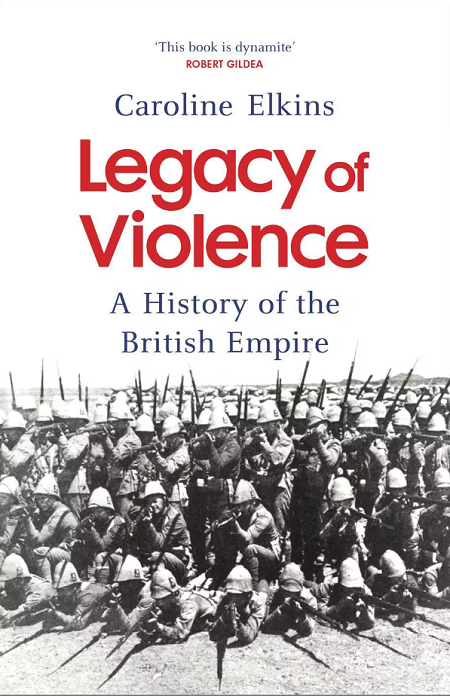
Published 6 May 2019After the disaster of the Franco-Prussian War, it was clear to the French military that the rationale for using paper cartridge in the Chassepot was no longer valid — a future rifle would need to use brass cartridges. A competition to design a conversion of the Chassepot to use modern ammunition resulted in the 1874 adoption of the rifle designed by French Artillery Captain Basile Gras. This maintained the use of the bolt handle as a single locking lug, but introduced a separate bolt head and extractor. The new cartridge was the 11mm Gras; very similar to the Chassepot loading but at a slightly higher velocity.
The Gras would be produced from 1874 until 1884, with more than 4 million made in total. Most were full length infantry rifles, but two patterns of carbine and a musketoon were also included for cavalry, gendarmerie, and artillery troops. These rifles saw significant use in colonial conflicts, but the much-anticipated war of revenge against Germany would not happen while the Gras was the standard French rifle. Instead, it would see a supporting role in the First World War, both in the original 11mm caliber and also converted to 8mm Lebel.
http://www.patreon.com/ForgottenWeapons
Cool Forgotten Weapons merch! http://shop.bbtv.com/collections/forg…
Contact:
Forgotten Weapons
PO Box 87647
Tucson, AZ 85754
December 20, 2021
Foreshadowing WW1 – Italo-Turkish War 1911-1912 I THE GREAT WAR
The Great War
Published 17 Dec 2021Sign up for Audible and get 60% off your first three months: https://audible.com/greatwar or text
greatwarto 500-500The Italo-Turkish War 1911 was one of the last classic imperial wars over colonial processions between two great powers. But it was in many ways also a first glimpse into what would come during the First World War: trenches, artillery, combat aircraft, motorboat attacks. This war in Ottoman Libya was fought between the Italian Army and Ottoman-led local Senussi forces.
» SUPPORT THE CHANNEL
Patreon: https://www.patreon.com/thegreatwar» THANKS TO OUR CO-PRODUCERS
John Ozment, James Darcangelo, Jacob Carter Landt, Thomas Brendan, Kurt Gillies, Scott Deederly, John Belland, Adam Smith, Taylor Allen, Rustem Sharipov, Christoph Wolf, Simen Røste, Marcus Bondura, Ramon Rijkhoek, Theodore Patrick Shannon, Philip Schoffman, Avi Woolf,» SOURCES
Askew, William C., Europe and Italy’s Acquisition of Libya, 1911-1912, (Durham, NC: Duke University Press, 1942)Caccamo, Francesco, “Italy, Libya and the Balkans” in Geppert, Dominik; Mulligan, William & Rose, Andreas (eds.), The Wars before the Great War: Conflict and International Politics Before the Outbreak of the First World War, (Cambridge: Cambridge University Press, 2016)
Childs, Timothy W, Italo-Turkish Diplomacy and the War Over Libya, 1911–1912, (Leiden: Brill, 1990)
Griffin, Ernest H., Adventures in Tripoli: A Doctor in the Desert (London: Philip Allen & Co., 1924)
Hindmarsh. Albert E. & Wilson, George Grafton, “War Declared and the Use of Force”, Proceedings of the American Society of International Law at Its Annual Meeting (1921-1969) Vol. 32 (1938)
McCollum Jonathan, “Reimagining Mediterranean Spaces: Libya and the Italo-Turkish War, 1911-1912”, in Mediterraneo cosmopolita, 23 (3) 2015.
McMeekin, Sean, The Ottoman Endgame (Penguin, 2013).
Paris, Michael, “The First Air Wars – North Africa and the Balkans, 1911-13”, Journal of Contemporary History, Vol. 26, No. 1 (1991)
Stephenson, Charles, A Box of Sand: the Italo-Ottoman War 1911-1912: the First Land, Sea and Air War, (Ticehurst: Tattered Flag Press, 2014)
Tittoni, Renato, The Italo-Turkish War (1911-12). Translated and Compiled from the Reports of the Italian General Staff, (Kansas City, MO: Frank Hudson Publishing Company, 1914)
Uyar, Mesut, The Ottoman Army and the First World War, (Abingdon: Routledge, 2021)
Vandervort, Bruce, Wars of Imperial Conquest in Africa 1830-1914, (Bloomington, IN: Indiana University Press, 1998)
Wilcox, Vanda, Italy in the Era of the Great War, (Leiden: Brill, 2018)
Wilcox, Vanda, “The Italian Soldiers’ experience in Libya, 1911-12” in Geppert, Dominik; Mulligan, William & Rose, Andreas (eds.), The Wars before the Great War: Conflict and International Politics Before the Outbreak of the First World War, (Cambridge: Cambridge University Press, 2016)
»CREDITS
Presented by: Jesse Alexander
Written by: Mark Newton, Jesse Alexander
Director: Toni Steller & Florian Wittig
Director of Photography: Toni Steller
Sound: Toni Steller
Editing: Jose Gamez
Motion Design: Philipp Appelt
Mixing, Mastering & Sound Design: http://above-zero.com
Research by: Mark Newton
Fact checking: Florian WittigChannel Design: Yves Thimian
Contains licensed material by getty images
All rights reserved – Real Time History GmbH 2021
December 16, 2021
QotD: “Advance Australia Fair”
Despite the remorseless filleting of the lyrics to “O Canada”, every year or two some grievance is lodged against the two or three remaining lines of the original. Thus:
O Canada!
Our home and native land…Which should of course be:
O Canada!
Our home on natives’ land…Game as I am to disparage the senior Dominion’s anthem, I have to say it’s effortlessly outpaced in insipidity by …
Australians all let us rejoice
For we are young and free
We’ve golden soil And wealth for toil
Our home is girt by sea…“Girt” is famously the only point of lyric interest in “Advance Australia Fair”. Peter Dodds McCormick wrote the song back in 1878, which meant, by the time they decided to make it the official anthem twenty years ago, most of the verses were unusable. No point shaking off the old cultural cringe of “God Save The Queen” only to start singing couplet after couplet about “gallant Cook from Albion” and “true British courage” and “old England’s flag”. And how about this quatrain?
Britannia then shall surely know
Beyond wide ocean’s roll
Her sons in fair Australia’s land
Still keep an English soul …So, after all the colonial sucking up was excised from the lyric, “girt” was pretty much all that was left. A few years ago, incidentally, there was an Aussie satirical magazine named Girt in its honor: I signed on with them but it folded after one issue. Don’t believe I ever got the check. Or cheque. I try not to be biased against “Advance Australia Fair” on that account, but honestly, was there ever such a gulf between the spirit of a great nation and its official musical embodiment?
Mark Steyn, adapted from A Song for the Season, 2008.
December 10, 2021
History Summarized: Britain and the Empire
Overly Sarcastic Productions
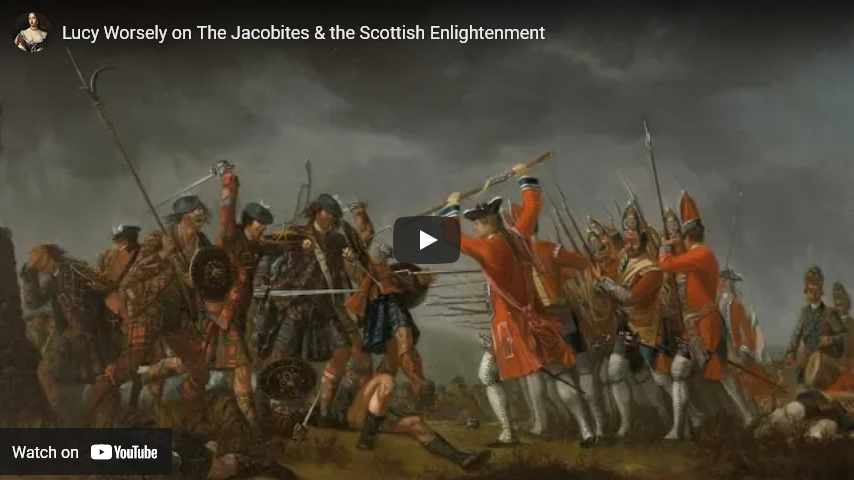
Published 20 Aug 2021How is it that the history of some islands off the northern coast of Europe balloons into a worldwide history? Empire is how! Let’s dig into the history of Britain since Union of the Crowns of England and Scotland in 1603, and follow that narrative through the monumental rise and precipitous fall of the British Empire.
Special thanks to the community members on Discord who assisted me with my script: Corvin the Crow, Johnny, Jdedredhed, Joud, Jéuname, Klieg, RileyTheProcrastinator, The Missing Link, and thesleepingmeerkat
SOURCES & Further Reading: The Great Courses Lecture series Foundations of Western Civilization II: A History of the Modern Western World by Robert Buchols lectures 11, 12, 13, 14, 15, 18, 19, 20, 21, 22, 30, The History Of England volumes 3 Rebellion, 4 Revolution & 5 Dominion by Peter Ackroyd, Scotland: A Concise History by Fitzroy MacLean, The Great Cities in History by John Julius Norwich, A Concise History of Wales by Geraint H. Jenkins, Sea Power: The History and Geopolitics of the World’s Oceans by James Stavridis.
Our content is intended for teenage audiences and up.
PATREON: https://www.Patreon.com/OSP
PODCAST: https://overlysarcasticpodcast.transi…
DISCORD: https://discord.gg/osp
MERCH LINKS: http://rdbl.co/osp
OUR WEBSITE: https://www.OverlySarcasticProductions.com
Find us on Twitter https://www.Twitter.com/OSPYouTube
Find us on Reddit https://www.Reddit.com/r/OSP/
November 27, 2021
King James I and his hatred of tobacco smoking — “so vile and stinking a custom”
Anton Howes recounts some stories he uncovered while researching English patent and monopoly policies during the Elizabethan and Stuart eras:
… some of the most interesting proclamations to catch my eye were about tobacco. Whereas tobacco was famously a New World crop, it is actually very easy to grow in England. Yet what the proclamations reveal is that the planting of tobacco in England and Wales was purposefully suppressed, and for some very interesting reasons.
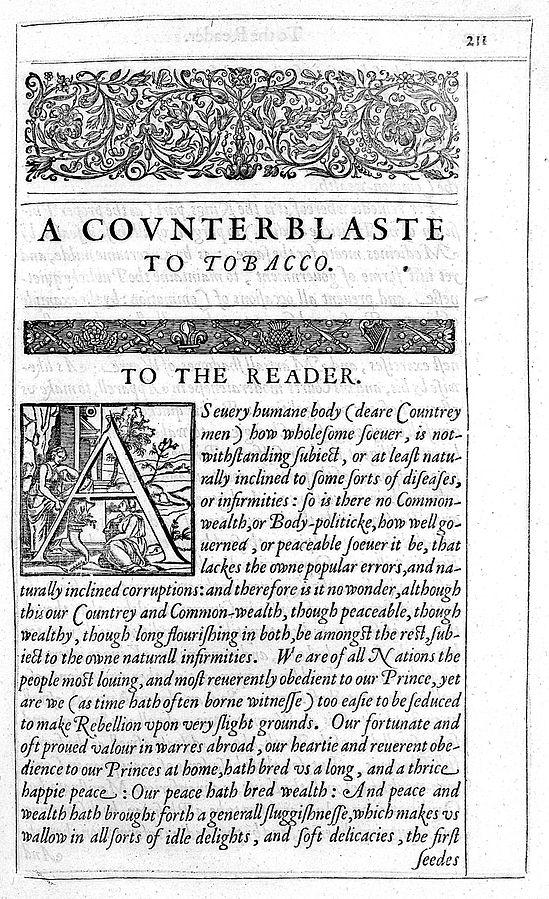
James I was an anti-tobacco king. He even published his own tract on the subject, A Counterblaste to Tobacco, just a year after his succession to the English throne. Yet as a result of his hatred of “so vile and stinking a custom”, imports of tobacco were heavily taxed and became a major source of revenue. Somewhat ironically, the cash-strapped king became increasingly financially dependent on the weed he never smoked. The emergence of a domestic growth of tobacco was thus not only offensive to the king on the grounds that he thought it a horrid, stinking, and unhealthy habit — it was also a threat to his income.
What I was most surprised to see, however, was just how explicitly the king admitted this. It’s usual, when reading official proclamations, to have to read between the lines, or to have to track down the more private correspondence of his ministers. Very often James’s proclamations would have an official justification for the public good, while in the background you’ll find it originated in a proposal from an official about how much money it was likely to raise. There was money to be made in making things illegal and then collecting the fines.
Yet the 1619 proclamation against growing tobacco in England and Wales had both. The legendary Francis Bacon, by this stage Lord High Chancellor, privately noted that the policy might raise an additional £3,000 per year in customs revenue. And the proclamation itself noted that growing tobacco in England “does manifestly tend to the diminution of our customs”. Although the proclamation notes that the loss of customs revenue was not usually a grounds for banning things, as manufactures and necessary commodities were better made at home than abroad, “yet where it shall be taken from us, and no good but rather hurt thereby redound to our people, we have reason to preserve”. Fair enough.
And that’s not all. James in his proclamation expressed all sorts of other worries about domestic tobacco. Imported tobacco, he claimed, was at least only a vice restricted to the richer city sorts, where it was already an apparent source of unrest (presumably because people liked to smoke socially, gathering into what seemed like disorderly crowds). With tobacco being grown domestically, however, it was “begun to be taken in every mean village, even amongst the basest people” — an even greater apparent threat to social order. James certainly wasn’t wrong about this wider adoption. Just a few decades later, a Dutch visitor to England reported that even in relatively far-flung Cornwall “everyone, men and women, young and old, puffing tobacco, which is here so common that the young children get it in the morning instead of breakfast, and almost prefer it to bread.”
[…]
Indeed, policymakers thought that the domestic production of tobacco would actively harm one of their key economic projects: the development of the colonies of Virginia and the Somers Isles (today known as Bermuda). Although James I hoped that their growth of tobacco would be only a temporary economic stop-gap, “until our said colonies may grow to yield better and more solid commodities”, he believed that without tobacco the nascent colonial economies would never survive. Banning the domestic growth of tobacco thus became an essential part of official colonial policy — one that was continued by James’s successors, who did not always share his more general hatred of smoking. Although the other justifications for banning domestic tobacco would soon fall away, that of maintaining the colonies — backed by an increasingly wealthy colonial lobby — was the one that prevailed.
November 15, 2021
“That is what I like about you Canadians … you are so ready to admit fault. It is a fine, if dangerous, national characteristic. You are all ashamed.”
John E. MacKinnon on the world’s first admittedly genocidal, terminally apologetic, “post-national” state … the entity that used to be known as the Dominion of Canada:
During one broadcast, [late CBC Radio host Peter] Gzowski recalled an incident that had occurred at the annual invitational golf tournament he hosted to benefit adult literacy programs across Canada. As one participant, standing next to Gzowski, leaned thoughtfully on his club, another drove a golf cart over his toes. Although it was unclear from the telling whether the cart-driver was American, the first golfer was obviously Canadian, since, shifting gingerly from foot to aching foot, he could only plead, “sorry”. Gzowski shared this anecdote with evident delight, since it struck him as so endearingly, because emblematically, Canadian.
But Gzowski’s soaring contentment with this view of his country and countrymen was no less emblematic. To Canadian nationalists of Gzowski’s era and ilk, the representative Canadian is no hewer of wood or carrier of water, no builder of bridges, roads and railways, no stormer of barricades or keeper of the peace, but a hobbled guest on a verdant fairway, eagerly apologizing for the pleasure of having his toes crushed. “That is what I like about you Canadians,” says Dr. Gunilla Dahl-Soot in Robertson Davies’s novel The Lyre of Orpheus, “you are so ready to admit fault. It is a fine, if dangerous, national characteristic. You are all ashamed.”
Over the past 200 years, notes Hungarian-born Canadian writer George Jonas, “we have been misled by science. Medicine became our hubris. Having learned to fix appendices, we thought we could fix history.” Today, in Canada, there is no clearer manifestation of this urge to renovate and repair the past than the vogue for apology. And no one has struck this posture of national self-abasement with quite the alacrity of Prime Minister Justin Trudeau. Just months after taking office, he apologized for the Komagata Maru incident in 1914, in which a ship carrying Sikhs, Muslims, and Hindus was sent back to Calcutta, where 20 died in a riot. In 2017, he apologized to Indigenous residential-school survivors in Newfoundland and Labrador, and, just days later, to LGBT Canadians for decades of “state-sponsored, systemic oppression.” A year later, he apologized for the execution, in 1864, of six Tsilhqot’in chiefs over a road-building dispute, and for a government refusal, in June, 1939, to allow into the port of Halifax the MS St. Louis, an ocean liner carrying more than 900 Jews fleeing Nazi Germany. In March, 2019, he apologized for the inhumane manner in which Inuit in northern Canada were treated for tuberculosis in the mid-20th century. Two months later, he exonerated Chief Poundmaker of the Poundmaker Cree, apologizing for the Chief’s conviction for treason more than 130 years before. Still at it in the spring of 2021, Trudeau issued a formal apology in the House of Commons for the internment of Italian-Canadians during the Second World War, even though many, it was subsequently revealed, were indeed hardcore fascists, loyal to an enemy in a time of war. Two weeks later, he lowered the Canadian flag for five months to mark the discovery of the remains of Indigenous children who died at residential schools.
In the midst of this flurry of breathy performances, the BBC asked, with more than a touch of arch obviousness, whether the Canadian Prime Minister might not perhaps apologize too much. And yet, in Trudeau, we simply have the apotheosis of that habit of abject contrition celebrated by Gzowskian nationalists. Under his government, it has become fashionable, even necessary, to apologize, not just for egregious historical episodes or policies, but for the existence of Canada itself. In an interview with the New York Times, Trudeau witlessly described the country that had so favoured him through a lifetime of privilege as “post-national”, suggesting that Canada as we know it had somehow served its purpose, extended itself beyond any warrantable use. And recently, not to be outpaced by more current styles of denunciation, he described Canada, “in all our institutions,” as “built around a system of colonialism, of discrimination, of systemic racism.” When China, responding to criticism of its brutal treatment of Muslim Uyghurs, lashed out at Canada for committing “genocide” against its own Indigenous population and subjecting Asian-Canadians to “systemic racism”, Canada’s political class was in no position to quibble — as its prime minister had already muttered his agreement to the claim that he presided over a genocide state.
This note of cringing repentance now echoes in the pronouncements of all of our institutions. No matter how admired our country may remain internationally, no matter how ardently people around the world long to immigrate here for a chance at a better life, our presumptive leaders are eager to scorn Canada as a meagre and regrettable conceit. That the confessional mode they favour has become so prevalent confirms what Christopher Lasch long ago diagnosed as the strain of narcissism that courses through contemporary culture, lending ready appeal to all such facile gestures of self-reproach. There is, indeed, no cagier career move for any Canadian academic, journalist, bureaucrat, or politician these days than to repudiate Canada, and with feeling.
November 1, 2021
Indochina and The Battle of Dien Bien Phu
The History Guy: History Deserves to Be Remembered
Published 29 Sep 2017The History Guy remembers how decolonization led to proxy war and the Battle of Dien Bien Phu in what is now known as Vietnam.
The episode discusses and presents historical photographs and film footage depicting events during a period of war, which some viewers may find disturbing. All events are described for educational purposes and are presented in historical context.
The History Guy uses images that are in the Public Domain. As photographs of actual events are often not available, I will sometimes use photographs of similar events or objects for illustration.
Patreon: https://www.patreon.com/TheHistoryGuy
The History Guy: Five Minutes of History is the place to find short snippets of forgotten history from five to fifteen minutes long. If you like history too, this is the channel for you.
Awesome The History Guy merchandise is available at:
https://teespring.com/stores/the-hist…The episode is intended for educational purposes. All events are presented in historical context.
#DienBienPhu #militaryhistory #thehistoryguy
October 19, 2021
QotD: Slaves and indentured servants in early Virginia
I saw from the start that some of Nikole [Hannah-Jones]’s 1619 rubbish merely exposed her utter ignorance of her subject. The blacks whom the Virginians bought from a Portuguese slave trader in 1619 were treated like whites – that is, they were treated as indentured servants who after 10 years were freed, given some farm tools, pointed at a plot of land and left to get on with it. (Some of them got on so well that before mid-century they were buying white and black indentured servants themselves to work their expanding acreages.)
One could justly say these early-arriving blacks were not treated exactly like poor English whites who – unless convicted of a crime – had always chosen to sign their ten-year indenture, to pay for transport across the Atlantic and survival while they found their feet. The closer analogy is to some Scottish whites. More than one clan chief sold some clansmen on indentures across the Atlantic when funds were low, and in 1707 a leading Scottish parliamentarian informed his peers that there was no need for them to fix the disastrous financial situation by accepting the English payment and voting their own abolition – Scotland’s elite could keep their separate parliament and avoid national bankruptcy by selling enough poor Scots to the Americas instead.
When the Portuguese offered to sell black slaves, those 1619 Virginians could only buy them as ten-year-indentured servants. They were still wholly under English common law and Lord Mansfield’s 1770s ruling merely echoed a two-centuries earlier ruling of Elizabethan judges that English common law knew no such state as slavery. It took the Virginians decades to start even questioning this and almost a century to unlearn it fully. As late as the 1690s, a black man who petitioned the Virginia council that his white master had made him serve not for ten years but for twelve “contrarie to all right and justice“, was freed by their order. If Nikole had called it the 1705 project, I’d have thought she at least knew something about the actual faults of the country whose history she was travestying. Only positive statute law can override English common law’s aversion to slavery, said Lord Mansfield – and 1705 was the year the Virginia legislature completed providing it. I knew from the start that Nikole was not just lying about all that, not just indifferent to the truth of all that – she was also pretty clueless about it.
Niall Kilmartin, “Critical Race Theorist literally knows nothing”, Samizdata, 2021-07-16.
October 12, 2021
Richard Overy looks at the “Great Imperial War” of 1931-1945
I missed Rana Mitter‘s review of Richard Overy’s latest book when it was published in The Critic last week:
Imagine there’s no Hitler. It’s not that easy, even if you try, at least if you’re a westerner thinking about the Second World War. But for millions of Asians, those years of conflict had little to do with the horrors of Nazi invasion and genocide, and it is their experience that frames Richard Overy’s account of a seemingly familiar conflict. For most non-Europeans, the war was not a struggle for democracy, but a conflict between empires, and in this book, that imperial struggle begins not with the invasion of Poland by Germany in 1939 but the occupation of Manchuria by the Japanese in 1931.
Blood and Ruins is really two books in one. The first is perhaps the single most comprehensive account of the Second World War yet to appear in one volume. You might think that by reading extensively, you could construct a book like this one. You could not — unless you have Overy’s control over a staggering range of World War II scholarship, much of it drawn from his own decades of research on the economics of total warfare, the development of technology, from radar to aerial bombing, and the idea of the “emotional geography” of war, encompassing morale, hope, and despair. Then you’d need to go back and cover all those categories for each of the major Allied and Axis belligerents: Britain, the US, Japan, Germany, France, Italy and China among them.
The second book is an argument about what kind of conflict the Second World War really was. Overy is clear: on a global as opposed to European scale, it was not (just) a war about democracy, but about empires and their fate, although “the starting point in explaining the pursuit of territorial empire is, paradoxically, the nation.”
Overy points out what is generally lost to view when the European war is placed at the centre of the historiography: both Britain and France were undertaking an “awkward double standard” in their defence of democratic values, as their Asian and African possessions “rested on a denial of those liberties and the repression of any protest against the undemocratic nature of colonial rule”. While this argument has been made before (not least by figures such as Nehru and Gandhi in India at the time), Overy does something unusual and revealing: he compares the western empires with Japan’s justification for its own imperial project in the early twentieth century.
The book is scrupulously careful not to endorse or excuse the worldview of Tokyo’s imperialists, and gives full weight to the voices of the Chinese nationalists and communists who were bitterly opposed to Japan’s expansion on the Asian mainland. Still, the comparison of Japan’s pre-war and wartime empire to those of the western powers provides an important and original broadening of a contemporary debate.
There is ongoing public British (and to some extent French) argument about whether empire was a “good” or “bad” thing. Yet neither attackers nor defenders of the British empire tend to analyse it alongside the Japanese equivalent that lasted nearly half a century. Britain committed colonial massacres (Amritsar) and deadly repression (Mau Mau). So did Japan (the rape of Nanjing, invasion of Manchuria).
Britain’s empire also created an aspirational middle class full of cosmopolitan nationalists, and drew on ideas of loyalty to recruit its subjects to fight in world wars. All these things are also true of Japan, which like Britain was a multi-party democracy for much of its period as an overseas empire (between 1898 and 1932), and whose capital city was an intellectual hub for political activists from across Asia.
As a colony of Japan between 1895-1945, Taiwan developed a middle class that was Japanese-speaking and keen to draw on new economic opportunities brought by empire: Lee Teng-hui, the first democratically elected president of the Republic of China on Taiwan, always thought of Japanese as his mother tongue. Park Chung-hee, the American-sponsored dictator of Cold War South Korea, learned his political craft as an army officer in the Japanese Manchukuo Army that occupied Manchuria.
October 11, 2021
The Darien Venture: The Colony that Bankrupted Scotland
Geographics
Published 14 Nov 2019If a Nation’s wealth and power were to be measured in stubbornness, resilience, and inventiveness, rather than GDP, Scotland would be a top-5 superpower. The people that brought to you televisions, refrigerators, penicillin, and gin & tonic have gone through many a rough patch throughout their history. Very often, hard times were related to their rocky relationship with their Southern neighbours, the English.
Credits:
Host – Simon Whistler
Author – Arnaldo Teodorani
Producer – Jennifer Da Silva
Executive Producer – Shell HarrisBusiness inquiries to admin@toptenz.net
QotD: Columbus Day
It was Columbus Day yesterday, where historically, Americans have celebrated the discovery of the “New world” by Christopher Columbus’ little fleet in 1492. Now, historically there were previous discoveries of parts of the Americas by Europeans. Vikings encountered Newfoundland in roughly 1000 and even had a small settlement there. Some writings indicate that an explorer named Brendan encountered the Americas in the sixth century AD. Chinese apparently had landed on the Pacific coast as early as 3300 years ago.
But when Columbus landed on the Caribbean Island of San Salvador in the Bahamas, he set off a wave of exploration and colonization which the previous discoveries had not. The Viking and Chinese settlements did not last, but the post-Columbian ones did. And that is an incredibly significant historical event, no matter how you view history.
In the 1970s it became popular on the left to consider Columbus a monster, a villain who gave the innocent and peaceful natives diseases, enslaved them, wiped out their culture, and destroyed all that was good. This theory teaches that the American natives were all good and peaceful and wonderful and just and true and righteous. They all ate free trade non-GMO gluten free food and were perfectly multicultural and non-judgmental, free of war and with perfect gender equality. Columbus, an evil white European showed up and ruined it all. In short, Columbus he infected the Eden-like paradise of the Americas with his Euro-masculinity.
And the origin of this theory is that of the Noble Savage. There were people living outside the evil corrupting influence of White European Males, and Columbus found them and ruined everything. That’s why when you hear someone talking about this, they never mention the nearly-constant wars, cannibalism, human sacrifice, rape, pillaging, genocide, disease, poverty, and incredible lack of technical and scientific, artistic, and literary knowledge of the native peoples of America.
Columbus was a man of his time, and a particularly greedy one at that. He ripped off his own people, acting as the King’s supreme representative and authority in the Americas (which at the time was not known to be as vast as it is). He took credit for what others did, he took over what they developed, he took the riches they found, and so on. And yes, he and his men enslaved the local natives, and because of their culture of “free love” spread European venereal diseases among the natives they were not exposed to before. Entire tribes were wiped out by the infections they had no resistances to.
Of course, the natives spread disease among the Europeans they hadn’t been exposed to, either, such as Typhus and Syphilis, and the natives were murderous and killed Europeans but those are details that modern revisionist historians either ignore, gloss over, or present as a rough sort of justice: they had it coming for daring to set foot in the Eden of the Americas.
Objectively, neither side was particularly admirable, as one would expect if you understand innate and original sin. If what’s bad comes from within us rather than outside influences, then its spread evenly throughout all humanity without regard to creed, culture, race, or location. The natives were bad because people are bad. The Spaniards and Columbus (who was Italian) was bad, because people are bad.
Christopher Taylor, “Eden Ruined By Italian”, Word Around the Net, 2018-10-09.
September 25, 2021
Will Mars become the equivalent to Earth that India and the East Indies once were for Europe?
In the latest Age of Invention newsletter, Anton Howes goes a long way in both time and space away from his normal Industrial Revolution beat to consider what might happen as humans attempt to colonize Mars:

The first true-colour image generated using the OSIRIS orange (red), green and blue colour filters. The image was acquired on 24 February 2007 at 19:28 CET from a distance of about 240 000 km; image resolution is about 5 km/pixel.
Photo taken by the ESA Rosetta spacecraft during a planetary flyby.
The other week I attended an unconference, which had a session on the implications of establishing colonies on other planets. Although this was largely meant to be about the likely impact on Earth’s natural environment — what will be the impact of extracting raw materials from asteroids and other planets? — some of the discussion reminded me of the challenges faced by the long-distance explorers, merchants, and colonists of four hundred years ago. There are quite a few parallels I can see between travelling to Mars, say, in a hundred years’ time, and travelling between continents in the age of sail.
For a start, there’s the seasonality and duration of the voyages. European ships headed for the Indian Ocean had to time their voyages around the monsoon season; trips across the Atlantic were limited to just half the year because of hurricanes. Round-trips took years. Similarly, the departure window for a voyage from Earth to Mars only comes around once every 26 months, and even the most optimistic estimates place eventual journey times at about 4-6 months. Supposing that Mars can be permanently settled, any colony there will likely be extremely dependent on the regular arrival of resupply craft. There’s only so long that any group can survive in a hostile environment on their own.
[…]
The Portuguese had once been the only Europeans to trade directly into the Indian Ocean, but the structure of their trade — essentially a state-run monopoly with some licensed private merchants — was unable to compete with the arrival of the Dutch. The initial Dutch forays into the Indian Ocean in the 1590s had originally been financed by lots of different companies, often associated with particular cities — similar to the proliferation of billionaire-led space exploration companies today. But the Dutch soon recognised that such a high-risk trade would only be able to survive if it came with correspondingly high rewards — rewards that could only be guaranteed by eliminating domestic competitors (and if possible, foreign ones too). They therefore amalgamated all of the smaller concerns into a single company with a state-granted monopoly on all of the nation’s trade with the region. In this, they actually copied the English model, but then outdid them in terms of the organisation and financing of that company […].
Are we likely to see a similar move towards state-granted monopoly corporations when it comes to space colonisation? I suspect it depends on the potential rewards, and on the strength of the competition. There is certainly precedent for incentivising risky and innovative ventures in this way, through the granting of patent monopolies. Patents for inventions in the English tradition originally even had their roots in patents for exploration. I would not be surprised if such policies end up being used again by countries that are late-comers to the space race, perhaps by granting domestic monopolies over the extraction of resources from particular planets or moons. Although direct state funding can help in being first, like they did for Spain and Portugal in the fifteenth and sixteenth centuries, state-granted monopolies for private actors may again end up being the ideal catch-up tool for laggards, as they were for the English and the Dutch.
How the monopolies are managed will also matter. The English East India Company, for example, was initially more focused on rewarding its shareholders than it was on investing in the full infrastructure with which to dominate a trade route. The Dutch company, by contrast, from the get-go was part of a more coordinated imperial strategy — one that sought to systematically rob the Portuguese of their factories and forts, to project force with the aid of the state. Indeed, if there’s one big lesson for the geopolitics of space, it’s that far-flung empires can be extremely fragile, with plenty of opportunities for late-arriving interlopers to take them over.
Although it’s difficult to imagine space colonies being able to become self-sufficient any time soon, it seems likely that those controlled by particular companies or countries may occasionally be persuaded — by bribes or by force — to defect. What’s to stop them when they’re hundreds of millions of kilometres away from any punishment or help? Ill-provisioned factors, forts, or colonies happily switched sides to whoever might provision them better. As I mentioned last week, such problems curtailed the ambitions of other would-be colonial powers, like the Duchy of Courland and Semigallia. When the Dutch turned up in the Indian Ocean, many of the Portuguese forts they threatened simply surrendered.
I bow to Anton’s far greater historical knowledge in most things, but state monopolies in the 16th to 19th centuries were very different creatures than their potential modern equivalents, and the much more comprehensive degree of state control of the economy now would probably mean that a state monopoly over extraterrestrial activities would be a worst-possible outcome. The greater the powers in the hands of the state, in almost every case, the worse all state-controlled activities have become. The incentives of civil servants are vastly different than those of individuals or businesses and are farcically incompatible with the risk-taking necessary on a dangerous frontier.
September 13, 2021
How Is Worcestershire Sauce Made? | How Do They Do It?
DCODE by Discovery
Published 25 Sep 2018Worcestershire Sauce was invented in 1835 when a posh army officer went to India to help run the British Empire. He fell in love, not with a woman, but with a fish sauce. DCODE how the iconic sauce is made in England today.
#DCODE, #HowDoTheyDoIt, #WorcestershireSauce
September 3, 2021
Anti-Slavery Patrols – The West Africa Squadron
Drachinifel
Published 1 Dec 2018Title says it all really, we look at something that was definitely worth doing, which really should have been done much sooner.