Quotulatiousness

July 21, 2019

How to use a Chisel CORRECTLY

Filed under: Tools, Woodworking — Tags: , , — Nicholas @ 02:00

Matt Estlea
Published on 26 May 2018

Chiselling is one of those things that looks easy at first glance, yet as soon as you have a go with one your work looks like roadkill.

In this video, I’ll be sharing certain tricks, tips and techniques to help make your chiselling more accurate, cleaner and enjoyable.

Best of luck and feel free to share any of your own tips in the comment section below!
_________________________________________________________________

Support what I do by becoming a Patron! I want to increase the production quality of my videos and thus need to finance some new equipment. Follow the link below to help me out! Thank you in advance! https://www.patreon.com/mattestlea
_________________________________________________________________

See what tools I use here: https://kit.com/MattEstlea
My Website: http://www.mattestlea.com
_________________________________________________________________

My name is Matt Estlea, I’m a 22 year old Woodworker from Basingstoke in England and my aim is to make your woodworking less s***.

I come from 5 years tuition at Rycotewood Furniture Centre and 4 years experience working at Axminster Tools and Machinery where I still currently work on weekends. During the week, I film woodworking projects, tutorials, reviews and a viewer favourite ‘Tool Duel’ where I compare two cometitive manufacturers tools against one another to find out which is best.

I like to have a laugh and my videos are quite fast paced BUT you will learn a lot, I assure you.

Lets go make a mess.

From the comments:

Matt Estlea
1 year ago

UPDATE

Watch your fingers on the sides of the chisel if you’re going for the pencil grip, they can sometimes be sharp. Firstly, this isn’t a bad thing; in fact its quite useful! Watch this video to see why: https://www.youtube.com/watch?v=Z9S6r104pQk

But if you do find you are cutting yourself, try one of these three things:
1: Loosen your grip. No need for a death grip here. Hold it with the same pressure as you would with a pencil.
2: Run a bit of 400 grit sandpaper up the edge of the chisel ONCE. Don’t go back and forth with it, one stroke will be enough to take the edge off.
3: Keep in mind that every time you cut yourself the skin toughens up. So if all else fails, keep battling through it!

QotD: History in a totalitarian age

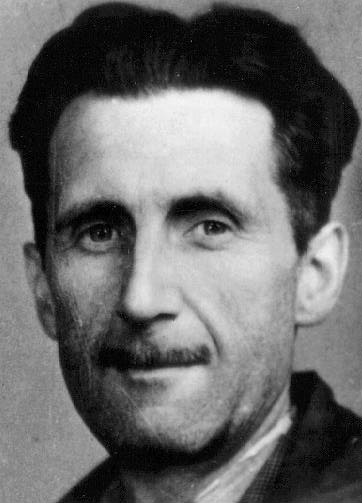
Orwell’s press card portrait, 1943

I know it is the fashion to say that most of recorded history is lies anyway. I am willing to believe that history is for the most part inaccurate and biased, but what is peculiar to our own age is the abandonment of the idea that history could be truthfully written. In the past people deliberately lied, or they unconsciously coloured what they wrote, or they struggled after the truth, well knowing that they must make many mistakes; but in each case they believed that “facts” existed and were more or less discoverable. And in practice there was always a considerable body of fact which would have been agreed to by almost everyone. If you look up the history of the last war in, for instance, the Encyclopaedia Britannica, you will find that a respectable amount of the material is drawn from German sources. A British and a German historian would disagree deeply on many things, even on fundamentals, but there would still be that body of, as it were, neutral fact on which neither would seriously challenge the other. It is just this common basis of agreement, with its implication that human beings are all one species of animal, that totalitarianism destroys. Nazi theory indeed specifically denies that such a thing as “the truth” exists. There is, for instance, no such thing as “Science”. There is only “German Science”, “Jewish Science”, etc. The implied objective of this line of thought is a nightmare world in which the Leader, or some ruling clique, controls not only the future but the past. If the Leader says of such and such an event, “It never happened” — well, it never happened. If he says that two and two are five — well, two and two are five. This prospect frightens me much more than bombs — and after our experiences of the last few years that is not a frivolous statement.

But is it perhaps childish or morbid to terrify oneself with visions of a totalitarian future? Before writing off the totalitarian world as a nightmare that can’t come true, just remember that in 1925 the world of today would have seemed a nightmare that couldn’t come true. Against that shifting phantasmagoric world in which black may be white tomorrow and yesterday’s weather can be changed by decree, there are in reality only two safeguards. One is that however much you deny the truth, the truth goes on existing, as it were, behind your back, and you consequently can’t violate it in ways that impair military efficiency. The other is that so long as some parts of the earth remain unconquered, the liberal tradition can be kept alive. Let Fascism, or possibly even a combination of several Fascisms, conquer the whole world, and those two conditions no longer exist. We in England underrate the danger of this kind of thing, because our traditions and our past security have given us a sentimental belief that it all comes right in the end and the thing you most fear never really happens. Nourished for hundreds of years on a literature in which Right invariably triumphs in the last chapter, we believe half-instinctively that evil always defeats itself in the long run. Pacifism, for instance, is founded largely on this belief. Don’t resist evil, and it will somehow destroy itself. But why should it? What evidence is there that it does? And what instance is there of a modern industrialized state collapsing unless conquered from the outside by military force?

Consider for instance the re-institution of slavery. Who could have imagined twenty years ago that slavery would return to Europe? Well, slavery has been restored under our noses. The forced-labour camps all over Europe and North Africa where Poles, Russians, Jews and political prisoners of every race toil at road-making or swamp-draining for their bare rations, are simple chattle slavery. The most one can say is that the buying and selling of slaves by individuals is not yet permitted. In other ways — the breaking-up of families, for instance — the conditions are probably worse than they were on the American cotton plantations. There is no reason for thinking that this state of affairs will change while any totalitarian domination endures. We don’t grasp its full implications, because in our mystical way we feel that a regime founded on slavery must collapse. But it is worth comparing the duration of the slave empires of antiquity with that of any modern state. Civilizations founded on slavery have lasted for such periods as four thousand years.

When I think of antiquity, the detail that frightens me is that those hundreds of millions of slaves on whose backs civilization rested generation after generation have left behind them no record whatever. We do not even know their names. In the whole of Greek and Roman history, how many slaves’ names are known to you? I can think of two, or possibly three. One is Spartacus and the other is Epictetus. Also, in the Roman room at the British Museum there is a glass jar with the maker’s name inscribed on the bottom, “Felix fecit“. I have a mental picture of poor Felix (a Gaul with red hair and a metal collar round his neck), but in fact he may not have been a slave; so there are only two slaves whose names I definitely know, and probably few people can remember more. The rest have gone down into utter silence.

George Orwell, “Looking back on the Spanish War”, New Road, 1943 (republished in England, Your England and Other Essays, 1953).

July 20, 2019

50th anniversary

Filed under: History, Space, Technology, USA — Tags: , , — Nicholas @ 11:41

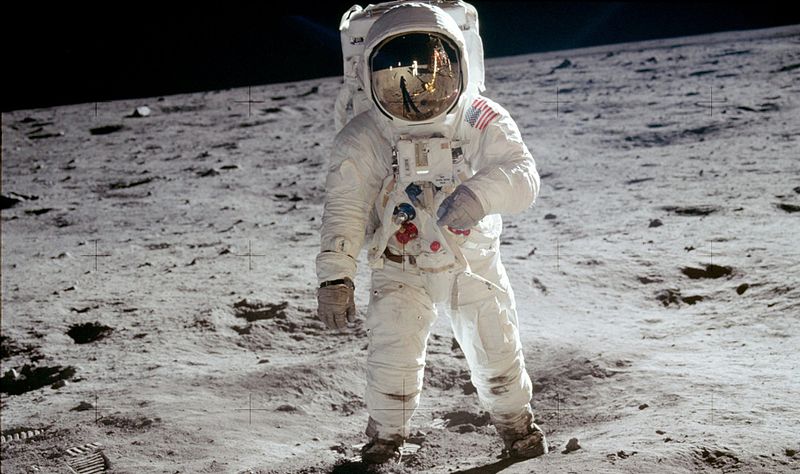
Astronaut Buzz Aldrin, lunar module pilot, stands on the surface of the moon near the leg of the lunar module, Eagle, during the Apollo 11 moonwalk. Astronaut Neil Armstrong, mission commander, took this photograph with a 70mm lunar surface camera. While Armstrong and Aldrin descended in the lunar module to explore the Sea of Tranquility, astronaut Michael Collins, command module pilot, remained in lunar orbit with the Command and Service Module, Columbia. *This is the actual photograph as exposed on the moon by Armstrong. He held the camera slightly rotated so that the camera frame did not include the top of Aldrin’s portable life support system (“backpack”). A communications antenna mounted on top of the backpack is also cut off in this picture. When the image was released to the public, it was rotated clockwise to restore the astronaut to vertical for a more harmonious composition, and a black area was added above his head to recreate the missing black lunar “sky”. The edited version is the one most commonly reproduced and known to the public, but the original version, above, is the authentic exposure.

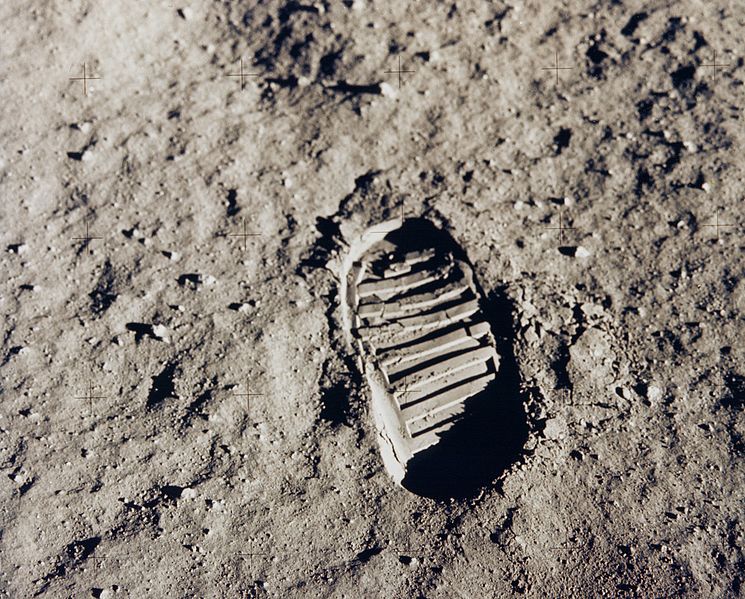
Bootprint in lunar dust created and photographed by Buzz Aldrin for the boot penetration (soil mechanics) task during the Apollo 11 moon walk.

A Bankrupt Germany Didn’t Create the Nazis | Between 2 Wars | 1928 Part 1 of 1

Filed under: Europe, Germany, History, Media — Tags: , , , , , — Nicholas @ 06:00

TimeGhost History
Published on 18 Jul 2019

When the world goes into economic overdrive in the second half of the 1920s, contrary to popular belief Germany rises with the tide – it is the Goldener Zwanziger, the Golden Twenties.

Join us on Patreon: https://www.patreon.com/TimeGhostHistory

Hosted by: Indy Neidell
Written by Francis van Berkel and Spartacus Olsson
Directed and Produced by: Spartacus Olsson and Astrid Deinhard
Executive Producers: Bodo Rittenauer, Astrid Deinhard, Indy Neidell, Spartacus Olsson
Creative Producer: Joram Appel
Post-Production Director: Wieke Kapteijns
Edited By: Daniel Weiss
Research by: Francis van Berkel

Sources:
Bundesarchiv, Photos from the Jonatan Myhre Barlien photo collection.

Colorization by Daniel Weiss
Thumbnail motive by Olga Shirnina
https://klimbim2014.wordpress.com/201…

A TimeGhost chronological documentary produced by OnLion Entertainment GmbH

“Boris Johnson is the only man alive who could convincingly turn The Emperor’s New Clothes into a one-man play”

Filed under: Britain, History, Media, Politics, Religion — Tags: , , , — Nicholas @ 05:00

In Spiked, Alaa al-Ameri says that Boris Johnson actually does have a valid point in his criticism of Islam:

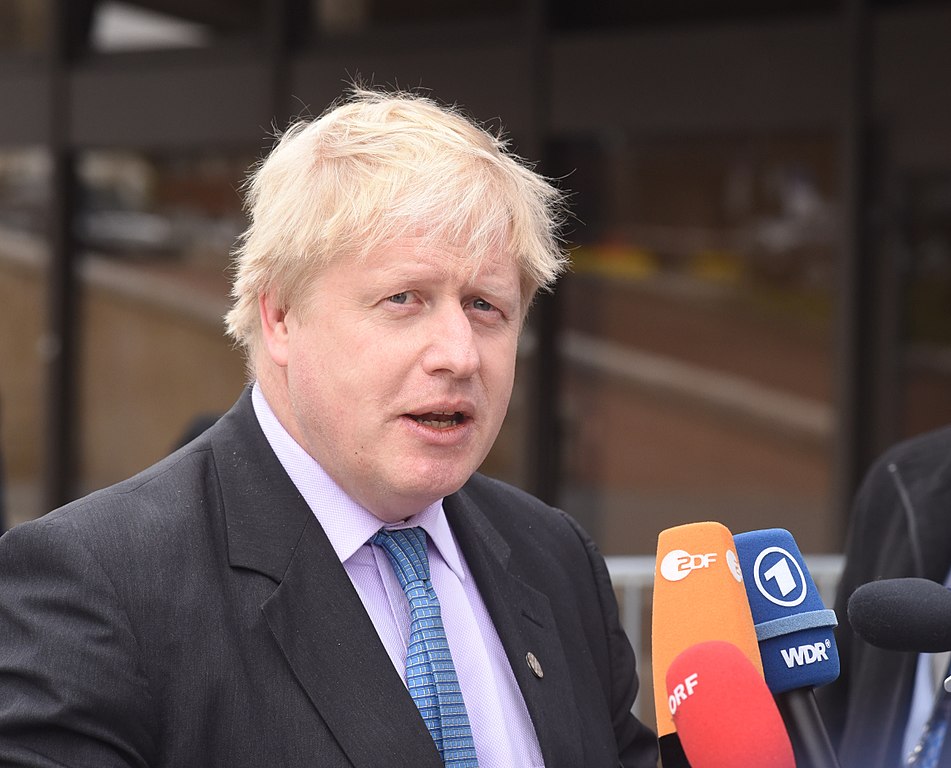
Boris Johnson, Secretary of State for Foreign and Commonwealth Affairs at an informal meeting of the Foreign Affairs Council on 15 February 2018.
Photo by Velislav Nikolov via Wikimedia Commons.

Boris Johnson is the only man alive who could convincingly turn The Emperor’s New Clothes into a one-man play. He’s perfect for every role – the pompous, bumbling, vain emperor; the barefaced conmen trafficking in audacious whoppers; and, most importantly, the little boy, unable to keep from blurting out the obvious, especially when everyone around him is busy parroting the convenient lie of the day.

Not for the first time, Johnson has offended polite society by suggesting that there might be something less than perfectly laudable about some aspects of Islam. Perish the thought. In particular, offence-miners at the Guardian have discovered that Johnson once wrote that Islam has held Muslim countries back by “centuries”.

A cursory look around the world is enough to conclude that there may be something to Johnson’s argument. A deeper look at Arab and Muslim history – both ancient and recent – might at least confirm the possibility that such a statement is something other than flat-out bigotry. Or so you might have thought, if you had recently awoken from a 30-year coma. In 2019, however, such thoughts are unthinkable.

We can moralise all day long about the evils of European colonialism. But it was a historical blink of an eye in comparison to the centuries of Arab and Muslim colonialism that produced the cultures to which Johnson was referring. We can wring our hands over the influence of literalist Christianity on American politics. But this is a drop in the ocean compared to the cultural and political leverage of Islam across the globe. We can lament the potential harm to Indian democracy posed by militant Hindu nationalism. But there is nothing questionable about entertaining the notion that centuries of Muslim global imperialism – which ended less than 100 years ago – might have left behind a less than a gleaming legacy.

Blaise in Trees | Buying Hardwood Lumber #2

Filed under: Woodworking — Tags: , — Nicholas @ 04:00

Matt Estlea
Published on 18 Jul 2019

Visiting a timber merchant can be a very unnerving experience. You don’t know where to go, how it works, what the rules are. It’s so easy to simple avoid the whole process altogether in favour of using easily accessible materials purchased from your local DIY merchant.

This series aims to prevent that intimidation and allow you to be prepared when visiting a sawmill or timber supplier for the first time.

Today, we are at a small sawmill just outside of Oxford, UK where timber is converted, dried, and sold on site by Blaise and his team. They specialise mainly in sourcing local timber in an effort to save it from being burnt for fuel or chipped. The selection here is incredible and I can’t wait for you to see what’s inside.
______________________________________________________________________________________________
View Blaise’s Website Here:
https://blaiseintrees.com

Also see his YouTube Channel Here:
https://www.youtube.com/channel/UCkVY…
______________________________________________________________________________________________

Support what I do by becoming a Patron! This will help fund new tools, equipment and cover my overheads. Meaning I can continue to bring you regular, high quality, free content. Thank you so much for your support! https://www.patreon.com/mattestlea

Don’t want to commit to a monthly direct debit but still want to help out? That’s fine!
You can make a one time donation here: https://www.paypal.me/MattEstlea
You can donate us biscuits here: https://amzn.to/2WOl1UR
______________________________________________________________________________________________
BUY THE WOODWORKING BIBLE HERE:
– UK: https://goo.gl/X8ZzSF
– US: https://goo.gl/UDqWf3
– CA: https://goo.gl/31jBxj
______________________________________________________________________________________________

My name is Matt Estlea, I’m a 23 year old Woodworker from Basingstoke in England and my aim is to make your woodworking less s***.

I come from 5 years tuition at Rycotewood Furniture Centre with a further 1 year working as an Artist in Residence at the Sylva Foundation. I now teach City and Guilds Furniture Making at Rycotewood as of September 2018.

I also had 5 years of experience working at Axminster Tools and Machinery where I helped customers with purchasing tools, demonstrated in stores and events, and gained extensive knowledge about a variety of tools and brands.

During the week, I film woodworking projects, tutorials, reviews and a viewer favourite ‘Tool Duel’ where I compare two competitive manufacturers tools against one another to find out which is best.

I like to have a laugh and my videos are quite fast paced BUT you will learn a lot, I assure you.

Lets go make a mess.

“Scheer is demonstrating what it actually looks like for a Canadian political leader to be utterly beholden to a special interest group”

Filed under: Bureaucracy, Cancon, Economics, Food, Politics — Tags: , , , — Nicholas @ 03:00

I wasn’t a fan of Andrew Scheer even before he bought the leadership of the Conservative party with Quebec dairy money. I think he was one of the worst possible choices for Tory leader, but we’re stuck with his ineffectual bought-and-paid-for self to attempt to beat an incumbent PM who has the undying loyalty of 95% of the mainstream media. And we know beyond a shadow of a doubt that his loyalty isn’t to Canada or to the Tories, but to his paymasters in Big Dairy. Despite this, Chris Selley says that The Milk Dud’s vassalage to a well-moneyed and legally privileged class may end up destroying the government cartel that is Supply Management:

Andrew Scheer, paid tool of Big Dairy, chugs some milk during a Press Gallery speech in 2017. I’ve called him the “Milk Dud” ever since.
Screencapture from a CTV video uploaded to YouTube.

There’s no shame in a conservative politician opposing the federal government of a gigantic country containing multitudes of lifestyles trying to create an ideal diet for all its citizens. “I’ll eat what I want, get out of my kitchen,” is a perfectly respectable position — especially since the food guide is such a joyless, under-salted slog. But that’s not Scheer’s position. Instead he’s vowing to “get it right.” This suggests consulting people other than medical and scientific experts, most of whom were relatively pleased with this edition of the food guide. It suggests bringing industry voices back into the mix. And that’s not something anyone other than Big Dairy and Big Meat should want.

The so-con comparison is somewhat facetious, of course: Abortion is a third-rail issue, or at least the media treats it as such, whereas unwavering protectionist support for our dairy farmers is an all-party consensus-cum-contest to see who can most abase themselves. The winner, by far, is Andrew Scheer. On Wednesday he excoriated the Liberal government for allegedly missing deadlines to explain how it would compensate dairy farmers for ever-so-slightly opening the Canadian market to European and Asian countries.

“(This) mistreatment is unacceptable,” he told the Saskatonian audience. His future government would “never back down from defending the (dairy) sector,” he vowed.

In a strange way, it gives me hope. Surely it’s objectively weird that a man the Liberals are trying to portray as the human embodiment of Canada’s future ruination is so cartoonishly in favour of subsidizing and coddling a given industry, thereby continuing to inflate prices for Canadian consumers, and yet his opponents’ only instinct is to find a way to agree with him. By rights it ought to be the Conservatives who bust up lactosa nostra (copyright CBC’s David Cochrane). But having rebuffed Big Dairy’s dubious dietary advice, the option is entirely open to the Liberals as well. The average Canadian grocery shopper will thank whichever party finally gets it done.

Early American Ginger Beer – 18th Century Cooking

Filed under: Food, History, USA — Tags: — Nicholas @ 02:00

Townsends
Published on 2 Oct 2017

In this episode we make a simple and delicious, 18th century Ginger Beer. #townsendsgingerbeer

Our suggested books on brewing▶ http://www.townsends.us/book-recommen… ▶▶

Help support the channel with Patreon ▶ https://www.patreon.com/townsend ▶▶

Check Out Our Website! ▶ http://www.townsends.us/ ▶▶

QotD: Spices

Filed under: Food, Health, Quotations, Science — Tags: , , , , — Nicholas @ 01:00

Why do we use spices in our foods? In thinking about this question keep in mind that (1) other animals don’t spice their foods, (2) most spices contribute little or no nutrition to our diets, and (3) the active ingredients in many spices are actually aversive chemicals, which evolved to keep insects, fungi, bacteria, mammals and other unwanted critters away from the plants that produce them.

Several lines of evidence indicate that spicing may represent a class of cultural adaptations to the problem of food-borne pathogens. Many spices are antimicrobials that can kill pathogens in foods. Globally, common spices are onions, pepper, garlic, cilantro, chili peppers (capsicum) and bay leaves. Here’s the idea: the use of many spices represents a cultural adaptation to the problem of pathogens in food, especially in meat. This challenge would have been most important before refrigerators came on the scene. To examine this, two biologists, Jennifer Billing and Paul Sherman, collected 4578 recipes from traditional cookbooks from populations around the world. They found three distinct patterns.

1. Spices are, in fact, antimicrobial. The most common spices in the world are also the most effective against bacteria. Some spices are also fungicides. Combinations of spices have synergistic effects, which may explain why ingredients like “chili power” (a mix of red pepper, onion, paprika, garlic, cumin and oregano) are so important. And, ingredients like lemon and lime, which are not on their own potent anti-microbials, appear to catalyze the bacteria killing effects of other spices.

2. People in hotter climates use more spices, and more of the most effective bacteria killers. In India and Indonesia, for example, most recipes used many anti-microbial spices, including onions, garlic, capsicum and coriander. Meanwhile, in Norway, recipes use some black pepper and occasionally a bit of parsley or lemon, but that’s about it.

3. Recipes appear to use spices in ways that increase their effectiveness. Some spices, like onions and garlic, whose killing power is resistant to heating, are deployed in the cooking process. Other spices like cilantro, whose antimicrobial properties might be damaged by heating, are added fresh in recipes.

Thus, many recipes and preferences appear to be cultural adaptations adapted to local environments that operate in subtle and nuanced ways not understood by those of us who love spicy foods. Billing and Sherman speculate that these evolved culturally, as healthier, more fertile and more successful families were preferentially imitated by less successful ones. This is quite plausible given what we know about our species’ evolved psychology for cultural learning, including specifically cultural learning about foods and plants.

Among spices, chili peppers are an ideal case. Chili peppers were the primary spice of New World cuisines, prior to the arrival of Europeans, and are now routinely consumed by about a quarter of all adults, globally. Chili peppers have evolved chemical defenses, based on capsaicin, that make them aversive to mammals and rodents but desirable to birds. In mammals, capsicum directly activates a pain channel (TrpV1), which creates a burning sensation in response to various specific stimuli, including acid, high temperatures and allyl isothiocyanate (which is found in mustard or wasabi). These chemical weapons aid chili pepper plants in their survival and reproduction, as birds provide a better dispersal system for the plants’ seeds than other options (like mammals). Consequently, chilies are innately aversive to non-human primates, babies and many human adults. Capsaicin is so innately aversive that nursing mothers are advised to avoid chili peppers, lest their infants reject their breast (milk), and some societies even put capsicum on mom’s breasts to initiate weaning. Yet, adults who live in hot climates regularly incorporate chilies into their recipes. And, those who grow up among people who enjoy eating chili peppers not only eat chilies but love eating them. How do we come to like the experience of burning and sweating — the activation of pain channel TrpV1?

Research by psychologist Paul Rozin shows that people come to enjoy the experience of eating chili peppers mostly by re-interpreting the pain signals caused by capsicum as pleasure or excitement. Based on work in the highlands of Mexico, children acquire this gradually without being pressured or compelled. They want to learn to like chili peppers, to be like those they admire. This fits with what we’ve already seen: children readily acquire food preferences from older peers. In Chapter 14, we further examine how cultural learning can alter our bodies’ physiological response to pain, and specifically to electric shocks. The bottom line is that culture can overpower our innate mammalian aversions, when necessary and without us knowing it.

Joseph Henrich, The Secret of Our Success: How Culture Is Driving Human Evolution, Domesticating Our Species, and Making Us Smarter, 2015.


July 19, 2019

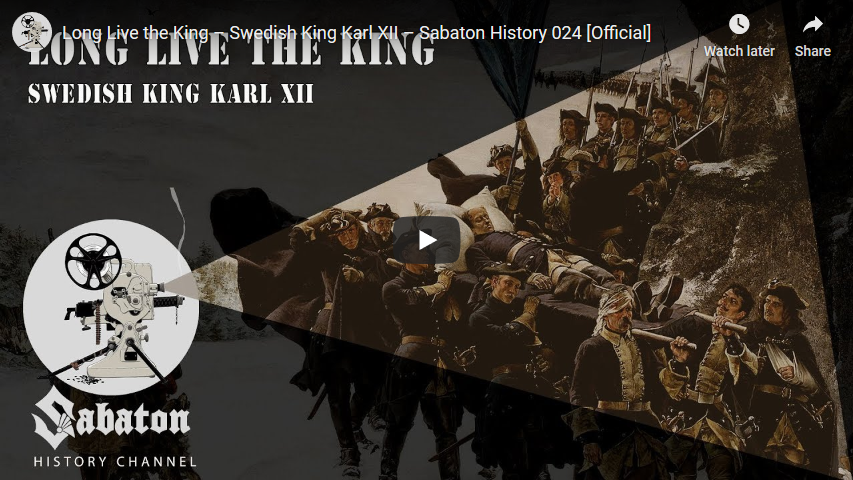
“Long Live the King” – Swedish King Karl XII – Sabaton History 024 [Official]

Filed under: Europe, History, Media, Military, Russia — Tags: , , , , , , — Nicholas @ 06:00

Sabaton History
Published on 18 Jul 2019

The Sabaton song “Long Live the King” is about the aftermath of the Battle of Poltava in June 1709. The future of Sweden lay in the hands of the parliament at home while the King was in voluntary exile with the Ottomans. What followed was a dark time in Swedish history where everything was uncertain, with an unexpectedly dark ending.

Support Sabaton History on Patreon: https://www.patreon.com/sabatonhistory

Listen to Carolus Rex (where “Long Live the King” is featured):
CD: http://bit.ly/CarolusRexStore
Spotify: http://bit.ly/CarolusRexSpotify
Apple Music: http://bit.ly/CarolusRexAppleMusic
iTunes: http://bit.ly/CarolusRexiTunes
Amazon: http://bit.ly/CarolusRexAmz
Google Play: http://bit.ly/CarolusRexGooglePlay

Check out the trailer for Sabaton’s new album The Great War right here: https://www.youtube.com/watch?v=HCZP1…

Hosted by: Indy Neidell
Written by: Markus Linke and Indy Neidell
Directed by: Astrid Deinhard and Wieke Kapteijns
Produced by: Pär Sundström, Astrid Deinhard and Spartacus Olsson
Creative Producer: Joram Appel
Executive Producers: Pär Sundström, Joakim Broden, Tomas Sunmo, Indy Neidell, Astrid Deinhard, and Spartacus Olsson
Maps by: Eastory
Edited by: Iryna Dulka
Sound Editing by: Marek Kaminski

Eastory YouTube Channel: https://www.youtube.com/channel/UCEly…
Archive by: Reuters/Screenocean https://www.screenocean.com
Music by Sabaton.

An OnLion Entertainment GmbH and Raging Beaver Publishing AB co-Production.

Sources:
– Photo of the bullet
– Bairuilong on Wikimedia Commons,
– Swedish National Museum

© Raging Beaver Publishing AB, 2019 – all rights reserved.

From the comments:

Sabaton History
2 days ago
THREE MORE NIGHTS! I think that most of you expected this episode to be from the new album that will be released next Friday, but as we all like a little unexpected Sabaton every now and then, we went with the 18th century instead. While we (of course) will continue with these videos, it feels like we have been working towards the 19th of July ever since we started this channel in February this year. Thank you all for being a part of this journey! We mean it when we say that this wouldn’t have been possible without all of you who watch our videos and especially those who support us on Patreon!

Forgotten History: Musée de Plans-Reliefs (Paris)

Filed under: France, History, Military — Tags: , , , , — Nicholas @ 04:00

Forgotten Weapons
Published on 18 Jul 2019

http://www.patreon.com/ForgottenWeapons

Cool Forgotten Weapons merch! http://shop.bbtv.com/collections/forg…

Hidden away up on the 4th floor of the Paris Army Museum (in Les Invalides) is the rather unexcitingly-named Musée de Plans-Reliefs. Up here in the dark is a collection of strategic dioramas dating back some 350 years. French King Louis XIV created a workshop to build these 1:600 sale models of the major fortifications around the French coast as a tool for planning military actions. Napoleon resumed the practice in the 1800s, and today the collection includes some 100 different models. Not all of these are on display, but they are quite large and intricately detailed. Truly a hidden gem of military history in the attic of the museum. If you have an opportunity to visit the Paris Musée d’Armée, don’t miss the chance to take an hour or so to see these!

http://www.museedesplansreliefs.cultu…

Contact:
Forgotten Weapons
PO Box 87647
Tucson, AZ 85754

Swiss 1929 Simplified Luger (Yes, Swiss and Simplified)

Filed under: Europe, Germany, History, Military, Weapons — Tags: , , , — Nicholas @ 02:00

Forgotten Weapons
Published on 15 May 2019

http://www.patreon.com/ForgottenWeapons

Cool Forgotten Weapons merch! http://shop.bbtv.com/collections/forg…

Switzerland was the first nation to adopt the Luger as a service pistol, and they purchased them DWM in Germany from 1900 until 1914. World War One stopped deliveries, of course, and after the war the Swiss opted to begin their own production at Waffenfabrik Bern. These Swiss Lugers have become known as the model 06/24 by collectors, and were made until 1933. During that time, Bern was looking for ways to simplify and economize their production, and these efforts came together with the development of the Model 1929. It actually entered production in 1934, and was made until 1947 with a total of about 28,000 made for the military and about 1,900 made for the civilian market.

The main mechanical change to the 1929 pattern was a lengthening of the grip safety. Other changes included simplifying the profile of the front strap of the grip, removing knurling and serrations on the controls, and only serializing four parts. A production date stamp was also added to the inside of the frame, however.

Contact:
Forgotten Weapons
PO Box 87647
Tucson, AZ 85754

QotD: “Re-imagining” Notre-Dame de Paris

Filed under: Architecture, France, History, Quotations, Religion — Tags: , , , — Nicholas @ 01:00

The monstrous regiment of modernists was so quick off the mark with their hideous, egomaniacal plans to rebuild the roof of Notre-Dame — one could not call any of their proposals a restoration — that I began to suspect that the fire that destroyed the roof was the result of a conspiracy by them. Gone were my suspicions that it was either Muslim terrorists or degenerate smokers who had set the fire, and my new hypothesis was perfectly reasonable. Modernists, after all, have done far more damage in the long run to the urban fabric of Europe than even the Second World War did; and it stands to reason that they, the modernists, would not want anything to escape their attentions for long, lest anything remain intact to shame by painful comparison their own wretched efforts.

So far their proposals have included apiaries and swimming pools, and all of them look like greenhouses for the cultivation of marijuana. And why not? After all, Baudelaire wrote a book about les paradis artificiels, that is to say those induced by psychoactive substances, and is not a spire an arrow pointing up to heaven? All conceptions of paradise are artificial in the sense than none of us has any direct knowledge of such a location; perhaps, in the spirit of ecumenical multiculturalism, a kind of Muslim-style paradise could be created under the glass roof (I shall refrain from describing it because young people might read this).

Of course, there is no end to the uses to which this prime space might be put. There could, for example, be a three-Michelin-star restaurant there. Think of the rent it would pay, the prices it could charge! The French state (which is responsible for the upkeep of the building) would — or at least could — be relieved of financial anxiety about it.

This proposal might be objected to because it would not be socially inclusive enough; the Pope would not countenance it because it would exclude illegal immigrants (except, perhaps, as plongeurs). The customers would be mainly wealthy foreigners, Russian oligarchs, Gulf oil sheikhs, and the like, and while this might assist with France’s yawning commercial deficit, it would do little for social justice, the ultimate aim of human existence, by which is meant the reduction of everything to the lowest common denominator.

Theodore Dalrymple, “What to Do With Notre-Dame?”, Taki’s Magazine, 2019-05-25.

July 18, 2019

Choose the best wood for your project

Filed under: Woodworking — Tags: , — Nicholas @ 06:00

Rex Krueger
Premiered 4 hours ago

More video and exclusive content: http://www.patreon.com/rexkrueger
(more…)

Andrew Coyne interviews NATO Secretary General Jens Stoltenberg

Filed under: Cancon, Europe, Military, Russia, USA — Tags: , , , , , — Nicholas @ 05:00

In the National Post, Andrew Coyne discusses NATO, Donald Trump, and Russia with the current Secretary General of NATO, Jens Stoltenberg:

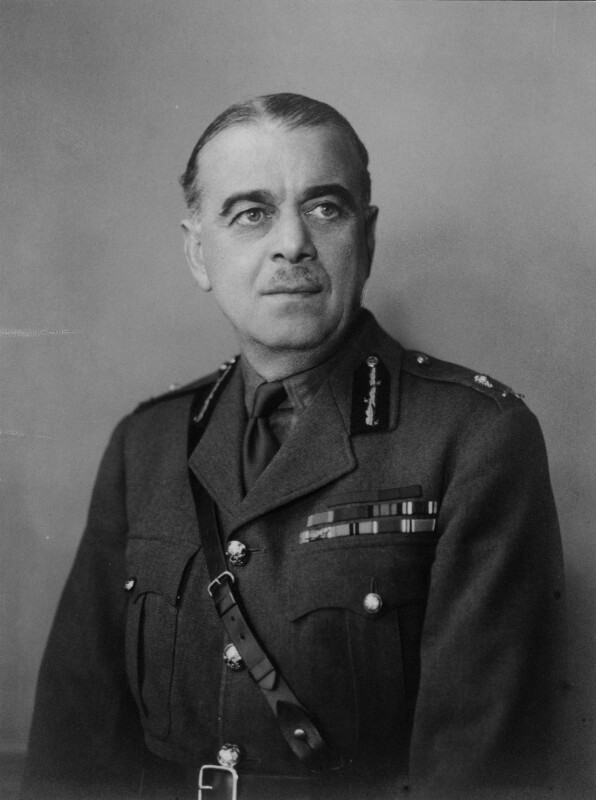
General Hastings “Pug” Ismay, later the first Secretary General of NATO during his military service as Winston Churchill’s chief military assistant in 1941.
Official British government photograph via Wikimedia Commons.

Throughout their term in government — and especially since Donald Trump’s victory in America’s 2016 election — Prime Minister Justin Trudeau’s Liberals have taken every opportunity to pay tribute to the “rules-based international order,” the consensus among countries that everyone’s interests are best served by following a set of rules and guiding principles that have evolved through the decades, expressed through things such as trade agreements and international alliances like the United Nations. If this consensus has a face it may be that of Jens Stoltenberg. The urbane former prime minister of Norway has been Secretary General of the North Atlantic Treaty Organization (NATO) since 2014, and through tough times for the international consensus he’s been one of the loudest voices defending it. This week he was in Canada to meet with Trudeau, to tour the Canadian Forces’ Garrison Petawawa and to discuss Canada’s NATO deployments in Latvia and Iraq. He sat down for an interview with the National Post‘s Andrew Coyne.

Q. Lord Ismay, NATO’s first secretary-general, famously defined the alliance’s mission as “keeping the Soviet Union out, the Americans in, and the Germans down.” When you hear some of the things Donald Trump says about NATO, about Article 5 (the collective defence provision) — are the Americans still in?

A. Yes. And they are more in now than they have been for a long time — meaning that they are actually increasing their NATO presence in Europe. After the end of the Cold War, Canada and the United States, for natural reasons, reduced their military presence in Europe. Because tensions went down, there was less need… Now tensions are increasing again, and both Canada and the United States are now increasing their military presence in Europe: Canada with a Canadian-led battle group in Latvia, and the United States with a battle group in Poland and also with a new armoured brigade. So what we see is that the United States is actually investing more in NATO, more military presence in Europe, more U.S. investments in infrastructure, in pre-positioned equipment, more exercises. So the message from the United States is that they are committed to NATO and we see that not only in words but also in deeds.

Q. But when you see Trump questioning the value of multilateral institutions, asserting “America First,” his chumminess with Putin, does it risk sending a signal that, if push came to shove — if Russia got up to no good in the Baltics or what have you — that America’s resolution to resist that would be less than certain?

A. For me the strongest possible signal to send is the presence of U.S. forces in Europe. The fact that we now, for the first time in the history of NATO, have U.S. troops in the eastern part of the alliance, in Poland and the Baltic countries. There is no way to send a clearer signal than that. And the Canadian troops because they are part of the picture. To have American troops in the Baltic countries sends a very clear signal that if a Baltic country is attacked it will trigger a response from the whole alliance… It’s not possible to imagine a stronger and clearer signal than that.

« Newer PostsOlder Posts »

Powered by WordPress