Quotulatiousness

July 24, 2019

Summer Stupidity: COPENHAGEN (City Review!)

Filed under: Europe, Food, Humour — Tags: , , , — Nicholas @ 06:00

Overly Sarcastic Productions
Published on 23 Jul 2019

It’s Copenhagen time! Hop on your bike and ride around one of Europe’s fanciest cities.

PATREON: https://www.Patreon.com/OSP

MERCH LINKS: https://www.redbubble.com/people/OSPY…

OUR WEBSITE: https://www.OverlySarcasticProductions.com
Find us on Twitter https://www.Twitter.com/OSPYouTube
Find us on Reddit https://www.Reddit.com/r/OSP/

Wait, you mean there might be a downside to cannabis legalization?

Filed under: Cancon, Health, Law, Liberty, USA — Tags: , , , , — Nicholas @ 05:00

As a libertarian of long standing, I’m on the record as being in favour of legalizing cannabis since long before it was cool (geeky and perpetually uncool libertarians probably helped keep it from being cool for at least a few years longer). I’m not enthused to hear that we may have been undersold on the risks of cannabis use … not that the government didn’t try telling is it was deadly, deadly poison (they did, repeatedly, and at great length), but they institutionalized the role of the boy who cried wolf, and every illegal narcotic got basically the same description. I’m actually not kidding here: the first health class I got in middle school included a lecture and a pamphlet on the dangers of pot; the second class covered the dangers of cocaine; the third warned against LSD; and so on … but they used a copy/paste to discuss the physical and mental risks of the different drugs, and they all read the same way. All those evil drugs are evil, bad, and rot your brain. Knowing that the pothead (“Hi, Gary!”) at the back of the class hadn’t suddenly had a psychotic break and tried to fly off the top of the school was the first hint that we were being oversold on the real world risks of (some) illegal drug use. The declared fact that some illegal narcotics actually are deadly, deadly poison ran up against the observed fact that a significant majority of people over the age of fifteen had tried cannabis and found it somewhat less scary than advertised.

Along with the beginnings of doubt that the government was being honest with us, and the clear understanding that even if using drugs wasn’t as dangerous as we were told, we shared a growing awareness that being caught with drugs by the police was significantly more dangerous and possibly deadly. Officer Friendly would shoot you down like a mad dog if he thought you were one’o’them drug-crazed hippies. It certainly changed the social dynamics of any interaction with Officer Friendly’s fellow heavily armed co-workers…

In the National Post, Barbara Kay suggests that not all the dangers of cannabis use were mere government propaganda:

Some years ago, in conversation with his wife, a forensic psychiatrist specializing in mentally ill criminals, former New York Times reporter Alex Berenson observed that the perpetrator of a recent violent crime had been high at the time, and had smoked pot regularly all his life. Her response — “Yeah, they all do” — jolted him. The result was his book, Tell Your Children: The Truth About Marijuana, Mental Illness and Violence.

Much of the referenced material in Berenson’s book had not yet been published a decade ago. But more recent studies only confirm what a few intrepid researchers were already warning about then.

Indeed, as I noted in a 2008 column, the head of the Medical research Council in the U.K., Professor Colin Blakemore, who in 1997 had been the moral authority behind a pot-legalization campaign, unequivocally reversed his pot-friendly stance in 2007, stating: “The link between cannabis and psychosis is quite clear now; it wasn’t 10 years ago.”

If you haven’t energy for a whole book, but would invest in 16 pages on the subject, you will be well rewarded by Steven Malanga’s in-depth article, “The Marijuana Delusion,” in City Journal‘s June issue. Here you will find debunked the blithe claim, still received as gospel by progressives and libertarians, that pot is virtually harmless and even therapeutic.

Unlike marijuana, real medications are deeply researched before coming on the market, and may attest to proven benefits, but are obligated to admit potential harms. Is pot a medicinal drug or a placebo? Nobody really knows. One may argue “who cares, as long as it works” (anecdotally I hear that pot works, and also that it doesn’t work), but that isn’t the point, since the legalization movement made medical claims for pot in order to bring the public onside politically. There was no will on the movement’s side to discover even radically fortified pot’s downsides.

The knowledge was out there for those interested. In 1987 a study of nearly 50,000 Swedish military conscripts followed for drug use over 15 years found that frequent pot use in teenhood was linked to a six-fold risk of schizophrenia as compared with non-usage. A 2004 meta-analysis of studies on pot use came to a similar conclusion. These studies, and others, are suggestive that heavy marijuana consumption, particularly in youth, may cause serious mental health problems. Yes, it is possible that the link isn’t entirely causal; people with mental health issues may be more likely to use marijuana heavily. But at the very least, this ought to be an issue of ongoing concern, particularly now that marijuana is legal in Canada and in an increasing number of U.S. states.

“[T]he debt ‘ceiling’ is about as sturdy and solid as those featured on those DIY home reno disaster shows”

Filed under: Economics, Government, Politics, USA — Tags: , , — Nicholas @ 03:00

Mark Steyn notes that yesterday’s the “big victory” over the debt ceiling (in President Trump’s words) could be almost the same as the “big victory” he wrote about eight years earlier:

The western front of the United States Capitol. The Neoclassical style building is located in Washington, D.C., on top of Capitol Hill at the east end of the National Mall. The Capitol was designated a National Historic Landmark in 1960.
Photo via Wikimedia Commons.

That thoughtful observer of the passing parade, Nancy Pelosi, weighed in on the “debt ceiling” negotiations the other day: “What we’re trying to do is save the world from the Republican budget. We’re trying to save life on this planet as we know it today.”

It’s always good to have things explained in terms we simpletons can understand. After a while, all the stuff about debt-to-GDP ratio and CBO alternative baseline scenarios starts to give you a bit of a headache, so we should be grateful to the House Minority Leader for putting it in layman’s terms: What’s at stake is “life on this planet as we know it today.” So, if right now you’re living anywhere in the general vicinity of this planet, it’s good to know Nancy’s in there pitching for you.

What about life on this planet tomorrow? How’s that look if Nancy gets her way? The Democrat model of governance is to spend four trillion dollars while only collecting two trillion, borrowing the rest from tomorrow. Instead of “printing money,” we’re printing credit cards and preapproving our unborn grandchildren. To facilitate this proposition, Washington created its own form of fantasy accounting: “baseline budgeting,” under which growth-in-government is factored in to federal bookkeeping as a permanent feature of life. As Arthur Herman of the American Enterprise Institute pointed out this week, under present rules, if the government were to announce a spending freeze – that’s to say, no increases, no cuts, everything just stays exactly the same – the Congressional Budget Office would score it as a $9 trillion savings. In real-world terms, there are no “savings,” and there’s certainly no $9 trillion. In fact, there isn’t one thin dime. But nevertheless that’s how it would be measured at the CBO.

Around the world, most folks have to work harder than that to save $9 trillion. That’s roughly the combined GDPs of Japan and Germany. But in America it’s an accounting device. This is something to bear in mind when you’re listening to the amount of “savings” touted by whatever triumphant bipartisan deal is announced at the eleventh hour in Washington.

So I find myself less interested in “life on this planet as we know it today” than in life on this planet as we’re likely to know it tomorrow if Nancy Pelosi and her chums decline to reacquaint themselves with reality. If you kinda dig life on this planet as you know it, ask yourself this: What’s holding the joint up? As the old gag goes, if you owe the bank a thousand dollars, you have a problem; if you owe the bank a million dollars, the bank has a problem. If you owe the banks 15,000,000,000,000 dollars, the planet has a problem. Whatever comparisons one might make with Europe’s soi-disant “PIIGS” re debt per capita or deficit-to-GDP ratio, the sheer hard numbers involved represent a threat to the planet that Portugal or Ireland does not. It also represents a threat to Americans. Three years ago, the first developed nation to hit the skids was Iceland. But, unless you’re Icelandic, who cares? And, if you are Icelandic, you hunker down, readjust to straitened circumstances, and a few years down the line Iceland will still be Iceland and, if that’s your bag, relatively pleasant.

That’s not an option for the U.S. We are chugging a highly toxic cocktail: 21st-century spendaholic government with mid-20th-century assumptions about American power. After the Battle of Saratoga, Adam Smith replied to a pal despondent that the revolting colonials were going to be the ruin of Britain: “There is a great deal of ruin in a nation,” said a sanguine Smith.

Sinking Ship Simulator: The Royal Navy’s Damage Repair Instructional Unit

Filed under: Britain, Military — Tags: , — Nicholas @ 02:00

Tom Scott
Published on Sep 7, 2015

http://tomscott.com – with many, many thanks to the Royal Navy and everyone at HMS Excellent! http://royalnavy.mod.uk

How do you train sailors to save a sinking ship? Sure, you can teach them the theory, but there’s no replacement for having to hammer softwood wedges into deck and bulkhead splits that are spraying cold, high-pressure water in your face.

At HMS Excellent in Portsmouth sits Hazard, a Royal Navy Damage Repair Instructional Unit (DRIU). Every Navy recruit who’s going out to sea will have to go through something like this — and on a much harder level than we did! But then, they’ll have had months of training and teamwork beforehand…

DIRECTED BY Matt Gray: http://mattg.co.uk – @unnamedculprit – see behind-the-scenes video at https://www.youtube.com/watch?v=zwlnb…

WITH:
Paul Curry – @cr3
Melinda Seckington – http://missgeeky.com – @mseckington

And again, with many thanks to all the Navy team who were so generous with their time and effort: http://royalnavy.mod.ukhttp://twitter.com/royalnavy

QotD: The failure of the Republican cause in the Spanish Civil War

Filed under: Europe, History, Military, Quotations — Tags: , , , , — Nicholas @ 01:00

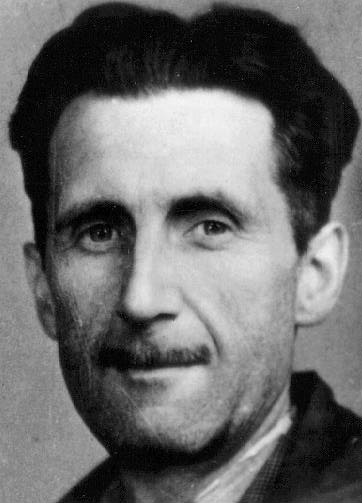
Orwell’s press card portrait, 1943

The backbone of the resistance against Franco was the Spanish working class, especially the urban trade union members. In the long run — it is important to remember that it is only in the long run — the working class remains the most reliable enemy of Fascism, simply because the working-class stands to gain most by a decent reconstruction of society. Unlike other classes or categories, it can’t be permanently bribed.

To say this is not to idealize the working class. In the long struggle that has followed the Russian Revolution it is the manual workers who have been defeated, and it is impossible not to feel that it was their own fault. Time after time, in country after country, the organized working-class movements have been crushed by open, illegal violence, and their comrades abroad, linked to them in theoretical solidarity, have simply looked on and done nothing; and underneath this, secret cause of many betrayals, has lain the fact that between white and coloured workers there is not even lip-service to solidarity. Who can believe in the class-conscious international proletariat after the events of the past ten years? To the British working class the massacre of their comrades in Vienna, Berlin, Madrid, or wherever it might be seemed less interesting and less important than yesterday’s football match. Yet this does not alter the fact that the working class will go on struggling against Fascism after the others have caved in. One feature of the Nazi conquest of France was the astonishing defections among the intelligentsia, including some of the left-wing political intelligentsia. The intelligentsia are the people who squeal loudest against Fascism, and yet a respectable proportion of them collapse into defeatism when the pinch comes. They are far-sighted enough to see the odds against them, and moreoever they can be bribed — for it is evident that the Nazis think it worth while to bribe intellectuals. With the working class it is the other way about. Too ignorant to see through the trick that is being played on them, they easily swallow the promises of Fascism, yet sooner or later they always take up the struggle again. They must do so, because in their own bodies they always discover that the promises of Fascism cannot be fulfilled. To win over the working class permanently, the Fascists would have to raise the general standard of living, which they are unable and probably unwilling to do. The struggle of the working class is like the growth of a plant. The plant is blind and stupid, but it knows enough to keep pushing upwards towards the light, and it will do this in the face of endless discouragements. What are the workers struggling for? Simply for the decent life which they are more and more aware is now technically possible. Their consciousness of this aim ebbs and flows. In Spain, for a while, people were acting consciously, moving towards a goal which they wanted to reach and believed they could reach. It accounted for the curiously buoyant feeling that life in Government Spain had during the early months of the war. The common people knew in their bones that the Republic was their friend and Franco was their enemy. They knew that they were in the right, because they were fighting for something which the world owed them and was able to give them.

One has to remember this to see the Spanish war in its true perspective. When one thinks of the cruelty, squalor, and futility of War — and in this particular case of the intrigues, the persecutions, the lies and the misunderstandings — there is always the temptation to say: “One side is as bad as the other. I am neutral”. In practice, however, one cannot be neutral, and there is hardly such a thing as a war in which it makes no difference who wins. Nearly always one stands more or less for progress, the other side more or less for reaction. The hatred which the Spanish Republic excited in millionaires, dukes, cardinals, play-boys, Blimps, and what-not would in itself be enough to show one how the land lay. In essence it was a class war. If it had been won, the cause of the common people everywhere would have been strengthened. It was lost, and the dividend-drawers all over the world rubbed their hands. That was the real issue; all else was froth on its surface.

George Orwell, “Looking back on the Spanish War”, New Road, 1943 (republished in England, Your England and Other Essays, 1953).

July 23, 2019

How Does It Work: Direct Gas Impingement

Filed under: History, Military, Technology, Weapons — Tags: , , — Nicholas @ 02:00

Forgotten Weapons
Published on 21 May 2019

Interested in small arms history? Make sure to pre-order a copy of my book, Chassepot to FAMAS: French Military Rifles 1866 – 2016:

https://www.kickstarter.com/projects/…

Direct gas impingement is an operating system that has been used only in a few production guns (all of them rifles). It is extremely simple, although perhaps not well suited to adjustability. It is also not the operating system of the AR series of rifles – we will cover those in a separate video.

http://www.patreon.com/ForgottenWeapons

Cool Forgotten Weapons merch! http://shop.bbtv.com/collections/forg…

Contact:
Forgotten Weapons
PO Box 87647
Tucson, AZ 85754

QotD: Science of the ancient Greeks

Filed under: Books, Greece, History, Quotations, Science — Tags: , , , , — Nicholas @ 01:00

… discussions that mention the Great Library and/or the supposed impact of Christianity on “progress”, with the idea being that the Scientific and Industrial Revolutions were due on some kind of inevitable deterministic historical timetable but were wantonly derailed “for a thousand years” by the destruction of the Great Library, which is supposedly why we don’t live on the moons of Jupiter.

The problem with all this is not just that the scholars of the Mouseion were rather more interested in the textual variants of Pindar’s paianes than studying physics, but also a common modern misunderstanding about the nature of Greek “science”. Many modern people, including modern scientists, hear about the Greeks discussing motion or “atoms” or doing geometry to measure the circumference of the Earth or the distance to the Sun and assume that they were doing “science” in the modern sense of the word. Historians also sometimes refer to Greek natural philosophy as “science” and popularisations of the history of science draw simplistic direct lines between things like Greek discussions of “atoms” and modern atomic theory. But this obscures the fact that Greek proto-science was, while a distant lineal ancestor of the modern sciences, very unlike them in many important respects. At best, it was a highly rational attempt at understanding fundamental precepts of the physical and natural world. But it used induction and common sense more than measurement and experiment. There were exceptions (mainly in geometry and its related field, astronomy), but the Greeks were usually not interested in empirical measurement and so were usually even less interested in genuine experiments. Most Greek proto-science was a highly abstract and philosophical affair, based on some observations, but without modern ideas of carefully designed and repeatable experiments with calibrated measurement and attendant mathematics. Most of their “science” was done by sitting around, thinking and talking about concepts, not by actually dropping weights from towers – though they did do thought experiments which sometimes led to correct conclusions and sometimes did not. Their “science” was not our science.

This means that a Greek conversation about “atoms” was largely an abstract and metaphysical exercise about the philosophical nature of a thing and how many times it could be divided conceptually and what this may mean; the word comes from the Greek ἄτομος meaning “unhewn, uncut, indivisible”. No Greek philosopher walked away from such a conversation and decided to try to build some equipment to explore the physical nature of atomic structure and would probably have considered such an idea absurd. Nor would they have taken the step of considering that different forms of matter, liquid or gas were made up of different combinations of atoms and so decide to experiment with these substances to understand this better, since this was completely contrary to their (erroneous) conception of the “Four Elements” of Earth, Air, Water and Fire. The nature of Greek thought did allow them to draw useful and often correct conclusions about the physical universe, but it also set up barriers to the true scientific method that they simply did not and could not cross.

This was one of the reasons there was no direct link between their proto-scientific “science” and technology. Natural philosophy was, as the term would suggest, the preserve of philosophers. In a world where most of the population had to be devoted to agricultural production and most of the rest often barely got by, sitting around and talking about abstractions like “atoms” was a rich man’s luxury. Most philosophers either came from the upper class (though maybe its lower echelons in many cases) or had rich patrons or both, which meant most philosophers had little interest in making or inventing things: that was generally the preserve of lowly mechanics and slaves. Again, there were exceptions to this – Archimedes seems to have had some interest in the engineering applications of his ideas, even if most of the inventions attributed to him are probably legends. On the whole, however, lofty Greek philosophers didn’t think to soil their hands with something as lowly as inventing and making things.

Tim O’Neill, “The Great Myths 5: The Destruction Of The Great Library Of Alexandria”, History for Atheists, 2017-07-02.

July 22, 2019

Joan of Arc – The Maid of Orleans – Extra History – #3

Filed under: Britain, France, History, Military, Religion — Tags: , , , — Nicholas @ 06:00

Extra Credits
Published on 20 Jul 2019

Join us on Patreon! http://bit.ly/EHPatreon

When Joan met the army of Orleans, they weren’t exactly keen on her idea to just GET ‘EM and go completely offensive — thinking she would have more use as a mascot. But both they, and she, would be in for many surprises…

FAL in the North: The Canadian C1A1

Filed under: Cancon, History, Military, Weapons — Tags: , , , , — Nicholas @ 04:00

Forgotten Weapons
Published on 19 Jul 2019

http://www.patreon.com/ForgottenWeapons

Cool Forgotten Weapons merch! http://shop.bbtv.com/collections/forg…

Canada was the first country to adopt the FAL rifle, purchasing trials rifles from FN within weeks of the formal standardization of the 7.62mm NATO cartridge. Canada acquired production rights to the rifle along with the technical package from FN, and spent 18 months converting the drawings into 1st-angle inch pattern (which would be used by the rest of the Commonwealth nations subsequently). Both a C1 rifle pattern and a C2 LMG pattern were made, although today we are looking at just the C1.

The first production was a run of 20 toolroom prototypes, one of which we have in today’s video. After a few changes were made – most distinctively to the rear sight – full-scale production commenced. Over the following years, a few minor changes were made, and a slightly improved C1A1 pattern adopted. These would service the Canadian military until eventually replaced with the C7 rifles.

Contact:
Forgotten Weapons
PO Box 87647
Tucson, AZ 85754

No Flag Northern Ireland

Filed under: Britain, Europe, History, Politics — Tags: , , , , — Nicholas @ 02:00

CGP Grey
Published on 18 Jun 2019

Northern Ireland’s officially unofficial flag.

QotD: Vivid vacation memories

Filed under: Quotations, Science — Tags: , — Nicholas @ 01:00

While on an adventurous holiday, many people experience that strange sense of time having slowed down in the most pleasurable way, and of conversations that begin, “Was it really only yesterday that we …?”

Ten days in a far-off land produces a richer treasury of detailed memories than 10 weeks back home. But what is behind this phenomenon? And does it teach us something about living a full life?

One answer comes from Claude Shannon, a titan of computer science still under-appreciated outside his field. In 1948, Shannon published one of his two profound contributions, A Mathematical Theory of Communication.

One of the implications of Shannon’s theory is that a message can be compressed to the extent that it is predictable. Anyone who has played the guessing game of Hangman knows that once a few letters are in place, the remainder are usually easy to guess. Similarly: sntnces wth vwls rmvd sty cmprhsbl. Ritualised conversations (“How are you?” “Very well, thank you. How are you?”) can be heavily compressed; poetry, perhaps, less so.

A movie can be compressed because, between cuts, each frame tends to resemble the previous one. A compression algorithm can start with the first frame after the cut and store a series of “diffs” — changes from the previous frame. The faster and more dramatic the movement or transitions, the harder a video is to compress, because the diffs are almost as big as the original frames.

Although the parallel is not exact, much the same thing seems to be going on with our memories of life. The brain is not a video recorder; we recall the gist. Sometimes the gist is very brief. If I get up in the morning at the usual time, eat my customary breakfast and catch my usual train to the office, why should my brain trouble itself to remember this day two weeks after the fact? The diffs are barely worth bothering with. In contrast, fresh experiences defy compression: the diffs are too big.

Tim Harford, “Why going on holiday gives us more memories”, Financial Times, 2019-04-26.

July 21, 2019

Good People on Both Sides? – WW2 – 047 – July 20 1940

World War Two
Published on 20 Jul 2019

Peace seems to slowly return to the European mainland, but not for long, as the Germans move their airplanes to the French coast to Battle Britain in the skies while they make invasion plans, and the Soviets are entering the Baltics after ‘elections’ invited them to.

Join us on Patreon: https://www.patreon.com/TimeGhostHistory
Or join The TimeGhost Army directly at: https://timeghost.tv

Follow WW2 day by day on Instagram @World_war_two_realtime https://www.instagram.com/world_war_t…
Join our Discord Server: https://discord.gg/D6D2aYN.
Between 2 Wars: https://www.youtube.com/playlist?list…
Source list: http://bit.ly/WW2sources

Written and Hosted by: Indy Neidell
Produced and Directed by: Spartacus Olsson and Astrid Deinhard
Executive Producers: Bodo Rittenauer, Astrid Deinhard, Indy Neidell, Spartacus Olsson
Creative Producer: Joram Appel
Post production director:Wieke Kapteijns
Research by: Indy Neidell
Edited by: Marek Kaminski
Map animations: Eastory

Colorisations by Norman Stewart and Julius Jääskeläinen https://www.facebook.com/JJcolorization/

Eastory’s channel: https://www.youtube.com/channel/UCEly…
Archive by Screenocean/Reuters https://www.screenocean.com.

A TimeGhost chronological documentary produced by OnLion Entertainment GmbH.

Debunking the “common wisdom” about the “Scopes Monkey Trial”

Filed under: Education, History, Law, Media, USA — Tags: , , , , , , — Nicholas @ 05:00

Mark Pulliam explains what really caused the “Scopes Monkey Trial” and what was at stake … which doesn’t match up well at all against what little most people will remember about it today:
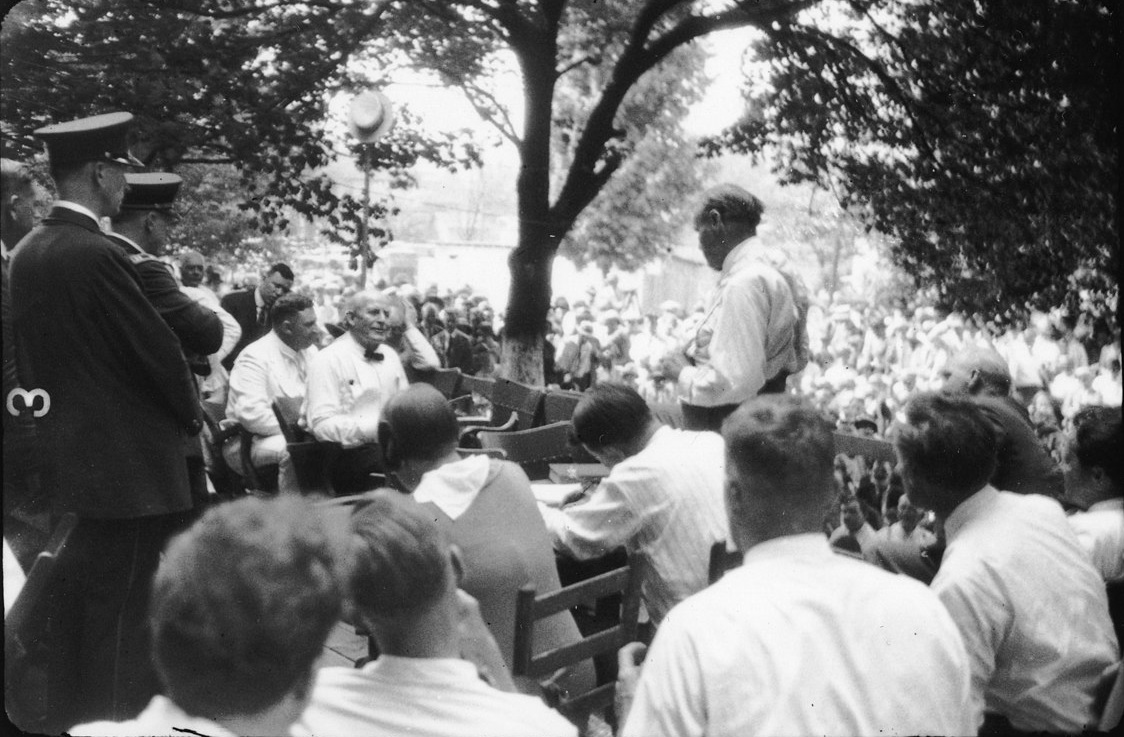
William Jennings Bryan (seated at left) being interrogated by Clarence Darrow, during the trial of the State of Tennessee v. John Thomas Scopes, July 20, 1925. That Monday afternoon, because of the extreme heat, Judge Raulston moved court proceedings outdoors. The session was held on a platform that had been erected at the front of the Rhea County Courthouse to accommodate ministers who wanted to preach during the time of the trial. Defense lawyers for Scopes (John R. Neal, Arthur Garfield Hays, and Dudley Field Malone) are visible seated to the extreme right. One of the men at left, with his back to the photographer, appears to be Scopes. The court reporters are seated at the table.
Photograph by Watson Davis via Wikimedia Commons.

We are again in another contentious period in America where battles over our culture and how we should live together are acrimonious. But there have been many points in our history that indicate we are only re-engaging a form of politics that is quintessentially American. One prominent past episode that occurred in Dayton, Tennessee during the summer of 1925 — the so-called “Scopes Monkey Trial” — has captured the American imagination like few legal proceedings ever have. Noted trial lawyer Clarence Darrow was part of the large legal team representing a 24-year-old substitute high school teacher, John Thomas Scopes, who was accused of violating the state’s Butler Act, which prohibited the teaching of evolution in a state-funded school. The celebrity co-prosecutor was William Jennings Bryan, the three-time Democratic presidential nominee, former Nebraska congressman, and Secretary of State to President Woodrow Wilson. Both Darrow and Bryan were prominent Progressive figures. Bryan, a left-wing evangelical and a fiery orator, is best known for his “Cross of Gold” speech at the 1896 Democratic National Convention.

The trial provided an opportunity for Darrow, whose reputation had been sullied by questionable tactics employed in the defense of radical labor leaders, to vindicate himself before a national audience. Chicago’s WGN radio station broadcast the trial nationwide and hundreds of reporters, some of them from overseas, covered the case. Geoffrey Cowan, author of the exhaustively-researched book The People v. Clarence Darrow, notes that Darrow achieved national notoriety, “won the support of Eastern sophisticates,” and “found new acceptance” as a result of the widely-publicized trial, especially his alleged humiliation of Darrow’s “old hero,” Bryan. This canard, which formed the dramatic crux of the 1960 movie Inherit the Wind, a highly-fictionalized depiction of the trial adapted from the 1955 play written by Jerome Lawrence and Robert E. Lee, is just one aspect of the popular mythology that surrounds the case.

Almost all of the “conventional wisdom” concerning the Scopes trial is false. Contrary to the impression created by Inherit the Wind and other popular accounts (including the sensational reportage of H. L. Mencken of The Baltimore Sun, one of the leading journalists of his day), the trial was not a fundamentalist inquisition, but an ill-conceived publicity stunt by Dayton businessmen who were trying to attract tourists to the small town — to put Dayton on the map. To generate a test case challenging the statute, the American Civil Liberties Union had offered to defend any teacher charged with violating the Butler Act, gratis. Dayton businessmen recruited Scopes to agree to serve as the defendant, even though he was unsure he had actually taught evolution. Nonetheless, Scopes volunteered to be charged. The trial — for a misdemeanor offense — was staged. Celebrity lawyers were solicited to participate for the sole purpose of increasing public interest in the case. The Baltimore Sun paid part of the defense’s expenses because it knew that the spectacle would sell newspapers, and it did. A lot of them.

I think it would be fair to say that H.L. Mencken had a passionate dislike for William Jennings Bryan, even after Bryan’s death a few days later:

It is the national custom to sentimentalize the dead, as it is to sentimentalize men about to be hanged. Perhaps I fall into that weakness here. The Bryan I shall remember is the Bryan of his last weeks on earth — broken, furious, and infinitely pathetic. It was impossible to meet his hatred with hatred to match it. He was winning a battle that would make him forever infamous wherever enlightened men remembered it and him. Even his old enemy, Darrow, was gentle with him at the end. That cross-examination might have been ten times as devastating. It was plain to everyone that the old Berserker Bryan was gone — that all that remained of him was a pair of glaring and horrible eyes.

But what of his life? Did he accomplish any useful thing? Was he, in his day, of any dignity as a man, and of any value to his fellow-men? I doubt it. Bryan, at his best, was simply a magnificent job-seeker. The issues that he bawled about usually meant nothing to him. He was ready to abandon them whenever he could make votes by doing so, and to take up new ones at a moment’s notice. For years he evaded Prohibition as dangerous; then he embraced it as profitable. At the Democratic National Convention last year he was on both sides, and distrusted by both. In his last great battle there was only a baleful and ridiculous malignancy. If he was pathetic, he was also disgusting.

Bryan was a vulgar and common man, a cad undiluted. He was ignorant, bigoted, self-seeking, blatant and dishonest. His career brought him into contact with the first men of his time; he preferred the company of rustic ignoramuses. It was hard to believe, watching him at Dayton, that he had traveled, that he had been received in civilized societies, that he had been a high officer of state. He seemed only a poor clod like those around him, deluded by a childish theology, full of an almost pathological hatred of all learning, all human dignity, all beauty, all fine and noble things. He was a peasant come home to the dung-pile. Imagine a gentleman, and you have imagined everything that he was not.

H/T to “WarEagle82” for the link.

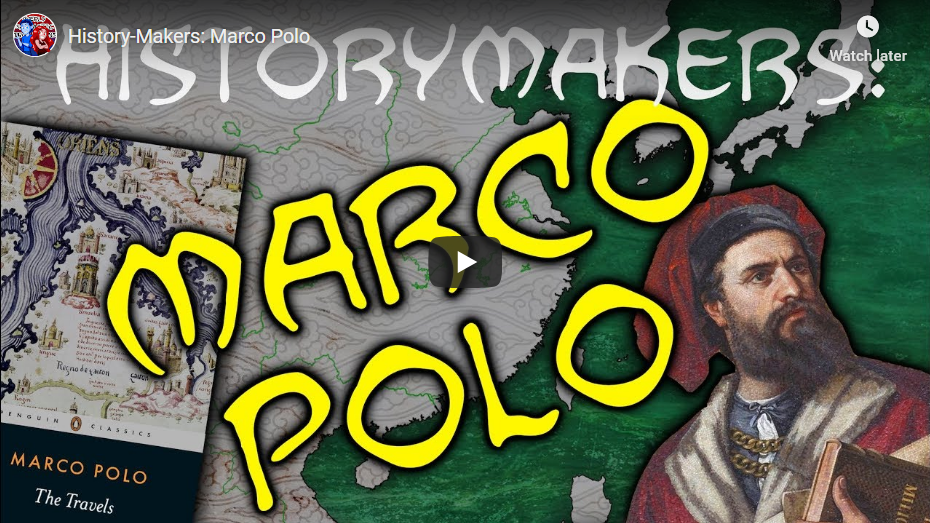
History-Makers: Marco Polo

Filed under: China, Europe, History, Humour — Tags: , , , , , , — Nicholas @ 04:00

Overly Sarcastic Productions
Published on 19 Jul 2019

Go to https://NordVPN.com/overlysarcastic and and use code OVERLYSARCASTIC to get 75% off a 3 year plan and an extra month for free. Protect yourself online today!

On this episode of History-Makers, Blue takes a trip alongside the legendary explorer Marco Polo to figure out how the intrepid Venetian merchant made his way to the Mongol Empire and back, and what that means for his written account of those Travels.

What History-Maker do you want to see next? Leave a comment!

NEW MERCH: “Let’s Do Some History” — https://www.redbubble.com/people/ospy…
NEW STORE: https://www.redbubble.com/people/OSPY…

PATREON: https://www.Patreon.com/OSP

OUR WEBSITE: https://www.OverlySarcasticProductions.com
Find us on Twitter https://www.Twitter.com/OSPYouTube
Find us on Reddit https://www.Reddit.com/r/OSP/

The humble egg – wonder food or deadly poison?

Filed under: Food, Health, Media, Science — Tags: , , , , , — Nicholas @ 03:00

If you’ve paid any attention to popular reporting on nutrition studies over the years, you’ll have noticed how just about any advice on food has not only changed, but has often been completely the opposite of advice offered just a few years earlier. During my teenage years, the egg was pushed (thanks in part to the “Egg Marketing Board”, one of Canada’s supply management bureaucracies) as “the perfect food”. During the next decade, as newer nutrition studies were published, suddenly the wonderful, nutritious egg was now a huge risk to your cardiovascular health and even one egg per week might be enough to kill you. Rinse and repeat for so many other foods and you either stop eating altogether or, more sensibly, stop paying any attention at all to mainstream media interpretations of nutrition studies.

It’s been a tortuous path for the humble egg. For much of our history, it was a staple of the American breakfast — as in, bacon and eggs. Then, starting in the late 1970s and early 1980s, it began to be disparaged as a dangerous source of artery-clogging cholesterol, a probable culprit behind Americans’ exceptionally high rates of heart attack and stroke. Then, in the past few years, the chicken egg was redeemed and once again touted as an excellent source of protein, unique antioxidants like lutein and zeaxanthin, and many vitamins and minerals, including riboflavin and selenium, all in a fairly low-calorie package.

This March, a study published in JAMA put the egg back on the hot seat. It found that the amount of cholesterol in a bit less than two large eggs a day was associated with an increase in a person’s risk of cardiovascular disease and death by 17 percent and 18 percent, respectively. The risks grow with every additional half egg. It was a really large study, too — with nearly 30,000 participants — which suggests it should be fairly reliable.

So which is it? Is the egg good or bad? And, while we are on the subject, when so much of what we are told about diet, health, and weight loss is inconsistent and contradictory, can we believe any of it?

Quite frankly, probably not. Nutrition research tends to be unreliable because nearly all of it is based on observational studies, which are imprecise, have no controls, and don’t follow an experimental method. As nutrition-research critics Edward Archer and Carl Lavie have put it, “‘Nutrition’ is now a degenerating research paradigm in which scientifically illiterate methods, meaningless data, and consensus-driven censorship dominate the empirical landscape.”

Other nutrition research critics, such as John Ioannidis of Stanford University, have been similarly scathing in their commentary. They point out that observational nutrition studies are essentially just surveys: Researchers ask a group of study participants — a cohort — what they eat and how often, then they track the cohort over time to see what, if any, health conditions the study participants develop.

H/T to Marina Fontaine for the link.

« Newer PostsOlder Posts »

Powered by WordPress