Quotulatiousness

August 20, 2019

Mini Workbench (Extendable) – Scrapwood Challenge Ep18

Filed under: Woodworking — Tags: — Nicholas @ 02:00

Pask Makes
Published on 17 Nov 2018

Plans for my Mini Workbench are now available here http://paskmakes.com/plans/

I’ve wanted to build a Mini Workbench for a long time and now I finally got around to it. Another project, hopefully in the near future is an outdoor workbench that will have no vices. That’s the reason I’ve built this Mini Extendable Workbench. I’ll be able to clamp it onto the outdoor bench and have lots of clamping options with the vice and dogs!

I didn’t go into too much detail with the vice build as I’ve already covered that in previous videos.

As always I’m happy to answer any questions.

If you would like to support this channel you can do so here
https://www.patreon.com/PaskMakes

You can also help me out by purchasing one of my shirts, you can find them here https://paskmakes.threadless.com

Check out my new website
http://paskmakes.com/

Check out my Instagram to see more of my work https://www.instagram.com/paskmakes/

Also you can check out my photography at my website (nothing to do with making but you may be interested in what I do) http://www.neilpaskin.com

My email can be found in the about section of this channel.
For real mail,

Pask Makes
P.O BOX 768
Yandina
Queensland
4561
Australia

QotD: Autobiography

Filed under: Books, Europe, History, Quotations — Tags: , , , — Nicholas @ 01:00

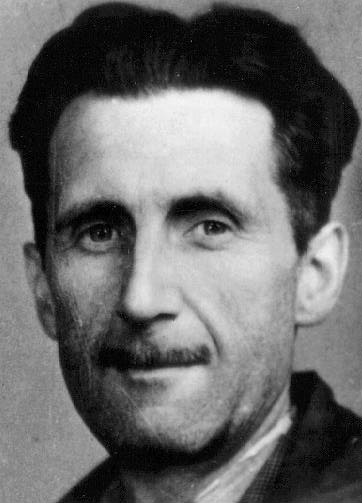
Orwell’s press card portrait, 1943

Autobiography is only to be trusted when it reveals something disgraceful. A man who gives a good account of himself is probably lying, since any life when viewed from the inside is simply a series of defeats. However, even the most flagrantly dishonest book (Frank Harris‘s autobiographical writings are an example) can without intending it give a true picture of its author. Dali’s recently published [The Secret Life of Salvador Dali] comes under this heading. Some of the incidents in it are flatly incredible, others have been rearranged and romanticised, and not merely the humiliation but the persistent ordinariness of everyday life has been cut out. Dali is even by his own diagnosis narcissistic, and his autobiography is simply a strip-tease act conducted in pink limelight. But as a record of fantasy, of the perversion of instinct that has been made possible by the machine age, it has great value.

George Orwell, “Benefit of Clergy: Some Notes on Salvador Dali”, Saturday Book for 1944, 1944.

August 19, 2019

The Peterloo Massacre

Filed under: Britain, History, Liberty, Military, Politics — Tags: , , , — Nicholas @ 05:00

In Spiked on Friday, Brendan O’Neill marked the 200th anniversary of a brutal suppression of thousands of protestors demanding the right to vote in Britain:

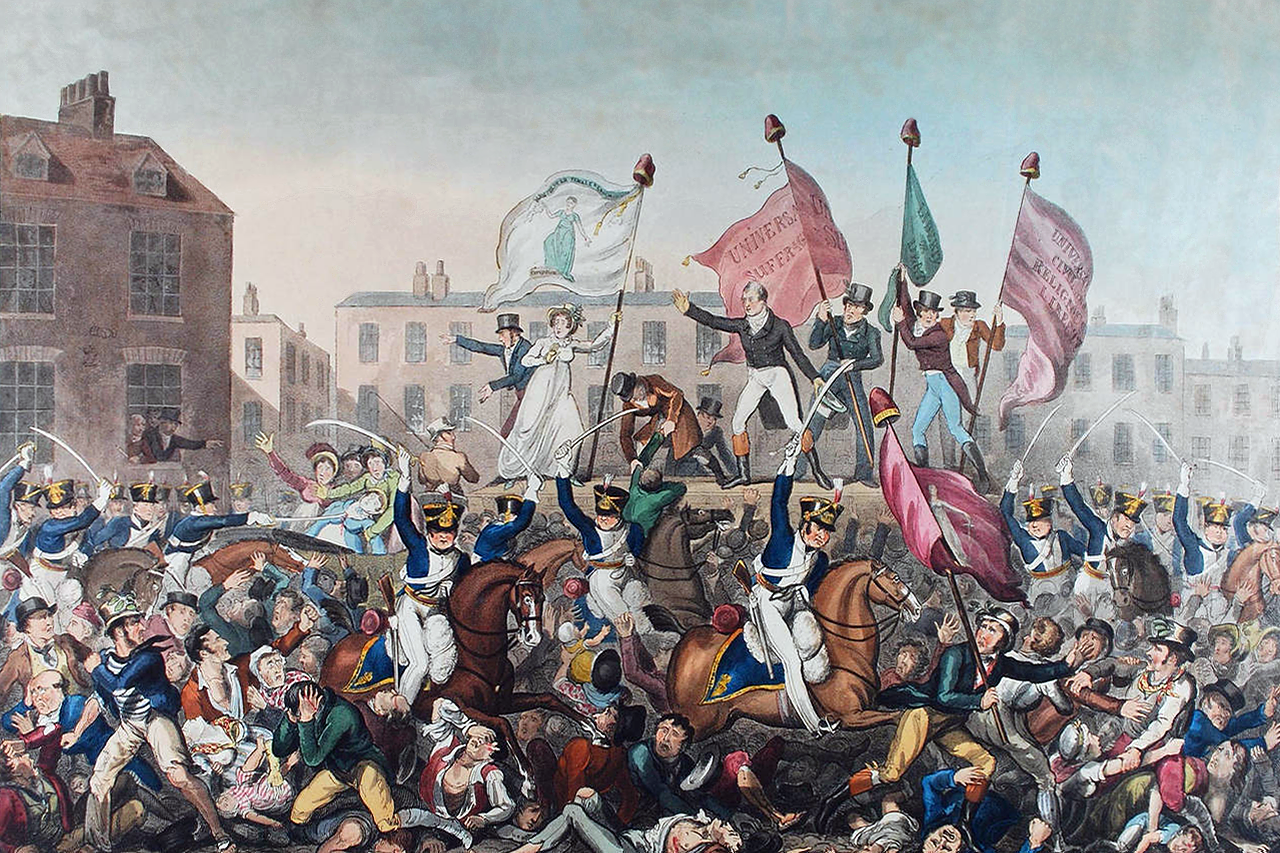
The Peterloo Massacre by Richard Carlile (1790-1843)
To Henry Hunt, Esq., as chairman of the meeting assembled in St. Peter’s Field, Manchester, sixteenth day of August, 1819, and to the female Reformers of Manchester and the adjacent towns who were exposed to and suffered from the wanton and fiendish attack made on them by that brutal armed force, the Manchester and Cheshire Yeomanry Cavalry, this plate is dedicated by their fellow labourer, Richard Carlile: a coloured engraving that depicts the Peterloo Massacre (military suppression of a demonstration in Manchester, England by cavalry charge on August 16, 1819 with loss of life) in Manchester, England.

All the poles from which banners are flying have Phrygian caps or liberty caps on top. Not all the details strictly accord with contemporary descriptions; the banner the woman is holding should read: Female Reformers of Roynton — “Let us die like men and not be sold like slaves”.
Manchester Library Services via Wikimedia Commons.

Today is the 200th anniversary of the Peterloo Massacre, when working people in Manchester were attacked and murdered by cavalry forces for daring to demand the right to vote. And what is our political class doing on this anniversary of such an important event in British political history? They are plotting, tirelessly, to overthrow something that millions of working-class people, and others, voted for: Brexit. They are doing what the Peterloo butchers did, only by political means and court cases rather than with bayonets and sabres. Our current political rulers may not physically attack the masses for having the temerity to use their democratic voices — not yet, anyway — but they view us with the exact same seething, elitist contempt as those who did attack the masses in St Peter’s Field on 16 August 1819.

Around 60,000 men, women and children gathered in St Peter’s Field in Manchester 200 years ago to demand parliamentary representation. They wanted that most basic and essential democratic right: the right to vote. The teeming industrial city of Manchester had no elected MPs in parliament. The old “rotten boroughs” system meant that often sparsely populated rural areas sent MPs to the Commons, involving much patronage and sometimes even the buying of votes by wealthy aspiring politicians, while newly industrialised cities full of the growing urban working classes had little to no political representation. Against a background of post-Napoleonic Wars economic depression and a fast-spreading radical desire for meaningful democratic change, the tens of thousands of marchers arrived in St Peter’s Field with a clear demand: let us vote, let us speak.

What happened next is well known. They were attacked by cavalry forces. Troops on horseback wielded sabres against the democratic crowd. They slashed and stabbed, killing 18 people. Around 500 were injured. The slaughter was given the name “Peterloo” as an ironic comparison to the Battle of Waterloo that took place four years earlier, in 1815. The bourgeoisie’s assault on the working-class democrats of Manchester had a deep impact on the radical psyche. New movements emerged in subsequent years, including the Chartists, the working-class movement for democratic representation. But it would be decades before the right to vote had been established across society. In 1867 some working-class men got the right to vote. In 1918, all men and some women got the right to vote. In 1928, finally all women got the vote. The General Election of 1929, 110 years after the march to St Peter’s Field, was the first election in which all adults had the right to vote.

The 200th anniversary of this bloody assault on working-class democrats ought to be a major occasion. It should be a reminder of the incredible, heroic sacrifices earlier generations made to secure people’s right to express themselves, to vote, and to see their votes be enacted. And yet while some in the political and media class will today pay lip service to the heroes of St Peter’s Field and express regret about the massacre of 18 of them, most of the elites will be too busy to do anything of the kind. Busy doing what? Trying to override and crush the votes of 17.4million people, which includes millions of working-class people and eight million women. It is a genuinely alarming and revealing moment: the 200th anniversary of the Peterloo Massacre arrives and the political set is engaged in an effective coup against the people; in a war against “No Deal Brexit” (which really just means a war against Brexit); in a concerted effort to force the ignorant public, as they see us, to vote for a second time and to give the “right” answer on this occasion.

Joan of Arc – Lies – Extra History

Filed under: Britain, France, History, Religion — Tags: , , , , — Nicholas @ 04:00

Extra Credits
Published on 17 Aug 2019

Writer Rob Rath talks about all the cool stories and facts we didn’t get to cover in our recent series on the hated and beloved Joan of Arc.

Join us on Patreon! http://bit.ly/EHPatreon

From the comments:

Extra Credits
2 days ago

Recommended reading:

Joan of Arc: A History, by Helen Castor

Joan of Arc by Herself and Her Witnesses, by Régine Pernoud

Orléans, 1429: France Turns the Tide, by David Nicolle

4:01 – really cool side characters that didn’t make the final video script (but did show up in Game of Thrones??)

8:12 – multiple versions of Joan’s meeting with Charles

10:48 – all the other famous people we didn’t mention, including Gilles de Rais

13:11 – Joan really did have excellent tactical acumen, which we had to gloss over in her later battles

19:55 – what’s next on Extra History

21:17 – Six Degrees of Walpole

UBI: threat or menace?

Filed under: Economics, Government, Politics — Tags: , , , — Nicholas @ 03:00

At Samizdata, Samizdata Illuminatus outlines the arguments for some form of Universal Basic Income (UBI) or Negative Income Tax (NIT) and argues that it’s a terrible idea that should not be implemented anywhere:

Cartoon that appeared with Michael K. Spencer’s article “Is Universal Basic Income really a solution?” at https://medium.com/@Michael_Spencer/is-universal-basic-income-really-a-solution-c0d6d95f100e

For those that are not familiar with the term, UBI (Universal Basic Income) means, roughly, “the government should guarantee everyone some minimum level of income whether they work or not”.

The notion began simply enough. Some economists observed that there are a myriad of intersecting government programs for the poor (in many countries, dozens) which distort behaviour in horrible ways and which cost a fortune in overhead to administer. This is where the problem of UBI begins, in the hubris of the armchair philosopher. “What if”, these economists asked, “we can’t get rid of the dole entirely (even though that would be better) but we could at least make it efficient by replacing the entire morass with a single program, say a negative income tax?”

Trained to explore ideas (no matter how bad) for a living, said academic economists then vigorously explored this impossible hypothetical world in which they could not get rid of the dole but could somehow get politicians to perfectly implement their hypothetical improved alternative, and proceeded to write lots of papers about it.

Again, this academic musing was already a utopian impossibility, for in the real world, there are interests that would act to block the elimination of existing welfare schemes and insist that the new scheme be added to the current ones rather than replacing them. This sort of thing is routine, of course; originally, VAT schemes were thought of by academic economists as a less distorting replacement for income taxes but ended up added in addition.

The interest groups arrayed against replacement of existing welfare schemes range from the bureaucrats whose job it is to administer said schemes (and who for whom “efficiency” means unemployment), to the vast range of contractors employed in providing benefits of one sort or another, to the politicians who get votes and power in exchange for largesse paid for with other people’s money, to the current recipients of existing benefit schemes who will correctly reason that the notion behind “efficiency” is not to increase their benefits. There’s no advantage in replacement for any member of the existing system, and thus, it was a non-starter to begin with.

This did not, however, prevent many people from falling in love with the idea, as wouldn’t-it-be-ever-so-elegant-if-it-could-happen so often trumps this-is-reality in the minds of those saying “what if” over a pint or seven late in the evening at the pub next to the economics department offices.

Oh, and of course, a form of the negative income tax was created in the United States under the name of the “earned income tax credit”; as might have been predicted in advance, it was added to existing welfare programs rather than in any way replacing them.

From this simple yet benighted beginning as a completely unrealistic thought experiment, the idea of UBI gained traction and then, as most cancers do, developed a mutant and even more virulent cell line, one that allowed it to spread and grow in the minds not only of leftists (who are already inclined towards redistribution of all sorts) but those on the right who are inclined to view ordinary people as useless.

We are now informed that UBI is a solution to a different problem as well. We are informed, in not-so-hushed tones, that the rise of new technologies like Artificial Intelligence will soon automate away most jobs, resulting in a vast class of people who will be unemployable in any trade whatsoever, which will consequently lead to mass unemployment, and that said permanently unemployable people will starve to death if we don’t find ways to provide them with income.

We are told we thus must guarantee a minimum income for all, without regard to whether they are capable of earning a living on their own, or we’ll have riots on our hands once AI based systems become ubiquitous. They claim that we should, nay, must, promise everyone some minimal subsistence income, whether they work or not. This will provide the masses with the ability to survive, and thus society will be preserved.

Cooking With Carrow – Episode 02

Filed under: Food, Gaming, Humour — Tags: , , — Nicholas @ 02:00

Zombie Orpheus Entertainment
Published on 11 Jul 2019

“Conjure Milk Raspberry Scones” with Brian Lewis and Christian Doyle, from the recipe by The Gluttonous Geek.

QotD: Hitler’s “wonder weapons”

Filed under: Germany, History, Military, Quotations, Technology, WW2 — Tags: , , , , , , — Nicholas @ 01:00

Historians have generally thought of the Type XXI [submarine] — along with other systems like the Me 262, V-1 and V-2 rockets, and the Tiger tank — as an example of Wunderwaffen, wonder weapons. Since 1945 many have fixated on the revolutionary military technologies that the Third Reich developed in the last two years of the war. The cultural impetus behind the concept, as implicitly or explicitly acknowledged by historians in the uneven and largely enthusiastic literature on the subject, was an irrational faith in technology to prevail in operationally or strategically complex and desperate situations — a conviction amounting to a disease, to which many in the Third Reich were prone in the latter years of the Second World War. To the extent that it shaped decision making, faith in the Wunderwaffen was a special, superficial kind of technological determinism, a confidence in the power of technology to prevail over the country’s strategic, operational, and doctrinal shortcomings. To the extent that leaders, officers, engineers, and scientists after 1943 believed innovation to be the answer to Germany’s strategic dilemmas, they displayed a naive ignorance of how technology interacts with cultural and other factors to influence the course of events. In particular, they reflected a willful ignorance of the extent to which even substantial technological superiority has proved indecisive in human conflict throughout history.

Marcus Jones, “Innovation For Its Own Sake: The Type XXI U-boat”, Naval War College Review, 2014-04.

August 18, 2019

The Austrian School on the causes and cures of economic recessions

Filed under: Economics — Tags: , — Nicholas @ 05:00

Tim Worstall responds to a Guardian article on recessions (we’re apparently due for another one, according to the writer) and suggests that the Austrian theories may be helpful to understand what’s going on:

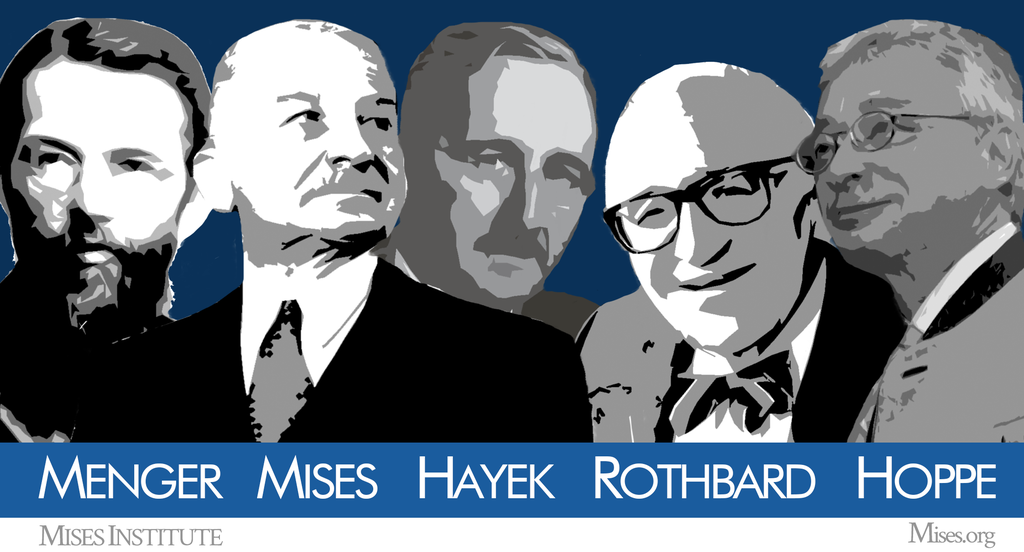
A Mises Institute graphic of some of the key economists in the Austrian tradition (Carl Menger, Ludwig von Mises, Friedrich Hayek, Murray Rothbard, and Hans-Hermann Hoppe.
Mises Institute via Wikimedia Commons.

As a pencil sketch – all you can do in a single article – that’s rather good. So, fine, let’s run with that. We’ve not had a normal recession for ages, one will come along soon enough and we’ve forgotten how to deal with it.

However, we can take this idea a little further too. Off into the wild spaces of Austrian theory. There a recession happens because of the built up malinvestment across the economy. Essentially, when it’s too easy to finance stuff then too much bad stuff gets financed. We need the regular recession to flick off the froth and get back to a more sensible allocation of capital.

My own view is that there is no one correct macroeconomic theory but that all of them contain elements of the truth. The trick is to work out which theory to apply to which happenstance. Reorganising the Soviet economy wasn’t going to be done by a bit of Keynesian demand management, there was a century of misallocation to chew through. Getting out of 2008 was different because it was the financial system that had fallen over, we didn’t just have that cyclical decline in business investment. Etc. Austrians can – perish the thought, eh? – be a little too fervent in the insistence that all recessions are about misallocation that must be purged.

But note the underlying thing we can pick up from Davies here. We’ve been staving off that normal recession for decades through that management. Perhaps it’s not all that good an idea to continually do that? He really does say that the Crash stemmed from those attempts to stave off after all. Thus, in a sense, we could argue that we’re going to get the recessionary horrors come what may. Even Keynesian demand management might not be the correct solution if it just gives us once in a generation collapses rather than more regular downturns?

That is, perhaps the Austrians are at least in part right? We need the regular purges for fear of something worse?

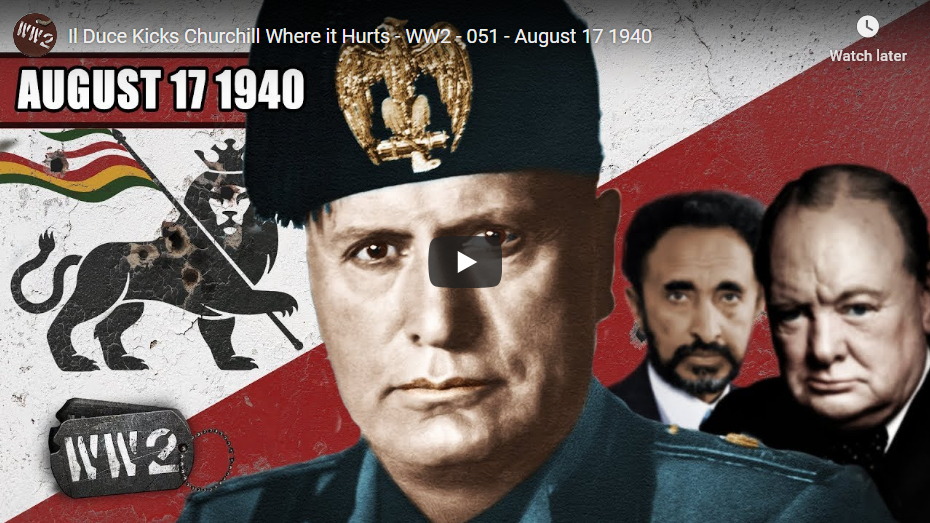
Il Duce Kicks Churchill Where it Hurts – WW2 – 051 – August 17 1940

Filed under: Africa, Britain, Europe, History, Italy, Military, WW2 — Tags: , , , , — Nicholas @ 04:00

World War Two
Published on 17 Aug 2019

As the Battle of Britain reaches not seen before levels of intensity, one of the British colonies is lost to the Italians.

Join us on Patreon: https://www.patreon.com/TimeGhostHistory
Or join The TimeGhost Army directly at: https://timeghost.tv

Follow WW2 day by day on Instagram @World_war_two_realtime https://www.instagram.com/world_war_t…
Join our Discord Server: https://discord.gg/D6D2aYN.
Between 2 Wars: https://www.youtube.com/playlist?list…
Source list: http://bit.ly/WW2sources

Written and Hosted by: Indy Neidell
Produced and Directed by: Spartacus Olsson and Astrid Deinhard
Executive Producers: Bodo Rittenauer, Astrid Deinhard, Indy Neidell, Spartacus Olsson
Creative Producer: Joram Appel
Post-Production Director: Wieke Kapteijns
Research by: Indy Neidell
Edited by: Iryna Dulka
Map animations: Eastory

Colorisations by Norman Stewart and Julius Jääskeläinen https://www.facebook.com/JJcolorization/

Eastory’s channel: https://www.youtube.com/channel/UCEly…
Archive by Screenocean/Reuters https://www.screenocean.com.

Sources:
– Banda groups scan by Localcivis
– Freepngimg.com
– Original photograph of Simon Gauleiter by Mykemalone on Wikimedia Commons
– Membership card photo Photograph by Zinneke on Wikimedia Commons
– IWM: E 1168, E 4350, NA 1670

A TimeGhost chronological documentary produced by OnLion Entertainment GmbH.

The SNC-Lavalin affair was “unethical and contrary to law”, but “relatively above board”

Filed under: Cancon, Government, Law — Tags: , , , — Nicholas @ 03:00

The initial affair itself, that is. Andrew Coyne:

It is the element of deception that raises the conduct described in the ethics commissioner’s report from the merely unlawful to the potentially criminal.

Until now what we had thought we were dealing with was only a sustained and mounting campaign, by the prime minister and by those acting at his direction, to pressure the former attorney general of Canada to set aside the prosecution of SNC-Lavalin, a company with a long history of corruption and even longer history of contributing to the Liberal party, for reasons that explicitly included considerations of partisan advantage.

All of this was vastly improper on its own. Prosecutorial independence is one of the bedrock principles of our system of law, as fundamental as judicial independence. It is settled law that the attorney general, in consideration of a particular prosecution, may not be pressured by anyone, least of all the prime minister, for any reason, least of all partisan gain. Yet Jody Wilson-Raybould was, repeatedly, to the point of being threatened with dismissal if she did not capitulate.

Still, if unethical and contrary to law, this was relatively above board, in so far as the pressure on the attorney general was direct and undisguised: a scandal, to be sure, and grounds for more resignations than those submitted to date, but not, as the cliché has it, a crime. That, of course, is not the standard we should expect of public office holders — that they should merely avoid committing crimes — but it is at least a standard.

Whereas the conduct unearthed by the ethics commissioner may have fallen below even that line. What we have learned is that senior government officials were not just pressuring the former attorney general to interfere in a criminal proceeding, by the unprecedented means of overturning a decision of the independent director of public prosecutions: they were deceiving her.

They did so not only by keeping important information from her, but by providing her with misleading information. They acted, not only in concert with each other, but with officials at SNC-Lavalin, and they carried on this conspiracy to, in the commissioner’s words, “circumvent, undermine and ultimately attempt to discredit” the authority of the attorney general even as the company’s appeal of the DPP’s ruling was before Federal Court — a proceeding to which the attorney general, via the DPP, was a party.

AAI 2nd Gen SPIW Flechette Rifles

Filed under: History, Military, Technology, USA, Weapons — Tags: , , , , — Nicholas @ 02:00

Forgotten Weapons
Published on 24 Jun 2019

http://www.patreon.com/ForgottenWeapons

Cool Forgotten Weapons merch! http://shop.bbtv.com/collections/forg…

The SPIW program began in 1962 with entries from Colt, Springfield, AAI, and Winchester. The first set of trials were a complete failure, and both Colt and Winchester abandoned the project at that point. AAI pressed on, producing these second generation rifles – one for trials in 1966 and one after. Both are chambered for the XM-645 5.6x57mm single-flechette cartridge. Under testing, both showed multiple serious problems in reliability, noise, cook-offs, and accuracy. The company would struggle on for years continuing to develop the flechette rifle system, but would be ultimately unsuccessful.

Thanks to the Rock Island Arsenal Museum for allowing me access to film this very interesting rifle! If you are in the Quad Cities in Illinois or Iowa, the Museum is definitely worth a visit. They have a great number of small arms on display as well as an excellent history of the Rock Island Arsenal.

http://www.arsenalhistoricalsociety.o…

Contact:
Forgotten Weapons
PO Box 87647
Tucson, AZ 85754

QotD: “Hitting back” at protectionist policies

Filed under: Business, Economics, Government, Quotations — Tags: , , — Nicholas @ 01:00

You buy lawn-care services from company XYZ located on the other side of town. Your neighbor, Mr. Stump, takes it upon himself to hold you up at gunpoint to the tune of $25 each time you buy services from XYZ rather than from Stump’s teenage son. You are less powerful than Stump and, not being suicidal, you pay the “tariff” that he officiously demands. But Stump is a magnanimous fellow, and so he agrees to a deal with XYZ: Stump drops his tariffs on your purchases from XYZ in return for XYZ agreeing to raise the price it charges you by $15.

But soon a trade dispute erupts. Stump discovers – correctly, we can assume – that XYZ is charging you less for its lawn-care services than Stump agreed is acceptable for you to be charged and that XYZ agreed in the trade deal to charge. Stump, being a master negotiator, threatens to reimpose the $25 tariff on you unless and until XYZ raises the price it charges you to at least the level that Stump has divined is acceptable and that is enshrined in the terms of the trade agreement between him and XYZ. Alas, XYZ gives in and agrees to raise the price it charges you. Stump then boasts that, by not letting XYZ get away with breaking its word in the trade deal, he is not only protecting the neighborhood from dangerously low prices but is also upholding the sacred rule of law and the sanctity of contractual agreements.

Of course, in reality, Stump’s presumptuous exercise of the power to rob you impose a tariff on you whenever you engage in commerce that he finds objectionable is a wrong inflicted on you and on your trading partner, XYZ. The fact that the practicalities of the situation result in your and XYZ going along with the “deal” to entice Stump to stop robbing you each time you buy XYZ’s services does not ethically oblige you to stick to the terms of the deal if you can, in secret, get better terms from XYZ. When Stump threatens to reimpose on you the $25 tariff, he harms you. That is, when in response to Stump’s threat to reimpose the tariff XYZ agrees to abide by the terms of its trade agreement with Stump and raise the price that it charges you, you are made worse off, not better off.

Stump’s enforcement of this agreement, in short, does not protect you from further victimization in the future; instead, that enforcement is itself an act of victimizing you. Successful enforcement of this agreement assures you a future less prosperous than it would be were Stump instead to ignore XYZ’s “violation” of the deal.

Note: we can all agree that, between the two options (1) $25 tariff and (2) no tariff but an enforced price-hike, under the trade agreement, of $15, that the second option is better for you than the first option. It is in this limited sense that trade agreements in reality are beneficial. But there’s a third option: (3) Stump does not interfere with your commerce and you pay whatever price you negotiate with XYZ without that price being artificially affected by Stump’s interference. This third option is, for you, the best of the three – and it’s the only fully ethical one of the bunch. (So when Dan Griswold, myself, and other free-traders defend trade agreements, we do so with the realistic recognition that option (3) is politically infeasible. Given this unfortunate infeasibility of option (3), we endorse option (2) over option (1).)

Don Boudreaux, “Strict Enforcement of an Impoverishing Deal Assures Continuing Impoverishment”, Café Hayek, 2017-07-07.

August 17, 2019

The Drive On Moscow – Russian Civil War Summer 1919 I THE GREAT WAR 1919

Filed under: History, Military, Russia — Tags: , , , , , — Nicholas @ 06:00

The Great War
Published on 16 Aug 2019

Register for our free newsletter: https://realtimehistory.net/subscribe

The summer of 1919 was a pivotal moment in the Russian Civil War. Backed with Allied support the White movement went on the offensive in the East under Alexander Kolchak and in the South under Anton Denikin. However, the Bolsheviks were not wasting time either. They consolidated their power and got the Red Army into shape to crush the enemy once and for all.

» SUPPORT THE CHANNEL
Patreon: https://realtimehistory.net/patreon
Merchandise: https://realtimehistory.net/spreadshirt
Become a member: https://realtimehistory.net/join

» BUY OUR SOURCES IN OUR AMAZON STORES
https://realtimehistory.net/amazon

» SOURCES
Smele, Jonathan. The “Russian” Civil Wars 1916-1926 (London: Hurst, 2015).

Makhno, Nestor. The Struggle Against the State and Other Essays. AK Press: Edinburgh & San Francisco, 1996.

Mawdsley, Evan. The Russian Civil War (New York: Pegasus Books, 2005).

Robert Gerwarth, The Vanquished. Why the First World War Failed to End, 1917-1923 (Penguin, 2017)

Sumpf, Alexandre. “Russian Civil War”, in 1914-1918 online. International Encyclopedia of the First World War. https://encyclopedia.1914-1918-online.

Mawdsley, Evan. “International Responses to the Russian Civil War”, in 1914-1918 online. International Encyclopedia of the First World War. https://encyclopedia.1914-1918-online…

Leonhard, Jörn. Der überforderte Frieden. Versailles und die Welt 1918-1923 (CH Beck, 2018).

Figes, Orlando. A People’s Tragedy. The Russian Revolution (London: The Bodley Head, 2017 [1996]).

Gilley, Christopher: “Makhno, Nestor Ivanovich”, in: 1914-1918-online. International Encyclopedia of the First World War, ed. by Ute Daniel, Peter Gatrell, Oliver Janz, Heather Jones, Jennifer Keene, Alan Kramer, and Bill Nasson, issued by Freie Universität Berlin, Berlin 2014-10-08 https://encyclopedia.1914-1918-online…

»CREDITS
Presented by: Jesse Alexander
Written by: Jesse Alexander
Director: Toni Steller & Florian Wittig
Director of Photography: Toni Steller
Sound: Toni Steller
Editing: Toni Steller
Mixing, Mastering & Sound Design: http://above-zero.com
Maps: Daniel Kogosov (https://www.patreon.com/Zalezsky)
Research by: Jesse Alexander
Fact checking: Florian Wittig

Channel Design: Alexander Clark
Original Logo: David van Stephold

A Mediakraft Networks Original Channel

Contains licensed material by getty images
All rights reserved – Real Time History GmbH 2019

From the comments:

The Great War
7 hours ago
Register for our free newsletter and win $250 worth of our recommended history books: https://realtimehistory.net/win *

*Instead of paying Facebook, Twitter & Co. money for the possibility to reach you with our content, we’d rather get in touch with you directly and spend the money on history books and the production of the show.

The “remarkably worthless” Sea Sparrow missile launchers on RCN Iroquois-class destroyers

Filed under: Cancon, History, Military, Weapons — Tags: , , , — Nicholas @ 05:00

Earlier this week, Tyler Rogoway posted a fascinating article about one of the original weapon systems installed on Royal Canadian Navy Iroquois-class destroyers. It was developed specifically for this class, and was eventually replaced with modern Mark 41 Vertical Launch Systems during the ships’ mid-life modernization refits:

Image posted to the Reddit r/WarshipPorn subreddit by u/Admhawk.

From manually aimed box launchers, to automated ones like the Mk29 still in use today, to vertical launch variants, the Sea Sparrow was adapted for many different launching methods. Yet the strangest had to the one found on Canada’s Iroquois class. About seven years ago, someone who had worked with RIM-7s on U.S. Navy vessels told me about how nuts the Canadian launch system was that he had seen demonstrated in the late 1980s. In fact, he said it was so clumsy and slow reacting, that it largely defeated the main purpose of the missile system, at least in a multitude of circumstances. “Remarkably worthless” was the way he described it. I had long forgotten about this exchange until recently when pictures of this exact system popped up on the always lively Reddit page r/Warshipporn. At first, when I saw the images I was flabbergasted as to how weird the setup was, then the memory of the conversation hit me. This is what my contact was talking about!

Four Iroquois-class destroyers were commissioned between 1972 and 1973 and all served until 2005, with the last example being retired two years ago, in 2017. They featured the MKIII Sea Sparrow system fitted inside their forward deckhouse, with doors that opened up on each side and overhead swing-arm launchers carrying four missiles each (eight in total, four on each side) that extended out from their garage-like enclosure that hung out off the side of the ship strangely when at the ready. The whole arrangement looks like something far from conducive to high sea state, not to mention rocket blast from the missiles, or a combat environment, for that matter. 32 missiles were carried in all, with twelve at the ready on each side, but reloading the system as a whole was a slow process.

In addition, it’s said that the Hollandse Signaal Mk22 Weapon Control System wasn’t really up to the task and just deploying the missiles and warming up their guidance systems could take minutes or longer. All of this is far from ideal for what is supposed to have been a fast-reacting point defense system capable of quickly fending off sea-skimming anti-ship missiles that arrive with little warning from over the horizon.

HMCS Iroquois (DDG 280) at Port of Hamburg, near Övelgönne, after mid-life refit replaced the Sea Sparrow launchers (via Wikimedia Commons)

History Summarized: Malta

Overly Sarcastic Productions
Published on 16 Aug 2019

Go to https://NordVPN.com/overlysarcastic and and use code OVERLYSARCASTIC to get 75% off a 3 year plan and an extra month for free. Protect yourself online today!

Malta, the Island of A Dozen Empires, chilling in the middle of the Mediterranean Sea, is one of the most social butterflies in History. Having played host to or fought against every major power in the Mediterranean, this island bears a gorgeous architectural and linguistic record of its past, and is still a treasure to behold in the modern day. I’ve covered a lot of nations and empires in my time here, but between the rich cultural blends, the overflowing artistic treasures, and the Still-In-One-Piece-ness of it all, Malta may have one of the strongest claims to being the Winner of History in my book. What’s so special about Malta? Watch and find out!

NOTE on 7:00 – 7:08 — I’m cheating the time-scales a little here. This church, the Rotunda of Mosta, was actually built mid 1800s. Malta’s lavish church construction continued nearly unabated from C. 1565 to the modern day, so I use this example here — but St Paul’s Co-Cathedral in Valletta, shown from 6:27-6:33 is a better example of pure original Baroque construction. Honestly, all of the churches in Malta deserve a look if you’re curious.

PATREON: https://www.Patreon.com/OSP

DISCORD: https://discord.gg/sS5K4R3

« Newer PostsOlder Posts »

Powered by WordPress