Quotulatiousness

September 13, 2019

The new German populists – Alternative für Deutschland (AfD)

Filed under: Europe, Germany, Politics — Tags: , , , — Nicholas @ 05:00

Sabine Beppler-Spahl discusses the rise of Alternative für Deutschland:

Germany is just two months away from commemorating the 30th anniversary of the fall of the Berlin Wall. But for many commentators, east and west Germany are more divided than ever. The success of the right-wing Alternative für Deutschland (AfD) in the recent state elections in Brandenburg and Saxony has fueled this concern. The AfD came second in both elections. In Brandenburg, it won 23.5 per cent of the vote, just 2.7 per cent below the ruling centre-left SPD. In Saxony, it won 27.5 per cent of the vote, 4.6 per cent behind the incumbent centre-right CDU. “When I, a Wessi [west German], leave Berlin … I see nothing but right-wingers … These are people whose sensitivities I don’t understand… Thirty years after the fall of the wall, there is still no unity”, said a writer for Der Spiegel.

Many in the east are just as keen as their western counterparts to distance themselves from AfD voters. The “most important message” from Saxony’s election result was that the “friendly Saxony” had won, said Michael Kretschmer, the state’s CDU minister president. As if reading from the same script, Brandenburg’s minister president, the SPD’s Dietmar Woidke, emphasised that “the face of Brandenburg would remain friendly”. Of course, “friendly” is a code word for mainstream or pro-establishment. But presenting the elections in these terms may have helped the governing parties to their narrow victories. Some analysts suggest that voters, who would otherwise have opted for the Greens or Die Linke (the Left Party), supported the ruling parties for fear of the AfD coming first.

The debate about the east-west divide is deeply anti-political. It focuses solely on the question of what is wrong with east German voters – and the roughly one million AfD voters in particular – rather than on what has gone wrong with German politics as a whole. As a result, there is a great deal of snobbery in the discussion. For Brigitte Fehrle, former editor of the left-liberal Berliner Zeitung, the AfD‘s success can be explained by a mixture of voters’ “disappointment” and their “unrealistic expectations about what is possible in politics”. Sociologist Cornelia Koppetsch, author of a bestselling book on right-wing populism, describes AfD voters as a “cross-section of globalisation’s losers”. This is despite research finding that people who voted for the AfD in 2017 don’t see themselves as “losers” of globalisation at all, and even rate their personal economic situation as above average. That AfD voters might simply hold different political values or views on climate policy, immigration and the family is rarely considered.

[…]

The established parties have ceded ground to the AfD by refusing to take it seriously. Instead of engaging AfD representatives in as many debates as possible, they have relied on trying to expose the party’s far-right connections. For instance, the AfD leader in Brandenburg has been accused of joining a Neo-Nazi demonstration in Greece in 2007. Though these accusations are not trivial by any means, they have only helped to strengthen the impression among AfD supporters that the established parties prefer to vilify the party morally, rather challenge it politically.

Ultimately, the desire for political change is not limited to east Germany. If the mainstream parties continue to be complacent, all voters will look elsewhere. On this front at least, the east and west might be closer than suspected.


No-Fuss Finishing for Wood

Filed under: Woodworking — Tags: , — Nicholas @ 04:00

Rex Krueger
Premiered 6 hours ago

More video and exclusive content: http://www.patreon.com/rexkrueger
(more…)

NDP leader Jagmeet Singh gets his tax plans vetted by the Parliamentary Budget Office

Filed under: Cancon, Economics, Politics — Tags: , , , , , — Nicholas @ 03:00

A recent innovation for political campaigns is that they can ask the Parliamentary Budget Office to provide an estimate for the impact of any taxation proposals, and NDP leader Jagmeet Singh was the first out of the gate to have his “super-wealth tax” evaluated. The PBO estimates that the levy would net out some $6 billion in the first full year of implementation. Sounds like a lot of money! Colby Cosh explains why it’s not quite what it might seem:

Federal NDP leader Jagmeet Singh taking part in a Pride Parade in June 2017 (during the leadership campaign).
Photo via Wikimedia.

Alas, the bean-counters always swoop in to spoil things. Singh’s wealth-tax scheme is instructive not only because he availed himself of PBO costing, but because it usefully reveals the limits of what the PBO or any other economic modeller can do. Look, in other words, at the fine print.

The PBO’s job was to estimate what you can extract from “an annual net wealth tax on Canadian resident economic families equal to one per cent of net wealth above $20 million.” In the PBO model this is a simple multiplication, but the roughly $6 billion take is arrived at only by reducing the revenue by 35 per cent to correct for “behavioural response” — that is, lawful (and unlawful) tricks employed to avoid the new tax by the rich targets. The net revenue is what’s left after you deduct another two per cent to cover administrative costs.

And, as the PBO immediately insists, “the estimate has high uncertainty” on both counts. This means they’re educated guesses. Jennifer Robson, a social policy prof at Carleton University’s Arthur Kroeger College, pointed out on Twitter that right now we don’t tax economic families per se and we don’t report assets and debts routinely to Revenue Canada. Ideas for pure wealth taxation (which is rare in practice) are predicated on the creation of, essentially, a new tax system — one which would have to detect and perpetually update how much, for example, the furniture in your house costs. The 35 per cent loss from behavioural response is at the high end of historic estimates from real-world examples. Even within our current tax system, Robson observes, we only get two extra dollars for every one we spend on expanding collections and compliance against the existing tax base.

As a practical matter, a wealth tax would mostly be, or would act most efficiently as, a tax on bank balances and investment accounts. Of course, there is always real estate. The super-rich seem to have a lot of that, and it is relatively easy to tax, and the resentment of Torontonians and Vancouverites who don’t own some is, for better or worse, a major reason the NDP is trying to weaponize envy.

But this reminds us that property taxes and taxes on property transfers perform a similar function, although they are not used primarily for income redistribution as such here — and in Canada ours are relatively high. The OECD does a little league table of tax structures, and compared with other industrialized countries Canada’s take from property taxes is about double the average. In a 36-country list we are near the bottom (33rd) in our dependence on taxing goods and services, and about average (12th) in dependence on corporate taxation, but fifth highest in dependence on personal taxation — and third in dependence on property taxes.

Why You Wouldn’t Want to Fly The First Jet Airliner: De Havilland Comet Story

Filed under: Britain, History, Technology — Tags: , , — Nicholas @ 02:00

Mustard
Published on 1 Dec 2017

Air travel before the Jet Age wasn’t always glamorous. The relentless noise and vibration from a piston powered propeller aircraft often made long flights even more exhausting. Most aircraft also couldn’t fly high enough to avoid bad weather, so air sickness was more common.

After World War Two, as part of an effort to develop its civil aviation industry, Britain stunned the world by unveiling the world’s first jet airliner. The de Havilland Comet was sleek, quiet, and flew higher and faster than any airliner of the day. As piston propeller technology was reaching its limits, the conventional thinking was that jet engines were too unreliable and produced too little power relative to their fuel consumption. But the de Havilland Comet proved that jet travel was the future. When the Comet entered service in 1952, it immediately began breaking travel time records and became a point of national pride for Britain.

The de Havilland Comet was perhaps little too ahead of its time. With such a clean sheet design, there were still lessons to learn. When early Comets suffered from catastrophic depressurization incidents, the entire fleet was grounded and their Certificate of Airworthiness was revoked. Flaws in the design of the aircraft’s fuselage were resolved in later Comet versions. However, the rest of the world was now catching up, and manufacturers including Boeing and Douglas began to offer their own jet airliners. While later version Comets served airlines reliably, they were outsold by competing aircraft. There’s no question However, that the comet paved the way. The British had taken a massive risk and brought the world into the jet age. #DeHavilland #CometAirliner #Airplane

Want to help Mustard grow? Support us on Patreon: https://www.patreon.com/MustardChannel

QotD: Orwell’s campaign against the jackboot

Filed under: Britain, Education, History, Media, Quotations — Tags: , , , — Nicholas @ 01:00

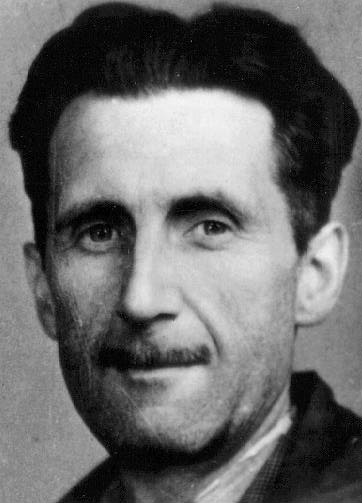
Orwell’s press card portrait, 1943

In spite of my campaign against the jackboot — in which I am not operating single-handed — I notice that jackboots are as common as ever in the columns of the newspapers. Even in the leading articles in the Evening Standard, I have come upon several of them lately. But I am still without any clear information as to what a jackboot is. It is a kind of boot that you put on when you want to behave tyrannically: that is as much as anyone seems to know.

Others besides myself have noted that war, when it gets into the leading articles, is apt to be waged with remarkably old-fashioned weapons. Planes and tanks do make occasional appearances, but as soon as an heroic attitude has to be struck, the only armaments mentioned are the sword (“We shall not sheathe the sword until”, etc., etc.), the spear, the shield, the buckler, the trident, the chariot and the clarion. All of these are hopelessly out of date (the chariot, for instance, has not been in effective use since about A.D. 50), and even the purpose of some of them has been forgotten. What is a buckler, for instance? One school of thought holds that it is a small round shield, but another school believes it to be a kind of belt. A clarion, I believe, is a trumpet, but most people imagine that a “clarion call” merely means a loud noise. One of the early Mass Observation reports, dealing with the coronation of George VI, pointed out that what are called “national occasions” always seem to cause a lapse into archaic language. The “ship of state”, for instance, when it makes one of its official appearances, has a prow and a helm instead of having a bow and a wheel, like modern ships. So far as it is applied to war, the motive for using this kind of language is probably a desire for euphemism. “We will not sheathe the sword” sounds a lot more gentlemanly than “We will keep on dropping block-busters”, though in effect it means the same.

One argument for Basic English is that by existing side by side with Standard English it can act as a sort of corrective to the oratory of statesmen and publicists. High-sounding phrases, when translated into Basic, are often deflated in a surprising way. For example, I presented to a Basic expert the sentence, “He little knew the fate that lay in store for him” — to be told that in Basic this would become “He was far from certain what was going to happen”. It sounds decidedly less impressive, but it means the same. In Basic, I am told, you cannot make a meaningless statement without its being apparent that it is meaningless — which is quite enough to explain why so many schoolmasters, editors, politicians and literary critics object to it.

George Orwell, “As I Please” Tribune, 1944-08-04.

September 12, 2019

Book Review: The Ross Rifle Story

Filed under: Books, Cancon, History, Military, Weapons, WW1 — Tags: , , , , — Nicholas @ 04:00

Forgotten Weapons
Published on 8 Sep 2019

http://www.patreon.com/ForgottenWeapons

Cool Forgotten Weapons merch! http://shop.bbtv.com/collections/forg…

The Ross Rifle Story is the Bible of Ross rifle collecting — it is the only substantial reference work on the subject and it has a tremendous amount of information about the development of the Ross. However, it is also one of the worst-edited firearms reference books I am aware of. It has a second Table of Contents on page 85 — need I say more than that?

Well, I will. The photographs are black and white and often too dark or too light. Beyond it really being two separate manuscripts printed back to back, the organization is really lacking. Finding information in the book is sometimes very difficult, as the subject matter jumps around a lot. The story of the Ross — especially separating the civilian and military development — is a pretty complicated one, and even a well-edited book on the subject might be a bit difficult to parse. This book is really bad at times.

But for all that, it does have the information (with only a few errors), and it’s the only book that does. If you are interested in the Ross, this is a must-have book despite its problems.

A second printing was run in 2002, and not much effort was put into marketing it. Despite the online prices all being $300+, the seller still has a couple dozen copies remaining as of this writing. To order one (for $100 plus shipping, via PayPal) email him at ross.rifle.story@sympatico.ca .

Contact:
Forgotten Weapons
6281 N. Oracle #36270
Tucson, AZ 85704

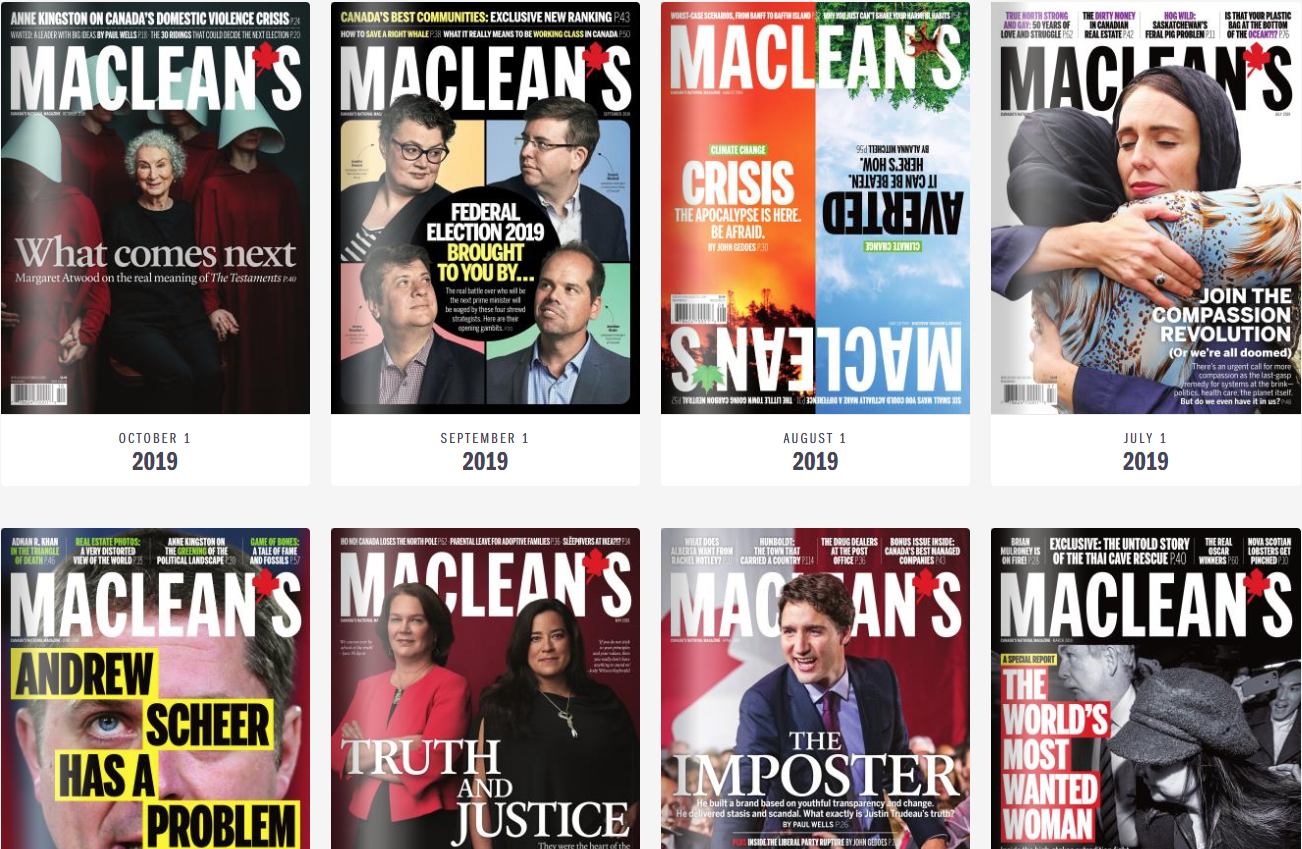
Maclean’s invades The Onion‘s pitch

Filed under: Cancon, History, Media — Tags: , , — Nicholas @ 03:00

Barbara Kay on a recent Maclean’s article that may indicate a change of editorial direction for the venerable Canadian magazine:

I never thought of Maclean’s as a satirical magazine, but perhaps they are testing the waters on a rebranding. I cannot otherwise account for the bizarre article just published under their aegis by Scott Gilmore, “Thank God I could Enjoy the Age of Mediocre White Men While It Lasted.” This self-flagellatory apologia for being a successful white male reads like a parody of our cultural moment.

I laughed when I read it, and checked the URL to make sure I hadn’t stumbled on a piece from The Onion by mistake, but no, it was indeed a Maclean’s piece. Sadly, I am all too aware that in these fanatically anti-white male times, a lot of identity-politics activists — including white men who pee sitting down to prove their wokeness — will not only take it seriously, they will applaud him.

Gilmore’s thesis is this in a nutshell: simply being white and male gives you such an advantage in life that for all of human history, other people, so dazzled by male whiteness that they are rendered oblivious both to white-male mediocrity and their own inherent superiority, willingly hand things over to you, things like their bodies, their possessions and their national sovereignty, and of course all the good careers. Your skin colour and sex are your ticket to ride. That state of affairs is now ending, Gilmore says, and this piece is effectively Gilmore’s thank-you note to history for allowing him to have benefited from this remarkable deal, and as well an expression of gratitude that white males are now headed to the dustbin of history, where they belong.

The first problem with the article is that Gilmore never defines “mediocre.” One dictionary definition is “of only moderate quality; not very good.” Let’s go with that. Let’s assume he means white men are dumber, lazier and of lesser character than all women and all non-white men. And yet, “being a white male has been the bee’s knees for about 2,000 years. We have been giving all the orders, taking all the credit, and pocketing all the money since Caesar told Cleopatra to pipe down. We wrote the history books and we built the empires (well, other people did the actual building, but we oversaw a lot of it from our sedan chairs). We drafted all the laws, and made sure to always stack the cards in our favour. And, for a truly impressive long time, we were able to keep all the fun to ourselves.”

Are Wooden Hand Screw Clamps Worth Anything?

Filed under: Tools, Woodworking — Tags: — Nicholas @ 02:00

Wood By Wright
Published on 1 Aug 2019

The humble wooden Hand Screw Clamp is not just a screw clamp from the past but an extremely useful tool for the shop of today. Not only for holding work while gluing but also for holding small pieces at the power tools and for detail work at the shop bench.

New Hand Screw Clamps I suggest: https://amzn.to/2LSVuUy

—Tools I Use—
https://www.woodbywright.com/tool-suggestions/

—Find Antique tools near you—
http://www.HandToolFinder.com

////Help this channel grow\\\\
https://www.woodbywright.com/support/

////You Can find me:\\\\
https://www.woodbywright.com/contact-me/

////My Podcast\\\\
https://www.youtube.com/channel/UC_0A…

Intro music: Tim Sway http://timsway.net/

background music: Udo Stehle https://www.upwork.com/freelancers/~0…
Instagram: @udostehle

QotD: Canadians and Europeans

Filed under: Britain, Cancon, Europe, Humour, Politics, Quotations, USA — Tags: — Nicholas @ 01:00

In the current issue of The Spectator, Niall Ferguson argues that the Anglo-American “special relationship” is doomed.

“The typical British family,” he writes, “looks much more like the typical German family than the typical American family. We eat Italian food. We watch Spanish soccer. We drive German cars. We work Belgian hours. And we buy second homes in France. Above all, we bow before central government as only true Europeans can.”

He has a point, though cultural similarities are not always determinative: Canadians eat American food, watch American sports, drive American cars, work American hours (more or less), and buy second homes in Florida. But they still bow down before central government as only true Europeans can.

Mark Steyn, Telegraph, originally posted to the old blog (no longer online), 2004-09-30.

September 11, 2019

Environmental virtue signalling – it’s other people who need to change, not me

Filed under: Environment, Politics, USA — Tags: , , , , — Nicholas @ 05:00

Heather Mac Donald notes that, as with so many other things, young people who like to virtue signal about their environmental concerns don’t consider it incumbent on them to change … it’s always other people whose habits must be changed, by force if necessary:

FridaysForFuture Demonstration, 25 January 2018 in Berlin.
Photo by C. Suthorn via Wikimedia Commons.

The claim about youth’s transformative commitment to radical environmental change is — based on informal observation — bunk. The cardinal rule when it comes to environmental virtue-signaling is that people give up what they’re willing to give up. Young people are no different. If being environmentally sound required sacrificing anything that a self-described environmental warrior actually valued, the conversation would quickly change to a different topic. One’s own habits are necessary; it’s everyone else’s that need to change.

This always-unreached threshold for environmental sacrifice is particularly notable on the part of celebrity Greens, with their fortress-like SUVs, multiple residences, and massive carbon footprints — whether it’s the cavalcade of yachts and private jets that brought such luminaries as Leonardo DiCaprio, Mark Zuckerberg, and Katy Perry to Google’s three-day climate-change summit in Sicily this July; environmental crusaders Prince Harry and Meghan Markle jetting off to Elton John’s French estate; or Reliable Sources host Brian Stelter’s “quick day trip” to Los Angeles from New York just ahead of the CNN climate-change debate. A police caravan drives New York City mayor Bill de Blasio 11 miles from his mayoral mansion in Manhattan to his favorite gym in Brooklyn. “Everyone in their own life has to change their own habits to start protecting the earth,” he has intoned, but taking the subway is not one of those changes appropriate for him.

Most young people have not yet reached such a flamboyant level of energy use, but if they could, they undoubtedly would, with as little sense of anachronism as that of Al Gore in his energy-guzzling mansion. These are the consumers who keep football fields of computer servers buzzing round the clock to support their social media habits. If being green meant turning off one’s phone for 22 hours a day or foregoing the latest smartphone upgrade, the reasons why such sacrifices are not required would spout from every Gen Z-er and millennial’s lips. Students from the University of California, Irvine, constantly run their air-conditioners in the apartment complex where I spend summers, regardless of how cool the temperature outside is. They drive with their windows sealed and the car AC on, no matter how fresh the day (this is the new driving norm for almost everyone now). The meteoric rise of food-delivery apps, producing torrents of plastic and paper waste and a constant circulation of cars and electric bikes, has been fueled by young people’s demand for convenience and instant gratification. Cooking is apparently unthinkable. At best, one buys precut and washed food in the inevitable plastic containers. A daily Starbucks habit is deemed consistent with railing against environmentally destructive corporate greed.

New York’s tap water is among the purest in the world. Yet a young neighbor of mine in New York, like progressives throughout the city, receives towering deliveries of bottled water, entailing huge energy outlays to package and transport, not to mention generating flotillas of discarded plastic. The swim team members in my gym turn on their showers in the locker room, then walk away or do nothing other than chat as water gushes down the drain. Uber drivers in college towns report that students regularly call a car to get to class, rather than walk or ride a bike.

Samson and Delilah – Old Testament Mythology – Extra Mythology – #1

Filed under: History, Middle East, Religion — Tags: , , — Nicholas @ 04:00

Extra Credits
Published on 9 Sep 2019

Join the Patreon community! http://bit.ly/EMPatreon

It was a time of trial for the tribes of Israel. They were no nation, but a loose confederation bound together by their divine covenants — which they had just broken. Amid this political and social chaos, a child was born, instructed by God to keep the Nazirite oath — stay away from alcohol, don’t eat unclean food, and don’t shave — and he would become a man of incredible strength.

Samson was on a mission from God to never drink alcohol, to not eat honey found in a lion’s carcass, and to not cut his hair ever. FORESHADOWING!

Margaret Atwood’s The Testaments

Filed under: Books, Cancon, Media, Politics, USA — Tags: , , , — Nicholas @ 03:00

Colby Cosh discusses the genesis of Atwood’s best-known work from 1984, The Handmaid’s Tale and the new sequel published this week, The Testaments:

In a CBS interview broadcast on Sunday, Atwood insisted again, as she always has, that her book wasn’t a prediction. People who read her book in a spirit of active dread, the kind of people who dress up as Handmaids and march on legislatures, will say that, well, dystopias are created specifically so that they won’t come true. What Atwood is trying to say goes deeper than that, and contradicts it. She won’t even insist that the book was intended as a warning. “I’m not a prophet,” she pleads, while everyone around her tells her what a terrific prophet she is.

What she means, but cannot say because it would sound arrogant, is: “I’m not a prophet, dammit, I’m an artist.” If tyrannies were easy to predict and prevent by spritzing around a bit of literary bug spray, they couldn’t come about in the first place. Atwood knows better than this; she knows that tragedies of this scale never take the form that an author might anticipate. Moreover, people who read The Handmaid’s Tale as a mere tract are deaf to its satirical elements — particularly those of the epilogue, in which the story is revealed to have been unearthed by scholars in a still-more-distant future.

These people are also failing to see that The Handmaid’s Tale is a book — researched, not merely imagined — about the past of humankind. The whole book is predicated on the observation (also made implicitly in Orwell’s Nineteen Eighty-Four) that totalitarian regimes are never libertine; they all police sexuality at least as strenuously as they do trade and creative activity, and always come with puritanical, sexually homogenizing features. The novel was heavily influenced by Ceausescu’s Romania and its pro-natalist Decree 770, which abolished contraception and imposed mass gynecological inspection on women of fertile age. Europeans and students (or veterans) of the Cold War will notice this, but how many of the young folk who dress up as Handmaids at protests have any idea? (Are some of them also cosplaying on Twitter as postmodern retro-communists?)

I am curious to see what the critics make of the sequel, because the act of writing one seems a bit cynical, and yet perhaps Atwood has found some clever way of making it work. Offred’s narrative in The Handmaid’s Tale is, as I say, unearthed in a later future; it is important to the functioning of the book that we come to see her as a figure from the past, a human voice whose plea from an obscure period has been flung forward into the hands of half-comprehending and unsympathetic scholarly boobs.

Straighten boards. No jointer. No jig.

Filed under: Tools, Woodworking — Tags: , , , — Nicholas @ 02:00

Rex Krueger
Published on 13 Apr 2018

More videos and exclusive content: http://patreon.com/rexkrueger
(more…)

QotD: Male versus female social structure

Filed under: Health, Politics, Quotations — Tags: , , — Nicholas @ 01:00

Female social structure is completely different from male social structure. Men tend to organize in a hierarchy of sorts. There’s one guy at the top, a few guys he trusts underneath him, etc. downward until you reach the guys that are on the bottom of the pile. The structure makes sense. It’s efficient, everyone knows who’s in charge, and it’s largely based around the individual. Someone can rise or fall in this hierarchy based on any number of things, but their position is usually pretty clear from the outside looking in.

Female social structure is more fluid. It’s based more on group identity than on individual characteristics. You tend to have one woman who is kind of in charge, your queen bee as it were. Those in her favor circle around her, and the circles continue outward until you have the women who are not part of the group. They aren’t at the bottom of the pile, they pretty much don’t exist. At least, if they’re lucky they don’t. One’s position in the social hierarchy can change at any time, to include who the queen bee is. Remember the scene in Mean Girls where Regina tries to sit at the lunch table with the other plastics but isn’t wearing the right color clothes? She was just knocked out of her position in the social hierarchy.

In a social structure like this, there’s no room for difference of opinion or people who stand out too much. If an individual, even by noncompliance, threatens the group identity; she will gain the ire of the entire group. They will hunt her without mercy until she complies with the demands of the group, is removed from their reach by either death or physical distance (which is getting much harder with the internet), or manages to win enough females to her side to either form a new group around her or replace the existing leader. The last option allows her to push her standard on the group as a whole. There is no option to live and let live. In other words, female social structure is closer to the Borg than the complex world we currently enjoy.

I can already hear the cries of, “But women aren’t violent!” If you’re talking about direct violence, you’re mostly right. Women are not men, and we don’t hunt in the way that men do. Our weapons are usually words and emotions, not direct violence. Instead of a brawl in which two people fight it out and determine which is the strongest, you’re looking at extreme emotional abuse for anyone who is outside the group and unlucky enough to have their attention. Emotional abuse attacks a person in the most deeply personal of ways, and the scars it creates are more damaging than the physical scars of a beating. We wonder why girls who stand out grow so bitter, but if you’re a little too pretty or a little too different, other girls swarm on you and rip you apart with constant emotional abuse. They attack who you are at the base of your being, your very self-perception. This is why you see truly beautiful women who struggle to see their worth. Other girls have been ripping into them since the nursery, and it only gets worse as they get older. Boys court you and try in their awkward boyish way to get your attention, but you’re mostly convinced that it’s a cruel joke they’re playing on you, because of course you aren’t pretty or smart or special. The scars run deep and never fully heal.

“outofthedarkness”, guest posting at According to Hoyt, 2017-08-09.

September 10, 2019

Gluing the Lid | Dovetail Box Project #10 | Free Online Woodworking School

Filed under: Tools, Woodworking — Tags: , , — Nicholas @ 04:00

Matt Estlea
Published on 7 Sep 2019

In this video, I show you how to apply glue and clamp the lid so that it is flat and accurate. By taking extra care at this stage, it will save you a lot of effort when flattening it later in the project.

Support what I do by becoming a Patron! This will help fund new tools, equipment and cover my overheads. Meaning I can continue to bring you regular, high quality, free content. Thank you so much for your support! https://www.patreon.com/mattestlea

Don’t want to commit to a monthly direct debit but still want to help out? That’s fine!
You can make a one time donation here: https://www.paypal.me/MattEstlea
You can donate us biscuits here: https://amzn.to/2WOl1UR
_

BUY THE WOODWORKING BIBLE HERE:
– UK: https://goo.gl/X8ZzSF
– US: https://goo.gl/UDqWf3
– CA: https://goo.gl/31jBxj
_

See what tools I use here: https://kit.com/MattEstlea
My Website: http://www.mattestlea.com
_

My name is Matt Estlea, I’m a 23 year old Woodworker from Basingstoke in England and my aim is to make your woodworking less s***.

I come from 5 years tuition at Rycotewood Furniture Centre with a further 1 year working as an Artist in Residence at the Sylva Foundation. I now teach City and Guilds Furniture Making at Rycotewood as of September 2018.

I also had 5 years of experience working at Axminster Tools and Machinery where I helped customers with purchasing tools, demonstrated in stores and events, and gained extensive knowledge about a variety of tools and brands.

During the week, I film woodworking projects, tutorials, reviews and a viewer favourite ‘Tool Duel’ where I compare two competitive manufacturers tools against one another to find out which is best.

I like to have a laugh and my videos are quite fast paced BUT you will learn a lot, I assure you.

Lets go make a mess.

« Newer PostsOlder Posts »

Powered by WordPress