LMS4767
Published on 30 May 2019

LMS4767
Published on 30 May 2019
Look around you – if we in the West and we humans, in general, had been invaded by aliens, what would be different?
- Our schools in America teach that the system under which America lives, from constitutional protections to (relatively … very relatively) free markets are evil and the cause of all evils in the world.
- Our schools further teach that all the problems in the world at large are the fault of “Imperialists” to include not just America, but the West which is America’s mother culture. They ignore the sins of other nations, many of which, still today, commit female mutilation and slavery, to concentrate ONLY on the West and the sins of the West, thereby obviating any possible pride the students might have in their own culture.
- Further, the schools, under the guise of environmentalism, promote the view that humanity is the worst plague on the planet. Without pointing out that any species can drive others to extinction, or that humans are the only species capable of self-regulating their impact on the environment, they concentrate on those extinctions humans have caused and fantasize that without humans the world would be a paradise.
- Without pointing out the difficulty of global censuses or that in fact we don’t and can’t know how large the world population is, our learning institutions, our cultural institutions, even our entertainment continually scare us with the idea of overpopulation. Without taking into account that there are more trees now in North America than when the colonists arrived, they picture humanity as creating deserts. Schools push middle schoolers to sign agreements never to reproduce.
- As if this weren’t enough, feminists picture women – in Western, well off, more or less equalitarian (at least before the law as it existed before feminist tampering made it take sides with women most of the time) systems – as perpetual victims, stoke a sense of outrage and anger at any and all males, and encourage women to consider normal intercourse “rape” and marriage a prison.
- As if this weren’t enough, the insanity has descended to preaching that there is no such thing as biological sex, and that one’s gender is a sort of “mood” which can be determined before a child is even fully developed. Parents giving hormones to children, to change their sex before the age of reason (let alone physical or emotional maturity) and effectively encouraging castration/neutering and precluding future generations aren’t considered deranged abusers. In fact, educational and medical establishments will encourage parents to thus destroy their progeny and will take the children away if the parents don’t do it, on the flimsiest of pretexts based on stereotypes, such as a boy who disdains male toys, or a girl who doesn’t like dolls. The rich panoply of human expression is ignored in a – dare we say it – alien attempt to make individual people fit stereotypes.
- Three generations into this, our leading lights in intellectual life, be it fiction, non-fiction, academia or even research, get plaudits and advancement ONLY from conclusions and policies that objectively hurt humans and prevent humans from reproducing. A subset of this is hate of the West, the most successful culture in the world, ever, in terms of extending life, preventing early death, preventing or curing disease and preventing and curing famine. Another and even more vociferous subset is the hatred of America, which took all of Western virtues and made them more so.
If aliens, hostile to the very idea of humanity and wanting to prevent us from prospering, let alone going into space (another cause that all so called “progressives” hate with a burning passion and try to prevent by all means possible, from telling us that there is still need on Earth so we shouldn’t spend money on going to space, to telling us that we must first learn to “take care of this planet” to just sustained screaming that the human plague shouldn’t propagate) had managed to take control of our culture, what would they do differently?
Sarah Hoyt, “What if We Have Been Invaded by Aliens?”, PJ Media, 2017-07-21.
World War Two
Published on 14 Sep 2019The Blitz continues as the German army seems close to the execution of Operation Sea Lion: the invasion of Britain.
Join us on Patreon: https://www.patreon.com/TimeGhostHistory
Or join The TimeGhost Army directly at: https://timeghost.tvFollow WW2 day by day on Instagram @World_war_two_realtime https://www.instagram.com/world_war_t…
Join our Discord Server: https://discord.gg/D6D2aYN.
Between 2 Wars: https://www.youtube.com/playlist?list…
Source list: http://bit.ly/WW2sourcesWritten and Hosted by: Indy Neidell
Produced and Directed by: Spartacus Olsson and Astrid Deinhard
Executive Producers: Bodo Rittenauer, Astrid Deinhard, Indy Neidell, Spartacus Olsson
Creative Producer: Joram Appel
Research by: Indy Neidell
Post-Production Director: Wieke Kapteijns
Edited by: Iryna Dulka
Map animations: EastoryColorisations by Norman Stewart and Julius Jääskeläinen https://www.facebook.com/JJcolorization/
Eastory’s channel: https://www.youtube.com/channel/UCEly…
Archive by Screenocean/Reuters https://www.screenocean.com.Sources:
– IWM: E 7304, E 1400, CH 4972, E 12789
– Italian poster – James Vaughan on Flickr
– Narodowe Archiwum CyfroweA TimeGhost chronological documentary produced by OnLion Entertainment GmbH.
From the comments:
World War Two
3 days ago
What if the Germans had invaded Britain this week? We will probably never know, but we get asked to give our views on counterfactual history questions like this all the time. Many did that during our first Q&A session on Instagram last week. We had a great time answering many questions about the war, about TimeGhost and about the production process, and we’ll certainly do similar Instagram Q&A sessions again. If you don’t already, you can follow us by looking up @world_war_two_realtime or https://www.instagram.com/world_war_two_realtime/Cheers,
Joram
Andrew Sullivan tries to put the Brexit debate into terms that coastal, urban Americans can understand:

One of the frustrating aspects of reading the U.S. media’s coverage of Brexit is that you’d never get any idea why it happened in the first place. Brexit is treated, automatically, as some kind of pathology, a populist act of wanton self-harm, an absurd idea, etc etc. And from the perspective of an upstanding member of the left-liberal media establishment, that’s all true. If your idea of Britain is formed by jetting in and out of London, a multicultural, global metropolis that is as lively and European as any city on the Continent, you’d think that E.U. membership is a no-brainer. Now that the full hellish economic consequences of exit are in full view, what could possibly be the impulse to stick with it?
I get this. I would have voted Remain. I find London to be far more fun now than it was when I left the place. But allow me to suggest a parallel version of Britain’s situation — but with the U.S. The U.S. negotiated with Canada and Mexico to create a free trade zone called NAFTA, just as the U.K. negotiated entry to what was then a free trade zone called the “European Economic Community” in 1973. Now imagine further that NAFTA required complete freedom of movement for people across all three countries. Any Mexican or Canadian citizen would have the automatic right to live and work in the U.S., including access to public assistance, and every American could live and work in Mexico and Canada on the same grounds. This three-country grouping then establishes its own Supreme Court, which has a veto over the U.S. Supreme Court. And then there’s a new currency to replace the dollar, governed by a new central bank, located in Ottawa.
How many Americans would support this? How many votes would a candidate for president get if he or she proposed it? The questions answer themselves. It would be unimaginable for the U.S. to allow itself to be governed by an entity more authoritative than its own government. It would signify the end of the American experiment, because it would effectively be the end of the American nation-state. But this is precisely the position the U.K. has been in for most of my lifetime. The U.K. has no control over immigration from 27 other countries in Europe, and its less regulated economy has attracted hundreds of thousands of foreigners to work in the country, transforming its culture and stressing its hospitals, schools and transportation system. Its courts ultimately have to answer to the European Court. Most aspects of its economy are governed by rules set in Brussels. It cannot independently negotiate any aspect of its own trade agreements. I think the cost-benefit analysis still favors being a member of the E.U. But it is not crazy to come to the opposite conclusion.
More to the point, the European Economic Community has evolved over the years into something far more ambitious. Through various treaties — Maastricht and Lisbon, for example — what is now called the European Union (note the shift in language) has embarked on a process of ever-greater integration: a common currency, a common foreign policy and now, if Macron has his way, a common central bank. It is requiring the surrender and pooling of more and more national sovereignty from its members. And in this series of surrenders, Britain is unique in its history and identity. In the last century, every other European country has experienced the most severe loss of sovereignty a nation can experience: the occupation of a foreign army on its soil. Britain hasn’t. Its government has retained control of its own island territory now for a thousand years. More salient: this very resistance has come to define the character of the country, idealized by Churchill in the country’s darkest hour. Britain was always going to have more trouble pooling sovereignty than others. And the more ambitious the E.U. became, the more trouble the U.K. had.
The Great War
Published on 13 Sep 2019Signup for your FREE trial to The Great Courses Plus here: http://ow.ly/F9LC30po9ux
The Great Courses Plus is currently available to watch through a web browser to almost anyone in the world and optimized for the US, UK, and Australian markets. The Great Courses Plus is currently working to both optimize the product globally and accept credit card payments globally.
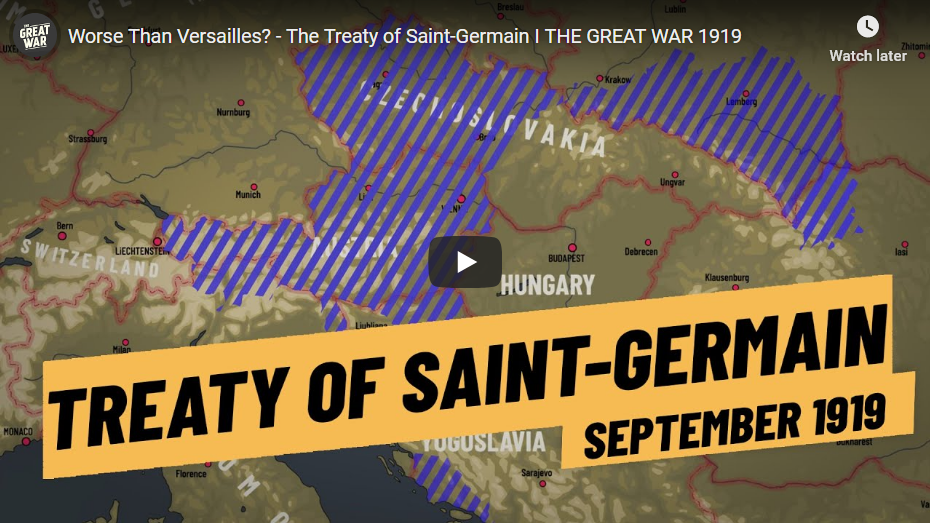
The Treaty of Versailles between the Allies and Germany was only one of the peace treaties that followed the defeat of the Central Powers. The new Austrian republic, one of the countries that emerged from the collapse of the Austro-Hungarian Empire, also tried to get a favorable deal with the Allies in Paris in 1919. Like Versailles, the The Treaty of Saint-Germain caused an outcry across the country.
» SUPPORT THE CHANNEL
Patreon: https://www.patreon.com/thegreatwar
Merchandise: https://shop.spreadshirt.de/thegreatwar/»CREDITS
Presented by: Jesse Alexander
Written by: Jesse Alexander
Director: Toni Steller & Florian Wittig
Director of Photography: Toni Steller
Sound: Toni Steller
Editing: Toni Steller
Mixing, Mastering & Sound Design: http://above-zero.com
Motion Design: Christian Graef – GRAEFX
Maps: Daniel Kogosov (https://www.patreon.com/Zalezsky)
Research by: Jesse Alexander
Fact checking: Florian WittigChannel Design: Alexander Clark
Original Logo: David van StepholdA Mediakraft Networks Original Channel
Contains licensed material by getty images
All rights reserved – Real Time History GmbH 2019
Canadian elections have their own quirks — historical, geographical, linguistic — that cannot be accurately captured in national opinion polls:

Conservative support is heavily concentrated in Alberta and Saskatchewan. Tens of thousands of its votes are therefore likely to be wasted racking up massive majorities in a relatively small number of seats.
The Liberal vote, by contrast, is more efficiently distributed, notably in Quebec, with its tight three- and four-way races, where a winning candidate might slip through with 30 per cent of the vote or less. So even though the Liberals are projected to win fewer votes than the Conservatives, they are also projected to win a solid plurality of the seats — perhaps even a majority.
Then again, the polls are misleading in another way. A poll can project, with some uncertainty, the level of support for the various parties among the voting-age population. It is a more difficult matter to predict what proportion of each party’s supporters will actually turn out to vote. The Liberals benefited in 2015 from a surge in turnout, especially among younger voters, on the strength of Justin Trudeau’s sunny idealism. No such enthusiasm, or idealism, is detectable this time around.
It all makes for a close, unpredictable race. The Liberal challenge is the usual one: to round up the vote on the left without giving too much ground on the centre, appealing to those tempted to vote NDP or Green not to split the progressive vote lest the Tories get in.
The Conservatives, for their part, will also be fighting a two-front war, with the emergence of the People’s Party to their right imposing some constraint on their ability to reach across the centre. To date the PPC has not posed much of a threat — its support has stalled at around 3.0 per cent — but it is not impossible that it could break out of that range now that voters are paying more attention.
Of course, Maxime Bernier being actively excluded from the debates, and the pollsters often not including a choice for the PPC will also limit the PPC’s visibility to ordinary Canadian voters. Oddly, this may benefit the Milk Dud and his “Conservatives”, as the media tries to ignore Bernier’s party but gives disproportional coverage to the Green and NDP campaigns, which potentially weakens support for Trudeau and the Liberals.
Update, 16 September: I guess the media finally noticed that excluding Maxime Bernier from the debates was a sub-optimal idea for their preferred winner (Justin Dressup).
The Leaders' Debates Commission (@debats_can) has invited @MaximeBernier to the Commission’s debates on October 7 and 10 #cdnpoli https://t.co/1ZGAZRO7KU
— Power & Politics (@PnPCBC) September 16, 2019
Rex Krueger
Premiered 3 hours agoMore video and exclusive content: http://www.patreon.com/rexkrueger
(more…)
Ditto with Islamic terrorists, incidentally. Unless we can see them, sometimes, from the angle that makes them most attractive, we miss the whole picture. Know the enemy, I say. The worst psychopath may offer to share some droll humour. It is my firm belief that even liberals and progressives can be charming, sometimes.
I wonder which part of Mr Browning’s works Herr Goering would reach for? Would it be an earlier work, as Paracelsus or Sordello? A later, such as Jocoseria or Asolando? Me, I think I would start with a dilatory romp through the Dramatic Idylls, then hunker down with The Ring and the Book.
David Warren, “Include me in”, Essays in Idleness, 2017-08-30.
TimeGhost History
Stalin has to deal with the consequences of forcibly changing the Soviet Union from an agrarian economy into a modern industrialized society as his first five-years plan reaches its final year.
Join us on Patreon: https://www.patreon.com/TimeGhostHistory
Hosted by: Indy Neidell
Written by: Spartacus Olsson and Naman Habtom
Directed by: Spartacus Olsson and Astrid Deinhard
Executive Producers: Bodo Rittenauer, Astrid Deinhard, Indy Neidell, Spartacus Olsson
Creative Producer: Joram Appel
Post-Production Director: Wieke Kapteijns
Research by: Naman Habtom
Edited by: Daniel Weiss en Wieke Kapteijns
Sound design: Marek KaminskiA TimeGhost chronological documentary produced by OnLion Entertainment GmbH.
From the comments:
TimeGhost History
1 hour ago (edited)
Debating the concepts, definition and framework of Marxism, Communism and Socialism is something that historians don’t seem to get enough of, much like applying these theories to historical and contemporary phenomena. The study of how these theories turned into ideology and what effect that had on nations, cultures, peoples and wars is a very interesting field of history, which can be debated to great lengths, which we ourselves also like to engage and participate in. However, we want to once again emphasise that we will only allow debate within the generally accepted rules of academic debate. Keep it civil, substantiated, name your sources whenever possible and stay away from pseudo-science and contemporary politics. We are fierce believers in the benefits of academic debate and don’t want to resort to turning off the comments, as other channels might do when talking about subjects like the 5-year plan or the Holodomor.Cheers, Joram
Forgotten Weapons
Want to see all of my Apocrypha behind-the-scenes videos? They are a perk for Patrons who help directly support Forgotten Weapons:
http://www.patreon.com/ForgottenWeapons
Cool Forgotten Weapons merch! http://shop.bbtv.com/collections/forg…
I partnered up with Military Historical Tours to guide a World War One battlefield tour this week, and I figured I’d give you a bit of a peek into it. We are looking at the war chronologically, starting with a day in Belgium to look at the German attack in 1914, visiting the remains of Fort de Loncin in Liege and the Mons cemetery. Next was a day in Ypres for the stagnation into trench warfare in 1915, seeing the Dodengang up on the Yser and then the Bayernwald trenches, Passchendaele Museum, and Kitchener’s Wood. The year of 1916 marks two of the huge Western Front offensives, and we took one day on the Somme (Beaumont-Hamel and Lochnagar Crater) and a day at Verdun (Driant’s command post and tomb, Fort Vaux, Fleury Village, and the Douaumont Ossuary). Today we move to the Chemin des Dames to look at the disastrous French Nivelle Offensives at the Plateau de Californie and the Caverne du Dragons, and tomorrow we will see the arrival of significant American forces and the Hundred Days Offensive the ended the war, through the sites of Les Mares Farm, Belleau Wood, and Blanc Mont. We have a great group of people along, and it’s been a lot of fun, if quite sobering at times. I hope to see you on a future tour!
Contact:
Forgotten Weapons
6281 N. Oracle #36270
Tucson, AZ 85704

The good news: someone in the RCMP was actively working on foreign intelligence.
The bad news: that someone was allegedly working for foreign intelligence:

According to sources, RCMP HQ Director General of the intelligence unit, Cameron Ortis was arrested in Ottawa under the secrets act for alleged espionage by foreign powers.
The arrest occurred on September 12 in Ottawa after an extensive national security investigation.
One insider called the allegations “serious spy s**t.”
The RCMP allege that Ortis allegedly had stolen “large quantities of information, which could compromise an untold number of investigations.”
Forgotten Weapons
Published on 11 Jul 2019http://www.patreon.com/ForgottenWeapons
Cool Forgotten Weapons merch! http://shop.bbtv.com/collections/forg…
Lever-delayed blowback is a relatively uncommon action system, although it is applicable to a wide variety of firearms and has been successfully used in submachine guns, rifles, and light machine guns. It uses a principle of mechanical disadvantage on a fulcrum lever to force a mass to accelerate rearward while the bolt remains closed. This allows the effective weight of the moving parts to be amplified, resulting in a lighter firearm.
Contact:
Forgotten Weapons
PO Box 87647
Tucson, AZ 85754

When so ordered, they went to war. Spreading themselves thinner still, they commanded and trained the civilians who heeded the trumpet’s call. The civilians did the fighting, of course — but they did it the Army’s way.
In 1861 millions of volunteers donned blue or gray. Millions of words have been written on American valor, but few books dwell on the fact that of the sixty important battles, fifty-five were commanded on both sides by West Pointers, and on one side in the remaining five.
In 1917 four million men were mustered in. Few of them liked it, but again they did things the way the professionals wanted them done.
The volunteers came and went, and the Army changed not at all.
But since the Civil War, the Army had neither the esteem nor the favor of public or government. Liberal opinion, whether business-liberal or labor-liberal, dominated the United States after the destruction of the South, and the illiberal Army grew constantly more alienated from its own society.
In a truly liberal society, centurions have no place. For centurions, when they put on the soldier, do not retain the citizen. They are never citizens to begin with.
There was and is no danger of military domination of the nation. The Constitution gave Congress the power of life or death over the military, and they have always accepted the fact. The danger has been the other way around — the liberal society, in its heart, wants not only domination of the military, but acquiesence of the military toward the liberal view of life.
Domination and control society should have. The record of military rule, from the burnished and lazy Praetorians to the juntas of Latin America, to the attempted fiasco of the Légion Étrangére, are pages of history singularly foul in odor.
But acquiesence society may not have, if it wants an army worth a damn. By the very nature of its mission, the military must maintain a hard and illiberal view of life and the world. Society’s purpose is to live; the military’s is to stand ready, if need be, to die.
Soldiers are rarely fit to rule — but they must be fit to fight.
The military is in essence a tool, to be used by its society. If its society is good, it may hope to be used honorably, even if badly. If its society is criminal, it may be, like the Wehrmacht, unleashed upon a helpless world.
But when the Wehrmacht dashed against the world, it was brought to ruin, not by a throng of amateurs, but by well-motivated, well-generaled Allied troops, who had learned their military lessons.
T.R. Fehrenbach, This Kind of War: A Study in Unpreparedness, 1963.
Sabaton History
Published on 12 Sep 2019While the British were already dying by the thousands in the trenches in Western Europe, their high command decided to try to break the stalemate with an attack on the Ottoman Empire in the Dardanelles. This is the first episode on the Sabaton song “Cliffs of Gallipoli” about the Allied landings on the shores off Gallipoli.
Support Sabaton History on Patreon: https://www.patreon.com/sabatonhistory
Listen to The Art of War (where “Cliffs of Gallipoli” is featured):
CD: http://bit.ly/TheArtOfWarStore
Spotify: http://bit.ly/TheArtOfWarSpotify
Apple Music: http://bit.ly/TheArtOfWarAppleMusic
iTunes: http://bit.ly/TheArtOfWariTunes
Amazon: http://bit.ly/TheArtOfWarAmz
Google Play: http://bit.ly/TheArtOfWarGooglePlayWatch the Official Lyric Video of “Cliffs of Gallipoli” here: https://www.youtube.com/watch?v=oOCe2…
Hosted by: Indy Neidell
Written by: Markus Linke and Indy Neidell
Directed by: Astrid Deinhard and Wieke Kapteijns
Produced by: Pär Sundström, Astrid Deinhard and Spartacus Olsson
Creative Producer: Joram Appel
Executive Producers: Pär Sundström, Joakim Broden, Tomas Sunmo, Indy Neidell, Astrid Deinhard, and Spartacus Olsson
Maps by: Eastory
Edited by: Iryna Dulka
Sound Editing by: Marek KaminskiEastory YouTube Channel: https://www.youtube.com/channel/UCEly…
Archive by: Reuters/Screenocean https://www.screenocean.com
Music by Sabaton.Sources:
– IWM: Q 57165, Q 1309, Q 515124, Q 13550, Q 13411, Q 53319, Q 13297, Art. IWM ART 4279, Q 112876, IWM ART 2452
– Photos of Ottoman Cavalry courtesy of the National Library of Israel
– Archives New Zealand
– New Zealand troops landing at Gallipoli taken by Joseph McBrideAn OnLion Entertainment GmbH and Raging Beaver Publishing AB co-Production.
© Raging Beaver Publishing AB, 2019 – all rights reserved.
From the comments:
Sabaton History
2 days ago (edited)
Thats right, “Cliffs of Gallipoli” will be featured in not one but two Sabaton History episodes! The next episode will dive into a different but equally perspective of the battle.Joakim already mentions it in the call to action of this episode, but we’re making Sabaton History Special Editions of all the older Sabaton albums, just like we did with The Great War. Those who support us at a certain level on Patreon before the end of November will be rewarded with the Sabaton History Edition of the Sabaton album Heroes. Check out our Patreon page to find out more! -> https://www.patreon.com/sabatonhistory
Cheers!
Sabine Beppler-Spahl discusses the rise of Alternative für Deutschland:
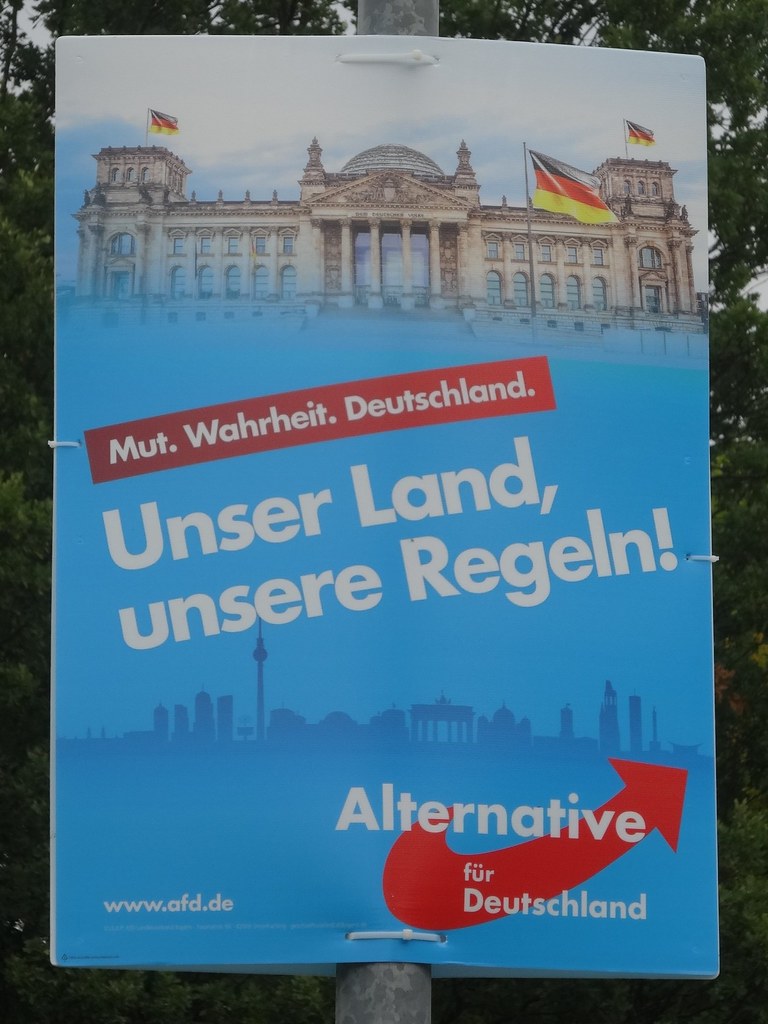
“AfD Election Poster” by harry_nl is licensed under CC BY-NC-SA 2.0


Germany is just two months away from commemorating the 30th anniversary of the fall of the Berlin Wall. But for many commentators, east and west Germany are more divided than ever. The success of the right-wing Alternative für Deutschland (AfD) in the recent state elections in Brandenburg and Saxony has fueled this concern. The AfD came second in both elections. In Brandenburg, it won 23.5 per cent of the vote, just 2.7 per cent below the ruling centre-left SPD. In Saxony, it won 27.5 per cent of the vote, 4.6 per cent behind the incumbent centre-right CDU. “When I, a Wessi [west German], leave Berlin … I see nothing but right-wingers … These are people whose sensitivities I don’t understand… Thirty years after the fall of the wall, there is still no unity”, said a writer for Der Spiegel.
Many in the east are just as keen as their western counterparts to distance themselves from AfD voters. The “most important message” from Saxony’s election result was that the “friendly Saxony” had won, said Michael Kretschmer, the state’s CDU minister president. As if reading from the same script, Brandenburg’s minister president, the SPD’s Dietmar Woidke, emphasised that “the face of Brandenburg would remain friendly”. Of course, “friendly” is a code word for mainstream or pro-establishment. But presenting the elections in these terms may have helped the governing parties to their narrow victories. Some analysts suggest that voters, who would otherwise have opted for the Greens or Die Linke (the Left Party), supported the ruling parties for fear of the AfD coming first.
The debate about the east-west divide is deeply anti-political. It focuses solely on the question of what is wrong with east German voters – and the roughly one million AfD voters in particular – rather than on what has gone wrong with German politics as a whole. As a result, there is a great deal of snobbery in the discussion. For Brigitte Fehrle, former editor of the left-liberal Berliner Zeitung, the AfD‘s success can be explained by a mixture of voters’ “disappointment” and their “unrealistic expectations about what is possible in politics”. Sociologist Cornelia Koppetsch, author of a bestselling book on right-wing populism, describes AfD voters as a “cross-section of globalisation’s losers”. This is despite research finding that people who voted for the AfD in 2017 don’t see themselves as “losers” of globalisation at all, and even rate their personal economic situation as above average. That AfD voters might simply hold different political values or views on climate policy, immigration and the family is rarely considered.
[…]
The established parties have ceded ground to the AfD by refusing to take it seriously. Instead of engaging AfD representatives in as many debates as possible, they have relied on trying to expose the party’s far-right connections. For instance, the AfD leader in Brandenburg has been accused of joining a Neo-Nazi demonstration in Greece in 2007. Though these accusations are not trivial by any means, they have only helped to strengthen the impression among AfD supporters that the established parties prefer to vilify the party morally, rather challenge it politically.
Ultimately, the desire for political change is not limited to east Germany. If the mainstream parties continue to be complacent, all voters will look elsewhere. On this front at least, the east and west might be closer than suspected.



Powered by WordPress