Quotulatiousness

January 1, 2024

Michael Palin’s Great-Uncle Harry

Filed under: Books, Britain, History, India, Military, WW1 — Tags: , , , , — Nicholas @ 04:00

In The Critic, Peter Caddick-Adams reviews Michael Palin’s Great-Uncle Harry:
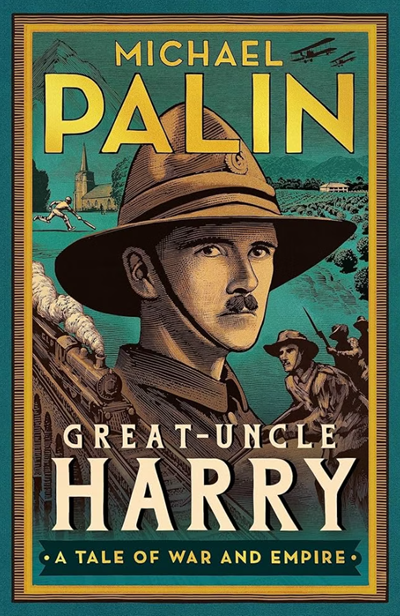
The first of last week’s volumes nestling on my desk, with its immediately identifiable Ripping Yarns cover illustration, was Sir Michael Palin’s story of his forebear, Great Uncle Harry, who travelled the world but disappeared on the Somme. Here, I felt an immediate connection, not least because Michael, I and his Great Uncle Harry Palin had hauled ourselves through the same academy of learning, Shrewsbury School, though at different times. There are plenty of 1914-18 memoirs and tributes around, but this is one of the best. The further the Great War (as it used to be called) recedes, the more we seem to need to torture ourselves with the staggering sacrifices it involved. I read my copy over Remembrance weekend, which made it doubly poignant.

In Great Uncle Harry, Palin’s gift is to give us the hinterland of his ancestor. Many First World War authors, here I could mention the great Lyn Macdonald, Richard Holmes and Martin Middlebrook, all of whom I place on pedestals, provide us with erudite studies, laced with gripping eyewitness accounts. I find myself doing the same with 1939-45, but of necessity there is no room to give the brave and the damned a back story. They are parachuted into the text. They fight and live or die and exit stage left. It is refreshing, therefore, to hold the hand of a first war warrior from birth unto death. Palin was lucky his Great Uncle Harry kept a series of notebooks and diaries of his time in khaki, and was able to research his globe-trotting years before battle. Our man was brought up in Herefordshire, and after school drifted out to British India. He had two stints, first working as a railway manager and latterly as overseer on tea plantations. The reader is fortunate that Palin the documentary-maker filmed in both environments and is able to look over his forebear’s shoulder and summon up the Edwardian social standards of the day, with its solar topees and chota pegs (sunset whiskeys), its heat and its dust. Palin the younger’s many diaries and written travelogues, of which I find New Europe (2007) the best, are equally good.

But Great Uncle Harry Palin was restless. The youngest and most headstrong of seven, he flounced out of each of his two jobs serving the Raj, and ended up trying his hand at farming in New Zealand. There he seemed more settled, but not quite. The Palin under the microscope, notes his great nephew, was one of the first to volunteer for war service with the 12th (Nelson) Regiment, a South Island infantry outfit, in August 1914 and sailed with them overseas, initially to Egypt. There they were absorbed into the Canterbury Battalion, and deployed to Gallipoli, from which Great Uncle Harry emerged without a scratch.

Gallipoli is a conjurer’s name. Now known by the Turks as their Gelibolu Peninsula, overlooking the ancient Hellespont (today’s Dardanelles Strait), its southern tip lies 200 miles from what was then Turkey’s capital, Constantinople, officially Istanbul after 1930. Only since the 1990s has this strategically significant sliver of land, across the Dardanelles from ancient Troy, and guarding entry to the Bosphorus and Black Sea, been opened up for tourists. The 1915 operation was dreamt up by Winston Churchill to break the stalemate of the Western Front. He advocated a naval advance on Constantinople, as a way of knocking the Austro-German alliance out of the war. Such a stratagem would then have offered Paris and London the ability to supply the troops of Tsar Nicholas the Last with modern arms and munitions to prevail against the Central Powers.

Instead of breaking the Western Front, Gallipoli broke Churchill. It was a campaign endlessly refought in the inter-war years, which generally concluded that amphibious warfare had no future, though Lieutenant Colonel George S. Patton in his 1936 General Staff study, The Defense of Gallipoli, found it fascinating. It was one reason why the allies had no maritime landing capability in 1939-40, to Britain’s detriment at Dunkirk, and later Germany’s disadvantage when planning a seaborne assault against southern England. Valuable lessons of what to do, and not to do, had to be relearned before D-Day in 1944 could be a success. My own assessment is right idea, wrong commanders. Gallipoli might have offered the success Churchill desired, but was executed poorly.

The original plan had been to overwhelm Constantinople with battleships, and there is evidence that the Turks were preparing to surrender. However, the Franco-British war fleet encountered German-supplied Krupp cannon along both shores of the Dardanelles and a minefield in the middle, and suffered catastrophic losses. A land campaign was then initiated to clear the Turkish land-based defences. This should have been foreseen and a simultaneous, rather than sequential, maritime-land attack might well have delivered the goods.

Instead, the few Turkish defenders on Gallipoli could see a landing was imminent, called in reinforcements and dug trenches ferociously. On the peninsula, amidst scrub, trench and memorials lie scattered British, Commonwealth, Ottoman and French (yes, they were there too) cemeteries, hinting at stirring tales of derring-do. Last time I was there, I encountered not only rifle cartridges, pieces of pottery rum jars, and shell cases, but human bones. My guide observed, “Probably wild pigs dislodging the topsoil. It happens all the time.” An indication of the 300,000 Allied and 255,000 Turkish killed, wounded and missing in a campaign where illness often took as many as combat wounds. Along the western coast, amidst shards of amphorae from pre-history, lie many wrecks associated with the 1915 campaign in crystal-clear water. It remains high on my recommended battlefields to visit.
May 4, 2023

Fierce fighting on Gallipoli … before WW1

Filed under: Europe, Greece, History, Military — Tags: , , , , — Nicholas @ 04:00

Bruce Gudmundsson outlines the operations of Ottoman Empire forces defending “Turkey in Europe” against Greek and Bulgarian invasion (in alliance with Serbia and Montenegro) in 1913:

In the English speaking world, the name Gallipoli invariably evokes memories of the great events of 1915 and 1916. A location of such strategic importance, however, rarely serves as the site of a single battles. Two years before the landings of the British, Indian, Australian, and New Zealand troops on the south-west portion of the the peninsula (and the concurrent French landings on the nearby mainland of Asia Minor near the ruins of the ancient city of Troy), Ottoman soldiers defended the Dardanelles against the forces of the Balkan League.

By the end of January of 1913, the combined efforts of Greece, Serbia, Montenegro, and Bulgaria had driven Ottoman forces from most of “Turkey in Europe”. Indeed, the only intact Ottoman formations on European soil were those trapped in the fortress of Adrianople, those holding the fortified line just west of Constantinople, and those that had recently arrived at Gallipoli.

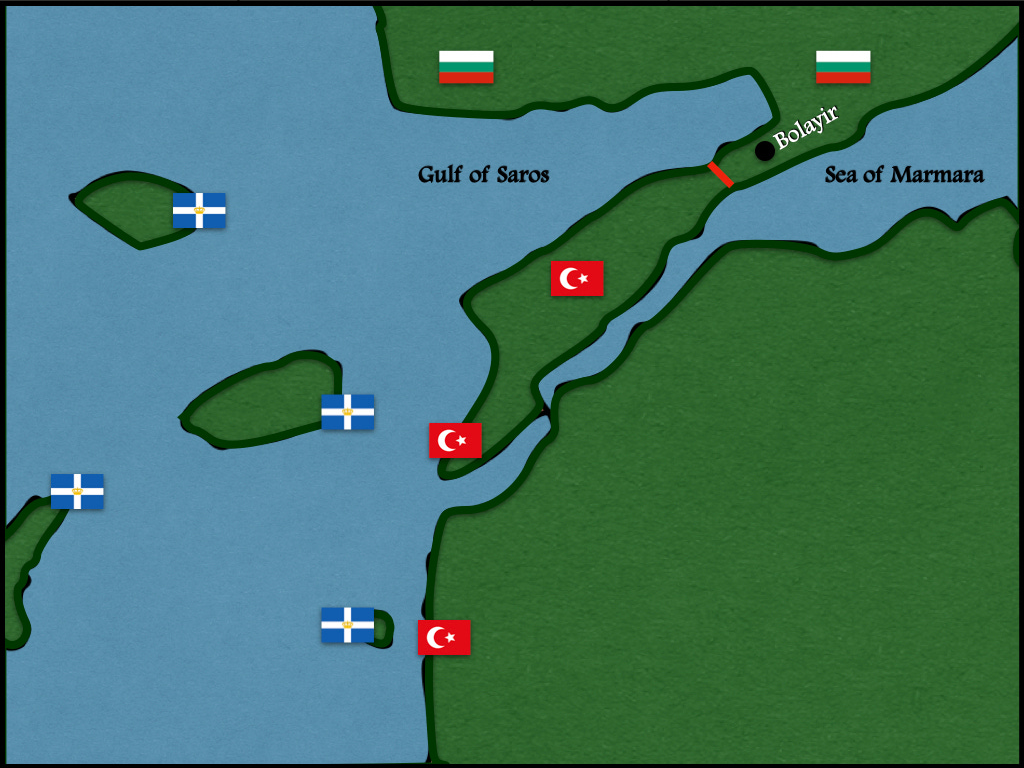
Soon after arriving, the Ottoman forces on Gallipoli began to build a belt of field fortifications across the narrowest part of the peninsula, a line some five kilometers (three miles) west of the the town of Bolayir. At the same time, they occupied outposts some twenty kilometers east of the line, at the place where the peninsula connected to the mainland.

The general situation in (and around) the Gallipoli Peninsula, 31 January 1913.

On 4 February 1913, the Bulgarians attacked. On the first day of this attack, they drove in the Ottoman outposts. On the second day, they broke through a hastily erected line of resistance, thereby convincing the Ottoman forces in front of them to evacuate Bolayir. However, rather than taking the town, or otherwise attempting to exploit their victory, they withdrew to positions some ten kilometers (six miles) east of the Ottoman earthworks.

While the Ottoman land forces returned to the earthworks along the neck of the Peninsula, ships of the Ottoman Navy operating in the Sea of Marmora located, and began to bombard, the Bulgarian forces near the coast. This caused the Bulgarians to move inland, where they took up, and improved, new positions on the rear slopes of nearby hills.

On 9 February, the Ottomans launched a double attack. While the main body of the Ottoman garrison of Gallipoli advanced overland, a smaller force, supported by the fire of Ottoman warships, landed on the far side of the Bulgarian position. Notwithstanding the advantages, both numerical and geometric, enjoyed by the Ottoman attackers, this pincer action failed to destroy the Bulgarian force. Indeed, in the course of two failed attacks, the Ottomans suffered some ten thousand casualties.

Though the Ottoman maneuver failed to dislodge the Bulgarians from their trenches, the two-sided attack convinced the Bulgarian commander to seek ground that was, at once, both easier to defend against terrestrial attack and less vulnerable to naval gunfire. He found this on the east bank of a river, thirteen kilometers (eight miles) northeast of Bolayir and ten kilometers (six miles) north of the place where the Ottoman landing had taken place.

September 20, 2019

“Cliffs of Gallipoli” Part 2 – The Great War – Sabaton History 033 [Official]

Filed under: Britain, History, Media, Middle East, Military, WW1 — Tags: , , , — Nicholas @ 04:00

Sabaton History
Published on 19 September 2019

The second part of our coverage of the Sabaton song “Cliffs of Gallipoli” is about the brutal fighting that took place once the landings had come to a standstill. A stalemate similar to the Western Front caused thousands of Ottoman and Allied soldiers to have to endure endless charges, barrages, sniper fire in addition to the hot summer climate of South-Eastern Europe.

Support Sabaton History on Patreon: https://www.patreon.com/sabatonhistory

Watch Part 1 of Cliffs of Gallipoli here: https://youtu.be/oDac6Oswyns

Listen to The Art of War (where “Cliffs of Gallipoli” is featured):
CD: http://bit.ly/TheArtOfWarStore
Spotify: http://bit.ly/TheArtOfWarSpotify
Apple Music: http://bit.ly/TheArtOfWarAppleMusic
iTunes: http://bit.ly/TheArtOfWariTunes
Amazon: http://bit.ly/TheArtOfWarAmz
Google Play: http://bit.ly/TheArtOfWarGooglePlay

Watch the Official Lyric Video of Cliffs of Gallipoli here: https://www.youtube.com/watch?v=oOCe2…

Hosted by: Indy Neidell
Written by: Markus Linke and Indy Neidell
Directed by: Astrid Deinhard and Wieke Kapteijns
Produced by: Pär Sundström, Astrid Deinhard and Spartacus Olsson
Creative Producer: Joram Appel
Executive Producers: Pär Sundström, Joakim Broden, Tomas Sunmo, Indy Neidell, Astrid Deinhard, and Spartacus Olsson
Maps by: Eastory
Edited by: Iryna Dulka
Sound Editing by: Marek Kaminski

Eastory YouTube Channel: https://www.youtube.com/channel/UCEly…
Archive by: Reuters/Screenocean https://www.screenocean.com
Music by Sabaton.

Sourses:
– IWM: Q 13450, 2509-07, Q 13324, Q 13249, Q 13219, HU 57426, Q 13585, Q 13676, Q 13667, Q 13637, Q 13714, Q 13663, Q 13680, Q 13709, Q 13335, Q 13285, Q 13447, Q 56637, HU 105641, Q 13622, Q 13633, Q 13647, Q 13689, Q 13677, Q14394, Q 13625
– Australian War Memorial
– A soldier of the Indian Labour Corps courtesy of National Army Museum of New Zealand

An OnLion Entertainment GmbH and Raging Beaver Publishing AB co-Production.

© Raging Beaver Publishing AB, 2019 – all rights reserved.

September 13, 2019

“Cliffs of Gallipoli” Part 1 – The Great War – Sabaton History 032 [Official]

Filed under: Britain, History, Media, Middle East, Military, WW1 — Tags: , , , — Nicholas @ 06:00

Sabaton History
Published on 12 Sep 2019

While the British were already dying by the thousands in the trenches in Western Europe, their high command decided to try to break the stalemate with an attack on the Ottoman Empire in the Dardanelles. This is the first episode on the Sabaton song “Cliffs of Gallipoli” about the Allied landings on the shores off Gallipoli.

Support Sabaton History on Patreon: https://www.patreon.com/sabatonhistory

Listen to The Art of War (where “Cliffs of Gallipoli” is featured):
CD: http://bit.ly/TheArtOfWarStore
Spotify: http://bit.ly/TheArtOfWarSpotify
Apple Music: http://bit.ly/TheArtOfWarAppleMusic
iTunes: http://bit.ly/TheArtOfWariTunes
Amazon: http://bit.ly/TheArtOfWarAmz
Google Play: http://bit.ly/TheArtOfWarGooglePlay

Watch the Official Lyric Video of “Cliffs of Gallipoli” here: https://www.youtube.com/watch?v=oOCe2…

Hosted by: Indy Neidell
Written by: Markus Linke and Indy Neidell
Directed by: Astrid Deinhard and Wieke Kapteijns
Produced by: Pär Sundström, Astrid Deinhard and Spartacus Olsson
Creative Producer: Joram Appel
Executive Producers: Pär Sundström, Joakim Broden, Tomas Sunmo, Indy Neidell, Astrid Deinhard, and Spartacus Olsson
Maps by: Eastory
Edited by: Iryna Dulka
Sound Editing by: Marek Kaminski

Eastory YouTube Channel: https://www.youtube.com/channel/UCEly…
Archive by: Reuters/Screenocean https://www.screenocean.com
Music by Sabaton.

Sources:
– IWM: Q 57165, Q 1309, Q 515124, Q 13550, Q 13411, Q 53319, Q 13297, Art. IWM ART 4279, Q 112876, IWM ART 2452
– Photos of Ottoman Cavalry courtesy of the National Library of Israel
– Archives New Zealand
– New Zealand troops landing at Gallipoli taken by Joseph McBride

An OnLion Entertainment GmbH and Raging Beaver Publishing AB co-Production.

© Raging Beaver Publishing AB, 2019 – all rights reserved.

From the comments:

Sabaton History
2 days ago (edited)
Thats right, “Cliffs of Gallipoli” will be featured in not one but two Sabaton History episodes! The next episode will dive into a different but equally perspective of the battle.

Joakim already mentions it in the call to action of this episode, but we’re making Sabaton History Special Editions of all the older Sabaton albums, just like we did with The Great War. Those who support us at a certain level on Patreon before the end of November will be rewarded with the Sabaton History Edition of the Sabaton album Heroes. Check out our Patreon page to find out more! -> https://www.patreon.com/sabatonhistory

Cheers!

June 10, 2018

The Landings At Cape Helles 1915 I THE GREAT WAR On The Road

Filed under: Britain, France, History, Middle East, Military, WW1 — Tags: , , , — Nicholas @ 04:00

The Great War
Published on 9 Jun 2018

Thank you to Mr Ali Serim for making this trip possible.

Indy and our guide Can Balcioglu explore the southern tip of Gallipoli where the British Army landed in April 1915.

June 5, 2018

The Landings At ANZAC Cove And Suvla Bay 1915 I THE GREAT WAR On The Road

Filed under: Australia, Britain, History, Military, WW1 — Tags: , , , , , , — Nicholas @ 04:00

The Great War
Published on 4 Jun 2018

With thanks to Mr. Ali Serim for making this episode possible.

Indy and our guide Can Balcioglu explore the northern landings sites of Gallipoli where the Australian and New Zealand Army Corps (ANZAC) landed in 1915.

May 28, 2018

Naval Operations In The Dardanelles Campaign 1915 I THE GREAT WAR On The Road

Filed under: Britain, France, History, Middle East, Military, WW1 — Tags: , , , , , — Nicholas @ 04:00

The Great War
Published on 25 May 2018

In our first episode filmed on the former Gallipoli battlefields, Indy and our guide Can Balcioglu explore the naval campaign that preceded the landings at Gallipoli in early 1915.

January 15, 2016

The Invasion Of Montenegro – The End of Gallipoli I THE GREAT WAR – Week 77

Filed under: Europe, History, Military, WW1 — Tags: , , , , , — Nicholas @ 05:00

Published on 14 Jan 2016

It already started around Christmas but this week the evacuation of Gallipoli is complete. While the evacuation was a success, the overall defeat is inarguable for the British. On top of that the Ottomans can now send 40.000 soldiers to the siege of Kut in Mesopotamia where the British are still awaiting relieve. At the same time the Austro-Hungarian Army starts its invasion of Montenegro and the Western Front is still quietly awaiting the offensive at Verdun.

December 8, 2015

Born On The Shores Of Gallipoli – ANZAC in WW1I THE GREAT WAR Special

Filed under: Australia, History, Middle East, Military, Pacific, WW1 — Tags: , , , — Nicholas @ 05:00

Published on 7 Dec 2015

The Australian and New Zealand Army Corps or ANZAC fought in Gallipoli, on the Western Front and in the Middle East during World War 1. Even though the Gallipoli campaign was an ultimate failure, it was the birth hour of the New Zealand and Australian national consciousness. Find out how the Great War shaped Australia and New Zealand in our special episode.

August 28, 2015

The Battle of Hill 60 – Lunatic Persistence in Gallipoli I THE GREAT WAR – Week 57

Filed under: Britain, Europe, History, Military, WW1 — Tags: , , , — Nicholas @ 05:00

Published on 27 Aug 2015

Peter Hart described the state of the Gallipoli campaign in 1915 as “lunatic persistence in the face of the obvious” – and the Battle of Hill 60 proved just that. Outgunned and with a lack of artillery support, the battle was one of the bloodiest days on the peninsular near Constantinople. The Ottoman capital was still out of reach for the Entente to capture. Meanwhile, the war spread to the Indian border region and on the Western and Eastern Front the carnage continued in the air and on ground.

August 14, 2015

The Ruse at Gallipoli and the Siege of Kovno I THE GREAT WAR – Week 55

Filed under: Australia, Europe, Germany, History, Military, Russia, WW1 — Tags: , , , , — Nicholas @ 05:00

Published on 13 Aug 2015

Another 20.000 soldiers fresh from the barracks are supposed to turn the tide at Gallipoli. But Mustafa Kemal is an Ottoman commander to be reckoned with. With a tactical ruse and the right timing, he surprises the inexperienced ANZAC recruits with a bayonet charge. As the sand of Chunuk Bair turns red, one thing is clear, Gallipoli is still not taken. On the Eastern Front the Germans lay siege on Kovno and are about to encircle the Russian troops near Brest-Litovsk. The German offensive on the Western Front is not nearly as successful though.

June 3, 2015

Winston Churchill I WHO DID WHAT IN WW1?

Filed under: Britain, History, WW1 — Tags: , , — Nicholas @ 04:00

Published on 1 Jun 2015

Winston Churchill’s life is actually too big for just one video. Even before World War 1, some biographies about him were published. His career during the Great War saw sheer brilliance like the modernisation of the Royal Navy and utter failure like the Gallipoli Landings. Find out all about Winston Churchill in our portrait.

May 20, 2015

Mustafa Kemal Atatürk I WHO DID WHAT IN WORLD WAR 1?

Filed under: Europe, History, Middle East, WW1 — Tags: , , , , — Nicholas @ 04:00

Published on 18 May 2015

Mustafa Kemal or simply Atatürk was the founder of the modern, secular Turkish Republic. He earned his stripes as an officer in World War 1 as the defender of Gallipoli against the ANZAC troops. You can find out all about Mustafa Kemal Atatürk during the last years of the Ottoman Empire in our biography.

May 1, 2015

The Sea Turns Red – Gallipoli Landings I THE GREAT WAR – Week 40

Filed under: Australia, Europe, History, Middle East, Military, WW1 — Tags: , , , , , — Nicholas @ 04:00

Published on 30 Apr 2015

Completely underestimating the Ottoman army at the Dardanelles, the British commanders decide to let the ANZACs take the Gallipoli peninsular as a gateway to the Bosporus and Constantinople. After the landing in ANZAC Cove and on Z Beach one thing comes clear though: Mustafa Kemal and his troops will fight for every inch of this piece of rock.

April 26, 2015

The Haka at Gallipoli

Filed under: History, Middle East, Military, WW1 — Tags: , , , — Nicholas @ 10:55

In the New Zealand Herald, Kurt Bayer recounts the story of New Zealand’s Maori contribution to the allied forces in World War 1:

The fierce Maori haka has put the fear of God into opposing international rugby teams for decades.

A century ago, however, when the bloodcurdling war cry rang out across the dusty, sloping battlefields of Gallipoli, it was not done in the name of sport: the Maori Contingent were coming to kill the Turkish defenders.

While the doomed World War I escapade needlessly cost tens of thousands of lives, Gallipoli helped forge the early identity of the Maori in fledgling New Zealand.

It secured their reputation as fierce fighters and loyal New Zealanders, and put them on an equal footing with their Pakeha brothers for the first time.

But when New Zealand joined Britain to declare war on Germany on August 5, 1914, the enthusiasm of many Maori to sign up was mixed.

Some opposed fighting for a Crown that had dispossessed them of land in the 19th century.

Other Maori were, like thousands of other young New Zealanders, keen to answer the call for King and Country, as well as the prospect of an adventure and to be “home by Christmas”.

However, Imperial policy initially opposed the idea of native peoples fighting in a war among Europeans.

Historian Matthew Wright wrote in Shattered Glory: The New Zealand Experience at Gallipoli and the Western Front that many Maori believed that contributing to the war effort might improve their position in what was then an effectively segregated society.

“The idea gained ground among iwi [tribes] and was pushed in Parliament during September by Maui Pomare, James Carroll, Apirana Ngata and Te Rangi Hiroa [Peter Buck]. [William] Massey’s Government had not envisaged a Maori contingent but bent to the pressure and – somewhat grudgingly – allowed a small force to be assembled.”

Military historian Dr Christopher Pugsley told the Herald that opposition to a Maori Contingent, as opposed to individual Maori serving in the ranks, came from the British Government and not New Zealand.

Update: Somehow managed to get the newspaper’s name wrong and forgot to hat-tip Roger Henry for the link.

Older Posts »

Powered by WordPress